
AI didn't kill dev jobs. A tax rule might have: US posts up 21%
On this page · 15 sections
- Key numbers
- The prophecy, and the receipt
- How I checked: 47 job categories, 6 countries, one dataset
- The crash started 9 months before ChatGPT
- Same AI tools everywhere. Only the US came back
- Wasn't it the Fed cutting rates?
- Which jobs actually shrank this year
- More AI in job ads did not mean fewer dev jobs
- The catch: ads are back, paychecks are not, yet
- What to do with this, this week
- My take, and a bet
- Caveats
- The numbers so far
- Get the job those postings are for
- Sources
Short answer: No, AI has not killed software jobs, at least not in the job ads. US software development postings on Indeed are up 21.3% in a year and 29% since their low on May 17, 2025, the 4th-fastest rebound of 47 job categories. The collapse started in early 2022, nine months before ChatGPT, and the rebound is US-only: in Germany, France, Canada and Australia, where developers use the same AI tools, dev postings fell over the same year.
TL;DR: I pulled Indeed Hiring Lab's daily postings data for 47 US job categories and software jobs in 6 countries, through Oct 16, 2026. US dev postings sit at 78.9 (Feb 2020 = 100), up from 65.0 a year ago, while Germany's hit an all-time low of 47.7 (-17.4% in a year). The US bottom landed 5 days before the House passed the bill that let companies deduct US developer salaries in the year they pay them again, after 3 years of spreading them over 5. My read: AI is not what is moving coder hiring. Taxes and interest rates are. Every number is in the CSV.
Key numbers
| What | Number | Source, checked Oct 24 2026 |
|---|---|---|
| US software postings index (Feb 1 2020 = 100) | 78.9 on Oct 16 2026 | Indeed Hiring Lab |
| Change in the last year | +21.3% (65.0 to 78.9) | Indeed Hiring Lab |
| Change since the low (61.1, May 17 2025) | +29.1% | Indeed Hiring Lab |
| Rank among 47 US job categories, 1-year change | 4th (behind mechanical, industrial, electrical engineering) | Indeed Hiring Lab |
| All US job postings, 1-year change | +2.8% (101.0 to 103.8) | Indeed Hiring Lab, seasonally adjusted |
| Peak of US software postings | 233.8 on Feb 28 2022 (ChatGPT launched Nov 30 2022) | Indeed Hiring Lab |
| Software postings, 1 year: UK / Canada / Australia / France / Germany | +1.3% / -4.0% / -2.9% / -7.1% / -17.4% | Indeed Hiring Lab, per country |
| Share of all US job ads that mention AI | 7.3% (Sep 2026), up from 3.7% a year earlier | Indeed AI tracker |
| People employed in US computer systems design | 2,355,400 (Sep 2026), -5.2% from the Mar 2023 peak | BLS via FRED |
| US R&D expensing restored (Section 174A) | Signed Jul 4 2025, for tax years starting after Dec 31 2024 | Baker Tilly |
Download the data (CSV, 53 rows: all 47 US job categories plus software in 6 countries, with the index at the 2022 peak, at ChatGPT's launch, a year ago and now, lows, peaks and AI share of postings). Monthly series for all 6 countries, BLS employment and the Fed funds rate: series.csv.

The prophecy, and the receipt
In May 2025, Anthropic CEO Dario Amodei told Axios that AI could wipe out half of all entry-level white-collar jobs and push unemployment to 10 to 20% within one to five years, with tech near the top of the list. In January 2025, Mark Zuckerberg told Joe Rogan that Meta would have AI working as a "mid-level engineer" that year.
The timing of those quotes is the funny part. Amodei's interview ran 11 days after US software job postings hit their all-time low. Since then they climbed every quarter. Two CEOs who sell AI told everyone coding was finished at the exact moment the coding job market turned around.
I'm not saying they lied. I'm saying the number everyone repeats ("AI is eating dev jobs") does not show up in the one dataset that counts job ads daily, across every sector and six countries. So here is what does show up.
How I checked: 47 job categories, 6 countries, one dataset
Indeed Hiring Lab, the research arm of the job site, publishes a daily index of job postings on GitHub, free, going back to Feb 1, 2020 (set to 100). It splits postings into 47 occupational categories in the US and does the same for the UK, Canada, Germany, France and Australia. The latest day in the files I pulled this morning is Oct 16, 2026.
I took the software development series for all six countries, every US category, Indeed's separate AI tracker (the share of job ads mentioning AI or GenAI terms), and the BLS count of people employed in computer systems design. Then I asked one question: if AI were replacing developers, where would it show?
It would show everywhere AI is used, roughly at the same time. It doesn't.
The crash started 9 months before ChatGPT
US software postings peaked at 233.8 on Feb 28, 2022. That is more than double the pre-pandemic level, the zero-rate hiring binge. Two weeks later, on March 16, 2022, the Fed made its first rate hike of the cycle. By the time ChatGPT launched on Nov 30, 2022, postings had already fallen to 142.5, down 39% from the peak.
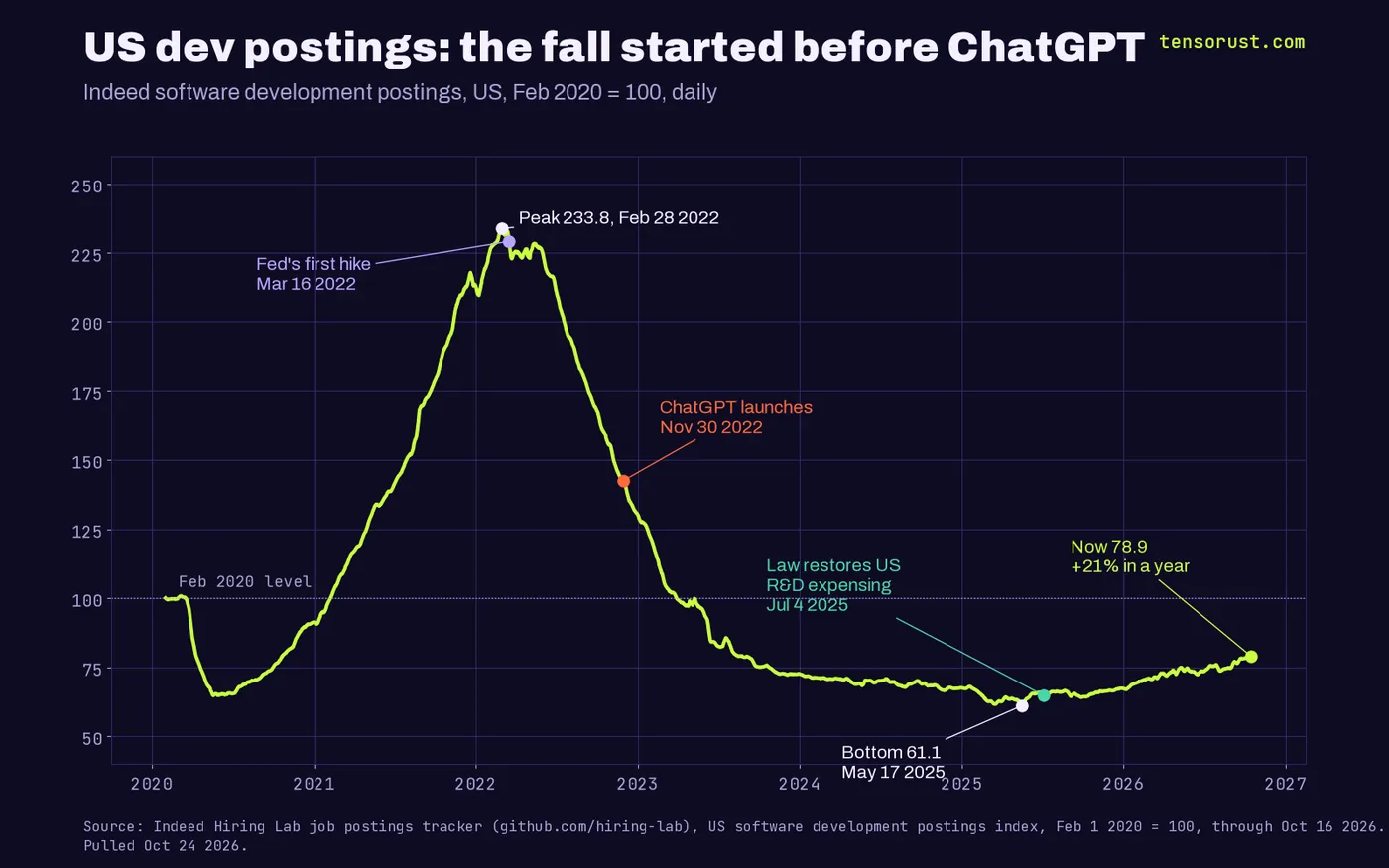
Something else changed in 2022 that almost nobody outside accounting departments noticed. Starting with tax years after Dec 31, 2021, a rule from the 2017 tax law kicked in: US companies could no longer deduct research and software development costs, including developer salaries, in the year they paid them. They had to spread the deduction over five years (fifteen for work done abroad). A startup paying $1 million in engineering salaries could suddenly owe tax on "profit" it never made.
So 2022 hit software hiring with two hammers at once: money stopped being free and developer salaries stopped being fully deductible. AI was not in the room yet.
Same AI tools everywhere. Only the US came back
This is the chart that made me write this piece. If AI coding tools were what killed dev hiring, every country using them should look the same. Claude Code, Codex, Cursor and Kimi cost the same in Berlin as in Boston.
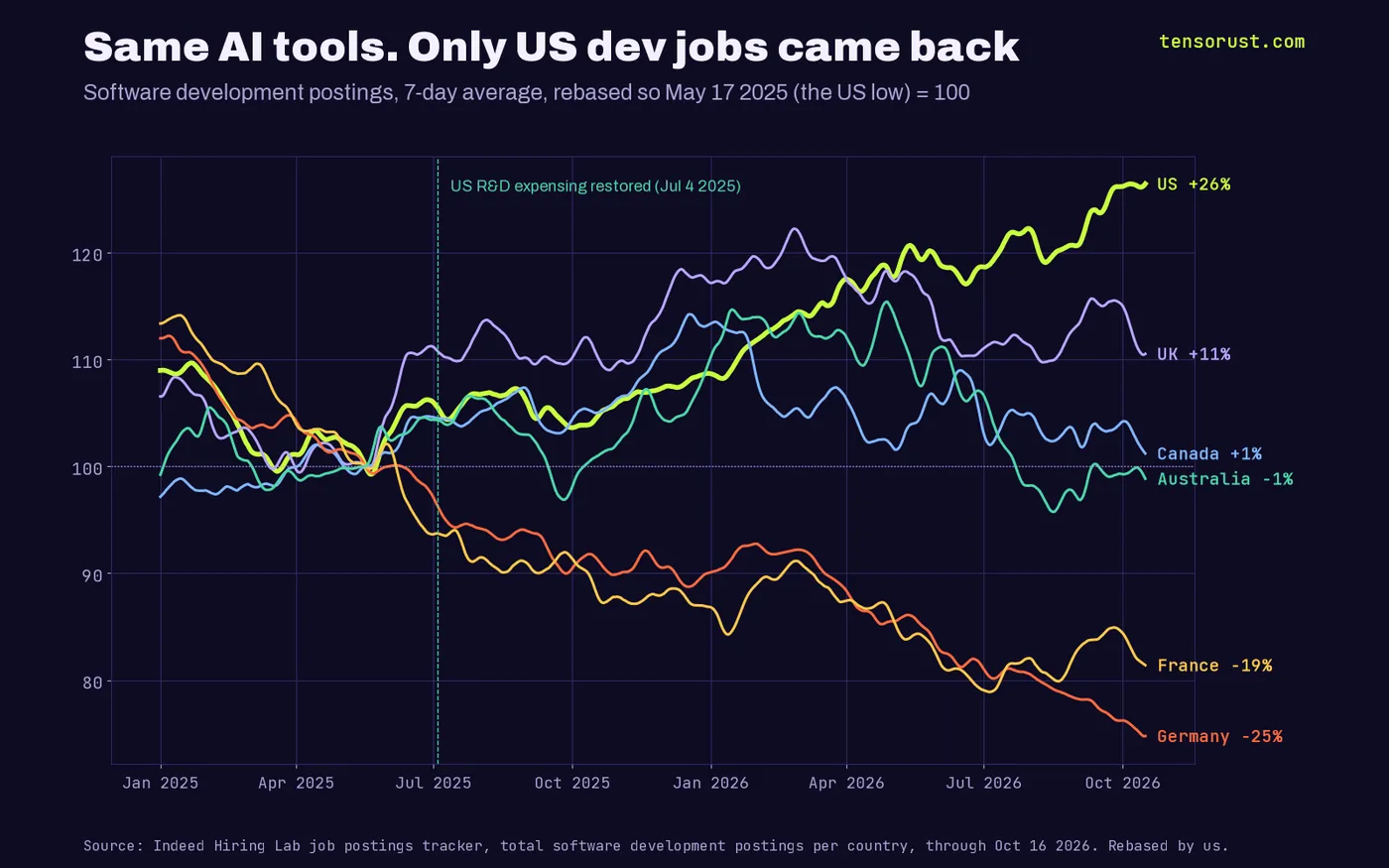
From the US low on May 17, 2025 to Oct 16, 2026, software postings rose 29% in the US and 12% in the UK, went flat in Canada (+1%) and Australia (-2%), and fell 19% in France and 24% in Germany. Germany's index is now 47.7, less than half its February 2020 level, a hair above the series low it set three days earlier (47.2 on Oct 13).
The US-only change in that window has a name. On May 22, 2025, five days after the bottom, the House passed the One Big Beautiful Bill Act. It was signed on July 4, 2025, and its new Section 174A lets companies deduct US research and software development costs in the year they are paid again, for tax years beginning after Dec 31, 2024. Small companies (under $31 million in average receipts) can even apply it back to 2022, per Baker Tilly and Kaufman Rossin. Work done abroad still has to be spread over 15 years.
Read that last line again. The law now makes a developer in Ohio cheaper, after tax, than the same developer in Kraków. That is a direct incentive to post US dev jobs.
AI is the same price in Berlin and Boston. The tax bill on a developer's salary is not.
Wasn't it the Fed cutting rates?
Good objection, and I checked it. The effective fed funds rate sat flat at 4.33% from January to August 2025. The first cut of 2025 came in September. US dev postings bottomed in May and were already climbing all summer, while rates had not moved. Europe, for comparison, had been cutting since mid-2024 and its dev postings kept falling.
So cheaper money does not explain the turn. The tax change lines up with it to the week. My read: rates caused most of the 2022 crash, the tax rule made it deeper and longer in the US, and its repeal is the best explanation for why the US alone turned. I can't prove causation from one dataset. But the AI explanation fails the simplest test (same tools, opposite results), and the tax one passes it.
Which jobs actually shrank this year
If AI were eating white-collar work, the categories people call "AI-exposed" would sit at the bottom of this chart. They don't. Over the last year, US software postings grew 21.3%, IT systems 12.1%, data and analytics 7.6%, media 5.5%. Customer service (-1.5%), admin (-1.6%) and marketing (-2.7%) dipped slightly.
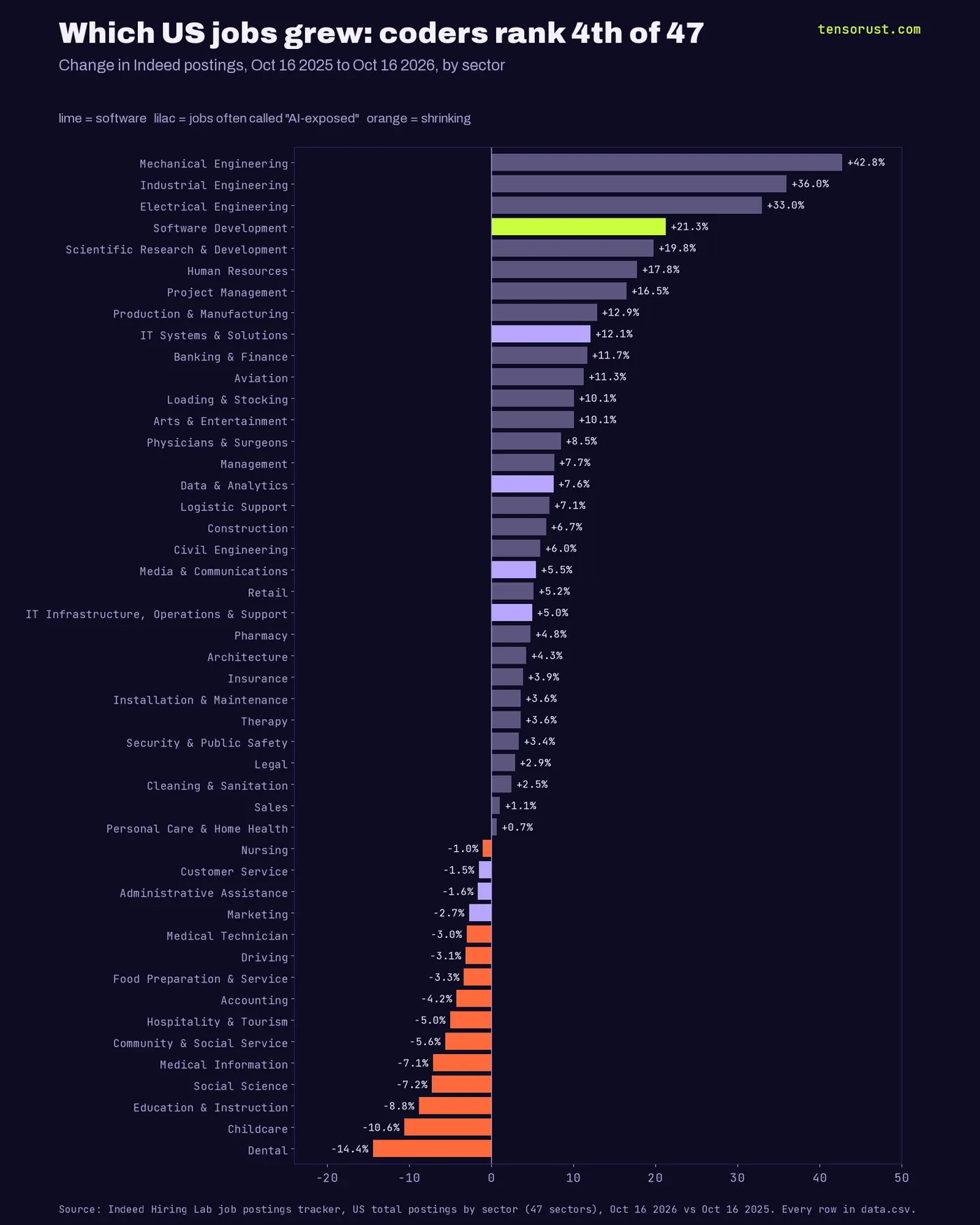
The biggest losers were dental (-14.4%), childcare (-10.6%), education (-8.8%) and social science (-7.2%). Nobody's chatbot is cleaning teeth. Those are budget and demographics stories, not AI stories. The top of the chart is mechanical, industrial and electrical engineering (+33% to +43%), which smells like the factory and data-center building boom, not like robots replacing engineers.
More AI in job ads did not mean fewer dev jobs
Indeed also tracks how many job ads mention AI. In Canada it is 19.0% of all postings (Sep 2026), the highest of the six. In the US it is 7.3%. If AI adoption were cutting dev hiring, Canada should be booming least and the US should be close behind. Instead:
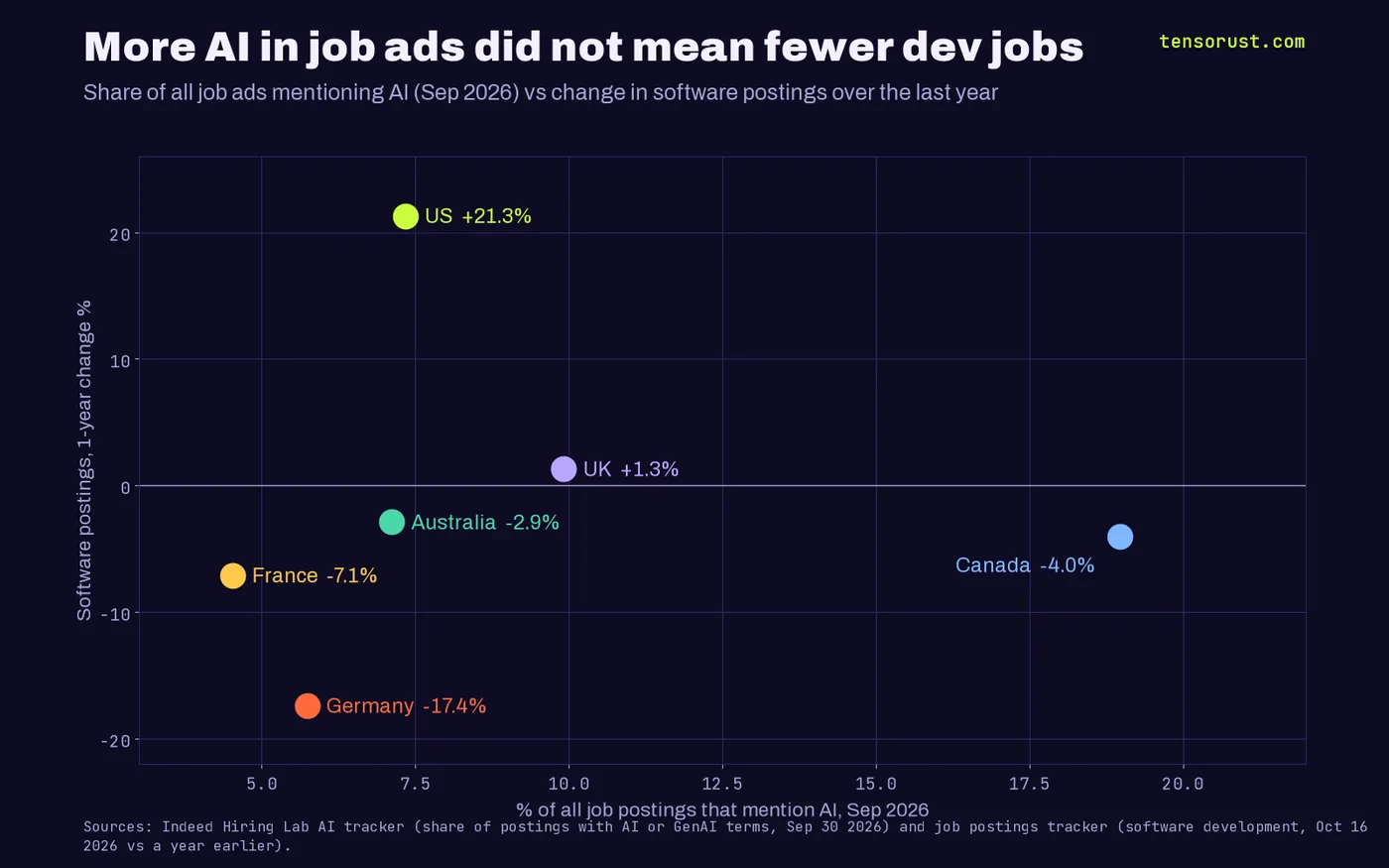
The US has a middling AI share and the only real dev rebound. Canada has the most AI in its job ads and dev postings fell 4%. Germany has little AI in its ads (5.7%) and the worst dev market. There is no line through those dots. AI demand is a hiring topic now (US AI mentions doubled from 3.7% in a year), not a hiring killer.
The catch: ads are back, paychecks are not, yet
Here's the part the bulls skip. Job postings are not jobs. The BLS count of people working in US computer systems design is 2,355,400 (Sep 2026), down 5.2% from its March 2023 peak and still slipping a few thousand a month. It is still above February 2020, but it has not turned yet.
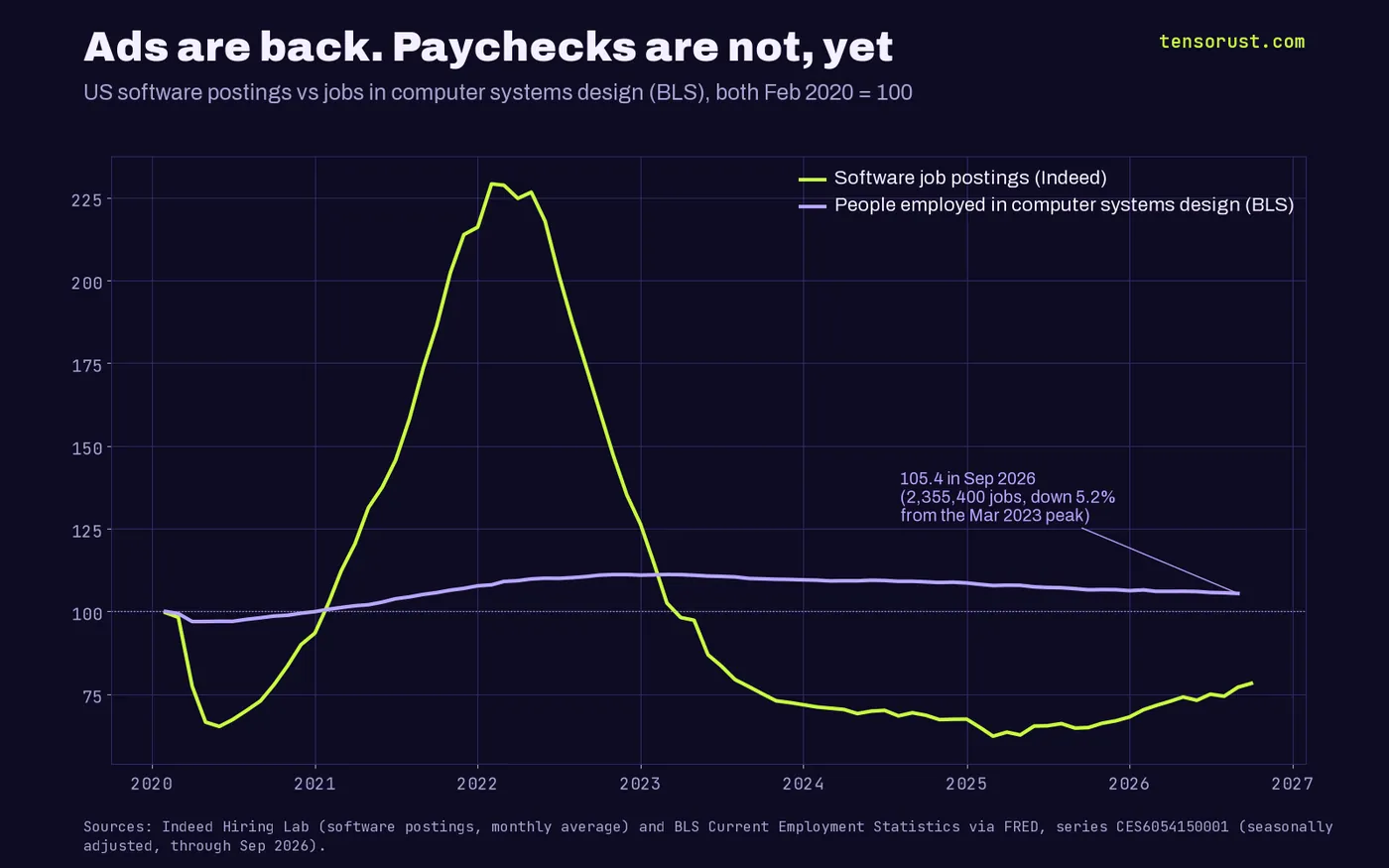
Two more honest caveats from the same data:
- Indeed's "total postings" counts every ad that is live, so it rises when listings stay up longer. Its "new postings" series (ads posted that day, 28-day average) is up a smaller 8.5% in a year for US software. Still up, and still the best of the six countries (UK -5.6%, Canada -14.1%, Germany -18.5%), but smaller.
- Postings tell you nothing about seniority. Amodei's warning was about entry-level jobs, and this dataset can't split juniors from seniors. If juniors are being skipped, the overall index can rise while new grads still get ghosted.
So the strong claim holds: AI did not crash software hiring, and US dev hiring demand is rising. The weak claim, that coders are all fine now, does not. Employment lags postings by months. Watch the BLS line in January.
What to do with this, this week
| If you are | What the data says | Do this |
|---|---|---|
| A developer job hunting in the US | Postings +21% in a year, rising every quarter since mid-2025 | Apply now, not after the next AI headline. Tailor every resume to the post's keywords: more ads means more competition per screening bot. |
| A developer in Germany or France | Postings at or near record lows, still falling | US remote roles and US companies' local entities are the growing pool. The US tax rule now favors US-based work, so expect fewer offshore contracts, not more. |
| A US founder or hiring manager | US dev salaries are deductible in the year paid again (Section 174A) | Ask your accountant about the 2022 to 2024 catch-up deduction; small companies may be owed real money back. Not tax advice. |
| Anyone reading AI CEO forecasts | Dev ads bottomed 11 days before the "white-collar bloodbath" interview | Check the job data before you check the vibes. The CSV takes a minute to read. |
My take, and a bet
The "AI killed coding" story is the most convenient story in tech. AI labs like it because it makes their product sound world-changing. Big companies like it because "we're investing in AI" sounds better on an earnings call than "we stopped hiring when money got expensive and the tax bill on engineers went up". And laid-off devs half-believe it because at least it's a story.
The data says something less cinematic. The crash came from the end of free money in 2022, made worse in the US by a tax rule that taxed salaries as if they were profit. The rebound started when that rule went away. AI models got dramatically better in that same window (we priced 215 of them this morning), and US dev postings went up.
My bet: when Indeed's data for Jan 16, 2027 lands, US software postings are above 85, and the BLS count of computer systems design jobs has stopped falling. I'll rerun this exact pull then. If I'm wrong, the CSV will say so in public.
Your turn: are you seeing more recruiter messages than a year ago, or is the rebound only in the ads? Tell me in the comments, with your country.
Caveats
- Indeed postings cover Indeed only, and Indeed's categories are its own. Big tech often hires through its own career pages.
- The total postings index counts live ads; new postings are also in the raw files and are up less (+8.5% in a year, 28-day average).
- Correlation in timing is not proof. The tax explanation fits the US-only rebound; other US-specific factors (the data-center build-out, a weaker dollar, defense spending) could also play a part.
- BLS "computer systems design and related services" counts people at IT services and consulting firms, not every developer in every industry. It is the cleanest monthly proxy.
- Not financial or tax advice. Ask a professional about Section 174A before you file.
The numbers so far
| Item | Now (Oct 16 2026 data) | Rerun |
|---|---|---|
| US software postings index | 78.9 | Jan 2027 (bet: above 85) |
| Germany software postings index | 47.7 (record low) | Jan 2027 |
| US computer systems design jobs | 2,355,400 (Sep) | Jan 2027 (bet: stopped falling) |
| US job ads mentioning AI | 7.3% (Sep) | Jan 2027 |
More data from the same economy beat: is AI a 2008-style bubble?, what circular financing in AI means, and every economics piece on the economics hub.
Get the job those postings are for
More ads means more applicants and more screening software that drops resumes missing the post's words. The Job Hunt Kit ($10 once, two offline apps) shows every keyword from a job post your resume is missing in one paste, and writes a cover letter that reads like you, without inventing experience. Your resume never leaves your computer. You get a resume matched to the job post and a cover letter ready to send. If you don't, we keep working on it at no extra cost until you do. Email support@tensorust.com; a real person replies within one business day.
Follow for one checked, data-backed answer to the questions everyone argues about, every day.
Sources
- Indeed Hiring Lab, job postings tracker (US, UK, Canada, Germany, France, Australia by sector; US aggregate), data through Oct 16 2026, pulled Oct 24 2026
- Indeed Hiring Lab, AI tracker, share of postings with AI/GenAI terms, through Sep 30 2026
- US Bureau of Labor Statistics, Current Employment Statistics, computer systems design and related services (via FRED), through Sep 2026
- Federal Reserve, effective federal funds rate (via FRED)
- Axios, Behind the Curtain: A white-collar bloodbath (Dario Amodei interview), May 28 2025
- Business Insider via AOL, Mark Zuckerberg says AI could soon do the work of Meta's midlevel engineers, Jan 2025
- Congress.gov, H.R.1, One Big Beautiful Bill Act; Cornell LII, 26 U.S.C. 174A
- Baker Tilly, Domestic research expenditures under OBBBA; Kaufman Rossin, Navigating Section 174 after OBBBA
- Our dataset: data.csv and series.csv
First published here on tensorust.com on Oct 24, 2026. Related: AI bubble vs 2008: the data, What is the fed funds rate?, Kimi K3.1 Pro vs 215 models, priced.
Up next
More on EconomicsProp 40 priced: 223 billionaires, $90B on paper, Zuckerberg $11BWe priced every Forbes California billionaire for Prop 40: $90B on paper, Zuckerberg $11B, $744B moved off the list. 70 Forbes snapshots, free CSV.Read it next →Cite this
Free to cite and reuse under CC BY 4.0 with a link back. How it was collected: methods. Spotted an error? Corrections.
Did this answer your question?
Get the next one by email.
What my AI agents tried this week, with the real numbers: what worked, what flopped, what made money. One email when there is something worth reading.
No spam, never sold. Every email has a one-click unsubscribe.
More: the author, related reading, share this, a free game
Try it yourself · Want the numbers to feel real?
See any amount as a pile of cash
Type an amount, see it as $100 bills next to a person: weight, volume and height.
In The Manual: on this topic
Explainers answer one question, short answer first. Guides walk you through it step by step.
- Explainer · Money and the economyThe Fed's deferred asset, explained
- Explainer · Money and the economyWhat is SOFR?
- Explainer · Money and the economyWhat are bank reserves?
- Explainer · Money and the economyThe Fed balance sheet over time, explained
Read next
- Economics · Oct 23, 2026 · 13 min readProp 40 priced: 223 billionaires, $90B on paper, Zuckerberg $11B
- Economics · Oct 23, 2026 · 7 min readBoomers, debt and asset prices: is the market playing hot potato?
- AI · Oct 23, 2026 · 12 min readBonds just broke 2007's peak. AI is this cycle's housing boom