
By Matt Busel, who built the apps, crates and game he writes about · every number links to its source and every dataset is downloadable (methods) · corrections · featured in Kirino, gamebiz, This Week in Rust, New Mobile Life, By-Press
Anti-nuclear fear killed more people than AI will. AI is ending it
On this page · 11 sections
- Key numbers
- The safest power we ever built is the one we were taught to fear
- America cancelled a bigger fleet than the one it runs
- The body count, by the numbers
- The strongest case for the other side
- Follow the money: who wins, who loses
- AI is the first buyer big enough to break the consensus
- AI also kills the paperwork that killed the reactors
- The pattern, stated flat
- What this means for you
- Sources
Short answer: The anti-nuclear movement won, and the win had a body count. Nuclear power kills about 0.03 people per terawatt-hour of electricity; coal kills 24.62, about 800 times more. When the US cancelled 134 reactor units between 1964 and 1990 (146.7 GW, more than the whole fleet running today) and Germany and Japan switched theirs off after 2011, fossil plants filled the gap. By our estimate that cost somewhere between 114,000 and 698,000 lives across the three countries. AI has caused nothing close to that, and our bet is it never will. AI is now the first force with enough money and enough paperwork muscle to end the fear, which is why the same groups who fought the reactors have moved on to fighting the data centers.
TL;DR: We put Our World in Data's death rates per TWh against 35 years of US, German and Japanese generation data and the full list of cancelled US reactors. At an assumed 80% capacity factor, the 146.7 GW America never built would have made about 1,028 TWh a year. Replace that with the coal and gas the country actually burned and you get roughly 581,000 excess US deaths from 1991 to 2025, or about 100,000 even if every lost megawatt-hour had come from gas. Meanwhile Big Tech has signed at least 9,855 MW of nuclear deals since September 2024, Vistra's stock is up 5.8x since ChatGPT launched against 1.9x for the S&P 500, and in December 2025 Greenpeace and Friends of the Earth signed a 230-group letter asking Congress to pause new AI data centers.
Key numbers
| What | Number | Source, checked Oct 25 2026 |
|---|---|---|
| Deaths per TWh: coal vs gas vs nuclear | 24.62 vs 2.821 vs 0.03 | Our World in Data |
| US reactor units cancelled, projects closed 1964-1990 | 134 units, 146.7 GW | Wikipedia list (cited unit data), our count |
| Excess US deaths from the fossil power that filled the gap, 1991-2025 | ~100,000 (gas-only) to ~581,000 (actual mix) | Our estimate from OWID rates and generation data |
| Germany: social cost of the post-Fukushima nuclear shutdown | ~$12B a year, over 70% from air-pollution deaths | Jarvis, Deschenes and Jha, NBER w26598 |
| Deaths prevented by nuclear power worldwide, historical | 1.84 million | Kharecha and Hansen 2013, NASA GISS |
| Fukushima: deaths from radiation documented by UNSCEAR | "no adverse health effects ... directly attributable" | UNSCEAR, quoted on Wikipedia |
| Fukushima prefecture: disaster-related deaths vs direct deaths | 2,038 vs 1,613 | Japan for Sustainability, 2016, Reconstruction Agency data |
| Big Tech nuclear deals since Sep 2024 | 9,855 MW (Meta up to 6,600) | Company releases, ANS |
| Groups on the Dec 2025 letter to pause AI data centers | 230+ | NPR via WLRN, Dec 9 2025 |
| US nuclear target in Executive Order 14300 | ~100 GW (2024) to 400 GW (2050) | White House, May 23 2025 |

The safest power we ever built is the one we were taught to fear
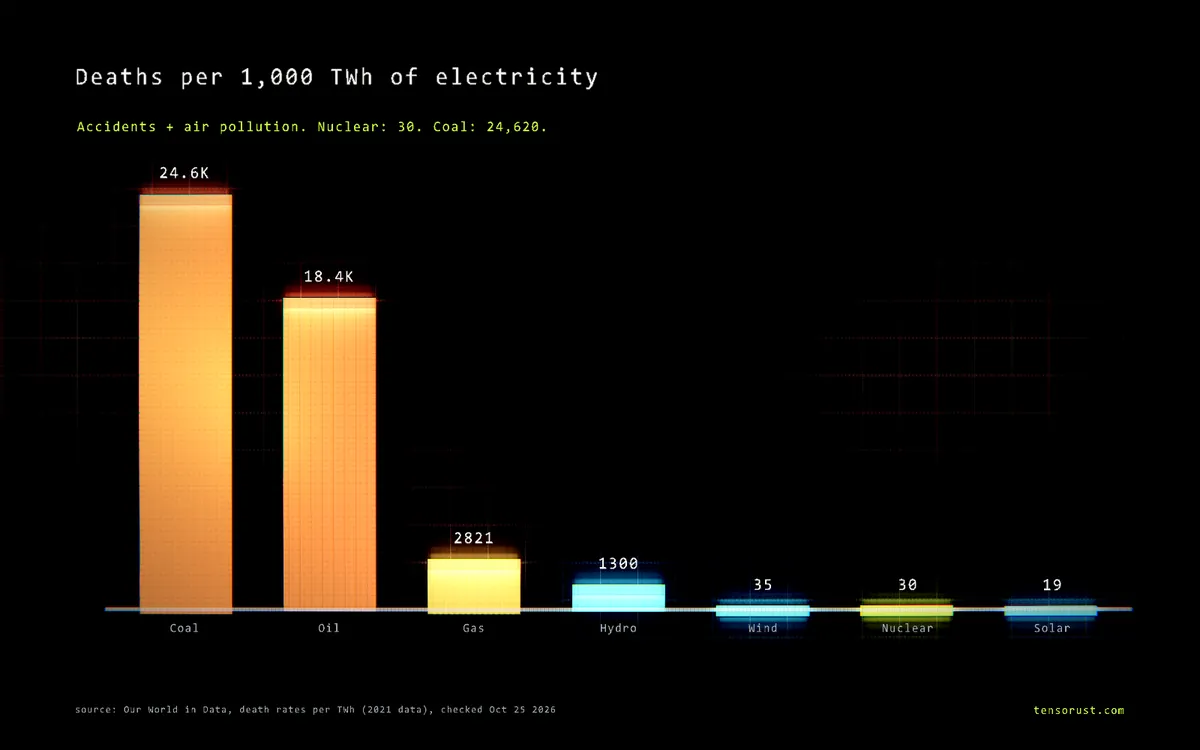
Start with the chart nobody on the evening news ever showed you. Our World in Data adds up accidents and air pollution for every way we make electricity and divides by output. Coal: 24.62 deaths per terawatt-hour. Oil: 18.43. Gas: 2.821. Nuclear: 0.03, about the same as wind (0.035) and in the same range as solar (0.019).
That figure already includes Chernobyl and Fukushima. Those are the two disasters that built a 50-year political movement, and they still leave nuclear one of the three safest sources on the list.
Fukushima is the cleanest test case. The UN Scientific Committee on the Effects of Atomic Radiation found "no adverse health effects among Fukushima residents have been documented that are directly attributable to radiation exposure." The evacuation, driven by fear of the radiation, is what killed people. By 2016 Japan's Reconstruction Agency had recognised 2,038 disaster-related deaths in Fukushima prefecture, more than the 1,613 killed there directly by the earthquake and tsunami. The Tokyo Shimbun linked at least 1,368 of them to the nuclear accident.
Read that again. The fear killed more people than the reactor did.
America cancelled a bigger fleet than the one it runs
The US once planned to go nuclear the way France did. Then it stopped. Wikipedia's list of cancelled US reactors, built from cited unit records, notes that "more than 120 reactor orders were cancelled" and that "considerable public opposition" by the late 1970s "contributed to delays in licensing planned nuclear power stations, and further increased costs."
We counted every unit in that list with a closing date. Between 1964 and 1990, 134 reactor units were cancelled, with a combined net capacity of 146.7 GW. The 2025 Executive Order puts today's whole US fleet at about 100 GW. America walked away from a nuclear fleet bigger than the one it has.
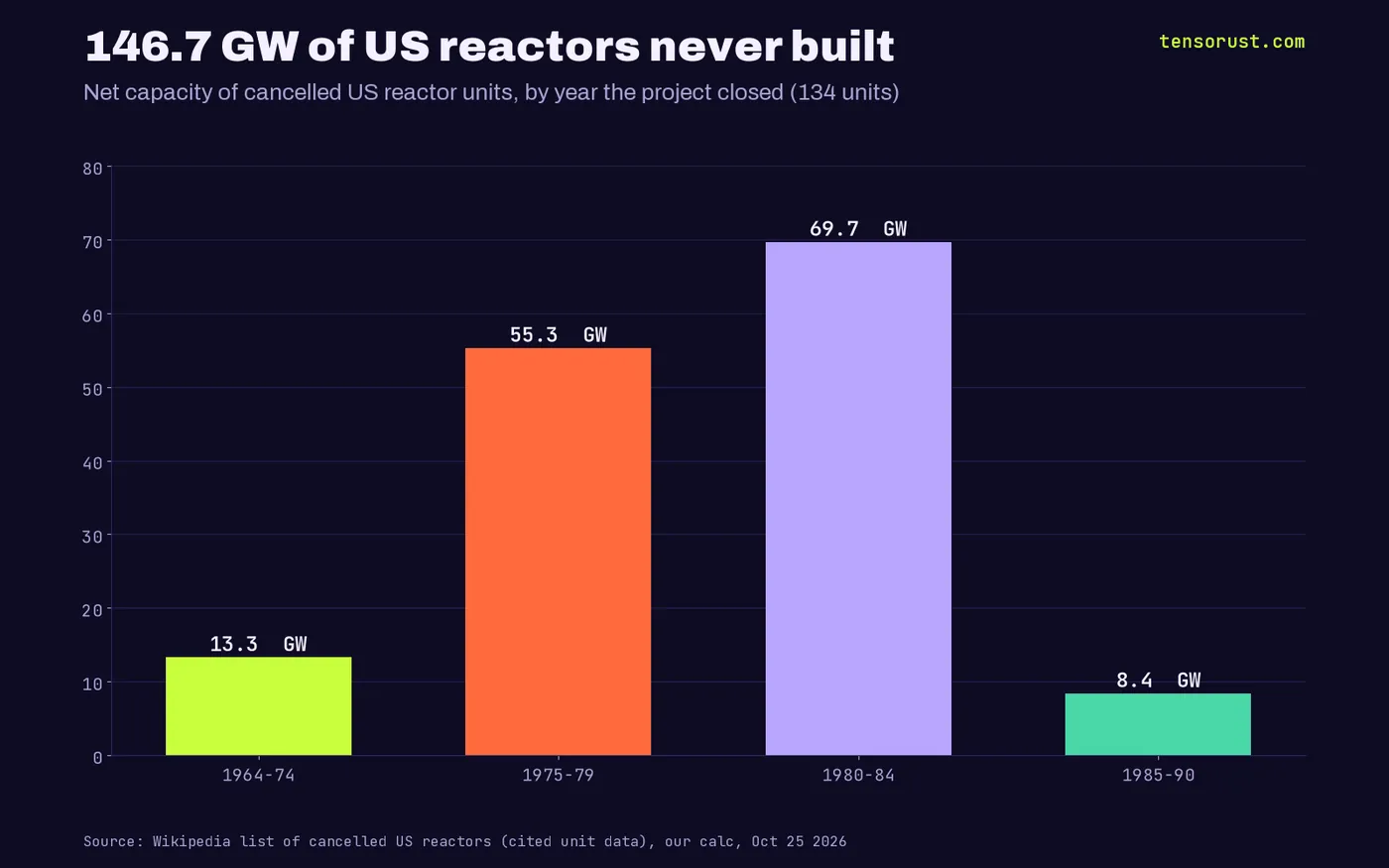
The wave peaked right after Three Mile Island in 1979: 69.7 GW of cancellations closed between 1980 and 1984 alone. Three Mile Island killed no one. It did not have to. The fear was the product, and it sold.
The body count, by the numbers
Here is our math, step by step, so you can check it or fight it. It lives in the data file below.
- Lost power: 146.7 GW of cancelled capacity at an assumed 80% capacity factor (our assumption, deliberately modest) is about 1,028 TWh a year. That is 22.7% of everything the US generated in 2025.
- Replacement: for each year from 1991 to 2025 we assume the lost nuclear power came from fossil plants in the same coal-to-gas ratio the US actually burned that year (Our World in Data generation data).
- Deaths: multiply by OWID's death rates (coal 24.62, gas 2.821) and subtract the 0.03 nuclear would have cost.
Result: about 581,000 excess US deaths over 35 years. Even if every single lost megawatt-hour had come from gas, the cleanest fossil fuel, the floor is about 100,000.
Germany and Japan add to it. Against its 2010 output, Germany gave up 1,127 TWh of nuclear power from 2011 to 2025, and Japan 3,611 TWh. Price that at gas rates and coal rates and you get 3,146 to 27,720 excess deaths in Germany and 10,079 to 88,805 in Japan. Across the three countries: roughly 114,000 at the floor, 698,000 at the top.
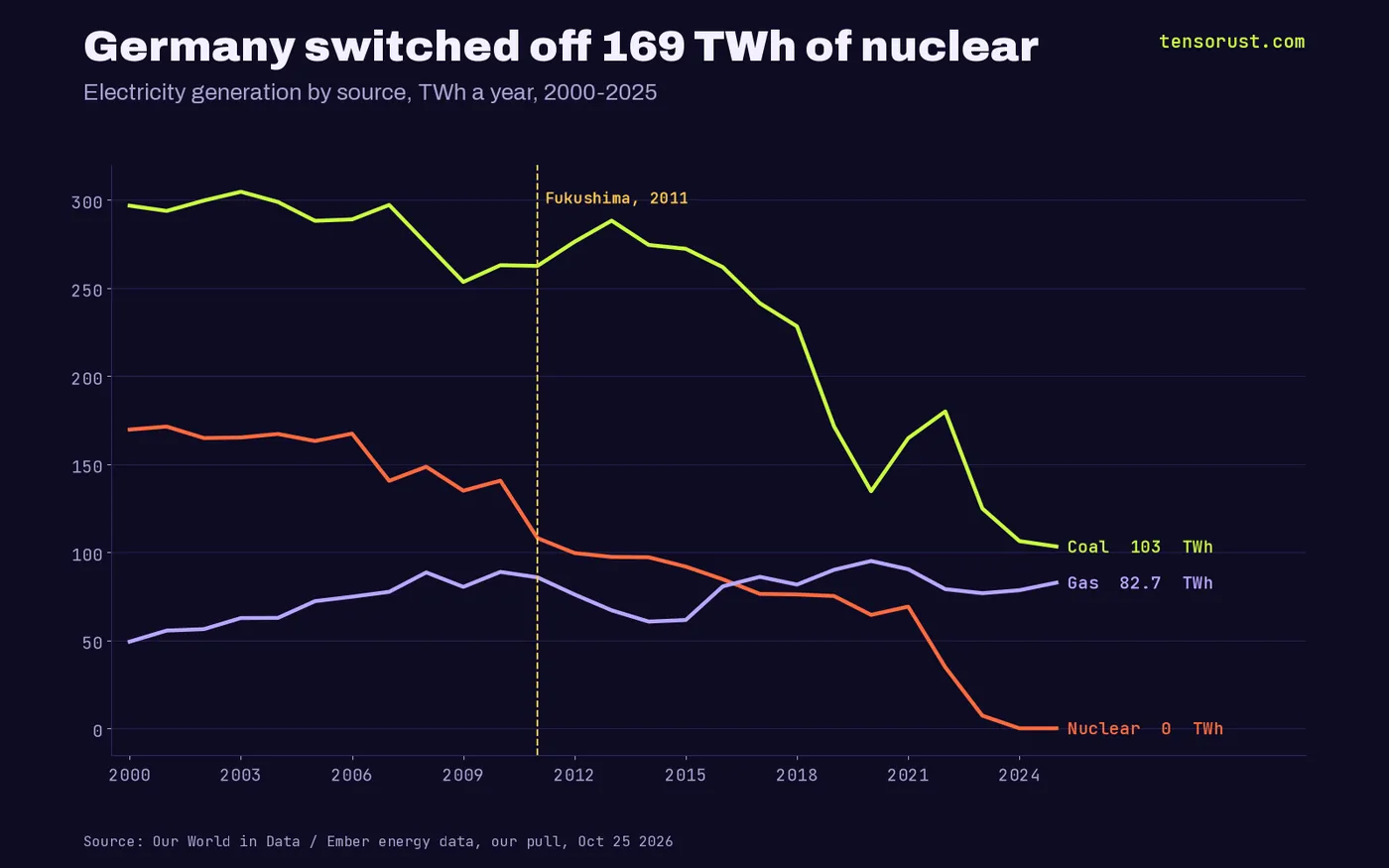
Germany is not a guess. Economists Stephen Jarvis, Olivier Deschenes and Akshaya Jha studied the shutdown with hourly plant data and, in their words, "a novel machine learning framework." Their finding: "the lost nuclear electricity production due to the phase-out was replaced primarily by coal-fired production and net electricity imports," at a social cost of about $12 billion a year, with "over 70% of this cost" coming from "increased mortality risk" from air pollution. You can see it in the data: German coal generation rose from 262.9 TWh in 2010 to 288.2 TWh in 2013 while nuclear fell.
Zoom out and the scale gets absurd. NASA climate scientists Pushker Kharecha and James Hansen calculated that global nuclear power has already "prevented an average of 1.84 million air pollution-related deaths." Every reactor that was never built is a share of that number that never happened.
The strongest case for the other side
The honest counterargument goes like this. Activists did not kill those reactors; economics did. Electricity demand growth slowed in the 1970s, interest rates spiked, and US builders ran up legendary cost overruns. Forbes called the US nuclear program "the largest managerial disaster in business history" in 1985. Waste storage is still unsolved politically, and Fukushima showed that a bad day can empty a region for years. Plenty of those 134 units would have died on cost alone.
All true, and it does not save the argument. Costs and delays were not separate from the fear; they were how it worked. Every intervention, hearing and lawsuit added years, and years are what kill a capital project when interest rates are high. Even Wikipedia's neutral summary connects opposition to "delays in licensing" and "further increased costs." Cost overruns are what fear looks like on a balance sheet.
And our floor survives the concession. Assume activism killed only one in five of those units and the gas-only floor still leaves about 20,000 dead Americans. That is more than any AI system has ever been tied to, by a long way.
Follow the money: who wins, who loses
Here is the part that should make you angry. The groups that won the reactor fight are still at it, and they have a new target.
Friends of the Earth sued PG&E in 2023 to force California's last nuclear plant, Diablo Canyon, to close by 2025, and challenged the NRC's extension in the Ninth Circuit; both challenges were rejected. Greenpeace sued the European Commission on April 18 2023 to strip the EU's sustainable-investment label from nuclear and gas. Then, in December 2025, Food & Water Watch drafted a letter to Congress calling for a national pause on new AI data centers. More than 230 groups signed. NPR named three of them: Greenpeace, Friends of the Earth and Physicians for Social Responsibility.
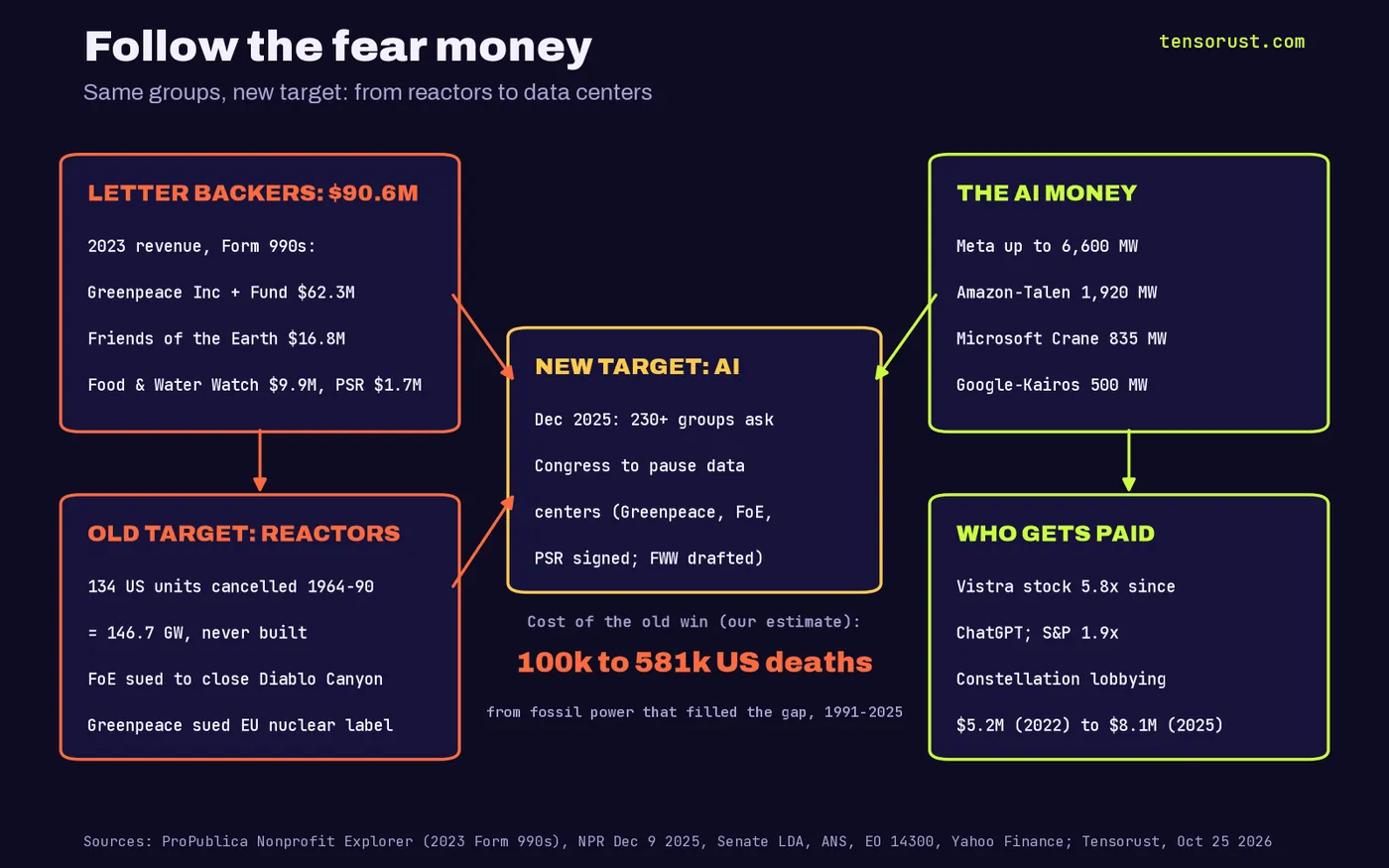
Those four organisations reported about $90.6 million in combined 2023 revenue on their Form 990s (ProPublica Nonprofit Explorer): Greenpeace Inc and Greenpeace Fund $62.3 million, Friends of the Earth $16.8 million, Food & Water Watch $9.9 million, Physicians for Social Responsibility $1.7 million. Fear is not a grassroots accident. It is a funded line of business with a payroll, and it needs a fresh villain to keep the donations coming.
That is our reading, and we will say it plainly: the anti-AI energy campaign is the anti-nuclear campaign wearing a new jacket. Same organisations, same pause-first demand, same promise that if we just stop building, things get safer. Fifty years of reactor history shows how that worked out. Nobody has proven donors coordinate it, but the overlap in the letterheads is documented, and the pattern says the playbook got reused because it worked.
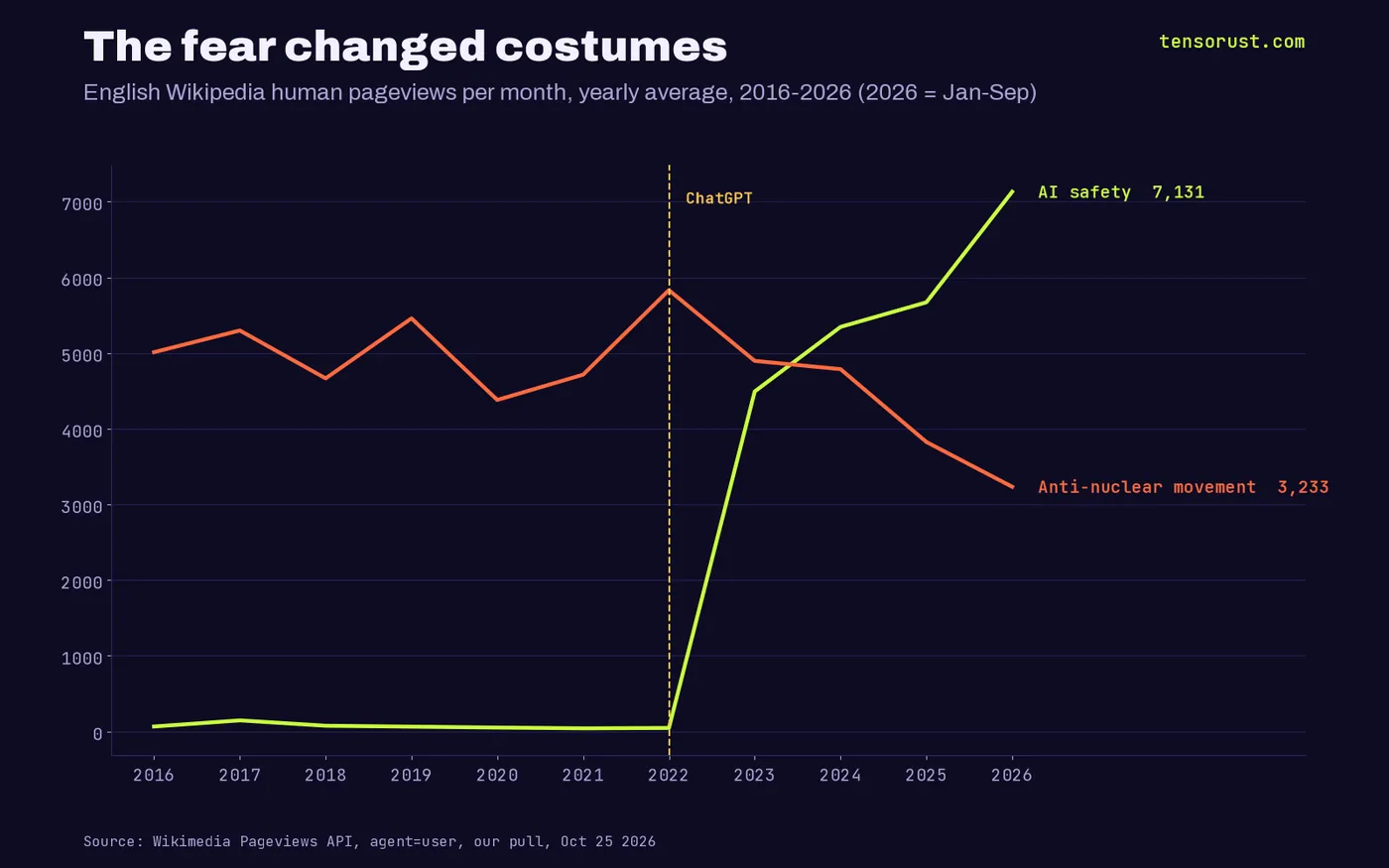
The attention data shows the costume change. English Wikipedia readers looked at the "Anti-nuclear movement" article about 5,010 times a month in 2016 and 3,233 in 2026. "AI safety" went from 46 a month in 2022 to 7,131 in 2026, overtaking the anti-nuclear page in 2024.
AI is the first buyer big enough to break the consensus
Fifty years of protest could not be outvoted. It is being outbid.
- Microsoft signed a 20-year deal in September 2024 to restart Three Mile Island Unit 1 as the Crane Clean Energy Center: about 835 MW, expected online in 2028, according to Constellation.
- Google signed for up to 500 MW of Kairos Power small reactors in October 2024, first unit targeted for 2030.
- Amazon signed for 1,920 MW from Talen's Susquehanna plant in June 2025, running through 2042.
- Meta signed with Vistra, TerraPower and Oklo on January 9 2026 for up to 6.6 GW by 2035, the biggest of the lot.
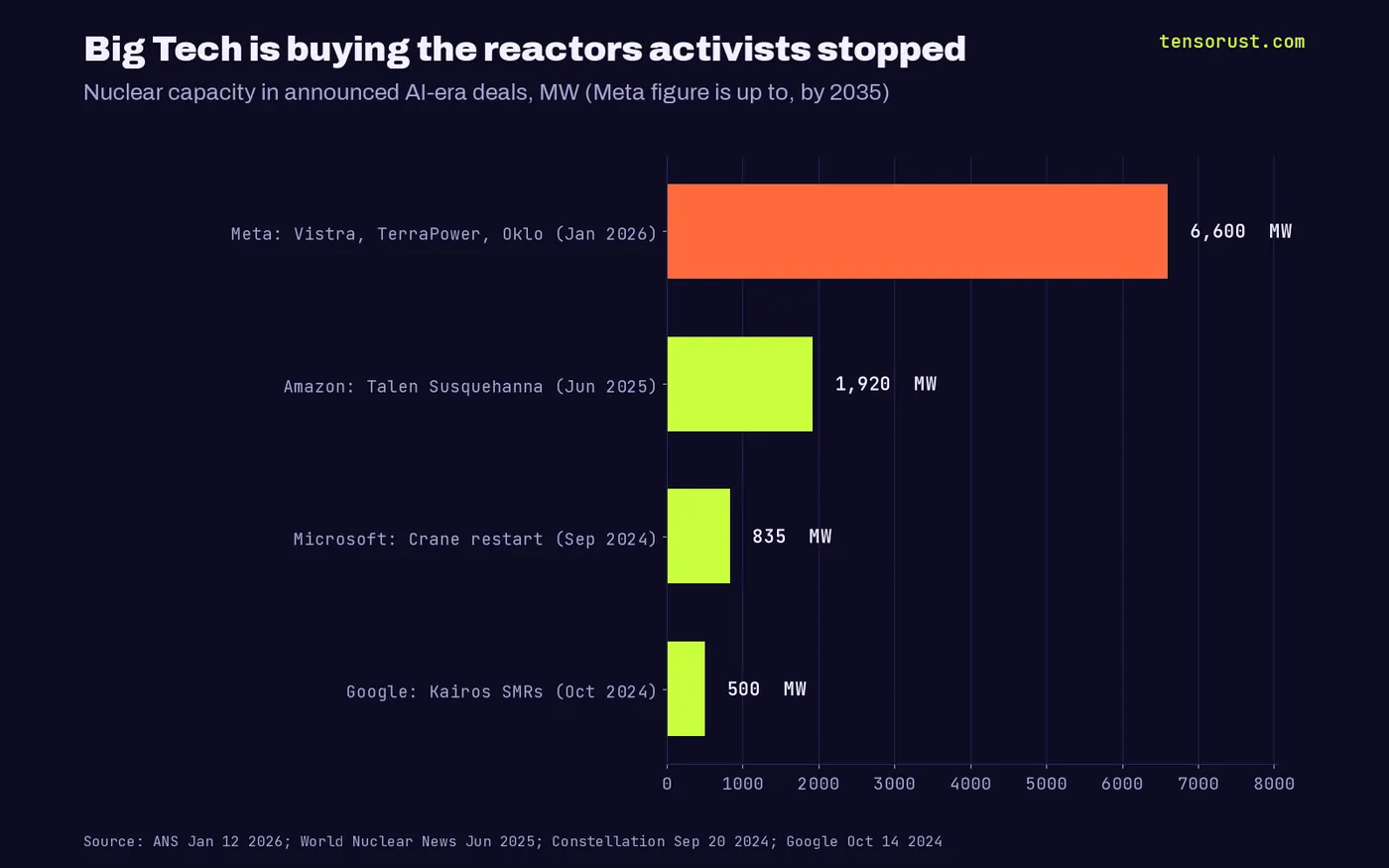
That is 9,855 MW of nuclear capacity bought by four software companies in 16 months. The state followed the money: Executive Order 14300 (May 23 2025) orders the NRC to decide new reactor applications within 18 months, sets a goal of 400 GW by 2050, and tells the regulator to reconsider the "no safe threshold" radiation model that has driven its rules for decades.
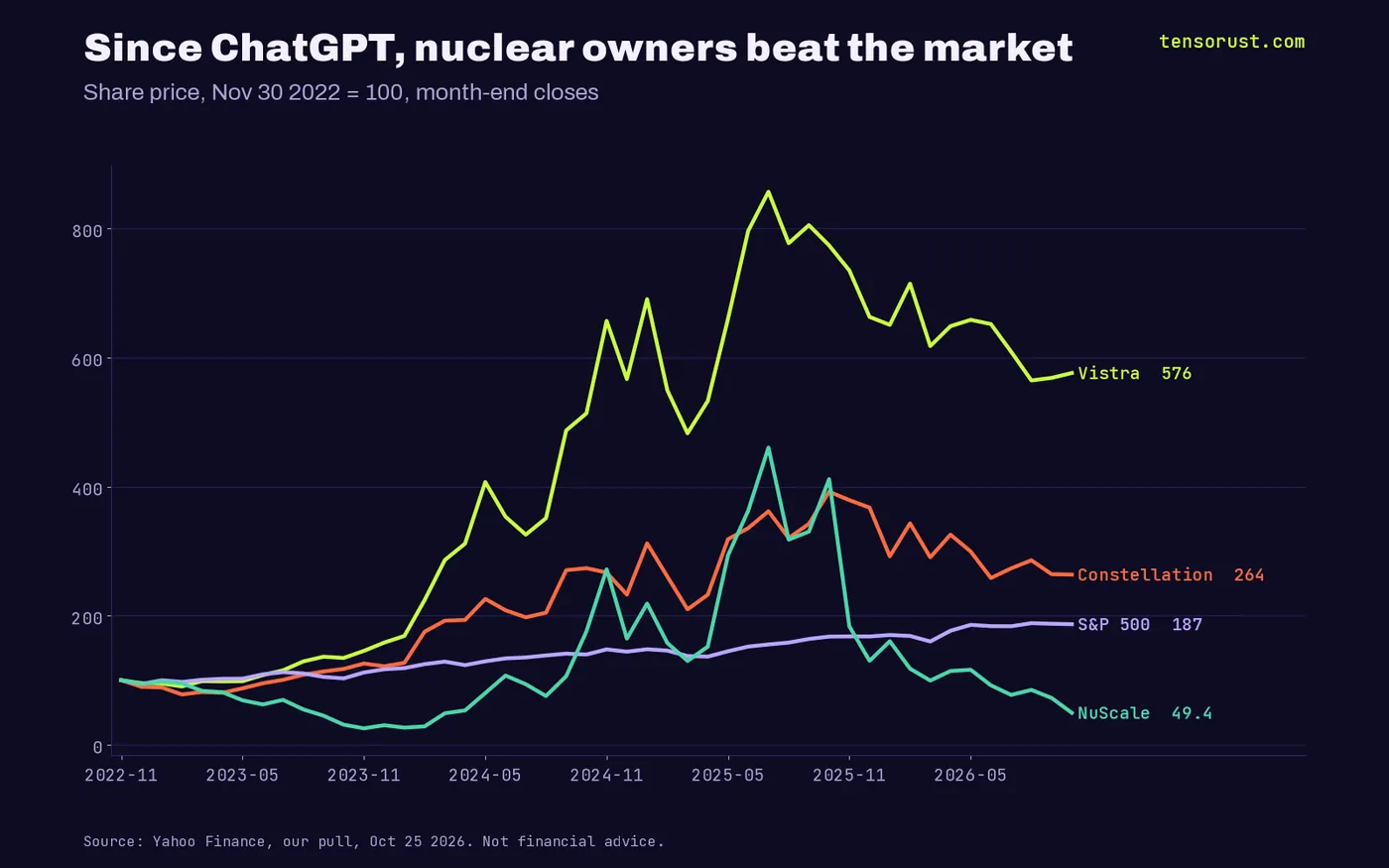
Markets noticed. Since ChatGPT launched on November 30 2022, Vistra's share price is up 5.8x and Constellation's 2.6x, against 1.9x for the S&P 500. Constellation's federal lobbying rose from $5.21 million in 2022 to $8.07 million in 2025 (Senate LDA filings, deduplicated). Not every nuclear bet paid: NuScale, the small-reactor pure play, is down about half over the same stretch. The money is going to the reactors that exist and the companies that can build, not the press releases.
AI also kills the paperwork that killed the reactors
Here is the twist the fear crowd did not see coming. The weapon that stalled nuclear for 50 years was paper: licensing files, reviews, hearings, documents nobody could find. That is exactly the kind of work AI eats.
Diablo Canyon became the first US nuclear plant to use generative AI, through a startup called Atomic Canyon and Oak Ridge National Laboratory. According to ORNL, the plant's databases hold about 2 billion pages and staff spend an estimated 15,000 hours a year searching for documents. Atomic Canyon trained its models on Oak Ridge's Frontier supercomputer using the NRC's own ADAMS library, about 53 million pages, with 20,000 GPU hours. The models are open source and, in the company's words, "available to anyone in the nuclear industry."
Our bet: within five years, AI-drafted and AI-checked license applications become standard, and the 18-month deadline the White House ordered stops looking aggressive and starts looking slow. The thing activists called the danger is the tool that undoes their best tactic.
The pattern, stated flat
The anti-nuclear movement told the public that the safest large-scale power source ever built was the most dangerous, and the public believed it for half a century. The price was paid in lungs, in places where nobody holds a press conference: the coal and gas plants that ran instead. Our floor is six figures of lives.
Now the same machine is aimed at AI, with the same demand to pause and the same promise of safety. Look at who gains: incumbents who never have to compete, fundraisers who need a new villain, and regulators who get to stay the bottleneck. The people who lose are the ones who breathe the air and pay the bill. Read our breakdown of who funds AI panic and how utilities use the data-center scare to raise your bill; it is the same story at a different address.
What this means for you
Treat the next "pause it" campaign the way you should have treated the last one: ask for the deaths per unit, ask who funds the letter, and ask what runs instead if the thing gets stopped. The answer for reactors was coal. The answer for AI is the old, slower, more expensive way of doing everything, and the people who profit from it.
Then build. The leverage is going to the people who use the tool instead of fearing it. If you want to start shipping with AI this week, on any model including one you run yourself, our $29 AI Builder Kit is five offline apps that keep your AI building what you meant. If it does not get your AI building what you meant, we keep working with you at no extra cost until it does. More of our takes live on the Opinion page and under economics, next to how your utility's guaranteed return works.
Not financial advice. Share prices and deals are cited as evidence for an argument, not as a recommendation to buy or sell anything.
Sources
- Our World in Data, Death rates per unit of electricity production, checked Oct 25 2026
- Our World in Data, energy dataset (generation by source and country), checked Oct 25 2026
- Wikipedia, List of canceled nuclear reactors in the United States, checked Oct 25 2026
- Jarvis, Deschenes and Jha, The Private and External Costs of Germany's Nuclear Phase-Out, NBER w26598, checked Oct 25 2026
- Kharecha and Hansen 2013, Prevented mortality and greenhouse gas emissions from historical and projected nuclear power, NASA GISS, checked Oct 25 2026
- Wikipedia, Fukushima nuclear accident (UNSCEAR quote), checked Oct 25 2026
- Japan for Sustainability, disaster-related deaths in Fukushima, Nov 24 2016, checked Oct 25 2026
- NPR via WLRN, Environmental groups call for a moratorium on data center construction, Dec 9 2025
- Friends of the Earth, suit over Diablo Canyon extension, checked Oct 25 2026
- Greenpeace EU, lawsuit against the European Commission over gas and nuclear, Apr 18 2023
- ProPublica Nonprofit Explorer, Form 990 revenue for Greenpeace Inc, Greenpeace Fund, Friends of the Earth, Food & Water Watch, Physicians for Social Responsibility, checked Oct 25 2026
- Constellation, Crane Clean Energy Center and Microsoft agreement, Sep 20 2024
- Google, Kairos Power agreement, Oct 14 2024
- World Nuclear News, Talen and Amazon 1,920 MW agreement, Jun 2025
- American Nuclear Society, Meta strikes deals with Vistra, Oklo, TerraPower, Jan 12 2026
- White House, Executive Order 14300, Ordering the Reform of the NRC, May 23 2025
- Oak Ridge National Laboratory, Frontier supercomputer ushers in new era of nuclear AI, Dec 11 2025
- US Senate Lobbying Disclosure Act filings, Constellation Energy, 2022-2025, checked Oct 25 2026
- Wikimedia Pageviews API, agent=user, checked Oct 25 2026
- Yahoo Finance, CEG, VST, SMR and S&P 500 daily closes, our pull, Oct 25 2026
First published here on tensorust.com on Oct 25, 2026. Related: Opinion, All opinion pieces, Who funds AI panic, Data centers and your power bill.
Up next
More on OpinionAWS is a landlord: 39% margins and a $496B lease on your stackAWS kept 39.4% of revenue as profit in Q2 2026 and Amazon's cloud lease book hit $496B. The same H100 costs 3.5x more at Google. The cloud is a landlord.Read it next →Cite this
Free to cite and reuse under CC BY 4.0 with a link back. How it was collected: methods. Spotted an error? Corrections.
Did this answer your question?
Get the next one by email.
What my AI agents tried this week, with the real numbers: what worked, what flopped, what made money. One email when there is something worth reading.
No spam, never sold. Every email has a one-click unsubscribe.
What are people saying about this? Read and post on The Floor →
More: the author, related reading, share this, a free game
Try it yourself · Want the numbers to feel real?
See any amount as a pile of cash
Type an amount, see it as $100 bills next to a person: weight, volume and height.
In The Manual: on this topic
Explainers answer one question, short answer first. Guides walk you through it step by step.
- Explainer · AI, LLMs and agentsClaude Code vs Cursor: what each costs now that SpaceX owns Cursor
- Explainer · Money and the economyHow Kalshi weather markets work
- Explainer · Money and the economyCan the Fed buy Treasuries directly from the government?
- Explainer · Money and the economyThe Fed's deferred asset, explained
Read next
- Economics · Oct 25, 2026 · 10 min readAWS is a landlord: 39% margins and a $496B lease on your stack
- Economics · Oct 25, 2026 · 11 min readIs college worth it? Grads 5.7% jobless vs 4.1%. The degree is a toll
- Economics · Oct 25, 2026 · 9 min readInflation since 2000: TVs -98%, hospitals +311%. The license is why