
By Matt Busel, who built the apps, crates and game he writes about · every number links to its source and every dataset is downloadable (methods) · corrections · featured in Kirino, gamebiz, This Week in Rust, New Mobile Life, By-Press
Amazon caps 41 data centers just under the EPA polluter line
On this page · 10 sections
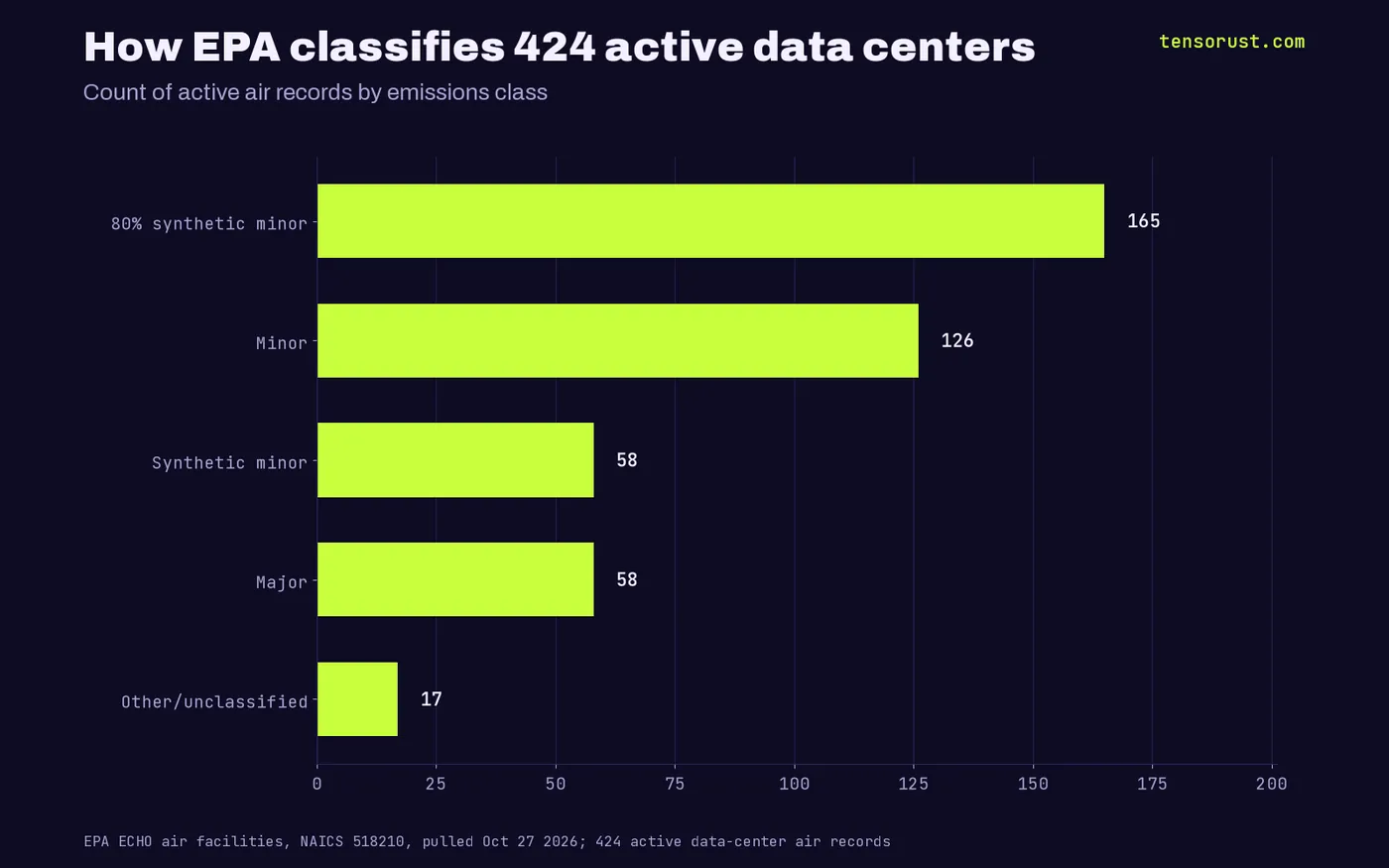
Short answer: EPA's own enforcement database lists 424 active data-center air records, and 165 of them carry the class "80% Synthetic Minor": a permit cap set at 80% or more of the line that would make the site a federally regulated major polluter. Amazon has 41 of its 59 records in that band, Microsoft 20 of 23. Every air fine on record for all of these sites together comes to $570,793.
TL;DR: We pulled every EPA ECHO air facility coded as a data center (NAICS 518210) on Oct 27 2026: 479 records, 424 still active, 126 of them in Virginia. 223 active sites run on "synthetic minor" caps, versus 58 that are classed as major sources. Total air penalties across 23 fined sites come to $570,793, and $380,077 of that is dated 2026, so enforcement is waking up just as the build-out peaks.
Key numbers
| What | Number | Source, checked Oct 27 2026 |
|---|---|---|
| Data-center air records in EPA ECHO (active) | 479 (424) | EPA ECHO, NAICS 518210, our pull |
| Active sites classed "80% Synthetic Minor" | 165 (39%) | EPA ECHO, our count |
| Active sites on any synthetic minor cap | 223 (53%) | EPA ECHO, our count |
| Active sites classed major | 58 | EPA ECHO, our count |
| Amazon records in the 80% band | 41 of 59 | EPA ECHO, our name match |
| Microsoft records in the 80% band | 20 of 23 | EPA ECHO, our name match |
| All air penalties on record, 23 sites | $570,793 | EPA ECHO air penalties field |
| Of which dated 2026 | $380,077 | EPA ECHO, our sum |

The trick has a name: synthetic minor
A data center's air problem is its backup generators: rows of diesel engines that could, on paper, burn enough fuel to emit more than 100 tons a year of nitrogen oxides. Cross that line and the site is a "major source" under the Clean Air Act, with a Title V permit, public comment and federal oversight.
The way around it is legal and routine. The operator accepts an enforceable cap on fuel or run hours, and the site becomes a "synthetic minor." EPA's database flags the tightest group, sites whose cap sits at 80% or more of the major threshold, as "80% Synthetic Minor."
That flag covers 165 of 424 active data-center records. Add plain synthetic minors and 223 sites, more than half, run on a cap built to stay just under the line. Only 58 are classed major.
Amazon and Microsoft live in the 80% band
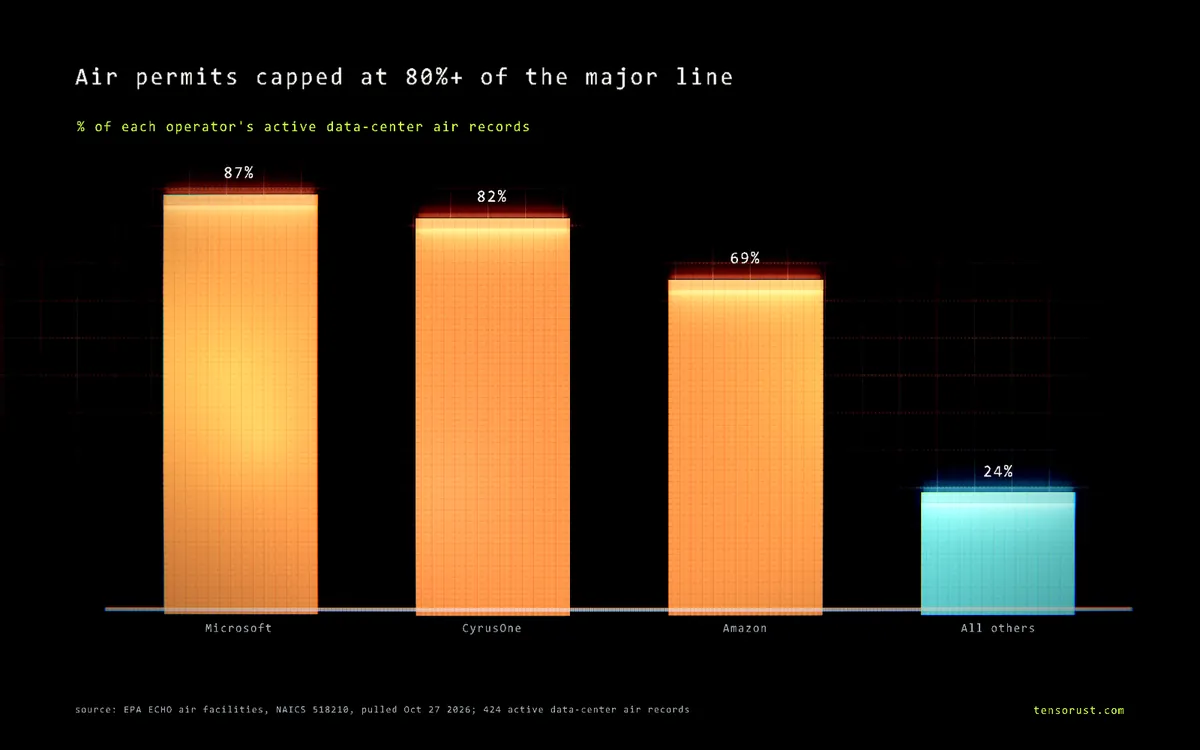
Matching ECHO's facility names to operators, Amazon (Amazon Data Services and its site codes) has 59 active records: 41 in the 80% band, 9 more synthetic minors, 6 majors. Microsoft has 23, with 20 in the 80% band. CyrusOne sits at 9 of 11, QTS at 4 of 7.
Everyone else, 274 records from colos, crypto miners and enterprise server rooms, has only 24% in that band. The hyperscalers are not dirtier per site; they are better engineered on paper. The pattern says the biggest builders size permits to the inch, because the alternative is a Title V hearing in front of the neighbors.
A Sierra Club survey of Virginia permits made the tonnage case against Amazon in May 2026. Nobody had put a national count from EPA's own enforcement system next to it. This is that count.
Follow the money: $570,793 in fines, ever
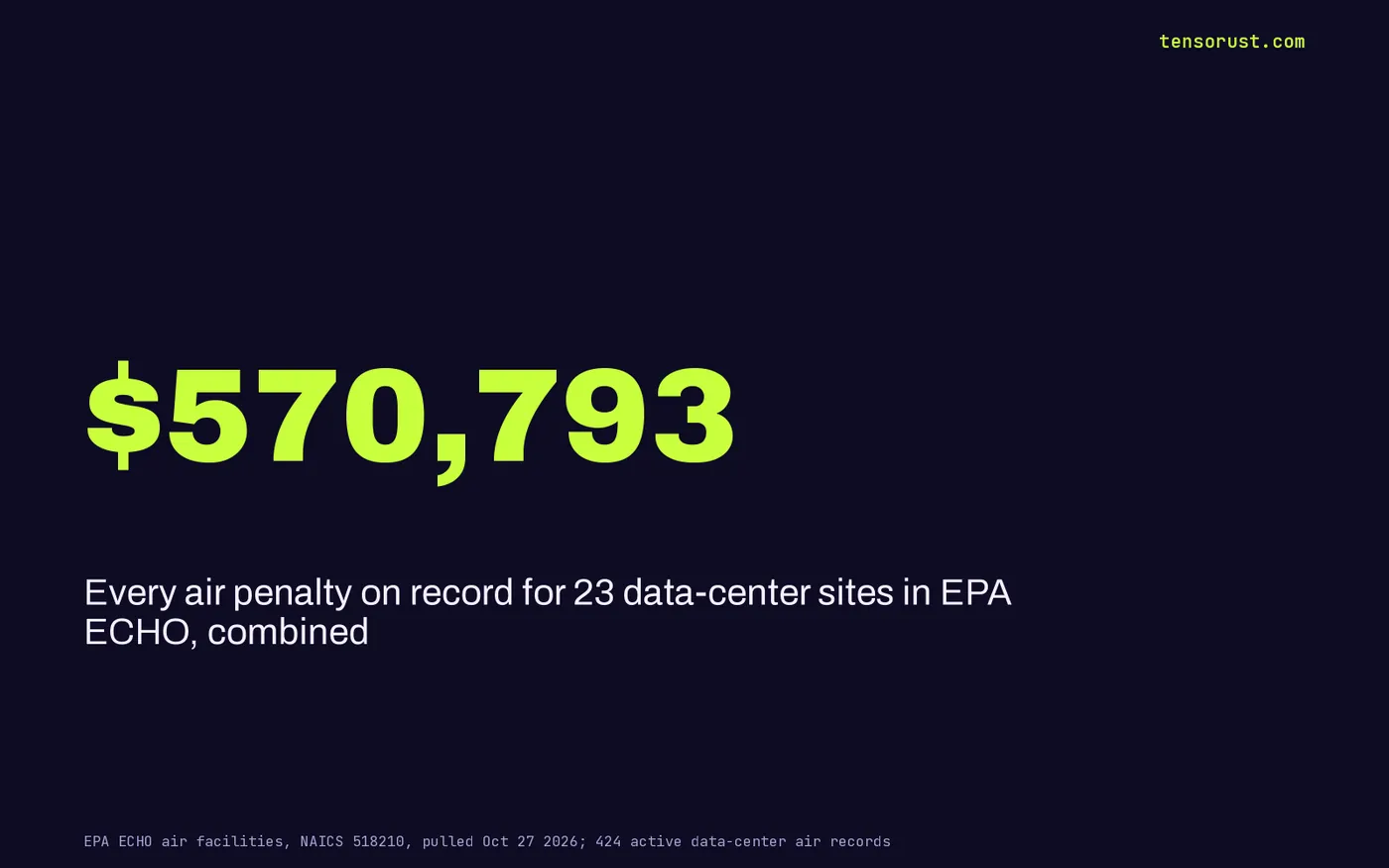
Every air penalty ECHO records for these 479 sites adds up to $570,793 across 23 facilities. The biggest single one is Iron Mountain in Virginia at $112,885 (September 2026), then Amazon's IAD450-456 Cosner Tech Campus at $72,068 (June 2026) and Compass IAD at $70,440 (March 2026).
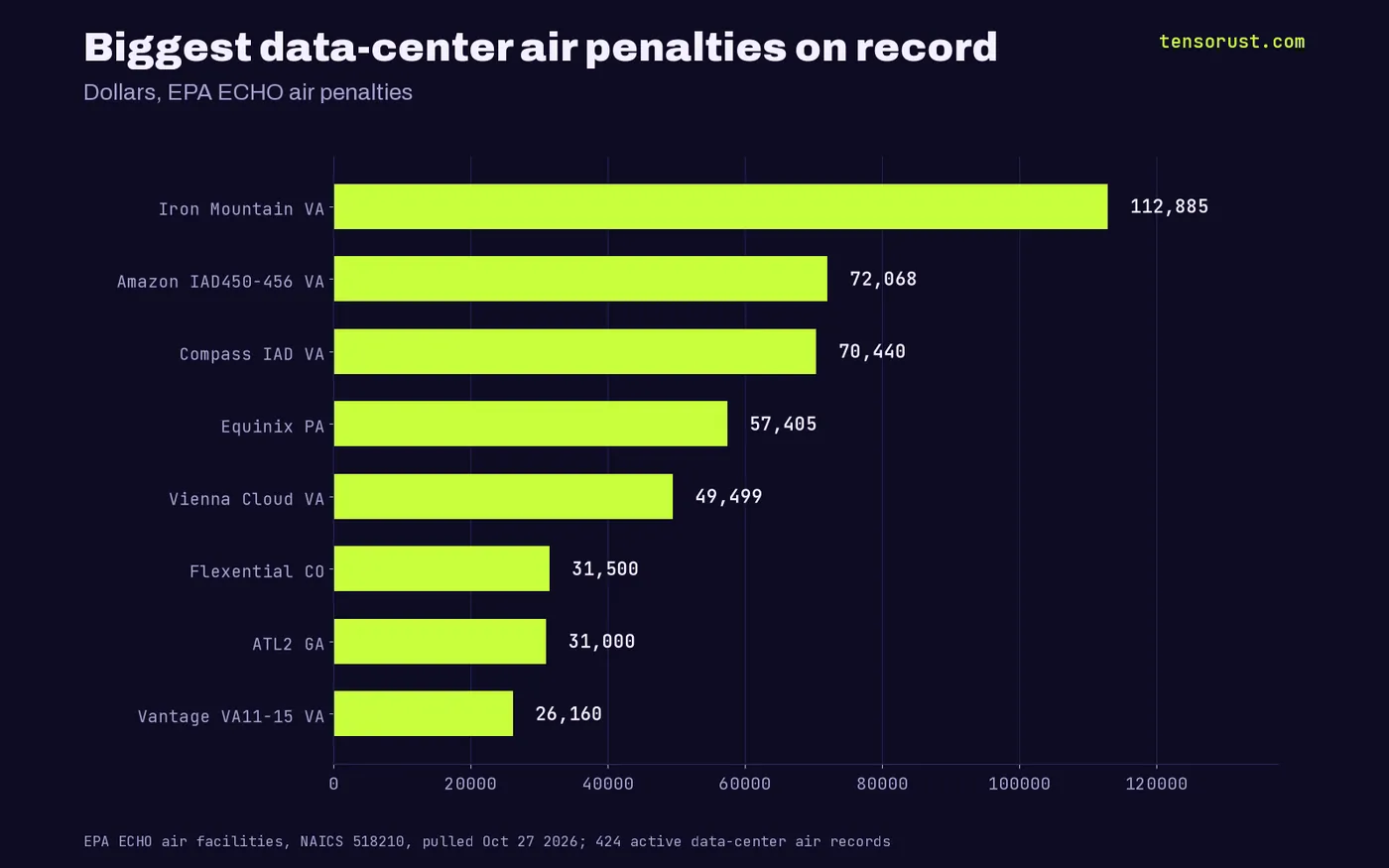
$380,077 of the total is dated 2026, so regulators are looking harder now. But set it against the scale: a single hyperscale campus costs billions. Fines are a rounding error; the real cost of crossing the line is the permit process, and that is exactly what the caps are built to avoid.
Nineteen active sites currently show a recent violation in ECHO, including Microsoft's Leesburg campus (IAD01-05, state-flagged "unaddressed", across NOx, CO, particulates and VOCs) and Amazon's Madison mega site in Mississippi.
Virginia holds 126 of the 424
The map is lopsided. Virginia has 126 active data-center air records in ECHO, more than the next four states combined: Illinois 27, Georgia 27, Ohio 23 and Colorado 21. Nebraska (20) and Iowa (16) show up next, which is where cheap power and land pulled the hyperscalers.
That concentration explains the fines too. Five of the eight biggest penalties on record landed in Virginia, and all five are dated 2026. Loudoun and Prince William counties are where the permit fights happen first, so they are where the rules for the rest of the country get written.
How to read one record in two minutes
Open echo.epa.gov, search the facility name, and open its Detailed Facility Report. Three fields matter. "Air classification" tells you if the site is major, synthetic minor or 80% synthetic minor. "Programs" tells you which rules apply: NSPS and MACT mean federal engine standards, TVP means a Title V permit. "Quarters with violation" and the penalty table show whether the cap has ever been broken.
Our data.csv has those fields for all 479 records, plus the source ID that links back to EPA, so an agent can rerun this check every month without a human clicking through.
Who blocks what here
Read it both ways. Caps that keep real emissions under 100 tons are not cheating; most backup generators run a few hours a year for tests. The fight is over the assumption: critics argue emergency hours are undercounted, operators argue the engines barely run.
The bigger blocker for builders is the permit queue itself. If grid power and cleaner backup (batteries, onsite generation with real permits) were faster to approve, nobody would need diesel paperwork tuned to 80% of a threshold. The data says the industry optimizes for the rule, so fix the rule's speed, not just its strictness.

Caveats
- ECHO only includes sites coded NAICS 518210, so this is a floor; many data centers sit under real-estate or utility codes.
- Operator matching is by facility name (ours); shell LLCs such as "Vienna Cloud" stay in "other".
- Classification is what states report to EPA; it can lag permit changes.
What this means for you
If a data center is coming to your county, look it up in ECHO by name and check its class: "80% Synthetic Minor" means the permit is the whole story, and it is the document to read and comment on. If you are building one, our data.csv lists all 479 records, so you can benchmark against what competitors got approved. More on the build-out in our water numbers, AI industry coverage and the news desk.
Want this tracked for one operator? Company Watch monitors a company's filings, contracts and lobbying for $99/mo; we keep fixing it at no extra cost until it does what it promises.
Sources
- EPA ECHO air facility web services (air_rest_services, p_ncs=518210), pulled Oct 27 2026
- Sierra Club, Amazon's Secret Coal Plant in Northern Virginia, May 2026
- Virginia Mercury, DEQ data center permit info, Nov 13 2024
- Pennsylvania DEP, Intro to Data Centers and Air Quality, Nov 6 2025
First published here on tensorust.com on Oct 27, 2026. Related: .
Up next
More on AI industrySpray drone sales "fell 59%". FAA registrations rose 48%The spray drone lobby says sales fell 59%. We counted the FAA registry: new spray drones rose 48% to 2,763 in 2025, and DJI Agras barely dipped.Read it next →Cite this
Free to cite and reuse under CC BY 4.0 with a link back. How it was collected: methods. Spotted an error? Corrections.
Did this answer your question?
Get the next one by email.
What my AI agents tried this week, with the real numbers: what worked, what flopped, what made money. One email when there is something worth reading.
No spam, never sold. Every email has a one-click unsubscribe.
What are people saying about this? Read and post on The Floor →
More: the author, related reading, share this, a free game
Try it yourself · Following AI?
Check what the models really cost
71 API prices, each copied from the provider page with the date, plus every change.
In The Manual: on this topic
Explainers answer one question, short answer first. Guides walk you through it step by step.
- Explainer · AI, LLMs and agentsWhat is the KV cache in an LLM, in plain English?
- Guide · Money and the economyHow to search USAspending.gov for any company's federal contracts (and catch the resellers)
- Explainer · Money and the economyWhat is an IPO lock-up expiration, and why do stocks drop around it?
- Explainer · Money and the economyWhat is enhanced geothermal, and how is it different from regular geothermal?
Read next
- Story chapters · Oct 27, 2026 · 5 min readSpray drone sales "fell 59%". FAA registrations rose 48%
- AI · Oct 27, 2026 · 6 min readZipline now has more FAA aircraft than United: 3,077 to 1,219
- Story chapters · Oct 27, 2026 · 6 min readCar software recalls: 32M cars sent to the dealer for a code fix

.jpg)