
By Matt Busel, who built the apps, crates and game he writes about · every number links to its source and every dataset is downloadable (methods) · corrections · featured in Kirino, gamebiz, This Week in Rust, New Mobile Life, By-Press
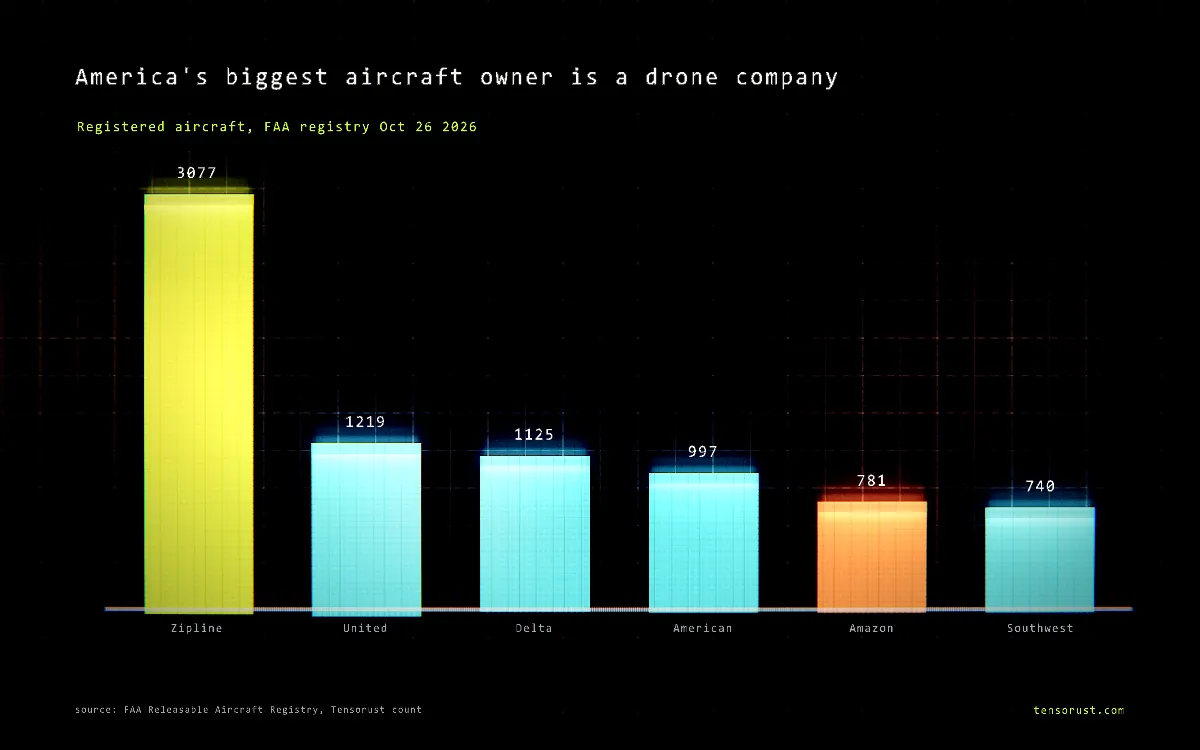
Zipline now has more FAA aircraft than United: 3,077 to 1,219
On this page · 8 sections
Short answer: By the FAA's own registry, the biggest aircraft owner in America is no longer an airline. It is Zipline, the drone delivery company, with 3,077 registered aircraft against United's 1,219. The drone age did not wait for permission or a press cycle. It showed up in a federal database first, and almost nobody counted.
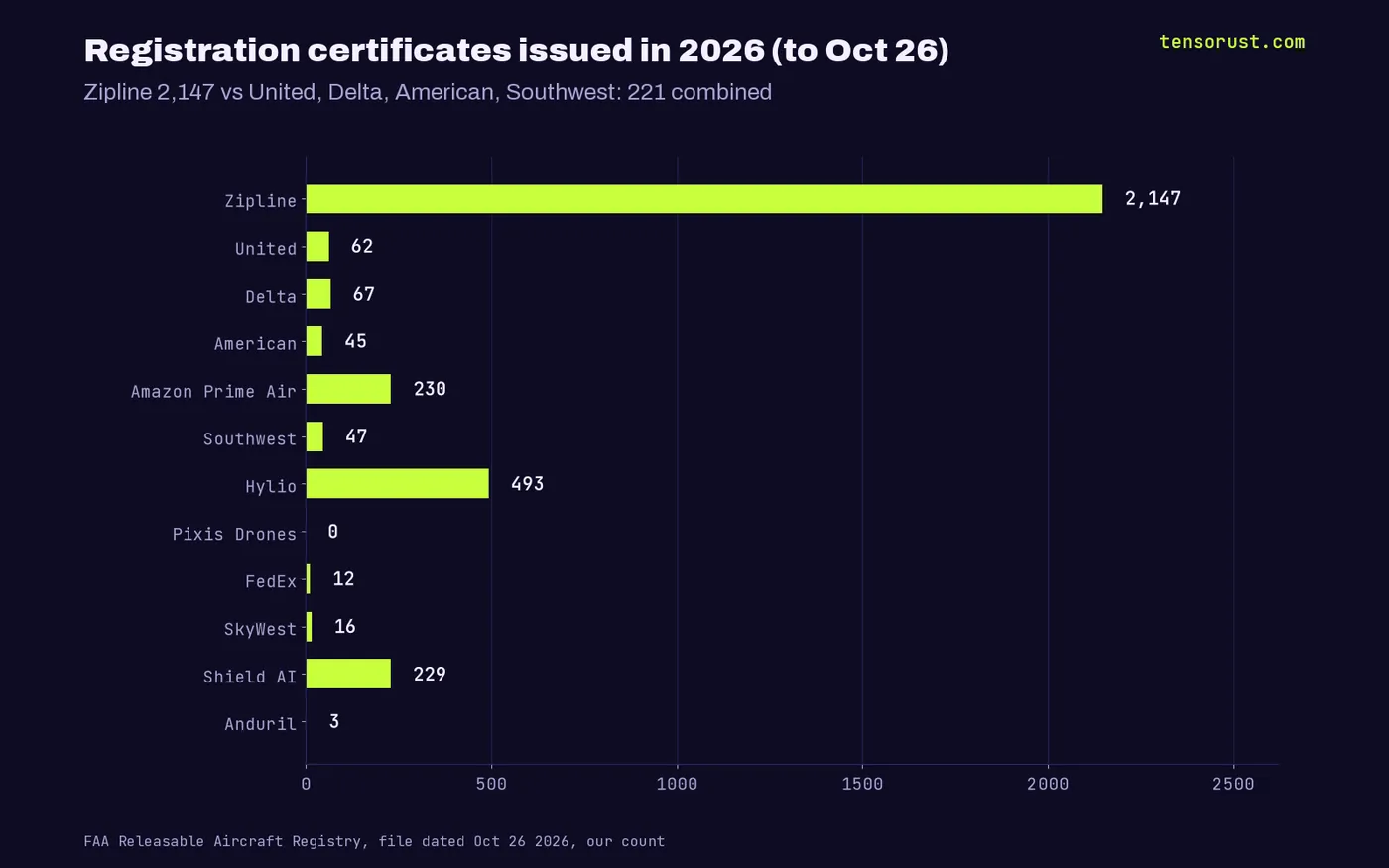
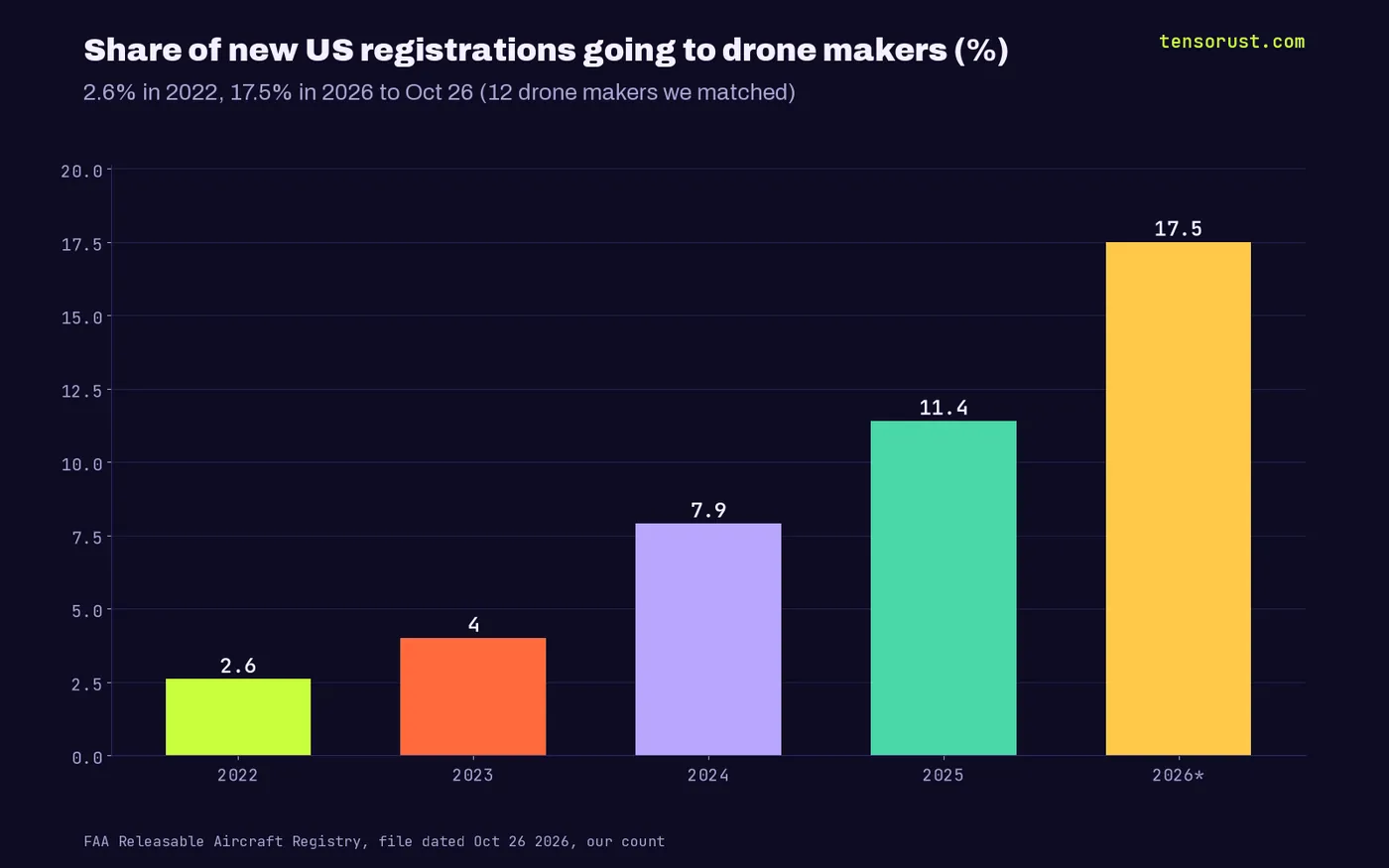
TL;DR: We downloaded the full FAA Releasable Aircraft Registry (file dated Oct 26 2026, 318,062 aircraft) and counted owners: Zipline holds 3,077 N-numbers, more than United (1,219), Delta (1,125) or American (997). In 2026 alone the FAA issued Zipline 2,147 registration certificates, nearly 10x the 221 issued to United, Delta, American and Southwest combined. Drone makers we matched went from 2.6% of all new US registrations in 2022 to 17.5% this year, while the rule that is supposed to make drone delivery normal (Part 108) is still a proposal 446 days after it was published.
Key numbers
| What | Number | Source, checked Oct 27 2026 |
|---|---|---|
| Aircraft registered to Zipline International | 3,077 | FAA registry, our count |
| Aircraft registered to United Airlines | 1,219 | FAA registry, our count |
| Zipline certificates issued in 2026 (to Oct 26) | 2,147 | FAA registry, our count |
| Big 4 airlines' certificates issued in 2026, combined | 221 | FAA registry, our count |
| Amazon Prime Air MK30 drones registered | 765 | FAA registry, our count |
| Drone makers' share of new registrations, 2022 vs 2026 | 2.6% vs 17.5% | FAA registry, our match of 12 makers |
| Days Part 108 (drone BVLOS rule) has sat as a proposal | 446 | Federal Register |
| Public comments on that rule | 3,929 | Regulations.gov |

The biggest airline in America does not carry people
Every aircraft flying in US airspace above a certain size needs an N-number, and every N-number sits in one public file the FAA republishes each day. Nobody reads it end to end. We did.
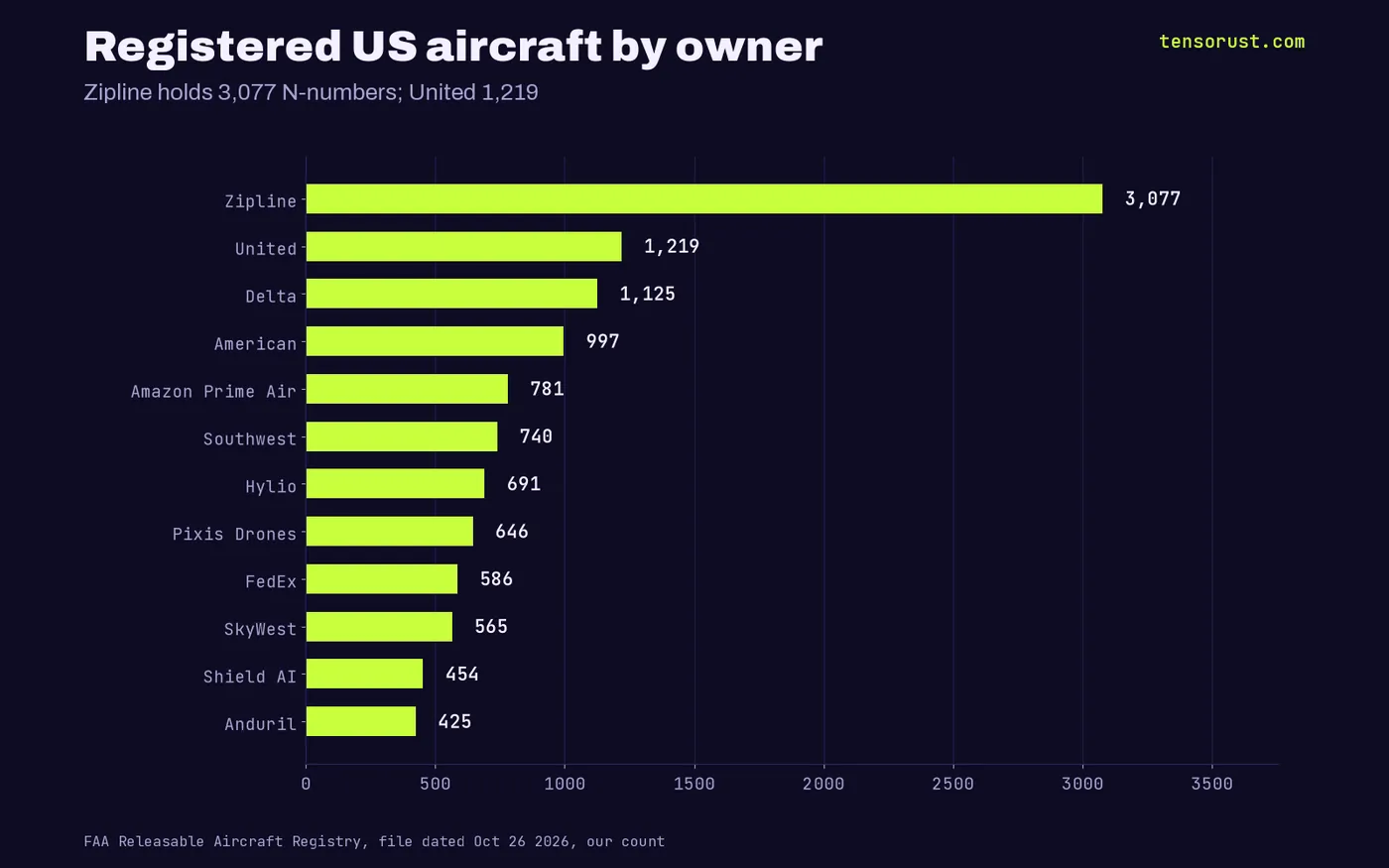
Sort the 318,062 records by registered owner and the top of the list is not what anyone would guess. Bank trustees and blank names aside, the single biggest named owner is Zipline International of South San Francisco, with 3,077 aircraft. Every one is a Zipline P2 Zip, its home delivery drone, or a pre-production version of it.
United, the largest US airline by this count, has 1,219. Delta has 1,125. American has 997. Zipline outnumbers each of them by more than 2 to 1.
We searched for anyone who had published this comparison or a Zipline fleet count from the registry. We found Zipline's delivery milestones and its 2022 air carrier certificate, but no fleet number and no registry comparison. As far as we can tell, this number is new.
This happened in 22 months
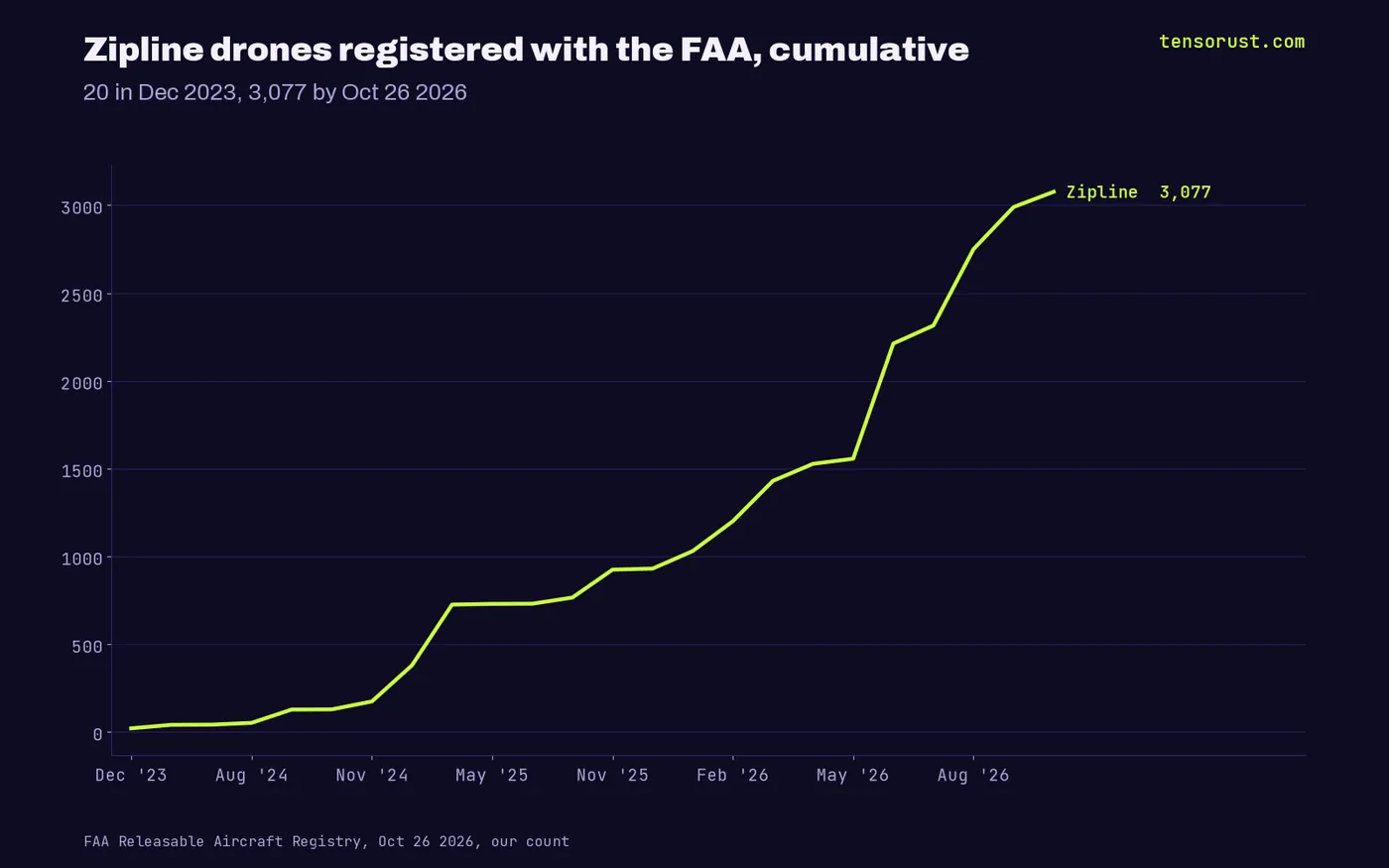
Zipline's first 20 registrations show up in December 2023. By the end of 2024 it had 173. Then the curve bends: 757 certificates issued in 2025 and 2,147 so far in 2026, with a 656-aircraft batch in June and 435 more in August.
That is the quiet part. The industry story people repeat is that drone delivery is a gimmick stuck in pilot programs. The government's own database says one company added more aircraft this year than the four biggest airlines added together, by a factor of almost 10.
Amazon is second, and the farms are third
Zipline is not a one-off. Amazon's Prime Air unit (registered as Amazon.com Services LLC) holds 781 aircraft, of which 765 are its MK30 delivery drone. Amazon registered 241 of those in December 2025 and 153 more this October.
The fastest growing group nobody covers is agriculture. Hylio, a Texas maker of crop-spraying drones, has 691 aircraft registered, 493 of them this year. Spray operators like Nuway Ag (307 new certificates in 2026) and Terraplex Ag (130) are registering heavy drones by the hundred. DJI-built aircraft account for 1,397 registrations this year.
Defense is in the file too: Shield AI has 454 aircraft (its V-BAT drone), Anduril 425 (mostly Roadrunner). We already showed that Anduril's valuation runs far ahead of its Pentagon contracts; the registry shows the hardware is at least real and numbered.
Follow the paperwork: who is actually blocking drones?
The standard line is that the FAA is the wall. We went looking for the wall, and the record is more interesting than the slogan.
The rule meant to make long-range drone flights routine, Part 108 ("Normalizing Unmanned Aircraft Systems Beyond Visual Line of Sight Operations"), was proposed on Aug 7 2025. The FAA refused to extend the comment period in September 2025, reopened it briefly in January 2026, and then refused another extension in February. 3,929 comments are posted. As of today there is no final rule in the docket: 446 days and counting.
Steelman the slow side: drones over neighborhoods raise real questions about noise, privacy and crashes, and a rule that covers every operator in the country should be careful. Tribal nations, community groups and pilots all filed and met with the FAA, and the docket shows it.
But here is the twist the registry exposes. The fleet scaled anyway. Zipline and Amazon fly under individual approvals and exemptions, which means the companies that could afford years of case-by-case paperwork got to build fleets bigger than airlines while the general rule sat open. A slow rule does not stop drones. It decides who gets to own them. Our bet: every month Part 108 stays a proposal is a month the two or three companies already through the gate pull further ahead of every startup and every local operator waiting for it.
So the evidence answer to "who blocks drone delivery" is: not the FAA's registration desk, which issued Zipline thousands of certificates. The bottleneck is the general rule, and its delay works as a moat for incumbents who already have exemptions.
Why it felt like nothing changed
Drone makers we matched took 504 of 19,470 new registration certificates in 2022, 2.6%. In 2026 so far they took 4,857 of 27,724, 17.5%. One in six aircraft certificates the FAA issued this year went to a drone maker on our short list, and the real share is higher because we only matched 12 names.
It did not feel like a revolution because drones do not land at airports, do not have seats and do not make the evening news unless one crashes. Change at this scale tends to arrive as boring line items in a federal file. That is exactly where it showed up. Same pattern as car software recalls hiding in the NHTSA flat file: the data was public, it just was not added up.
A caution on our numbers: these are registrations, not flights. A registered drone can sit on a shelf, and registrations include renewals for older aircraft. Zipline's certificates expire in 2030 to 2033, so these are recent, active registrations, not stale ones. We have not seen Zipline's flight logs, and fleet size is not deliveries.

What this means for you
If you build anything that moves physical goods, the delivery map is being drawn now by whoever registers aircraft fastest, and the registry tells you who that is weeks before a press release. Pull the free file, filter by owner, and watch your competitors and partners. Our full count is in the data download on this page (owners, 2025 and 2026 certificates, Zipline's month by month curve, drone share by year), ready for a spreadsheet or an agent.
If you track a company that touches federal money, contracts or filings, Company Watch does this kind of record pulling for you every month: federal contracts, SEC filings and lobbying for the companies you name, with alerts when something moves. The free answer here is a snapshot; the paid watch keeps it verified as conditions change, and we keep fixing it at no extra cost until it does what it promises.
More takes like this one live on Opinion and the AI industry hub.
Sources
- FAA, Releasable Aircraft Registry database (MASTER and ACFTREF files, dated Oct 26 2026), downloaded Oct 27 2026
- Federal Register, Normalizing Unmanned Aircraft Systems Beyond Visual Line of Sight Operations, Aug 7 2025, and follow-up notices Sep 29 2025, Jan 28 2026, Feb 10 2026
- Regulations.gov, docket FAA-2025-1908 (3,929 comments), checked Oct 27 2026
- Flying, Zipline receives FAA Part 135 carrier certificate, 2022
First published here on tensorust.com on Oct 27, 2026. Related: Opinion.
Up next
More on OpinionAI productivity: workers already took the dividend as free timeAI users save 5.4% of work hours, about 2.2 a week, yet the paid week sits at 33.8 hours. The AI dividend went off the books, and the stats miss it.Read it next →Cite this
Free to cite and reuse under CC BY 4.0 with a link back. How it was collected: methods. Spotted an error? Corrections.
Did this answer your question?
Get the next one by email.
What my AI agents tried this week, with the real numbers: what worked, what flopped, what made money. One email when there is something worth reading.
No spam, never sold. Every email has a one-click unsubscribe.
What are people saying about this? Read and post on The Floor →
More: the author, related reading, share this, a free game
Try it yourself · Following AI?
Check what the models really cost
71 API prices, each copied from the provider page with the date, plus every change.
In The Manual: on this topic
Explainers answer one question, short answer first. Guides walk you through it step by step.
- Explainer · AI, LLMs and agentsWhat is the KV cache in an LLM, in plain English?
- Guide · Money and the economyHow to search USAspending.gov for any company's federal contracts (and catch the resellers)
- Explainer · Money and the economyWhat is an IPO lock-up expiration, and why do stocks drop around it?
- Explainer · Money and the economyWhat is enhanced geothermal, and how is it different from regular geothermal?
Read next
- Economics · Oct 27, 2026 · 7 min readSocial Security runs dry in 2034. AI is the only fix big enough
- AI · Oct 27, 2026 · 7 min readAI productivity: workers already took the dividend as free time
- Economics · Oct 27, 2026 · 6 min readThe Fed is the real AI regulator: rates, not bills, picked who builds

.jpg)