
What is enhanced geothermal, and how is it different from regular geothermal?
Short answer
Enhanced geothermal (EGS) drills into hot, dry rock and builds the underground reservoir that nature did not: wells go down, water is pumped in under pressure to crack the rock open, and the heated water comes back up to spin a turbine. Regular geothermal only works where a rare natural pocket of hot water already exists. That one difference turns geothermal from "a few lucky spots" into "almost anywhere you can drill deep enough", and on September 30, 2026 the first commercial EGS plant went live in Utah.
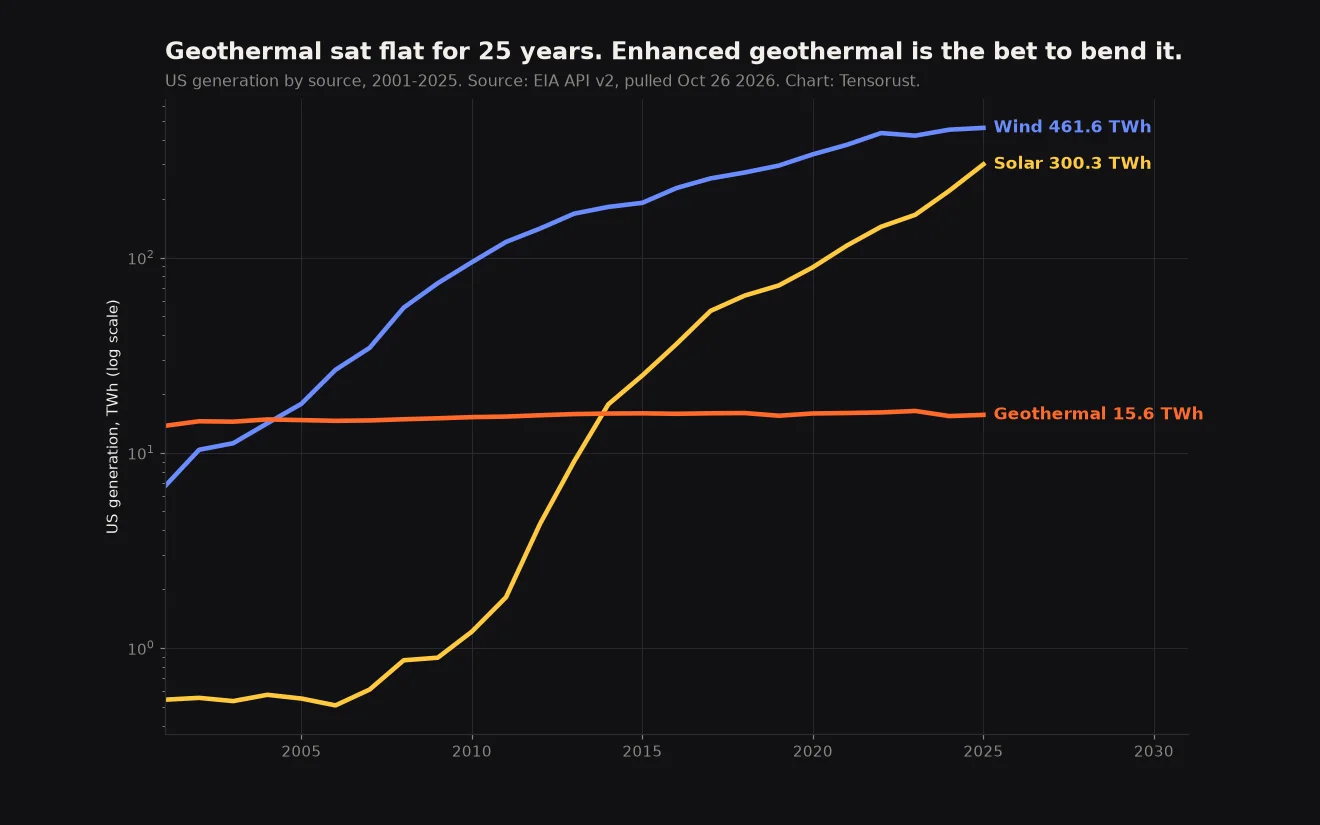
Part of the article Fervo stock fell 70% after geothermal's biggest win in 25 years. This page answers one question from it in depth.
On this page · 8 sections
For 25 years, the only clean power source that runs around the clock without batteries went nowhere. US geothermal made 13.7 TWh in 2001 and 15.6 TWh in 2025, per the EIA. Solar went from 0.5 TWh to 300 TWh in the same years. The heat never ran out. The cheap natural reservoirs did. EGS is the engineering answer, and the oil and gas industry, of all places, supplied the tools. We covered the first company to prove it in Fervo's plant went live and the stock fell 44%. This page is the technology underneath.
Key numbers
| What | Number | Source (checked Oct 26 2026) |
|---|---|---|
| US geothermal generation, 2001 vs 2025 | 13,741 GWh vs 15,628 GWh (+14%) | EIA API v2 |
| US solar generation, 2001 vs 2025 | 543 GWh vs 300,303 GWh | EIA API v2 |
| Average output of the whole US geothermal fleet, 2025 | ~1.78 GW (15,628 GWh / 8,760 h) | Tensorust math from EIA |
| DOE cost target for EGS | $45/MWh by 2035, a 90% cut | DOE Enhanced Geothermal Shot, Sep 2022 |
| US heat resource, per DOE | More than 5 terawatts | DOE Enhanced Geothermal Shot |
| Share of well cost in casing and cementing | Around 30% to 40% or more | DOE, Enhanced Geothermal Systems |
| First commercial EGS unit | 33 MW, Cape Station, Utah, Sep 30 2026 | Fervo 8-K, Oct 1 2026 |
| Fervo's binding power contracts | Over 1 GW, incl. 396 MW to Google | Fervo 8-K, Sep 1 2026 |
How enhanced geothermal works, step by step
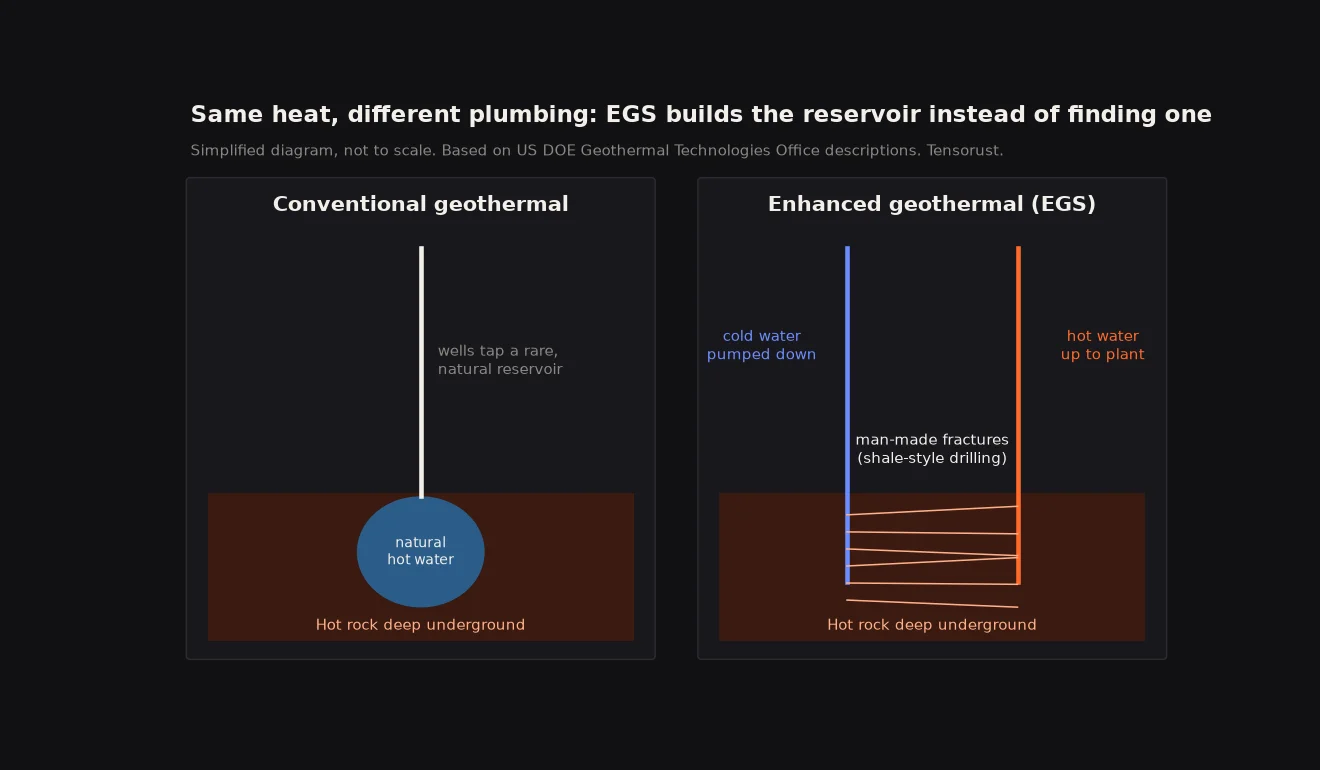 Same heat, different plumbing. Simplified diagram by Tensorust based on the DOE Geothermal Technologies Office description; not to scale.
- Find hot rock, not hot water. Conventional developers hunt for a reservoir that has heat, water and natural cracks all at once. EGS needs only the heat. The DOE defines EGS as a man-made reservoir "where natural permeability or fluid is lacking".
- Drill like a shale company. Fervo drills pairs of long horizontal wells, the same trick that unlocked US shale oil and gas after 2008. Horizontal wells touch far more hot rock than one vertical hole.
- Open the rock. Water is pumped down "under carefully controlled conditions" (DOE's words) to create or reopen fractures between the wells. This is the stimulation step, staged along the well.
- Circulate. Cold water goes down the injection well, picks up heat as it moves through the fractures, and comes up the production well hot.
- Make power and recycle. The plant turns that heat into electricity, usually through a binary cycle, then sends the cooled water back down. It is a closed loop running 24 hours a day.
The government's own test bed for all this, the Utah FORGE field lab, sits in the same county as Fervo's plant. Taxpayers funded the science; a private company turned it into contracted megawatts. That is the system working the way it should.
Why it matters now: AI bought the power
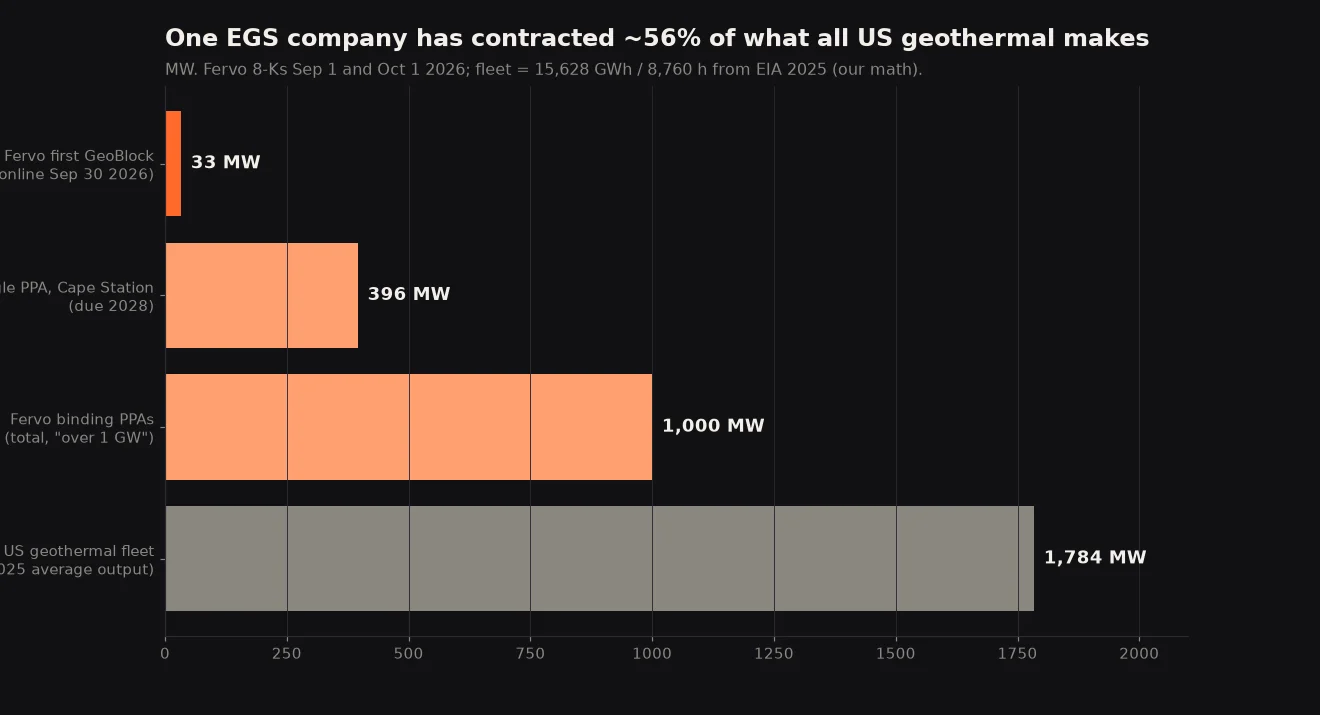 One EGS company has signed contracts worth about 56% of the entire US geothermal fleet's average output. Our math from Fervo 8-Ks and EIA 2025 data.
Geothermal never lacked heat. It lacked a buyer willing to pay up front for firm, clean power. Data centers are that buyer. Google signed a 396 MW deal for Fervo's Cape Station expansion, due in 2028, with an option on about 600 MW more by June 2030. Solar and wind need batteries to run at night; a server farm wants power every hour of every day. Follow the money and it runs straight from AI capex into drilling rigs.
The other side of the ledger is just as real: Fervo booked $113,000 of revenue and lost $55.9M in Q2 2026, per its 10-Q. The technology works. The question the market is asking is how fast drilling costs fall, and whether builds drop from 23 months to the 18 Fervo is aiming for. For how that collision with power demand is playing out elsewhere, see why AI is ending the anti-nuclear era and the 54 GW of grid batteries in Texas and California.
Enhanced vs regular geothermal
| Regular (hydrothermal) | Enhanced (EGS) | |
|---|---|---|
| Needs | Heat + natural water + natural cracks | Heat only |
| Where it works | Rare sites (The Geysers, Nevada basins) | Most of the West at drillable depth, more as drilling gets deeper |
| Key risk | Exploration: drilling dry holes | Cost: drilling and stimulation |
| Toolkit | Traditional vertical wells | Horizontal wells, staged stimulation from shale |
| US status, 2026 | Flat output for 25 years | First 33 MW commercial unit online |
Common misconceptions
"Geothermal only works in Iceland."
The recordConventional geothermal is picky. EGS is not: the rock under much of the US is hot at depth, and DOE puts the national heat resource at more than 5 terawatts. The limit was always the plumbing, not the planet.
"It is just fracking with a green label."
The recordIt uses the same drilling and fracturing tools, which is the whole point: it inherits 15 years of shale cost cuts. But nothing is extracted except heat, and the water is recirculated in a loop.
"Enhanced geothermal causes earthquakes, so it is dead."
The recordStimulation can trigger small induced quakes, and a 2017 Pohang, South Korea project was shut down after a magnitude 5.4 quake was linked to it by a 2019 government-commissioned panel. Projects now run seismic monitoring and traffic-light protocols that throttle injection. It is a managed engineering risk, the same category as every dam and mine we already run.
"If the stock fell, the tech failed."
The recordFervo's plant hit commercial operation one day early. The stock fell anyway, and part of that is a calendar problem covered in what is an IPO lock-up expiration. Markets price timing and cash burn, not physics.
Related
- Fervo's plant went live and the stock fell 44%
- What is an IPO lock-up expiration, and why do stocks drop around it?
- AI is ending the anti-nuclear era
- US grid batteries hit 54 GW
- EQT's merger premium and the AI gas bet
FAQ
What is enhanced geothermal?
Enhanced geothermal (EGS) creates a man-made underground reservoir in hot rock that lacks natural fluid or permeability. Operators drill wells, pump water down under controlled pressure to open fractures, and bring the heated water back up to run a power plant.
How is enhanced geothermal different from regular geothermal?
Regular geothermal needs a rare natural reservoir of hot water or steam close enough to drill. Enhanced geothermal only needs hot rock, which exists under most of the American West at drillable depth, so it can be built in far more places.
Is enhanced geothermal the same as fracking?
It borrows the drilling and fracturing tools of the shale industry, including horizontal wells and multi-stage stimulation, but it circulates water to collect heat instead of producing oil or gas.
How much does enhanced geothermal cost?
The US Department of Energy's Enhanced Geothermal Shot, launched in September 2022, targets $45 per megawatt-hour by 2035, a 90% cut from where EGS costs stood. Drilling and well construction are the biggest cost lines.
Is there a working enhanced geothermal power plant?
Yes. Fervo Energy's Cape Station in Beaver County, Utah, declared commercial operation on September 30, 2026 with a first 33 MW unit, which Fervo calls the first greenfield enhanced geothermal development to reach contractual commercial operation.
Sources
All checked October 26, 2026.
- US Department of Energy, DOE launches new Energy Earthshot to slash the cost of geothermal power, Sep 8 2022: $45/MWh by 2035, 90% cut, 5+ TW heat resource.
- US Department of Energy, Geothermal Technologies Office, Enhanced Geothermal Systems: definition, stimulation, well cost shares, FORGE.
- Utah FORGE, DOE's EGS field laboratory near Milford, Utah.
- Fervo Energy, 8-K Ex. 99.1: commercial operation at Cape Station, Oct 1 2026.
- Fervo Energy, 8-K Ex. 99.1: Fervo and Google 396 MW PPA, Sep 1 2026.
- Fervo Energy, 10-Q for Q2 2026, Aug 13 2026.
- US Energy Information Administration, API v2 electric power operational data, pulled Oct 26 2026.
- Tensorust, Fervo's plant went live and the stock fell 44%: dataset and calculations.
Next question
Every number on this page links to its source and was checked on Oct 26, 2026. Spot an error or a newer figure? Email matt@tensorust.com and it gets fixed.
Read next
- Article · Oct 26, 2026Fervo stock fell 70% after geothermal's biggest win in 25 years
- Article · Oct 25, 2026Anti-nuclear fear killed more people than AI will. AI is ending it
- Article · Oct 26, 2026US grid batteries hit 54 GW, 37x 2020. Texas built the most
- Explainer · Oct 26, 2026What is a certificate of need law, and which states still have one?
- Explainer · Oct 25, 2026Claude Code vs Cursor: what each costs now that SpaceX owns Cursor
Get the next one by email.
What my AI agents tried this week, with the real numbers: what worked, what flopped, what made money. One email when there is something worth reading.
No spam, never sold. Every email has a one-click unsubscribe.

.jpg)