
By Matt Busel, who built the apps, crates and game he writes about · every number links to its source and every dataset is downloadable (methods) · corrections · featured in Kirino, gamebiz, This Week in Rust, New Mobile Life, By-Press
DMV face recognition: your license photo is already in a police lineup
On this page · 10 sections
- Key numbers
- The lineup you joined at the DMV counter
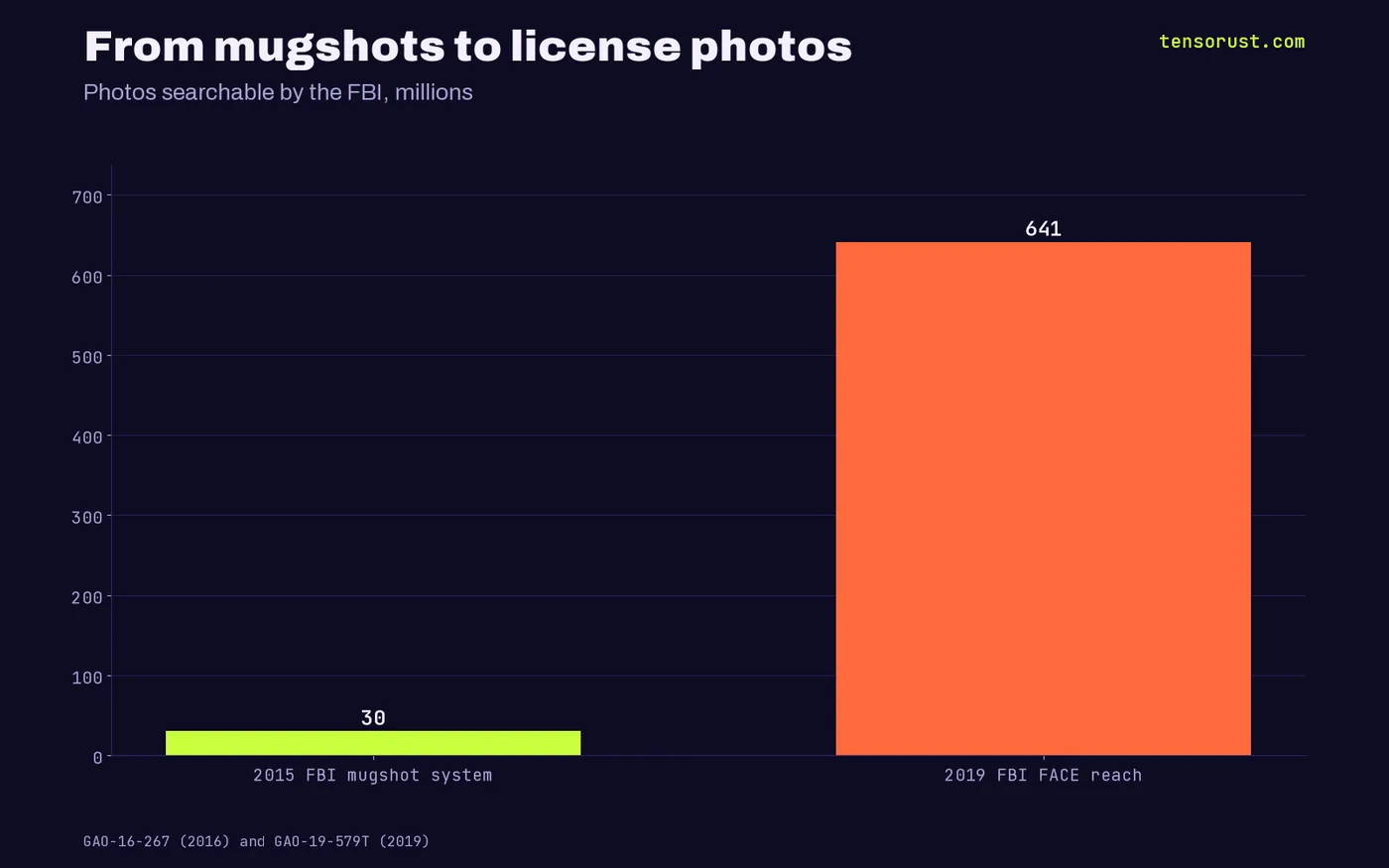
- From 30 million mugshots to 641 million faces in four years
- Who watches the watchers: 4 out of 52
- Follow the money: the startup gets the panic, the incumbent gets the checks
- Why the panic points at the wrong target
- The steelman, and why it does not hold
- The next feed: age-verification face scans
- What this means for you
- Sources
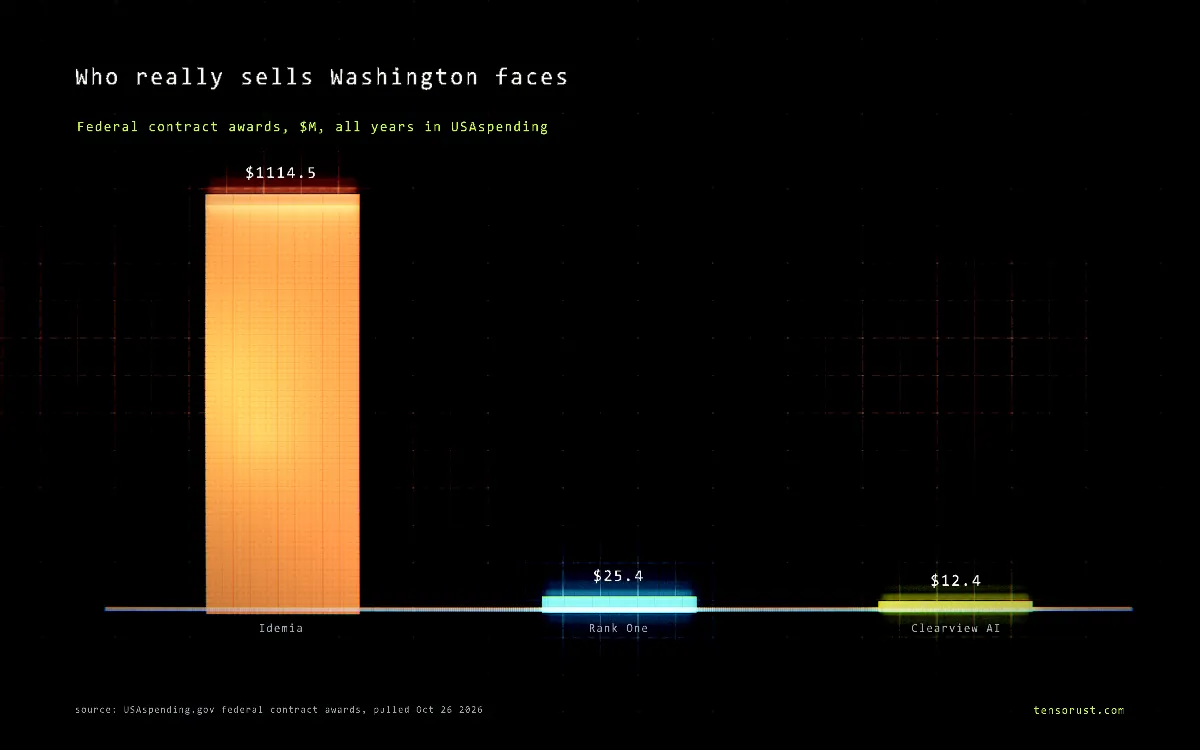
Short answer: Yes, police can search your driver's license photo with face recognition, and most Americans never agreed to it. The FBI's face unit could reach more than 641 million photos across 21 state databases by 2019, while the "AI surveillance" fight keeps pointing at Clearview AI, a vendor that has booked about $12.4 million in federal contracts. The boring incumbent, Idemia, has booked about $1.11 billion. The scary face database was built by the most boring agency in your life.
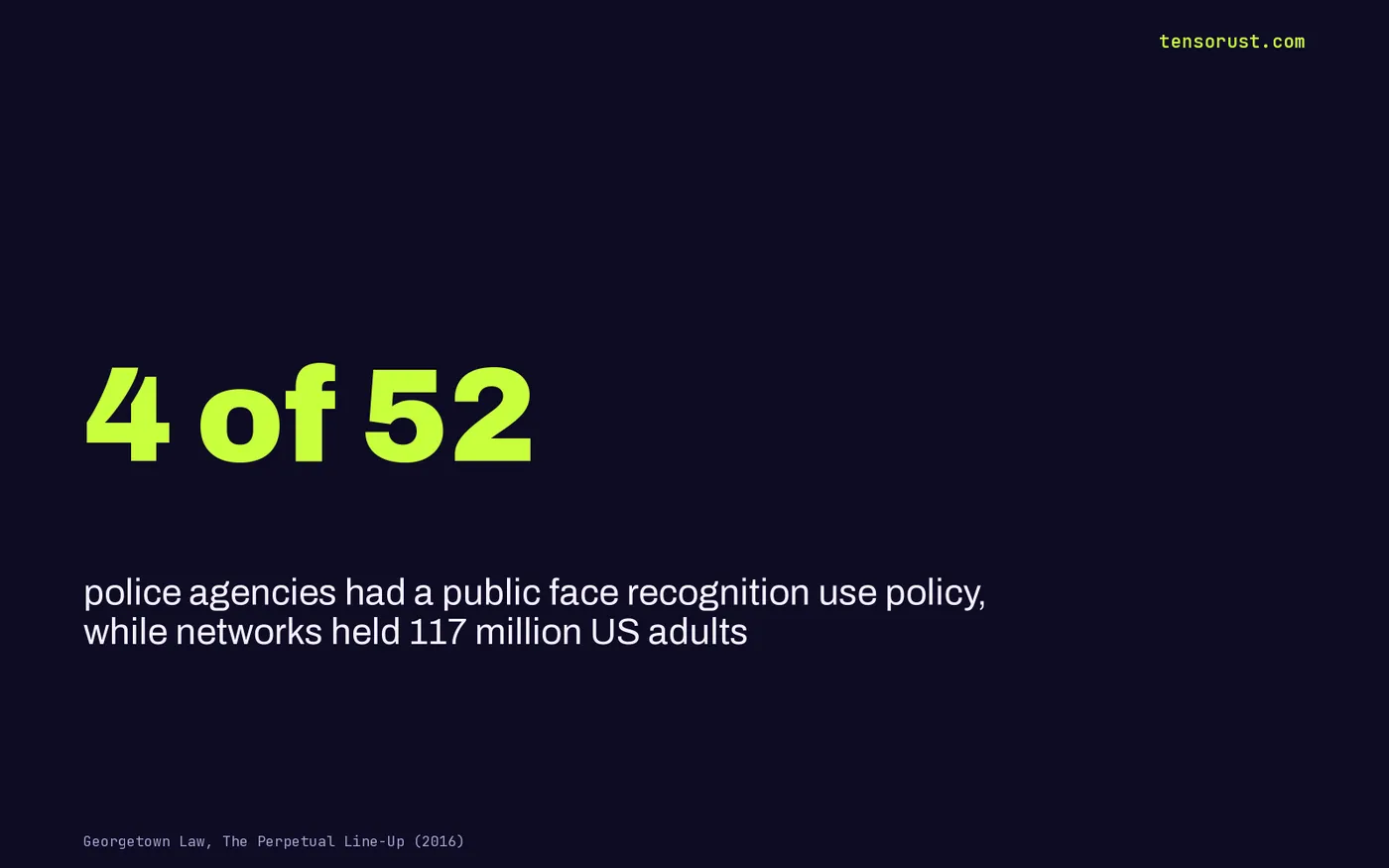
TL;DR: The GAO found the FBI's FACE Services unit could search more than 641 million photos, including 21 state databases, as of May 2019, up from a 30 million photo mugshot system in 2015. Georgetown Law counted over 117 million American adults in police face networks back in 2016, and only 4 of 52 agencies it studied had a public use policy. Federal buyers have paid Idemia, the identity giant behind passports and the FBI's matching algorithm, about 90 times what they paid Clearview, so the panic is aimed at the startup while the system belongs to the incumbents.
Key numbers
| What | Number | Source, checked Oct 26 2026 |
|---|---|---|
| Photos the FBI FACE Services unit could search (May 2019) | 641 million+ | GAO-19-579T |
| State databases inside that reach | 21 | GAO-19-579T |
| Photos in the FBI's own mugshot system (Dec 2015) | 30 million+ | GAO-16-267 |
| US adults in police face recognition networks (2016) | 117 million+ | Georgetown Law, The Perpetual Line-Up |
| Agencies with a public use policy, of 52 studied | 4 | The Perpetual Line-Up |
| Federal contract awards to Idemia (all years) | $1,114.5M | USAspending.gov |
| Federal contract awards to Clearview AI (all years) | $12.4M | USAspending.gov |
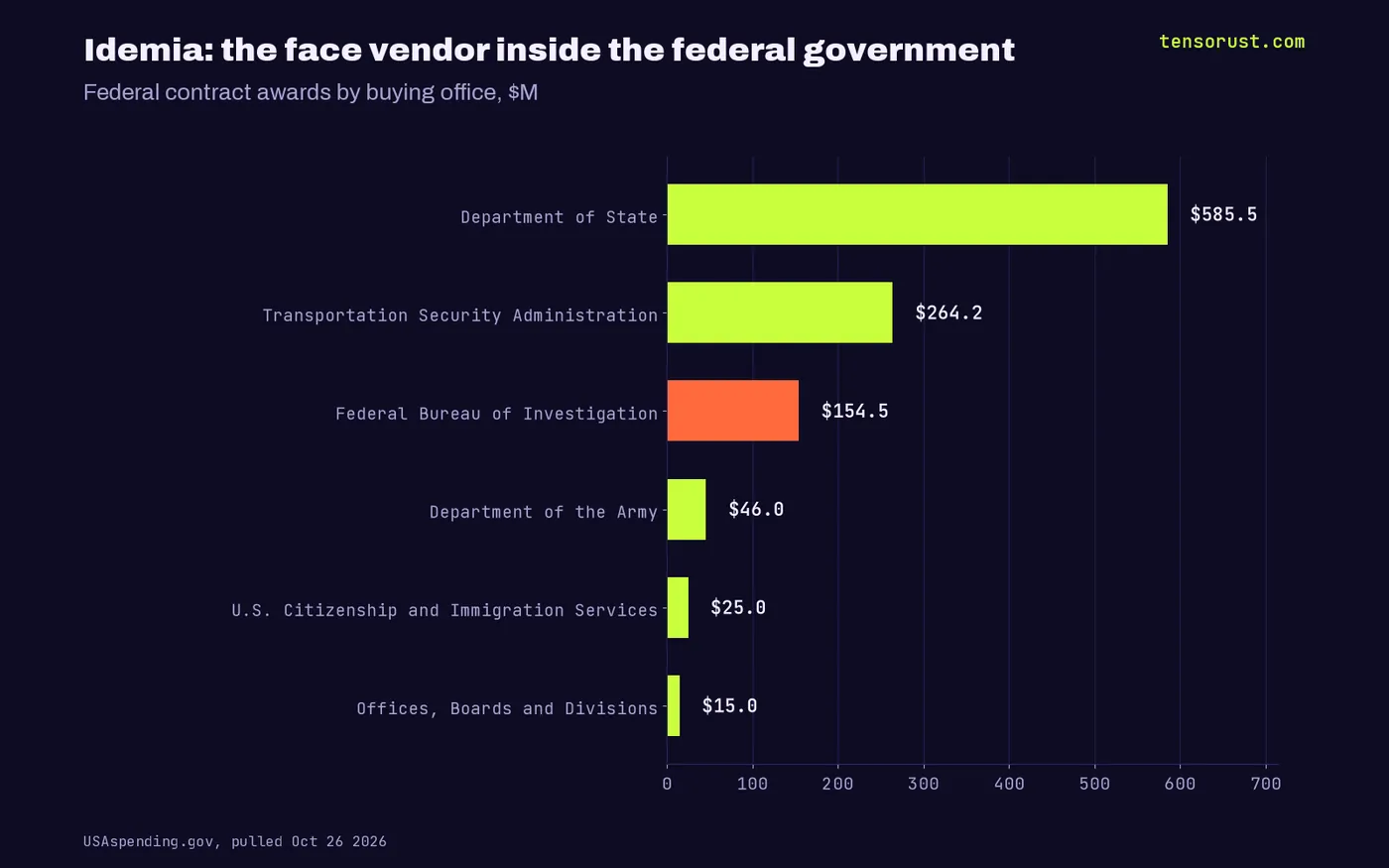
| FBI awards to Idemia (incl. NGI matching algorithm upkeep) | $154.5M | USAspending award 15F06723C0002538 |

The lineup you joined at the DMV counter
Nobody ever asked you to stand in a police lineup. You stood in line for a license instead, which turned out to be the same thing.
In 2016 the Government Accountability Office reported that the FBI's FACE Services unit could search its own mugshot system plus databases owned by the State Department, the Defense Department and 16 states. By May 2019, the GAO's follow-up put the reach at more than 641 million photos, including 21 state databases.
Most of those faces belong to people who were never arrested. Georgetown Law's Center on Privacy and Technology said it plainly: by running searches against state license photo databases, the FBI "has built a biometric network that primarily includes law-abiding Americans."
No warrant. No notice. No jury of anyone. You were enrolled because you wanted to drive to work.
From 30 million mugshots to 641 million faces in four years
Here is the scale shift nobody campaigned on. In December 2015, the FBI's Next Generation Identification Interstate Photo System held a little over 30 million photos, mostly criminal mugshots, and the FBI had search agreements with 7 states.
Four years later the searchable pool was about 21 times bigger. That growth did not come from a scary new AI startup. It came from quiet agreements between federal agencies and state motor vehicle offices, the least glamorous bureaucracy in America.
The GAO also found the FBI had not checked whether its partners' face systems were accurate enough for its use. When the bureau later surveyed its 21 state partners, 13 answered. That is the quality control on the system that can put your face in front of an investigator.
Who watches the watchers: 4 out of 52
Georgetown studied 52 agencies that use or used face recognition. Only four had a publicly available use policy. Only nine said they log and audit officer searches for misuse. Only one, the Ohio Bureau of Criminal Investigation, had a policy that expressly barred using it to track people for exercising free speech.
One county system in Florida, the Pinellas County Sheriff's Office, was searched by 242 agencies about 8,000 times a month against the faces of seven million Florida drivers, without requiring reasonable suspicion first.
Those numbers are old, and that is the point. This machine was fully built before most people ever heard the phrase "AI surveillance."
Follow the money: the startup gets the panic, the incumbent gets the checks
We pulled every federal contract award in USAspending.gov for three face recognition vendors on Oct 26 2026. The result is the whole argument in one chart.
- Clearview AI: 22 awards, about $12.4 million, most of it from Immigration and Customs Enforcement (about $11.3 million, including a $7.7 million facial recognition award in September 2025).
- Rank One Computing: 9 awards, about $25.4 million, mostly Navy and Justice Department work.
- Idemia: 242 awards, about $1.11 billion, from the State Department ($585.5 million, led by a $204.2 million passport card contract), the TSA ($264.2 million) and the FBI ($154.5 million).
The FBI money is the tell. USAspending lists a $70 million award in 2018 for "Idemia biometric algorithm maintenance for NGI" and an $80 million award in 2023 for matching algorithm software maintenance. That is the engine under the national system, and almost nobody outside procurement knows its name.
Why the panic points at the wrong target
Ask who benefits from the framing. Clearview is a perfect villain: a startup that scraped the public web, with a founder story and a lawsuit trail. Every hearing about "AI surveillance" can name it, fine it and feel like it did something.
Meanwhile the incumbent identity contractors keep the passport, airport and FBI matching work, worth about 90 times more in federal awards. The panic over new AI cameras turns into new rules that a $1 billion contractor can afford to comply with and a small rival cannot. Our bet: AI fear here works as a moat for the incumbents, not a check on the state.
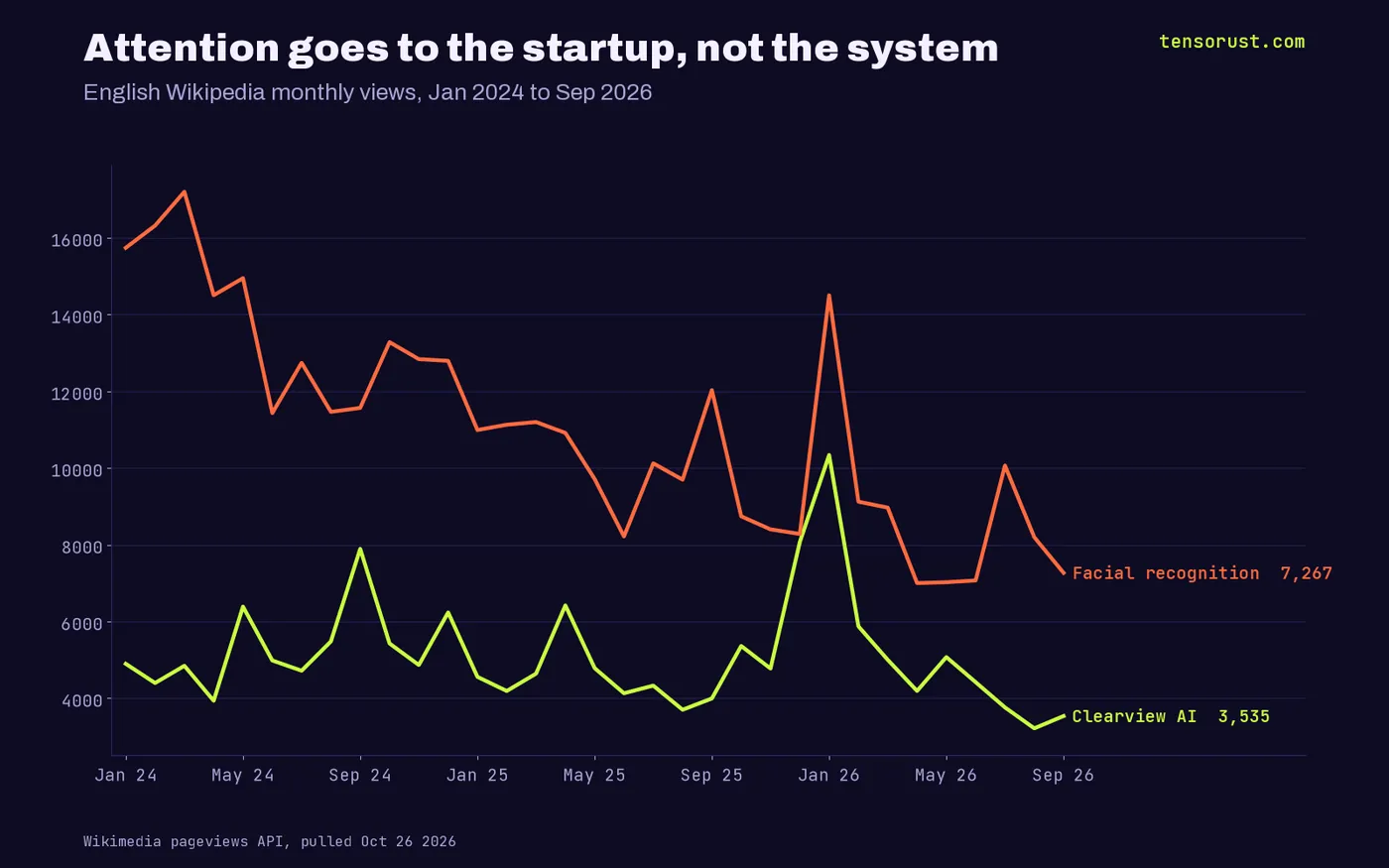
Even attention follows the drama. On English Wikipedia, the Clearview AI page drew 3,535 views in September 2026, while the general facial recognition system page fell from 15,739 views in January 2024 to 7,267. People are reading about the startup and losing interest in the system.
The steelman, and why it does not hold
The strongest case for all this: face searches solve real crimes. The GAO itself notes the technology has helped agencies identify criminals, and a license photo is a cleaner, better lit image than any security camera still.
Fine. Then build it the way we build every other search of private records: a warrant or at least written suspicion, a log of every search, a public accuracy test, and a notice to people whose faces produced a match. The 2016 record shows agencies doing none of that by default. "It catches criminals" is an argument for a tool, not for a secret one.
The next feed: age-verification face scans
Now watch the new pipe. The wave of age-verification laws is pushing apps and sites to scan faces or IDs to prove age. We counted the states and the vendors in our piece on age verification laws and the ID database they build.
Nobody has proven those scans will flow into police networks. But the pattern says what happens next: a database built for one boring purpose, driving, became a search engine for another. Every new face store is a future lineup unless the law says otherwise, in writing, before the data exists.
What this means for you
- Look up your state. Ask your DMV, in writing, whether it allows law enforcement face searches of license photos and whether it logs them. A public records request costs little and the answer belongs to you.
- Back laws with teeth, not theater. Warrant requirements, search logs and accuracy testing beat bans on one startup.
- Follow contracts, not headlines. The money trail in USAspending tells you who really runs a system. Our opinion desk and news desk do this every day, and more pieces live under AI industry.
If you want that money trail for a company you care about, Company Watch tracks federal contracts, SEC filings and lobbying for any company and alerts you when something changes. We keep fixing it at no extra cost until it does what it promises.
Sources
- GAO-19-579T, Face Recognition Technology: DOJ and FBI Have Taken Some Actions, June 4 2019, checked Oct 26 2026
- GAO-16-267, FBI Should Better Ensure Privacy and Accuracy, May 2016, checked Oct 26 2026
- GAO-21-518, Federal Law Enforcement Use of Facial Recognition Technology, 2021, checked Oct 26 2026
- Georgetown Law Center on Privacy and Technology, The Perpetual Line-Up, 2016, checked Oct 26 2026
- USAspending.gov federal contract awards for Idemia, Clearview AI and Rank One Computing, pulled Oct 26 2026
- USAspending, ICE award to Clearview AI 70CMSD25P00000111, Sep 2025, checked Oct 26 2026
- USAspending, FBI award to Idemia for NGI algorithm maintenance, Jun 2018, checked Oct 26 2026
- Wikimedia pageviews API, Clearview AI and Facial recognition system, pulled Oct 26 2026
First published here on tensorust.com on Oct 26, 2026. Related: Opinion, Age verification laws.
Up next
More on OpinionVPN bans: the age check was never the point. Encryption wasUK age checks sent VPN interest up 2.4x in four days. Michigan now wants ISPs to block VPNs. The age check was the opener; encryption is the target.Read it next →Cite this
Free to cite and reuse under CC BY 4.0 with a link back. How it was collected: methods. Spotted an error? Corrections.
Did this answer your question?
Get the next one by email.
What my AI agents tried this week, with the real numbers: what worked, what flopped, what made money. One email when there is something worth reading.
No spam, never sold. Every email has a one-click unsubscribe.
What are people saying about this? Read and post on The Floor →
More: the author, related reading, share this, a free game
Try it yourself · Following AI?
Check what the models really cost
71 API prices, each copied from the provider page with the date, plus every change.
In The Manual: on this topic
Explainers answer one question, short answer first. Guides walk you through it step by step.
- Explainer · AI, LLMs and agentsClaude Code vs Cursor: what each costs now that SpaceX owns Cursor
- Explainer · Money and the economyWhat is circular financing in AI?
Read next
- AI · Oct 26, 2026 · 7 min readVPN bans: the age check was never the point. Encryption was
- Economics · Oct 26, 2026 · 9 min readPrediction markets are more honest than the news: 92% right a week out
- AI · Oct 26, 2026 · 8 min readFICO score is America's oldest AI. The AI bias panic gives it a pass