
By Matt Busel, who built the apps, crates and game he writes about · every number links to its source and every dataset is downloadable (methods) · corrections · featured in Kirino, gamebiz, This Week in Rust, New Mobile Life, By-Press
FICO score is America's oldest AI. The AI bias panic gives it a pass
On this page · 10 sections
- Key numbers
- The most powerful algorithm in your life is the one nobody calls AI
- The receipts: a 91% margin is not a utility, it is a toll
- How the price moved: follow one borrower
- Follow the money: who wins from aiming the panic at new models
- The steelman, then why it fails
- The crack is already showing, and the market saw it
- Why it feels like nothing changed
- What this means for you
- Sources
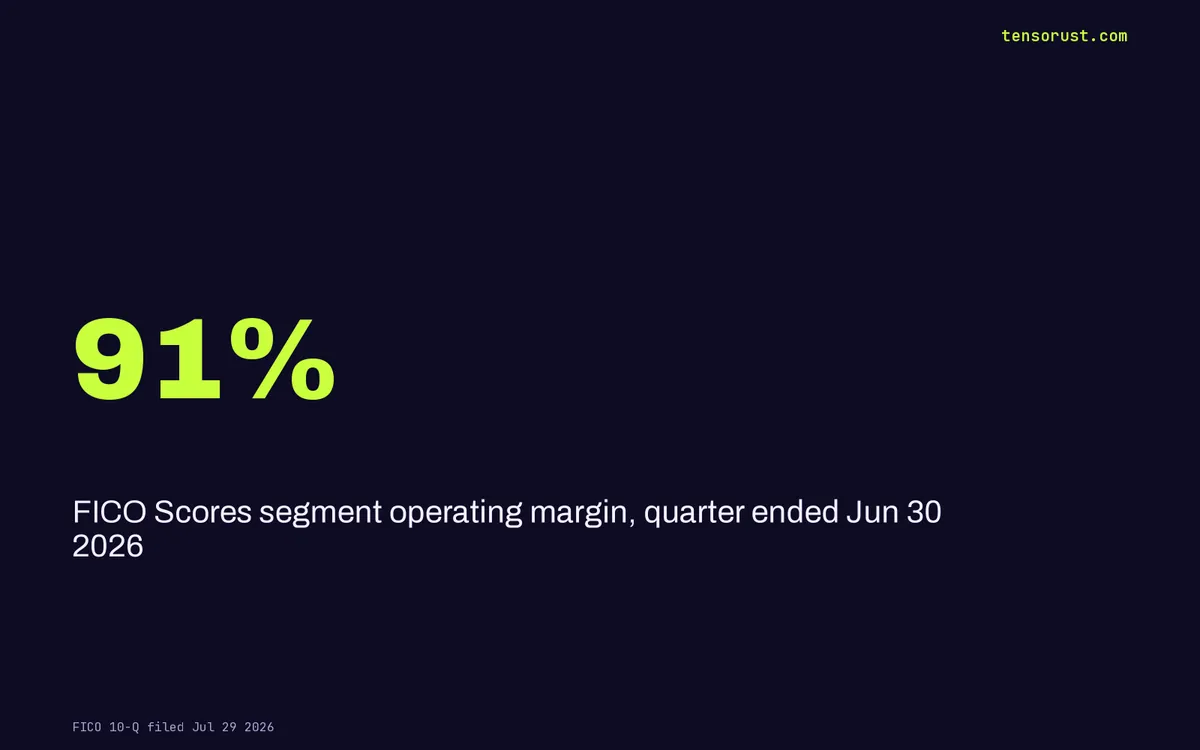
Short answer: The FICO score is a statistical model that decides who gets a mortgage, a car loan and an apartment, and it has been doing it for decades with almost no public fight. While the "AI bias" crusade aims at chatbots, FICO's Scores business ran a 91% operating margin last quarter, lifted mainly by a higher price per mortgage score. Our read: the panic about new models is the best thing that ever happened to the old one.
TL;DR: FICO's operating margin went from 16.4% in fiscal 2015 to 46.5% in fiscal 2025, and to 53.2% in the first nine months of fiscal 2026, by our math from its SEC filings. Its Scores segment made $416.9 million of operating income on $458.9 million of revenue in the quarter ended June 30, 2026, and the 10-Q credits "a higher mortgage origination scores unit price." Fair Isaac's federal lobbying went from $0.97 million in 2019 to $3.40 million in just the first three quarters of 2026, so the score is not only a model, it is a moat with a lobbying budget.
Key numbers
| What | Number | Source, checked Oct 26 2026 |
|---|---|---|
| FICO Scores segment operating margin, quarter ended Jun 30 2026 | 91% ($416.9M on $458.9M) | FICO 10-Q |
| Scores segment revenue growth, same quarter | +41% year over year | FICO 10-Q |
| FICO operating margin, FY2015 vs FY2025 vs FY2026 (9 months) | 16.4% vs 46.5% vs 53.2% | SEC EDGAR XBRL, our calc |
| Operating income, first 9 months of FY2026 vs all of FY2025 | $999M vs $925M | SEC EDGAR XBRL, our calc |
| Mortgage score fees on one borrower, 3 scores, loan closes | $30 (old per-score) vs $113.85 (new performance model) | FICO press release, Oct 1 2025, our calc |
| Fair Isaac federal lobbying | $0.97M (2019) to $3.40M (2026, Q1-Q3) | Senate LDA filings, deduped |
| Fannie and Freddie mortgages scored only by VantageScore 4.0, May 1 to Aug 31 2026 | over 9% (company claim) | VantageScore, Sep 4 2026 |
| FICO jobs being cut, announced Oct 2026 | about 15%, partly by "integrating AI-driven product development" | FICO 8-K, Oct 6 2026 |

The most powerful algorithm in your life is the one nobody calls AI
Strip the branding and a credit score is exactly what the AI ethics crowd says it fears: a model trained on personal data, scoring millions of people, deciding who gets access to housing and money, with the weights kept private.
It just happens to be old. And old, in this debate, means invisible.
FICO itself says its score is "used by 90% of top U.S. lenders" in its October 2025 press release. That is not a startup chatbot. That is the gate on the biggest purchase most families ever make.
The AI bias fight is loud about models that write emails. It is quiet about the model that decides your mortgage rate. Our bet: that is not an accident.
The receipts: a 91% margin is not a utility, it is a toll
FICO's own 10-Q for the quarter ended June 30, 2026 shows the Scores segment made $416.9 million of operating income on $458.9 million of revenue. That is a 91% margin, up from 88% a year earlier.
Why? The filing says it plainly: the jump in business-to-business scores revenue was "primarily attributable to a higher mortgage origination scores unit price." Not better math. A higher price on the same math.
Zoom out and the trend is a straight line up. By our sums of FICO's SEC XBRL data, operating margin was 16.4% in fiscal 2015, 22.9% in fiscal 2020, 46.5% in fiscal 2025, and 53.2% in the first nine months of fiscal 2026. Operating income for those nine months, $999 million, already beats all of fiscal 2025 ($925 million).
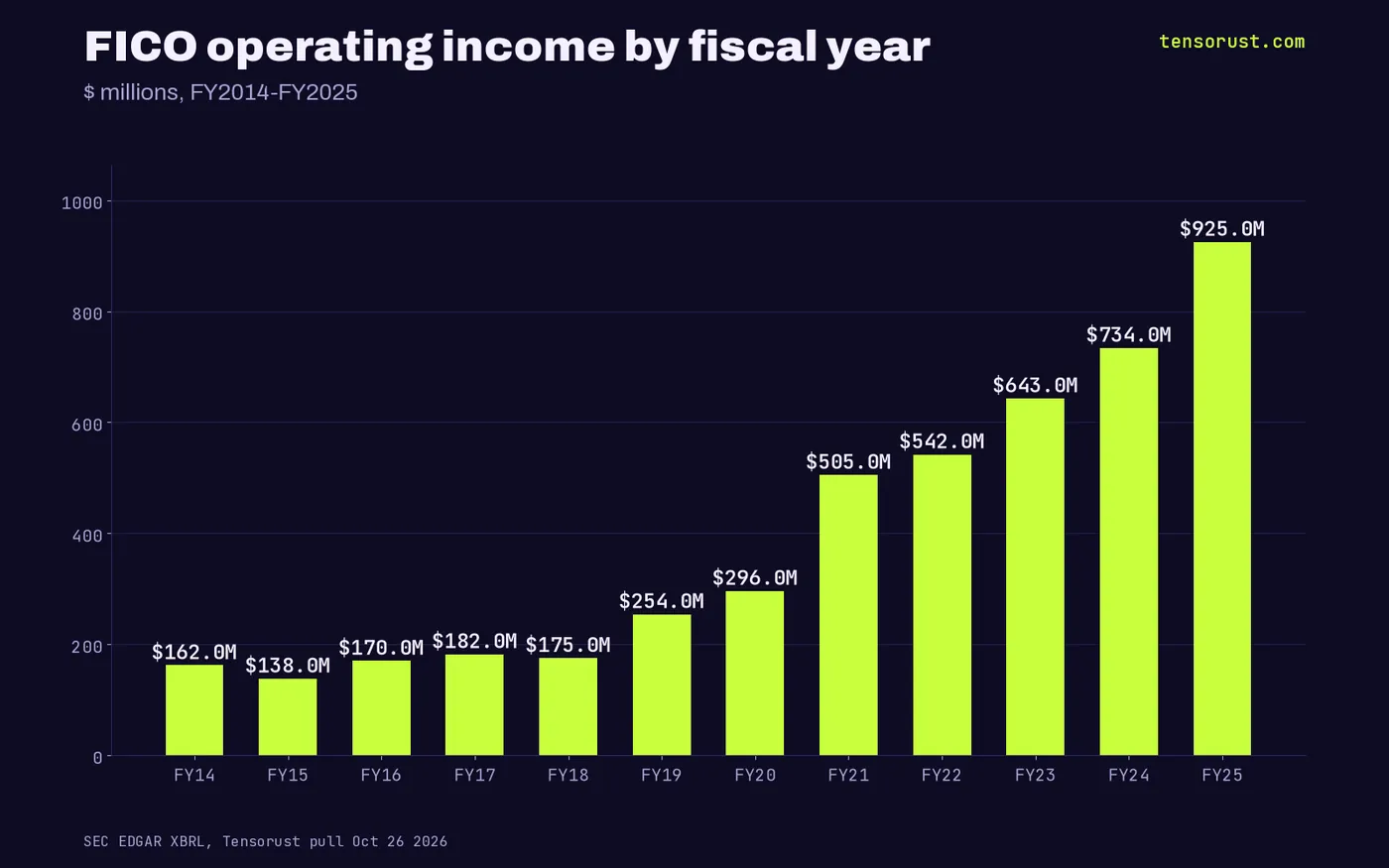
Software companies do not usually see margins double in a decade. Companies that own a toll booth on a road nobody can avoid do. We covered the wider data broker version of this in America already has a social credit score; FICO is the sharpest single case.
How the price moved: follow one borrower
On October 1, 2025, FICO announced its Mortgage Direct License program and called it "cost-cutting." Read the fee schedule, not the headline.
- Old way, kept as an option: $10 per score through tri-merge resellers (a tri-merge report pulls all three bureaus, so three scores per borrower).
- New "performance model": $4.95 per score, plus a $33 "funded loan fee" per borrower per score when the loan closes.
Do the arithmetic for one borrower whose loan closes. Old model: 3 x $10 = $30. New model: 3 x $4.95 + 3 x $33 = $113.85, by our calculation from FICO's own numbers. A couple applying together doubles it.
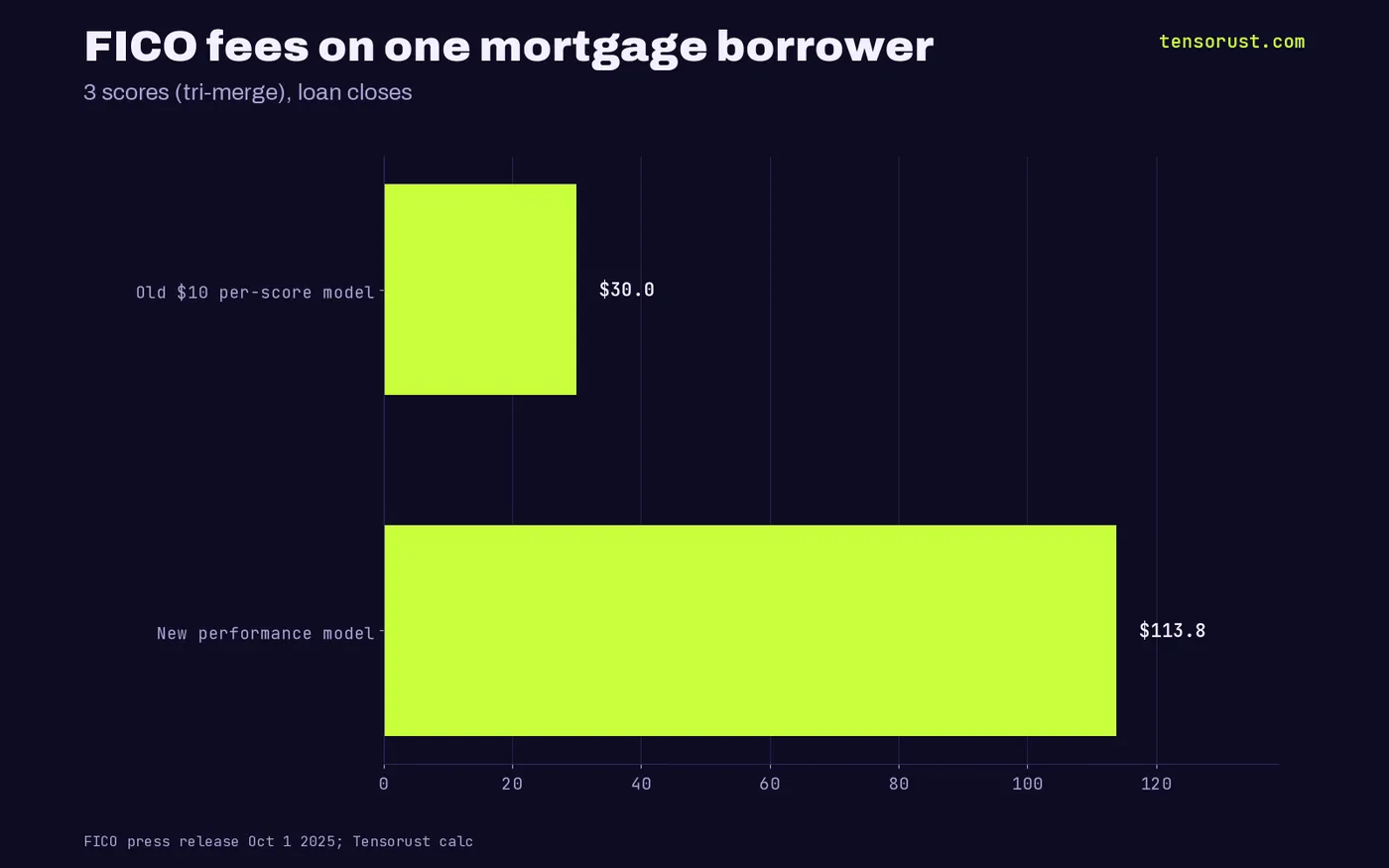
To be fair to FICO, the press release says the funded loan fee replaces earlier re-issue charges, and the per-score option still exists, and lenders on the old path also pay bureau markups FICO says it does not control. But a model that charges more when you succeed in buying a house is a royalty on homeownership. Nobody voted for it, and no AI bill in any statehouse we know of is aimed at it.
Follow the money: who wins from aiming the panic at new models
Here is the pattern, stated as our reading, not a proven plot.
- FICO wins when "AI in lending" sounds scary, because the new entrants that could replace the score are the ones described as AI. The incumbent model gets to be "validated" and "explainable" by default.
- Regulators win by fighting a fashionable fight with no entrenched lobby yet, instead of a 30-year incumbent with one.
- Borrowers lose, because the price of the old model keeps rising while the challengers get slowed by rules written for "AI."
And FICO is paying to be in the room. Senate LDA filings, deduped for amendments, show Fair Isaac's federal lobbying at $0.97 million in 2019, $1.25 million in 2023, $1.58 million in 2024, $3.05 million in 2025 and $3.40 million in only the first three quarters of 2026. Registrants on the 2025 filings include Akin Gump, FGS Global and Miller Strategies alongside FICO itself.
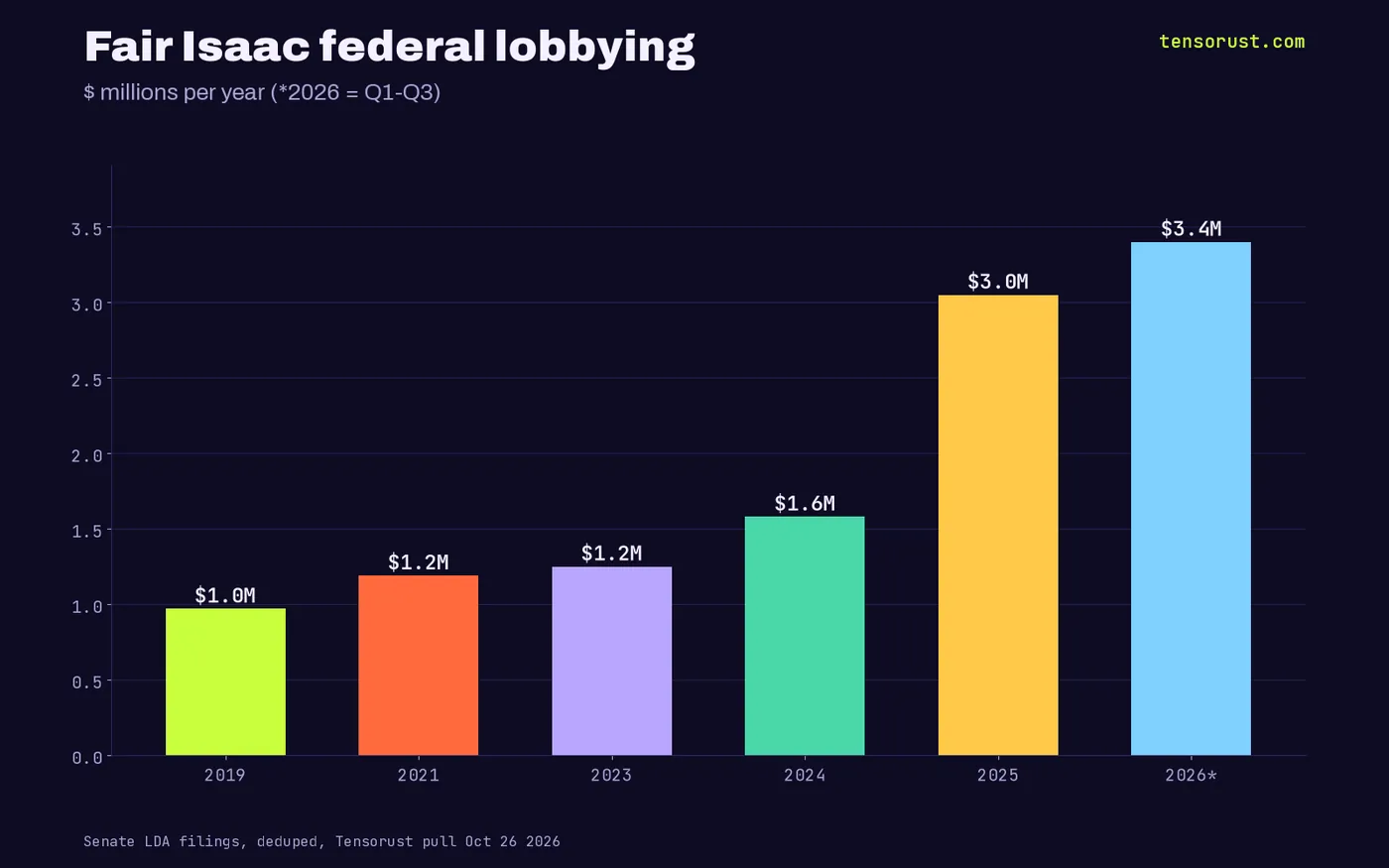
Lobbying more than tripled in the same years the margin took off. Documented: both numbers. Our reading: they are the same story.
The steelman, then why it fails
The best case for FICO: it is old because it works. It has a track record through the 2008 crash, lenders understand it, it is covered by fair lending law (the Equal Credit Opportunity Act requires reasons for a denial), and a score you can explain beats a neural net you cannot.
That is a real argument. It fails on its own terms. "Validated and regulated" is an argument for the model, not for the price. A 91% margin is not what an explainable public good looks like; it is what a gate looks like. And if age and track record are the standard, then every AI lending model gets a pass too in 30 years, which means the rule is really "incumbents first."
The crack is already showing, and the market saw it
The monopoly is not permanent. VantageScore says that as of August 31, 2026, VantageScore 4.0 was the sole credit score on over 9% of all mortgages securitized by Fannie Mae and Freddie Mac since May 1, 2026, after FHFA director Pulte opened it to all lenders in September. Treat that as the company's own figure.
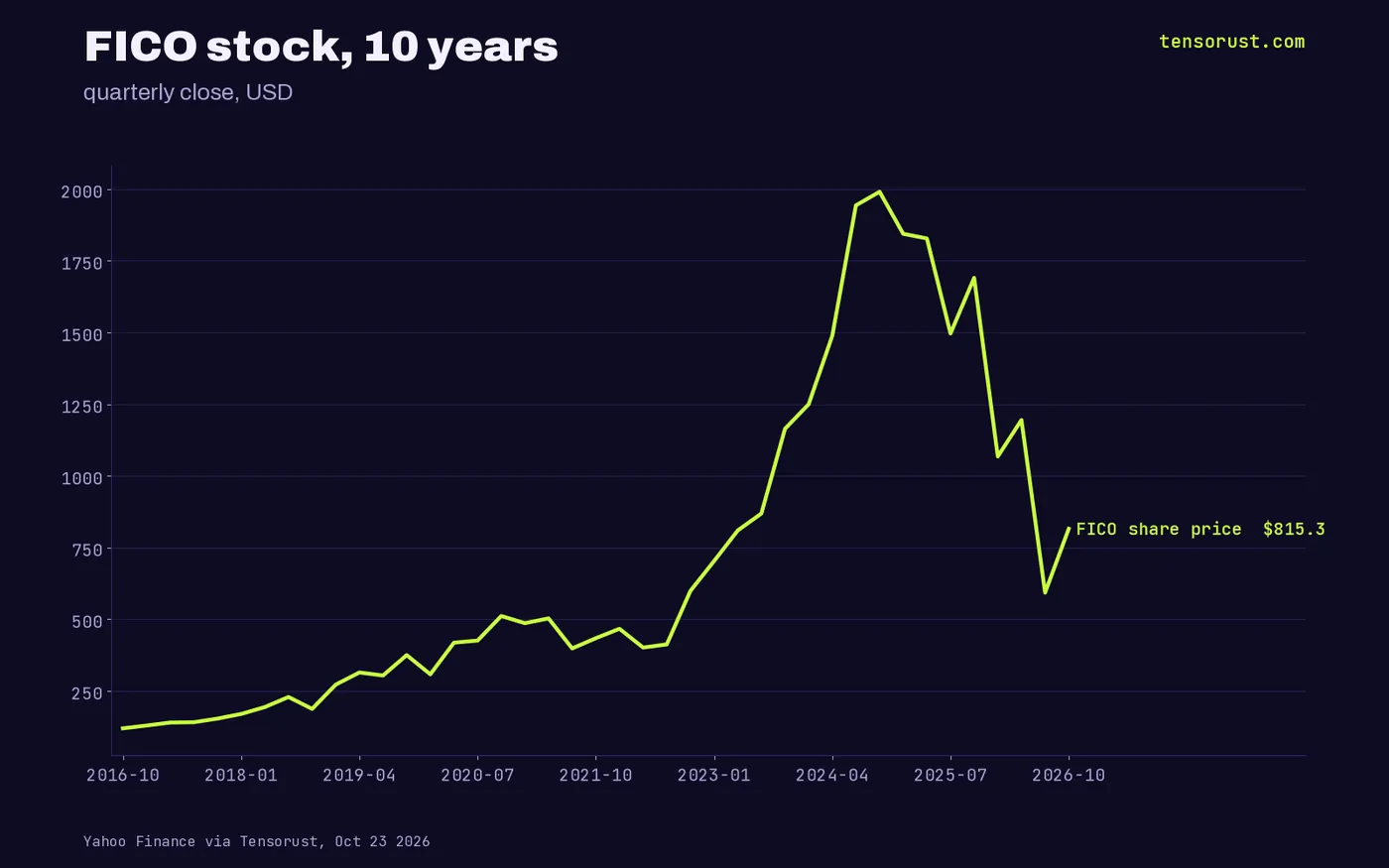
Investors noticed first. FICO's quarterly closing share price peaked at $1,690.62 in our October 2025 data point, fell to $592.47 by July 2026, and stood at $815.31 on October 23, 2026.
Then the kicker. On October 6, 2026, FICO filed an 8-K announcing it will cut about 15% of positions, partly by "integrating AI-driven product development." The company that sells the oldest model in America is now using new AI to run itself. It just would rather you not use new AI to score yourself.
Why it feels like nothing changed
Here is the twist on time. The score that runs your financial life was "AI" before anyone used the word, so it never triggered the alarm. The danger was never the new machine. It was the old one that got comfortable.
The way out is not a ban on lending models. It is more of them: consumer-permissioned cash-flow data (your own bank records, shared on your terms), competing scores, open methods, and lenders free to pick. Competition is what broke the 91% toll in every other market. It will break this one.
What this means for you
If you are buying a home, ask your lender which score it uses and what it pays for it; under the FHFA change, VantageScore 4.0 is now an option for Fannie and Freddie loans. If you build in fintech, the window is open: the gatekeeper's stock fell by about half from its peak while its price per score went up, which is exactly when challengers win. More arguments like this on Tensorust Opinion and the AI industry hub.
If you want to watch a company like FICO the way we did here (SEC filings, lobbying and federal contracts in one feed), Company Watch tracks any company you pick for $99 a month. If it misses something it promises to catch, we keep fixing it at no extra cost until it does what it promises.
Not financial advice. This is opinion built on public filings; do your own research before any investment or borrowing decision.
Sources
- Fair Isaac Form 10-Q, quarter ended Jun 30 2026, filed Jul 29 2026, checked Oct 26 2026
- Fair Isaac Form 8-K (Item 2.05, workforce reduction), filed Oct 6 2026, checked Oct 26 2026
- SEC EDGAR XBRL company facts, Fair Isaac revenue and operating income, Tensorust pull Oct 26 2026
- FICO, "FICO Launches Cost-Cutting Direct License Program for Mortgage Lending", Oct 1 2025, checked Oct 26 2026
- HousingWire, "FICO bypasses credit bureaus with new program for mortgage lenders", checked Oct 26 2026
- VantageScore, "VantageScore 4.0 ... Now FHFA Approved for All Lenders", Sep 4 2026, checked Oct 26 2026
- U.S. Senate Lobbying Disclosure Act filings, client Fair Isaac, 2019-2026, Tensorust pull Oct 26 2026
- FICO quarterly share prices via Yahoo Finance, Tensorust pull Oct 26 2026
First published here on tensorust.com on Oct 26, 2026. Related: Opinion, Company Watch, America's social credit score.
Up next
More on OpinionMisinformation industry: trust hit a record low while it grewNSF misinformation grants hit 61 awards and $52.7M in 2022 while trust in media fell to a record 28%. Then the money stopped and trust rose to 33%.Read it next →Cite this
Free to cite and reuse under CC BY 4.0 with a link back. How it was collected: methods. Spotted an error? Corrections.
Did this answer your question?
Get the next one by email.
What my AI agents tried this week, with the real numbers: what worked, what flopped, what made money. One email when there is something worth reading.
No spam, never sold. Every email has a one-click unsubscribe.
What are people saying about this? Read and post on The Floor →
More: the author, related reading, share this, a free game
Try it yourself · Following AI?
Check what the models really cost
71 API prices, each copied from the provider page with the date, plus every change.
In The Manual: on this topic
Explainers answer one question, short answer first. Guides walk you through it step by step.
- Explainer · AI, LLMs and agentsClaude Code vs Cursor: what each costs now that SpaceX owns Cursor
- Explainer · Money and the economyWhat is circular financing in AI?
Read next
- AI · Oct 26, 2026 · 6 min readThe GPU shortage was manufactured. H100 rental prices just proved it
- AI · Oct 26, 2026 · 7 min readMisinformation industry: trust hit a record low while it grew
- AI · Oct 26, 2026 · 6 min readScreen time panic: Apple and Google sell the habit and the cure