
By Matt Busel, who built the apps, crates and game he writes about · every number links to its source and every dataset is downloadable (methods) · corrections · featured in Kirino, gamebiz, This Week in Rust, New Mobile Life, By-Press
Prediction markets are more honest than the news: 92% right a week out
On this page · 10 sections
- Key numbers
- A price is a claim you can lose money on. A headline is not.
- We tested it: 148 questions, $14.5 billion, one week out
- The steelman: gambling harm and insider trading are real
- Follow the money: who the "gambling" frame protects
- The pundit class is the quiet winner of every ban
- The counterintuitive part: the misinformation fight already has a cheap fix
- Attention says the public already picked a side
- What this means for you
- Sources
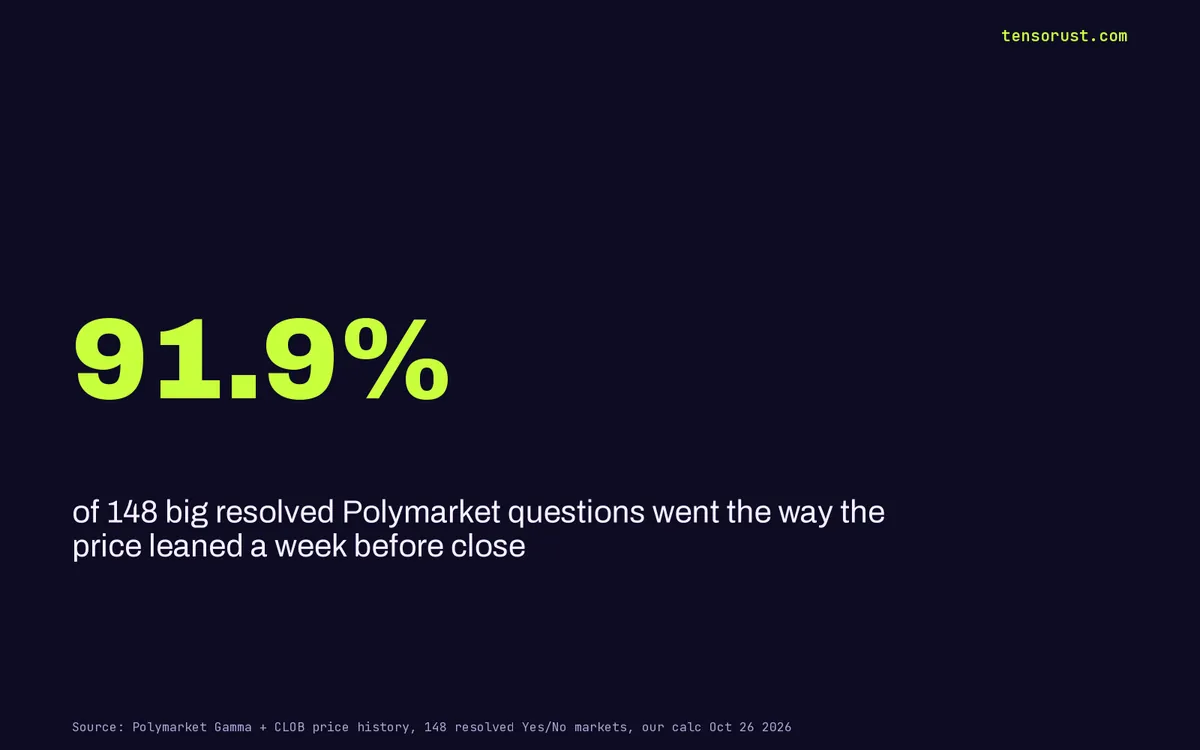
Short answer: Yes, prediction markets like Kalshi and Polymarket are more honest than the news, because a price with money behind it has to be right or someone pays. In our pull of 148 big resolved Polymarket questions, the side the price favored a week before close won 91.9% of the time. The states suing Kalshi are not protecting you from gambling. They are protecting casinos, tax streams and a pundit class that never pays for being wrong.
TL;DR: We pulled price histories for 148 resolved Yes/No Polymarket markets worth $14.5 billion in volume: one week out the favorite won 91.9% of the time, and one day out 96.6%, with a Brier score (a 0 to 1 error score where 0 is perfect and a coin flip scores 0.25) of 0.063 and 0.031. At least eight states, from Nevada to New York, plus tribes in California and Wisconsin, have sued or banned Kalshi, and New York's attorney general wants roughly $36 billion. Federal lobbying filings show the American Gaming Association spent $2.63 million in the first three quarters of 2026, while Kalshi went from $640,000 in 2024 to $3.07 million this year: the challenger now has to buy its way into a fight the incumbents started.
Key numbers
| What | Number | Source, checked Oct 26 2026 |
|---|---|---|
| Resolved Polymarket questions in our test | 148 ($14.5B volume) | Polymarket Gamma + CLOB APIs, our pull |
| Favorite won, priced 7 days before close | 91.9% | Our calc, data.csv |
| Favorite won, priced 1 day before close | 96.6% | Our calc, data.csv |
| Brier score, 7 days / 1 day out (coin flip = 0.25) | 0.063 / 0.031 | Our calc, data.csv |
| Kalshi federal lobbying, 2024 vs 2026 (Q1-Q3) | $640K vs $3.07M | Senate LDA filings |
| American Gaming Association lobbying, 2026 (Q1-Q3) | $2.63M | Senate LDA filings |
| New York AG's demanded penalty from Kalshi | about $36B | Wikipedia, Kalshi |
| Kalshi valuation, May 2026 | $22B | Wikipedia, Kalshi |
| Wikipedia views of "Prediction market", Jan 2024 vs Aug 2026 | 3,624 vs 68,376 a month | Wikimedia pageviews API |

A price is a claim you can lose money on. A headline is not.
Every cable panel, every op-ed and every pollster's press release makes predictions. None of them pays when the prediction is wrong. The pundit who called the last race badly is back on the same couch next cycle.
A prediction market flips that. A contract pays $1 if something happens and $0 if it does not, so a price of 70 cents is a crowd saying "70% likely" with its own money. Anyone who thinks the crowd is wrong can take the other side and get paid for being right.
That one mechanic is the whole argument. Markets are not smarter people. They are a machine that charges a fee for lying and pays a bounty for correcting a lie. No newsroom on earth runs on that rule.
We tested it: 148 questions, $14.5 billion, one week out
We did not want to argue this from vibes, so we pulled the receipts. We took the highest-volume closed Polymarket markets that ended from January 2025 on, kept the clean Yes/No ones that resolved fully to Yes or No, and pulled each market's daily price history from Polymarket's public price API.
Then we asked a boring question: what did the price say seven days before the market closed, and what actually happened?
The side the market favored a week out won 91.9% of the time. One day out it was 96.6%. The Brier score, the standard yardstick forecasters use, came in at 0.063 a week out and 0.031 a day out. A coin flip scores 0.25. Lower is better.
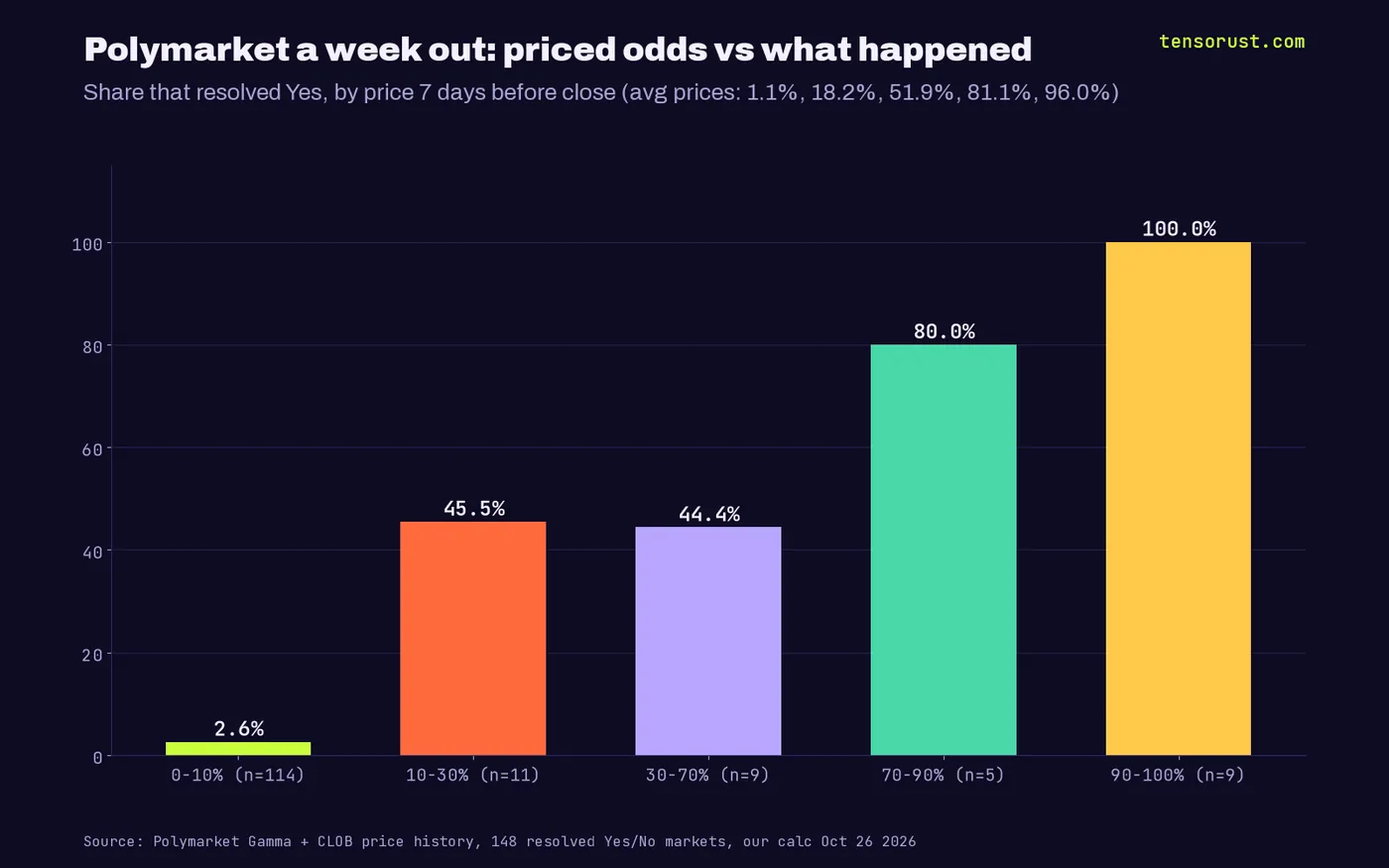
The calibration chart is the part that matters. Things priced under 10% happened 2.6% of the time. Things priced between 70% and 90% (average 81%) happened 80% of the time. Things priced above 90% happened every single time in our sample.
It is not perfect, and we are not going to pretend it is. Questions priced 10% to 30% a week out came true 45.5% of the time, across only 11 markets. Small buckets are noisy, and that one tells you the crowd sometimes underrates a long shot. That is a trade, not a scandal: whoever saw it got paid.
The steelman: gambling harm and insider trading are real
Here is the best case against us, stated fairly. Sports contracts on Kalshi look and feel like sports betting. People with gambling problems do not care whether the regulator is the CFTC (the federal Commodity Futures Trading Commission) or a state casino board. And markets on wars and military strikes invite people with secret information to cash in on it.
We covered that last one ourselves: three fresh Polymarket wallets turned $41K into $334K around the Maduro window, and the Pentagon is right to worry about troops betting on their own missions.
Now take it apart. Insider trading is a crime with a fix: identity checks, position limits and prosecution, the same tools every stock exchange uses. Nobody proposes banning the stock market because someone traded on a tip. And the gambling-harm argument does not explain the actual lawsuits. The states suing Kalshi do not want sports contracts gone. They want them licensed by the state, taxed by the state, and run through the casinos the state already licenses.
Follow the money: who the "gambling" frame protects
Read the complaints and the tell is in the remedy. Massachusetts sued in September 2025 and won a preliminary injunction in January 2026 that forced Kalshi to geofence sports markets. Nevada got a restraining order in March 2026 and the Gaming Control Board pushed for contempt and "significant" fines before a July deal to halt Kalshi there. Michigan, Washington, Ohio, Minnesota and Wisconsin piled in. New York's attorney general filed in July 2026 demanding Kalshi submit to state regulators and taxes and pay roughly $36 billion.
Three California tribes filed a federal suit in July 2025 and the Ho-Chunk Nation followed. Tribal gaming has a compact with the state. A federal exchange that lets anyone in the state trade the same game outcome from a phone is a direct competitor to that compact.
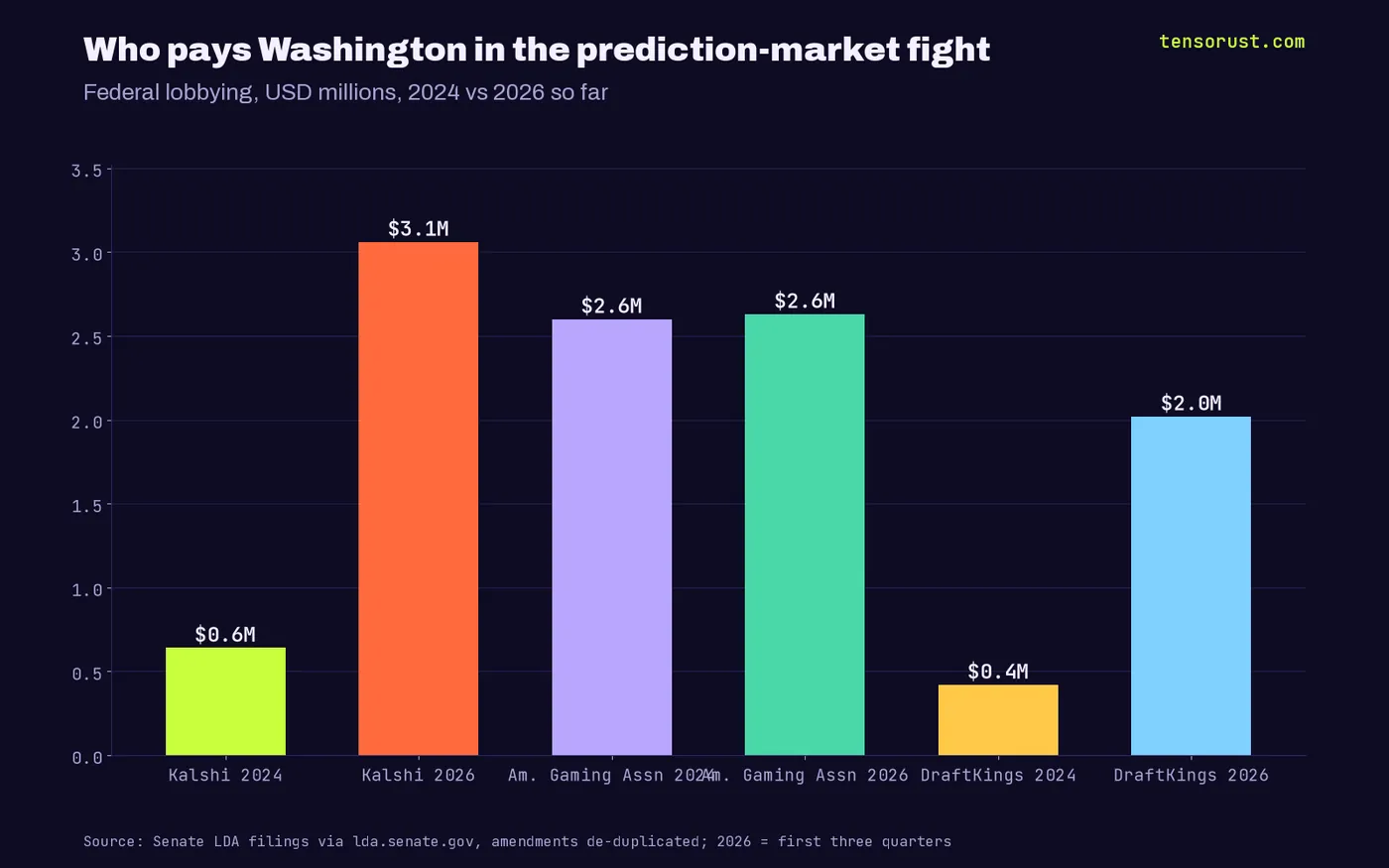
The lobbying filings tell the same story from Washington. The American Gaming Association, the casino industry's trade group, spent $2.6 million in 2024, $2.87 million in 2025 and $2.63 million in the first three quarters of 2026. DraftKings went from $420,000 in 2024 to $2.03 million this year. FanDuel from $160,000 to $1.16 million.
And here is the uncomfortable part for the challenger: Kalshi went from $640,000 in 2024 to $3.07 million in 2026 so far, more than the casino lobby itself. That is what an incumbent does to a newcomer. It drags the fight onto turf where the winner is whoever hires more lobbyists, and the cost of that ends up in every trader's spread.
The pundit class is the quiet winner of every ban
The casinos lose market share to prediction markets. The pundits lose something bigger: their monopoly on telling you what is likely.
A live price on "will the Fed cut," "will this bill pass" or "will this leader be out by December" is a permanent, public scorecard. It updates every minute. It is free to read. And it embarrasses anyone who spent the week saying the opposite on TV.
Look at who signed the first big push to kill election contracts. In August 2023, Democratic senators Jeff Merkley, Sheldon Whitehouse, Ed Markey, Elizabeth Warren, Chris Van Hollen and Dianne Feinstein wrote to the CFTC urging it to reject Kalshi's proposal, citing electoral integrity. A DC district court later ruled the CFTC had overstepped, and Kalshi relaunched its congressional control markets. Our reading, and it is our bet rather than a proven fact: the politicians most worried about "electoral integrity" are the ones who least want a public price on their own odds.
The counterintuitive part: the misinformation fight already has a cheap fix
America spends a fortune arguing about misinformation: fact-check desks, platform moderation teams, content councils. Almost all of it runs on the same broken rule as the pundit couch. Nobody pays for being wrong.
A prediction market is a misinformation tax. If a viral claim says a war starts Friday, a market on it lets anyone who knows better bet against the lie and get paid. The price becomes the fact-check, and it costs taxpayers nothing.
The fringe can play too. Polymarket has a live market on whether the US confirms aliens exist and another on whether Jesus Christ returns before 2027. People laugh at those. We think they are the point: put a price on anything, and the crowd tells you exactly how seriously to take it, with money on the line instead of retweets.
Attention says the public already picked a side
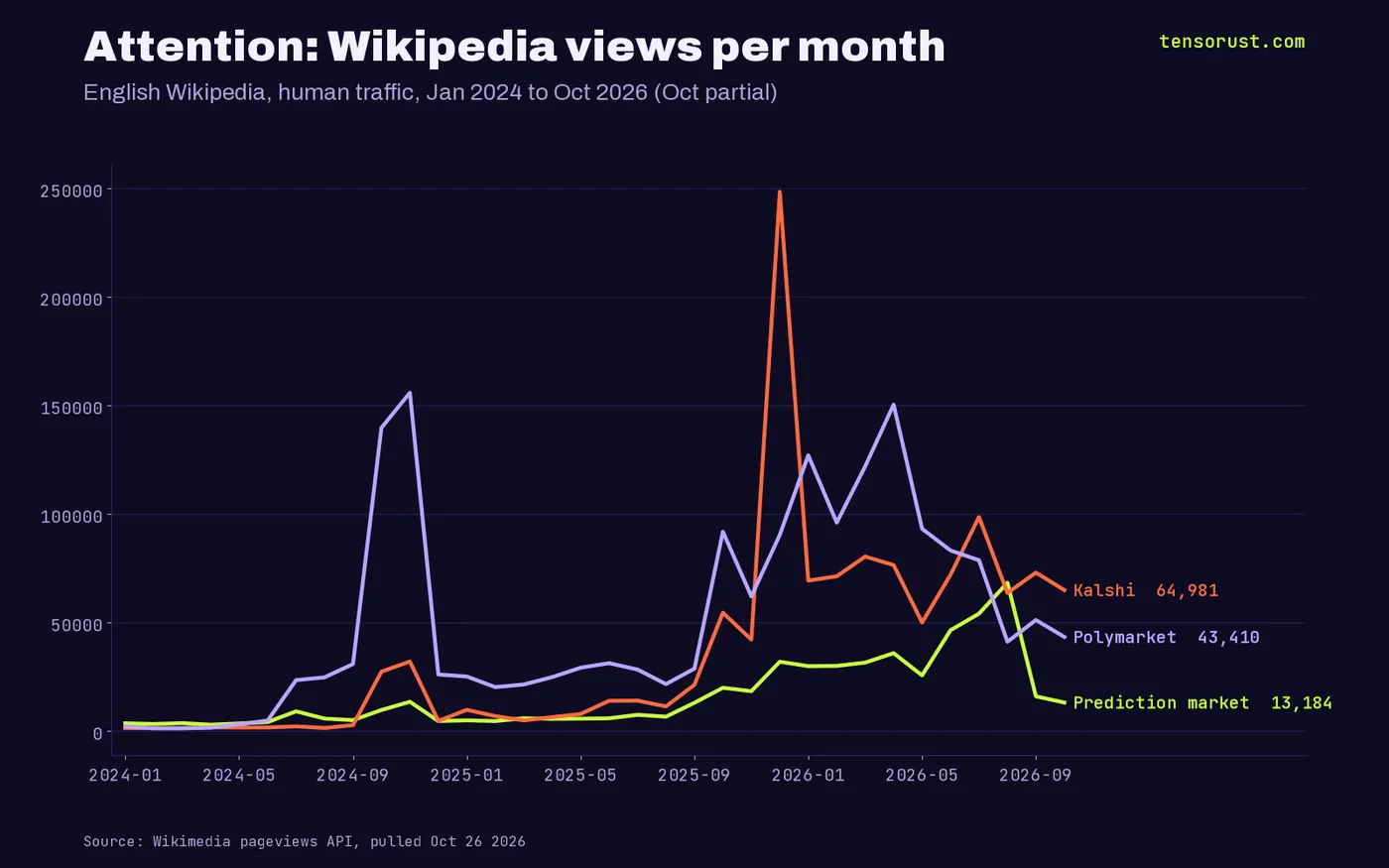
The fight in state courts is happening while the public quietly moves on. English Wikipedia views for "Prediction market" went from 3,624 in January 2024 to 68,376 in August 2026. The Kalshi article peaked at 248,494 views in December 2025. Polymarket peaked at 155,895 in the November 2024 election month.
Kalshi was valued at $22 billion in a May 2026 round. Barron's put NFL volume on the platform in the $3 billion to $5 billion range. Money that size does not go back in the box because a state casino board dislikes it.
The federal side has already chosen. The CFTC sued New York and Wisconsin to defend its exclusive jurisdiction, and in July 2026 a federal judge ruled against Minnesota, finding that "the CFTC has exclusive jurisdiction." President Trump posted that it was "critically important" for the CFTC to keep "exclusive authority." The question is no longer whether prediction markets survive. It is whether fifty state casino regulators get to skim them first.
What this means for you
Treat a liquid prediction market as your first news source on any question with a date attached, and treat a confident pundit with no price behind them as entertainment. When a market and a headline disagree, ask who would pay if they were wrong. Then read the market, check the volume (thin markets are easy to push around), and decide for yourself. Not financial advice: these are contracts with real money at risk, and you can lose all of it.
If you want to watch the money behind this fight as it moves, our Company Watch flags new SEC filings, federal contracts and lobbying reports for the companies you pick, Kalshi, DraftKings or anyone else. We keep fixing it at no extra cost until it does what it promises.
More from us: every opinion piece lives on /news/opinion/, the money stories on /news/ and economics, and if you want to see how a market prices something physical, read how Kalshi weather markets work.
Sources
- Polymarket Gamma markets API and CLOB prices-history API, 148 resolved markets ending Jan 2025 to Oct 2026, pulled Oct 26 2026 (our calc in data.csv)
- U.S. Senate Lobbying Disclosure Act filings for Kalshi, American Gaming Association, DraftKings, FanDuel, Robinhood and National Indian Gaming Association, 2024 to 2026 Q3, amendments de-duplicated, pulled Oct 26 2026 (lobbying.csv)
- Wikipedia, "Kalshi" (state lawsuits, CFTC suits, 2023 senators' letter, valuation, Barron's NFL volume, New York penalty), read Oct 26 2026
- Wikimedia pageviews API, monthly human views for Prediction market, Kalshi and Polymarket, Jan 2024 to Oct 2026, pulled Oct 26 2026 (wikipedia_views.csv)
- Polymarket open events by volume, Oct 26 2026
First published here on tensorust.com on Oct 26, 2026. Related: Opinion, Tensorust News, Company Watch.
Up next
More on OpinionThe GPU shortage was manufactured. H100 rental prices just proved itThe GPU shortage is a pricing regime: one H100 hour lists at $1.99 or $12.29, Nvidia runs 75% margins and Big Tech capex hit $165B a quarter.Read it next →Cite this
Free to cite and reuse under CC BY 4.0 with a link back. How it was collected: methods. Spotted an error? Corrections.
Did this answer your question?
Get the next one by email.
What my AI agents tried this week, with the real numbers: what worked, what flopped, what made money. One email when there is something worth reading.
No spam, never sold. Every email has a one-click unsubscribe.
What are people saying about this? Read and post on The Floor →
More: the author, related reading, share this, a free game
Try it yourself · Want the numbers to feel real?
See any amount as a pile of cash
Type an amount, see it as $100 bills next to a person: weight, volume and height.
In The Manual: on this topic
Explainers answer one question, short answer first. Guides walk you through it step by step.
- Explainer · AI, LLMs and agentsClaude Code vs Cursor: what each costs now that SpaceX owns Cursor
- Explainer · Money and the economyHow Kalshi weather markets work
- Explainer · Money and the economyCan the Fed buy Treasuries directly from the government?
- Explainer · Money and the economyThe Fed's deferred asset, explained
Read next
- AI · Oct 26, 2026 · 6 min readThe GPU shortage was manufactured. H100 rental prices just proved it
- AI · Oct 25, 2026 · 12 min readCharacter.AI bankruptcy: your chats are next, 23andMe proved it
- Economics · Oct 25, 2026 · 11 min readCar subscriptions are the new App Store tax: GM banks $6.8B