By Matt Busel, who built the apps, crates and game he writes about · every number links to its source and every dataset is downloadable (methods) · corrections · featured in Kirino, gamebiz, This Week in Rust, New Mobile Life, By-Press
Medline: 511 FDA device recalls in 2026, one in five nationwide
On this page · 9 sections
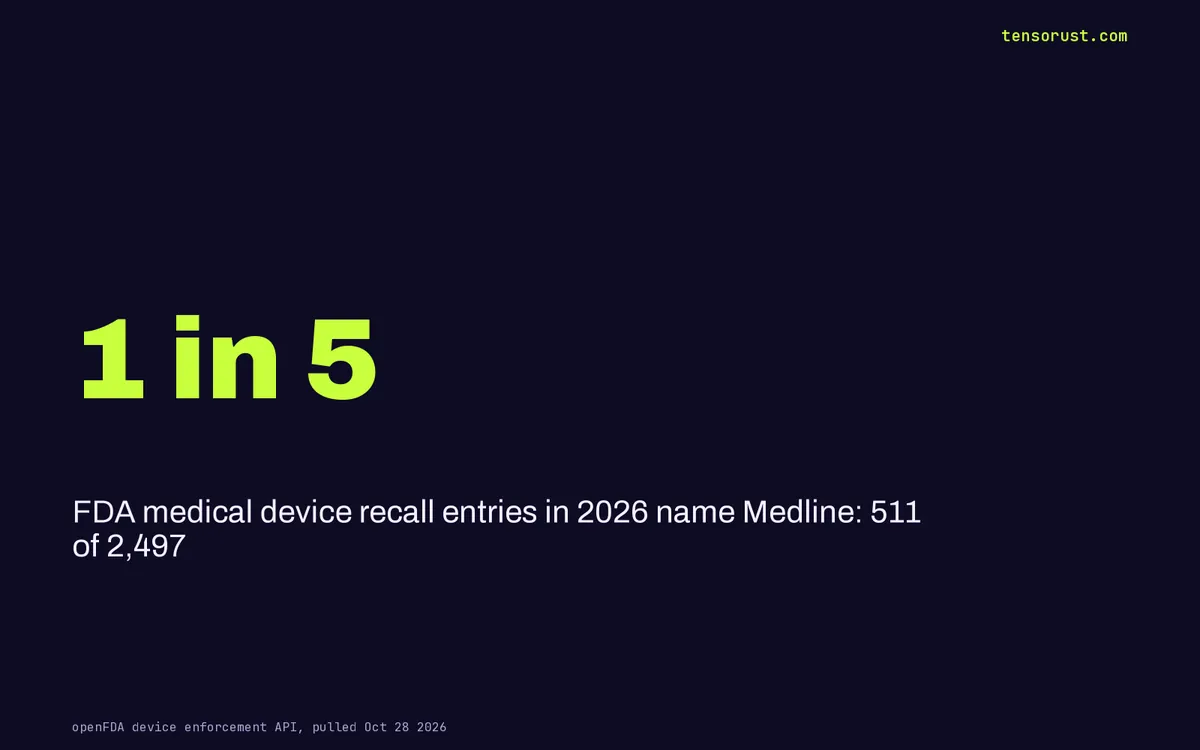
Short answer: Medline, the hospital supply giant that now trades on Nasdaq as MDLN, is named on 511 of the 2,497 medical device recall entries the FDA has posted in 2026 so far. That is 20.5% of every device recall entry in the country, from one company, and more than four times the next firm on the list. In 2019 it was 9.
TL;DR: We pulled every FDA device enforcement record since 2019 and counted Medline: 9 entries in 2019, 210 in 2023, 399 in 2024, and 511 in 2026 with two months left. 69 of this year's entries are Class I, the FDA tier for products that can cause serious injury or death. Medline's latest 10-Q uses the word "recall" exactly once, in a generic risk bullet, while its stock sits about 32% under its February high.
Key numbers
| What | Number | Source, checked Oct 28 2026 |
|---|---|---|
| Medline device recall entries, Jan 1 to Oct 28 2026 | 511 | openFDA device enforcement |
| All FDA device recall entries, same window | 2,497 | openFDA |
| Medline share | 20.5% | Our calculation |
| Next firm (Olympus Corporation of the Americas) | 119 | openFDA |
| Medline Class I entries in 2026 | 69 | openFDA |
| Separate Medline recall events in 2026 | 58 (vs 9 in 2019) | openFDA |
| Times "recall" appears in Medline's Q2 2026 10-Q | 1 | SEC EDGAR |
| MDLN share price, Feb 2026 month close vs Oct 28 | $47.51 vs $32.49 | Yahoo Finance via our price pull |

From 9 recall entries to 511 in seven years
An FDA recall "entry" is one product line in one recall. A single recall event can list dozens of kits, so we counted both.
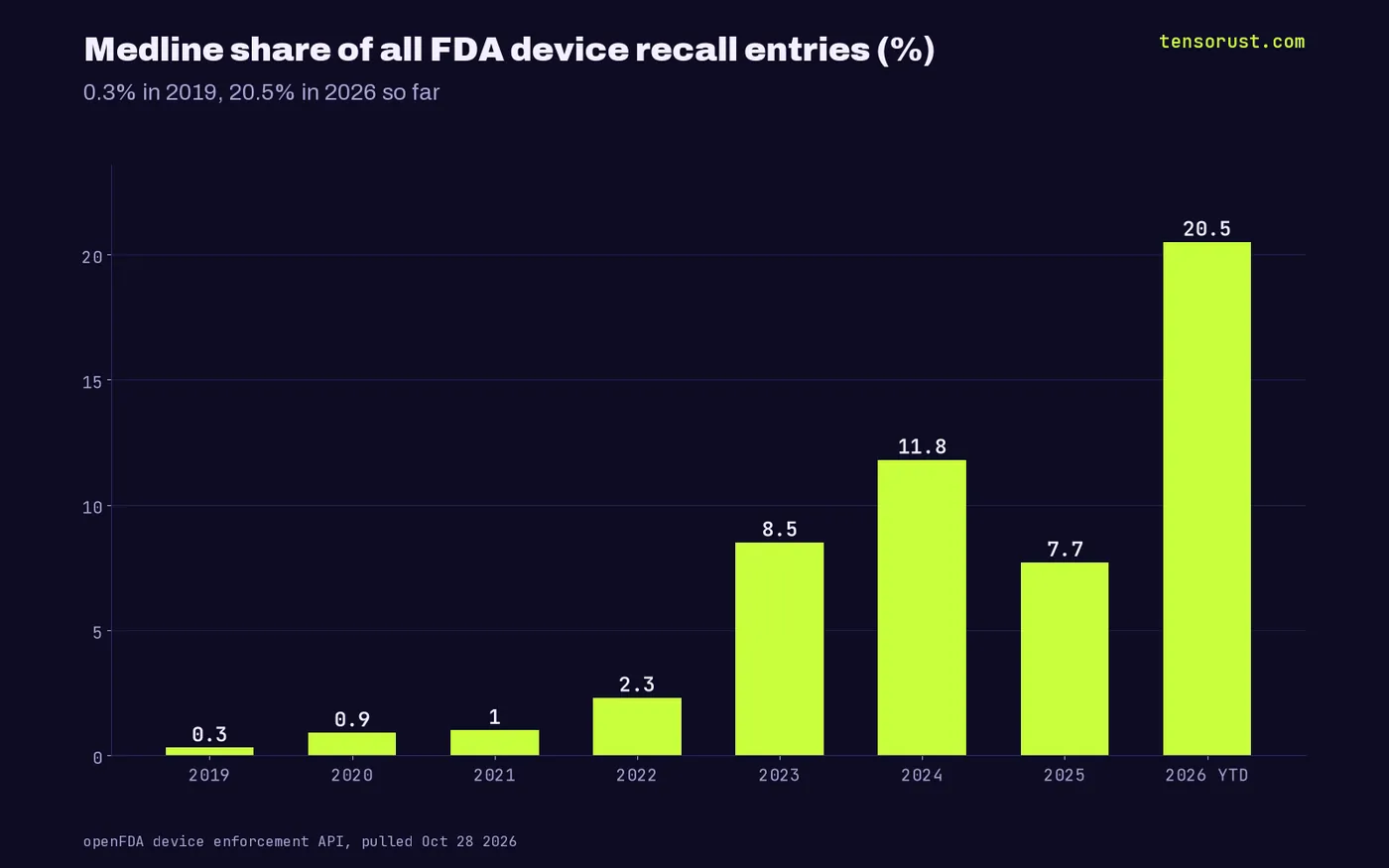
By entries, Medline went 9, 27, 22, 50, 210, 399, 224, and now 511 in 2026 with November and December still to come. By events, it went from 9 in 2019 to 58 this year, its highest since at least 2019.
The rest of the industry did not grow with it. Total device recall entries were 2,801 in 2019 and 2,497 so far this year. Medline's share went from 0.3% to 20.5%.
No other company is close
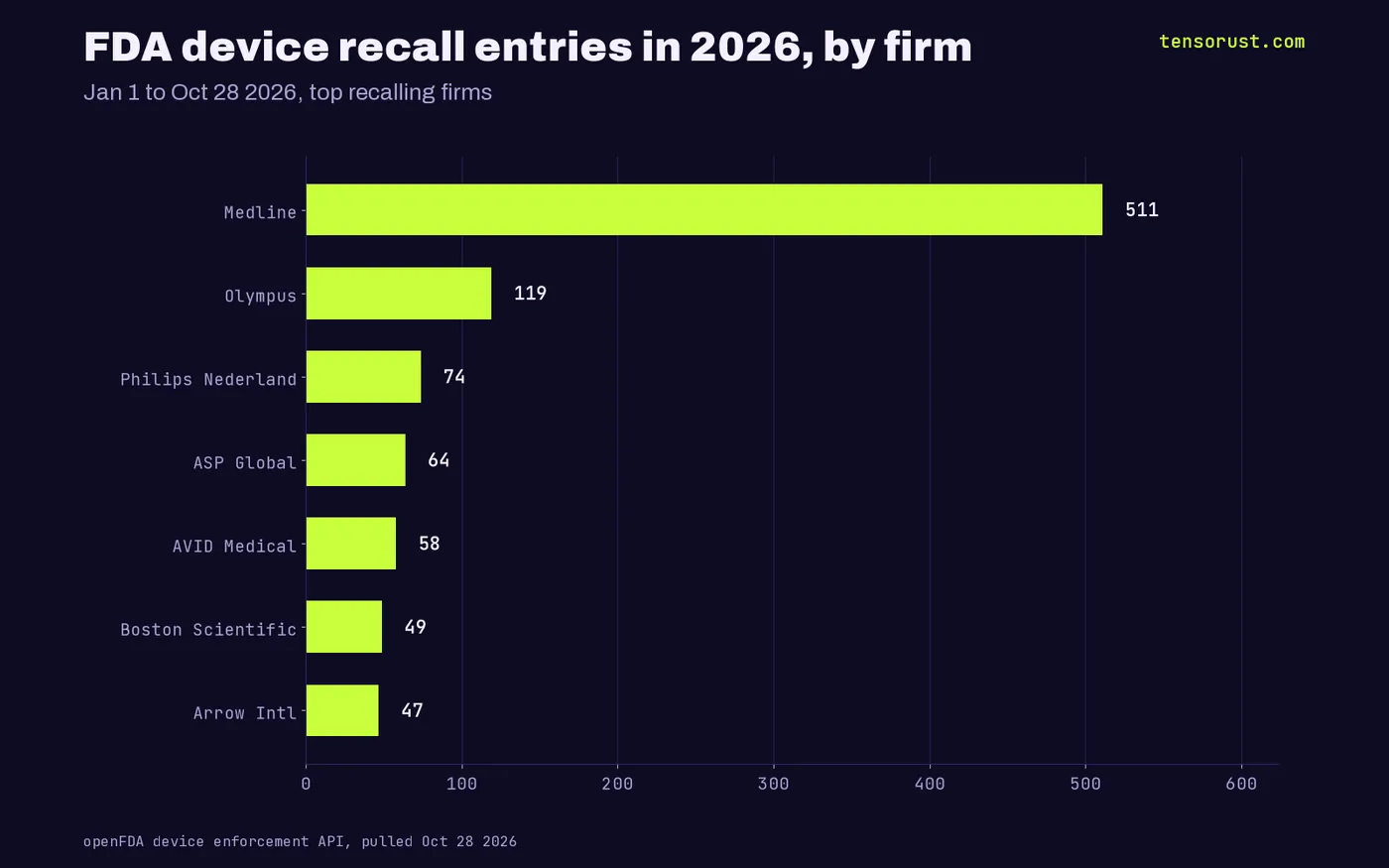
Second place in 2026 is Olympus with 119. Philips' Dutch unit has 74. Boston Scientific has 49. Medline has more device recall entries than the next five firms on the list combined (364).
Why: the kit is the blast radius
Medline's core business is the surgical and procedure kit: a tray that bundles a scalpel, drapes, syringes, an antiseptic applicator and a dozen other parts from many makers. When any one part is recalled, every kit carrying it gets recalled too.
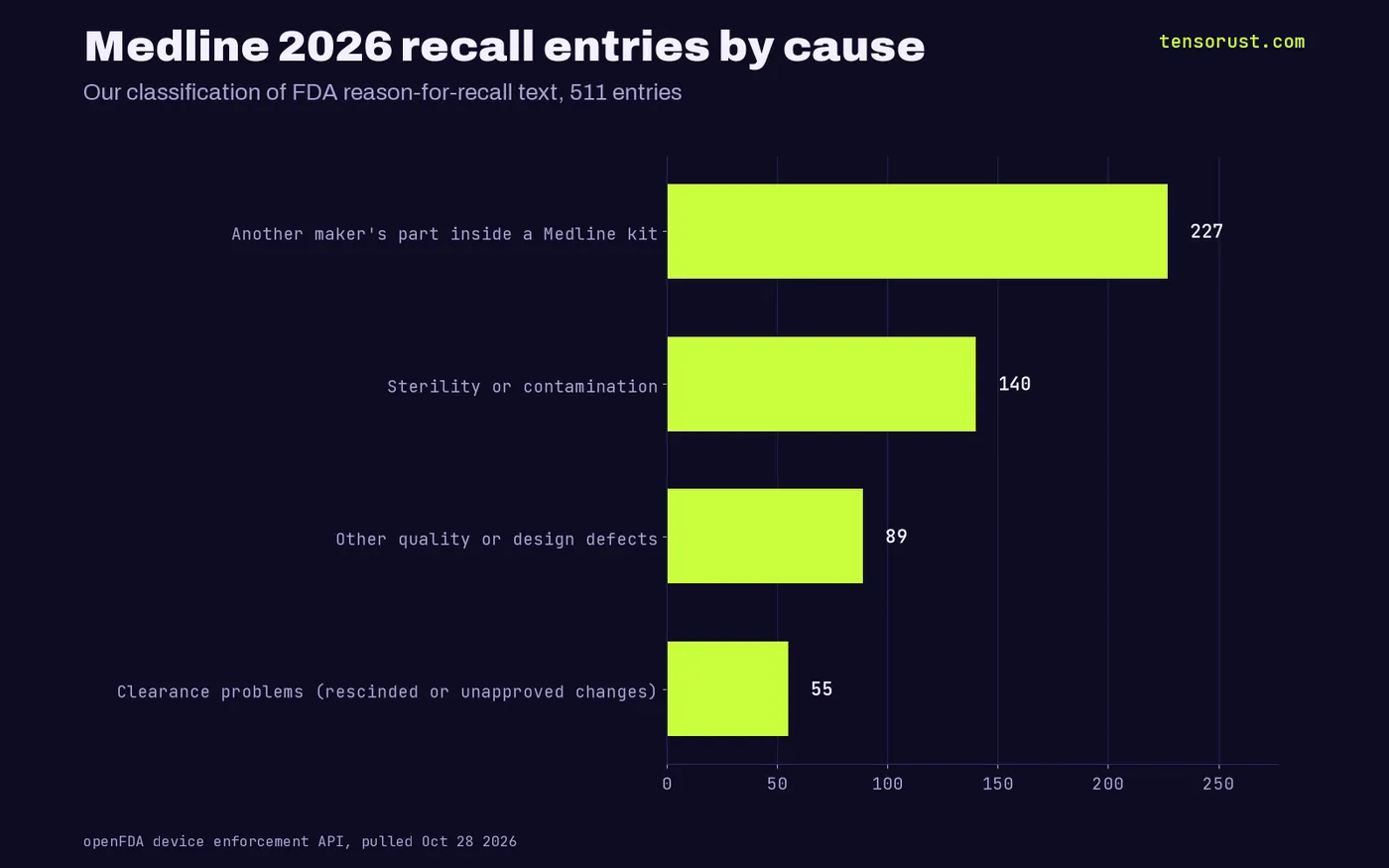
We sorted all 511 entries by the FDA's own reason text. 227 trace to another company's part inside a Medline kit: Ferndale's MASTISOL adhesive, BD ChloraPrep applicators, Huons lidocaine and bupivacaine. That is the multiplier, and Medline's own 10-K admits it: products from "other manufacturers that have been incorporated into our surgical and procedural kits" have "resulted in" recalls.
But the other 284 entries are Medline's own problems. 140 are sterility or contamination: two January events (84 entries) cite "calibration of the equipment used to sterilize and package the devices," and a March event (31 entries) found "higher-than-expected endotoxin levels" on a neuro sponge. 55 more are clearance problems: FDA 510(k) clearances "rescinded" for control syringes, guidewires and tubing, and "unapproved design changes" outside cleared specs.
The 69 that can hurt someone
Class I is the FDA's most serious tier: a reasonable chance the product causes serious harm or death. Medline has 69 Class I entries in 2026, up from 33 in all of 2025 and 2 in 2019.
The biggest Class I group, 19 entries, is a syringe whose rotating adaptor can unwind during use, found through Medline's own post-market surveillance. Next: 11 entries for particulate "within the fluid path" of manifolds, the plumbing that carries contrast and saline into a patient during imaging procedures.
Then 7 entries for kits that shipped with Huons bupivacaine, a spinal anesthetic later recalled by its maker; 7 for sterile applicators that "may contain fungal contamination"; and 7 for reprocessed catheters that may carry "small particles of residual material."
Three of those five groups are Medline's own products or its own reprocessing line, not a supplier's part. The kit excuse covers some of the count. It does not cover most of the dangerous end.
The pace has not slowed
By month of FDA posting, Medline's 2026 entries ran 25 in January, 78 in February, 14 in March, 70 in April, 91 in May, 72 in June, 67 in July, 4 in August, 67 in September and 23 so far in October.
That is no single bad batch. It is a recall wave every month or two, from January through the fall, after the company was already trading publicly and telling investors that quality problems "could" lead to recalls.
One more detail from the raw records: FDA lists a recall number for each entry and an event ID that ties them together. Two January events alone, both blamed on sterilizer calibration, produced 84 entries covering devices across Medline's catalog. A single miscalibrated machine can reach that many product lines because one plant sterilizes for many kits.

What the filings say: almost nothing
Medline's Q2 2026 10-Q, filed Aug 5, contains the word "recall" once, in a boilerplate bullet that quality problems "could" lead to recalls. Its 10-K uses it 17 times, all in generic risk language. Neither gives a count.
Investors have been left to piece it together from law-firm press releases about the stock drop. MDLN closed February at $47.51 and traded at $32.49 on Oct 28. The recall count was sitting in a free federal API the whole time. Nobody added it up.
Our bet: a company that sells convenience as the product (one tray, one invoice) is also selling concentrated risk, and the 2026 numbers are what that risk looks like at scale. Nobody has proven the recalls drove the share price, but the pattern is hard to ignore.
What this means for you
If you buy for a hospital or clinic: pull your Medline kit SKUs against the CSV below today. It has every 2026 entry with recall numbers, product descriptions and our cause tag, so a script or an agent can match it against your inventory in seconds.
If you hold or cover MDLN: track the recall count quarterly yourself, because the filings will not do it for you. Not financial advice.
If you build health tech: a recall-to-inventory matcher for kit buyers does not exist as a cheap product. The data is free. Build it.
Want this watched for you? Company Watch tracks a company's federal filings, contracts and lobbying for $99/mo, and we keep fixing it at no extra cost until it does what it promises. More data pieces: news, economics, and our dresser recall factory join.
Sources
- openFDA, device enforcement reports API, pulled Oct 28 2026
- Medline Inc., Form 10-Q for the quarter ended June 27 2026, SEC EDGAR, Aug 5 2026
- Medline Inc., Form 10-K for 2025, SEC EDGAR, Feb 25 2026
- FDA recall database, sample Medline entry, checked Oct 28 2026
- MDLN monthly closes, Yahoo Finance via tdata, Oct 28 2026
First published here on tensorust.com on Oct 28, 2026. Related: .
Up next
More on EconomicsAssurant phone insurance: carriers get $2.62 for every $1 of claimsAssurant's phone and auto protection unit spent $4.99B on selling and $1.90B on claims in 2025. That is $2.62 to the sales channel for every $1 paid out.Read it next →Cite this
Free to cite and reuse under CC BY 4.0 with a link back. How it was collected: methods. Spotted an error? Corrections.
Did this answer your question?
Get the next one by email.
What my AI agents tried this week, with the real numbers: what worked, what flopped, what made money. One email when there is something worth reading.
No spam, never sold. Every email has a one-click unsubscribe.
What are people saying about this? Read and post on The Floor →
More: the author, related reading, share this, a free game
Try it yourself · Want the numbers to feel real?
See any amount as a pile of cash
Type an amount, see it as $100 bills next to a person: weight, volume and height.
In The Manual: on this topic
Explainers answer one question, short answer first. Guides walk you through it step by step.
- Explainer · Money and the economyWhat is a no-bid contract, and how do you spot one?
- Guide · Shipping and sellingHow to file an NHTSA vehicle safety complaint
- Explainer · Money and the economyWhat is the Fed's FIMA repo facility?
- Explainer · Money and the economyWhy does Belgium own so much US debt?
Read next
- Economics · Oct 28, 2026 · 6 min readAssurant phone insurance: carriers get $2.62 for every $1 of claims
- Economics · Oct 28, 2026 · 6 min readOracle's $20B funding cap leaves out $30.1B of bonds due by FY30
- Politics · Oct 28, 2026 · 5 min readTSA ID scanners: Idemia won 2 bids, then a no-bid $17.7M warranty