
By Matt Busel, who built the apps, crates and game he writes about · every number links to its source and every dataset is downloadable (methods) · corrections · featured in Kirino, gamebiz, This Week in Rust, New Mobile Life, By-Press
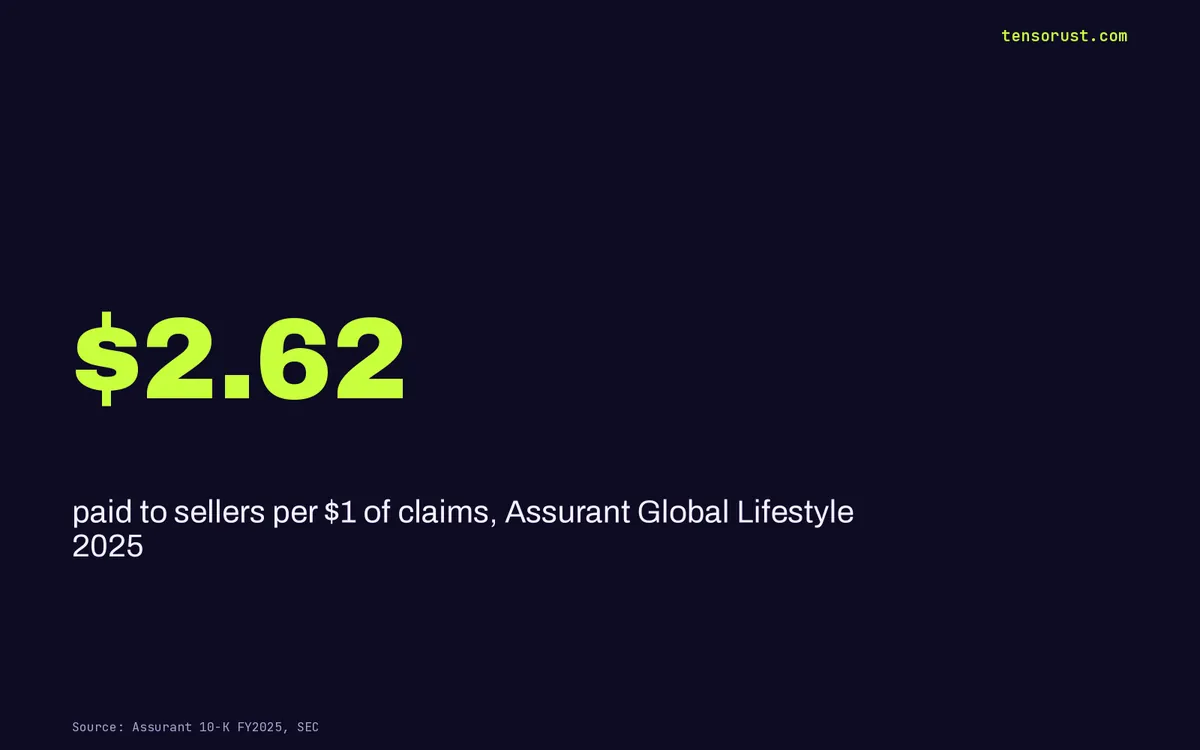
Assurant phone insurance: carriers get $2.62 for every $1 of claims
On this page · 9 sections
- Key numbers
- Device protection is a commission product with an insurance policy attached
- The steelman: claims are rising, so the plan is getting better
- The crossover nobody charted: 2020
- Follow the money: who wins, who loses
- Why the seller's cut keeps growing
- The builder's angle: a market this lopsided is an opening
- What this means for you
- Sources
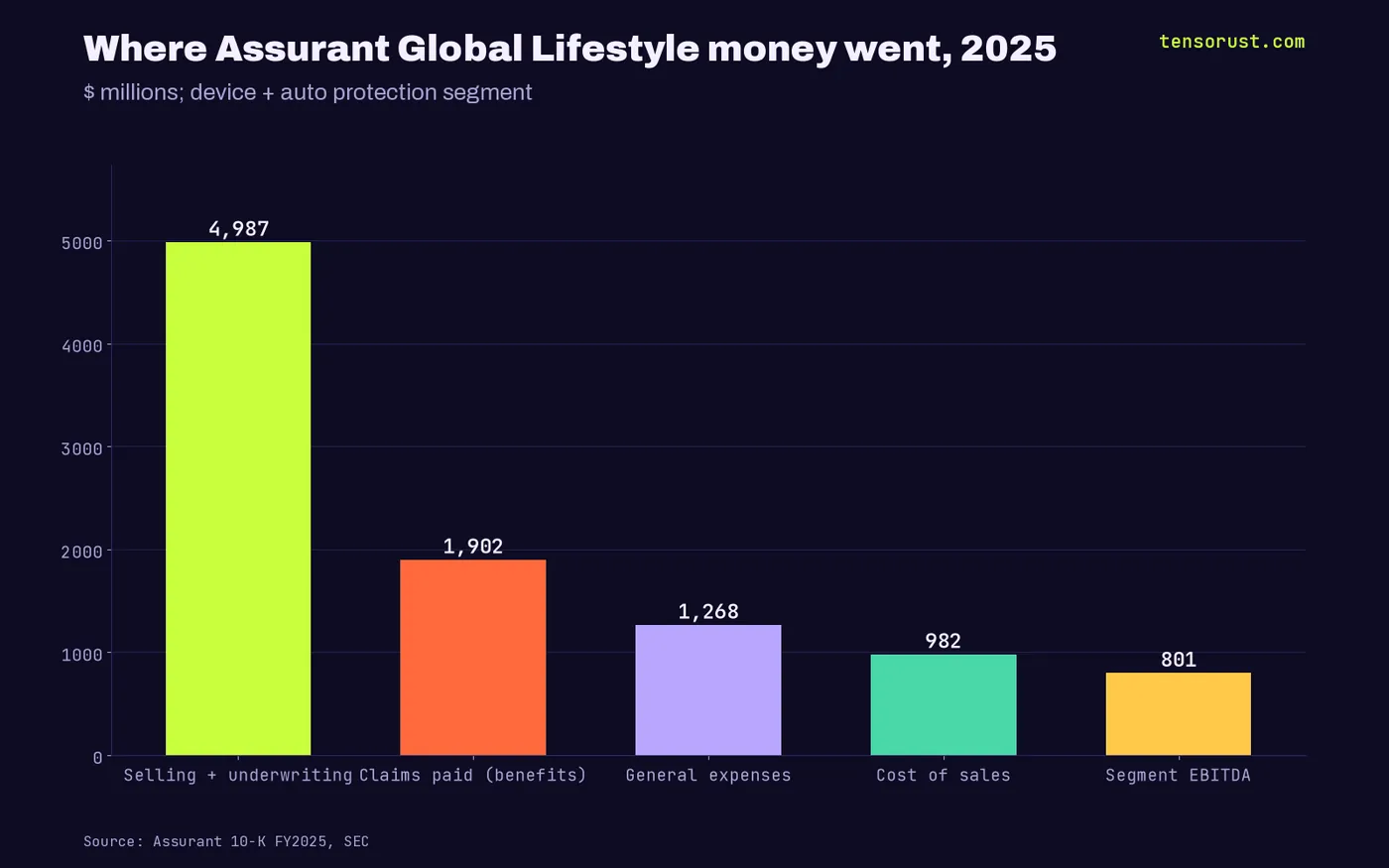
Short answer: The phone protection plan on your carrier bill is mostly a sales commission. In 2025, Assurant's Global Lifestyle segment (the business behind carrier device protection and auto service contracts) spent $4.99 billion on selling and underwriting and $1.90 billion on claims. That is $2.62 to the sales channel for every $1 that went back to customers for broken, lost or stolen gear.
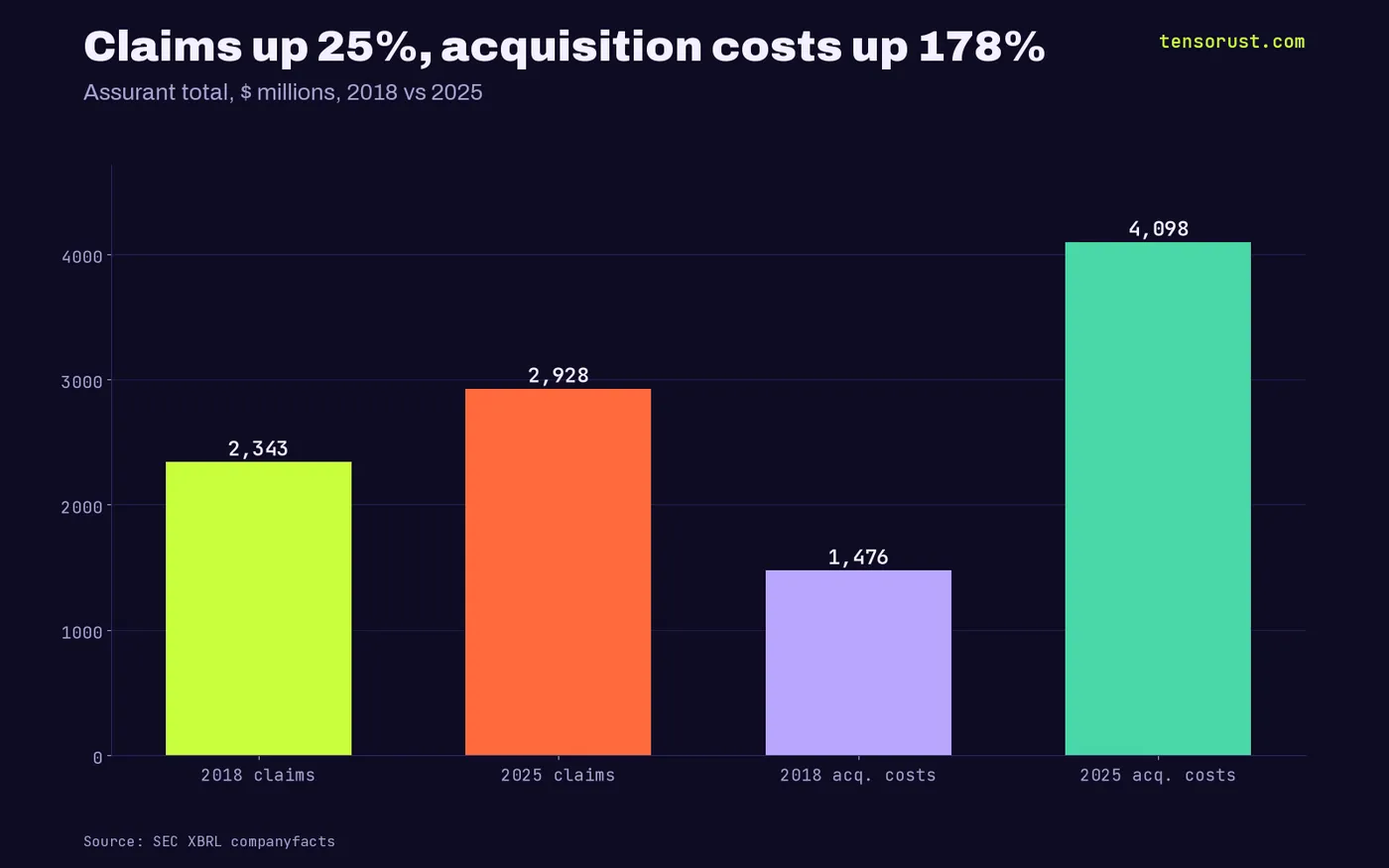
TL;DR: Of $9.94 billion in segment revenue in 2025, claims took 19.1 cents per dollar while selling and underwriting took 50.2 cents. Across all of Assurant, acquisition costs passed claims in 2020 and have stayed above them every year since: $4.10 billion vs $2.93 billion in 2025, after costs grew 178% since 2018 while claims grew 25%. If you pay for device protection, you are mostly funding the seller's cut, so price the plan against self-insuring before your next upgrade.
Key numbers
| What | Number | Source, checked Oct 28 2026 |
|---|---|---|
| Global Lifestyle selling and underwriting, 2025 | $4,986.8M | Assurant 10-K FY2025 |
| Global Lifestyle policyholder benefits (claims), 2025 | $1,901.7M | Assurant 10-K FY2025 |
| Seller cost per $1 of claims, Global Lifestyle 2025 | $2.62 (our calculation) | Same filing |
| Claims per $100 of premium, Global Lifestyle, 2022 to 2025 | $19.51 to $24.09 | 10-K FY2023 and FY2025 |
| Assurant acquisition cost amortization vs claims, 2025 | $4,098M vs $2,928M | SEC XBRL company facts |
| Growth 2018 to 2025: acquisition costs vs claims | +178% vs +25% | SEC XBRL company facts |
| Returned to shareholders, 2025 | $468.3M | Assurant 10-K FY2025 |

Device protection is a commission product with an insurance policy attached
The pitch at the counter is safety: crack your screen, get a new phone. The filing says something else. Claims are only the second-biggest cost line in the segment, and not by a little.
Assurant writes it plainly in the 10-K: selling and underwriting rose in 2025 "primarily due to an increase in commission expenses in Connected Living, mainly related to the growth from global mobile device protection programs." The carrier or retailer that sells you the plan is the client. You are the premium.
We added up the segment's own table. Per $100 of 2025 revenue: $50.20 to selling and underwriting, $19.10 to claims, $12.80 to general expenses, $9.90 to cost of sales (mostly trade-in programs), and $8.10 of adjusted EBITDA for Assurant.
The steelman: claims are rising, so the plan is getting better
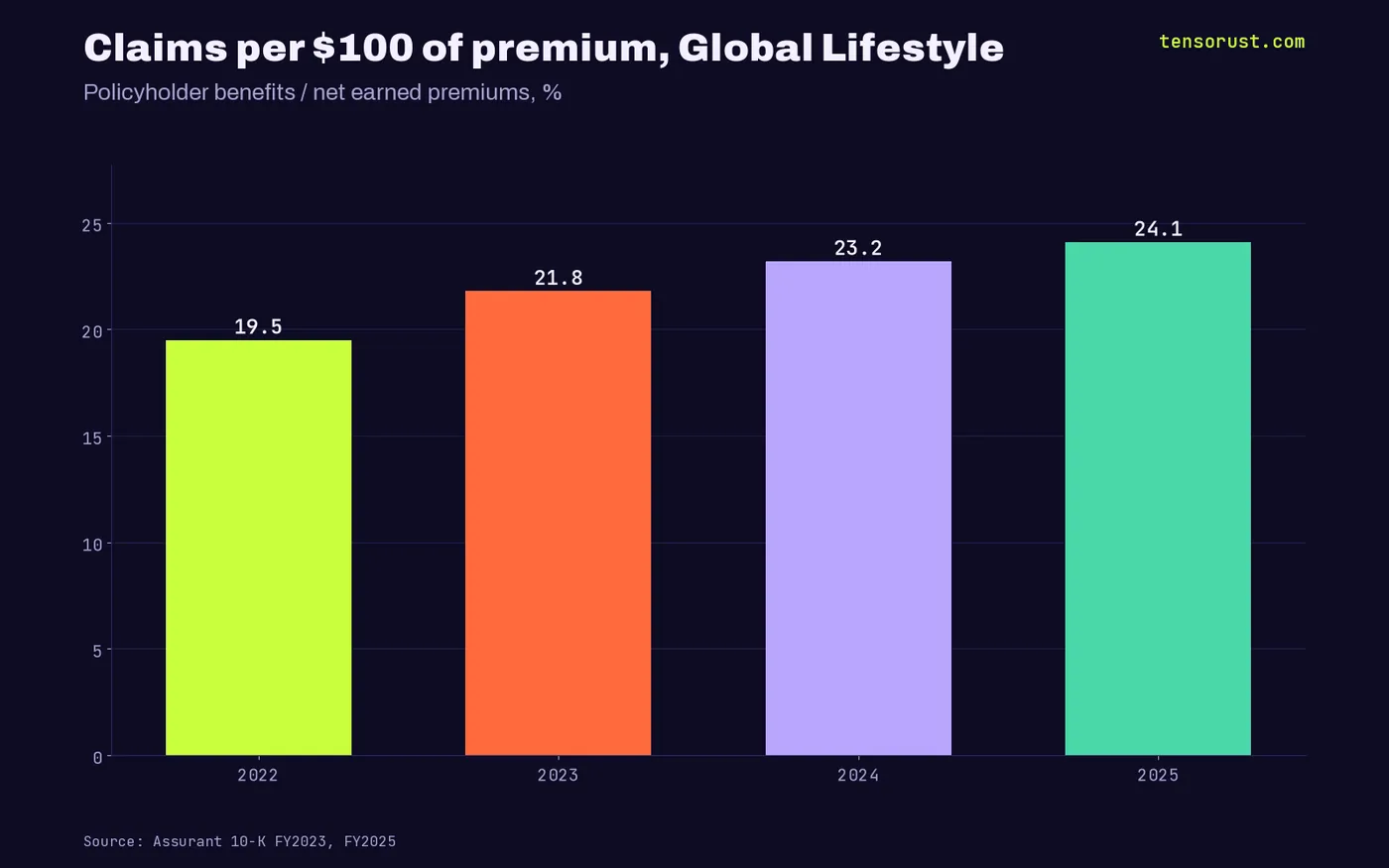
Fair point on its face. Claims per $100 of Global Lifestyle premium went from $19.51 in 2022 to $21.84 in 2023, $23.16 in 2024 and $24.09 in 2025. Phones got pricier, repairs got pricier, and payouts followed.
But follow the dollar, not the ratio. Even at the 2025 high, three of every four premium dollars never come back as a claim. And the 10-K says claims grew "primarily due to financial services in Connected Living", while Global Automotive losses fell. The rising line is not a gift to phone owners.
The crossover nobody charted: 2020
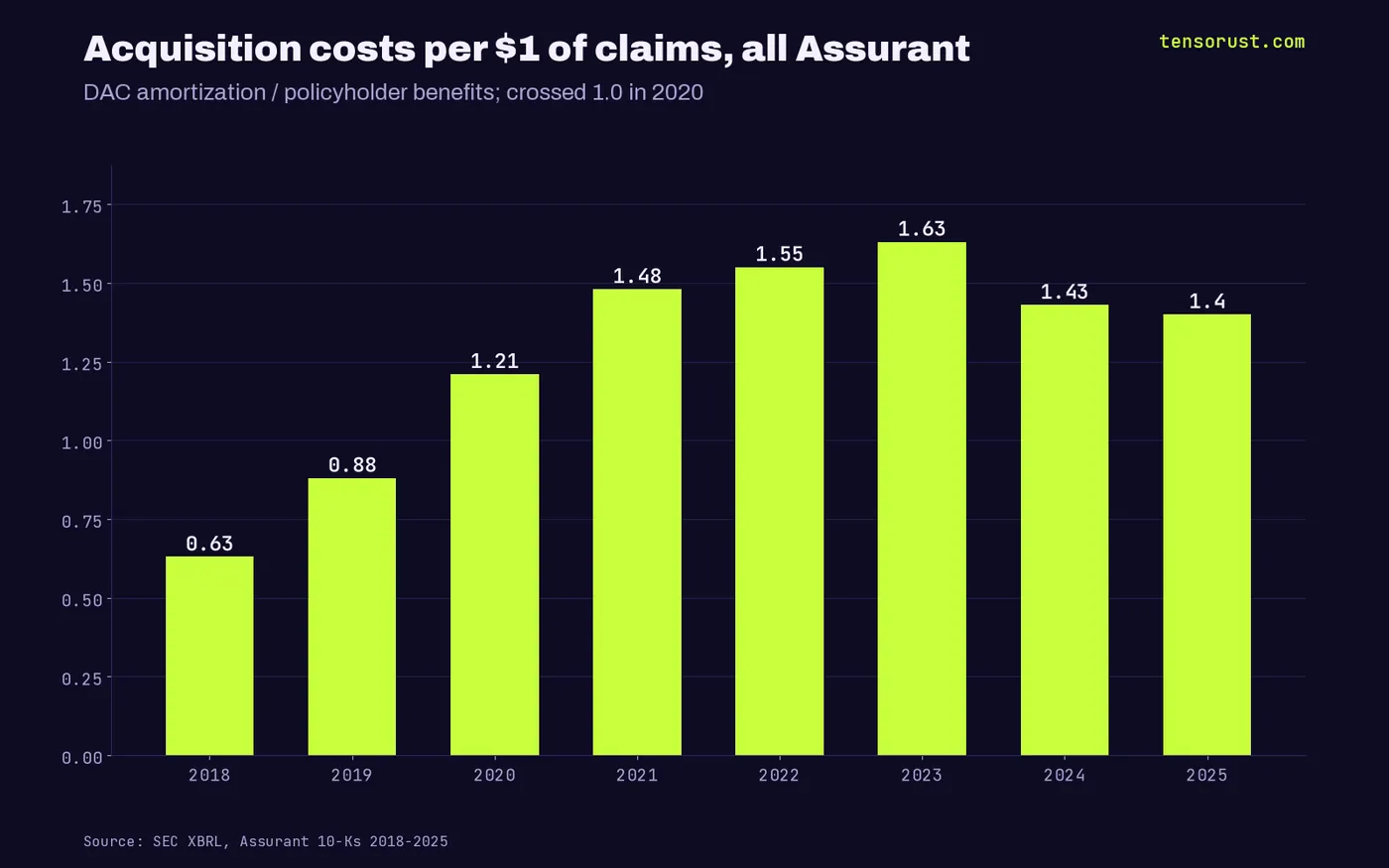
Zoom out to all of Assurant using the XBRL data it files with the SEC. In 2018, amortized acquisition costs (the commissions and fees paid to win contracts, spread over their life) were $1.48 billion against $2.34 billion of claims. By 2020 the lines crossed: $2.76 billion vs $2.28 billion.
They never crossed back. In 2025 it was $4.10 billion in acquisition costs vs $2.93 billion to policyholders, or $1.40 per claim dollar across the whole company, and $2.62 inside the device and auto segment. We searched for this comparison before publishing and found no one who had put the two lines side by side.
Follow the money: who wins, who loses
Winners: the carriers and retailers, who earn a commission on a product they push at checkout, and Assurant shareholders, who got $304 million in buybacks and $168 million in dividends in 2025. The board added a fresh $700 million buyback authorization in November 2025.
Losers: the buyer who never files. Device protection runs on people paying monthly for years without a claim. Assurant even lists the risk that regulators "could require us to reduce our rates" if they "consider our loss ratios to be too low." Our reading: that line is the whole business model, written as a risk factor.
Who blocks a cheaper deal? On this record, nobody has to. The plan is sold where the phone is sold, bundled into a bill, and priced against a panic moment. The fix is not a law. It is a buyer with the number.
Why the seller's cut keeps growing
A protection plan has no shelf. It lives on the receipt, the bill and the checkout screen, and whoever owns that screen sets the price of access. That is why the money moved from claims to distribution as the business grew.
The numbers show the shift year by year. Assurant's total premiums rose from $6.16 billion in 2018 to $10.48 billion in 2025, a 70% gain. Claims rose from $2.34 billion to $2.93 billion. Acquisition costs nearly tripled, from $1.48 billion to $4.10 billion. Growth was bought, and the bill went to the channel, not the customer.
Global Lifestyle also sells auto service contracts through dealers, the same model with a car in place of a phone: $4.20 billion of 2025 segment revenue came from Global Automotive and $5.38 billion from Connected Living. The filing does not split costs between the two, so our $2.62 is a segment number, not a phone-only number. We say that up front because the phone side is where the 10-K points when it explains the commission growth.

The builder's angle: a market this lopsided is an opening
When half of every dollar pays for distribution and a fifth pays for the actual product, the product is underpriced and the shelf is overpriced. That gap is exactly where new players win: repair networks that sell direct, phone makers bundling their own cover, and apps that price risk per device instead of per bill.
Our bet: device protection gets unbundled the way travel insurance did, sold at the moment of need with prices you can compare. The data to price it is already public. What is missing is a buyer who reads the 10-K before signing up for a monthly fee. Now you have.
What this means for you
Do the math once: take your monthly protection fee times 24, add the deductible, and compare it with the repair or replacement price for your phone. If you have not broken a phone in two years, a savings account labelled "phone" beats the plan for most people. Keep the plan only if you lose or break devices often, and drop it the day the phone is paid off. More on the opinion desk, in our Frontdoor home warranty piece, and on the economics hub. The raw numbers are in the CSV below. Not financial advice.
If you track companies like this for work, Company Watch ($99/mo) watches filings, contracts and lobbying for the names you pick and flags shifts like this one; we keep fixing it at no extra cost until it does what it promises.
Sources
- Assurant, Form 10-K for fiscal 2025, filed Feb 19 2026
- Assurant, Form 10-K for fiscal 2023, filed Feb 15 2024
- SEC XBRL company facts, Assurant (CIK 1267238), pulled Oct 28 2026
First published here on tensorust.com on Oct 28, 2026. Related: Opinion, Economics.
Up next
More on OpinionFrontdoor cut warranty payouts to 44 cents. Buybacks got the gapFrontdoor (American Home Shield) spent 44.4 cents on repairs per $1 of revenue, down from 57.3 in 2022, while buybacks rose from $59M to $300M a year.Read it next →Cite this
Free to cite and reuse under CC BY 4.0 with a link back. How it was collected: methods. Spotted an error? Corrections.
Did this answer your question?
Get the next one by email.
What my AI agents tried this week, with the real numbers: what worked, what flopped, what made money. One email when there is something worth reading.
No spam, never sold. Every email has a one-click unsubscribe.
What are people saying about this? Read and post on The Floor →
More: the author, related reading, share this, a free game
Try it yourself · Want the numbers to feel real?
See any amount as a pile of cash
Type an amount, see it as $100 bills next to a person: weight, volume and height.
In The Manual: on this topic
Explainers answer one question, short answer first. Guides walk you through it step by step.
- Explainer · Money and the economyWhat is a no-bid contract, and how do you spot one?
- Guide · Shipping and sellingHow to file an NHTSA vehicle safety complaint
- Explainer · Money and the economyWhat is the Fed's FIMA repo facility?
- Explainer · Money and the economyWhy does Belgium own so much US debt?
Read next
- Politics · Oct 28, 2026 · 5 min readTSA ID scanners: Idemia won 2 bids, then a no-bid $17.7M warranty
- Economics · Oct 28, 2026 · 6 min readFrontdoor cut warranty payouts to 44 cents. Buybacks got the gap
- Economics · Oct 28, 2026 · 5 min readTitle insurers paid shareholders $4.7B, 1.6x their title claims

.jpg)