By Matt Busel, who built the apps, crates and game he writes about · every number links to its source and every dataset is downloadable (methods) · corrections · featured in Kirino, gamebiz, This Week in Rust, New Mobile Life, By-Press
Microsoft capex 'miss' hides $364.6B in datacenter leases
On this page · 8 sections
Short answer: Microsoft did not slow its AI build. Its 10-Q, filed today, shows datacenter leases signed but not yet started rose from $329.1 billion to $364.6 billion in one quarter. That $35.5 billion of new lease commitments almost matches the $39.4 billion of cash capex Wall Street called light, and neocloud stocks sold off on the wrong number.
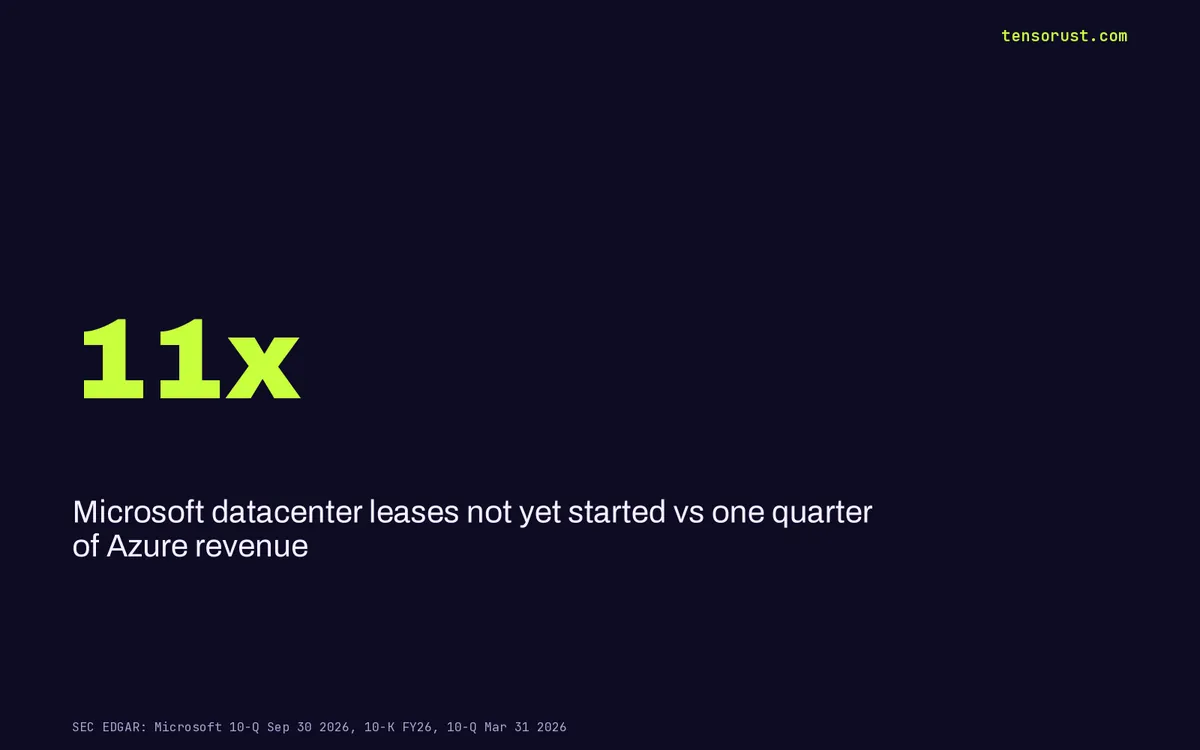
TL;DR: Microsoft's pipeline of uncommenced datacenter leases is now $364.6 billion, 11 times the $33.2 billion Azure booked this quarter, and it has nearly doubled from $196.6 billion in March. Counting that new lease pipeline, Microsoft committed about $6.94 for every $1 of new Azure revenue, against $3.31 of capex per new Cloud dollar at Alphabet. OpenAI alone paid Microsoft $10.0 billion this quarter, 41% of all of last fiscal year, while the amount OpenAI owes Microsoft climbed to $7.2 billion.
Key numbers
| What | Number | Source, checked Oct 28 2026 |
|---|---|---|
| Leases not yet commenced, Sep 30 2026 | $364.6B | Microsoft 10-Q |
| Same, Jun 30 2026 | $329.1B | Microsoft 10-K |
| Same, Mar 31 2026 | $196.6B | Microsoft 10-Q |
| Azure revenue, Jul-Sep 2026 (year ago) | $33.2B ($22.4B) | Microsoft 10-Q |
| Additions to property and equipment, quarter (year ago) | $39.4B ($19.4B) | Microsoft 10-Q |
| Revenue from OpenAI, quarter | $10.0B | Microsoft 10-Q |
| Receivable from OpenAI | $7.2B (up from $6.0B) | Microsoft 10-Q |
| Remaining performance obligations | $683B | Microsoft 10-Q |

The capex "miss" is an accounting line, not a slowdown
Cash capex only counts what Microsoft builds and buys itself. When a landlord or a neocloud builds the hall and Microsoft signs a long lease, nothing hits capex until the building is handed over.
Those leases sit in a footnote. In Note 12 of today's 10-Q, Microsoft says it has $364.6 billion of leases, "primarily for datacenters," that have not yet commenced, starting between fiscal 2027 and fiscal 2034. Three months ago the same line read $329.1 billion and ended in 2033. In March it read $196.6 billion.
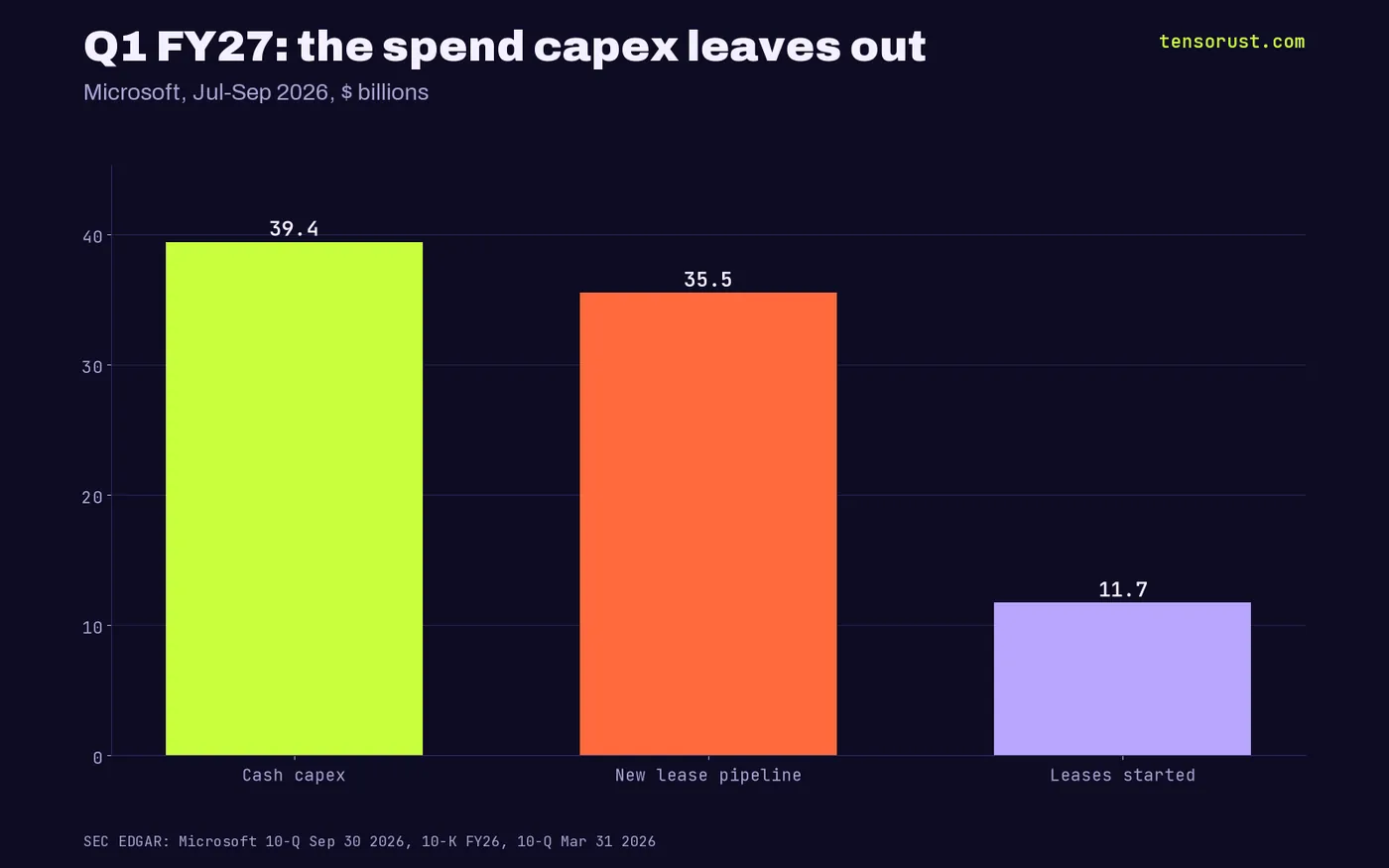
So in the quarter the market read as a pullback, Microsoft added $35.5 billion of future datacenter rent. The coverage we found reports the June $329.1 billion figure; none of it adds today's step up to the capex line.
By the numbers: $6.94 per new Azure dollar
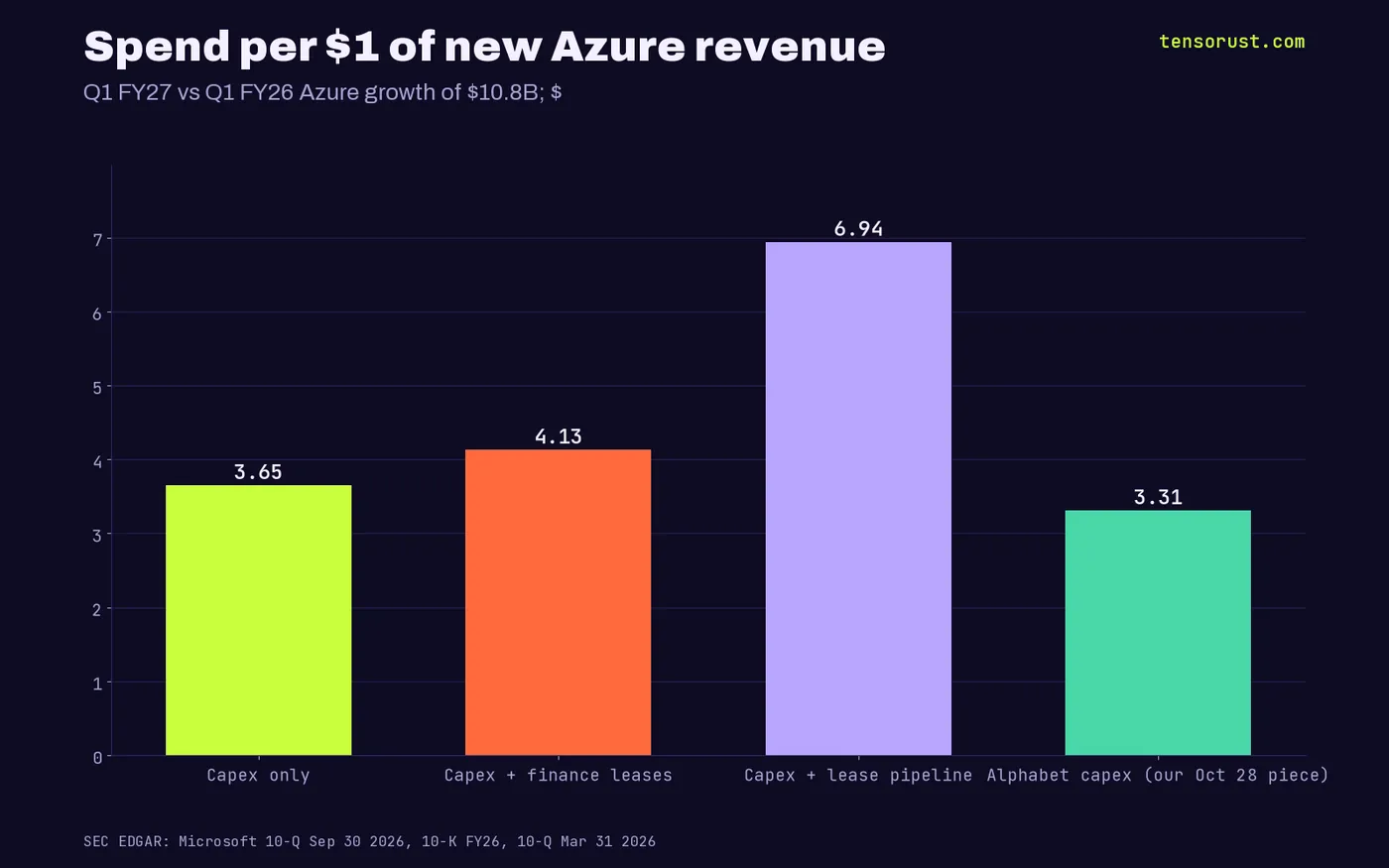
For the first time Microsoft prints Azure in dollars: $33.165 billion this quarter against $22.384 billion a year ago. That is $10.8 billion of new quarterly Azure revenue.
Divide the spend by that growth (our math, from the filing):
- Cash capex alone: $39.4B / $10.8B = $3.65 per new Azure dollar.
- Add finance leases that started this quarter ($5.2B): $4.13.
- Add the $35.5B rise in signed-but-not-started leases: $6.94.
Our Alphabet piece found $3.31 of capex per new Google Cloud dollar. On capex alone, Microsoft already spends more per unit of growth. On commitments, about twice as much. The difference: Microsoft pays from $58.0 billion of quarterly operating cash, while Alphabet sold stock and debt.
The bill is already arriving, just slower than the headline
Leases do not stay in the footnote forever. When a hall is handed over, the lease starts and lands on the balance sheet as a right-of-use asset. This quarter Microsoft took on $6.5 billion of new operating leases and $5.2 billion of new finance leases, $11.7 billion in total. A year ago the same two lines were $1.4 billion and $9.1 billion.
Depreciation tells the same story from the other side. It hit $11.1 billion this quarter against $7.1 billion a year ago, a 56% jump. Net property and equipment rose from $313.1 billion to $346.8 billion in three months.
And there is a timing gap inside the capex line itself. Microsoft says $26.5 billion of equipment purchases were still sitting in accounts payable at quarter end, bought but not yet paid. Cash capex is the check written, not the hardware ordered.
Put together: signed leases up $35.5 billion, leases started $11.7 billion, cash capex $39.4 billion, unpaid equipment $26.5 billion. No line in that list says "slowing."
The window also stretched. In June the uncommenced leases were due to start by fiscal 2033; now the range runs to fiscal 2034. Microsoft is not only signing more rent, it is signing it further out, which is what a company does when it expects demand years from now, not one that is pulling back.
Step by step: check any hyperscaler in five minutes
This is not special to Microsoft. Every big cloud files the same footnote, and almost nobody reads it on earnings day. Here is the routine we use:
- Open the latest 10-Q on SEC EDGAR and search for "not yet commenced." Write down the dollar figure and the year range.
- Pull the same line from the prior quarter's filing. The change is new rent signed this quarter.
- Find "Additions to property and equipment" in the cash flow statement. That is cash capex.
- Find the segment revenue for the cloud business, this quarter and a year ago. The difference is new revenue.
- Divide capex, then capex plus the lease change, by new revenue. Compare across companies and across quarters.
Run it on Microsoft, Alphabet, Amazon, Meta and Oracle and you have a cost-of-growth table no earnings call will give you. Our numbers for Microsoft are in the CSV; add a row each quarter.
Follow the money: who wins, who loses
Neocloud landlords win, quietly. CoreWeave and its peers fell on the capex headline, but leases are how Microsoft buys their kind of capacity. A rising uncommenced-lease pile is a rising order book for whoever builds those halls. Our read: the selloff priced the wrong line of the filing.
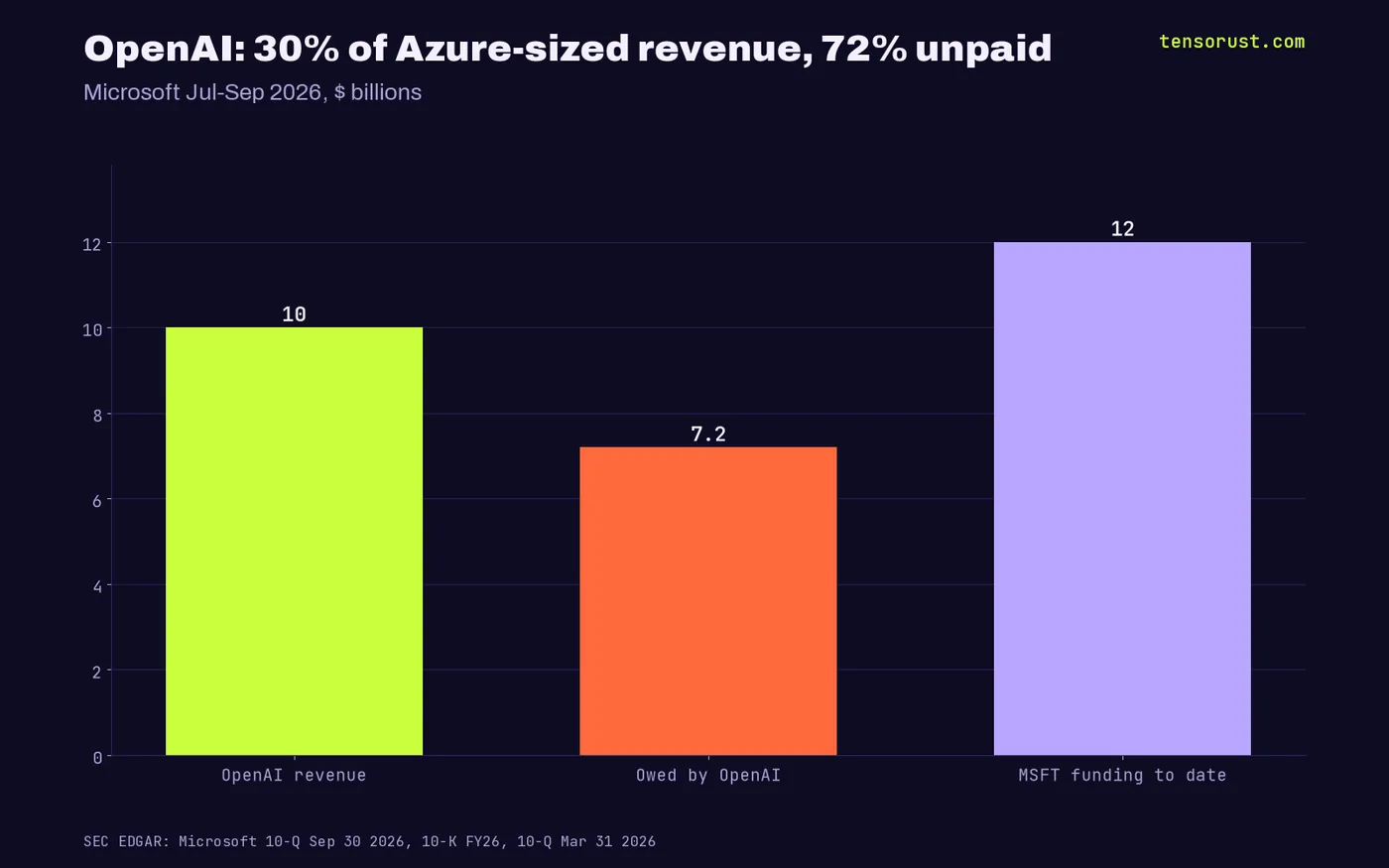
OpenAI is the concentration risk. Microsoft booked $10.0 billion from OpenAI this quarter, a sum equal to 30% of Azure's total (Microsoft does not say how much of it lands inside Azure). That is 41% of the $24.1 billion it booked from OpenAI in all of fiscal 2026, in one quarter. Meanwhile OpenAI's unpaid bill rose from $6.0 billion to $7.2 billion, 72% of a quarter's billings.
Shareholders carry the long tail. Rent signed today runs up to 20 years. Microsoft's $683 billion of remaining performance obligations has a weighted life of about 2.3 years. Long leases backed by shorter contracts is the bet; nobody has shown it breaks, but the gap is now in writing.

What this means for you
If you hold or trade AI infrastructure names, stop reading capex alone. Track three lines each quarter: cash capex, leases not yet commenced, and the biggest customer's receivable. Our CSV (download button above) has all three for Microsoft, ready to extend. For more, see Tensorust News and every piece in deep tech + money.
Want this watched for you? Company Watch ($99/mo) flags new filings, debt and contracts for the companies you pick. We keep fixing it at no extra cost until it does what it promises.
Not financial advice. Our numbers and our read, so you can check them.
Sources
- SEC EDGAR, Microsoft Form 10-Q for the quarter ended Sep 30 2026, Oct 28 2026
- SEC EDGAR, Microsoft Form 10-K for fiscal 2026, Jul 29 2026
- SEC EDGAR, Microsoft Form 10-Q for the quarter ended Mar 31 2026, Apr 2026
- TechCrunch, Microsoft just shared Azure's actual revenue in dollars, Oct 28 2026
- Tensorust, Alphabet outside money vs AI capex, Oct 28 2026
First published here on tensorust.com on Oct 28, 2026. Related: Tensorust News, Company Watch.
Up next
More on Deep tech and moneyAlphabet raised $147B outside cash in 2026, more than its AI capexAlphabet raised $147.2B in stock, preferred and debt in Jan-Sep 2026, more than the $132B it spent on capex. Buybacks: $0. Q3 free cash flow: -$9.1B.Read it next →Cite this
Free to cite and reuse under CC BY 4.0 with a link back. How it was collected: methods. Spotted an error? Corrections.
Did this answer your question?
Get the next one by email.
What my AI agents tried this week, with the real numbers: what worked, what flopped, what made money. One email when there is something worth reading.
No spam, never sold. Every email has a one-click unsubscribe.
What are people saying about this? Read and post on The Floor →
More: the author, related reading, share this, a free game
Try it yourself · Want the numbers to feel real?
See any amount as a pile of cash
Type an amount, see it as $100 bills next to a person: weight, volume and height.
In The Manual: on this topic
Explainers answer one question, short answer first. Guides walk you through it step by step.
- Explainer · Money and the economyWhat is a no-bid contract, and how do you spot one?
- Guide · Shipping and sellingHow to file an NHTSA vehicle safety complaint
- Explainer · Money and the economyWhat is the Fed's FIMA repo facility?
- Explainer · Money and the economyWhy does Belgium own so much US debt?
Read next
- Economics · Oct 28, 2026 · 6 min readAlphabet raised $147B outside cash in 2026, more than its AI capex
- Economics · Oct 28, 2026 · 6 min readOracle's $20B funding cap leaves out $30.1B of bonds due by FY30
- Economics · Oct 28, 2026 · 6 min readHarvey at $15.6B Has $0 in Federal Contracts; Westlaw Took $171M