
OpenAI math papers: 748 AI proofs, 0 human names, comments locked
On this page · 10 sections
- Key numbers
- OpenAI published like a lab and signed like a press release
- 369 papers in 48 hours, and nobody to email
- The comment box is welded shut
- Follow the money: who wins, who loses
- They do cite people. They just cite each other more than you think
- "Formalized" is doing a lot of work
- The flood is bigger than OpenAI
- What this means for you
- Sources
Short answer: OpenAI's math repo holds 748 manuscript folders written by an unreleased model, and every one we could read is signed "OpenAI" with no human name and no contact address. Issues are switched off and both pull requests ever opened are locked. The proofs may well be a genuine leap. The checking is being done for free by mathematicians on a fan-run fork with 27 stars.
TL;DR: We parsed all 748 folders in github.com/openai/math: 745 list "OpenAI" as the only author, 369 are dated September 23 or 24, and they hold 19,045 bibliography entries, a median of 22 per paper. OpenAI withdrew 3 papers and repaired 14 more one day after launch, and its own Lean catalogue lists 173 papers, not the 300 results its changelog claims. Meanwhile arXiv's math listing hit 10,285 entries in September, double September 2025, and the people who have to read all of it are not on anyone's payroll.
Key numbers
| What | Number | Source, checked Oct 25 2026 |
|---|---|---|
| Manuscript folders in openai/math | 748 (OpenAI says 719 manuscripts, 372 families) | openai/math, our parse |
| Folders signed "OpenAI" only | 745 of 748 (the other 3 are withdrawn) | README citation blocks, our parse |
| Dated Sep 23 or Sep 24 2026 | 369 | folder dates, our parse |
| Bibliography entries, all papers | 19,045 (median 22 per paper) | .bib and bibitem entries, our parse |
| Papers citing another OpenAI paper | 413 of 748 (55%) | our parse |
| GitHub issues / discussions | Off / off | GitHub API |
| Pull requests, ever | 2, both by OpenAI staff, both locked | lock-prs.yml |
| Withdrawn / repaired on day 1 | 3 / 14 | history.md |
| Papers in the Lean catalogue | 173 (changelog claims 300 of 719 results) | lean/formalization.yaml |
| arXiv math listing, Sep 2026 vs Sep 2025 | 10,285 vs 5,144 | arXiv |
| Stars: openai/math vs the community fix-up hub | 15,491 vs 27 | oai-math-revised |

OpenAI published like a lab and signed like a press release
On October 6 OpenAI dropped "Sharing AI progress in mathematics" and a GitHub repo of manuscripts produced by an internal model. The README says the model was posed about 4,000 problems and that each result used, on average, three hours of ChatGPT Pro thinking compute.
The claims are not small. The overview claims Yau's uniformization conjecture, the Artin K(pi,1) conjecture and positivity of Serre's intersection multiplicity, and one manuscript title is Hilbert's tenth problem over the rational numbers. Terence Tao has already written up a sketch of a simplified version of the nine-page Siegel zero paper from the release, built on digestions by Banks, Kerr and Green.
So the math is getting taken seriously by the best people alive. That is exactly why the packaging is a problem. We read the citation block in every folder: 745 of 748 say author = {{OpenAI}}. No model name, no researcher, no email.
That is not a hypothetical gap. Jialong Deng asked on MathOverflow (126 votes, 5,000 views) how to reach the authors after spotting that families 335 and 336 generalize his September 2 arXiv paper without mentioning it. He says OpenAI Support told him it could not forward his message or give a correspondence address. We searched all five manuscripts in those two families: the name "Deng" appears zero times.
369 papers in 48 hours, and nobody to email
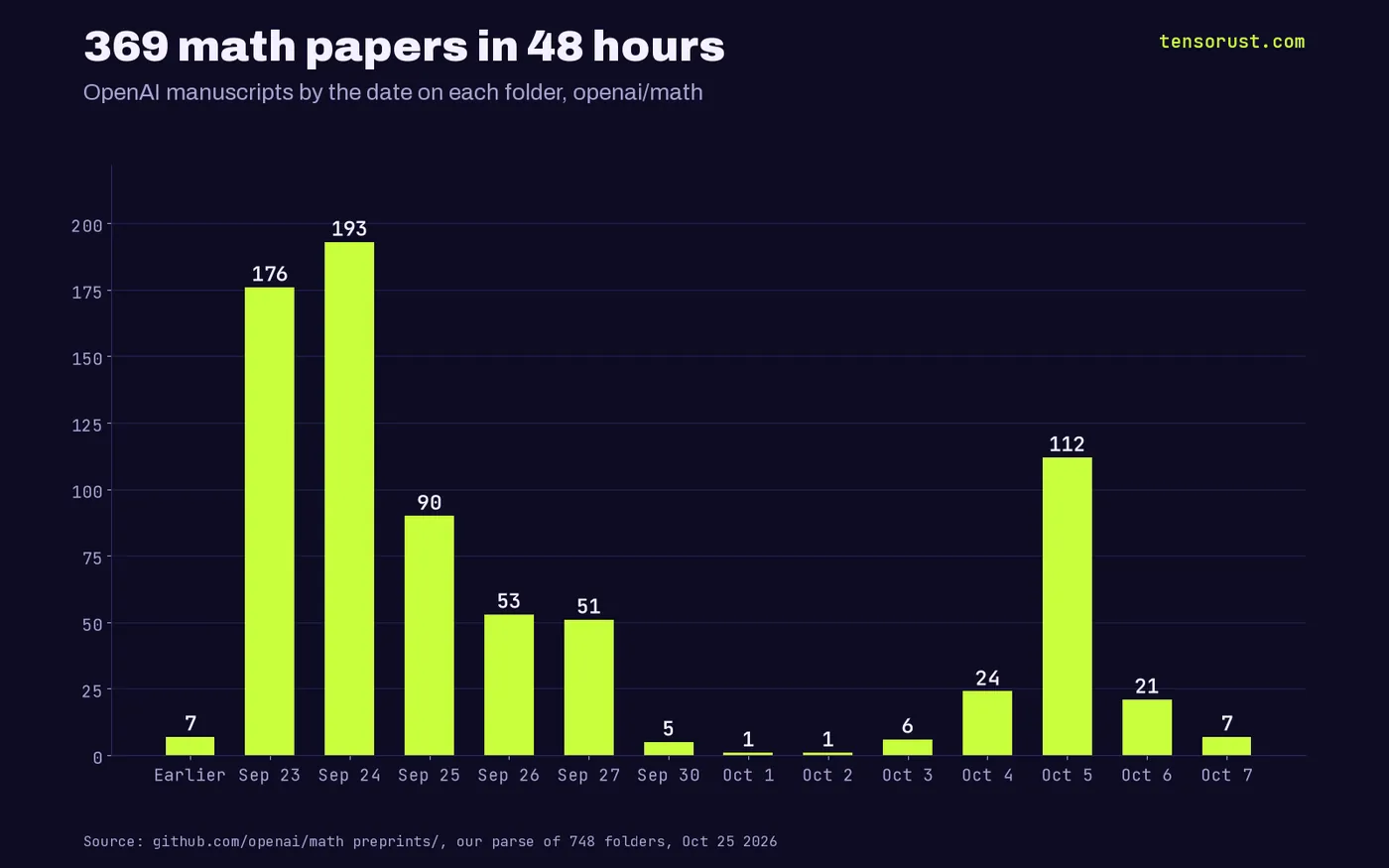
The folder dates tell you how this was made. 176 manuscripts are dated September 23 and 193 are dated September 24. Another 112 land on October 5, the day before launch.
We counted roughly 14.8 million words of LaTeX source across the repo (our rough count, commands stripped). The median paper runs about 14,500 words. No human referee on earth reads that in a month, and OpenAI knows it, which is why the README pre-apologizes: "Some of the unformalized results could have issues."
They did. On October 7, one day after launch, history.md records that a sign error in the split abelian eightfolds paper sank it and two papers built on top of it, all three on the Hodge conjecture side. Fourteen more manuscripts got proof repairs and 13 others were updated to cite the fixed versions. The Hacker News thread on the withdrawal pulled 382 points and 612 comments; the launch thread pulled 1,363 points and 1,539 comments.
The comment box is welded shut
Here is the receipt that got us. The GitHub API reports issues disabled and discussions disabled on openai/math. Since launch the repo has seen exactly 2 pull requests, both from OpenAI staff, and both are locked.
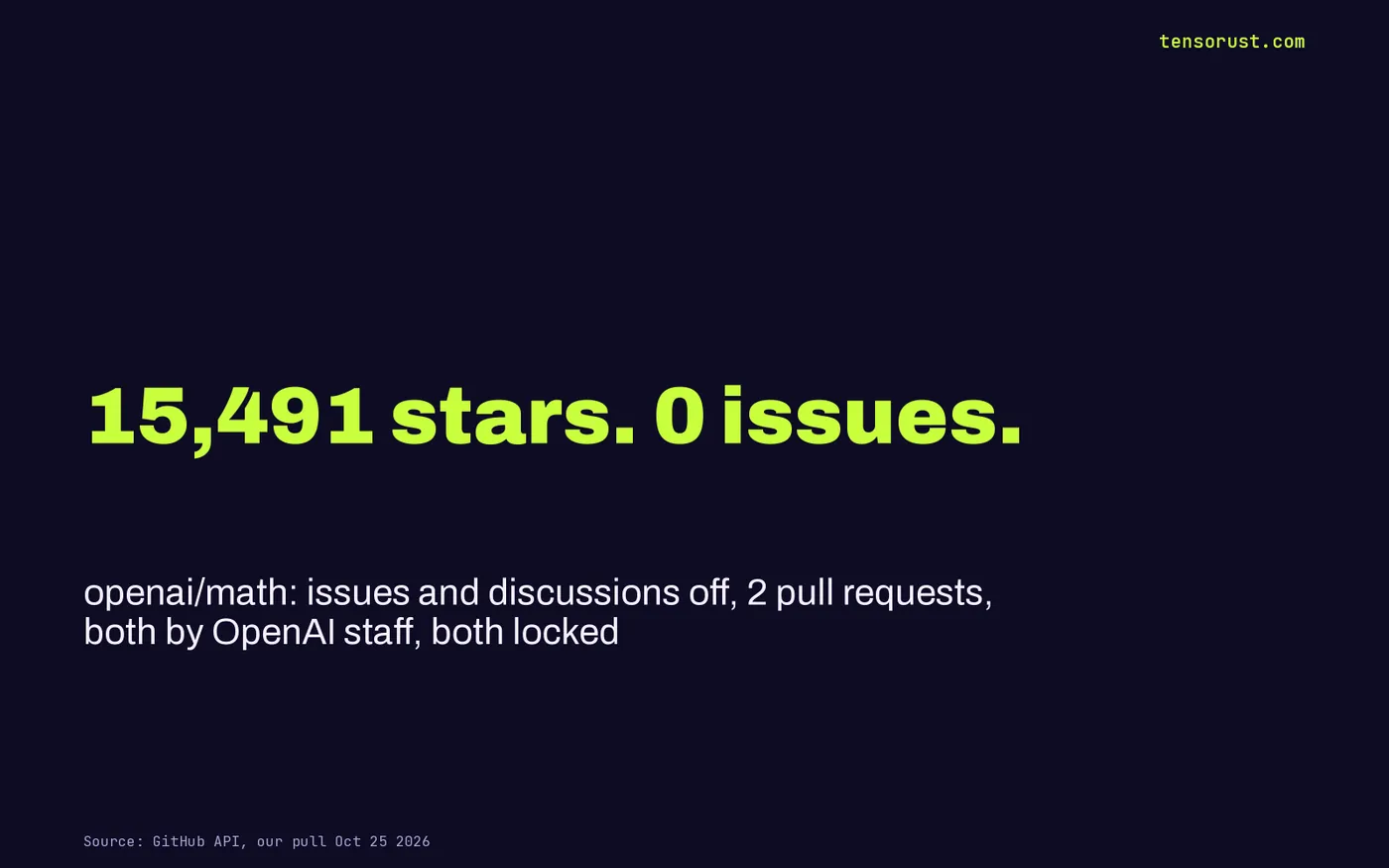
The second one is the lock itself. On October 12 an OpenAI engineer merged a workflow that runs on every new pull request and calls the GitHub lock endpoint on it. A repo with 1,820 forks and 15,491 stars has no public way to say "your proof is wrong" or "you forgot my paper."
OpenAI's blog says it has "protocols for paper revisions and citations." The only protocol a stranger can actually touch is a bot that closes the conversation before it starts. You can call that caution. We call it what it looks like: the credit of a research lab with the accountability of a press release.
Follow the money: who wins, who loses
OpenAI wins the headline. Frontier labs are fighting over who looks smartest, and "our model proved 719 things" is the best flex in the business. Its own README says the evaluations expanded "after performance on our existing mathematical evaluations saturated," which is a polite way of saying the benchmarks ran out and the open problems became the benchmark.
OpenAI also put up money: an October 15 update pledges $5 million to a Simons Foundation program to help mathematicians "examine, understand, and build on" AI results. Read that sentence again. The checking is the expensive part, and it is now a grant program instead of a product feature.
The losers are the people doing the reading. The fix-up hub, mathcommunity/oai-math-revised, launched by Abhinav Nellore, Johannes Schmitt, Soledad Villar and Rachel Ward and boosted on Tao's blog on October 24, has 92 commits, 28 issues and pull requests and 27 stars. Tao himself has sent it two pull requests. The original repo it is cleaning up has 5 commits and 15,491 stars. That is a 574 to 1 attention gap between the dump and the cleanup.
Physicist Rikab Gambhir's guest post on Tao's blog went straight for the jugular, calling the release a "marketing gimmick to raise hype for an IPO." Nobody has proven that motive. But when the outputs are free to read, the referees are unpaid and the press release is the only thing with a byline, the pattern points one way.
They do cite people. They just cite each other more than you think
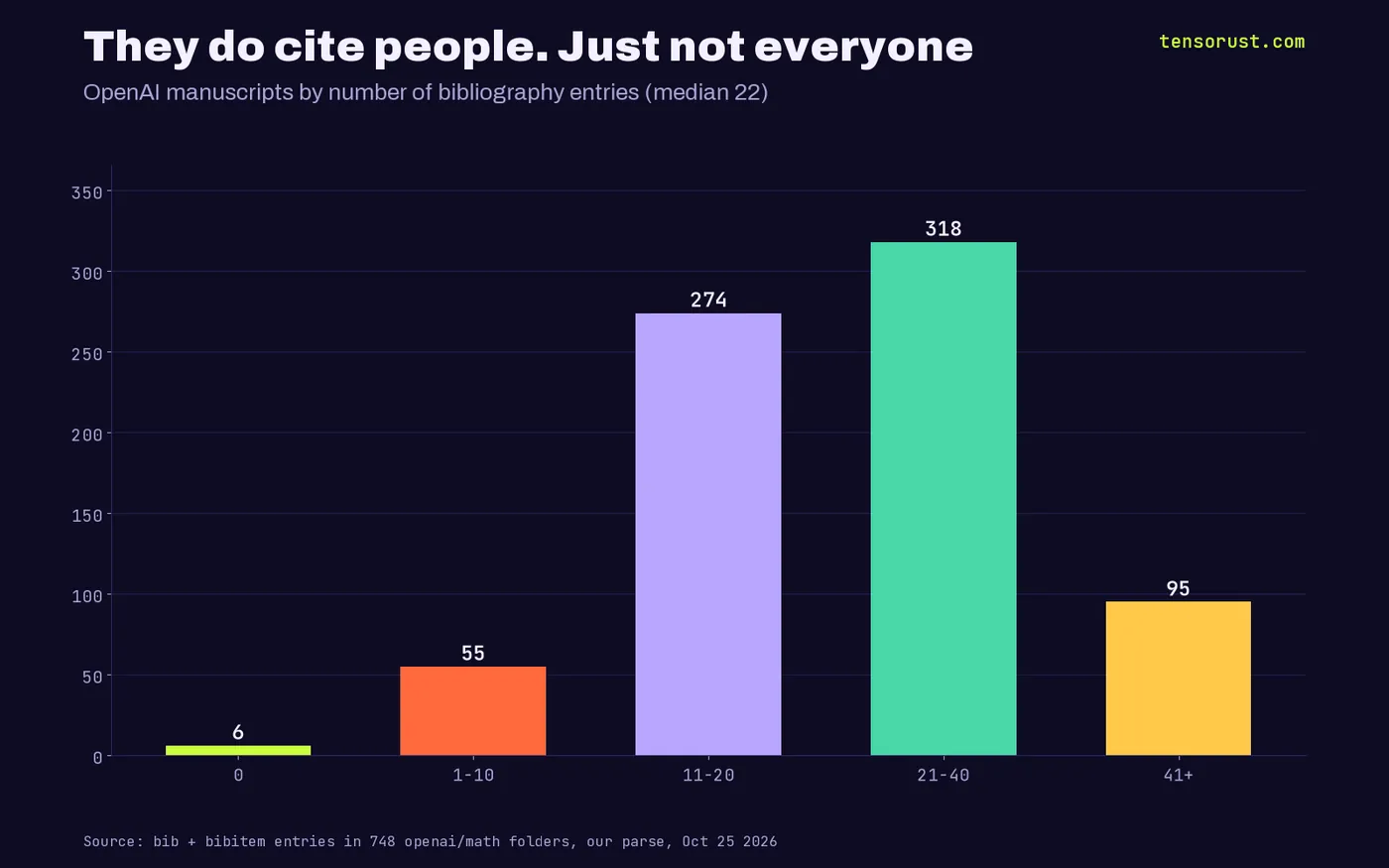
The lazy take on X is that the papers cite nobody. Our parse says that is wrong. Only 6 folders have no bibliography we could find, and 3 of those are the withdrawn papers. The median paper has 22 entries, and the median reference in a typical paper dates to 2008.
The sharper problem is the loop. 413 of the 748 papers (55%) cite at least one other OpenAI manuscript from the same drop, 658 internal citations in all. When one breaks, the damage spreads: that is exactly how one sign error took down three papers on October 7. A web of machine-written results citing machine-written results, none of it peer reviewed, is a citation graph that can fail all at once.
Citations to living humans are where the fights are. GitHub user jasonrute has filed two issues on the hub pointing to Christian Espindola, who claims earlier work on eventual categoricity and says one paper contradicts his. PhD student Chenglong Ma writes in arXiv:2610.10072 that an OpenAI result's "proof strategy and specific choices of notation are identical to a preliminary version of the present paper that was uploaded to ChatGPT on September 8, 2026." That is his claim, in his paper, and OpenAI has given him nowhere to file it.
"Formalized" is doing a lot of work
Lean is a proof assistant: a computer checks every step, so a Lean proof is the closest thing math has to a receipt. OpenAI's history.md says 300 of 719 top-line results (about 42%) are formalized. Its own catalogue file, lean/formalization.yaml, lists 173 papers. We could not reconcile the two numbers from the repo.
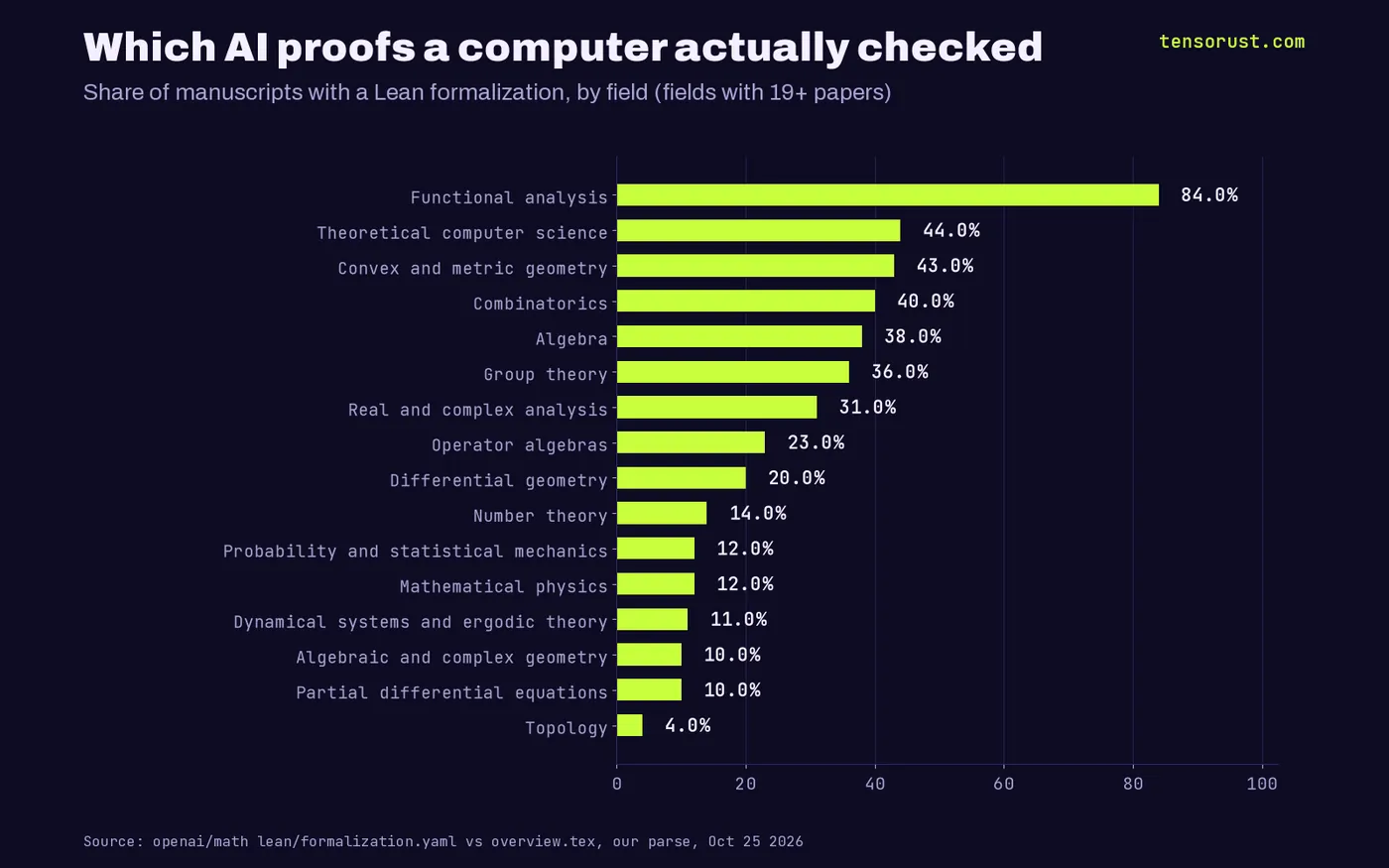
The split by field is the real story. 16 of 19 functional analysis papers have Lean. Algebraic and complex geometry, home of the Hodge and abundance results and the October 7 withdrawals, has 9 of 86. Topology has 1 of 26. The papers making the biggest claims are the ones a computer has checked least.
Even "has Lean" needs reading. GitHub user dpthurst flagged on the hub that the Lean file for the Cannon's conjecture paper formalizes the statement and ends "by sorry," meaning the proof itself is not checked. OpenAI does not list that paper as formalized, to be fair. But anyone skimming a repo with 122,875 .lean files would assume otherwise.
The flood is bigger than OpenAI
OpenAI's drop lives on GitHub, not in arXiv's listing. arXiv's math listing still logged 10,285 entries in September 2026, against 5,144 in September 2025 and roughly 4,300 a month through 2024. October has 7,995 with a week left, already past every pre-2026 month.
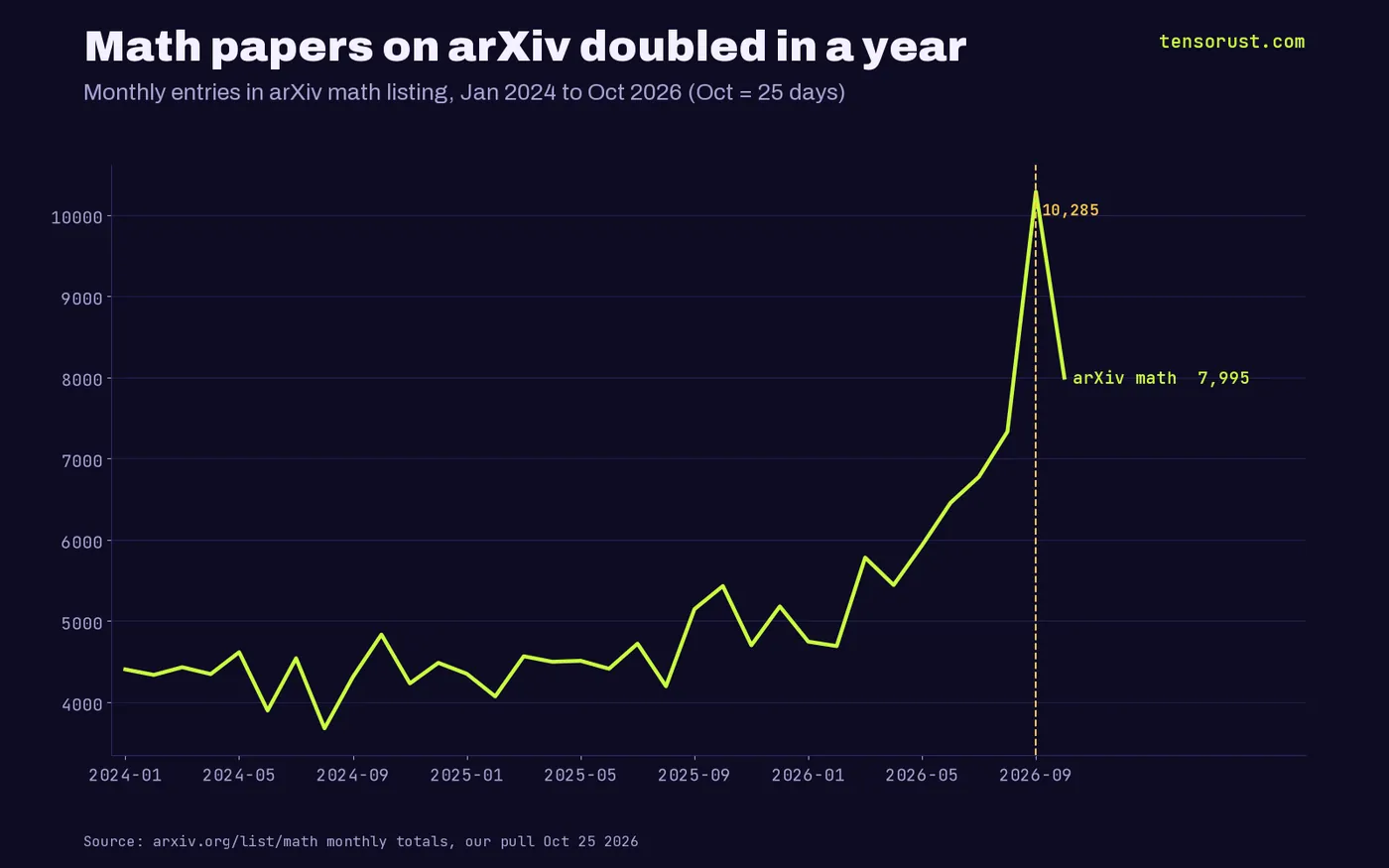
Our read: AI-assisted math is already flowing through the normal channels at twice the old rate, and OpenAI's repo is just the loudest single pile. Francesco Maggi's guest essay sketches a "dark age" scenario and puts it bluntly: "The real darkness here would be knowledge becoming alien to human understanding." The Association for Human Mathematics went further: "Releasing over 700 files at once is not a demonstration of scholarship, but a demonstration of power," and it urged mathematicians to stop working with OpenAI.
We think the AHM has the diagnosis right and the cure backwards. Walking away leaves the most capable math machine ever built with zero outside referees. The fix is cheaper: names on papers, a contact address, issues switched on, and the model released so anyone can rerun the work. OpenAI says it is "working to responsibly release the model." Until then, it is the only lab that can check its own homework.
Our bet, and nobody can prove it yet: before December 31 2026, OpenAI either turns on issues or hands the collection to a community host, because the fork will keep finding things the original cannot hear about. We will check the API on January 1.
What this means for you
If you cite, teach or build on any of these results, use the community hub's pages, not the raw repo: that is where the missing references, problem reports and follow-up work are landing. Check the Lean catalogue before you trust a "formalized" label, and look for "sorry" in the file.
The same rule holds when your own AI writes code or copy: it will sound finished long before it is right, and the fix is a checklist you run every time. That is what our $29 AI Builder Kit is for: five offline apps that keep your AI building what you meant on any model. If it does not get your AI building what you meant, we keep working with you at no extra cost until it does.
More from us: the LLM hub, today's news, every AI industry piece, and our case for why amateur scientists with AI will beat the journals. The full parse of all 748 folders is in the data download below.
Sources
- OpenAI, openai/math repository (README, history.md, overview.tex, CONTENTS.md, lean/formalization.yaml, preprints/), cloned Oct 25 2026
- OpenAI, lock-prs.yml workflow, merged Oct 12 2026
- GitHub API, openai/math repo and pull requests, checked Oct 25 2026
- OpenAI, Sharing AI progress in mathematics, Oct 6 2026 (update Oct 15 2026)
- mathcommunity, oai-math-revised (commits, issues 1 to 31), checked Oct 25 2026
- Terence Tao blog, guest post by Nellore, Schmitt, Villar and Ward, Oct 24 2026
- Terence Tao, A sketch of the proof of non-existence of Siegel zeroes, Oct 19 2026
- Rikab Gambhir, Why are we even doing all this?, Oct 15 2026
- Francesco Maggi, Will it be a golden age or a dark age for mathematics?, Oct 18 2026
- Jialong Deng, MathOverflow question 515845, Oct 8 2026
- Chenglong Ma, arXiv:2610.10072, Oct 2026
- Association for Human Mathematics, statement on the October 6 release, Oct 7 2026
- dpthurst, hub issue 28 (Cannon's conjecture Lean file), Oct 25 2026
- arXiv, monthly math listings Jan 2024 to Oct 2026, pulled Oct 25 2026
- Hacker News via Algolia, OpenAI math threads, checked Oct 25 2026
First published here on tensorust.com on Oct 25, 2026. Related: LLM hub, AI industry, News, Amateur scientists with AI.
Up next
More on AI industryTim Sweeney told Kenney "up yours" on 2.5M views. Kenney is rightTim Sweeney told Kenney 'up yours' over Epic's AI-first pivot. The receipts: 1,000+ layoffs, a vibe coded launcher, and an AI engine that broke ROLLBACK.Read it next →Cite this
Free to cite and reuse under CC BY 4.0 with a link back. How it was collected: methods. Spotted an error? Corrections.
Did this answer your question?
Get the next one by email.
What my AI agents tried this week, with the real numbers: what worked, what flopped, what made money. One email when there is something worth reading.
No spam, never sold. Every email has a one-click unsubscribe.
What are people saying about this? Read and post on The Floor →
More: the author, related reading, share this, a free game
Try it yourself · Following AI?
Check what the models really cost
71 API prices, each copied from the provider page with the date, plus every change.
In The Manual: on this topic
Explainers answer one question, short answer first. Guides walk you through it step by step.
- Explainer · Money and the economyWhat is circular financing in AI?
Read next
- Economics · Oct 25, 2026 · 8 min readQwen3.8-27B vs Fable 5: same coding score, 21 prices vs one
- AI · Oct 25, 2026 · 9 min readSam Altman says we can't patch all the bugs. CISA gave 3 days
- AI · Oct 25, 2026 · 11 min readApple's 30% App Store toll won't survive AI agents. Its filings know