
Amateur scientists with AI will beat the journals. Elsevier knows it
On this page · 10 sections
- Key numbers
- The breakthrough already happened, on a wiki
- Outsiders were already winning before the models arrived
- Follow the money: the gate prints cash
- And now they sell your papers to the AI labs
- The steelman: someone has to stop the cranks
- The garage lab is back, and it costs less than a used car
- The twist: it will look like nothing happened
- What this means for you
- Sources
Short answer: Will amateur scientists with AI make the next big breakthroughs? Yes, and the record already shows it. In eight months, 81 Erdős problems, open math questions that sat for decades, were fully resolved with AI as a primary contributor, logged on a public GitHub wiki and checked in the open, mostly with no journal anywhere in the loop. The thing in the way is not talent or equipment. It is an academic publishing system that earns 33% to 38% margins on research other people write, review and pay for, and its owner just told the SEC that "alternative publication channels" are a risk to its business.
TL;DR: Elsevier's parent RELX made £1,035 million of adjusted operating profit on £2,714 million of journal-arm revenue in 2025, a 38.1% margin, while peer reviewers put in more than 100 million unpaid hours in a single year. A gaming GPU now buys 54 times more compute per dollar than one from 2008, and arXiv, the free preprint server, took 284,486 papers in 2025 and has already passed that in 2026. The same gate that charges $12,690 to publish one paper in Nature let through enough fraud that 13,368 papers were retracted in 2023 alone, so the question is not whether outsiders are good enough for the journals, it is whether the journals are good enough for science.
Key numbers
| What | Number | Source, checked Oct 25 2026 |
|---|---|---|
| Erdős problems fully resolved with AI as a primary contributor, Nov 2025 to Jun 2026 | 81 distinct problems (of 1,221 in the database) | teorth/erdosproblems wiki, Tensorust count |
| RELX Scientific, Technical & Medical (Elsevier) revenue and adjusted operating profit, 2025 | £2,714M and £1,035M (38.1% margin, our calc) | RELX 2025 20-F |
| Wiley Research revenue and adjusted EBITDA margin, fiscal 2026 | $1,129.9M, 33.2% | Wiley FY2026 10-K |
| Wiley Research AI licensing revenue | $33.1M in FY2026, up from about $11M | Wiley FY2026 10-K |
| Unpaid peer review, 2020 | 100M+ hours; US reviewers' time worth $1.5B+ | Aczel, Szaszi & Holcombe 2021 |
| Fee to publish one open-access paper | $12,690 (Nature), $6,990 (Nature Communications) | OpenAlex sources API |
| Retractions in 2023, and the share from Wiley's Hindawi | 13,368, of which 9,673 (72%) | Retraction Watch database via Crossref, Tensorust count |
| Psychology studies that replicated with a significant result | 36% (vs 97% of originals) | Open Science Collaboration, Science 2015 |
| arXiv submissions, 2010 vs 2025 | 70,131 vs 284,486 | arXiv monthly stats |
| Consumer GPU compute per dollar, GTX 280 (2008) vs RTX 4090 (2022) | 0.96 vs 51.7 GFLOP/s per $ (54x) | Epoch AI hardware database, our calc |

The breakthrough already happened, on a wiki
Paul Erdős left behind hundreds of problems, many with cash prizes, that thwarted, in his words, "the best mathematicians for many decades." The database at erdosproblems.com lists 1,221 of them. Since late 2025, a community wiki in the teorth/erdosproblems GitHub repository has logged every claim that an AI system moved one forward.
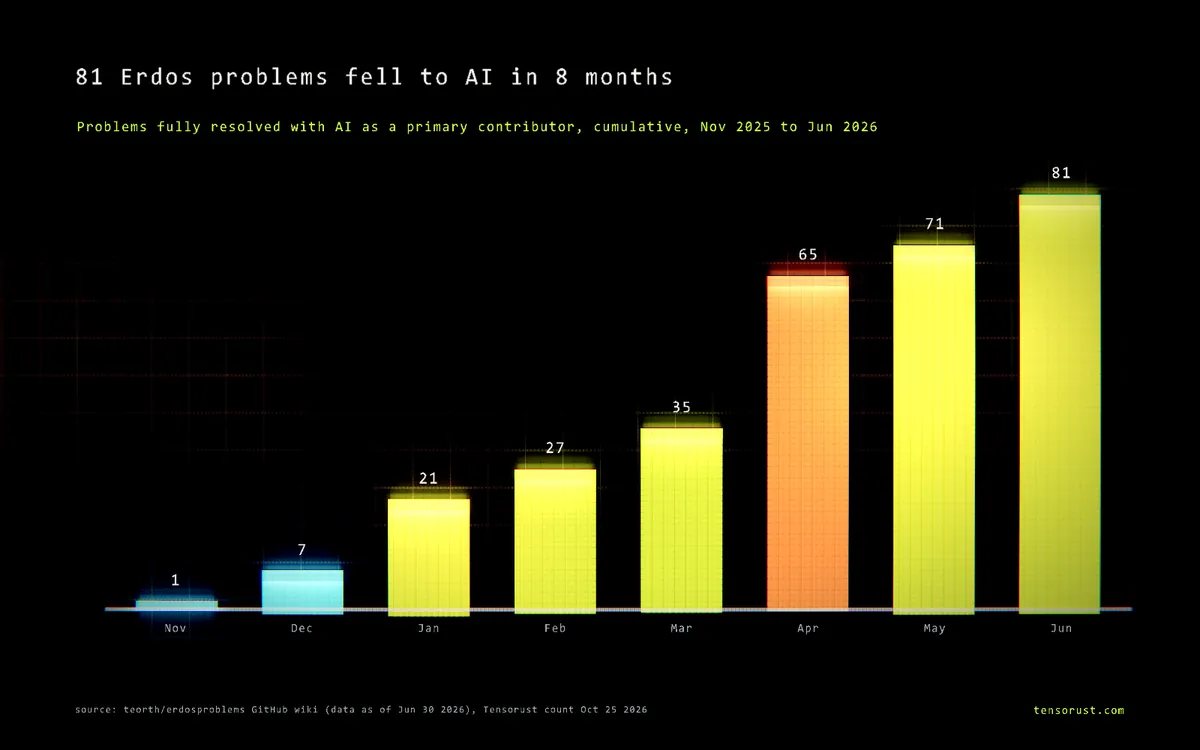
We counted the table. Between November 2025 and June 2026 it records 256 primary AI contributions, and 81 distinct problems marked fully resolved. April 2026 alone added 30. The systems in the log are not secret lab rigs only: GPT-5.5 Pro, Claude, Gemini, Codex and, in one entry, "ChatGPT free version" all show up.
The human side is just as telling. Section 1(d), where people and models worked together, names 83 different human collaborators. Some are famous. Most are names you have never heard of, which is the point.
None of this waited for a journal. Problems were stated in public, attacked in public, and checked in public, often with a machine-checked proof in Lean, a language where a computer verifies every step. The wiki even says it out loud in its own disclaimers: "A solution to an Erdős problem does not automatically qualify as publishable paper in a journal." Read that again. The math is solved. The gate has not caught up.
Outsiders were already winning before the models arrived
This is not a one-off. In November 2022, David Smith, an amateur Wikipedia simply calls a hobbyist, found the "hat," a single tile that seemed to cover a flat plane only without ever repeating, the long-sought "einstein" shape. He then recruited the professionals to write it up.
In July 2024, an online amateur collective called the Busy Beaver Challenge proved that the fifth busy beaver number is 47,176,870, with the proof formalized in the Rocq proof assistant. Quanta's headline: "Amateur Mathematicians Find Fifth 'Busy Beaver' Turing Machine."
And in 2025, Hannah Cairo, 17, disproved the Mizohata-Takeuchi conjecture, open since the 1980s, then skipped straight from no bachelor's degree to a PhD program. Three results, three outsiders, and every one of them leaned on open tools and open verification rather than the credential ladder.
Now hand those same people a frontier model, 260 million free protein structures from AlphaFold DB and a GPU. The pattern says the outsider share of big results goes up, not down.
Follow the money: the gate prints cash
Here is how the research loop works, using nothing but filings and published papers. Taxpayers fund the work: NIH alone spent more than $35 billion on grants in fiscal 2023, about $26 billion on direct research and $9 billion on overhead, by its own February 2025 notice. Researchers do the work and often pay to publish it, up to $12,690 for one paper in Nature.
Peer reviewers check it for free. A 2021 study by Balazs Aczel, Barnabas Szaszi and Alex Holcombe put the total at more than 100 million hours in 2020, with US reviewers' time alone worth over $1.5 billion. Then the publisher owns the final version and sells it back to university libraries, which pay out of the overhead line of those same grants. That last link is our reading of how the money moves, and nobody has shown us a better one.
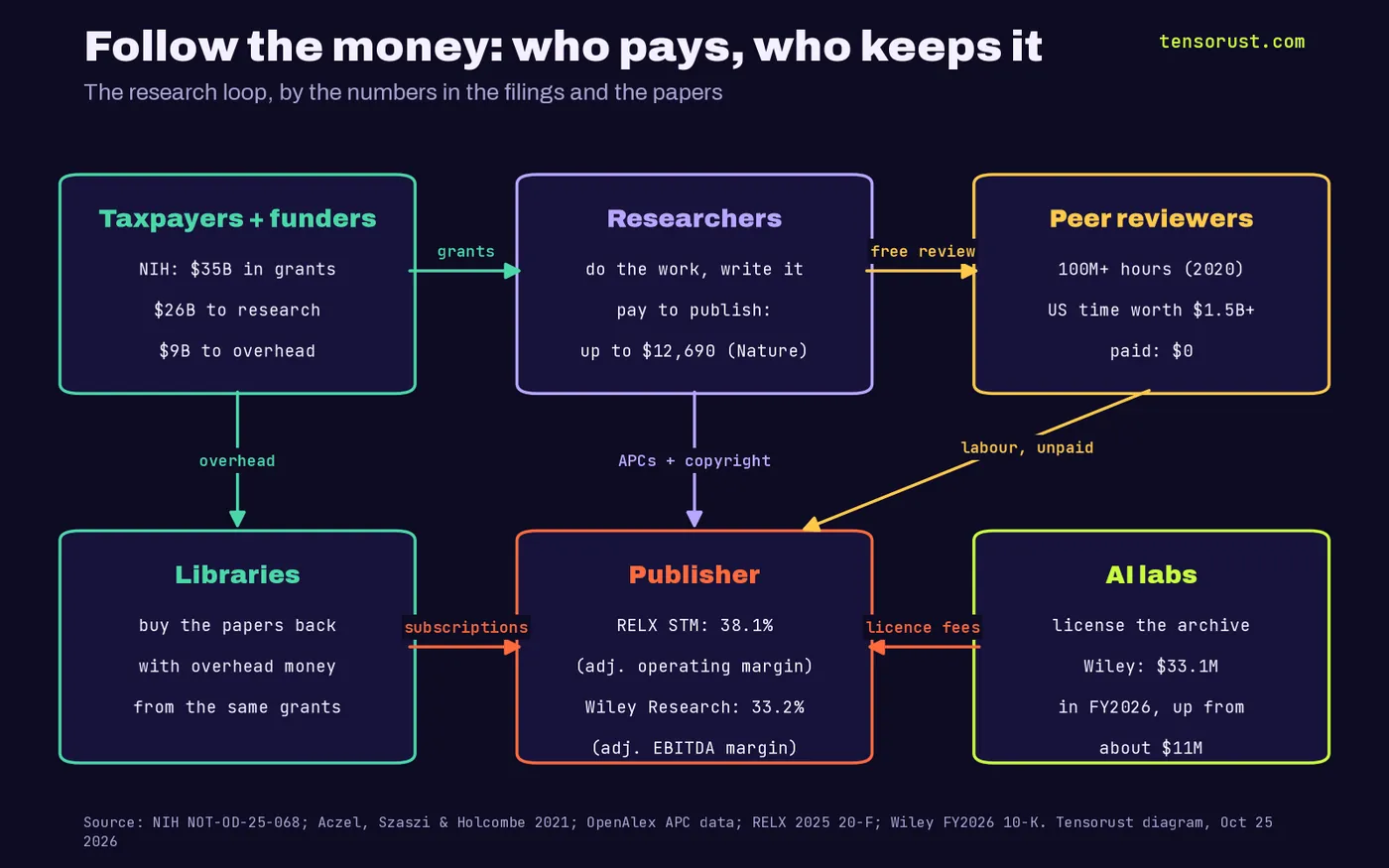
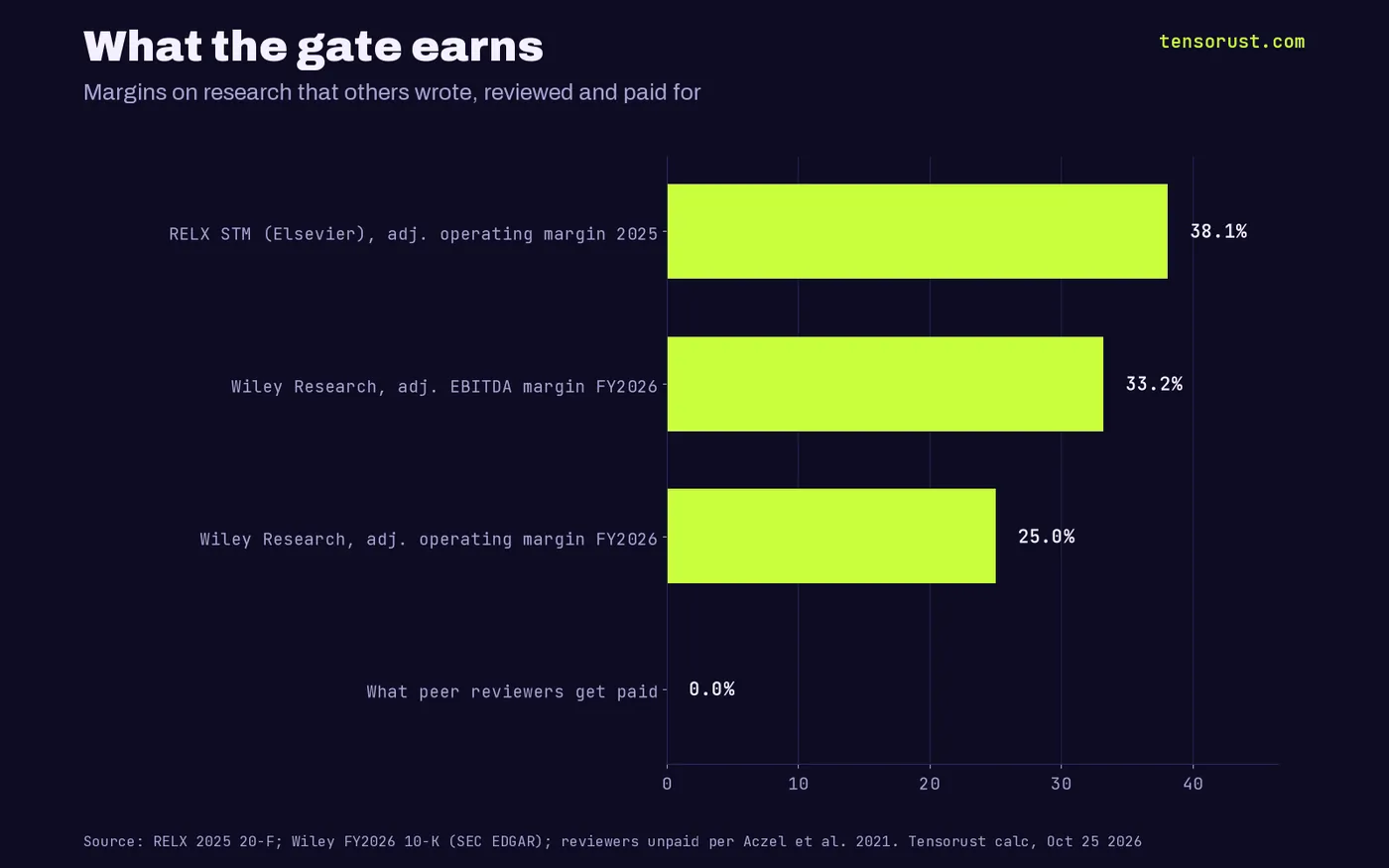
The result shows up in the margins. RELX's journal arm, Scientific, Technical & Medical, booked £2,714 million of revenue and £1,035 million of adjusted operating profit in 2025. That is a 38.1% margin. Wiley's Research segment earned a 33.2% adjusted EBITDA margin on $1.13 billion in fiscal 2026. For comparison, the people who did the reviewing earned 0%.
And now they sell your papers to the AI labs
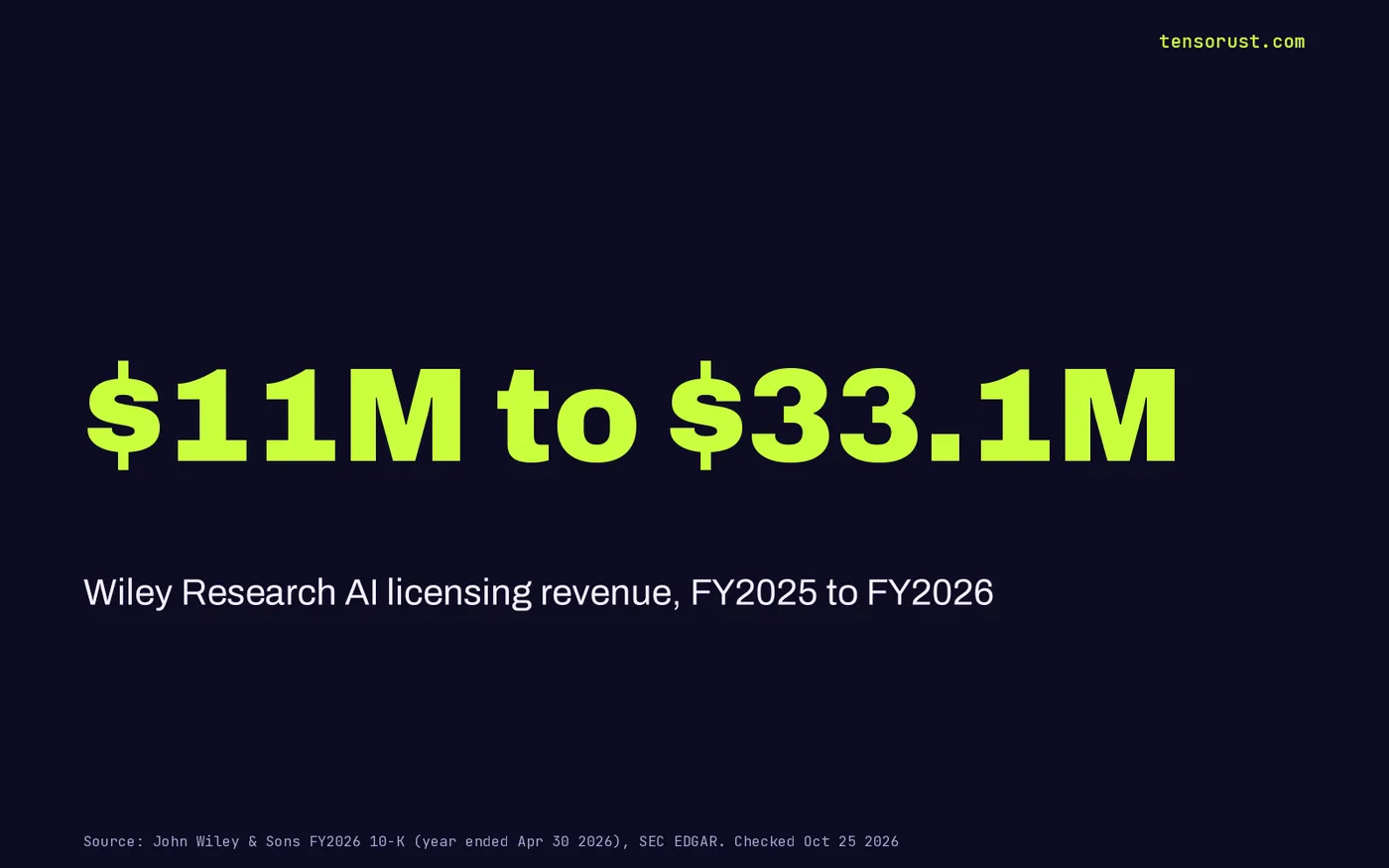
Here is the part that should make every researcher laugh. Wiley's 10-K reports Research AI licensing revenue of $33.1 million for the year ended April 30, 2026, up from about $11 million the year before. Its own strategy section names "the ever-increasing need for authoritative content to fuel AI models."
So the same company that tells an outsider their AI-assisted result needs a journal to count is licensing the journal archive to AI companies, three times more of it than a year earlier. The authors did not get a cut. The reviewers did not get a cut. The taxpayers who funded the work did not get a cut.
RELX is playing the same hand. Its 2025 20-F talks up Scopus AI and a new "end-to-end AI-powered researcher solution" called LeapSpace. In the same filing, under risks, it writes that "changes in the payment model for these products or alternative publication channels for our content, could adversely affect our business."
That is the whole story in one sentence from the company itself. The incumbent is not afraid of AI. It is afraid of AI it does not own, used by people who do not need its journals.
The steelman: someone has to stop the cranks
The strongest case for the gate goes like this. Science runs on trust, most outsider "breakthroughs" are wrong, and AI makes it cheap to mass-produce convincing nonsense. Peer review, slow and imperfect as it is, filters the flood. The Erdős wiki itself flags 17 primary AI claims as incorrect.
That is a real argument. Here is why it fails on the record.
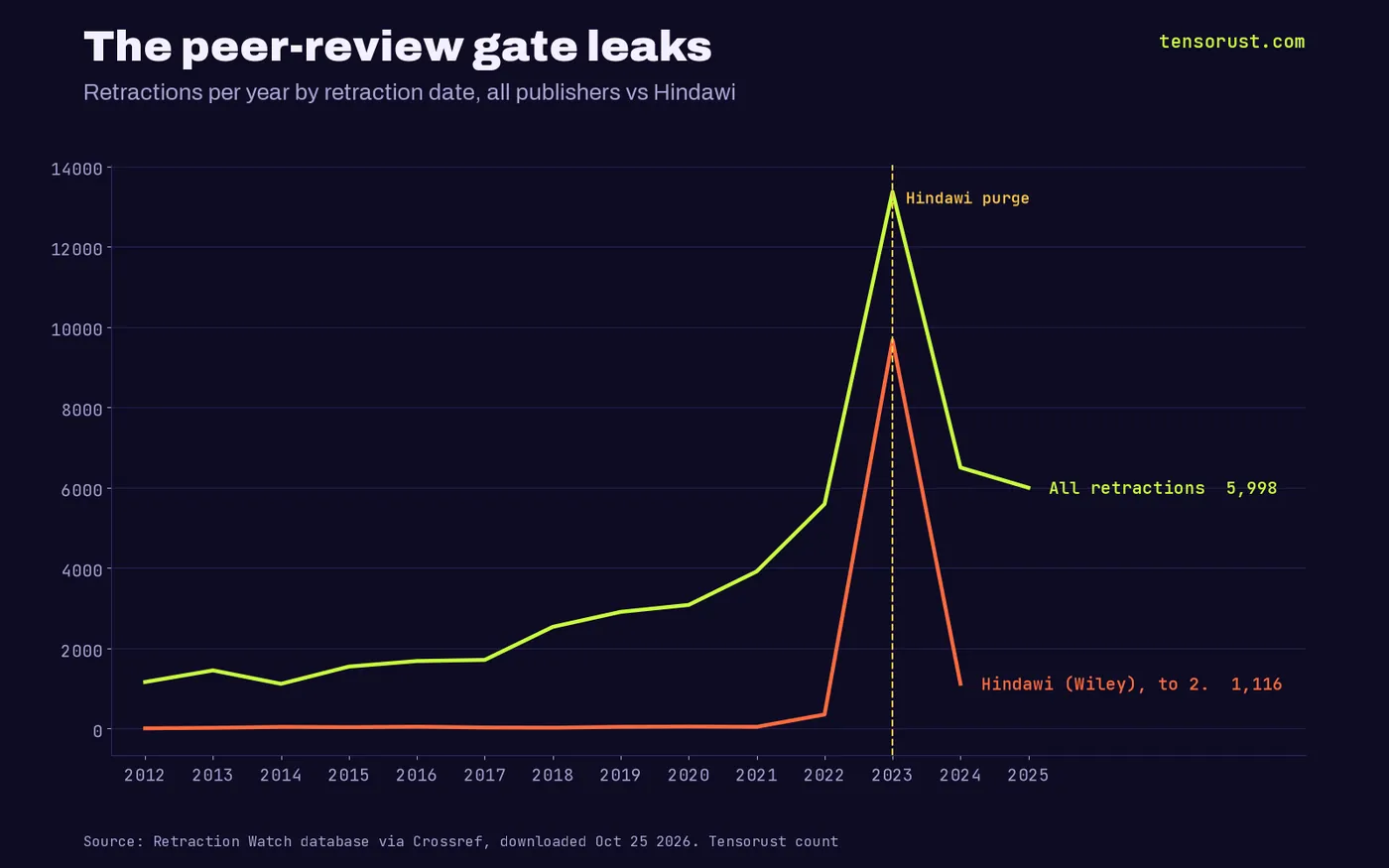
First, the gate does not filter well. The Retraction Watch database, which we downloaded in full, shows 13,368 retractions in 2023. Of those, 9,673 came from Hindawi, a Wiley-owned open-access publisher whose special issues were suspended, in Wiley's own words, "due to the presence in certain special issues of compromised articles." Paper mills, factories that sell fake papers, were cited as a reason in 6,782 retractions that year. That was not outsiders sneaking past peer review. That was the gate running a toll booth on the fraud.
Second, passing the gate does not mean being right. When the Open Science Collaboration re-ran 100 published psychology studies in 2015, 97% of the originals had reported significant results and only 36% of the replications did. Peer review approved all of them.
Third, and this is the part the steelman misses, the Erdős wiki caught its own 17 bad claims fast, in public, mostly by checking proofs in Lean. The new filter is not an anonymous referee taking months. It is a proof checker that says yes or no in minutes and an open log anyone can audit. Verification moved from prestige to machines, the same way the Rust compiler moved code safety from code review to the build.
The garage lab is back, and it costs less than a used car
The reason this is happening now is not mysterious. It is the price of compute.
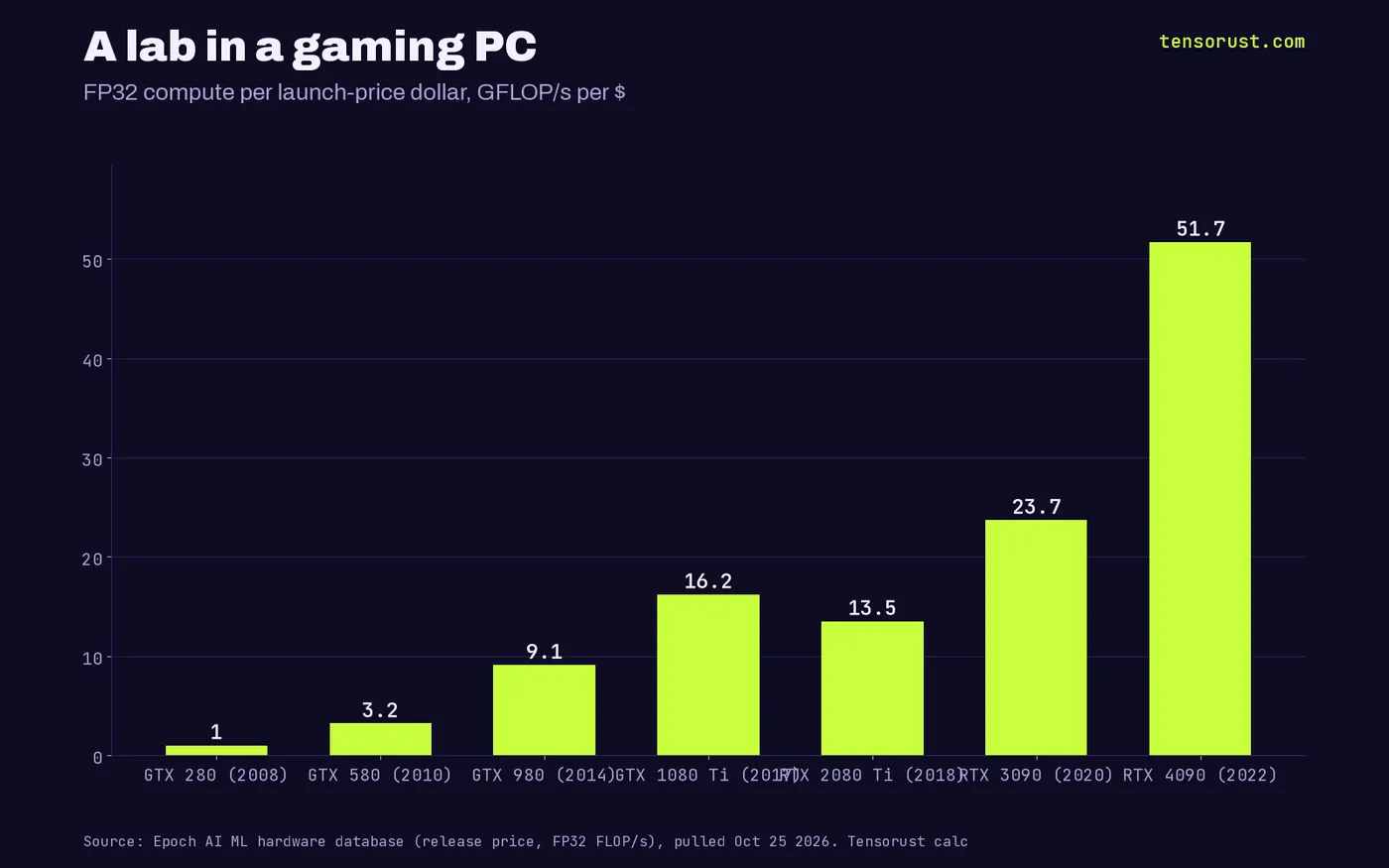
Epoch AI's hardware database lists Nvidia's GTX 280 from 2008 at $649 for 0.62 trillion operations a second in standard precision. The RTX 4090 from 2022 lists at $1,599 for 82.6 trillion. Per dollar, that is 0.96 versus 51.7 billion operations a second, a 54x drop in the cost of a home lab in 14 years, before you count the frontier models anyone can rent by the month.
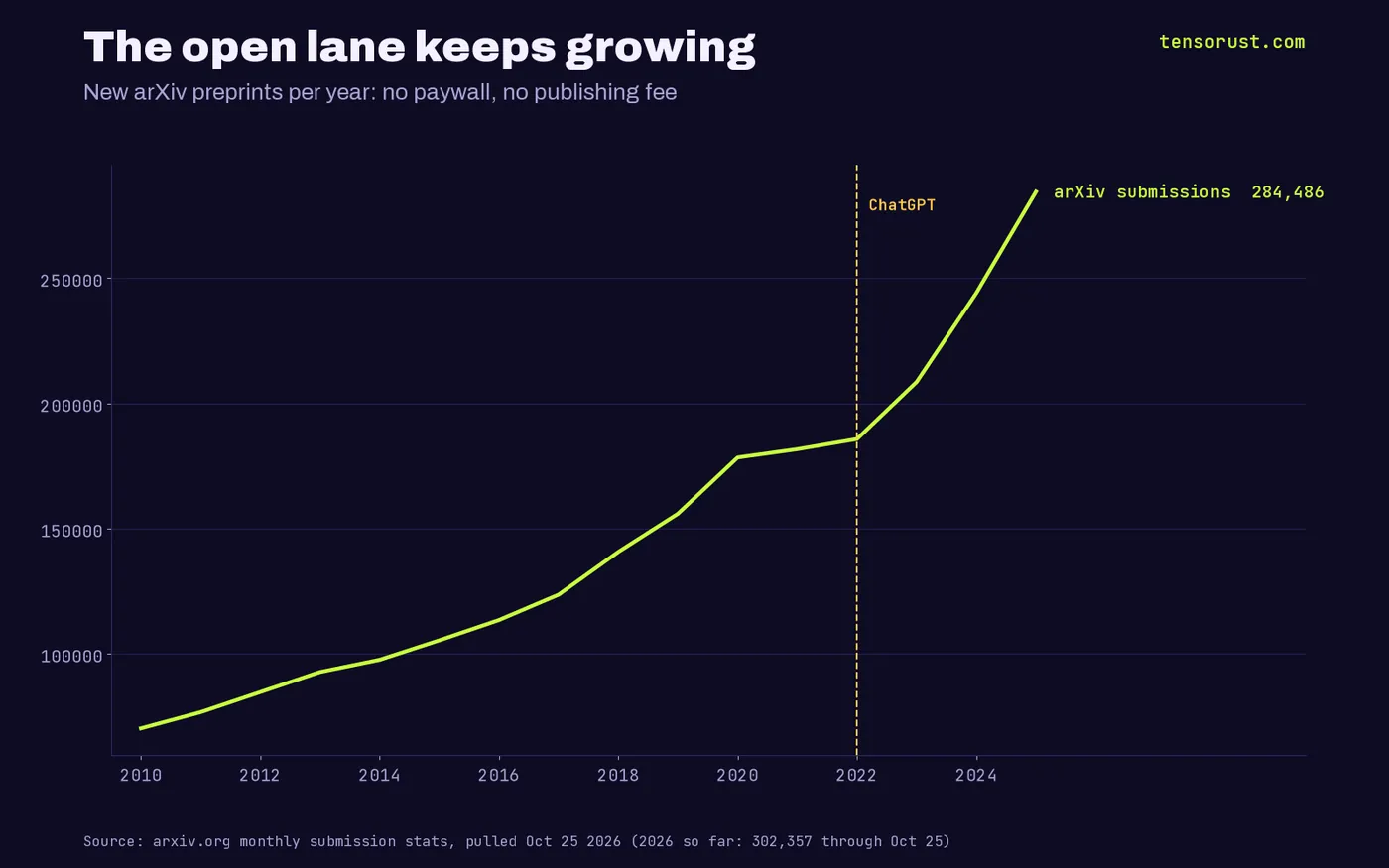
Meanwhile the open lane is exploding. arXiv, where physicists, mathematicians and AI researchers post papers for free with no publishing fee, took 70,131 submissions in 2010 and 284,486 in 2025. By October 25, 2026 it already had 302,357 for the year. The work is moving to the place with no toll.
The incumbents have fought every step of this. Elsevier backed the Research Works Act, which would have banned open-access mandates for US federally funded research, and drew a boycott signed by more than 5,000 academics by February 2012. It won a $15 million default judgment against Sci-Hub in 2017, the shadow library that by 2022 held 88 million files. The Association of American Publishers spent $2.04 million on federal lobbying in 2024 by our sum of Senate LDA filings. RELX, Elsevier's parent, spent $5.06 million across all its businesses.
The twist: it will look like nothing happened
Here is our bet, stated flat. The next result that would have won a Nobel or a Fields Medal in the old world will first appear as a GitHub repo, a Lean file and a thread, from a team with no university affiliation, and the press will not notice for months.
It will feel like nothing changed, the same way AI growth in general feels like a normal Tuesday. There will be no cover story. There will be a row in a wiki that says "Full solution," and a journal that asks, a year later, whether the authors would like to submit it for $12,690.
We think that by 2030, more than half of notable new math results will be machine-verified and public before any journal touches them. Nobody has proven that yet. But the curve in our hero chart went from 1 to 81 in eight months, and gates do not hold back curves like that. They just get walked around.
Who benefits from you believing otherwise? The same people the AI panic money trail keeps pointing to: incumbents who need "only credentialed experts with our stamp can do science" to stay true, because their 38% margin depends on it.
What this means for you
If you have a problem you care about, a hard math question, a protein, a dataset nobody has looked at, you no longer need permission. Pick a public open problem list, use a frontier model or a local one on your own GPU, verify what you can in a checker like Lean, and publish the whole thing, code and data, on arXiv or GitHub the day it works. Credit comes from being right in public, not from a logo on a PDF.
Want a setup that keeps your AI working on what you meant instead of drifting? Our $29 AI Builder Kit is five offline apps that keep your AI building what you meant, on any model including a local one. If it does not get your AI building what you meant, we keep working with you at no extra cost until it does.
More from the opinion desk at Opinion and all opinion pieces, and see what models cost to run on our LLM price list. Our case for Rust makes the same argument about compilers as the new reviewer. Download the data behind every chart below.
Not financial advice. RELX and Wiley figures are from their own filings; the margin math and the reading of the money loop are ours.
Sources
- Erdős problems wiki, AI contributions to Erdős problems (data as of Jun 30 2026), checked Oct 25 2026
- erdosproblems.com, checked Oct 25 2026
- RELX PLC, 2025 Form 20-F, SEC EDGAR, checked Oct 25 2026
- John Wiley & Sons, FY2026 Form 10-K and FY2024 Form 10-K, SEC EDGAR, checked Oct 25 2026
- Aczel, Szaszi & Holcombe, A billion-dollar donation: estimating the cost of researchers' time spent on peer review, Research Integrity and Peer Review, 2021, checked Oct 25 2026
- Open Science Collaboration, Estimating the reproducibility of psychological science, Science, 2015, checked Oct 25 2026
- Retraction Watch database, distributed by Crossref, full download Oct 25 2026
- arXiv monthly submission statistics, checked Oct 25 2026
- Epoch AI, Machine Learning Hardware database, checked Oct 25 2026
- OpenAlex, journal APC prices, checked Oct 25 2026
- NIH, NOT-OD-25-068, Supplemental Guidance on indirect cost rates, Feb 2025, checked Oct 25 2026
- AlphaFold Protein Structure Database, EMBL-EBI, checked Oct 25 2026
- Senate Lobbying Disclosure Act filings, 2024, Tensorust sum, checked Oct 25 2026
- Wikipedia, Einstein problem; Busy beaver; Hannah Cairo; Elsevier; Sci-Hub, checked Oct 25 2026
- Ben Brubaker, Quanta Magazine, Amateur Mathematicians Find Fifth 'Busy Beaver' Turing Machine, Jul 2 2024
First published here on tensorust.com on Oct 25, 2026. Related: Opinion, All opinion pieces, LLM price list.
Up next
More on OpinionAmerica already has a social credit score. Data brokers run itThe US banned bulk data sales to China, then 37 days later dropped the rule limiting sales to everyone else. 603 brokers, $20B a year: our social credit score.Read it next →Cite this
Free to cite and reuse under CC BY 4.0 with a link back. How it was collected: methods. Spotted an error? Corrections.
Did this answer your question?
Get the next one by email.
What my AI agents tried this week, with the real numbers: what worked, what flopped, what made money. One email when there is something worth reading.
No spam, never sold. Every email has a one-click unsubscribe.
What are people saying about this? Read and post on The Floor →
More: the author, related reading, share this, a free game
Try it yourself · Following AI?
Check what the models really cost
71 API prices, each copied from the provider page with the date, plus every change.
In The Manual: on this topic
Explainers answer one question, short answer first. Guides walk you through it step by step.
- Explainer · Money and the economyWhat is circular financing in AI?
Read next
- Economics · Oct 25, 2026 · 10 min readAI data centers aren't why your power bill is up. Utilities are
- AI · Oct 25, 2026 · 14 min readThe new class divide: 3 tiers, and 3 in 4 workers sit out the AI one
- AI · Oct 25, 2026 · 14 min readAmerica already has a social credit score. Data brokers run it