
Return to office is a landlord bailout: office loans 12.2% delinquent
On this page · 11 sections
- Key numbers
- The mandates failed at the one thing they claim to do
- The productivity case was tested, and it lost
- Follow the money: the loans behind the towers
- Who sits on both sides of the desk
- The cities need you on the train
- The office bailout already has its own lobby
- The best case for the office, and why it fails
- The AI twist: why they need the mandate now
- What this means for you
- Sources
Short answer: Return to office mandates are not about productivity. The best trial on hybrid work found no performance loss, and the mandates barely moved how much America works from home (27.6% of paid days when Amazon announced five days a week, 26.8% now). What they do protect is a $3.16 trillion pile of bank commercial real estate loans, a CMBS office market where 12.16% of loans are delinquent, and city budgets that draw a fifth of their property tax from office towers. Your commute is the collateral.
TL;DR: Office badge swipes in the 10 biggest US office markets sit at 55.1% of the February 2020 level, office vacancy hit a record 21%, and Trepp's office CMBS delinquency rate reached 12.16% in September 2026, after an all-time high of 12.34% in January. Lobbying reports naming the Revitalizing Downtowns Act, a tax credit to bail out empty offices by converting them, went from 20 in 2021 to 92 in 2024, filed for groups like the National Association of Realtors, the Real Estate Roundtable and the Mortgage Bankers Association. Meanwhile a 1,612-person randomized trial in Nature found hybrid work cut quits by a third with no change in performance or promotions, and a quarter of executives in a BambooHR survey admitted they hoped mandates would make people quit.
Key numbers
| What | Number | Source, checked Oct 25 2026 |
|---|---|---|
| Office occupancy, 10 big metros, vs Feb 2020 baseline | 55.1% (week of Oct 13 2026) | Kastle Occupancy Barometer |
| Share of US paid workdays done from home, Sep 2024 vs Sep 2026 | 27.6% vs 26.8% (pre-COVID: 7.2%) | WFH Research SWAA |
| US office vacancy rate, Q1 2026 | 21% (17% in 2020) | Moody's via Bisnow, Apr 6 2026 |
| Office CMBS delinquency rate, Sep 2026 | 12.16% (record 12.34%, Jan 2026) | Trepp via Scotsman Guide, Oct 6 2026 |
| CRE loans held by US banks | $3.16 trillion (from $2.30T in Dec 2019) | Federal Reserve H.8 via FRED |
| Commercial mortgages maturing in 2026 | $875 billion, 17% of $5.0 trillion | MBA, Feb 10 2026 |
| Lobbying reports naming the Revitalizing Downtowns Act, 2021 vs 2024 | 20 vs 92 | Senate LDA API, our count |
| Quit rates under hybrid work, randomized trial of 1,612 staff | Down one third, no performance change | Bloom, Han, Liang, Nature, Jun 2024 |

The mandates failed at the one thing they claim to do
Start with the official story. CEOs say people must come back because work happens better in the room. If that were the real goal, the mandates would be judged by one number: how many days Americans actually work in the office. So we pulled that number.
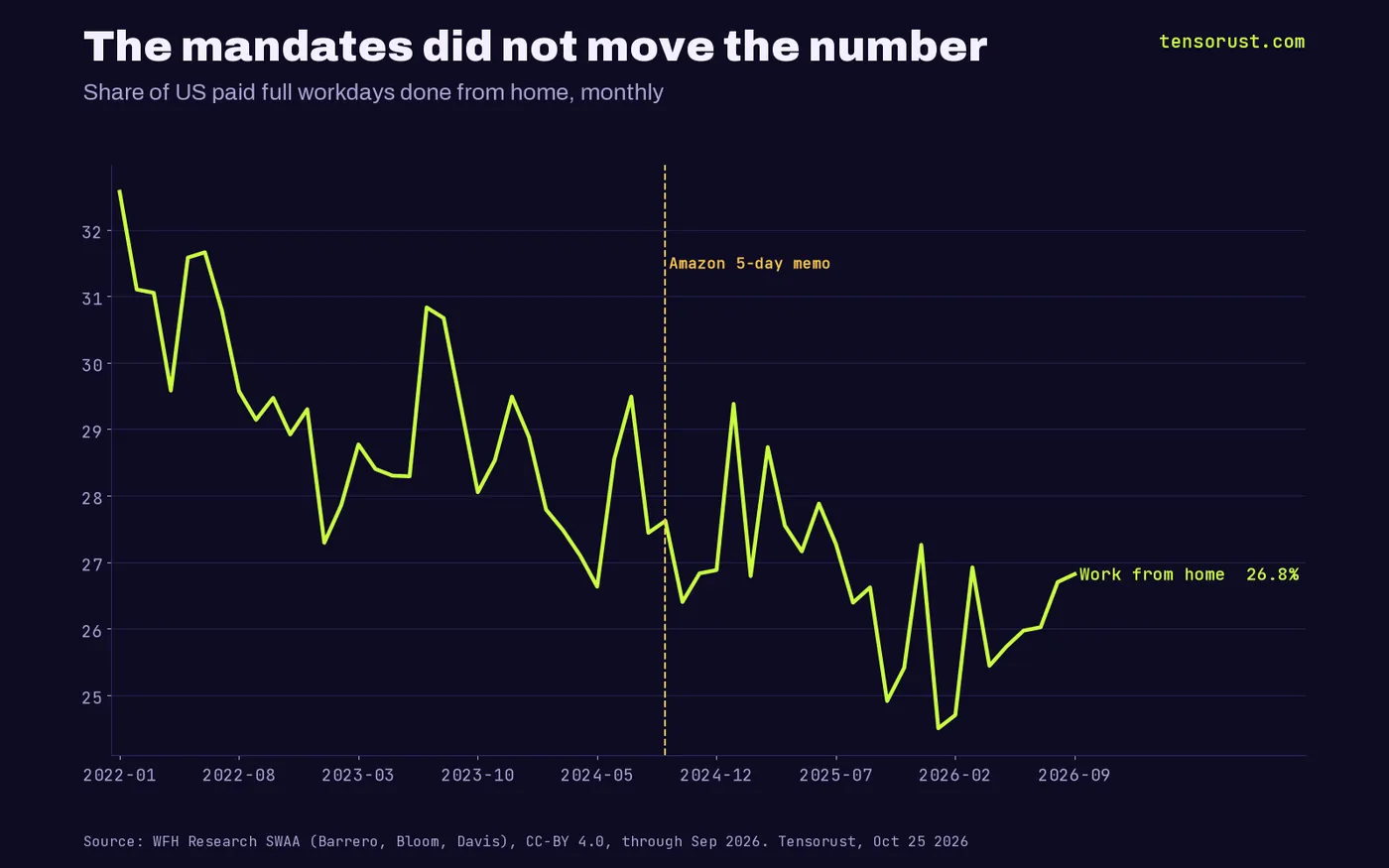
WFH Research, the Stanford-led survey run by Jose Maria Barrero, Nick Bloom and Steven Davis, tracks the share of paid full workdays done from home every month. In September 2024, the month Andy Jassy told Amazon's corporate staff they were going back five days a week starting January 2, 2025, it was 27.6%. In January 2025, the month JPMorgan's operating committee told hybrid staff to come in five days a week, starting as early as March, it was 29.4%. That same month President Trump's January 20, 2025 memo told every federal agency to "terminate remote work arrangements." In September 2026 the number is 26.8%.
That is less than one point of movement after the loudest return to office campaign in history. Before COVID the number was 7.2%. Work from home did not lose. It settled at nearly four times its old level and stayed there.
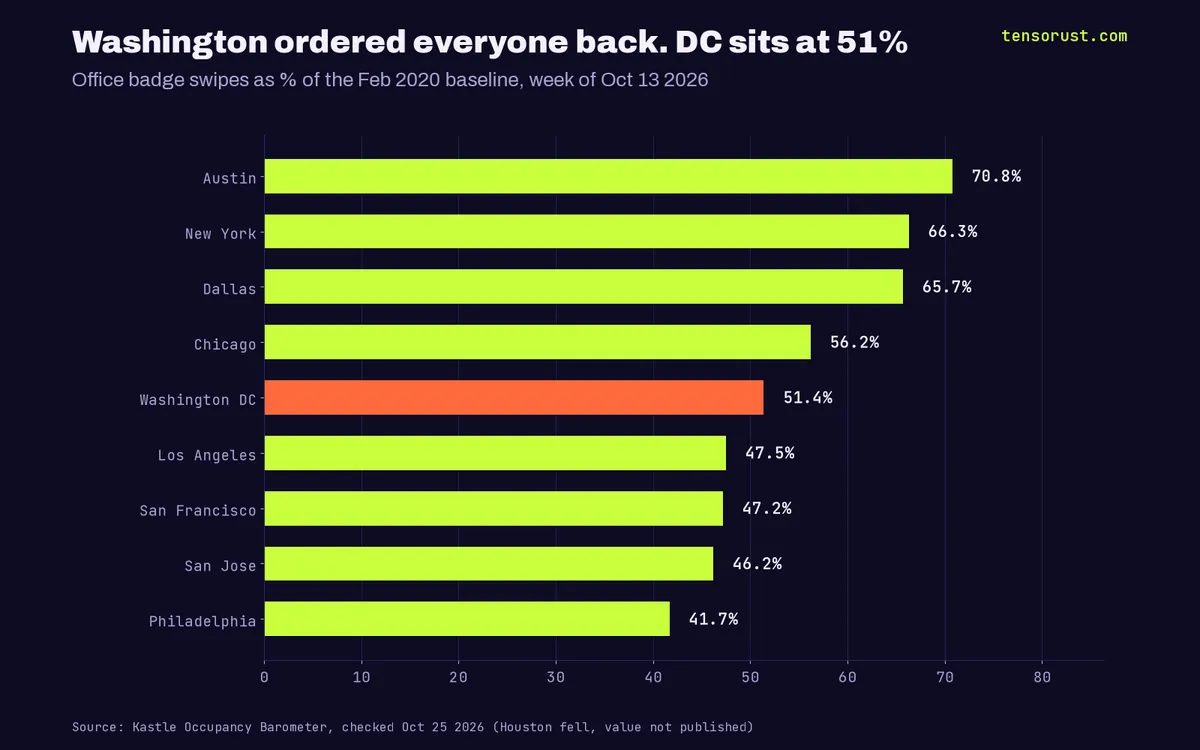
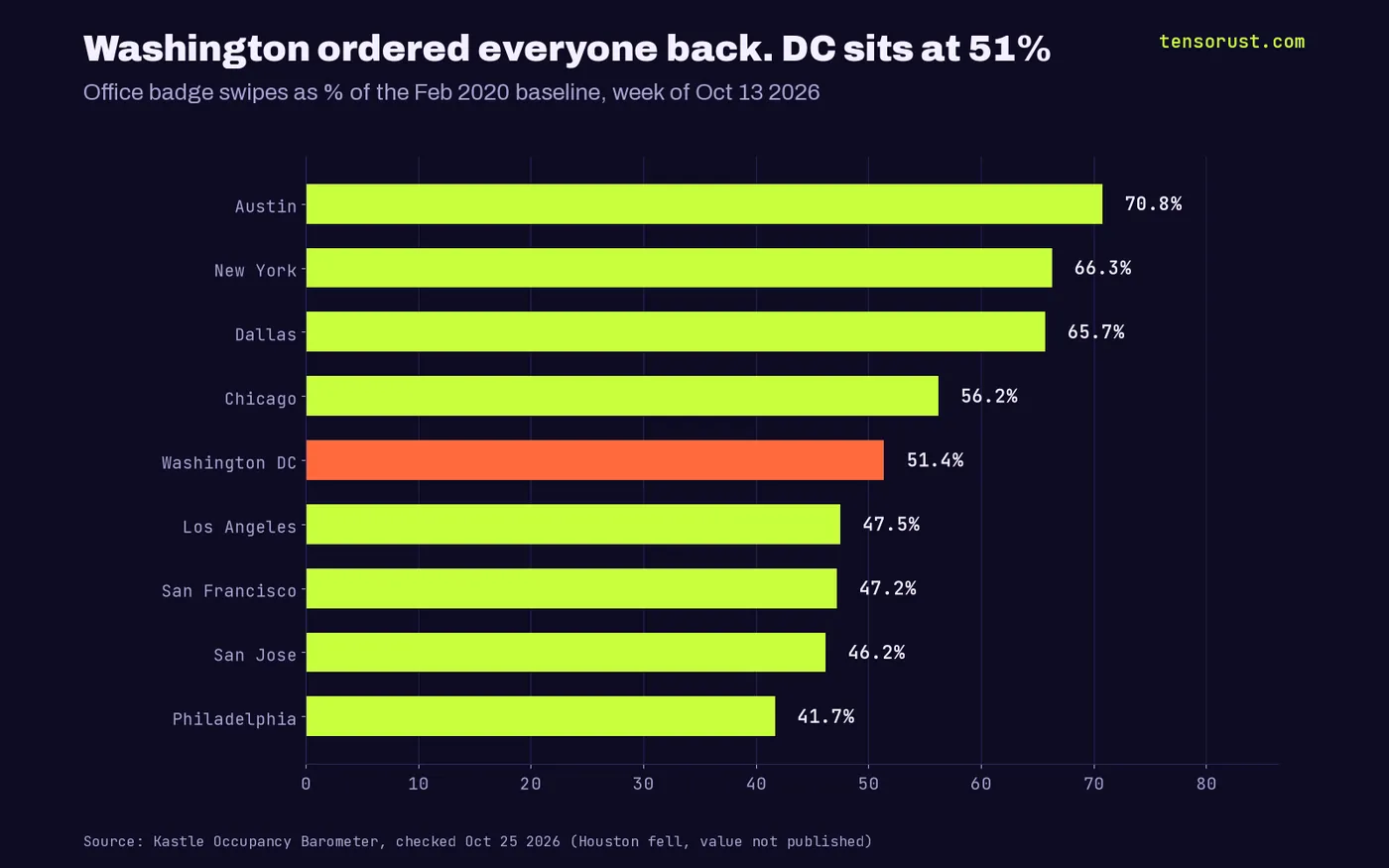
The buildings tell the same story from the other side. Kastle's badge swipes, from more than 300,000 users in 10 metros, put national office occupancy at 55.1% of the February 2020 baseline for the week of October 13, 2026. New York is at 66.3%. San Francisco is at 47.2%. Philadelphia is at 41.7%.
So here is the question nobody asking you back will answer: if the mandates do not fill the desks, what are they for?
The productivity case was tested, and it lost
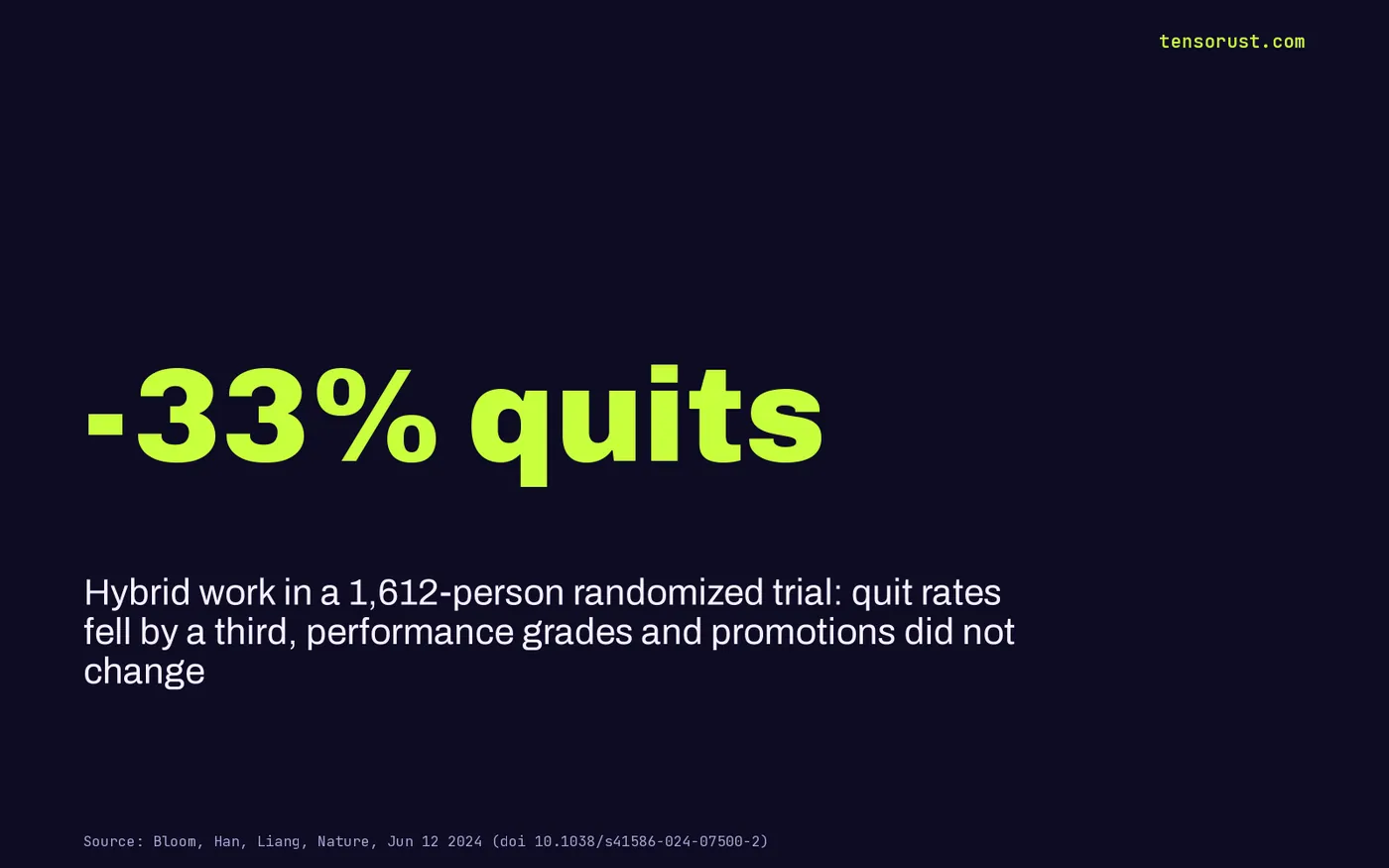
The best evidence on this is not a survey. It is a randomized trial, the gold standard, published in Nature in June 2024 by Nicholas Bloom, Ruobing Han and James Liang. They put 1,612 employees at Trip.com on a schedule with two days a week at home for six months and tracked them for two years.
Hybrid work cut quit rates by one third. Performance grades did not change. Promotions did not change. Lines of code written by engineers did not change. The 395 managers in the trial went from expecting a 2.6% productivity hit to estimating a 1.0% gain once they saw the data.
Then look at why the mandates actually get issued. Mark Ma and Yuye Ding at the University of Pittsburgh studied S&P 500 firms that announced mandates. Their read: the data is "consistent with employees' concerns that managers use RTO for power grabbing and blaming employees for poor performance," and the mandates hurt employee satisfaction but do not improve firm performance.
And some bosses just said it out loud. In a BambooHR survey reported by Fox Business in July 2024, about one quarter of VPs and C-suite executives admitted they rolled out return to office policies hoping for "voluntary turnover." That is a layoff without the severance.
Follow the money: the loans behind the towers
Now look at who is bleeding. An office tower is not just a building. It is a loan, and usually several. The loan was underwritten on rent from tenants who needed the space. Empty floors mean less rent, less rent means a lower appraisal, and a lower appraisal means the loan is worth less than the paper says.
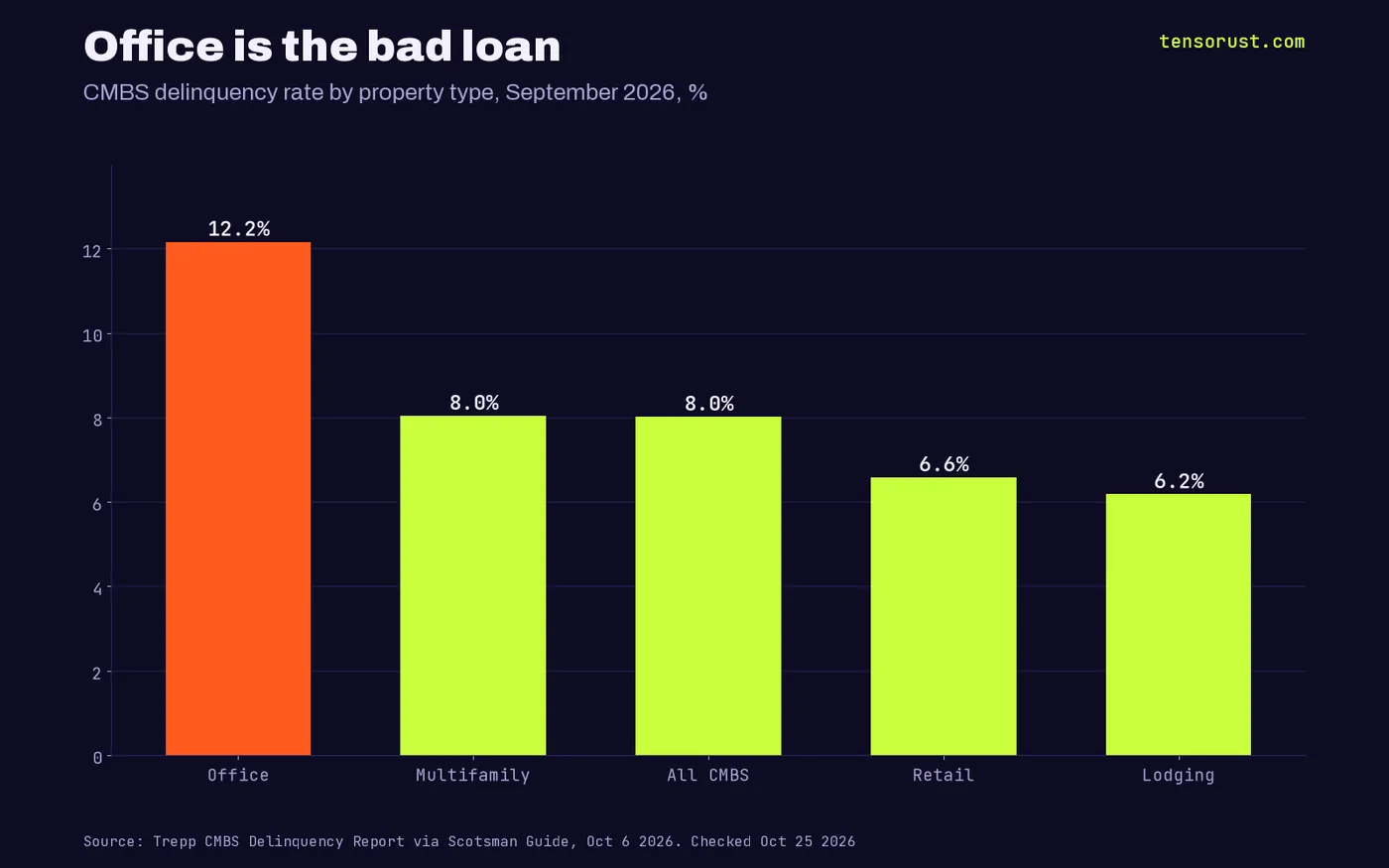
That is exactly what is happening. Moody's put national office vacancy at a record 21% in Q1 2026, up from 17% at the start of the pandemic. Trepp's office CMBS delinquency rate, the share of office loans packaged into bonds that are behind on payments, hit 12.16% in September 2026. It set an all-time high of 12.34% in January. Multifamily is at 8.04%, retail 6.58%, lodging 6.18%.
And the bill keeps coming due. The Mortgage Bankers Association says $875 billion of commercial mortgages mature in 2026, 17% of all $5.0 trillion outstanding, including 17% of office loans. Banks and thrifts service $396 billion of that. Every one of those loans needs a fresh appraisal or an extension, and an appraiser looks at occupancy.
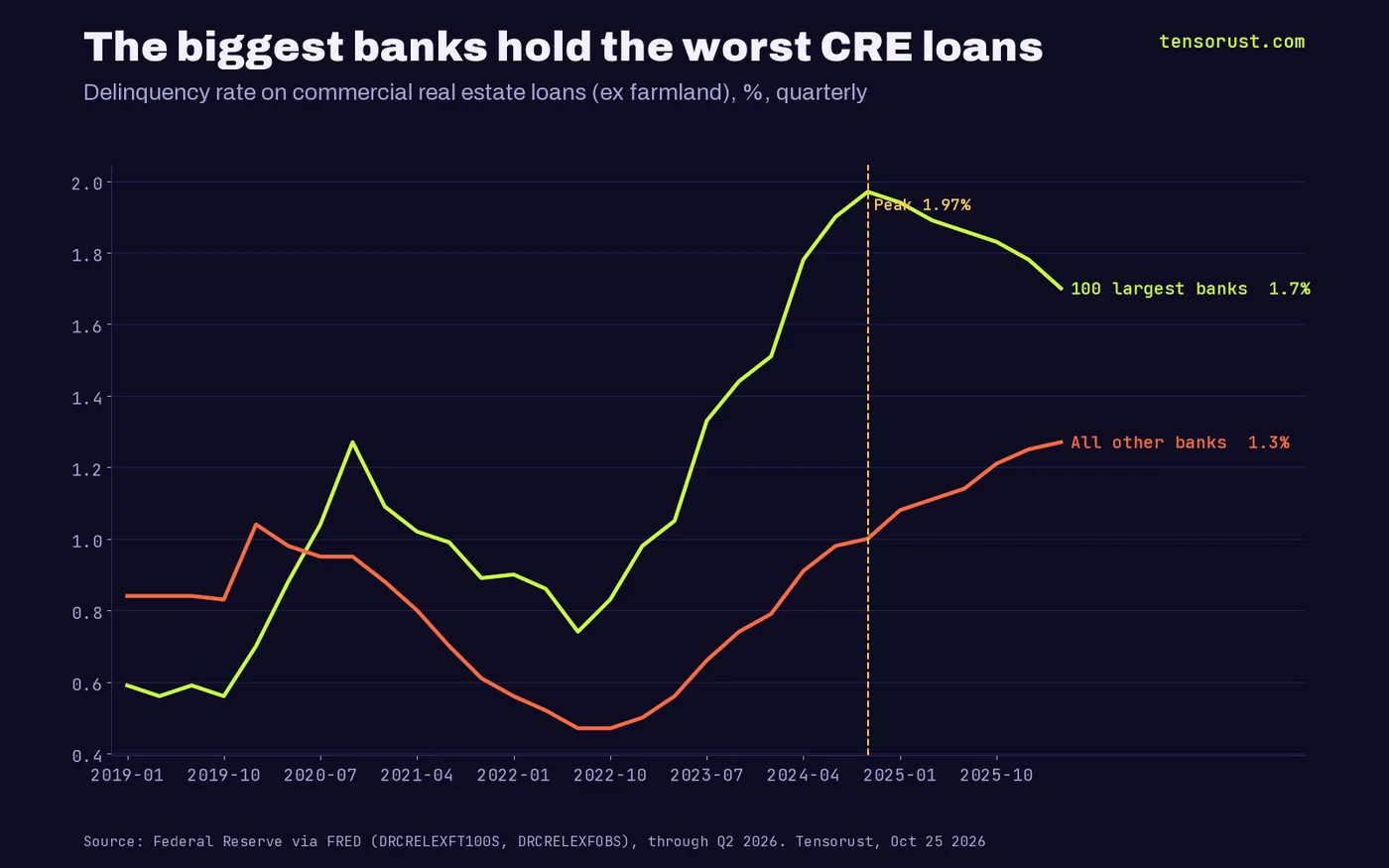
Banks did not shrink their exposure. They grew it. Federal Reserve data shows commercial real estate loans on US bank books rose from $2.30 trillion in December 2019 to $3.16 trillion in October 2026. The delinquency rate on those loans at the 100 largest banks went from 0.56% in late 2019 to a peak of 1.97% in Q4 2024. At every other bank it is still climbing, to 1.27% in Q2 2026, the highest since 2015.
Who sits on both sides of the desk
Here is the part that should make you suspicious. The loudest mandate voices are also the biggest stakeholders in the buildings.
JPMorgan is New York City's largest private office tenant, according to Bisnow, and it built a 60-story, 1,388-foot headquarters at 270 Park Avenue. It is also one of the 100 largest banks whose commercial real estate books carry the delinquency rate in the chart above. When the country's biggest bank says the office is where work happens, it is talking its own book twice: as a tenant that signed for the space and as a lender that needs downtown values to hold.
The federal government is the purest case. The White House ordered every agency back full time in January 2025. Washington DC badge swipes, 21 months later, sit at 51.4% of the 2020 baseline. The order did not fill the city. It did signal to every landlord, lender and downtown business group that Washington was on their side.
Executives also told surveyors the quiet part. A Resume.org survey reported by Fortune in December 2024 found half of companies that rent offices said their leases affected their return to office decisions, and 16% called it a "major impact." Half of those leases do not expire until 2028 or later. You are being asked to justify a contract you never signed.
The cities need you on the train
Then come the politicians. Office towers are taxed at a much higher effective rate than homes, so cities lean on them. The New York City Comptroller found that office buildings made up 21% of the FY2024 property tax levy and roughly 10% of all city taxes. In the Comptroller's downside case, falling office values open a $1.12 billion hole in the levy by FY2027.
That is why mayors cheer every mandate. Your commute props up the assessed value of the building, the building props up the tax roll, and the tax roll props up the budget. None of that is about whether you write better code in a cubicle.
The office bailout already has its own lobby
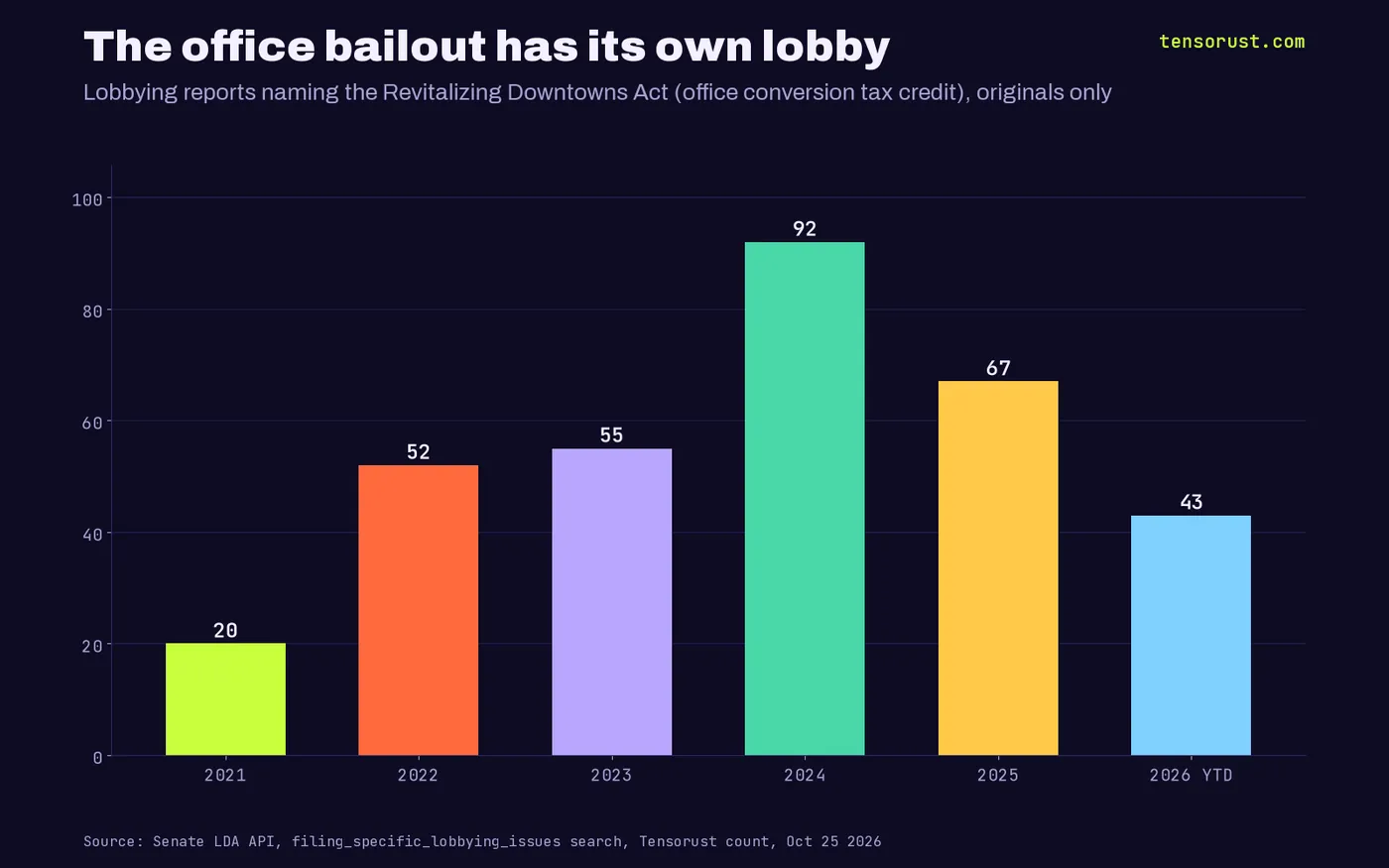
If the industry believed the office was coming back, it would not need a federal tax credit to turn offices into something else. It wants one. The Revitalizing Downtowns Act would give a tax credit for converting office buildings, and it has become a lobbying fixture.
We counted lobbying reports in the Senate LDA database that name it. There were 20 original filings in 2021, 52 in 2022, 55 in 2023 and 92 in 2024, then 67 in 2025 and 43 so far in 2026. The clients include the National Association of Realtors, the Real Estate Roundtable, the Mortgage Bankers Association, Nareit, the National Multifamily Housing Council, the commercial developers' group formerly called NAIOP and, in 2026, the City of Dallas.
The money behind those names is large. The National Association of Realtors reported $54.1 million in in-house lobbying expenses in 2025 across all its issues, by our sum of its quarterly LDA reports. The Real Estate Roundtable reported $5.2 million. The Mortgage Bankers Association reported $2.4 million. When the same groups that need the towers full also lobby to have taxpayers pay for converting them, the message is clear: they know the old office is over, and they want two exits, your commute now and a subsidy later.
The best case for the office, and why it fails
Here is the strongest version of the other side. Juniors learn by watching seniors. Hard problems get solved at a whiteboard. Culture is built in hallways, and fully remote teams can drift. Even Bloom's trial tested hybrid, two days at home, not fully remote. That is all fair.
But look at what the mandates actually demand. Not two days, which the evidence supports, but five. Not coaching programs for juniors, but badge-swipe tracking for everyone. And they show up, per Ding and Ma, after weak stock performance, not after a mentorship study. If the goal were learning, the policy would look like Bloom's trial. It looks like a lease schedule instead.
The AI twist: why they need the mandate now
Here is our reading, and nobody has proven it yet. The mandate wave is not a return to 2019. It is a bridge to a smaller company, and AI is the reason the timing matters.
Look at the Amazon sequence, all from Amazon's own posts. September 16, 2024: five days a week, plus a demand to raise the ratio of individual contributors to managers by at least 15%. June 17, 2025: Jassy writes that AI efficiency will "reduce our total corporate workforce" over the next few years. October 28, 2025: about 14,000 corporate roles cut. The mandate came first. It thinned the ranks through quits, then AI justified the rest.
The same tools that make a small team productive from anywhere (agents that write code, draft docs and run meetings) are the tools that make a corporate tower look like a stranded asset. A company that runs on AI agents needs fewer desks, not more. So the people who own, lend against and tax those desks have a short window to keep the narrative alive: get the bodies back in, keep the occupancy reports up, refinance the $875 billion while the appraisals still look reasonable.
Our bet: the mandates fade quietly once the big maturities are refinanced, the conversion credits pass, and the layoffs are done. The work from home share will still be about 27% when they do.
What this means for you
Treat a five-day mandate as a negotiation about someone else's balance sheet, not a verdict on your work. Ask your employer what share of its costs are leases, check whether it is a big commercial real estate lender, and bring the Bloom trial to the table when you ask for two days at home.
Then build your leverage where the data says the jobs are going. Hybrid and remote roles are about 42% of arrangements in the latest WFH Research data, and the people who land them can show results without a badge swipe. If you are looking, our $10 Job Hunt Kit matches your resume to the post and writes a cover letter that sounds like you, offline. If it does not get you there, we keep working on it at no extra cost until it does.
More from us: the rest of our opinion pieces, our case that AI data centers are not why your power bill rose, the new class line between people who earn online and people who do not, and every economics piece.
This is not financial advice. Do your own research before you make any investment or career decision.
Sources
- Kastle Systems, Kastle Occupancy Barometer, week of Oct 13 2026, checked Oct 25 2026
- WFH Research, Survey of Working Arrangements and Attitudes time series (Barrero, Bloom, Davis, CC-BY 4.0), data through Sep 2026, checked Oct 25 2026
- Bloom, Han, Liang, "Hybrid working from home improves retention without damaging performance", Nature, Jun 12 2024
- University of Pittsburgh, Mark Ma and Yuye Ding, Return-to-Office Mandates, checked Oct 25 2026
- Fox Business, BambooHR survey on RTO and turnover, Jul 25 2024
- Scotsman Guide, Trepp CMBS delinquency for September 2026, Oct 6 2026
- Connect CRE, Trepp office delinquency all-time high of 12.34%, Feb 5 2026
- Bisnow, Moody's office vacancy hits 21% in Q1, Apr 6 2026
- MBA NewsLink, 17% of commercial and multifamily mortgage balances to mature in 2026, Feb 10 2026
- Federal Reserve H.8, CRE loans at all commercial banks, via FRED, checked Oct 25 2026
- Federal Reserve, CRE delinquency rate, 100 largest banks and all other banks, via FRED, through Q2 2026
- Senate Lobbying Disclosure Act API, filings naming the Revitalizing Downtowns Act and client expense reports, pulled Oct 25 2026
- NYC Comptroller, What risks does the office market pose for the City's finances, Jun 13 2023
- Fortune, Office leases driving RTO policies (Resume.org survey), Dec 23 2024
- Bisnow, JPMorgan calls managing directors back full time, Apr 12 2023
- WJLA, JPMorgan demands staff return five days a week, Jan 13 2025
- The White House, Return to In-Person Work, Jan 20 2025
- Amazon, Andy Jassy return to office memo, Sep 16 2024; generative AI memo, Jun 17 2025; workforce reduction, Oct 28 2025
First published here on tensorust.com on Oct 25, 2026. Related: Opinion, All opinion pieces, The utility rate grab.
Up next
More on OpinionAI data centers aren't why your power bill is up. Utilities arePower bills rose 49% where demand fell and 29% where it grew fastest. Utilities lifted capex 58% to $73B. The AI power panic is their cover story.Read it next →Cite this
Free to cite and reuse under CC BY 4.0 with a link back. How it was collected: methods. Spotted an error? Corrections.
Did this answer your question?
Get the next one by email.
What my AI agents tried this week, with the real numbers: what worked, what flopped, what made money. One email when there is something worth reading.
No spam, never sold. Every email has a one-click unsubscribe.
What are people saying about this? Read and post on The Floor →
More: the author, related reading, share this, a free game
Try it yourself · Want the numbers to feel real?
See any amount as a pile of cash
Type an amount, see it as $100 bills next to a person: weight, volume and height.
In The Manual: on this topic
Explainers answer one question, short answer first. Guides walk you through it step by step.
- Explainer · Money and the economyCan the Fed buy Treasuries directly from the government?
- Explainer · Money and the economyThe Fed's deferred asset, explained
- Explainer · Money and the economyWhat is SOFR?
- Explainer · Money and the economyWhat are bank reserves?
Read next
- Economics · Oct 25, 2026 · 10 min readAI data centers aren't why your power bill is up. Utilities are
- AI · Oct 25, 2026 · 14 min readThe new class divide: 3 tiers, and 3 in 4 workers sit out the AI one
- AI · Oct 24, 2026 · 14 min readAI isn't overhyped. Prices fell 99% and it feels like nothing changed