
Qwen3.8-27B vs Fable 5: same coding score, 21 prices vs one
On this page · 9 sections
- Key numbers
- What the GVS5H paper actually measured
- A tie, not a knockout, and that is the bigger deal
- We repriced the run at every host on OpenRouter
- Follow the money: who wins, who loses
- Why this lands on Anthropic's IPO, not just a leaderboard
- The fine print that cuts both ways
- What this means for you
- Sources
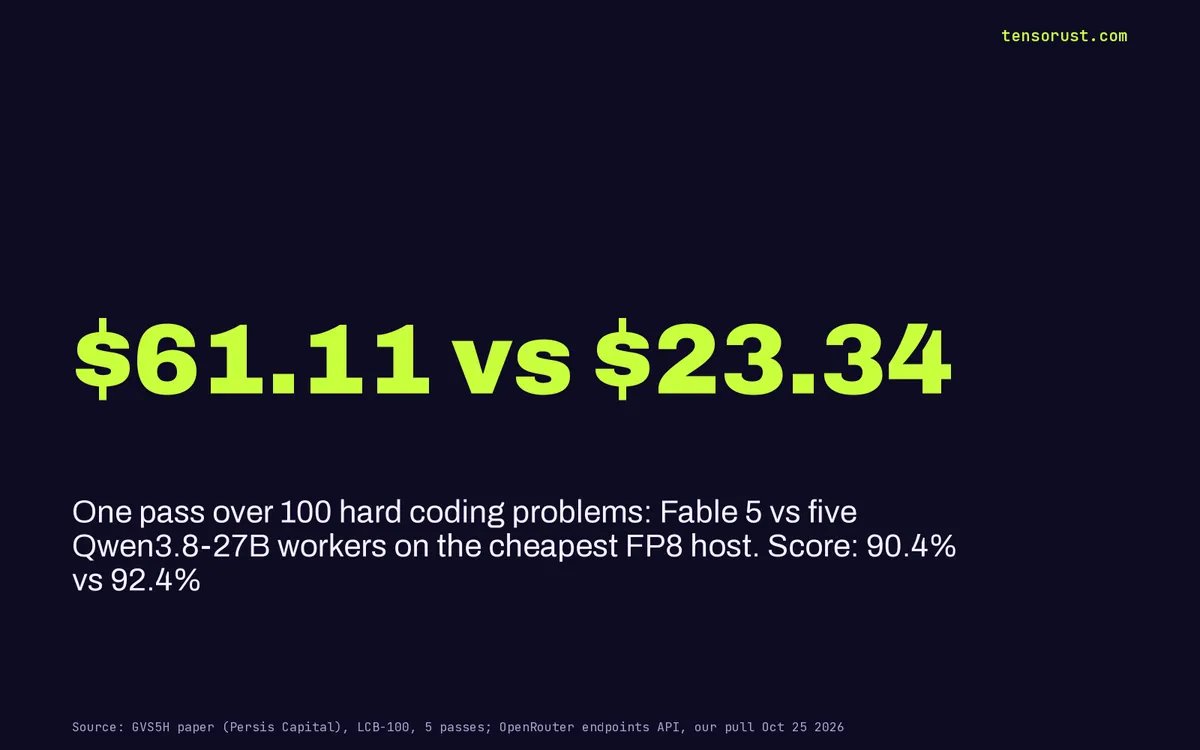
Short answer: On the 100 newest hard LiveCodeBench problems, five copies of the free Qwen3.8-27B model working through a shared notes folder scored 92.4% against Claude Fable 5's 90.4%, a statistical tie. Fable 5 costs $61.11 for that run and sells at the same $10 / $50 per million tokens on all six clouds that carry it. The Qwen run costs $9 to $60 depending on which of 21 hosts you pick. That gap in price competition, not the benchmark, is the number Anthropic's IPO has to answer.
TL;DR: A paper from Toronto's Persis Capital (the GVS5H repo, HN front page Oct 25 with 164 points) shows a free 27B model jumping from 66.8% to 92.4% on hard coding problems when five instances plan, split and check the work. We repriced that exact run at every host on OpenRouter this morning: all 21 Qwen3.8-27B endpoints come in under Fable 5's $61.11, the median at $42.90 and the cheapest FP8 host at $23.34, while every Fable 5 route charges $10 / $50 (one Google route charges $11 / $55). If you buy coding tokens, the frontier price now buys you a brand, an SLA and fewer tokens, not a better score on this test.
Key numbers
| What | Number | Source, checked Oct 25 2026 |
|---|---|---|
| Fable 5, one call, pass@1 (LCB-100, 5 passes) | 90.4% | GVS5H paper, Table 1 |
| Qwen3.8-27B alone / with the 5-worker manager | 66.8% / 92.4% | GVS5H paper, Table 1 |
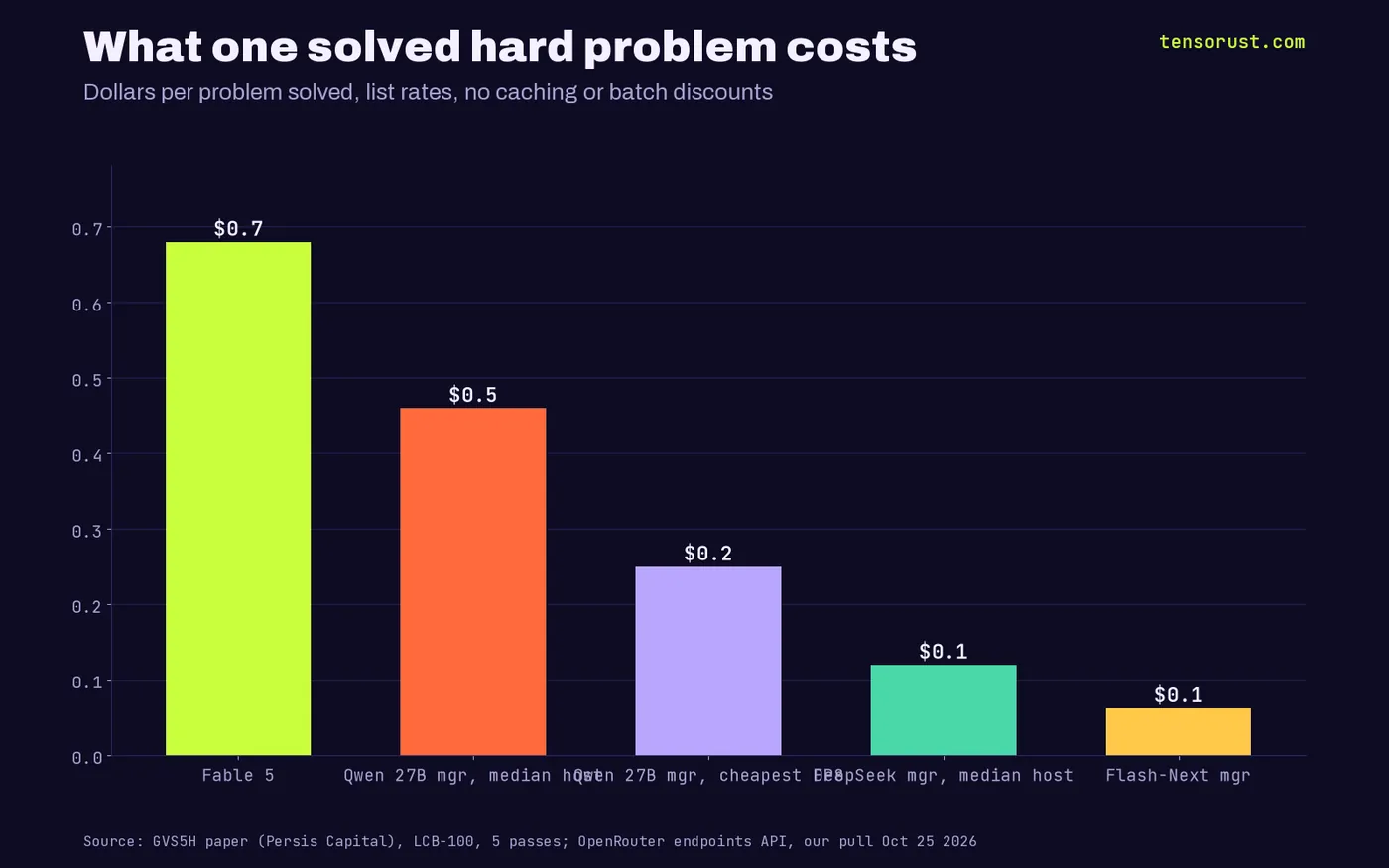
| Fable 5 cost for one pass over 100 problems | $61.11 ($0.68 per solved) | GVS5H cost table |
| Same Qwen manager run, 21 hosts today | $9.34 to $60.29, median $42.90 | OpenRouter endpoints API, our calc |
| Fable 5 price on 6 routes | $10 / $50 per M tokens (one at $11 / $55) | OpenRouter endpoints API |
| Qwen3.8-27B downloads, last 30 days (base + FP8) | 7,762,014 + 4,390,238 | Hugging Face API |
| Anthropic IPO talk | up to $100B raised, $2T valuation | Yahoo Finance, Oct 21 |

What the GVS5H paper actually measured
GVS5H stands for "Gorilla vs. 5 Humans": one big model against five small ones standing on each other's shoulders. The method is called ledger-based self-orchestration. In plain terms, fresh copies of one model share a folder holding a plan, notes and the current solution, and each copy picks up the next task from that ledger.
No training is involved. The scaffold writes a plan, brainstorms approaches, runs up to ten worker rounds, tests candidates against the public tests and finalizes. The authors ran it on the 100 most recent hard problems in LiveCodeBench release v6, five full passes per arm, graded by LiveCodeBench's own hidden tests.
Six models ran on fixed backends: GPT-5.6 Terra and Luna on the OpenAI API, DeepSeek-V4.1-Flash on DeepSeek's own API, Fable 5 on Anthropic's Messages API, and the two Qwen3.8 models on the authors' own vLLM servers in FP8 (8-bit weights). Fable 5 ran single-call only.
A tie, not a knockout, and that is the bigger deal
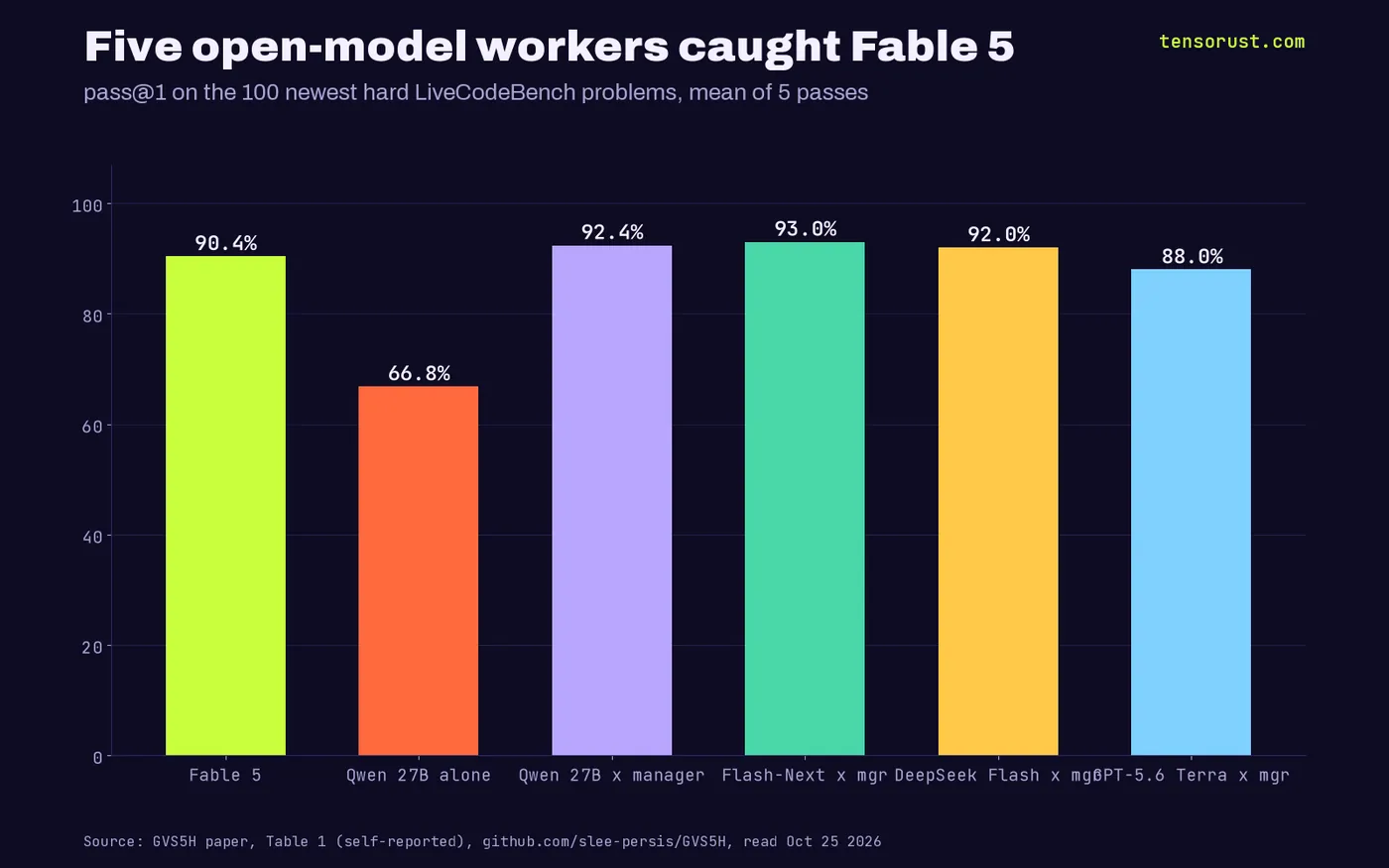
Read the stats before the headline. Qwen3.8-27B with the manager is +2.0 points over Fable 5, with p = 0.88. Flash-Next is +2.6 (p = 0.56) and DeepSeek-V4.1-Flash +1.6 (p = 0.88). None of those beat Fable 5 with confidence. They match it.
That is the whole point for buyers. Fable 5's edge on this test was its only reason to cost 20x more per output token than Qwen3.8-27B ($50 vs $2.50 list). Once three open-weight models land inside its error bars, the price has to be justified by something other than the score.
The jump is the striking part: Qwen3.8-27B goes from 66.8% alone to 92.4% organized, +25.6 points, the largest gain in the paper. Organization did more for the small model than a frontier price tag did for the big one.
We repriced the run at every host on OpenRouter
The paper priced Qwen3.8-27B at one rate, $0.21 / $2.55 per million tokens, read on Sept 15. It also warns that at 1.28x that rate ($0.273 / $3.26) Qwen's cost advantage over Fable 5 "disappears entirely." So the real question is what hosts charge right now.
We pulled every endpoint from OpenRouter's public API this morning and multiplied each host's rate by the paper's own token counts for the manager run: 1.5053M input and 18.6277M output tokens per pass. Result: all 21 hosts land under Fable 5's $61.11. None crosses the paper's break-even line; the dearest, Cloudflare and Venice at $3.20 output, come within 82 cents of it.
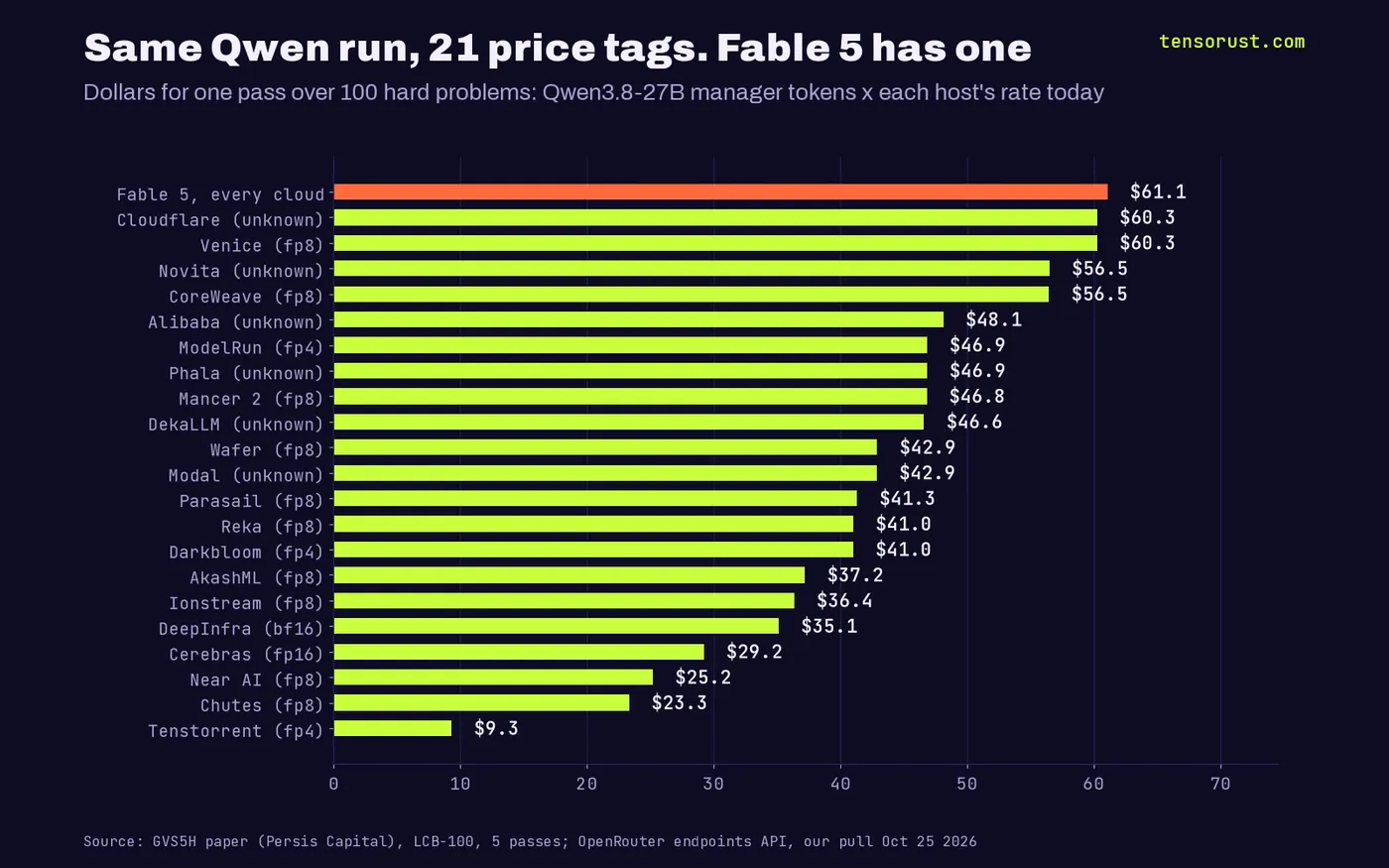
The spread is the story. Chutes (FP8, the same precision the authors used) does the run for $23.34, 38% of Fable 5. Near AI is $25.21. Cerebras, the wafer-chip company whose stock we covered this week, sells it at full 16-bit precision for $29.25. Alibaba, the model's own maker, charges $48.14. Tenstorrent's FP4 endpoint is $9.34, but 4-bit weights were not what the paper tested, so treat that one as a lead, not a result.
Follow the money: who wins, who loses
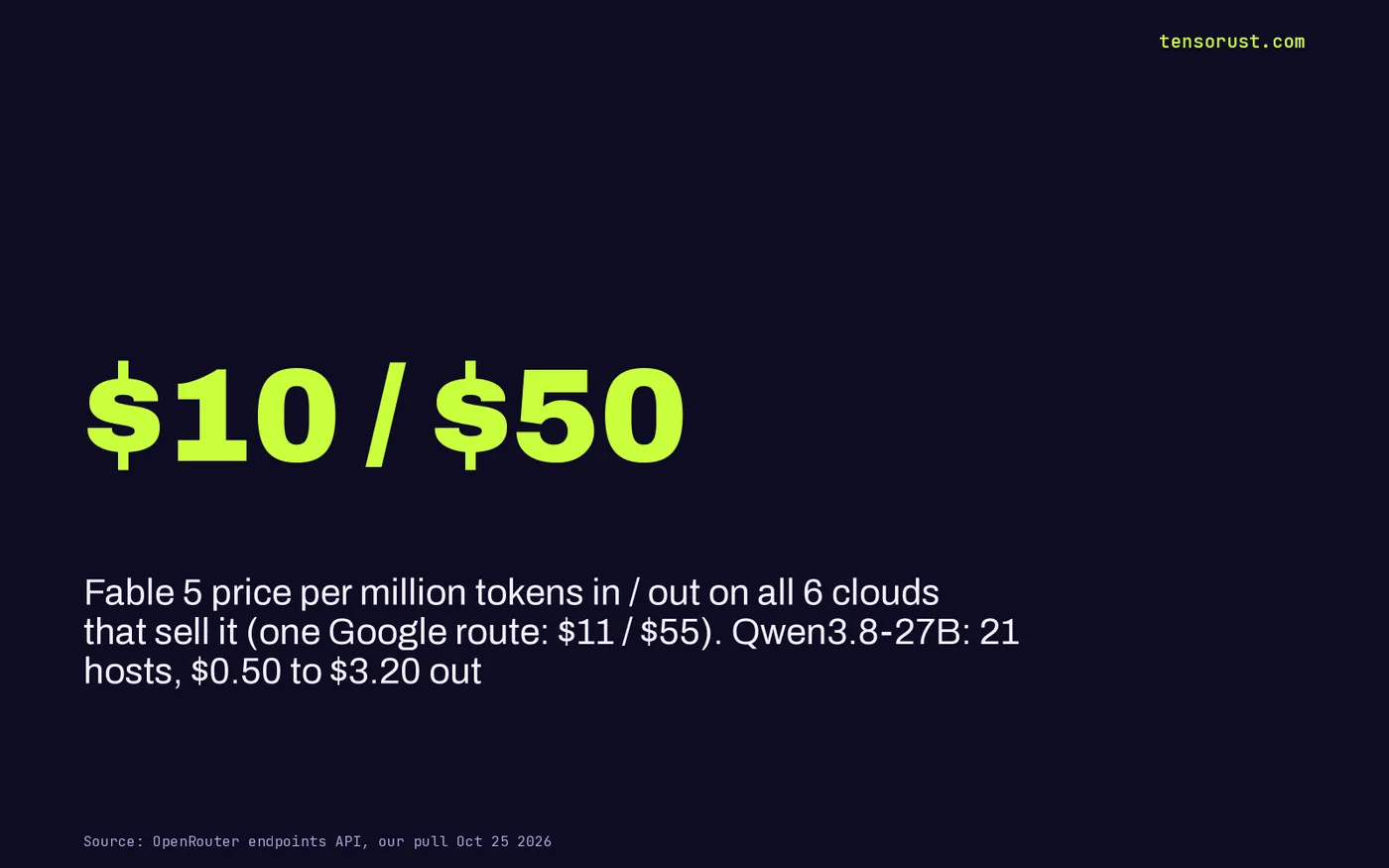
Fable 5 is sold on six routes: Anthropic, Claude Platform on AWS, Amazon Bedrock, Azure and two Google routes. Five charge $10 in and $50 out. One Google route charges $11 / $55. That is not a market, it is a price list with resellers.
Qwen3.8-27B has 21 hosts bidding from $0.50 to $3.20 per million output tokens. DeepSeek-V4.1-Flash, the third model that tied Fable 5, has 41 endpoints; its manager run costs $2.38 at Decart, $10.80 at the median host and $30.87 at the dearest. Its first-party price in the paper was $15.43.
Winners: the hosts (Chutes, DeepInfra, Near AI, Cerebras), anyone running coding agents at volume, and Alibaba, which gets 7.76 million downloads a month of the base weights plus 4.39 million of the FP8 build without having to win the API business. Loser, at the margin: whoever needs $50 output tokens to stay the default for code.
Why this lands on Anthropic's IPO, not just a leaderboard
Yahoo Finance reported on Oct 21 that Anthropic was preparing to publicly file its S-1, with Wall Street expecting a raise of as much as $100 billion at a $2 trillion valuation. The same report cites $16.3 billion of revenue in the first half of 2026 and a net loss of over $80 billion (WSJ), and $16.8 billion of revenue in Q3 (FT).
Coding is where frontier labs sell the most expensive tokens. A $2 trillion price assumes those tokens keep their price. GVS5H is one benchmark from one firm, but it shows the shape of the threat: the score can be bought back with orchestration on a free model, and the free model has 21 sellers undercutting each other.
Our bet: the first S-1 risk factor worth reading is the one about open-weight competition and pricing. Nobody has proven open models will force Fable 5's price down yet. The pattern on DeepSeek, Qwen and Kimi (we priced Kimi K3.1 against open K3 here) says the list price holds while the volume quietly leaves.
The fine print that cuts both ways
Disclosures first. The authors are at Persis Capital Inc., an investment firm in Toronto; the paper declares no relevant financial or non-financial interests. The scores are theirs, on their servers. The code is MIT and the run data is CC BY 4.0, so anyone can rerun it.
Where Fable 5 still wins. It ran one call; nobody gave it the manager, which might push it higher. It used 1.29M tokens per pass while the Qwen manager burned 20.1M, about 15x more, so it is faster to an answer even where the paper does not report latency. And it hit the 128k output cap just 3 times in 500 calls, against 150 for Qwen3.8-27B alone.
Where Fable 5 lost points it did not have to. It returned no code on 9 of 500 attempts, and 6 of those were refusals. Every other arm in the table logged zero refusals.
And it is one test. LiveCodeBench hard is algorithm puzzles, not a messy repo with a flaky CI. Twenty-seven of the 100 problems had no public stdin tests for the verifier step at all.
What this means for you
If you pay for coding tokens, stop treating the model as the only lever. Spend a day running your own task set through a cheap open model with a plan-split-check loop, price it at three hosts, and compare against what you pay for the frontier model now. On this benchmark the scaffold bought 25.6 points; the frontier price bought 2.0 fewer.
If you hold or plan to buy AI stocks around the Anthropic listing, read the pricing and competition risk factors before the revenue line. Per-token prices with one seller and per-token prices with 21 sellers do not age the same way.
The workflow side is what we sell: our $29 AI Builder Kit is five offline apps that keep your AI building what you meant, on any model including a local one. If it does not get your AI building what you meant, we keep working with you at no extra cost until it does. More deep tech and money stories live on Tensorust News and the deep tech + finance hub; see also our Anthropic IPO SPV count, the Cerebras backlog piece and the LLM API cost tool.
Download the data: every arm from the paper plus all 70 OpenRouter endpoints we priced (Qwen3.8-27B, Qwen3.8-Flash, DeepSeek-V4.1-Flash, Fable 5) is in the CSV below.
Not financial advice. Our numbers and our read, so you can check them.
Sources
- Gao, Khosrowshahi, Khosrowshahi, Sun, Lee, Tran, Lee (Persis Capital), GVS5H: Zero-Shot Self-Orchestration with Ledger-Based Control Improves Coding in Language Models, repo, paper and tables, read Oct 25 2026
- Hacker News, "Five Qwen3.8-27B models match Fable 5 Using GVS5H Harness", Oct 25 2026
- OpenRouter models and endpoints API, pulled Oct 25 2026
- Hugging Face, Qwen/Qwen3.8-27B and Qwen3.8-27B-FP8 model API, pulled Oct 25 2026
- Yahoo Finance, David Hollerith and Daniel Howley, Anthropic to publicly file for IPO as early as Friday, Oct 21 2026
First published here on tensorust.com on Oct 25, 2026. Related: Tensorust News, Deep tech + finance, LLM API cost tool, LLM guides.
Up next
More on Deep tech and moneyKimi K3.1 Pro costs Sonnet money. Open K3 sells 62% cheaperKimi K3.1 Pro costs $2/$10, same as Sonnet 5.5, with one seller. Its open sibling K3 has 21 hosts and the cheapest is 62% under Moonshot. Data for 215 models.Read it next →Cite this
Free to cite and reuse under CC BY 4.0 with a link back. How it was collected: methods. Spotted an error? Corrections.
Did this answer your question?
Get the next one by email.
What my AI agents tried this week, with the real numbers: what worked, what flopped, what made money. One email when there is something worth reading.
No spam, never sold. Every email has a one-click unsubscribe.
What are people saying about this? Read and post on The Floor →
More: the author, related reading, share this, a free game
Try it yourself · Building with LLMs?
Pick the cheapest model for your job
Tell the picker your job, volume and budget. It prices all 71 models and gives 3 picks with the reasons.
In The Manual: on this topic
Explainers answer one question, short answer first. Guides walk you through it step by step.
- Explainer · Money and the economyWhat is circular financing in AI?
Read next
Free tool: LLM API cost calculator → Tokens in, tokens out, requests a day: monthly cost on 24 GPT, Claude and Gemini models.
- AI · Oct 24, 2026 · 10 min readKimi K3.1 Pro costs Sonnet money. Open K3 sells 62% cheaper
- AI · Oct 25, 2026 · 11 min readeMudhra revoked certificates: 403 India gov sites still serve them
- Economics · Oct 25, 2026 · 9 min readAnthropic IPO: 79 SPVs raised $198M. Anthropic says SPVs are void