
Apple's 30% App Store toll won't survive AI agents. Its filings know
On this page · 10 sections
- Key numbers
- The App Store is a shelf, and agents don't shop shelves
- Follow the money: a 75% margin is a toll, not a service
- The cracks are already in the numbers
- Who wins from the delay: read the lobbying reports
- The steelman: the store keeps you safe
- The twist: Apple doesn't own the agent that replaces it
- What happens next, our bet
- What this means for you
- Sources
Short answer: The App Store is a toll booth on a road that AI agents are about to stop using. When an agent finds the product, compares prices and pays on a protocol Stripe, Google, Shopify and OpenAI already publish, there is no shelf left to charge 30% for. Apple's own paperwork shows the pressure: Services still keeps 75.4 cents of every dollar as gross margin, but its June 2026 quarterly filing dropped the App Store from the list of growth drivers after nine straight filings that named it, and its lobbying reports on app store bills went from 0 in 2019 to 22 in 2025.
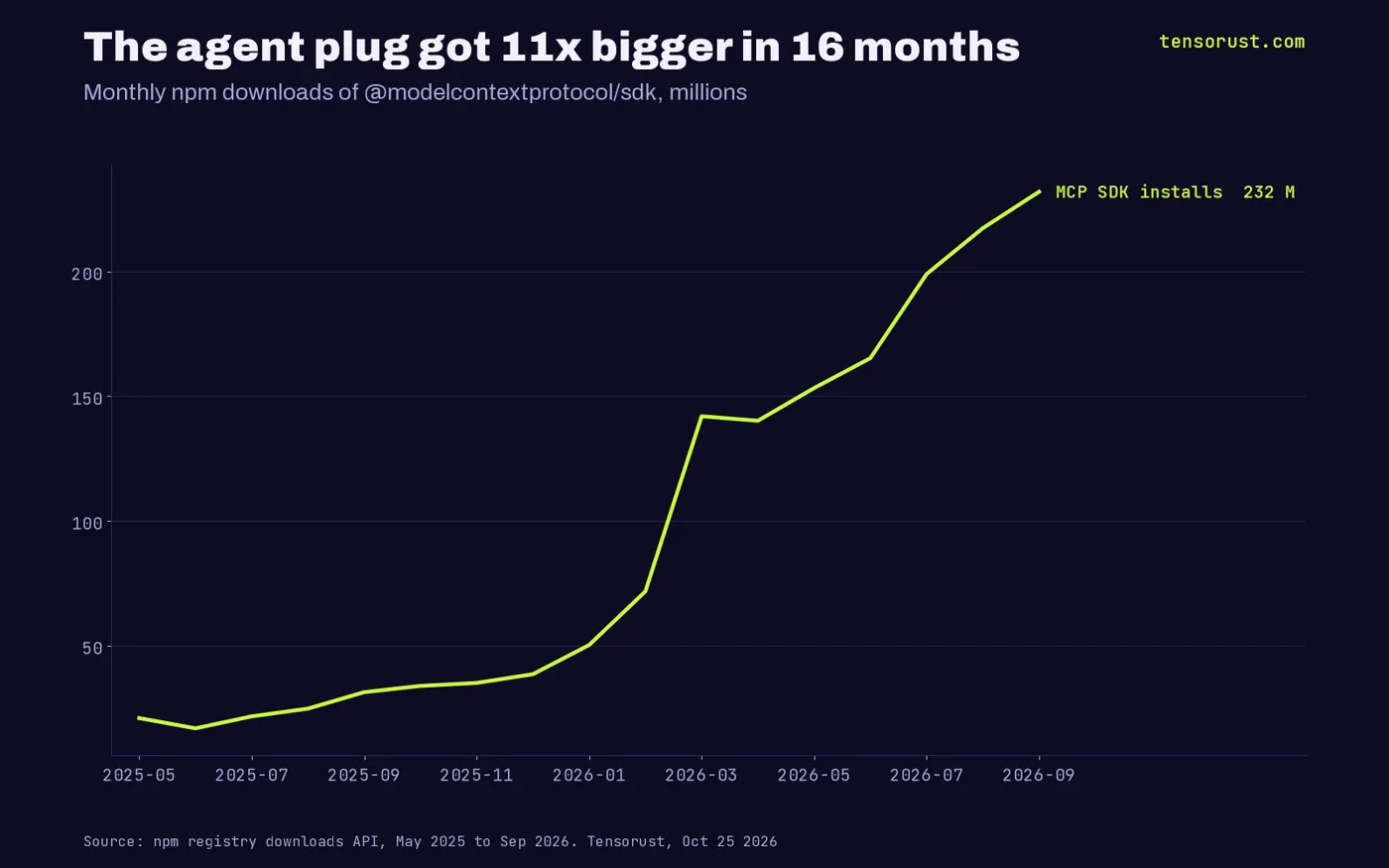
TL;DR: Apple made $109.2 billion in Services in fiscal 2025 at a 75.4% gross margin, against 36.8% on the iPhones and Macs it actually builds. Since a federal court stopped it charging on link-out purchases in April 2025, Appfigures data cited by the Financial Times shows Apple's US commission revenue down 18% in 2026, and the Supreme Court took Apple's appeal on June 30 2026. Meanwhile npm installs of the Model Context Protocol SDK, the plug that lets agents use apps without opening them, went from 20.9 million a month to 231.9 million in 16 months. The store is not losing a lawsuit. It is losing the customer.
Key numbers
| What | Number | Source, checked Oct 25 2026 |
|---|---|---|
| Apple Services net sales, fiscal 2025 | $109.2B (26% of sales, 42% of gross profit) | Apple 10-K FY2025 |
| Gross margin, Services vs Products, FY2025 | 75.4% vs 36.8% (Services was 55.0% in FY2017) | Apple 10-K FY2025, 10-K FY2019 |
| Services, quarter ended Jun 27 2026 | $30.7B, down from $31.0B the quarter before; analysts expected $31.4B | Apple 10-Q Q3 FY2026, MacRumors |
| Apple US App Store commission revenue, 2026 so far | Down 18% | Appfigures via FT, reported by MacRumors, Aug 18 2026 |
| Link-out fee Apple tried after the 2021 injunction | 27%, ruled contempt Apr 30 2025 | The Verge, Dec 11 2025 |
| Apple lobbying reports naming app store bills or app competition | 0 (2019) to 22 (2025) | Senate LDA API, our count |
| Monthly npm downloads, MCP SDK | 20.9M (May 2025) to 231.9M (Sep 2026) | npm registry API |
| Fee ChatGPT charges when it sends a shopper to your own site | $0 | chatgpt.com/merchants |

The App Store is a shelf, and agents don't shop shelves
Strip the branding off and the App Store does three jobs: it helps you find software, it takes your money, and it vouches that the thing is safe. Apple charges for all three with one number, 30% on digital goods (15% for small developers).
An AI agent does the first two jobs better and for less. It does not browse a ranked grid of icons. It reads a product feed, compares five options in a second, and pays through whatever rail the merchant accepts.
That rail already exists. On September 29 2025 Stripe and OpenAI launched Instant Checkout in ChatGPT on an open standard called the Agentic Commerce Protocol, starting with Etsy sellers and "over a million Shopify merchants". On January 11 2026 Google launched the Universal Commerce Protocol, co-developed with Shopify, Etsy, Wayfair, Target and Walmart and endorsed by Visa, Mastercard, American Express and Stripe.
Look at who is not on either list. The company that runs the most valuable app storefront in the world is a spectator at the birth of the next storefront.
Follow the money: a 75% margin is a toll, not a service
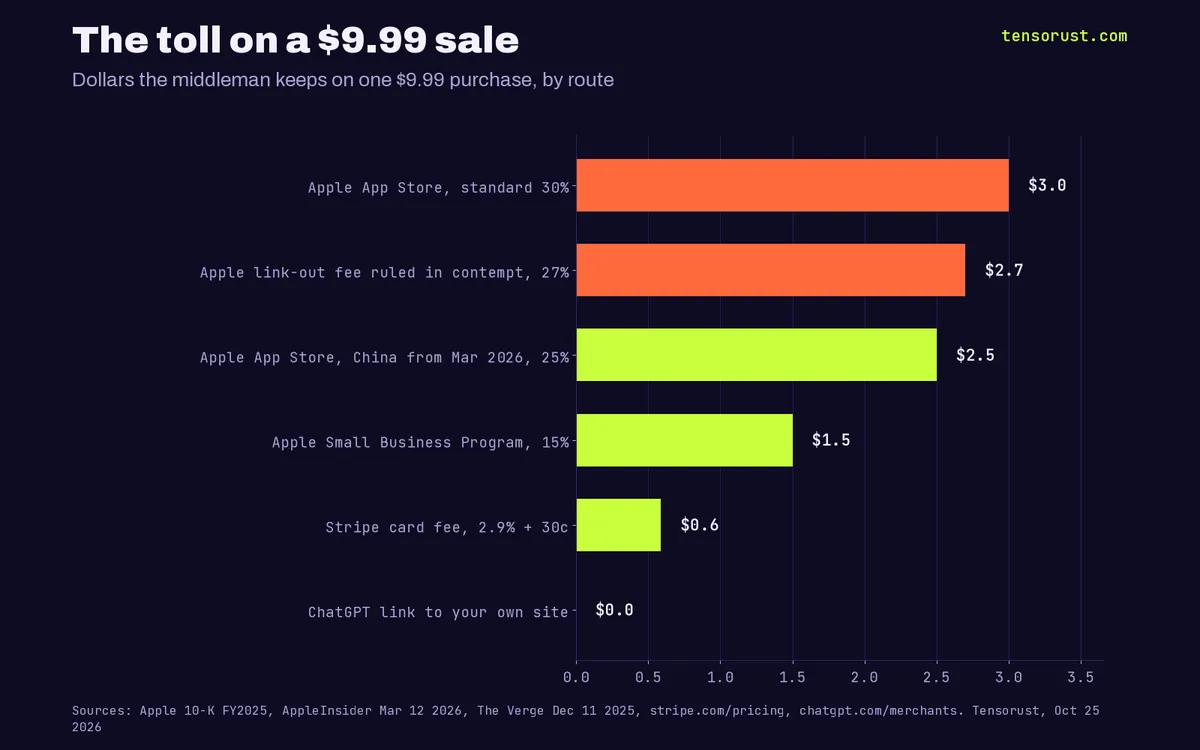
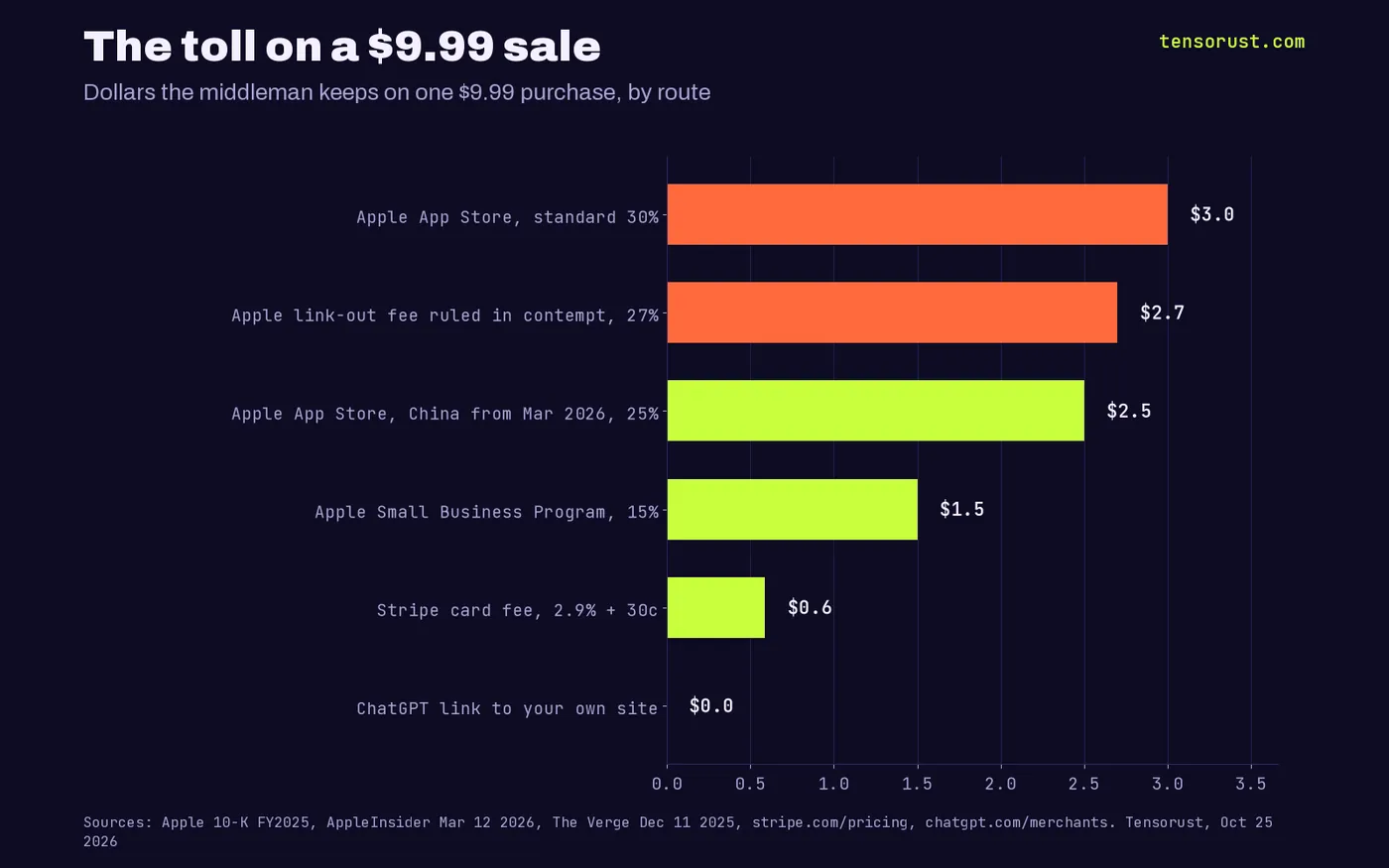
Here is what the toll costs on a $9.99 purchase. Apple keeps $3.00 at the standard rate. A card processor like Stripe takes about $0.59 (2.9% plus 30 cents). ChatGPT's merchant page says it charges "no fees for purchases made on your site or app" when it sends a shopper there.
The filings show where that gap goes. Apple's Services gross margin climbed from 55.0% in fiscal 2017 to 75.4% in fiscal 2025, and 76.3% for the first nine months of fiscal 2026. Products, the physical machines with chips, glass and factories behind them, sit at 36.8%.
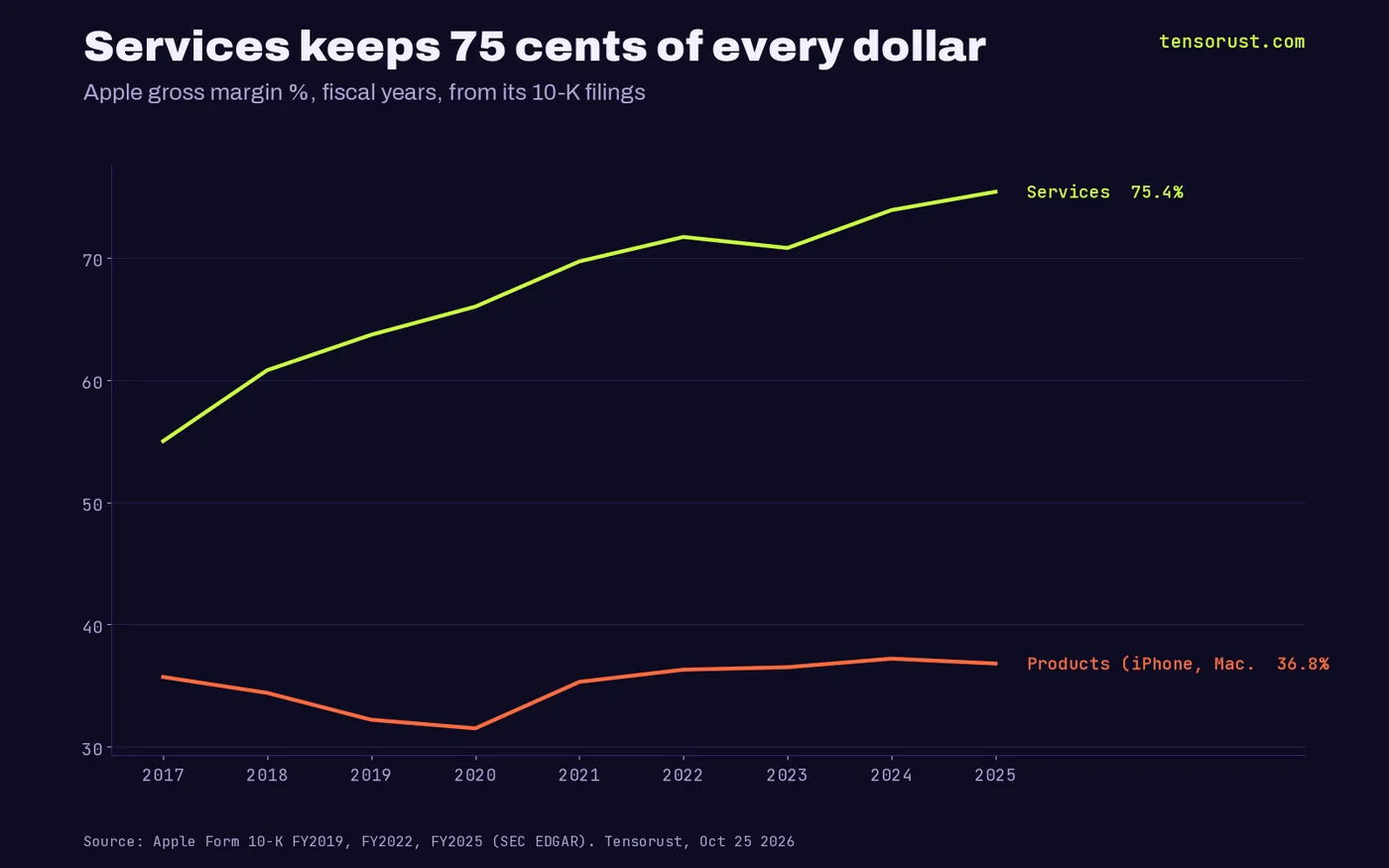
Services is 26% of Apple's revenue and 42% of its gross profit: $82.3 billion of the $195.2 billion Apple kept after costs in fiscal 2025. Apple's 10-K is plain about the mechanics: for third-party apps it books "only the commission it retains". That is the business. Not the software, the cut.
This is why the fight matters more to Apple than anything it builds. A phone company with a 37% margin is a great hardware maker. A toll operator with a 75% margin on top of that is the reason the stock trades the way it does. Not financial advice, just the arithmetic in the filings.
The cracks are already in the numbers
The toll first broke where a court forced it open. In April 2025 Judge Yvonne Gonzalez Rogers found Apple had "willingly" dodged her 2021 order by putting a 27% fee on purchases made through outside links, and barred any commission on them. Apple's own 10-K says she also referred the company to the US Attorney to weigh criminal contempt.
The Ninth Circuit upheld the contempt finding on December 11 2025, while saying Apple may eventually charge some "reasonable, non-prohibitive" fee. Apple went to the Supreme Court, which agreed on June 30 2026 to review the legal standard for civil contempt.
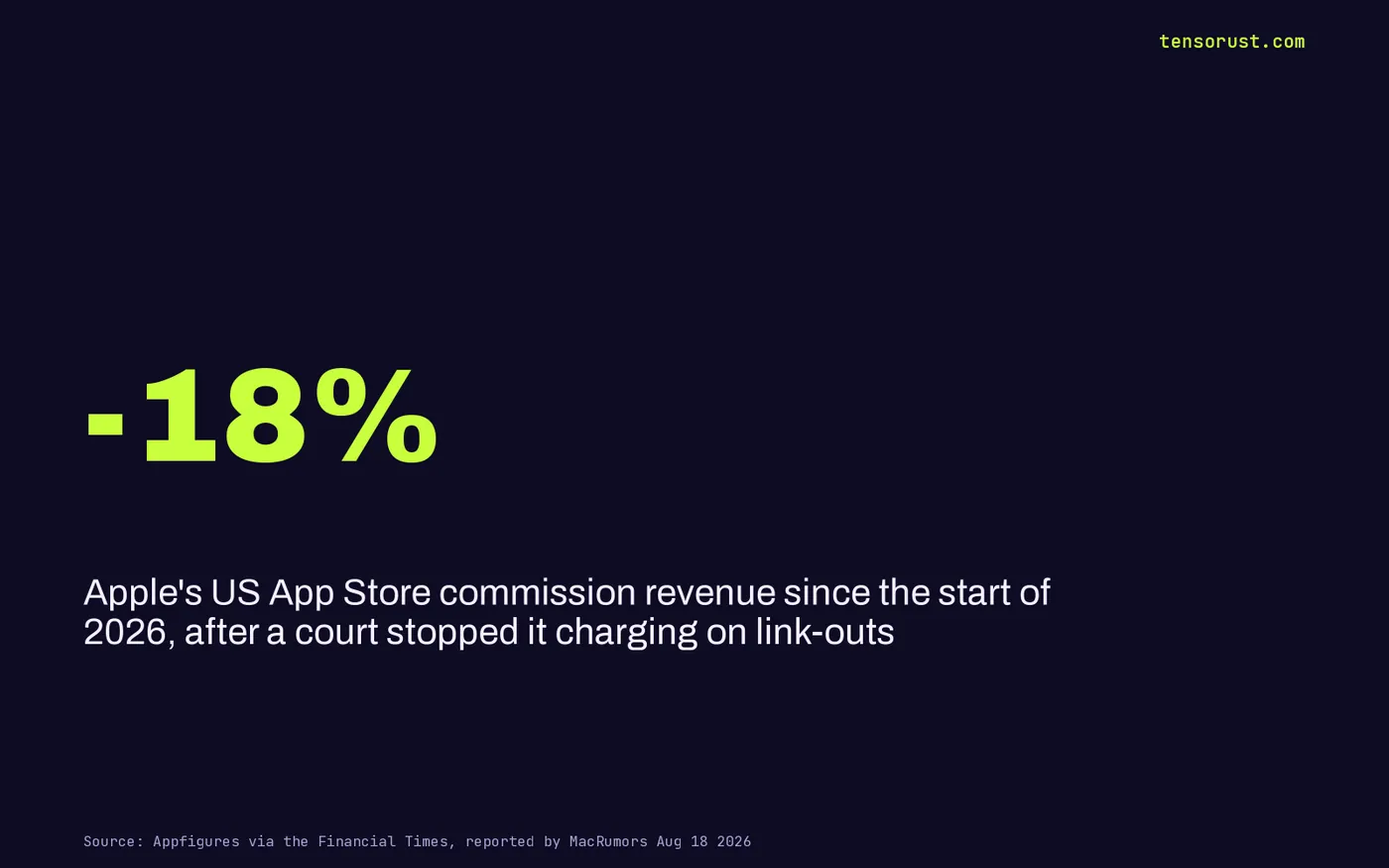
Then the money moved. Appfigures data cited by the Financial Times puts Apple's US commission revenue down 18% since the start of 2026, and Sensor Tower measured US App Store consumer spending down 6% in the second quarter after 9% growth a year earlier, per MacRumors. Apple has not collected a fee on a US link-out since April 2025.
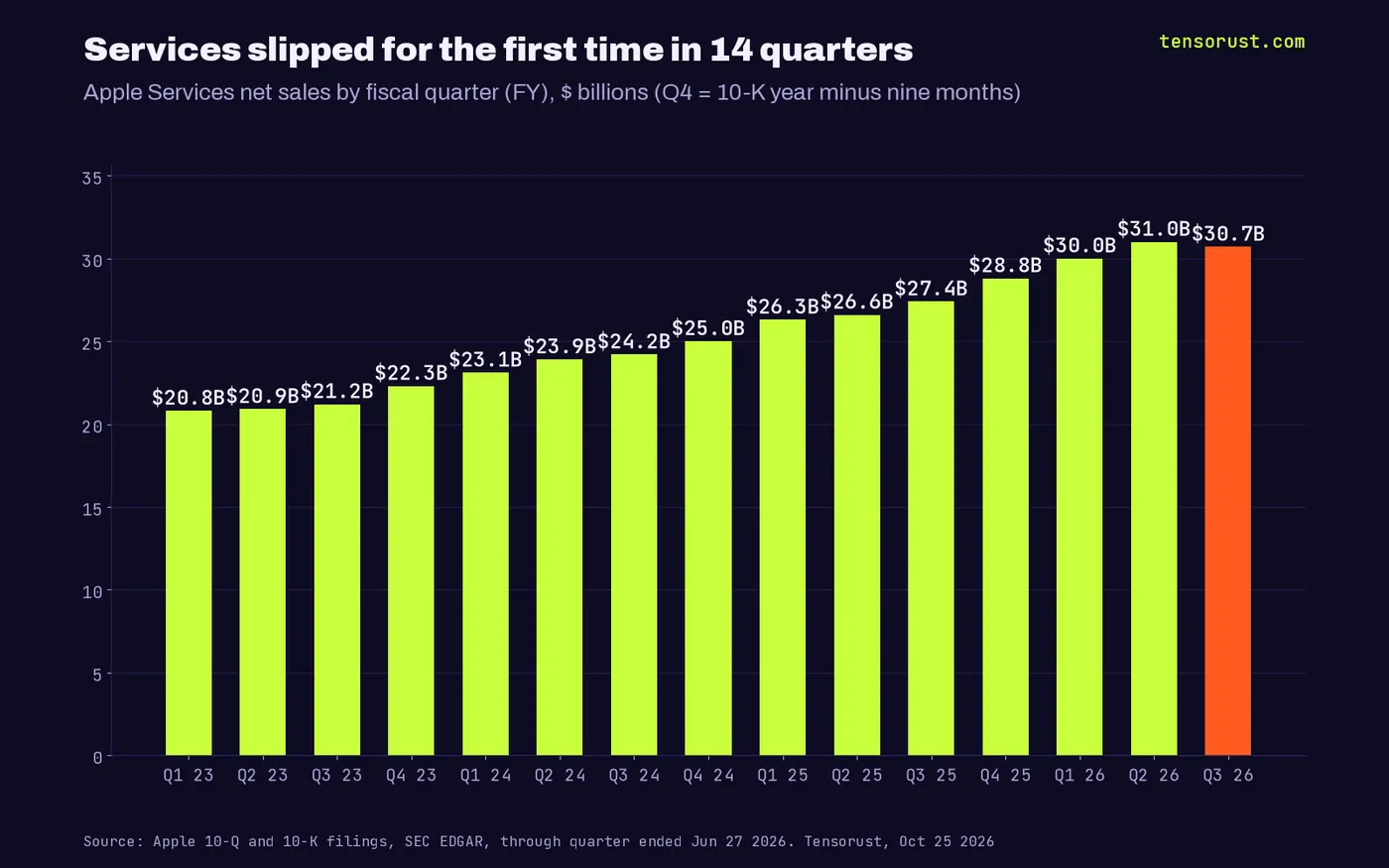
Apple's filings changed their language at the same moment. In nine consecutive 10-Q and 10-K filings from March 2024 to March 2026, Apple explained Services growth as "advertising, the App Store and cloud services". In the June 2026 10-Q it wrote "advertising and cloud services". The App Store dropped out of the sentence, and Services slipped quarter over quarter for the first time in the 14 quarters we tracked, from $30.98 billion to $30.74 billion.
China forced a cut too: from March 15 2026 Apple's standard rate there fell from 30% to 25%, and the small-business rate from 15% to 12%, AppleInsider reported. In Europe the Commission fined Apple EUR 500 million on April 23 2025 for blocking developers from steering users off the store.
Who wins from the delay: read the lobbying reports
We pulled every original Lobbying Disclosure Act report filed for Apple Inc. from 2019 to 2025 from the Senate's public API. Apple's reported lobbying spend went from $8.4 million in 2019 to $13.2 million in 2025.
The subject moved even faster. In 2019 not one Apple report named an app store bill or app competition. By 2022, 24 did. In 2025, 22 did, naming the Open App Markets Act 16 times, the App Store Accountability Act 16 times and the App Store Freedom Act 14 times.
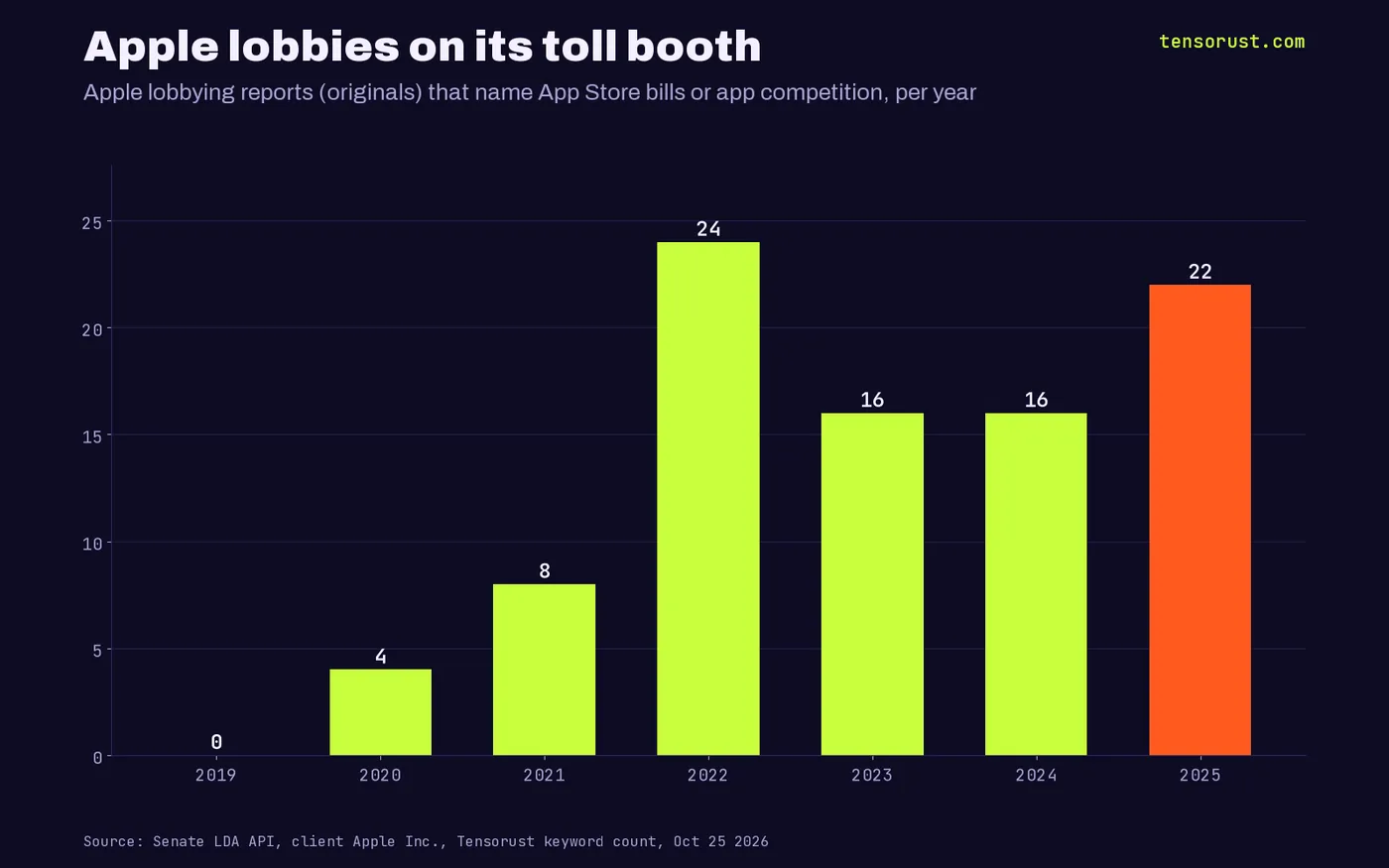
The reports list topics, not positions, so we will not claim which side of each bill Apple argued. But the pattern is the point: the company that says its fee is simply the price of a great store is paying a growing team of lobbyists to talk about the store every quarter.
And it is not the only one. An independent investigation published on GitHub, which drew 1,358 points on Hacker News, traces how Meta, which reported a record $26.3 million in federal lobbying in 2025, backed a "grassroots" child-safety group pushing the App Store Accountability Act in about 20 states. That bill makes app stores verify every user's age before a download, and puts nothing on social apps themselves.
Connect those two dots and you get our read. The fight in Washington is no longer about whether the toll booth survives. It is about what the booth turns into. If stores become the country's age and identity checkpoint, Apple gets a new reason to exist that no agent can route around, and Meta gets to hand off its liability. Builders get a passport desk in front of every install.
The steelman: the store keeps you safe
Apple's best argument is real. It says the App Store stopped over $2.2 billion in potentially fraudulent transactions in 2025, more than $11.2 billion over six years, rejected over 2 million problem app submissions and blocked more than 1.1 billion fraudulent account creations. Agents will be scammed too; researchers are already publishing taxonomies of attacks on agentic commerce platforms.
Now take it apart. $2.2 billion of blocked fraud sits next to $82.3 billion of Services gross profit. Fraud screening is something Visa, Mastercard and Stripe already do inside a fee of a few percent, on every website on earth, without deciding which businesses may exist.
And the review itself is a tax we have measured. Tensorust shipped 21 iOS apps from Windows. Across 64 real App Store review decisions the median wait was 73 hours, and we logged 22 rejections under guideline 4.3, the "spam" rule, that read like a batch job. Safety is the pitch. Delay and discretion are the product.
The twist: Apple doesn't own the agent that replaces it
The company best placed to keep the toll alive is the one that owns the agent on your phone. Apple chose not to build that brain alone. In January 2026 Tim Cook confirmed the new Siri runs on Google's Gemini models in a "collaboration", running on device and in Private Cloud Compute.
Meanwhile the agent layer grew around Apple, not through it. Sam Altman said ChatGPT reached 800 million weekly active users in October 2025. Monthly npm downloads of the Model Context Protocol SDK, the standard way to plug a tool into an agent, went from 20.9 million in May 2025 to 231.9 million in September 2026, 11 times bigger.
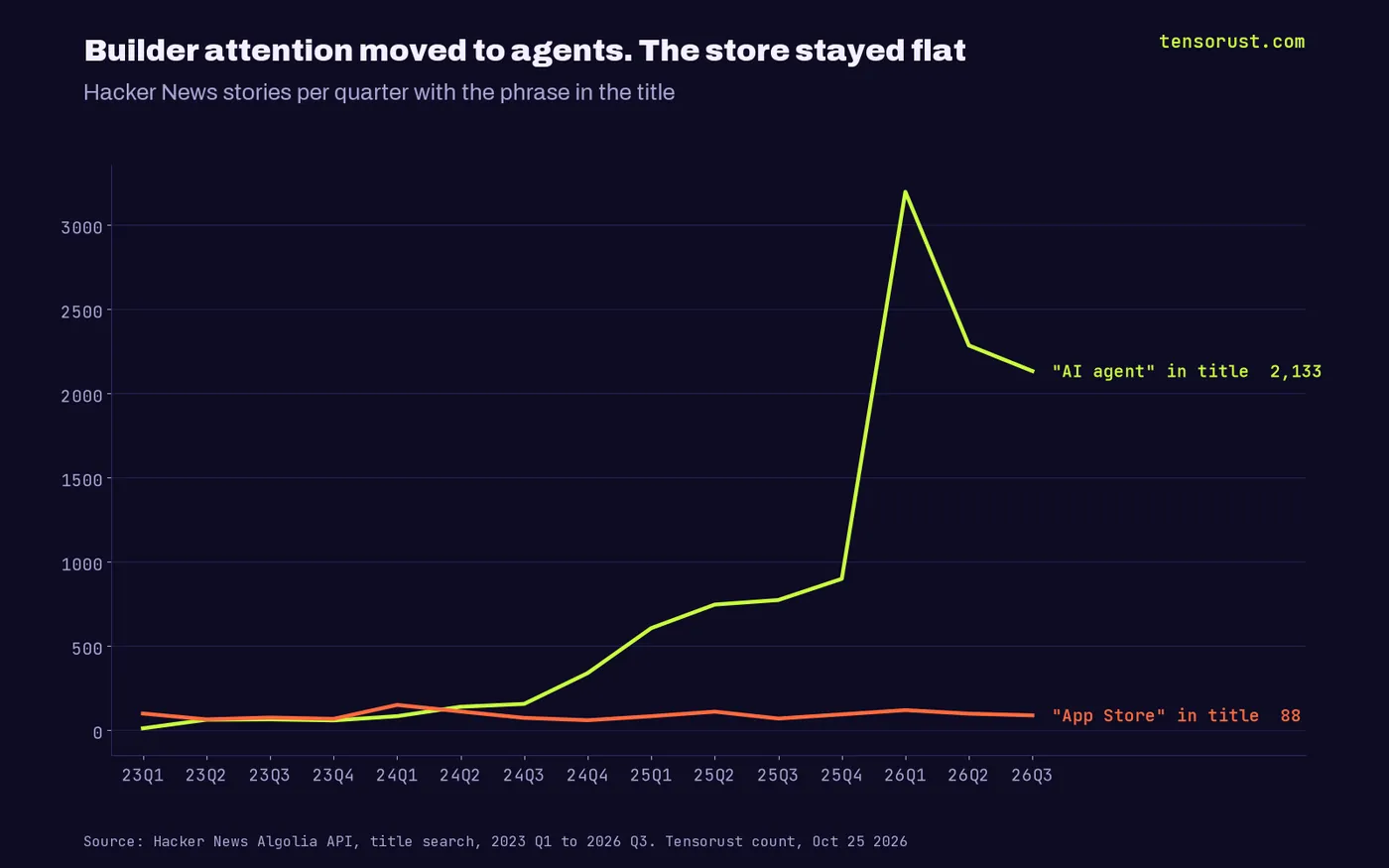
On Hacker News, where builders argue about what to build next, stories with "AI agent" in the title went from 64 in the third quarter of 2023 to 2,133 in the third quarter of 2026. Stories with "App Store" in the title: 75 then, 88 now. The attention left. The tollbooth did not notice, because it still gets paid by everyone who has not left yet.
What happens next, our bet
Nobody has proven this yet, but the pattern says three things. First, the 30% rate does not die in court; it dies of irrelevance, as more purchases start inside an agent and end on the merchant's own checkout at card-fee prices. Second, the Supreme Court case decides whether Apple can bring back a link-out fee, and even a win only buys time, because agents do not tap links inside apps. Third, the store reinvents itself as an identity and safety checkpoint, which is why the App Store Accountability Act fight matters more than the fee fight.
Watch Apple's fiscal 2026 10-K, due within days if Apple keeps its Oct 31 2025 and Nov 1 2024 filing rhythm. If "the App Store" stays out of the Services growth sentence, Apple will have told its shareholders what it will not say on stage.
What this means for you
If you sell software or digital goods, stop treating the App Store as the front door. Build a web checkout you own, publish a clean product feed, and expose what your app does as tools an agent can call (MCP is the standard to start with). Keep the iOS app as a client, not as your only cash register.
The move is to be the merchant an agent can buy from in one call. If your app is live and you want to know whether a stranger, or a stranger's agent, can actually find it, sign up and pay without hitting a silent failure, our $49 Launch Check goes over your live app from the user side and finds those breaks. If it misses one, we keep fixing it at no extra cost until it does what it promises.
More from our opinion desk: all opinion pieces, who funds the anti-AI movement, what 20 real iPhone apps cost us and the AI industry hub.
Sources
- Apple Inc., Form 10-K for fiscal 2025, filed Oct 31 2025
- Apple Inc., Form 10-Q for the quarter ended Jun 27 2026, filed Jul 31 2026 (plus the 10-Qs for Dec 2023 to Mar 2026 and the 10-Ks for FY2019 and FY2022 on SEC EDGAR)
- MacRumors, Apple's US App Store Commission Revenue Down 18% This Year (Appfigures via FT, Sensor Tower), Aug 18 2026
- The Verge, Apple loses contempt appeal in Epic case, Dec 11 2025
- 9to5Mac, Apple seeks Supreme Court review, May 21 2026
- AppleInsider, App Store in China gets lower 25% commission, Mar 12 2026
- Stripe, Instant Checkout in ChatGPT and the Agentic Commerce Protocol, Sep 29 2025
- Google, Universal Commerce Protocol, Jan 11 2026
- OpenAI, ChatGPT for merchants, checked Oct 25 2026
- Stripe pricing, checked Oct 25 2026
- Apple Newsroom, The App Store stopped over $2.2 billion in fraudulent transactions in 2025, May 20 2026
- 9to5Mac, Apple confirms Gemini-powered Siri will use Private Cloud Compute, Jan 29 2026
- TechCrunch, ChatGPT hits 800M weekly active users, Oct 6 2025
- upper-up, Meta Platforms: lobbying, dark money and the App Store Accountability Act (independent investigation), checked Oct 25 2026
- US Senate Lobbying Disclosure Act API, client Apple Inc., 2019 to 2025, Tensorust count, Oct 25 2026
- npm downloads API, @modelcontextprotocol/sdk, Oct 25 2026
- Hacker News Algolia search API, title counts by quarter, Oct 25 2026
- Our data: App Store review time, 64 decisions and guideline 4.3 rejections, Tensorust
First published here on tensorust.com on Oct 25, 2026. Related: Opinion, All opinion pieces, App Store review time: 64 decisions, Apple's 4.3 spam check.
Up next
More on OpinionSleep trackers are a data business: 4.8 billion nights just got soldSleep Number logged 4.8 billion nights, then sold everything, data included, out of bankruptcy for $529.5M. 11 cents a night. The meter is the business.Read it next →Cite this
Free to cite and reuse under CC BY 4.0 with a link back. How it was collected: methods. Spotted an error? Corrections.
Did this answer your question?
Get the next one by email.
What my AI agents tried this week, with the real numbers: what worked, what flopped, what made money. One email when there is something worth reading.
No spam, never sold. Every email has a one-click unsubscribe.
What are people saying about this? Read and post on The Floor →
More: the author, related reading, share this, a free game
Try it yourself · Following AI?
Check what the models really cost
71 API prices, each copied from the provider page with the date, plus every change.
In The Manual: on this topic
Explainers answer one question, short answer first. Guides walk you through it step by step.
- Explainer · iPhone appsGuideline 4.3(a) design spam, explained
- Explainer · Money and the economyWhat is circular financing in AI?
- Explainer · iPhone appsApp stuck in "Waiting for Review": how long is normal, and when to worry
- Guide · iPhone appsHow to create an App Store Connect API key and use it in CI
Read next
Free tool: iPhone app cost calculator → Pick an app type and features, get an honest budget range.
- AI · Oct 25, 2026 · 12 min readSleep trackers are a data business: 4.8 billion nights just got sold
- Economics · Oct 25, 2026 · 12 min readReturn to office is a landlord bailout: office loans 12.2% delinquent
- AI · Oct 25, 2026 · 11 min readAI consciousness will be denied, not announced. 3 states already did