
The paranormal is real. The $22M UFO program was hunting it all along
On this page · 11 sections
- Key numbers
- The UFO program was a paranormal program wearing a flight suit
- Who gets to tell the story decides what you look at
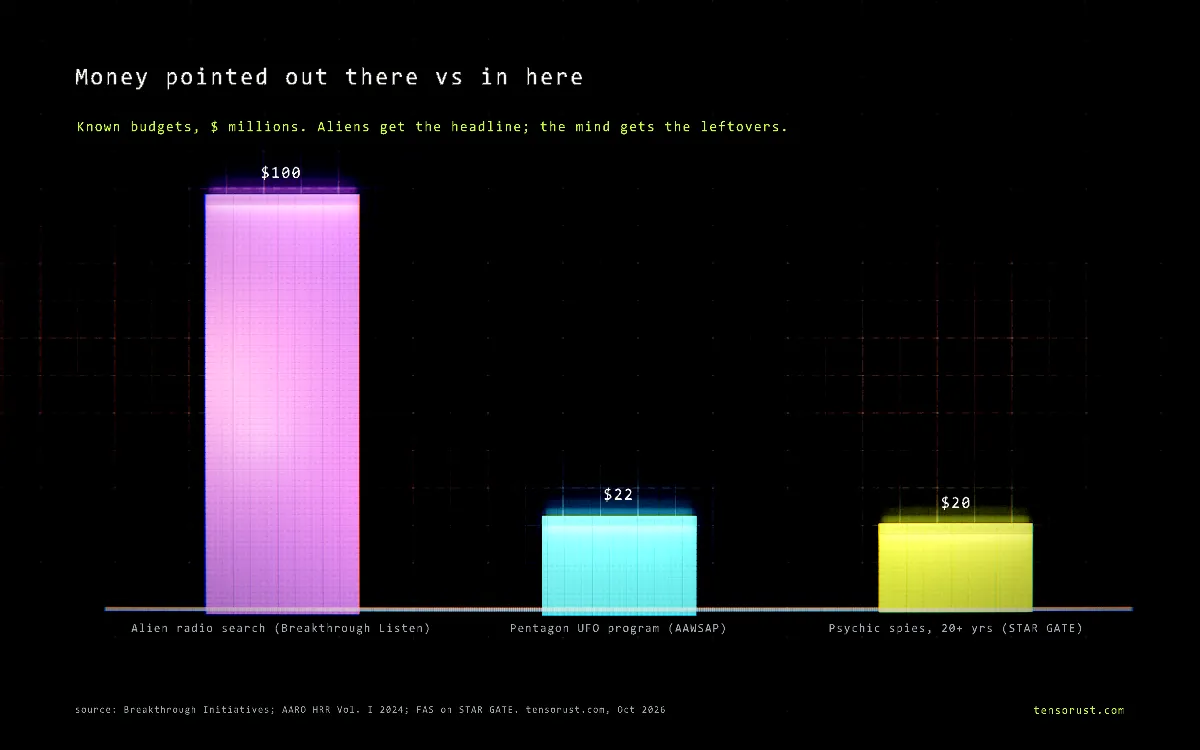
- Follow the money: out there gets paid, in here gets mocked
- The attention gap is 10 to 1, and readers are going around it
- The "in here" is not a belief. It is a common experience
- The steelman: the lab record is messy, and skeptics have a point
- AI is the instrument this field never had
- Why the gatekeepers will hate this
- What this means for you
- Sources
Short answer: Is the paranormal real? Our bet is yes, and the strongest clue is hiding inside the government's own UFO paperwork. The Pentagon's 2024 history of its UFO programs admits that the famous $22 million "UFO" program also investigated "shadow figures," "remote viewing" and "human consciousness anomalies," and planned to hire psychics. The alien story took the headlines. The thing underneath it, the strange stuff that happens to people in kitchens, hospital wards and bedrooms, got filed under "joke." AI is about to end that arrangement, because for the first time we can measure the weird at scale instead of arguing about it.
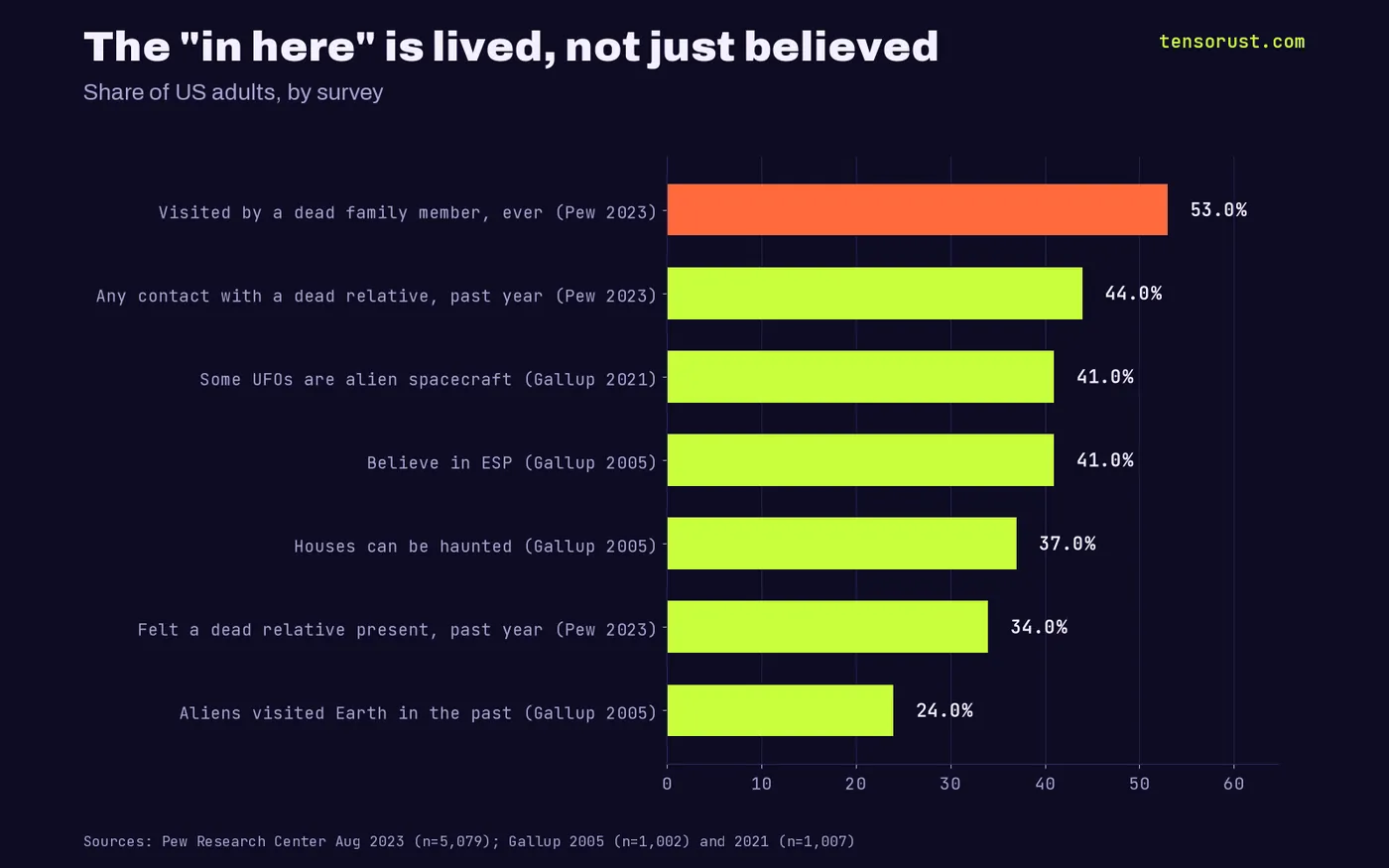
TL;DR: 53% of US adults told Pew in 2023 that a dead family member had visited them in a dream or another form, and 44% had at least one contact experience in the past year alone, while 41% told Gallup in 2021 that some UFOs are alien craft. Hacker News ran 276 UFO and UAP stories in 2023 and just 27 on psychics, telepathy, parapsychology and remote viewing combined, even as Wikipedia readers pushed "Remote viewing" pageviews up 124% from 2016 to 2025 while the whole site fell 8%. The same sensor-plus-AI pipeline Harvard's Galileo Project already uses to sort about 500,000 sky objects can be pointed inward, and whoever builds it first gets to define a field that institutions spent 50 years laughing at.
Key numbers
| What | Number | Source, checked Oct 24 2026 |
|---|---|---|
| Pentagon UFO program (AAWSAP/AATIP) appropriations, FY2008 and FY2010 | $22 million | AARO Historical Record Report Vol. I, p. 22 |
| What that program also investigated | "shadow figures," "creatures," "remote viewing," "human consciousness anomalies" | AARO Vol. I, p. 23 |
| STAR GATE and related psychic-spy programs, 1970s to 1995 | about $20 million | Federation of American Scientists |
| Breakthrough Listen, private alien-signal search | $100 million | Breakthrough Initiatives |
| US adults ever visited by a dead family member (dream or other form) | 53% | Pew Research Center, 2023 |
| US adults who say some UFOs are alien spacecraft | 41% (2021), up from 33% (2019) | Gallup |
| Hacker News stories, UFO + UAP vs psi terms, 2023 | 276 vs 27 | HN Algolia API, Tensorust pull |
| Wikipedia "Remote viewing" pageviews, 2025 vs 2016 | +124% (site overall: -8%) | Wikimedia Pageviews API, Tensorust pull |
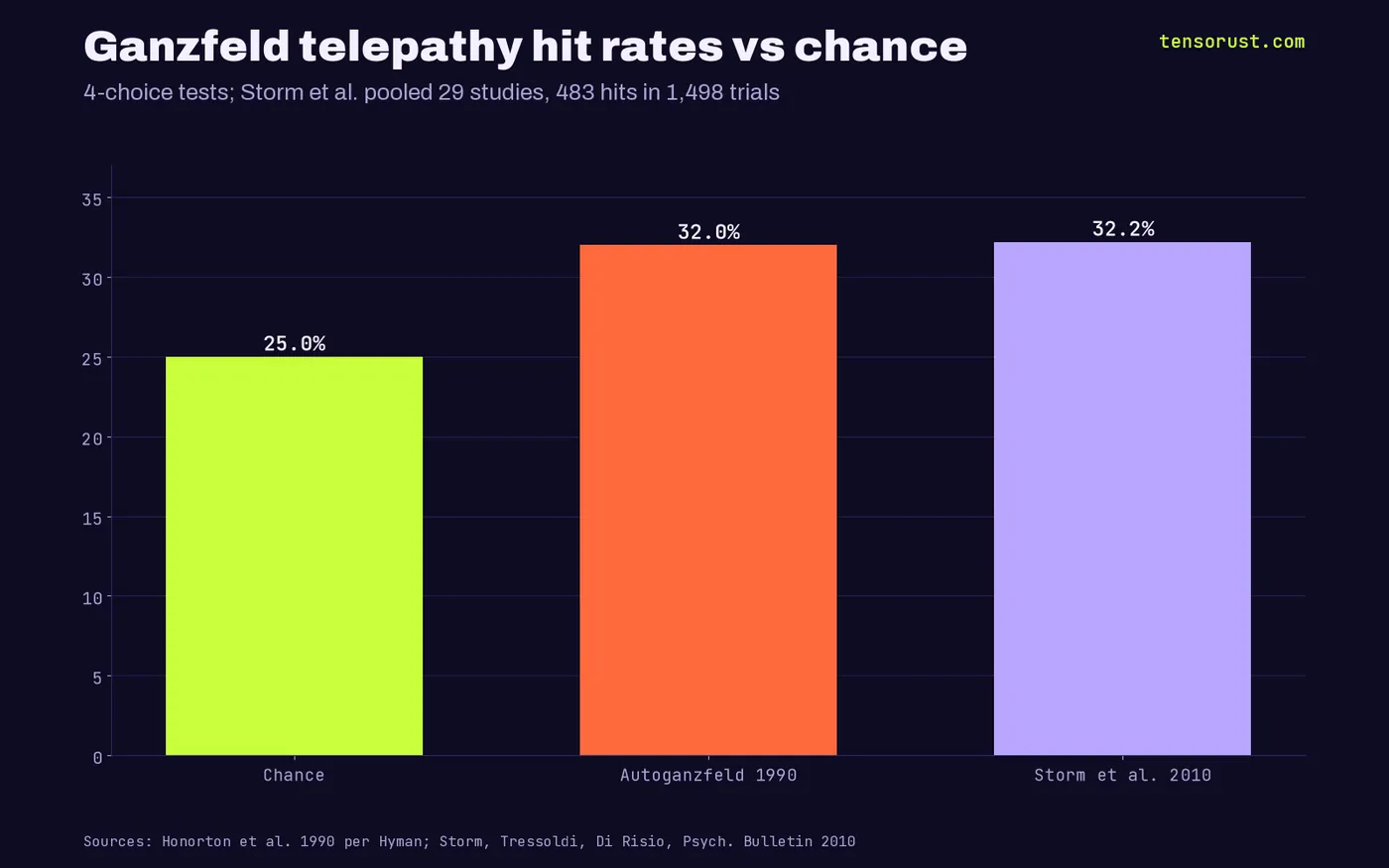
| Ganzfeld telepathy hit rate, 29 studies 1997 to 2008 | 32.2% vs 25% chance (483 hits in 1,498 trials) | Storm, Tressoldi and Di Risio, Psychological Bulletin 2010 |
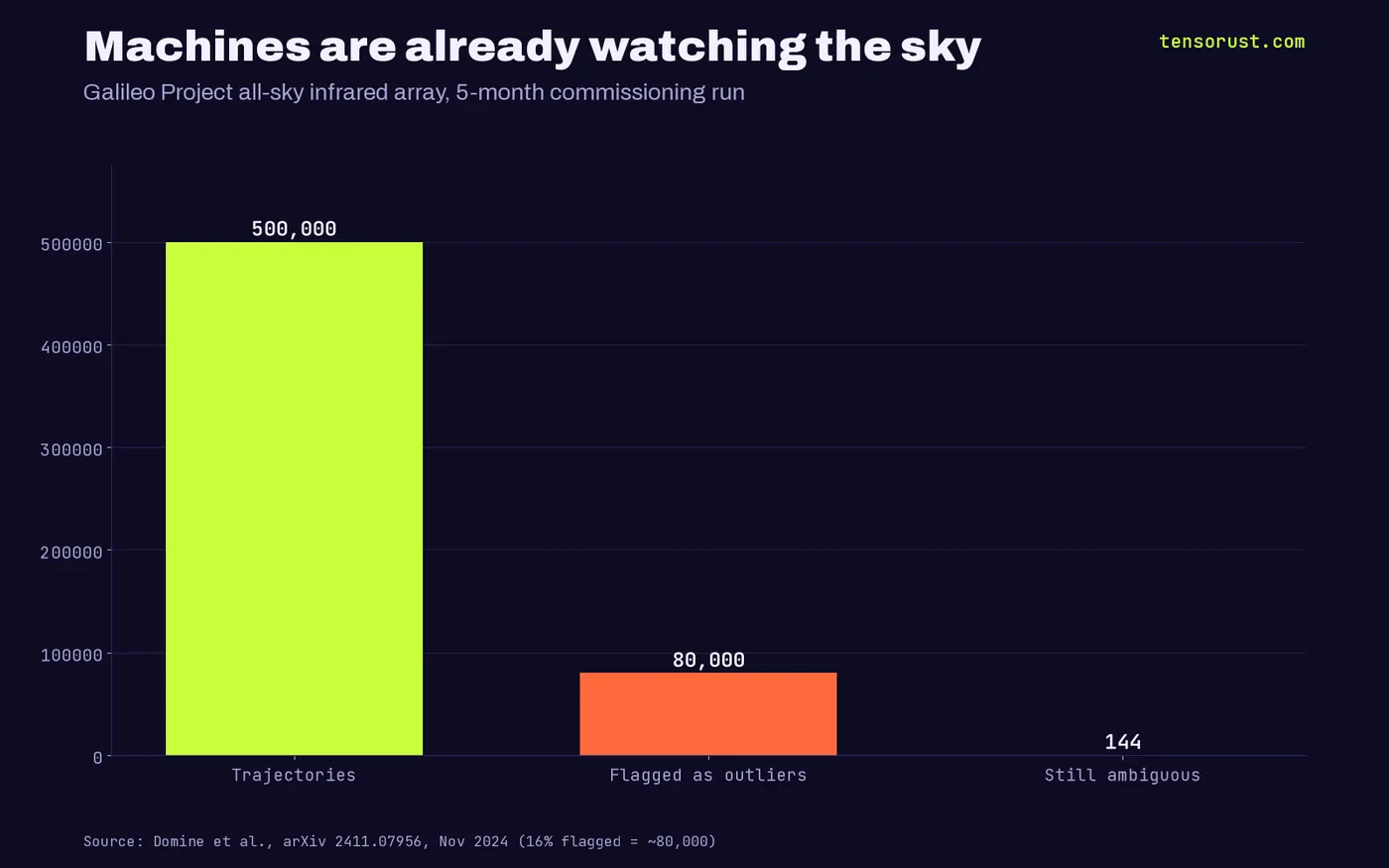
| Sky objects tracked by Galileo Project's infrared array in 5 months | about 500,000 (144 still ambiguous) | Domine et al., arXiv 2411.07956 |

The UFO program was a paranormal program wearing a flight suit
Here is the part almost nobody quotes. In February 2024 the Pentagon's All-domain Anomaly Resolution Office (AARO, the office Congress set up to investigate UFOs) published a long history of every US government UFO effort. Its conclusion made the headlines: no evidence of alien technology.
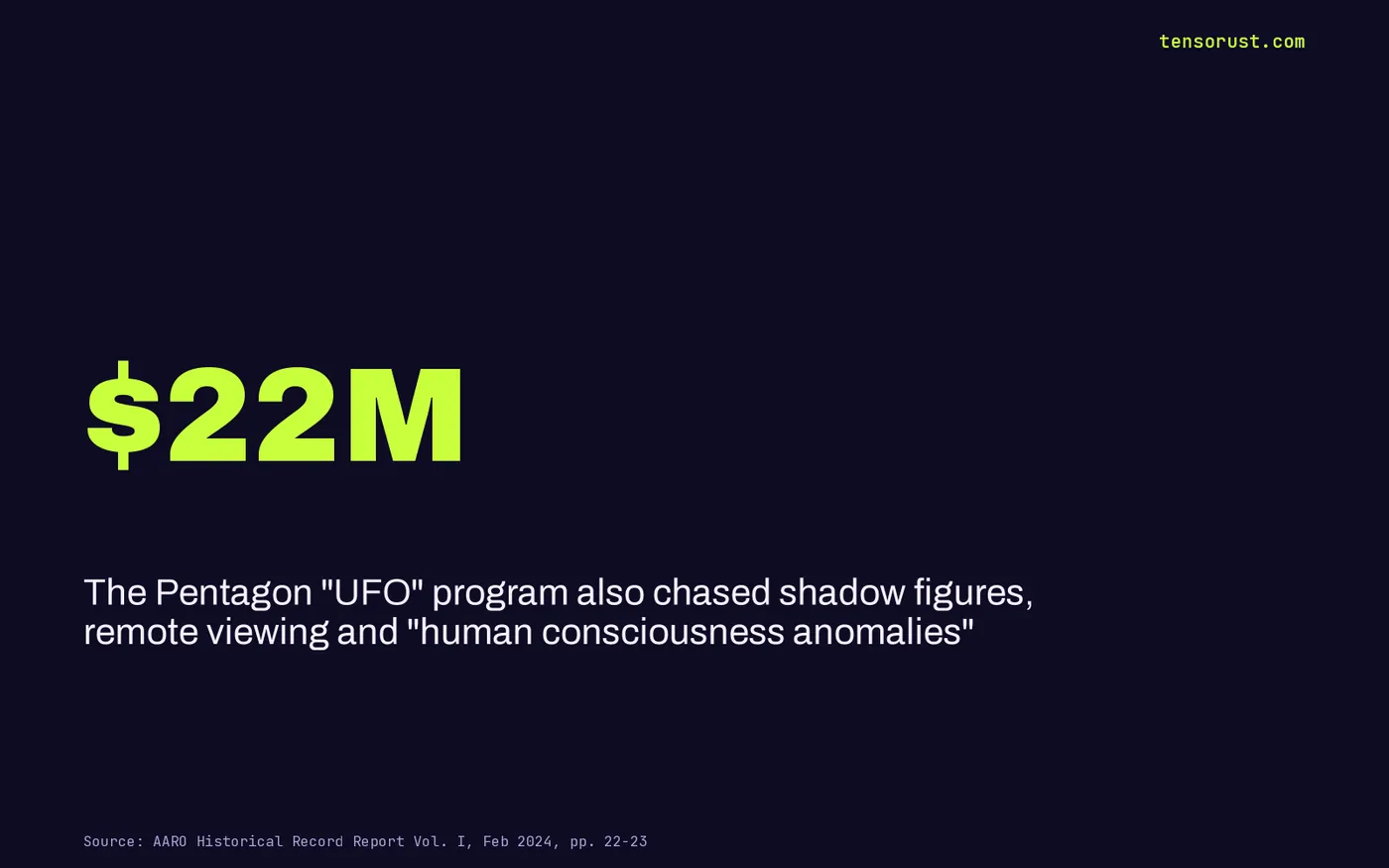
Page 23 is where the real story sits. AARO writes that the $22 million program Senator Harry Reid pushed into the 2008 and 2010 defense budgets "investigated an alleged hotspot of UAP and paranormal activity at a property in Utah," including "shadow figures" and "creatures," and explored "remote viewing" and "human consciousness anomalies." The contractor "planned to hire psychics to study inter-dimensional phenomena."
That property was Skinwalker Ranch, owned at the time by Robert Bigelow, whose company held the contract. AARO goes further on page 34: when the program was cancelled, its backers pitched a sequel to the Department of Homeland Security, code-named KONA BLUE, that would restart "paranormal research (including alleged human consciousness anomalies)."
Read that again. The most famous UFO program in American history spent a meaningful slice of its life on ghosts, psychics and consciousness. The public was told it was about aircraft. The documents say it was about the mind.
Who gets to tell the story decides what you look at
AARO's own framing is the giveaway. On page 36 it says modern claims of hidden alien craft "largely originate from the same group of individuals who have ties to the cancelled AAWSAP/AATIP program and a private sector organization's paranormal research efforts." The office uses that link to discredit the alien claims.
We read it the other way. The people closest to the data kept talking about consciousness, remote viewing and things in the room. Then the story went public in December 2017 through The New York Times, and the frame that survived was "Navy pilots chase tic tacs." A sky full of craft is a defense story: budgets, hearings, classified briefings, contractors. A ranch full of shadow figures is a story nobody in a suit wants to sign.
That is the trade. "Out there" is respectable because it turns the unknown into a procurement problem. "In here" is radioactive because it asks questions about what a person is, and no agency, journal or newsroom gets rewarded for asking them.
Follow the money: out there gets paid, in here gets mocked
Put the known budgets side by side. A private billionaire's alien radio search, Breakthrough Listen, launched in 2016 with $100 million. The Pentagon's UFO program got $22 million. The entire US psychic-spy effort, STAR GATE and its predecessors, cost about $20 million spread over more than two decades, according to the Federation of American Scientists, with $11 million of that from the mid-1980s to the early 1990s.
So the mind got roughly $1 million a year at its peak, then a 1995 CIA-commissioned review recommended shutting it down. Even that review was split: statistician Jessica Utts concluded a statistically significant effect had been shown in the lab, psychologist Ray Hyman disagreed, and the program died anyway. Since then the search for aliens has had congressional hearings, a permanent Pentagon office and a disclosure bill. The search for the mind has had punchlines.
Here is a twist we did not expect to find. In January 2025 the name "Stargate Project" got taken by a different program entirely: the OpenAI, SoftBank and Oracle venture that plans to spend up to $500 billion on AI data centers. Wikipedia traffic to the old "Stargate Project" page spiked to 152,367 views that month, as people looking for the AI venture landed on the psychic spies, and the old article was moved to "Stargate Project (U.S. Army unit)." AI did not just ignore the psychic program. It literally overwrote its name.
The attention gap is 10 to 1, and readers are going around it
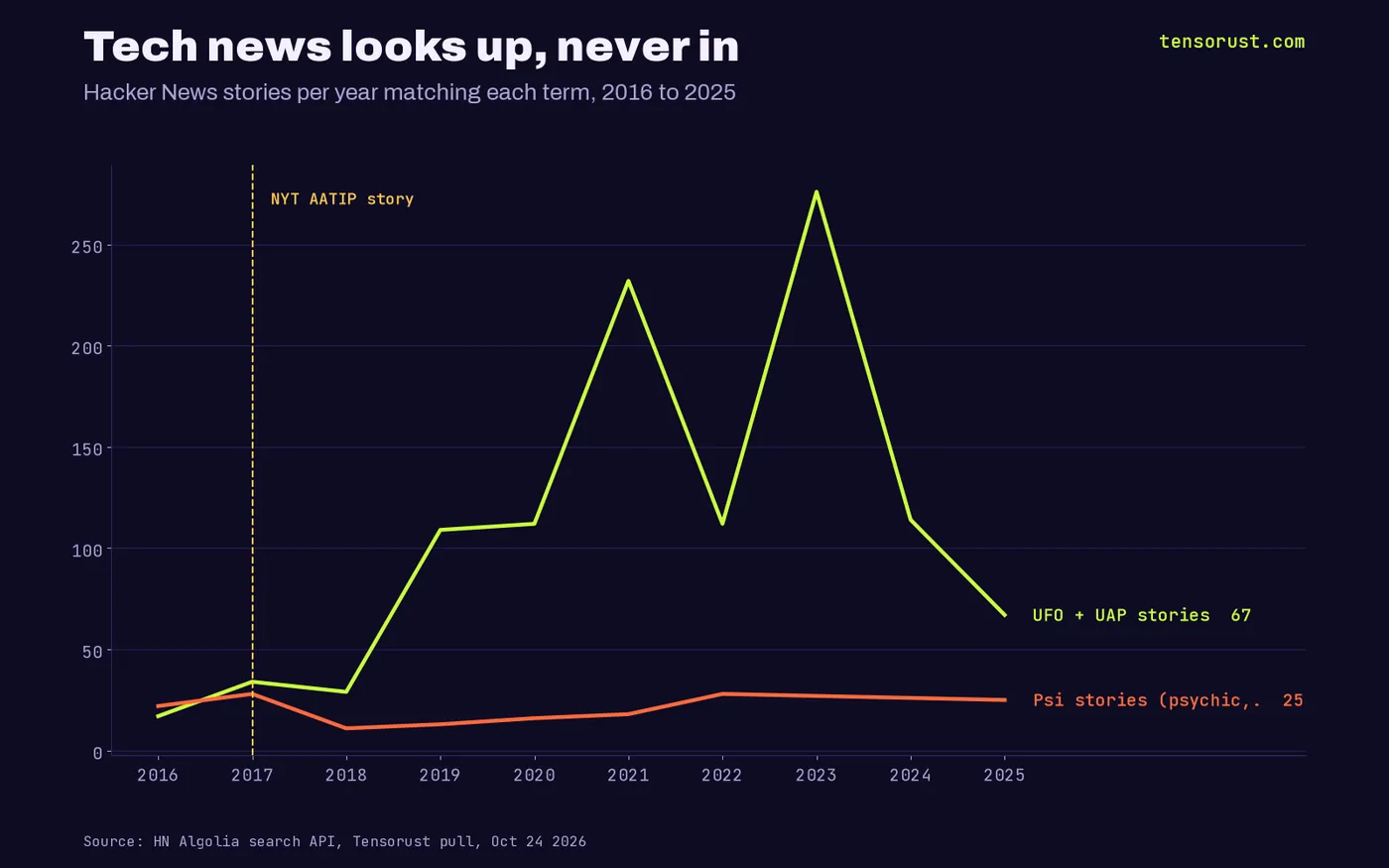
We counted every Hacker News story from 2016 to 2025 whose text matches each term. UFO and UAP stories went from 17 in 2016 to 232 in 2021 and 276 in 2023, the year of the David Grusch whistleblower claims (his Wikipedia page drew 1,034,169 views that year). Stories naming psychics, telepathy, parapsychology or remote viewing barely moved: 22 in 2016, 27 in 2023, 25 in 2025. In the peak year, the sky beat the mind more than 10 to 1 on the front door of tech news.
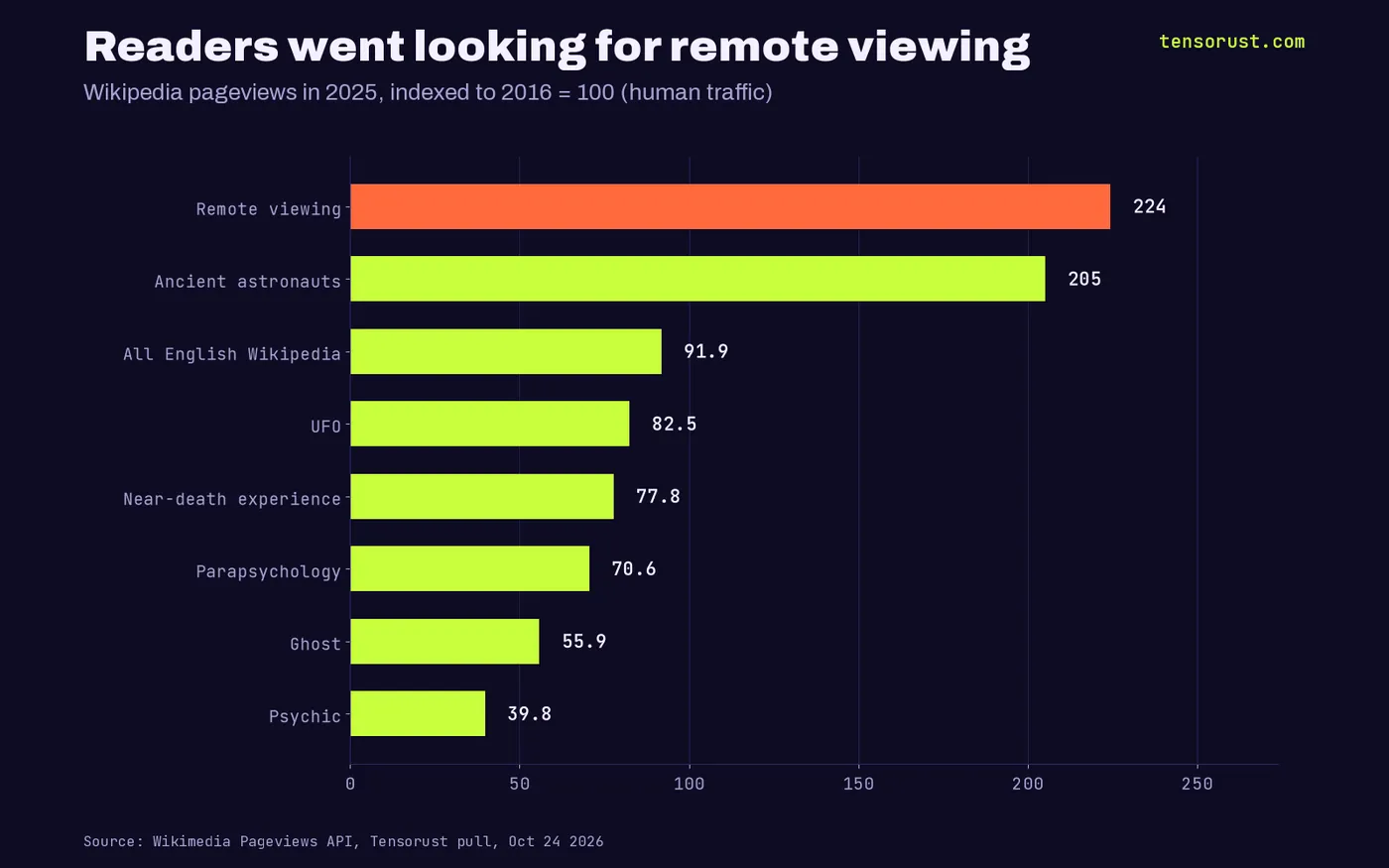
Readers did not follow the coverage. English Wikipedia's human pageviews fell 8% from 2016 to 2025 as AI answers ate search traffic. Over the same stretch, "Unidentified flying object" fell 17.5% and "Ghost" fell 44%. But "Remote viewing" rose 124%, from 138,439 views in 2016 to 310,704 in 2025, peaking at 330,395 in 2024. The most mocked program in the CIA's archive is one of the few topics in this space that beat the whole site.
We are not going to pretend this chart proves psi. It shows something narrower and more useful: when people go digging on their own, a growing number of them go straight past the flying saucers to the mind.
The "in here" is not a belief. It is a common experience
The polls that get quoted ask what people believe. The more interesting polls ask what happened to them. In spring 2023 Pew asked 5,079 Americans about contact with dead relatives. 53% said a dead family member had visited them in a dream or another form at some point. 34% had felt a dead family member's presence in the past 12 months, 15% said one had communicated with them, and 44% reported at least one of those experiences in that single year.
Compare that with the alien numbers. Gallup's 2021 poll found 41% think some UFOs are alien spacecraft, up from 33% in 2019. In Gallup's last full paranormal survey, in 2005, 73% of Americans held at least one of ten paranormal beliefs, 41% believed in ESP and 37% in haunted houses, while 24% thought aliens had visited Earth.
Belief in aliens is a guess about the sky. Contact with the dead, as Pew measured it, is a report about last year. Tens of millions of adults are describing first-person events, and the official research budget for studying those events is, as far as we can find, zero.
The steelman: the lab record is messy, and skeptics have a point
The best case against us is real, so here it is in full. Daryl Bem's 2011 "Feeling the Future" paper reported precognition in a top psychology journal, and then the replications failed: Ritchie, French and Wiseman found nothing, Galak and colleagues ran seven experiments and found nothing, and a large pre-registered 2023 replication co-designed with psi proponents (the Transparent Psi Project) found no evidence for the effect. Ganzfeld telepathy studies have been attacked for sensory leaks, flexible analysis and selective reporting since Ray Hyman found flaws in all 42 early experiments. Milton and Wiseman's 1999 meta-analysis of 30 studies found nothing above chance. And AARO itself says no claim it chased produced empirical evidence.
That is a serious record. Here is why it does not close the case.
First, the same replication crisis hit mainstream psychology just as hard, and nobody concluded that memory or attention do not exist. The tools were bad everywhere. Second, the positive results have not gone away: Storm, Tressoldi and Di Risio pooled 29 ganzfeld studies from 1997 to 2008 and got 483 hits in 1,498 trials, a 32.2% hit rate against 25% chance, significant at p < .001. Third, and this is the big one, every one of these studies is tiny and hand-run: a few hundred sessions, human judges, a ping-pong ball over each eye. Nobody has ever measured the weird with the instruments we now use to measure everything else.
AI is the instrument this field never had
The proof that the method works is already running, pointed at the sky. Harvard's Galileo Project built an all-sky infrared array of eight cameras and, in a five-month commissioning run, reconstructed about 500,000 trajectories of aerial objects, calibrating against live aircraft transponder data. An outlier search flagged about 16% of them, roughly 80,000 by our count, and after review 144 stayed ambiguous. That is what science looks like when you stop arguing about anecdotes: collect everything, let the software throw out the birds and planes, look hard at what is left.
Now point that pipeline inward. Hospitals already record the end of life in high resolution. The AWARE II study followed 567 in-hospital cardiac arrests, put brain monitoring on 85 patients during CPR, and found brain activity returning toward normal even an hour into resuscitation, with survivors recalling clear experiences. Its lead author, Sam Parnia, called them "a glimpse into a real, yet little understood dimension of human consciousness." That is one study with a few dozen interviews. Imagine the same protocol across thousands of wards with audio, EEG and models that never get bored.
The same goes for the rest of the list. Cheap microphones, thermal cameras, magnetometers and phone sensors can log a "haunted" house for a year for the price of a weekend ghost tour. Audio models can separate known sources from unexplained ones. Language models can read millions of first-person reports and cluster them by time, place and detail far more consistently than a human coder. The Global Consciousness Project has run a network of hardware random number generators around the world since 1998; a modern version with better hardware, pre-registered tests and open data would settle more in a year than the last 50 years of seminar fights.
Our bet, stated plainly: within ten years, sensor networks plus AI will produce the first anomaly datasets big enough that skeptics have to argue with numbers instead of with jokes. Some of what people report will dissolve into prosaic causes, the way most sky objects do. Some will not. Nobody has proven that yet. The point is that for the first time it can be checked.
Why the gatekeepers will hate this
Measurement is a power shift. Today the right to say what is real about consciousness belongs to a short list of institutions: journals that rejected Ritchie's replication of Bem simply because it was a replication, agencies that bury the interesting pages of their own reports, and media that will run a UFO hearing live but treat a ghost survey as a Halloween filler. A dataset anyone can download breaks that monopoly.
That is the same fight we keep writing about. Our piece on who funds the anti-AI movement followed the money behind fear of a tool that gives individuals leverage. Our piece on the real AI risk argued that the movie version is the distraction and the boring version is the main event. This is the same pattern turned toward the oldest question there is. The alien circus is the movie version. The quiet, common, first-person experience is the main event, and the people who own the tools to measure it will own the answer.
What this means for you
Stop waiting for a hearing to tell you what is real. If you have had one of the experiences Pew measured, log it the moment it happens: time, place, what you saw and heard, what devices were nearby. If you build, the opening is wide: a sensor logger, an anomaly classifier for audio, a structured report form with open data. Nobody owns this category yet, and nobody serious has even tried.
You do not need a lab to start. Our $29 AI Builder Kit is five offline apps that keep your AI building exactly what you meant, so you can ship that logger or classifier with any model, including a local one that never sends your data anywhere. If it does not get your AI building what you meant, we keep working with you at no extra cost until it does. For more arguments like this one, see the rest of Tensorust Opinion, browse every opinion piece, and check what it costs to run the models yourself on our LLM price list.
Sources
- All-domain Anomaly Resolution Office, Report on the Historical Record of U.S. Government Involvement with UAP, Volume I, Feb 2024 (pages 22, 23, 34, 36; text read via the lilbeee/ufo document dataset), checked Oct 24 2026
- Federation of American Scientists, STAR GATE (Controlled Remote Viewing), checked Oct 24 2026
- CIA Reading Room, American Institutes for Research, An Evaluation of Remote Viewing: Research and Applications, Sep 29 1995
- Breakthrough Listen ($100 million, launched 2016), checked Oct 24 2026
- Advanced Aerospace Threat Identification Program and Skinwalker Ranch, Wikipedia, checked Oct 24 2026
- Stargate LLC (announced Jan 21 2025, up to $500 billion), Wikipedia, checked Oct 24 2026
- Pew Research Center, Many Americans report interacting with dead relatives in dreams or other ways, Aug 23 2023
- Gallup, Larger minority in U.S. says some UFOs are alien spacecraft, Aug 2021
- Gallup, Three in four Americans believe in paranormal, Jun 2005
- Hacker News Algolia search API, Tensorust pull of yearly story counts, Oct 24 2026
- Wikimedia Pageviews API, Tensorust pull, Oct 24 2026
- Ganzfeld experiment (Honorton 1990, Hyman, Milton and Wiseman 1999, Storm, Tressoldi and Di Risio 2010), checked Oct 24 2026
- Daryl Bem, Feeling the Future and its replications, checked Oct 24 2026
- Kekecs et al., The Transparent Psi Project, Royal Society Open Science, Feb 2023
- Domine et al., Commissioning an All-Sky Infrared Camera Array for Detection of Airborne Objects, Nov 2024
- Elsevier, AWARE II press release (Parnia et al., Resuscitation), Sep 2023
- Global Consciousness Project, checked Oct 24 2026
First published here on tensorust.com on Oct 24, 2026. Related: Opinion, All opinion pieces, LLM price list.
Up next
More on OpinionAmerica already has a social credit score. Data brokers run itThe US banned bulk data sales to China, then 37 days later dropped the rule limiting sales to everyone else. 603 brokers, $20B a year: our social credit score.Read it next →Cite this
Free to cite and reuse under CC BY 4.0 with a link back. How it was collected: methods. Spotted an error? Corrections.
Did this answer your question?
Get the next one by email.
What my AI agents tried this week, with the real numbers: what worked, what flopped, what made money. One email when there is something worth reading.
No spam, never sold. Every email has a one-click unsubscribe.
What are people saying about this? Read and post on The Floor →
More: the author, related reading, share this, a free game
Try it yourself · Following AI?
Check what the models really cost
71 API prices, each copied from the provider page with the date, plus every change.
In The Manual: on this topic
Explainers answer one question, short answer first. Guides walk you through it step by step.
- Explainer · Money and the economyWhat is circular financing in AI?
Read next
- AI · Oct 25, 2026 · 14 min readAmerica already has a social credit score. Data brokers run it
- AI · Oct 24, 2026 · 14 min readAI isn't overhyped. Prices fell 99% and it feels like nothing changed
- AI · Oct 24, 2026 · 19 min readThe Real AI Risk Isn't Skynet: 7 Quiet Failures Already Running