
AI isn't overhyped. Prices fell 99% and it feels like nothing changed
On this page · 11 sections
- Key numbers
- The fastest price collapse in software history, and nobody threw a parade
- Usage went up 8x. The conversation went quiet
- We have seen this movie before, and it felt like Tuesday
- The scoreboard is built to miss it
- The boom is already in the data. It just looks boring
- Follow the money: who gets paid while it feels like nothing changed
- The best case for "it's all hype", and why it fails
- Our bet for the next five years
- What this means for you
- Sources
Short answer: No, AI is not overhyped. It is moving so fast that it has already been absorbed into normal life, and that is exactly why it feels like nothing happened. The price of GPT-4-class AI fell 99.6% in 29 months, ChatGPT went from 100 million to 800 million weekly users, and US productivity has grown 2.51% a year since ChatGPT launched, against 1.60% for the 15 years before the pandemic. Meanwhile the share of business income that goes to workers just hit its lowest level since records began in 1947. The change is real. The feeling of "nothing changed" is the part that is being managed.
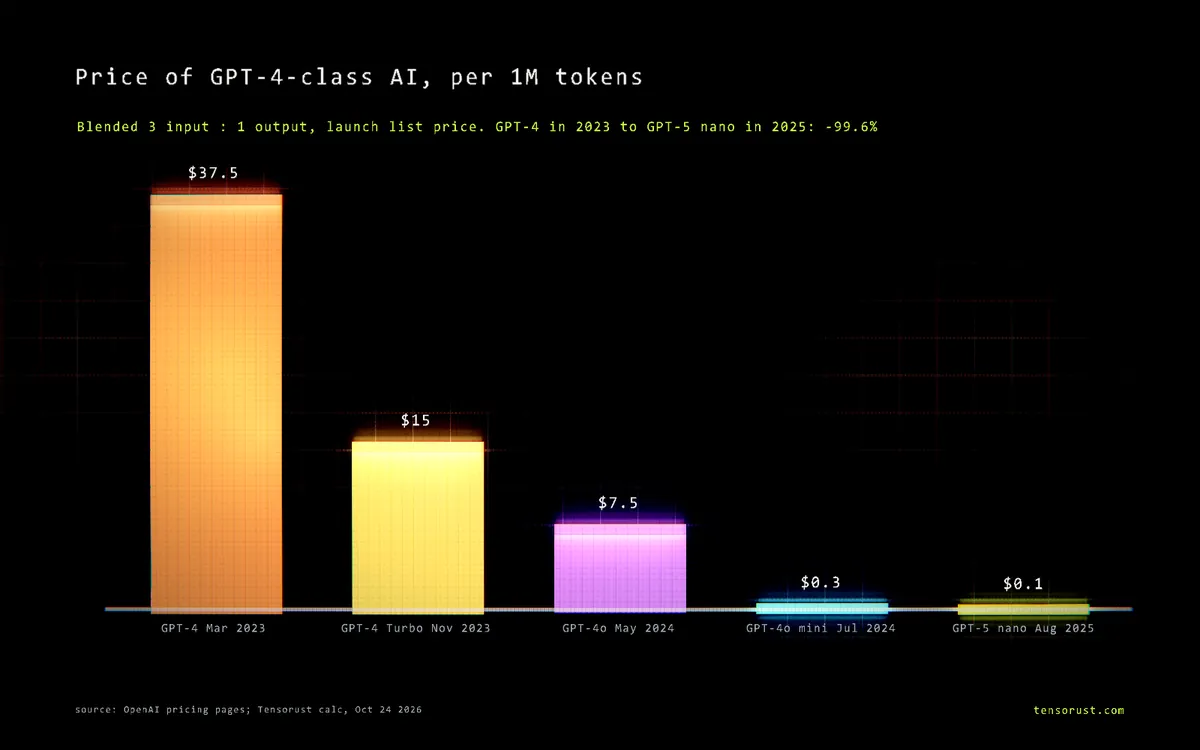
TL;DR: The fastest price collapse in the history of software (GPT-4 at $37.50 per million tokens in March 2023, GPT-5 nano at $0.14 in August 2025) produced no parade, because things that get cheap disappear into the background. Hacker News stories naming ChatGPT fell 76% from their peak while its weekly users grew 8x, and stories about an "AI bubble" went from 2 a quarter to 180. Since Q4 2022, output per hour rose 9.1%, real pay per hour rose 4.6%, after-tax corporate profits rose 49.2% and labor share fell 3.6% to a record low: the gains are landing, just not in your paycheck, and the people who notice early are the ones who get to keep them.
Key numbers
| What | Number | Source, checked Oct 24 2026 |
|---|---|---|
| GPT-4 price at launch, blended per 1M tokens (Mar 2023) | $37.50 | OpenAI pricing |
| GPT-5 nano price, blended per 1M tokens (Aug 2025) | $0.14 (-99.6%) | Tensorust LLM price list |
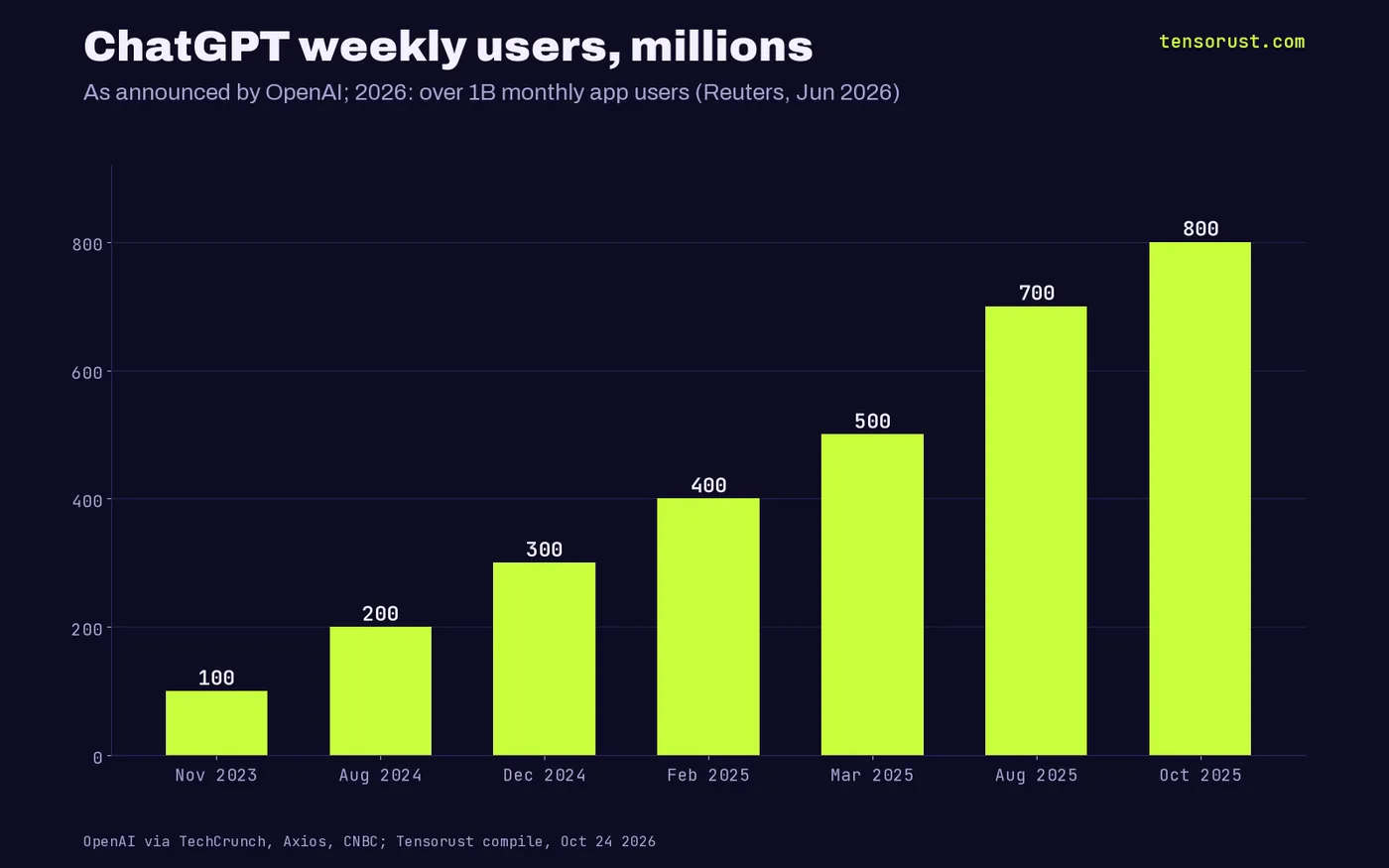
| ChatGPT weekly users, Nov 2023 vs Oct 2025 | 100M to 800M | TechCrunch |
| Hacker News stories naming ChatGPT, 2023 Q1 vs 2026 Q3 | 2,978 to 719 (-76%) | HN Algolia API, Tensorust pull |
| Hacker News "AI bubble" stories, 2023 Q1 vs 2025 Q4 | 2 to 180 | HN Algolia API, Tensorust pull |
| US productivity growth since ChatGPT (Q4 2022 to Q2 2026) | 2.51% a year | BLS via FRED |
| US productivity growth, 2004 to 2019 | 1.60% a year | BLS via FRED |
| Labor share, nonfarm business, Q2 2026 | 93.4 (record low since 1947) | BLS via FRED |
| After-tax corporate profits, Q4 2022 to Q2 2026 | +49.2% (nominal) | BEA via FRED |
| US adults with a smartphone, 2011 vs 2026 | 35% to 91% | Pew Research Center |

The fastest price collapse in software history, and nobody threw a parade
In March 2023, GPT-4 cost $30 per million input tokens and $60 per million output tokens. Blend that the way real workloads use it (three tokens in for every one out) and you get $37.50 per million tokens.
In August 2025, GPT-5 nano launched at $0.05 in and $0.40 out, or $0.14 blended. That is 99.6% cheaper, a 272x drop, in 29 months. And nano is not a worse GPT-4: the original GPT-4 scored 39% on the GPQA graduate-level science benchmark in the benchmark's own paper, while independent evaluators put GPT-5 nano at about 68% on the harder Diamond subset (Artificial Analysis, via OpenRouter: 67.6% at high reasoning effort).
This is not one cherry-picked model. Epoch AI measured that the price of reaching GPT-4's level on PhD-level science questions fell 40x per year, and that the decline across tasks ranges from 9x to 900x per year. For comparison, Moore's law, the thing that built Silicon Valley, is roughly 2x every two years.
We track 74 live models on the Tensorust LLM price list. The cheapest text model on it today costs a nickel per million input tokens. A million tokens is about 750,000 words, roughly ten novels.
Here is the twist. When something gets 272x cheaper, it does not feel like a revolution. It feels like nothing. Cheap things vanish into the background, the same way nobody wakes up grateful that a long-distance phone call is free.
Usage went up 8x. The conversation went quiet
ChatGPT had 100 million weekly users in November 2023. It had 200 million in August 2024, 300 million in December 2024, 700 million in August 2025 and 800 million in October 2025. By June 2026 the app alone passed 1 billion monthly users, per app-tracking data reported by Reuters.
Now look at what the most AI-obsessed crowd on the internet talked about over the same stretch. We pulled every Hacker News story per quarter from the Algolia search API, exact matches only, no typo matching.
Stories naming ChatGPT peaked at 2,978 in Q1 2023. By Q3 2026 they were down to 719, a 76% fall, while the user base grew roughly eightfold. The product became more important and less interesting at the same time.
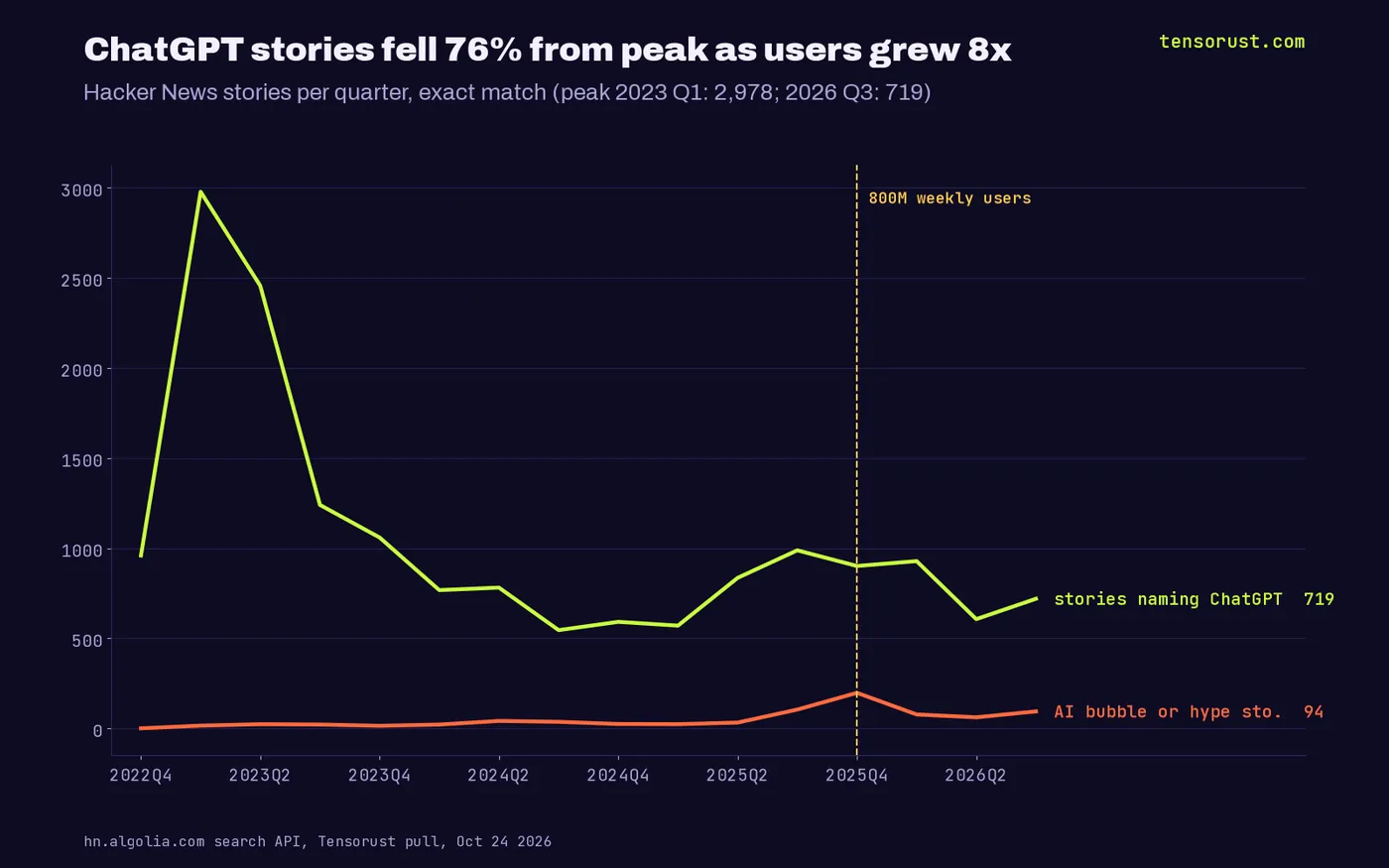
The only AI word that kept climbing was "bubble". Stories with "AI bubble" in them went from 2 in Q1 2023 to 180 in Q4 2025, the exact quarter ChatGPT announced 800 million weekly users. Usage up, attention down, doubt up. That is what normalization looks like in data.
It is not only ChatGPT. Economists at the St. Louis Fed, Vanderbilt and Harvard found that nearly 40% of US adults aged 18 to 64 used generative AI by late 2024, and that overall adoption has been faster than either the personal computer or the internet. The fastest-adopted technology ever measured, and the dominant story about it is that it might be a fad.
We have seen this movie before, and it felt like Tuesday
In May 2011, 35% of American adults owned a smartphone. By 2024 it was 91%, where it still sits in Pew's 2026 survey. In about eight years, the majority of the country put a camera, a map, a bank, a TV station and a slot machine in their pocket.
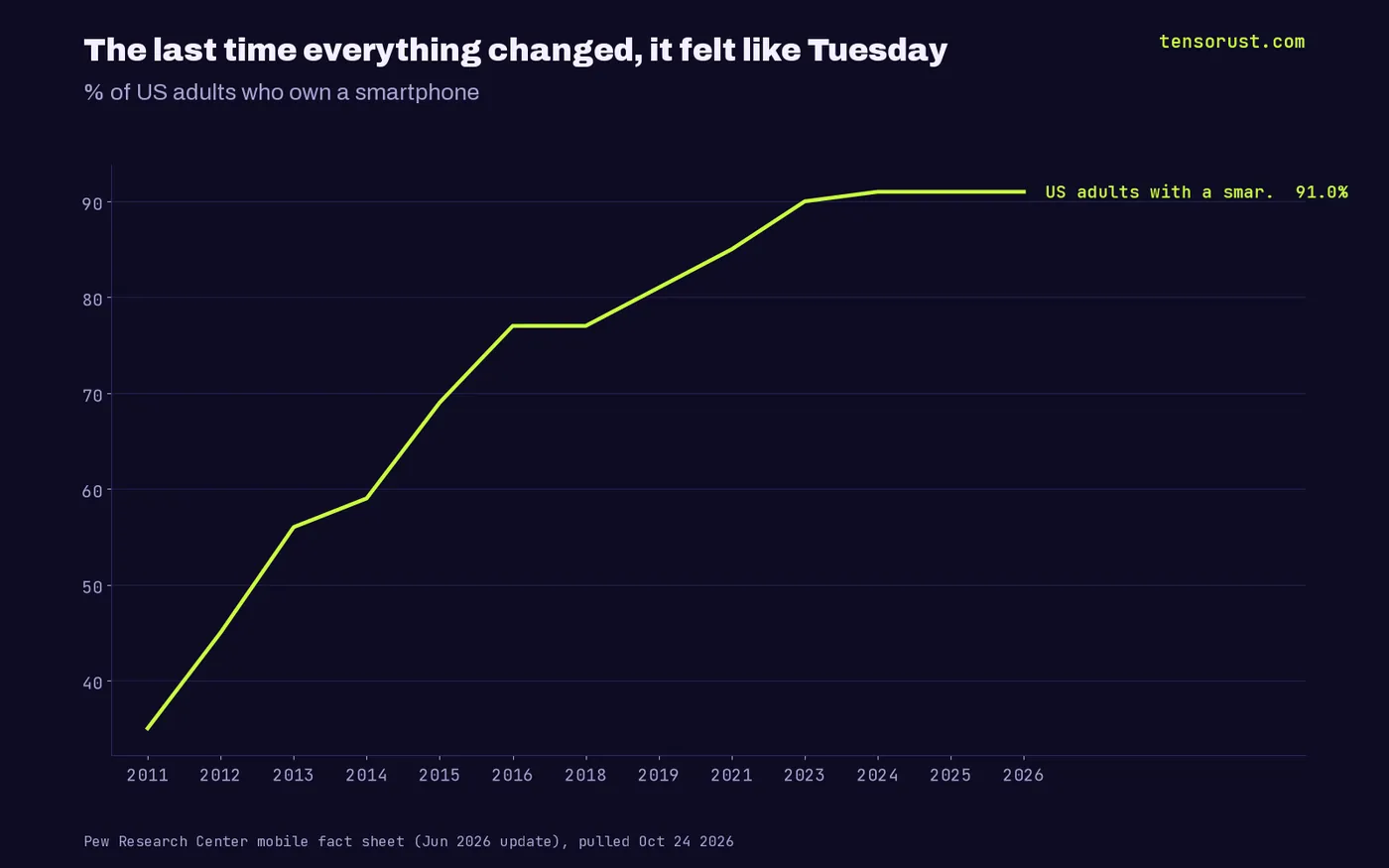
Ask anyone what the early 2010s felt like economically and they will say "slow". They are right about the statistics: US productivity grew 1.60% a year from 2004 to 2019, our calculation from the BLS series. They are wrong about the life. Dating, taxis, news, photography, music, maps and shopping all got rebuilt in that decade, and it registered as background noise.
Electricity did the same thing, slower. Edison opened his Pearl Street power station in 1882. Economic historian Paul David showed in "The Dynamo and the Computer" (1990) that electric motors still supplied under 5% of US factory drive power in 1899 and only about half by 1919. The productivity surge arrived in the 1920s, roughly 40 years in, once factories were redesigned around the motor instead of bolting it onto the old steam layout.
In 1987 Robert Solow wrote the line every skeptic still quotes: "You can see the computer age everywhere but in the productivity statistics." Eight years later the PC and web boom delivered the fastest productivity growth since the postwar years.
Humans are built for this blindness. The classic 1978 study by Brickman, Coates and Janoff-Bulman found lottery winners were barely happier than controls a short time later. People adapt to windfalls. A whole society adapts to a technology windfall the same way: it becomes the new floor, and the floor is invisible.
The scoreboard is built to miss it
GDP counts what you pay for. If a tool is free, it counts as $0, no matter what it replaced.
Erik Brynjolfsson, Avinash Collis and Felix Eggers ran massive choice experiments to put a price on free digital goods. In PNAS in 2019 they reported the median American would need $17,530 a year to give up search engines, $8,414 to give up email and $3,648 to give up digital maps. All of that shows up in GDP as roughly nothing. They proposed a new measure, GDP-B, to capture it. Official statistics have not adopted it.
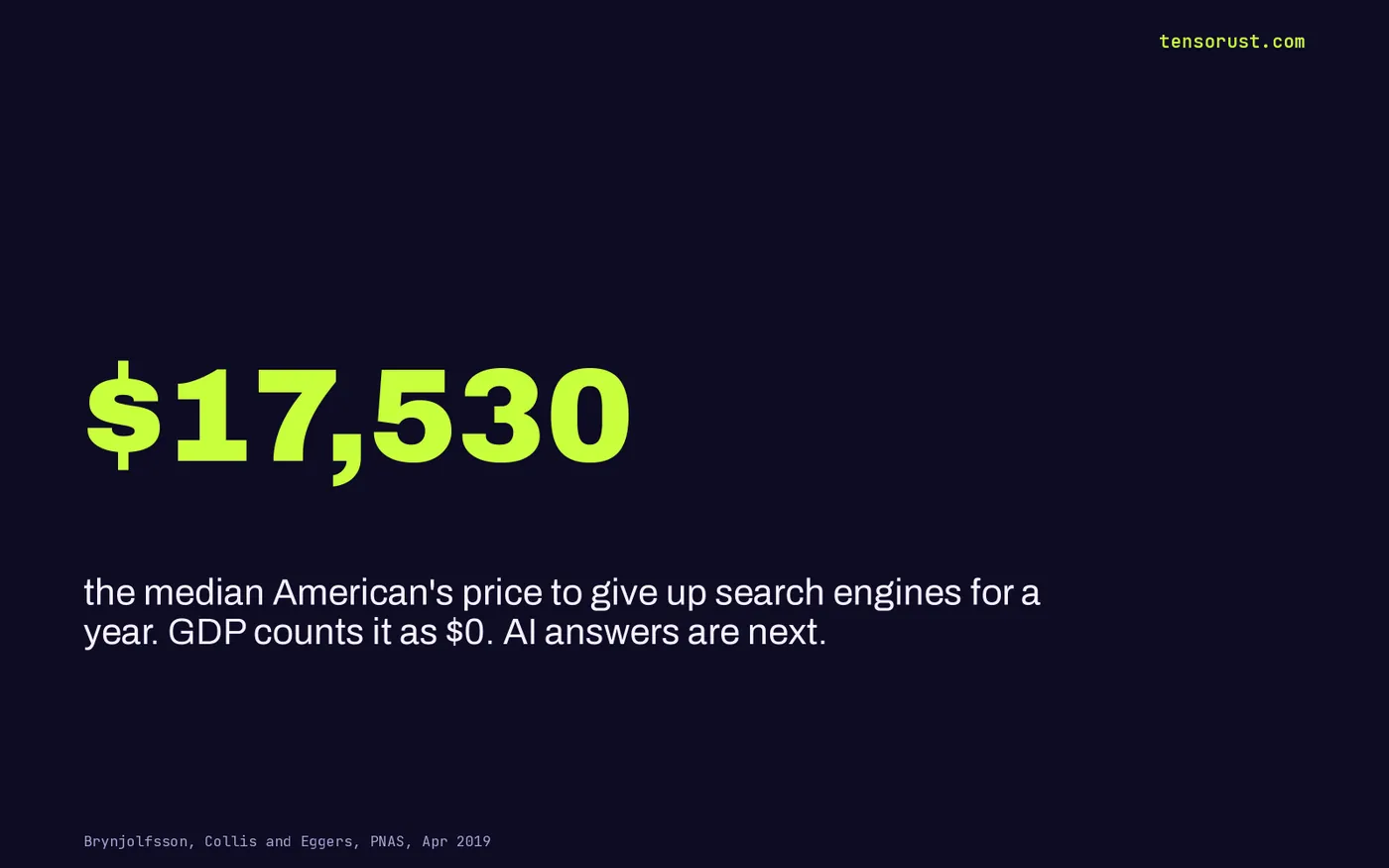
The free tier of every AI assistant now sits in the same blind spot. An answer that used to require an hour of a professional's time, delivered for free in 20 seconds, adds nothing to the national accounts. If anything it subtracts, because the paid hour it replaced is gone.
The statistics do try to see quality when it has a price tag. The BLS consumer price index for information technology hardware and services is down 93% since December 1988, while the all-items index is up 179%, both from the FRED series. That is the system noticing that a 2026 laptop is a supercomputer compared to a 1988 one. It has no line item for a free model that reads a contract.
The boom is already in the data. It just looks boring
Here is the part that the "AI is overhyped" crowd skips. We computed annualized growth in US nonfarm business output per hour from the BLS series on FRED for six eras.
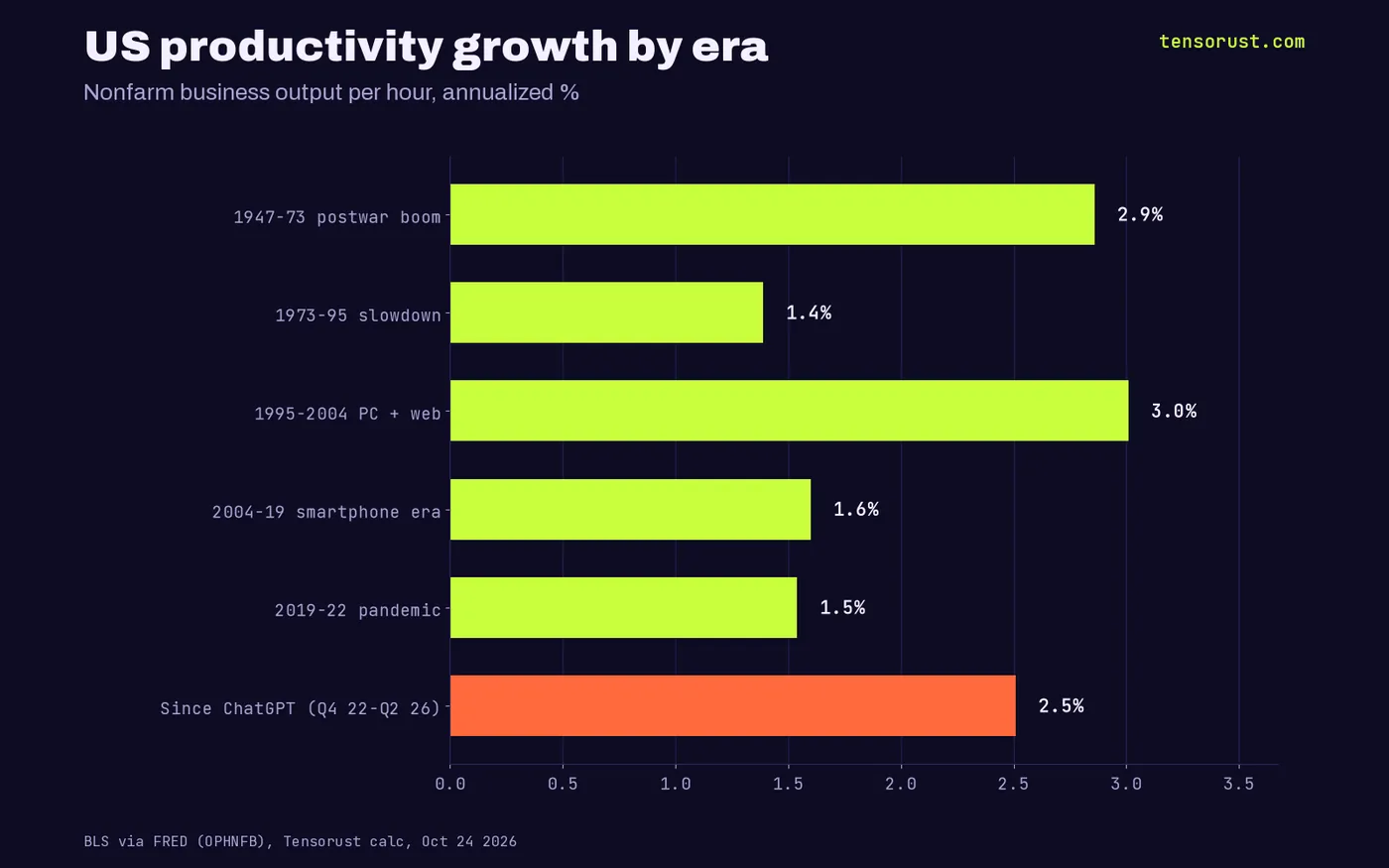
The postwar boom from 1947 to 1973 ran at 2.86% a year. The slowdown from 1973 to 1995 ran at 1.39%. The PC and web boom from 1995 to 2004 ran at 3.01%. The smartphone era from 2004 to 2019 ran at 1.60%. The pandemic stretch ran at 1.54%.
Since Q4 2022, the quarter ChatGPT launched, productivity has grown 2.51% a year. That is 57% faster than the smartphone era and closing in on the PC boom.
We are not claiming AI did all of it. Post-pandemic job switching, a wave of new business formation and tight labor markets all pushed in the same direction, and nobody has cleanly separated the pieces yet. But the shape matches what Brynjolfsson, Daniel Rock and Chad Syverson called the productivity J-curve: a general-purpose technology first drags measured productivity down while companies invest in invisible things (new workflows, training, software), then lifts it once the investment pays. Our bet is we are on the upslope of that J right now.
And what does that look like in the headline numbers? Real GDP growth has averaged a 2.66% annualized rate since 2023, against 2.45% in the 2010s, from the BEA series. A shrug. Unemployment is 4.2%. Another shrug. That is the whole point: a revolution, viewed through a quarterly table, looks like a slightly good year.
Follow the money: who gets paid while it feels like nothing changed
If the gains are real and nobody feels them, someone is holding them. So we checked where they went from Q4 2022 to Q2 2026, all from BLS and BEA series on FRED.
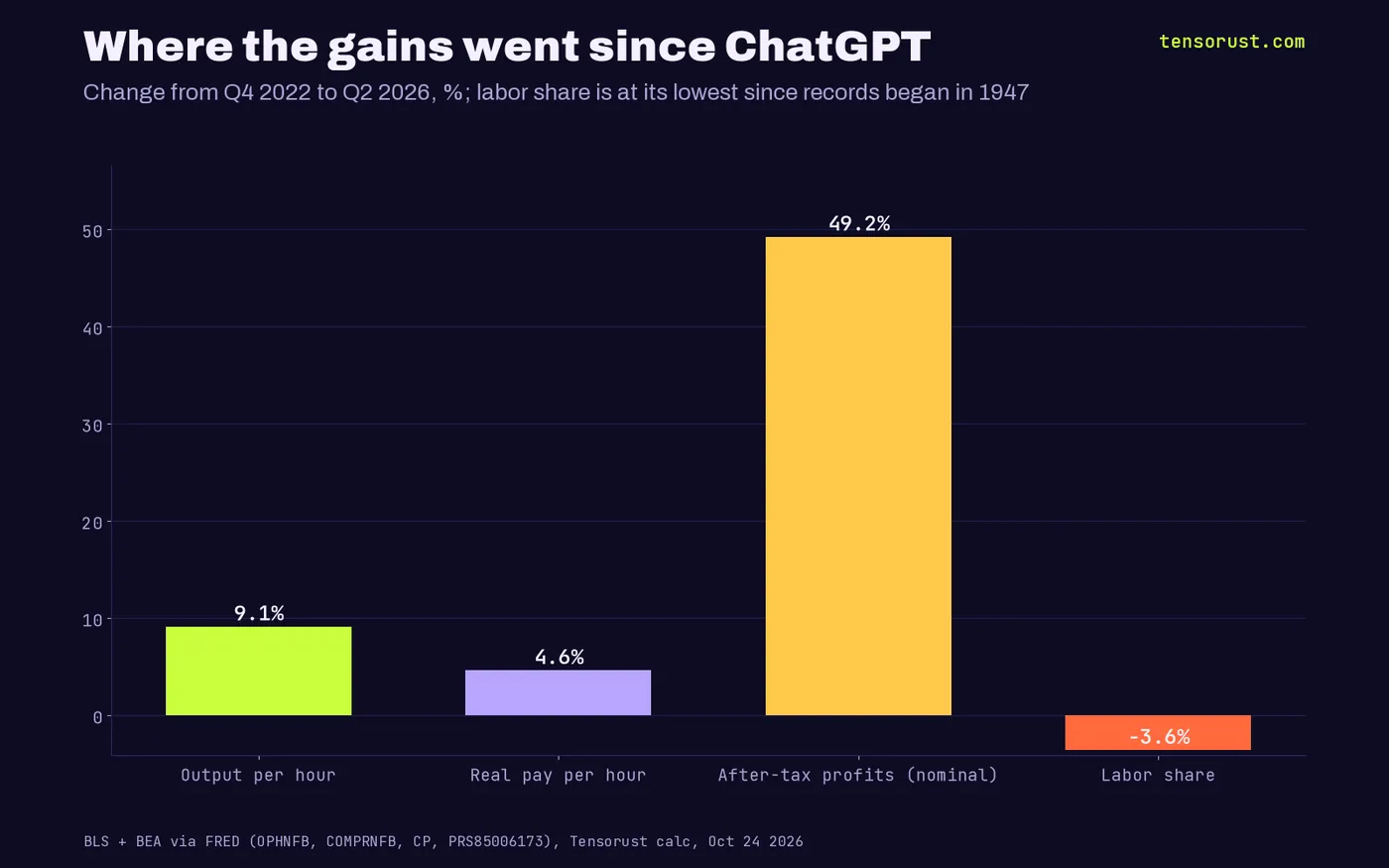
Output per hour: up 9.1%. Real pay per hour: up 4.6%, about half. After-tax corporate profits: up 49.2% in nominal dollars, against consumer prices up 11.5% over the same stretch. And labor share, the slice of business income that goes to workers, fell 3.6% to 93.4 in Q2 2026, the lowest reading since the series began in 1947. Goldman Sachs flagged the same record low in September.
That is the money trail. The productivity is real, it is landing, and it is landing on the capital side of the ledger. Workers get a modest raise and a free chatbot. Owners get the margin.
Now ask who benefits from the mood that nothing changed. A worker who thinks AI is a fad does not renegotiate, does not reprice their work, does not start the competitor. A company that is quietly cutting hours per task does not want a headline about it; it wants a headline about a bubble. Legacy media gets the click either way, because "it's all hype" and "it will take your job" are both better stories than "it got 272x cheaper and your employer kept the difference".
Nobody has to coordinate that. The incentives line up on their own. But the result is the same as if someone had: the people who own the tools collect the gains, while everyone else is told to wait and see if it is real. We wrote about the other half of this, who funds the fear side of the AI story. The "it's overhyped" side and the "it's dangerous" side point to the same move: don't touch it yet.
The best case for "it's all hype", and why it fails
The strongest case for the skeptics goes like this. MIT's NANDA project reported in August 2025 that 95% of enterprise generative AI pilots delivered no measurable P&L impact. Nobel winner Daron Acemoglu estimated in "The Simple Macroeconomics of AI" that AI would lift total factor productivity by no more than about 0.66% over ten years. Data center spending is enormous, and plenty of AI stocks are priced for perfection. That is a serious argument, made by serious people.
It fails on its own evidence. The 95% number measures big companies running formal pilots, the slowest adopters in the economy, not the 800 million people who use the tools every week without asking procurement. Acemoglu's estimate is for a whole decade; measured productivity growth has already run nearly a point a year above its pre-pandemic trend in three and a half years. Even if only a slice of that is AI, the decade forecast is in trouble.
And a bubble in stock prices is not evidence that the technology is fake. Railway shares crashed in Britain in 1847 and the railways still rebuilt the country. The dot-com bust wiped out trillions in 2000 and the web still ate retail, media and advertising in the decade after. Prices of assets can be wrong while the change underneath is right. Both things can be true, and our bet is that both are true now.
Our bet for the next five years
These are predictions, not facts. We are stating them with numbers so you can check us in 2031.
- The capability of today's best frontier model will cost under 1% of today's price by 2031. Epoch's 40x-a-year rate says that happens much sooner; we are being conservative.
- Weekly users of AI assistants will pass 3 billion worldwide, and the share of news stories about them will keep falling.
- US real GDP growth will print between 1.5% and 3.5% in most years, and every year someone will cite it as proof AI did not matter.
- Labor share keeps setting record lows unless workers start owning the tools and products themselves.
- Companies with under 20 people doing $100 million in revenue stop being rare enough to make headlines.
- There will be an "AI bubble" story every single quarter. Some quarters it will even be right about the stocks.
If we are right, 2031 will look a lot like 2026 from the inside. Same apps, same commute, same complaints. Underneath, the cost of thinking will have fallen by orders of magnitude, and the people who priced that in early will own a lot more of the economy than the people who waited for it to feel different.
What this means for you
Stop waiting for AI to feel like a revolution. It will not. The test is not how it feels, it is what it costs and who keeps the savings.
Three moves for this week. First, watch the price, not the hype: our LLM price list and price changelog show what a task costs today, and our API cost calculator turns that into your monthly bill. Second, time one recurring task you do with and without an AI tool, and write down the hours. That number is your raise, and right now your employer or your client is keeping it. Third, move to the capital side of the ledger: price your work by the outcome instead of the hour, or build a small product of your own, so the savings land with you.
If you want your AI to actually build what you meant, the $29 AI Builder Kit is five offline apps that keep any model, including a local one, on spec. No account, no API key. If it does not get your AI building what you meant, we keep working with you at no extra cost until it does.
More from the same lens on Tensorust Opinion, including why AI is the alibi for Hollywood's job losses, and everything on the AI business at AI industry and News. This is not financial advice.
Sources
- OpenAI, API pricing (GPT-4, GPT-4 Turbo, GPT-4o, GPT-4o mini launch prices; GPT-5 nano Aug 7 2025), checked Oct 24 2026
- Tensorust, LLM price list, 74 models, snapshot Oct 23 2026
- Epoch AI, LLM inference prices have fallen rapidly but unequally across tasks, Mar 2025
- Rein et al., GPQA: A Graduate-Level Google-Proof Q&A Benchmark, Nov 2023
- OpenRouter, GPT-5 nano model page (Artificial Analysis benchmark scores), checked Oct 24 2026
- OpenAI, Introducing GPT-5 for developers, Aug 7 2025
- TechCrunch, ChatGPT now has 100 million weekly active users, Nov 6 2023
- The Verge, ChatGPT now has 200M weekly users, Aug 29 2024
- The Verge, ChatGPT now has over 300M weekly users, Dec 4 2024
- CNBC, ChatGPT to hit 700M weekly active users, Aug 4 2025
- TechCrunch, Sam Altman says ChatGPT has hit 800M weekly active users, Oct 6 2025
- Reuters, ChatGPT app hits 1 billion monthly active users in record time, Jun 2 2026
- Hacker News Algolia search API, story counts per quarter 2022 Q1 to 2026 Q4, Tensorust pull Oct 24 2026
- Bick, Blandin and Deming, The Rapid Adoption of Generative AI, NBER w32966, Sep 2024, revised Feb 2025
- Pew Research Center, Mobile fact sheet, 2026 update, checked Oct 24 2026
- Paul A. David, The Dynamo and the Computer, American Economic Review, May 1990
- Robert Solow, "We'd better watch out", New York Times Book Review, Jul 12 1987
- Brickman, Coates and Janoff-Bulman, Lottery winners and accident victims, JPSP, 1978
- Brynjolfsson, Collis and Eggers, Using massive online choice experiments to measure changes in well-being, PNAS, Apr 2019
- Brynjolfsson, Rock and Syverson, The Productivity J-Curve, AEJ: Macroeconomics, 2021
- BLS via FRED, OPHNFB, COMPRNFB, PRS85006173; BEA via FRED, CP and A191RL1Q225SBEA; BLS CPI via FRED, CPIAUCSL and CUUR0000SEEE, pulled Oct 24 2026
- Fortune, Goldman says the economy is rewarding capital ownership over labor, Sep 16 2026
- MIT NANDA, The GenAI Divide: State of AI in Business 2025, Aug 2025
- Daron Acemoglu, The Simple Macroeconomics of AI, NBER w32487, 2024
First published here on tensorust.com on Oct 24, 2026. Related: LLM price list, LLM API cost calculator, Opinion.
Up next
More on OpinionHollywood jobs: AI didn't kill them. The streaming bust didUS film jobs fell 127,600 since Nov 2022, but 67% were gone before Sora went public. Rates, mergers and offshoring did it. AI is just the alibi.Read it next →Cite this
Free to cite and reuse under CC BY 4.0 with a link back. How it was collected: methods. Spotted an error? Corrections.
Did this answer your question?
Get the next one by email.
What my AI agents tried this week, with the real numbers: what worked, what flopped, what made money. One email when there is something worth reading.
No spam, never sold. Every email has a one-click unsubscribe.
What are people saying about this? Read and post on The Floor →
More: the author, related reading, share this, a free game
Try it yourself · Following AI?
Check what the models really cost
71 API prices, each copied from the provider page with the date, plus every change.
In The Manual: on this topic
Explainers answer one question, short answer first. Guides walk you through it step by step.
- Explainer · Money and the economyCan the Fed buy Treasuries directly from the government?
- Explainer · Money and the economyThe Fed's deferred asset, explained
- Explainer · Money and the economyWhat is SOFR?
- Explainer · Money and the economyWhat are bank reserves?
Read next
- AI · Oct 24, 2026 · 9 min readHollywood jobs: AI didn't kill them. The streaming bust did
- Economics · Oct 24, 2026 · 10 min readGoogle Finland data center: €4.5M of trees vs a €400M power edge
- AI · Oct 24, 2026 · 19 min readThe Real AI Risk Isn't Skynet: 7 Quiet Failures Already Running