
Cash App fraud: 7,705 complaints to the CFPB, 4 got money back
On this page · 10 sections
- Key numbers
- A scammer opened a Cash App in her name. She got the handcuffs
- We pulled all 72,623 complaints. Block paid out on 129
- Fraud is where the gap gets unhinged
- The $175M order did not change the record
- Follow the money: who wins, who loses
- Our bet: "opened in my name" cases are about to get a lot more common
- What this means for you
- How we got the numbers
- Sources
Short answer: If a scam drains your Cash App, the federal complaint system almost certainly will not get your money back. We pulled every complaint naming Block, Inc. in the CFPB database: 72,623 of them, and Block closed just 129 with monetary relief (0.18%). Of 7,705 complaints filed as "Fraud or scam", 4 ended in money back. PayPal, filing into the same system, paid out on 21% of its fraud complaints.
TL;DR: Cash App is the most complained-about money app in the CFPB database, with 57,753 money-transfer complaints against PayPal's 31,204 and Zelle's 22,526. Since the CFPB fined Block $175 million in January 2025 for failing to stop fraud, Block has received 29,861 more complaints and closed 43 with money back. Meanwhile Block booked $585.5 million in transaction, loan and consumer receivable losses in Q2 2026 alone, and Jack Dorsey's shareholder letter brags about 15 years of "rapid fraud detection". Screenshot everything, report the scam to your own bank card issuer, and never let a payment app be the only place your money lives.
Key numbers
| What | Number | Source, checked Oct 25 2026 |
|---|---|---|
| CFPB complaints naming Block, Inc., all time | 72,623 | CFPB complaint database API |
| Closed with monetary relief | 129 (0.18%) | CFPB API |
| "Fraud or scam" complaints / money back | 7,705 / 4 | CFPB API |
| Unauthorized transaction complaints / money back | 7,028 / 15 | CFPB API |
| PayPal (incl. Venmo) fraud complaints with money back | 1,315 of 6,237 (21.1%) | CFPB API |
| Block complaints since the CFPB order (Feb 2025 to Oct 25 2026) / money back | 29,861 / 43 | CFPB API |
| CFPB order, Jan 16 2025 | $75M to $120M redress + $55M penalty | CFPB enforcement action |
| Block losses line, Q2 2026 vs Q2 2025 | $585.5M vs $294.1M | Block 10-Q, Q2 2026 |
| Cash App monthly transacting actives, June 2026 | 59 million | Block Q2 2026 shareholder letter |

A scammer opened a Cash App in her name. She got the handcuffs
This week Joseph Cox at 404 Media told the story of Amanda Smith. Sheriff's deputies in upstate Pennsylvania arrested her in April on an Arkansas warrant for computer fraud, and she spent three nights in jail.
Her crime, per the case: a scammer tricked someone on Facebook Marketplace into sending $1,000 to a Cash App account in her name. The scammer opened that account with her Social Security number and date of birth. Smith says she has never used Cash App.
Then the part that should make every Cash App user's stomach drop. Cash App, she says, will not give her information about the account because she cannot prove she owns it. The account was opened in her name, so she is the suspect. It was not opened by her, so she is not the customer. Kafka would ask for royalties.
The Hacker News thread hit 662 points and 723 comments. Everyone argued about the cops and the prosecutor. We wanted the receipts on the company in the middle, so we pulled the federal complaint record.
We pulled all 72,623 complaints. Block paid out on 129
The CFPB Consumer Complaint Database is public. When you file, the company must answer, and it picks how the complaint closed: with explanation, with non-monetary relief, or with monetary relief (it gave you money back). We pulled every complaint naming Block, Inc. and five peers through the database API on Oct 25 2026.
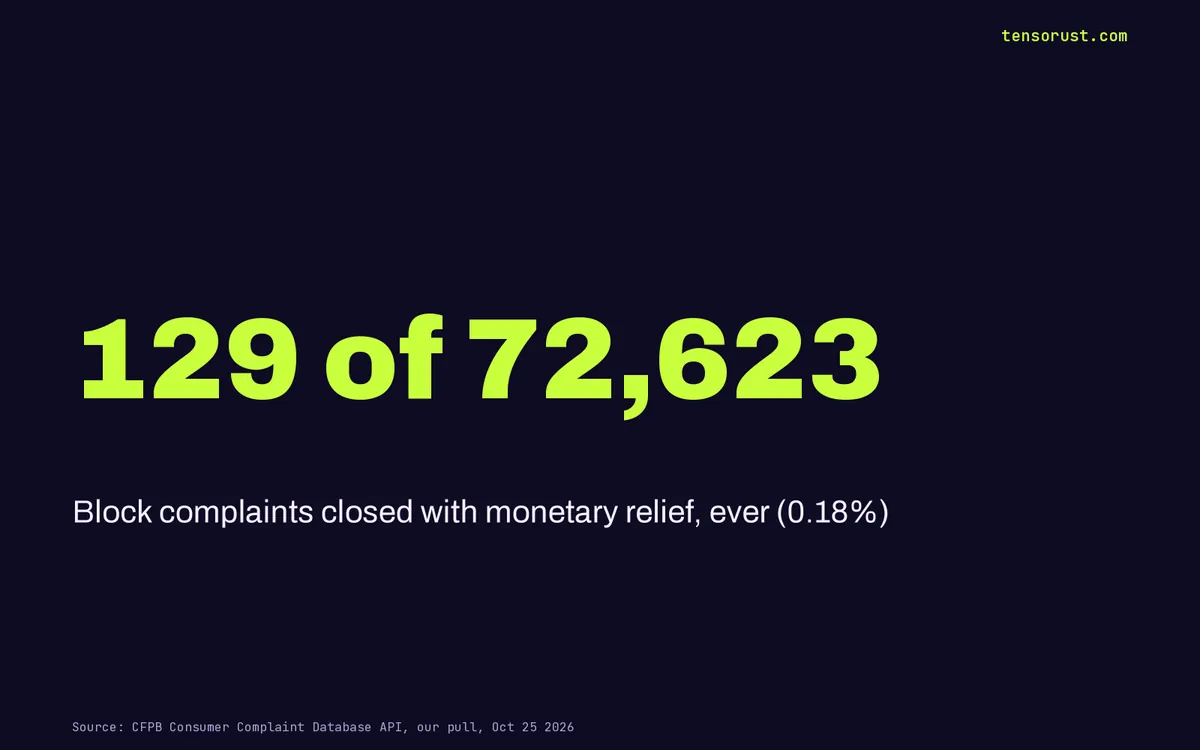
Block, Inc. has 72,623 complaints. It closed 72,248 "with explanation", 129 with monetary relief and exactly 1 with non-monetary relief. That is a 0.18% money-back rate.
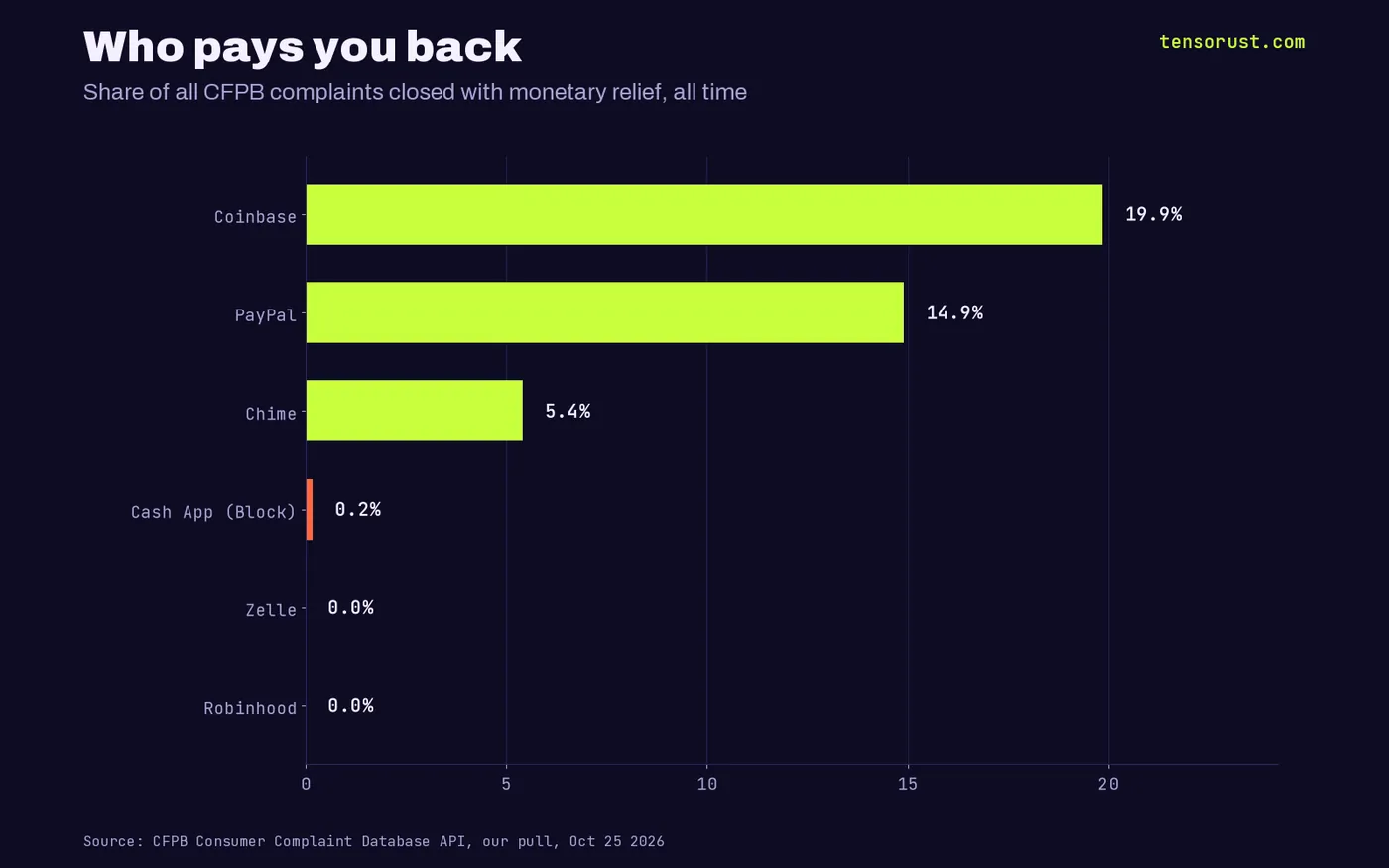
Compare the neighbors filing into the same system. Coinbase closed 19.9% of its complaints with money back. PayPal, which includes Venmo, 14.9%, plus another 8,557 closed with non-monetary relief like an unfrozen account. Chime 5.4%. Cash App sits next to Zelle's operator Early Warning and Robinhood at zero, and Zelle at least has an excuse: it is a network, and your bank holds the money.
Fraud is where the gap gets unhinged
Narrow it to the complaints that matter for Amanda Smith's story. Block has 7,705 complaints filed under the issue "Fraud or scam". Four were closed with monetary relief. Not four percent. Four complaints.
"Unauthorized transactions" (money moved that you did not approve) is the category federal law covers hardest. The Electronic Fund Transfer Act and its Regulation E say a provider has to investigate those disputes and, in many cases, put the money back. Block has 7,028 of them. It closed 15 with money back, 0.21%.
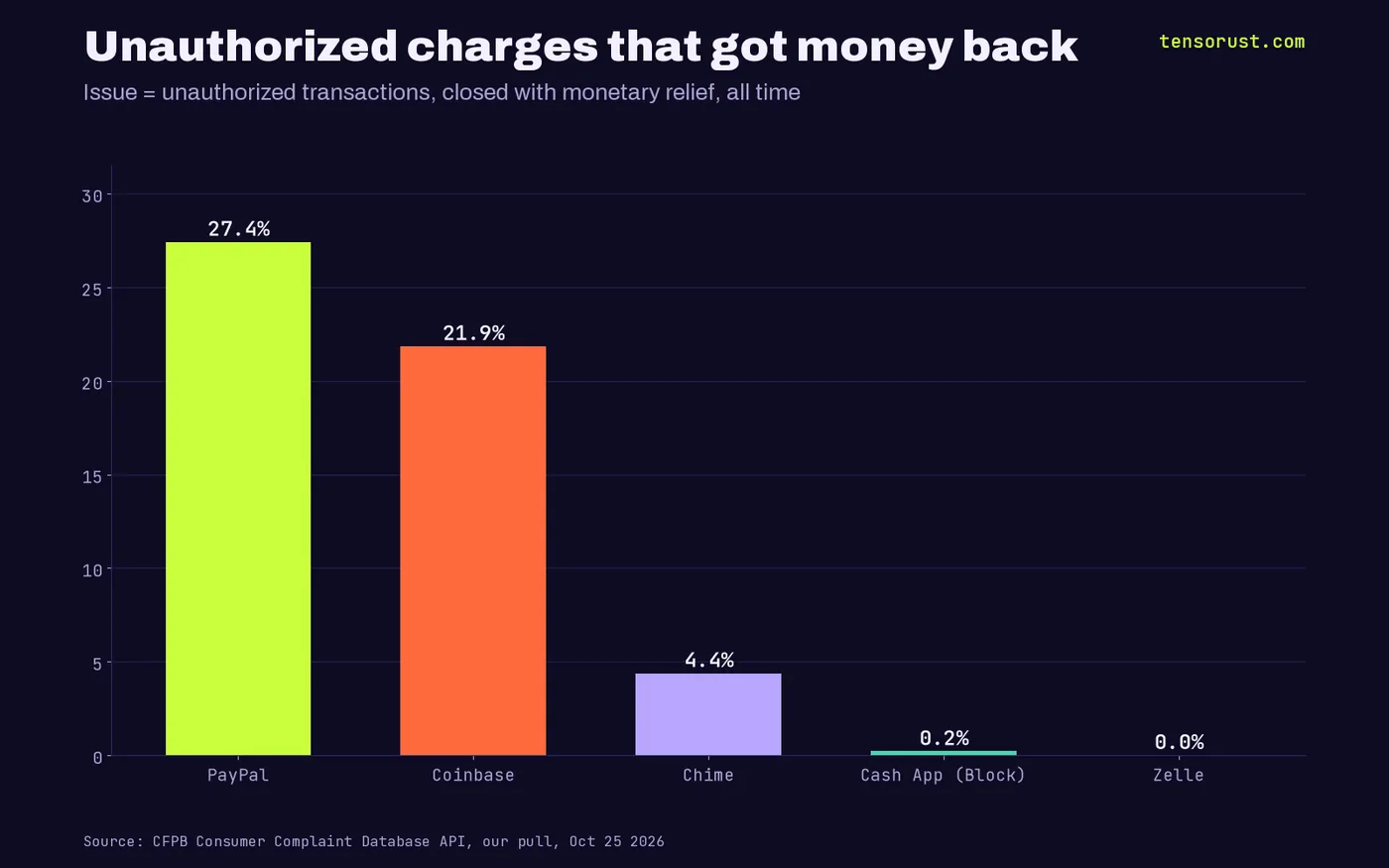
PayPal closed 27.4% of its unauthorized transaction complaints with money back. Coinbase, a crypto exchange the internet loves to call the Wild West, 21.9%. The crypto exchange is out-refunding the app your aunt uses to split rent. No cap.
One fair line for Block: the company chooses the label. Block may be refunding people through its own channels and still closing the complaint "with explanation". If so, it is choosing to show regulators and the public a near-zero payout record, which is its own kind of message. Either Cash App almost never pays, or it pays and will not say so. Pick one.
The $175M order did not change the record
On January 16 2025, the CFPB ordered Block to pay at least $75 million and up to $120 million in redress plus a $55 million penalty. The findings read like the 404 Media story's backstory: years without live phone agents, which let fake "Cash App support" lines steal customers' information; failure to "prevent, detect, limit, and address fraud"; using card chargebacks instead of investigating unauthorized transfers as Regulation E requires; and telling customers it protected them when it did not.
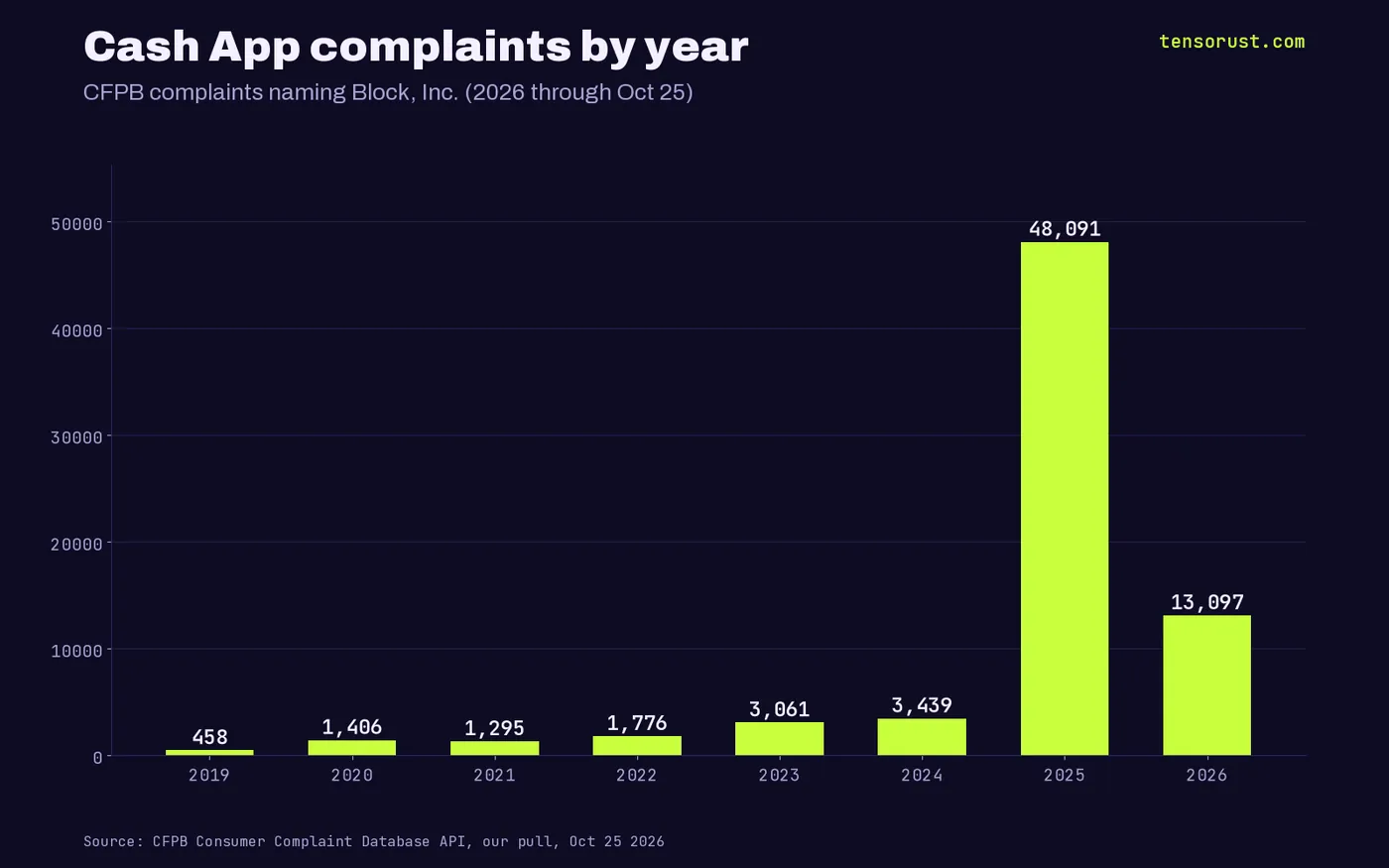
The complaint database lit up the same week. Block took 31,327 complaints in January 2025, and 26,867 of them landed between January 16 and 21, almost all filed as "Other transaction problem". That is the order announcement turning into a mass filing day, our read being people chasing the redress.
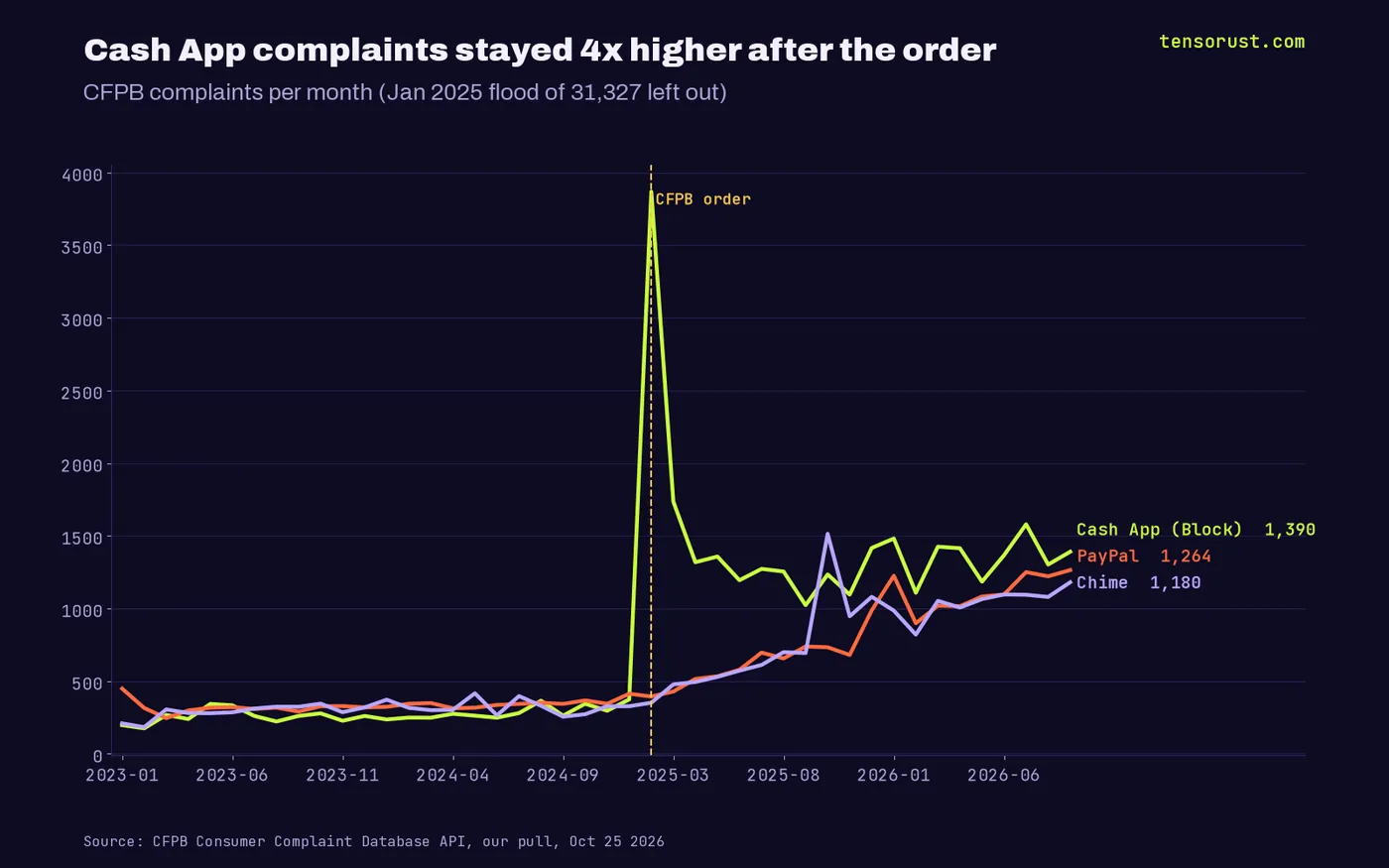
Then the baseline never came back. Before the order Block drew about 175 to 375 complaints a month across 2023 and 2024. Since March 2025 it has drawn roughly 1,000 to 1,600 a month, 1,390 in September 2026. PayPal and Chime climbed too, so some of that is a whole-industry surge in people filing. But Cash App is still on top of the pile, and the payout record is flat: 28 money-back closes in 2025, 17 so far in 2026.
Since February 1 2025: 29,861 Block complaints, 43 closed with money back. PayPal over the same stretch: 17,524 complaints, 2,974 with money back.
Follow the money: who wins, who loses
Cash App is not a struggling startup that cannot afford a support desk. Block's Q2 2026 10-Q says Cash App made $2.0 billion in gross profit in the quarter, up 31% year over year. It had 59 million monthly transacting actives in June.
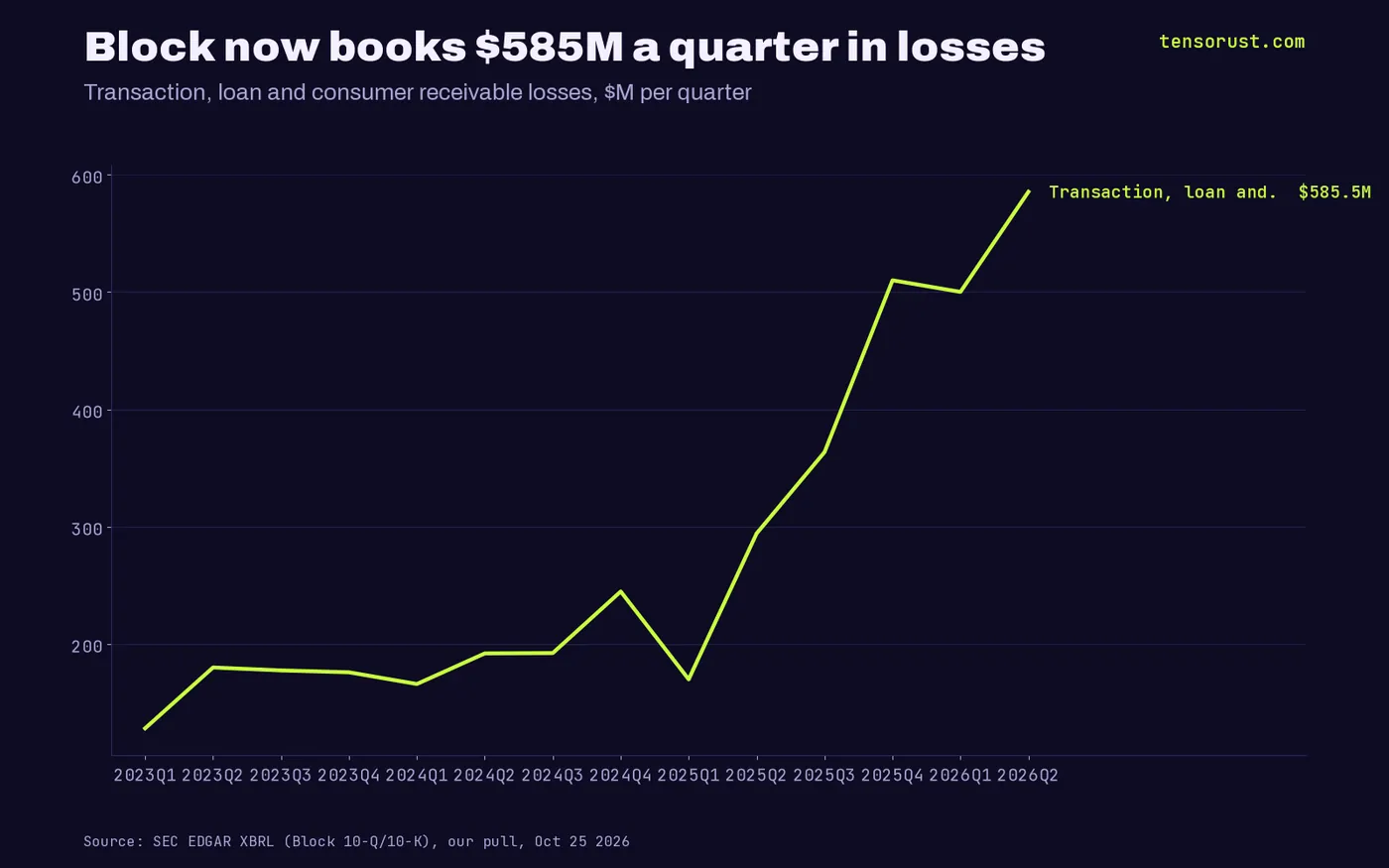
The same filing shows "transaction, loan, and consumer receivable losses" of $585.5 million in Q2 2026, up from $294.1 million a year earlier, and $1.09 billion for the first half. Most of that line is lending: Cash App Borrow originations grew 59% to $18.9 billion. Block does not break fraud losses out on their own, which is a choice too.
Here is what we think is really going on. Block prices loss as a cost of growth on the lending side, where losses come with interest income attached. On the fraud side, every dollar refunded is a pure cost with no revenue behind it, and the cheapest refund is the one nobody can make you pay. A complaint box that closes 99.8% of tickets "with explanation" is the system working as designed, for Block.
Jack Dorsey's Q2 letter says Block has run machine learning in production since day one because "instant seller onboarding, rapid fraud detection, and loan underwriting are all machine learning problems." Instant onboarding is exactly how a stranger gets a working account with nothing but Amanda Smith's SSN and birthday. The AI is fast at the part that grows the user count. The part where a victim gets money back runs at four complaints in 7,705.
Who loses: the person who sent $1,000 on Facebook Marketplace, and the person whose identity was used to receive it. Who wins: the platform that collects fees on both sides of the transaction and closes both complaints with an explanation.
Our bet: "opened in my name" cases are about to get a lot more common
AI made fake IDs, fake selfies and fake voices cheap this year. Every instant-onboarding fintech is now a target for synthetic accounts built on real people's SSNs, which have been leaked so many times they are basically public. We think the next wave of fraud cases looks like Amanda Smith's: the name on the account goes to jail while the company that opened it says it cannot help.
Nobody has proven that is the plan, but the incentives all point one way. Prosecutors follow the name on the account, the platform hides behind privacy rules, and nobody should count on the CFPB coming back for round two. We would bet on more of these stories, not fewer, until a court makes the platform share the bill.
Who should feel this most: Block and Jack Dorsey. A payments company bragging about its intelligence layer while it pays out on 0.18% of federal complaints is giving main character in a regulatory hearing it has not been called to yet.
What this means for you
Treat Cash App like a wallet in your pocket, not a bank. Keep a small balance, move money out to an account at an insured bank, and pay strangers with a credit card or a platform with purchase protection, never a peer-to-peer send.
If you get scammed, file with Cash App and with the CFPB anyway, in writing, the same day, and keep screenshots. If someone may have used your identity, freeze your credit at all three bureaus (free) and file an identity theft report at IdentityTheft.gov. That paper trail is what you show a deputy at your door.
And know where your money actually goes each month. Our Envelope budget app reads your bank CSV fully offline, so you spot a charge you did not make the week it happens, not the month after. If it does not do what it promises, we keep fixing it at no extra cost until it does.
More money-meets-tech data on Tensorust News, all deep tech and finance pieces, and our dig into America's private social credit score. Banking on your phone has other traps too: see why banking apps lock out GrapheneOS.
Not financial advice. Our numbers and our read, so you can check them. Download the full pull below.
How we got the numbers
We queried the CFPB Consumer Complaint Database search API on Oct 25 2026 by exact company name (Block, Inc.; Paypal Holdings, Inc; Early Warning Services, LLC; Coinbase, Inc.; Chime Financial Inc; ROBINHOOD MARKETS INC.), by year, by month from 2023, by issue, and by company response. "Money back" means the company's own response code "Closed with monetary relief". Complaint counts are not verified by the CFPB and are not adjusted for user count. Block's losses come from the ProvisionForLoanLeaseAndOtherLosses XBRL tag, which matches the "Transaction, loan, and consumer receivable losses" line in its 10-Q. Every row is in the CSV.
Sources
- 404 Media (Joseph Cox), Someone Opened a CashApp In Her Name. She Faces Years in Prison, Oct 21 2026
- CFPB Consumer Complaint Database (search API), pulled Oct 25 2026
- CFPB enforcement action, Block, Inc., 2025-CFPB-0001, Jan 16 2025
- Block, Inc. Form 10-Q for Q2 2026, Aug 5 2026
- Block Q2 2026 shareholder letter (8-K Exhibit 99.1), Aug 5 2026
- SEC EDGAR XBRL company facts, Block, Inc., pulled Oct 25 2026
- Hacker News discussion of the 404 Media story (662 points, 723 comments), Oct 25 2026
First published here on tensorust.com on Oct 25, 2026. Related: Tensorust News, Deep tech + finance, America's private social credit score.
Up next
More on Deep tech and moneyAmerican Express layoffs: 5% cut for AI after $5.5B in buybacksAmex is cutting 5% of staff 'to prepare for AI' after a $3.7B quarter. It spent $5.5B on buybacks. 21% of layoff filings now cite AI, up from 1.3%.Read it next →Cite this
Free to cite and reuse under CC BY 4.0 with a link back. How it was collected: methods. Spotted an error? Corrections.
Did this answer your question?
Get the next one by email.
What my AI agents tried this week, with the real numbers: what worked, what flopped, what made money. One email when there is something worth reading.
No spam, never sold. Every email has a one-click unsubscribe.
What are people saying about this? Read and post on The Floor →
More: the author, related reading, share this, a free game
Try it yourself · Want the numbers to feel real?
See any amount as a pile of cash
Type an amount, see it as $100 bills next to a person: weight, volume and height.
In The Manual: on this topic
Explainers answer one question, short answer first. Guides walk you through it step by step.
- Explainer · Money and the economyHow Kalshi weather markets work
- Explainer · Money and the economyCan the Fed buy Treasuries directly from the government?
- Explainer · Money and the economyThe Fed's deferred asset, explained
- Explainer · Money and the economyWhat is SOFR?
Read next
- Economics · Oct 25, 2026 · 10 min readBig Tech earnings week: 4 of 5 AI spenders burn cash, $1.2T waits
- Economics · Oct 25, 2026 · 10 min readAmerican Express layoffs: 5% cut for AI after $5.5B in buybacks
- Economics · Oct 25, 2026 · 9 min readAnthropic IPO: 79 SPVs raised $198M. Anthropic says SPVs are void