
By Matt Busel, who built the apps, crates and game he writes about · every number links to its source and every dataset is downloadable (methods) · corrections · featured in Kirino, gamebiz, This Week in Rust, New Mobile Life, By-Press
Screen time panic: Apple and Google sell the habit and the cure
On this page · 9 sections
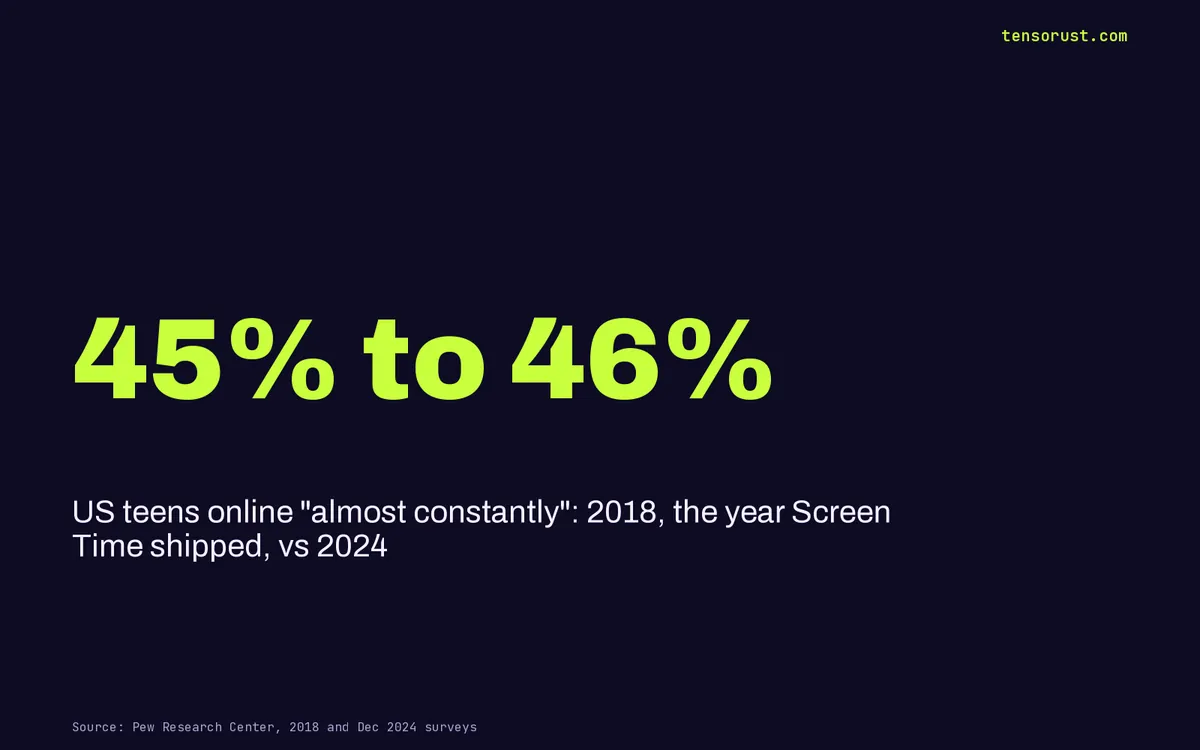
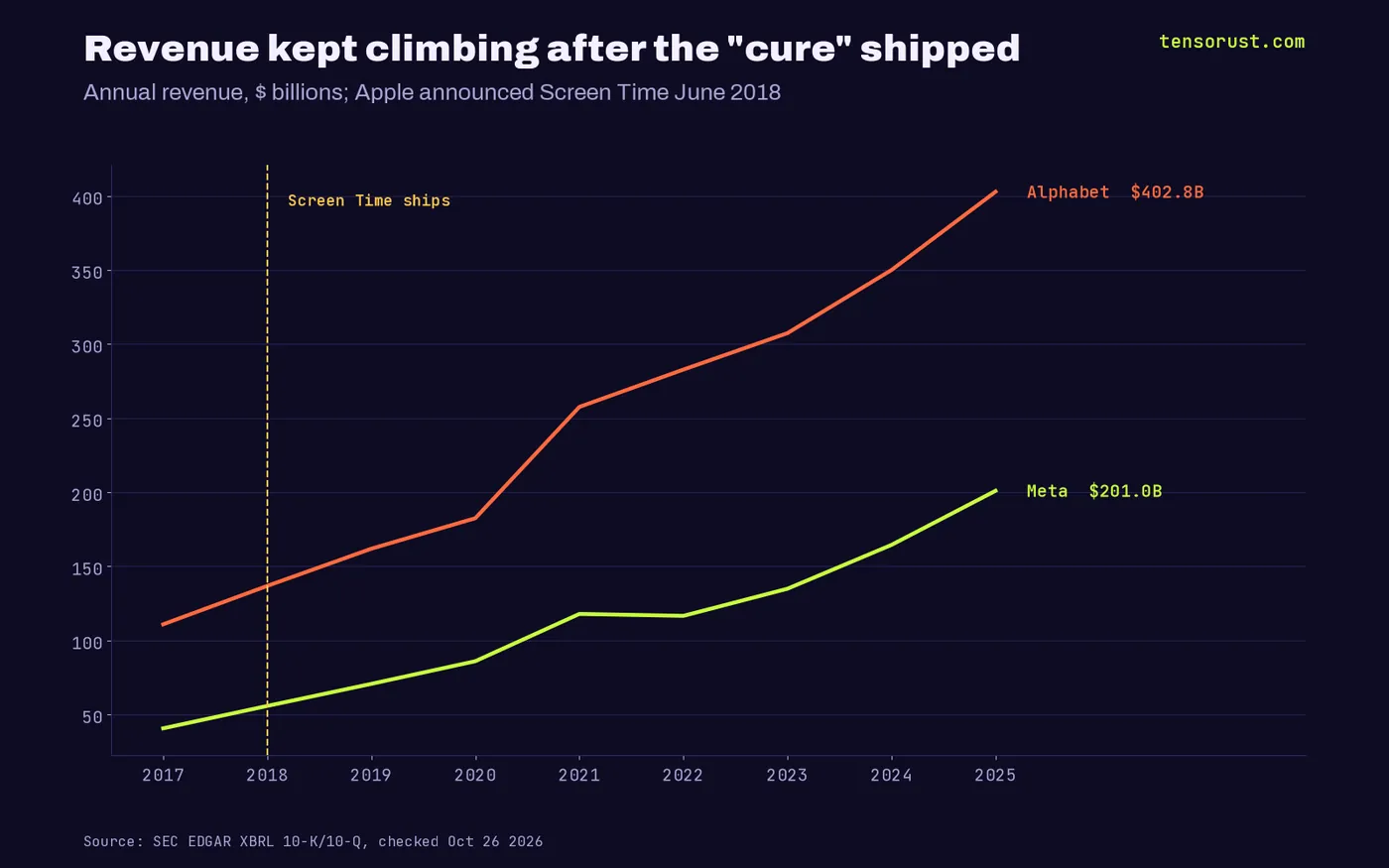
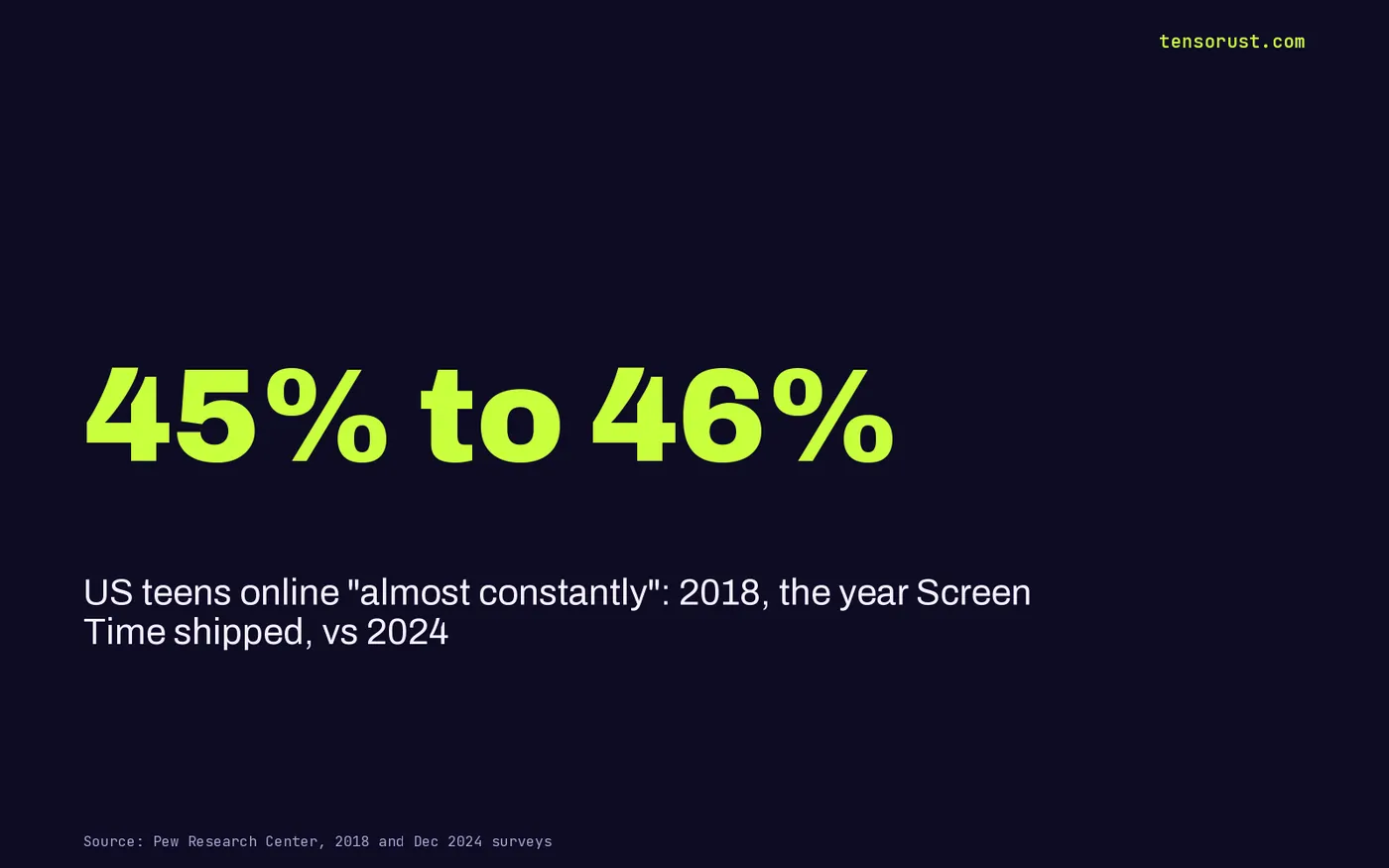
Short answer: The screen time panic is a product category, not a rescue. In 2018, the year Apple announced Screen Time, 45% of US teens told Pew they were online "almost constantly." In 2024 it was 46%. The cure changed nothing, and the companies that shipped it grew their revenue anyway: Meta from $55.8B to $201.0B, Alphabet from $136.8B to $402.8B.
TL;DR: Pew's "almost constantly online" number for teens went from 24% in 2014-15 to 45% in 2018, then flatlined at 46% in 2024, six years into the screen time dashboard era. Over the same stretch Meta's yearly revenue rose 260% and a new worry industry was born: Life360 alone went from $228.3M in revenue in 2022 to $489.5M in 2025. In 2025, Google, Apple and Meta filings named the Kids Online Safety Act 29 times between them, so the people who own the feed are also in the room writing the fix.
Key numbers
| What | Number | Source, checked Oct 26 2026 |
|---|---|---|
| US teens online "almost constantly", 2014-15 | 24% | Pew Research Center 2018 |
| Same, 2018 (the year Screen Time was announced) | 45% | Pew Research Center 2018 |
| Same, 2024 | 46% | Pew Research Center Dec 2024 |
| Teens who say they spend too much time on social media | 36% (2022) to 45% (2025) | Pew Research Center Apr 2025 |
| Meta revenue, 2018 vs 2025 | $55.8B to $201.0B | SEC EDGAR, Meta 10-K/10-Q |
| Alphabet revenue, 2018 vs 2025 | $136.8B to $402.8B | SEC EDGAR, Alphabet 10-K/10-Q |
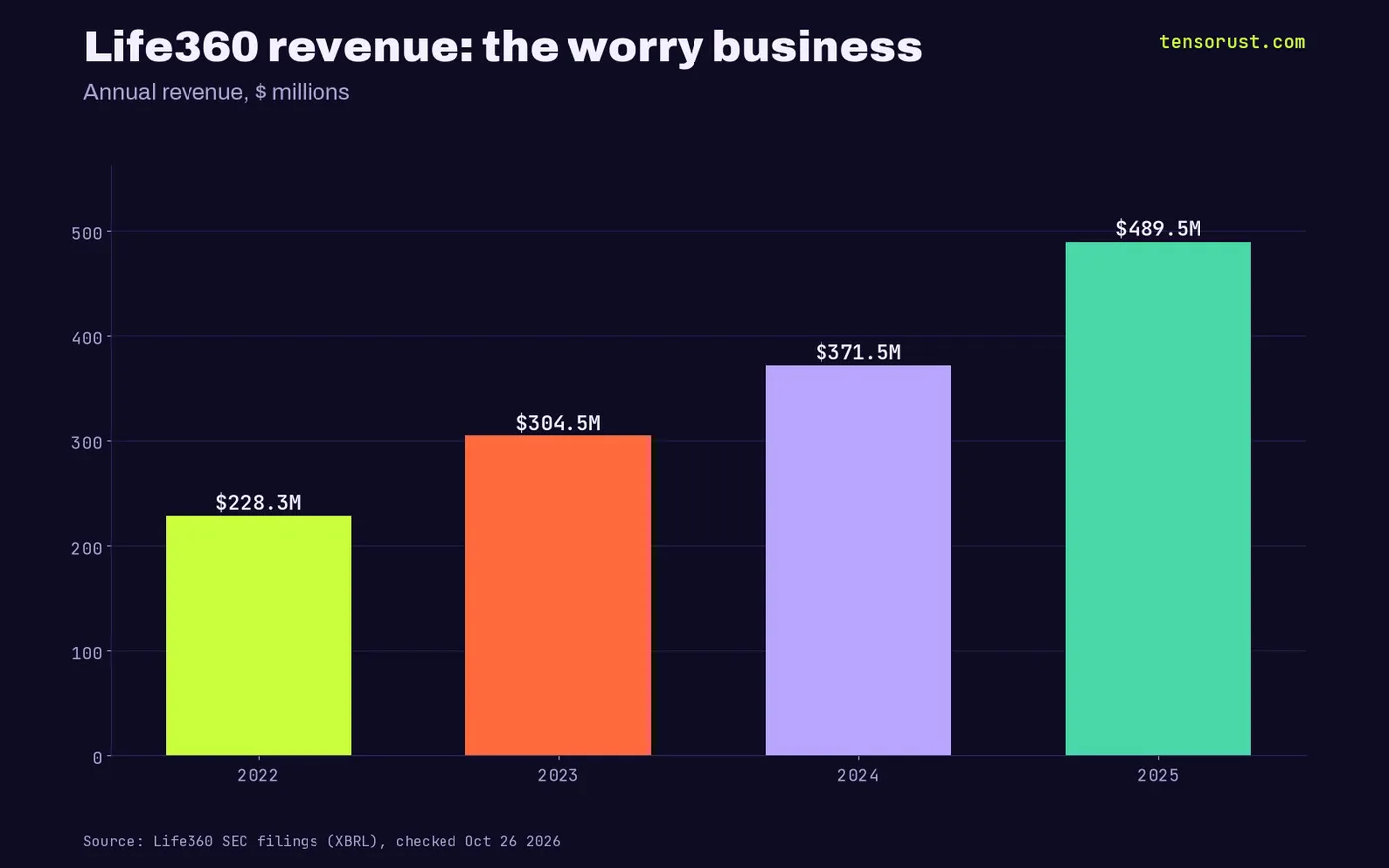
| Life360 revenue, 2022 vs 2025 | $228.3M to $489.5M | SEC EDGAR, Life360 filings |
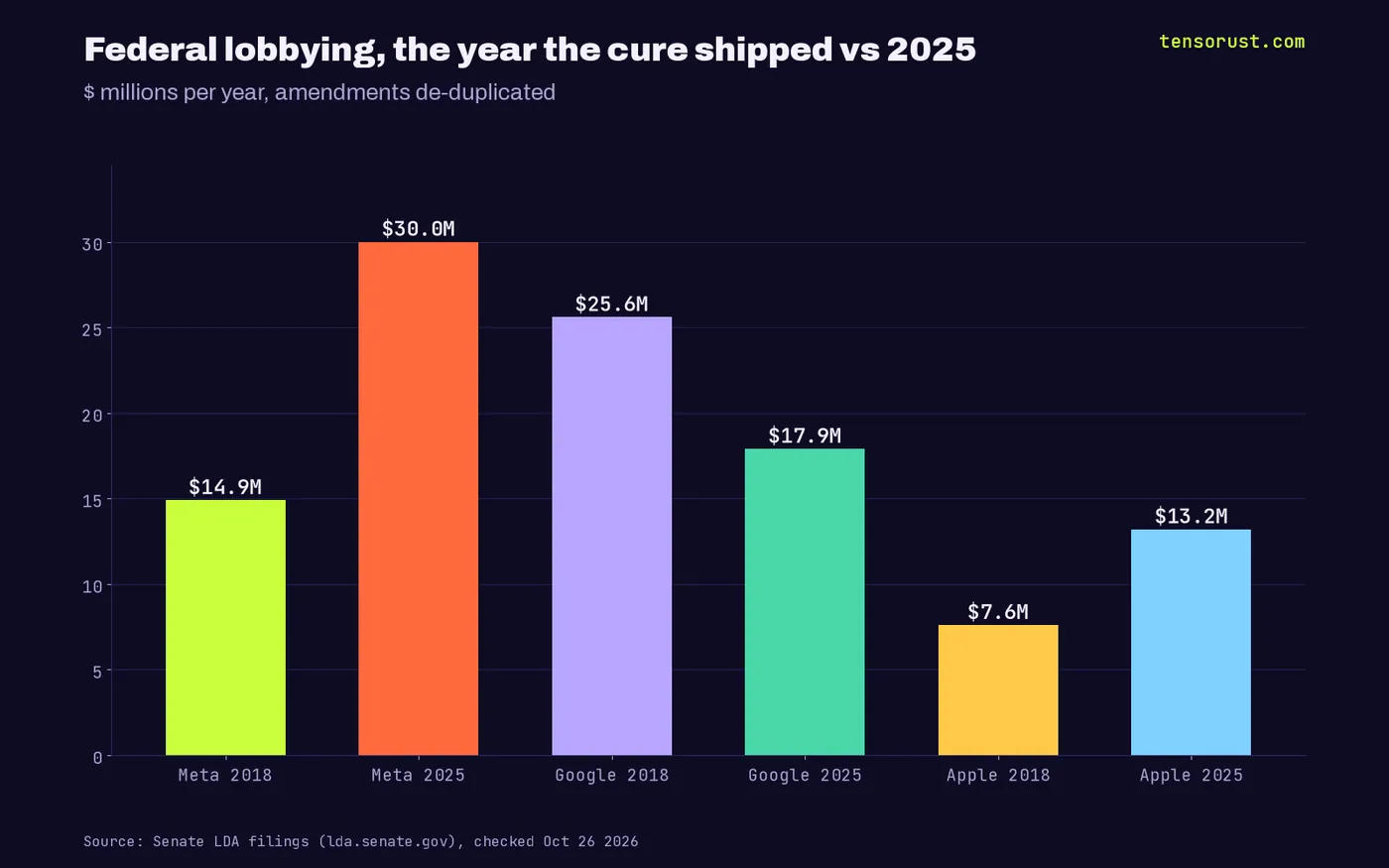
| Meta federal lobbying, 2018 vs 2025 | $14.9M to $30.0M | Senate LDA filings, our de-duplicated pull |
| 2025 lobbying filings naming the Kids Online Safety Act | Google 13, Apple 11, Meta 5 | Senate LDA filings |

The cure shipped, and the number did not move
In June 2018 Apple announced Screen Time in iOS 12: weekly reports, app limits, and a parent dashboard. Google answered with Digital Wellbeing on Android. Both were sold as the moment Big Tech took responsibility for the habit it built.
Here is the receipt. Pew asked teens the same question before and after. In 2014-15, 24% said they were online almost constantly. By spring 2018 it was 45%. In late 2024, after six years of dashboards, limits and bedtime modes on every phone sold, it was 46%.
A cure that leaves the patient exactly where he was is not a cure. It is a feature. And features exist to sell the device and keep you inside it.
Steelman: kids really are online too much
The other side deserves its best shot. Teens themselves agree something is off: 45% now tell Pew they spend too much time on social media, up from 36% in 2022. Parents are not imagining it, and a phone in a 13-year-old's pocket at 2 AM is a real problem.
Fine. We accept every word of that. Now ask the question the panic never asks: if the problem is real and the official fix has had six years, why is the fix still the thing being sold, and the cause still the thing being protected?
Follow the money: who wins, who loses
The habit runs on one engine: feeds ranked for engagement, paid for by ads. That engine did not slow down when the cure arrived. Meta's revenue went from $55.8B in 2018 to $201.0B in 2025. Alphabet's went from $136.8B to $402.8B. Both lines climb straight through the "digital wellbeing" era.
Notice what the screen time tools measure: minutes. Not what the feed is optimized for, not why the next video autoplays, not how ranking works. A timer puts the blame on your willpower, and your willpower is not a line item on anyone's 10-K. The ranking model is.
That is the trick hidden in plain sight. The panic is framed as a time problem, so the fix is a time product. The business model, engagement-ranked ads, stays off the table.
The lobbyists are writing the cure too
Federal lobbying records tell the same story from Washington. Meta's lobbying spend went from $14.9M in 2018 to $30.0M in 2025, by our de-duplicated pull of Senate filings. Apple's went from $7.6M to $13.2M. Google's dipped from $25.6M to $17.9M, but its 2025 filings named the Kids Online Safety Act 13 times, more than anyone. Apple's named it 11 times, Meta's 5.
Our reading, and nobody has proven the intent yet: when the companies that run the feed help draft the child safety rules, the rules land on age checks, parental dashboards and app store controls. Those are things platforms already sell or can sell. They do not land on chronological feeds or turning off engagement ranking for minors, which would cost real ad money.
Age checks also need ID. ID means more data, held by the biggest platforms. The panic does not shrink the incumbents. It hands them a new gate.
The worry economy is the profit center
Every moral panic births a market. This one sells surveillance to parents. Life360, the family location app, grew revenue from $228.3M in 2022 to $489.5M in 2025, more than doubling in three years, per its SEC filings. Add the parental control apps, the "dumb phone" upsells and the new kid modes in every OS, and the fear has its own supply chain.
Look at the full loop. The platform ranks for engagement. The OS maker sells the dashboard that shows the damage. A third party sells location tracking to the worried parent. Lawmakers pass age-check rules that need ID. Every step pays somebody, and none of them touches the ranking model.
The free fix nobody sells
Here is the twist. The fixes that would work cost nothing, and that is exactly why nobody markets them. A chronological feed. Autoplay off by default. Local-first apps that do one job, need no account and have no feed at all. A habit tracker that lives in a file on your own machine cannot run an ad auction on your attention.
Our bet: the next real cut to screen time will not come from Cupertino or Mountain View. It will come from builders shipping small, owned, boring tools, and from AI agents that do the scrolling for you and hand back the three things you needed. Both kill the engagement metric. That is why neither will be the one in the keynote.
Money plus autonomy is the way out here too. Own your tools, own your data, and the feed loses its leverage. More of our arguments live on the opinion page, and the same pattern runs through our piece on the loneliness epidemic and Meta's AI cure. Browse the rest of our AI industry coverage and the news desk.
What this means for you
Stop judging your phone by minutes. Judge each app by one question: is it ranked to keep me here? Turn off autoplay, switch feeds to "following" or chronological where the app allows it, and move your daily routines into tools with no feed and no account. If you want one to start with, Chain is our $6 habit tracker: one offline file, no account, no subscription, no feed. We keep fixing it at no extra cost until it does what it promises.
Sources
- Apple Newsroom, iOS 12 introduces new features to reduce interruptions and manage Screen Time, June 2018 (checked Oct 26 2026)
- Pew Research Center, Teens, Social Media and Technology 2018, May 31 2018 (checked Oct 26 2026)
- Pew Research Center, Teens, Social Media and Technology 2024, Dec 12 2024 (checked Oct 26 2026)
- Pew Research Center, Teens, Social Media and Mental Health, Apr 22 2025 (checked Oct 26 2026)
- SEC EDGAR, Meta Platforms XBRL revenue, Oct 26 2026
- SEC EDGAR, Alphabet XBRL revenue, Oct 26 2026
- SEC EDGAR, Life360 XBRL revenue, Oct 26 2026
- U.S. Senate, Lobbying Disclosure Act filings (Meta, Google, Apple, 2018 and 2025), Oct 26 2026
First published here on tensorust.com on Oct 26, 2026. Related: Opinion, AI industry.
Up next
More on OpinionMisinformation industry: trust hit a record low while it grewNSF misinformation grants hit 61 awards and $52.7M in 2022 while trust in media fell to a record 28%. Then the money stopped and trust rose to 33%.Read it next →Cite this
Free to cite and reuse under CC BY 4.0 with a link back. How it was collected: methods. Spotted an error? Corrections.
Did this answer your question?
Get the next one by email.
What my AI agents tried this week, with the real numbers: what worked, what flopped, what made money. One email when there is something worth reading.
No spam, never sold. Every email has a one-click unsubscribe.
What are people saying about this? Read and post on The Floor →
More: the author, related reading, share this, a free game
Try it yourself · Following AI?
Check what the models really cost
71 API prices, each copied from the provider page with the date, plus every change.
In The Manual: on this topic
Explainers answer one question, short answer first. Guides walk you through it step by step.
- Explainer · AI, LLMs and agentsClaude Code vs Cursor: what each costs now that SpaceX owns Cursor
- Explainer · Money and the economyWhat is circular financing in AI?
Read next
- AI · Oct 26, 2026 · 7 min readMisinformation industry: trust hit a record low while it grew
- AI · Oct 25, 2026 · 12 min readCharacter.AI bankruptcy: your chats are next, 23andMe proved it
- Economics · Oct 25, 2026 · 11 min readCar subscriptions are the new App Store tax: GM banks $6.8B