
By Matt Busel, who built the apps, crates and game he writes about · every number links to its source and every dataset is downloadable (methods) · corrections · featured in Kirino, gamebiz, This Week in Rust, New Mobile Life, By-Press
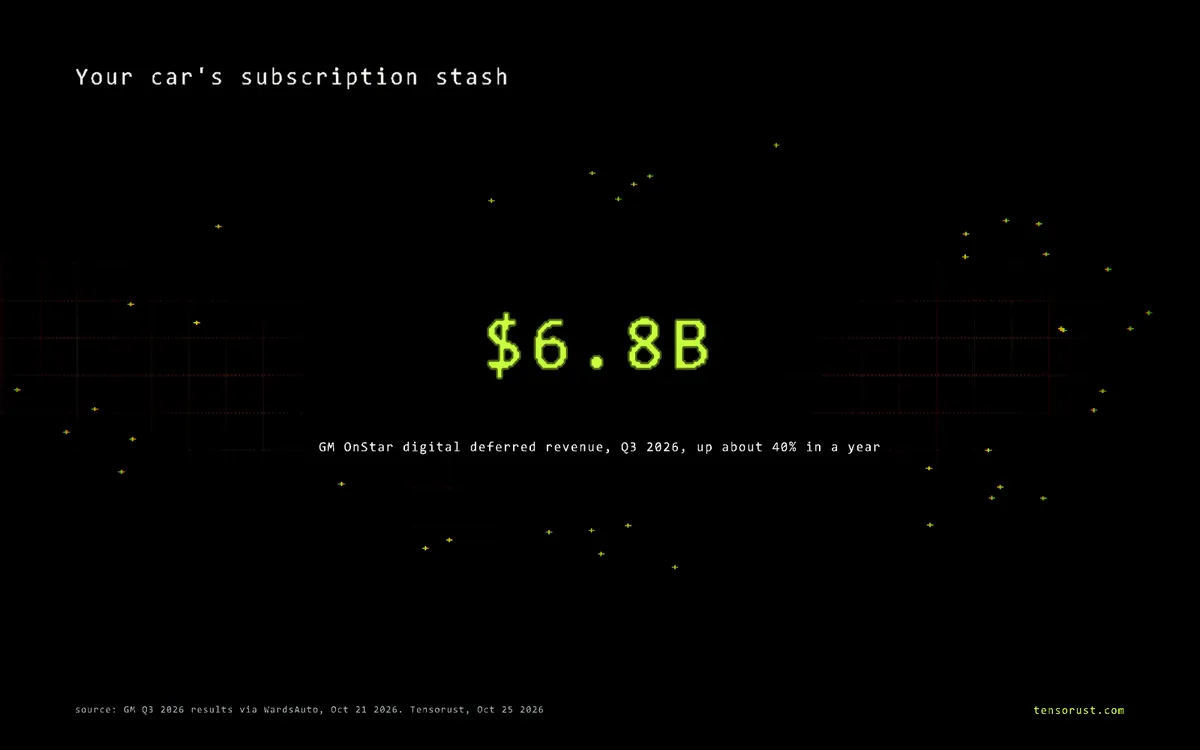
Car subscriptions are the new App Store tax: GM banks $6.8B
On this page · 12 sections
- Key numbers
- The App Store just moved into your driveway
- Read the balance sheet: they are pre-selling your car back to you
- Follow the money to the CEO's paycheck
- Rent it for the life of the car and the math turns ugly
- The steelman: software costs money, and updates are real
- The side door: the car was already selling you
- The moat: $26.6 million against a 75% vote
- The AI assistant is the cash register
- Who wins, who loses
- What this means for you
- Sources
Short answer: Car subscriptions are the App Store's 30% toll moved onto a 4,000-pound device you already paid for. GM now carries $6.8 billion in deferred revenue from OnStar digital services, Tesla stopped selling Full Self-Driving outright on February 14 and rents it at $99 a month, and one of the milestones in Elon Musk's pay award is 10 million active FSD subscriptions. The in-car AI assistant is being built as the cash register, and right-to-repair and data laws are the only brake anyone has found.
TL;DR: GM's total deferred revenue, the money it has collected for services it still owes you, doubled from $5.47 billion at the end of 2021 to $11.05 billion at the end of 2025, and GM says its OnStar digital piece alone hit $6.8 billion in Q3 2026, up about 40% in a year. Rented for the 12.8 years the average US car stays on the road, Tesla's FSD at $99 a month costs $15,206, almost double the $8,000 it sold for in January. When Massachusetts voters forced automakers to share car data with owners and repair shops, the industry spent $26.6 million trying to stop it, lost 75% to 25%, and its trade group still lists the federal REPAIR Act on every lobbying report.
Key numbers
| What | Number | Source, checked Oct 25 2026 |
|---|---|---|
| GM deferred revenue, end of 2021 vs end of 2025 | $5.47B vs $11.05B (2x) | GM 2025 10-K, Note 12 |
| GM OnStar digital deferred revenue, Q3 2026 | $6.8B, up about 40% | WardsAuto, Oct 21 2026 |
| Tesla deferred revenue for FSD, connectivity and updates, Sep 30 2026 | $4.08B | Tesla Q3 2026 10-Q |
| Milestone 2 in Musk's CEO performance award | 10 million active FSD subscriptions | Tesla Q3 2026 10-Q |
| FSD over 12.8 years at $99/mo vs one-time price before Feb 14 | $15,206 vs $8,000 (our math) | TechSpot, S&P Global Mobility via RDN |
| Ford active paid software subscriptions, Q3 2026 | 1.7 million+, up 40%+ | Ford 8-K, Oct 2 2026 |
| Automaker money against Massachusetts Question 1 (2020) vs the yes vote | $26.6M vs 74.97% yes | Ballotpedia |
| Alliance for Automotive Innovation federal lobbying, 2025 | $8.32M (up from $5.07M in 2024) | Senate LDA filings, our deduped pull |

The App Store just moved into your driveway
The phone toll works like this: you own the device, but the company owns the door every purchase walks through, and it takes a cut. We have argued that AI agents are about to break that toll on the phone. The car makers read the same playbook and are building the exact thing the phone is losing.
The difference is what sits behind the paywall. On a phone it is someone else's app. In a car it is hardware you already paid for: seat heaters, motor output, cameras and the modem, all bolted in at the factory and unlocked by a software switch.
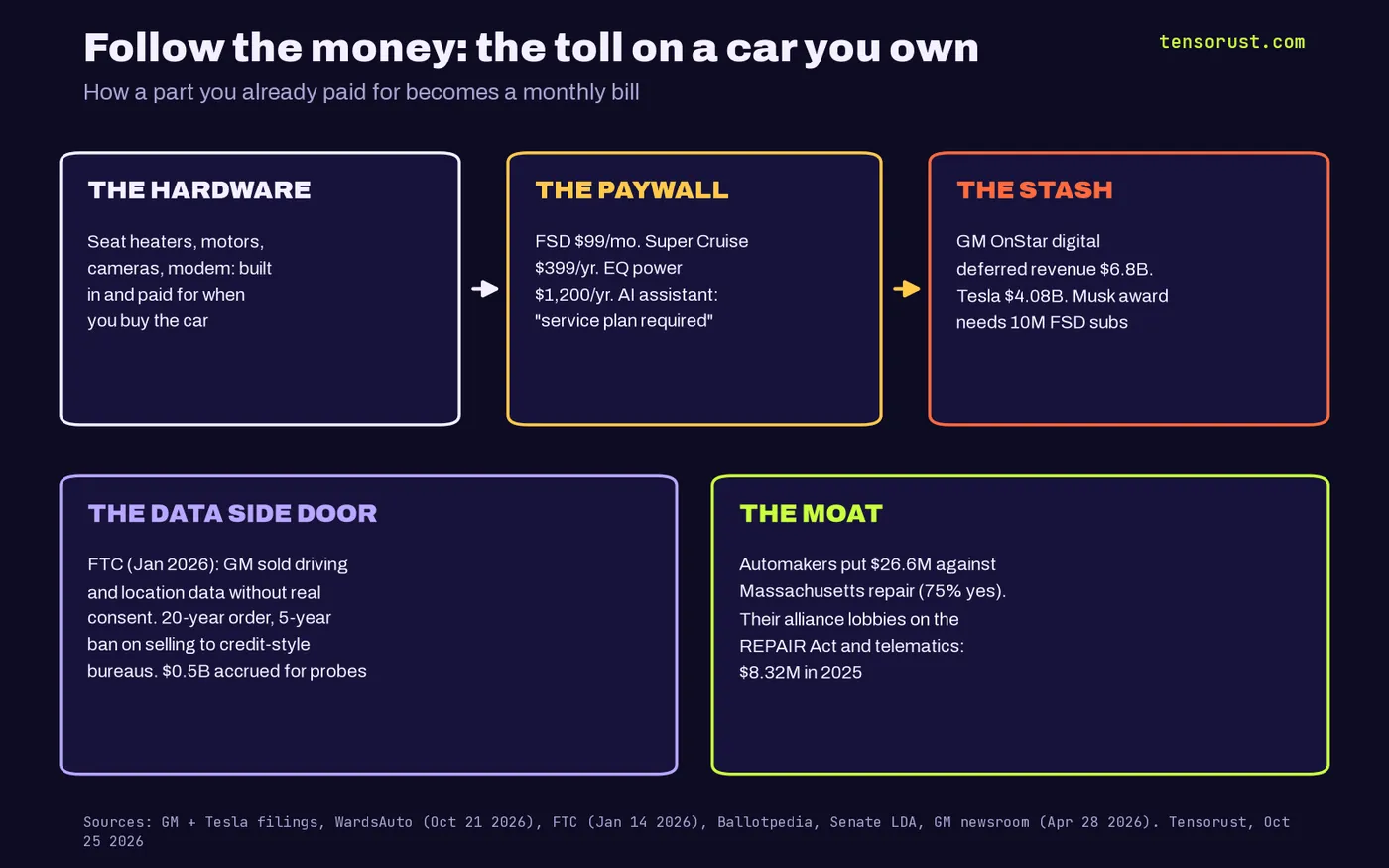
Mercedes charges $1,200 a year to raise the output of motors already in some EQE and EQS models, from 288 to 348 horsepower on the EQE 350. GM sells Super Cruise hands-free driving for $39.99 a month or $399 a year. Tesla's FSD went from an $8,000 purchase to a $99 monthly rent on February 14, 2026, per Musk's own post.
Read the balance sheet: they are pre-selling your car back to you
Deferred revenue, in plain terms, is cash a company has already booked for something it still owes you. For carmakers it is the meter on the subscription business, and the filings show the meter spinning faster every year.
We pulled GM's year-end deferred revenue from eight 10-K filings. It sat between $5.5 billion and $6.5 billion from 2018 to 2022, then jumped to $7.82 billion in 2023, $9.31 billion in 2024 and $11.05 billion in 2025. That line also holds maintenance plans and extended warranties, so it is not all software, but GM's 10-K says what drives it: "OnStar, Super Cruise, vehicle connectivity", recognized "over a period of up to eight years".
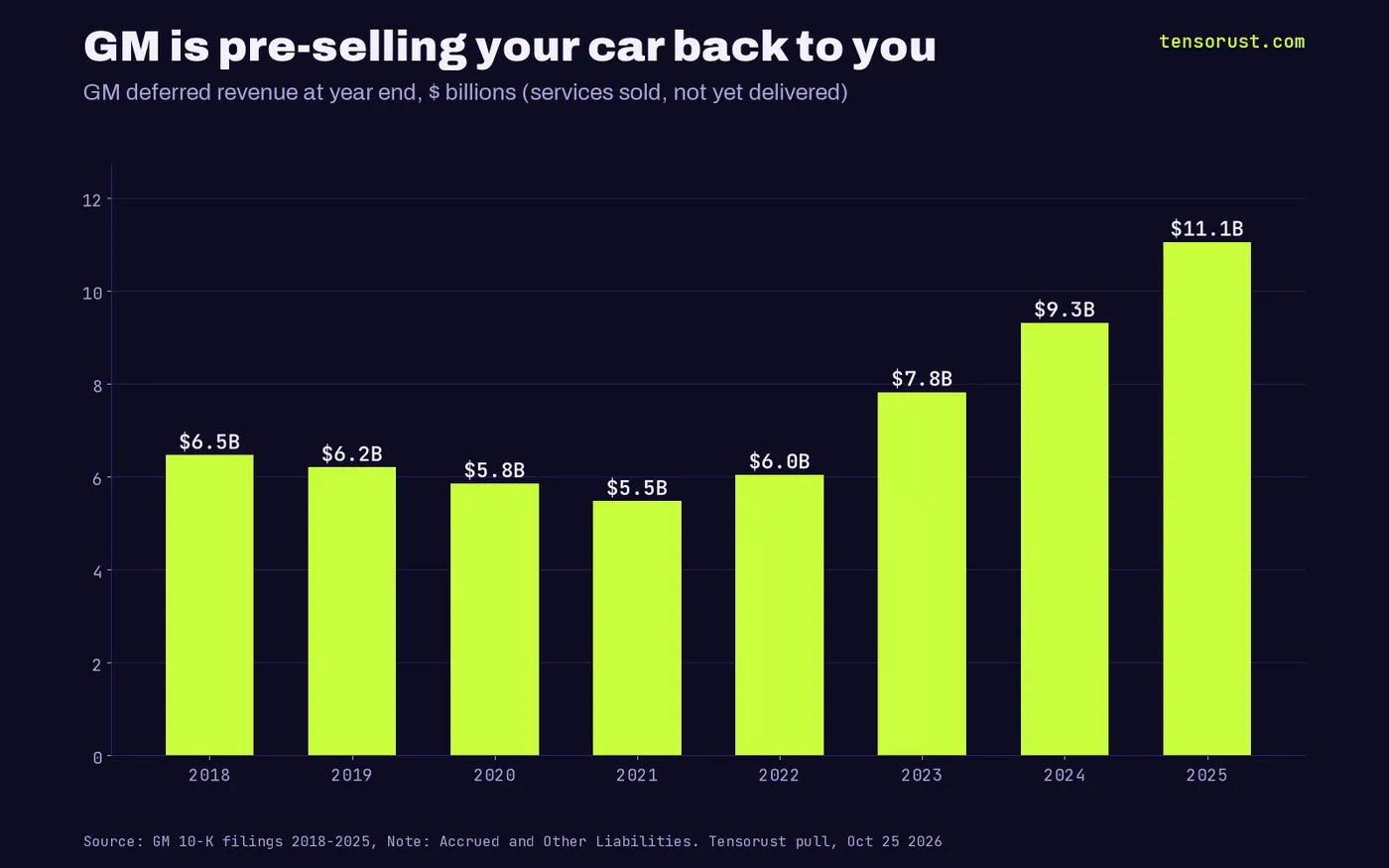
The long-dated part is the tell. The slice GM expects to deliver more than a year out grew from $2.72 billion in 2020 to $7.10 billion in 2025, 2.6 times bigger. That is money for services stretching most of the life of the car. And on the October 21 call, GM said OnStar digital deferred revenue alone reached $6.8 billion, up about 40%, with a target of 13 million OnStar subscribers and 850,000 Super Cruise subscribers by year end.
Tesla's version is $4.08 billion of deferred revenue at September 30, 2026 for "internet connectivity, access to our FSD (Supervised) features", Supercharging programs and updates, up from $3.87 billion at the start of the year. Its Q3 10-Q credits "higher revenue from FSD (Supervised) subscriptions" for part of the growth.
Follow the money to the CEO's paycheck
This is where the story stops being about seat heaters. Tesla's own filings list the operational milestones in Musk's CEO performance award. Milestone 1 is 20 million vehicles delivered. Milestone 2 is "10 million active FSD subscriptions".
Not FSD sold. Not FSD miles driven. Active subscriptions. A few months after that award was approved, Tesla ended the option to buy FSD outright. Our read: the switch is the most honest disclosure in the industry, because it names the metric the people at the top are paid on.
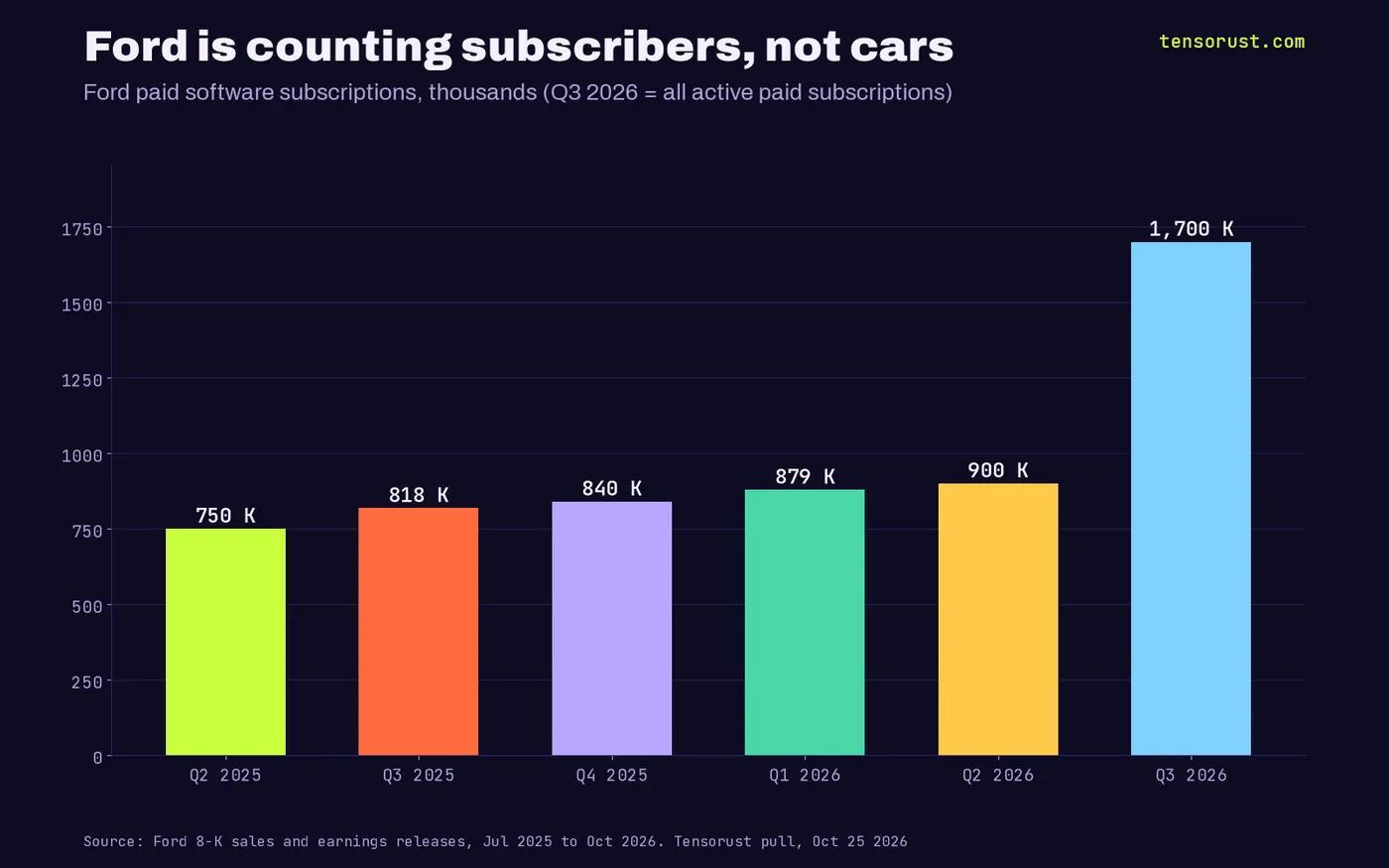
Ford says the same thing in a quieter voice. Its sales releases now headline subscriptions next to truck sales: 750,000 Ford Pro paid software subscriptions in Q2 2025, 900,000 a year later, and "active paid software subscriptions" above 1.7 million in Q3 2026, a wider count that rose more than 40%.
Rent it for the life of the car and the math turns ugly
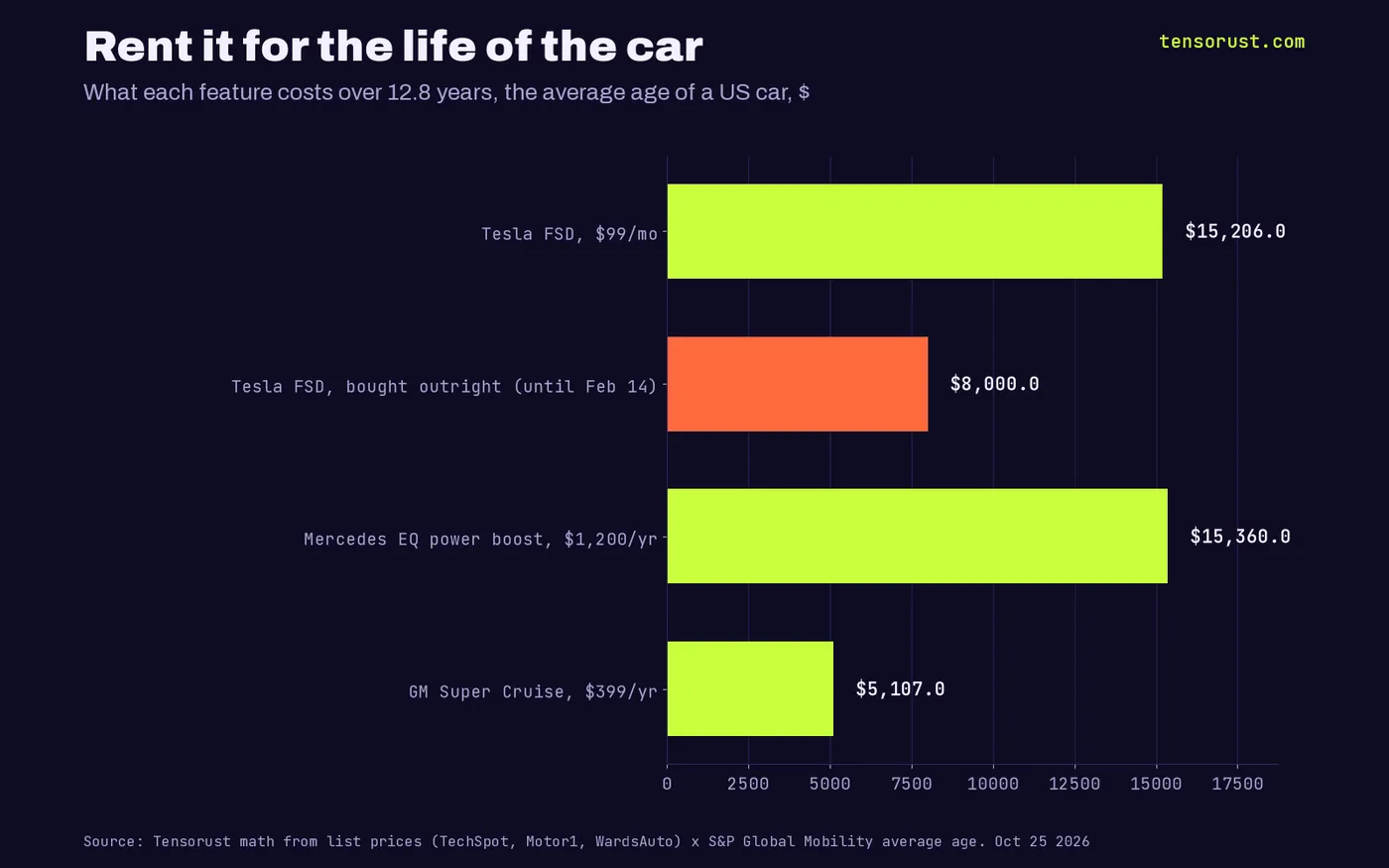
The pitch for subscriptions is flexibility: try a feature for a month, pay only when you need it. The average US light vehicle is now 12.8 years old, per S&P Global Mobility, so we priced each feature over that life.
FSD at $99 a month comes to $15,206, against the $8,000 one-time price Tesla sold it at until February. Mercedes' power boost comes to $15,360 for horsepower the car left the factory with. Super Cruise at $399 a year comes to $5,107. These are our estimates from today's list prices, and list prices can rise.
BMW ran the experiment in public and lost. It charged monthly to switch on heated seats already wired into the car, then dropped it in 2023. Its sales board member Pieter Nota told Autocar that "people feel that they paid double", per WhichCar. BMW kept subscriptions for driver-assist and parking features. The heated seat was the only thing customers could see clearly enough to refuse.
The steelman: software costs money, and updates are real
Here is the best case for the carmakers. A modern car runs on code that needs constant patching, mapping and model training. Super Cruise needs mapped roads, FSD needs training compute, and connectivity needs a cellular bill every month. Selling those as a service matches the price to an ongoing cost, and an owner who never wants hands-free driving no longer pays for it up front.
That is true for the parts that actually cost money every month. It falls apart for everything else. A seat heater has no server bill. A motor tune has no cloud cost. And the companies selling "we need recurring revenue to fund updates" are the same ones whose filings show the recurring revenue growing far faster than any update schedule.
The bigger problem is the second revenue stream the subscription pitch never mentions.
The side door: the car was already selling you
In January 2025 the FTC charged GM and OnStar with collecting and selling precise location and driving behavior data from millions of vehicles without real consent, signed up through a misleading enrollment flow for a feature called Smart Driver. The final order on January 14, 2026 runs 20 years and bans GM for five years from sharing that data with consumer reporting agencies.
GM's 2025 10-K says it had accrued $0.5 billion for the related investigations and lawsuits, with several state attorneys general still suing. Mozilla reviewed 25 car brands in 2023 and failed all 25 on privacy, a first in the guide's history.
So the car charges you rent on the hardware and sells the data the hardware collects. It is the same private scoring pipeline we traced through America's data brokers, with a steering wheel attached.
The moat: $26.6 million against a 75% vote
In 2020 Massachusetts voters were asked whether car owners and independent shops should get access to the car's wireless data. Automakers funded the no side, the Coalition for Safe and Secure Data, with $26.6 million, led by GM at $5.5 million and Toyota and Ford at $4.5 million each. The yes side won 74.97% to 25.03%.
The industry then sued to block the law, and lost in federal court in February 2025. In the meantime, Subaru and Kia chose to switch off their connected-car systems on new cars sold in the state rather than open the data, per The Drive. Read that again: they would rather sell a dumber car than a car the owner controls.
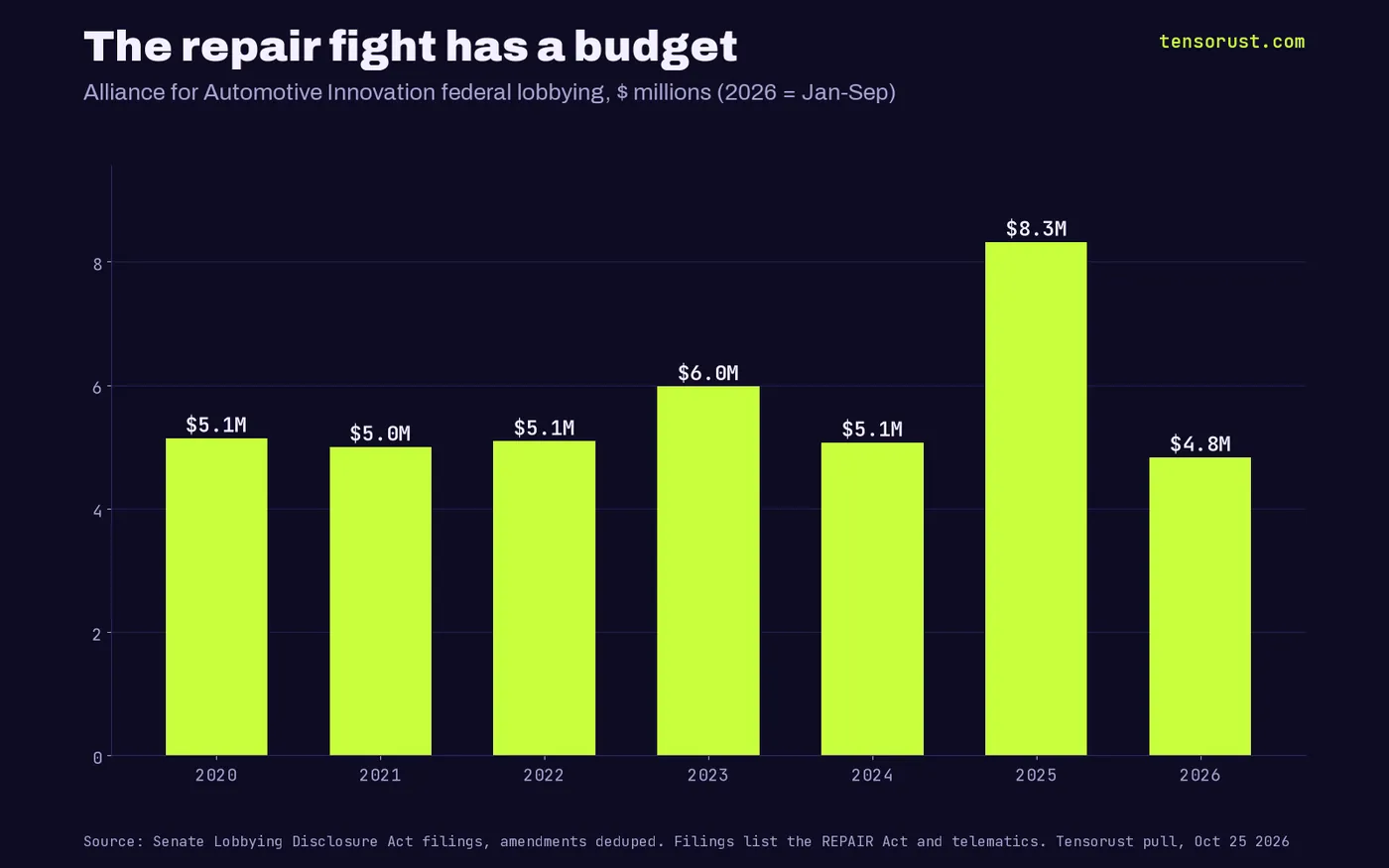
In Washington, the fight never stopped. We pulled every Lobbying Disclosure Act filing for the Alliance for Automotive Innovation, the trade group for most major automakers. Spending ran about $5 million to $6 million a year from 2020 to 2024, then jumped to $8.32 million in 2025, and every one of its in-house quarterly reports for 2025 lists the REPAIR Act (H.R. 1566), the SAFE Repair Act, "Telematics" and "Draft Privacy Legislation". We are not claiming every dollar went to repair; these filings cover many issues. We are saying the data fight is on the list every single quarter.
The AI assistant is the cash register
Now connect the last dot. In April 2023 GM said it would drop Apple CarPlay and Android Auto from future EVs, starting with the 2024 Chevrolet Blazer, a move Reuters noted could help it "capture more data on how consumers drive and charge EVs". Phone mirroring was the last part of the dashboard the carmaker did not own.
In April 2026 GM announced Google Gemini for about 4 million eligible vehicles, with a custom GM assistant "fine-tuned with proprietary vehicle data" coming later. The fine print: "Select service plan required" and "Features may differ depending on subscription".
On a phone, AI agents threaten the toll booth because they can go around the store. In a car, the agent is being installed as the store. It knows where you are, how you drive, when you need fuel or a service, and it sits behind a paid plan. Our bet: within a few model years the in-car assistant will be the main way new paid features get sold, the same way the App Store became the main way apps got sold, and it will be pitched as convenience.
Who wins, who loses
The winners are easy to name: automaker finance teams who get software-style recurring revenue on top of the car sale, executives paid on subscription counts, and the data buyers on the other side of the modem.
The losers are the second and third owners. A subscription tied to a 12.8-year asset means the person buying a used car in 2032 inherits a car whose features depend on a company's pricing and server decisions. Independent repair shops lose too, because a car that hides its data is a car only the dealer can fix.
And the open alternatives keep getting written out. Phone mirroring got pulled, owner data access got litigated, and the AI layer is arriving behind a service plan. This is the same landlord model we found in the cloud: you pay to use what you thought you owned.
What this means for you
Buy features outright whenever the option exists, and ask the dealer in writing which features in the car you are buying are subscription-locked and what happens to them on resale. Price any subscription over 12 years, not 12 months. Favor cars that still support phone mirroring, since your phone's assistant works for you, not for the carmaker.
Turn off the data sharing you can: GM's FTC order now gives US owners the right to request their data, ask for deletion and opt out. Support right-to-repair and owner data access laws in your state; the Massachusetts vote shows they pass when people get to vote. Keep your own records, too: a service history you own is worth more at resale than one locked in a dealer's system.
That last part is what our $7 Odometer app does. It is a car maintenance log that runs in your browser from one file, with no account and no subscription: service reminders at your driving pace, fuel economy, true cost per mile and a printable service history for the day you sell. If it does not keep your car's records the way it promises, we keep fixing it at no extra cost until it does.
This is opinion and analysis, not financial advice.
More from us: all opinion pieces, the opinion archive and the news desk.
Sources
- General Motors, 2025 Form 10-K (deferred revenue, privacy accrual), filed Jan 27 2026; earlier 10-Ks for 2018-2024 via EDGAR
- WardsAuto, GM's Super Cruise revenue jumps 60% in Q3, Oct 21 2026
- Tesla, Q3 2026 Form 10-Q and 2025 Form 10-K
- TechSpot, Tesla ends one-off Full Self-Driving purchases, Jan 2026
- Ford, Q3 2026 sales release (8-K), Oct 2 2026, and earlier Ford 8-K releases Jul 2025 to Jul 2026
- Motor1, $1,200 Mercedes subscription unlocks more power for EQ models, Nov 2022
- WhichCar, BMW rolls back on heated seat subscriptions, Sep 2023
- Repairer Driven News, S&P Global Mobility average vehicle age, May 28 2025
- FTC, final order against GM and OnStar, Jan 14 2026
- Mozilla Foundation, every car brand reviewed flunks privacy test, Sep 6 2023
- Ballotpedia, Massachusetts Question 1 contributions and result, Jan 26 2021
- WBUR, federal judge dismisses automaker challenge to Massachusetts law, Feb 12 2025
- The Drive, Subaru disables Starlink in 2022 vehicles, Nov 2021
- Senate Lobbying Disclosure Act filings, Alliance for Automotive Innovation, 2020-2026, our pull Oct 25 2026
- Reuters via KOMU, GM plans to phase out Apple CarPlay in EVs, Apr 2023
- GM newsroom, GM brings Google Gemini to millions of vehicles, Apr 28 2026
First published here on tensorust.com on Oct 25, 2026. Related: Opinion, All opinion pieces, AI agents vs the App Store tax, America's private scoring system, The cloud is a landlord.
Up next
More on OpinionCharacter.AI bankruptcy: your chats are next, 23andMe proved it23andMe sold 14M genomes in court for $305M, about $22 each. Character.AI's 12M users are next, and 28 of 31 privacy policies we read pre-approve the sale.Read it next →Cite this
Free to cite and reuse under CC BY 4.0 with a link back. How it was collected: methods. Spotted an error? Corrections.
Did this answer your question?
Get the next one by email.
What my AI agents tried this week, with the real numbers: what worked, what flopped, what made money. One email when there is something worth reading.
No spam, never sold. Every email has a one-click unsubscribe.
What are people saying about this? Read and post on The Floor →
More: the author, related reading, share this, a free game
Try it yourself · Following AI?
Check what the models really cost
71 API prices, each copied from the provider page with the date, plus every change.
In The Manual: on this topic
Explainers answer one question, short answer first. Guides walk you through it step by step.
- Explainer · AI, LLMs and agentsClaude Code vs Cursor: what each costs now that SpaceX owns Cursor
- Explainer · Money and the economyHow Kalshi weather markets work
- Explainer · Money and the economyCan the Fed buy Treasuries directly from the government?
- Explainer · Money and the economyThe Fed's deferred asset, explained
Read next
- AI · Oct 25, 2026 · 12 min readCharacter.AI bankruptcy: your chats are next, 23andMe proved it
- AI · Oct 25, 2026 · 10 min readInsurers filed 4,078 AI exclusions. They're the real AI regulator
- Economics · Oct 25, 2026 · 13 min readAnti-nuclear fear killed more people than AI will. AI is ending it