
Wikipedia lost 12% of its human readers in 2 years. Bots: 1 in 3 views
On this page · 11 sections
- Key numbers
- The decline is real, and it is the steepest on record
- Wikimedia already admitted it, and blamed AI
- Bots now make 1 in 3 pageviews
- Desktop readers left. Phones stayed
- Casual editors quit. The hardcore work harder than ever
- Follow the money: fewer readers, a richer Foundation
- The content won. The website lost
- Where the next readers come from
- What this means for you
- Sources
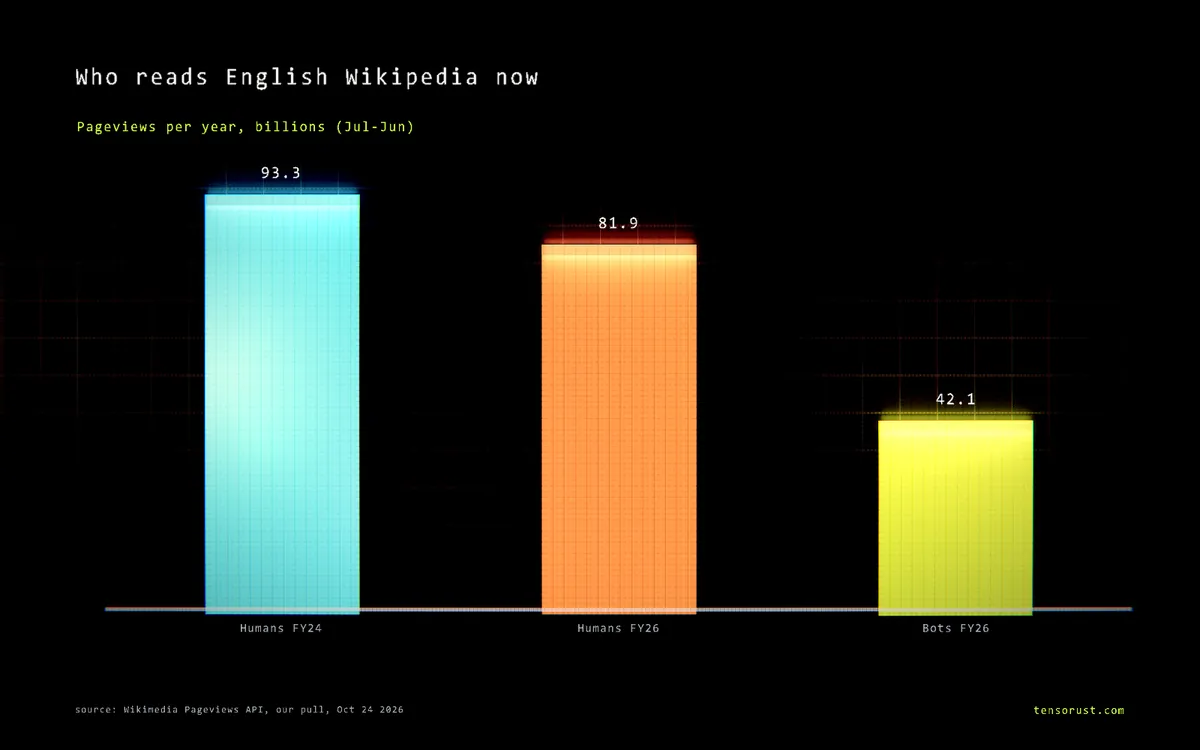
Short answer: Yes, Wikipedia traffic from real people is falling, and fast. English Wikipedia served 81.9 billion human pageviews in the year to June 2026, down 12.2% from 93.3 billion two years earlier, and the 12 months to September 2026 are the lowest on record in Wikimedia's own data. Meanwhile crawlers and automated traffic made 34% of all views. AI did not kill the encyclopedia. It killed the website, and the content is now read mostly somewhere else.
TL;DR: We pulled every monthly number the Wikimedia Pageviews and Analytics APIs publish back to July 2015. Human pageviews on English Wikipedia hit 80.4 billion in the 12 months to September 2026, the lowest trailing-year total in the series, with desktop readers down 28% since 2019 while the mobile app grew 30%. Casual editors (1 to 4 edits a month) fell 20% since 2019, yet the hardcore (100+ edits a month) grew 18% and total edits rose 19%. And the Wikimedia Foundation's revenue per 1,000 human pageviews more than doubled, from $0.41 in FY2016 to $0.96 in FY2023, so the readers are leaving a nonprofit that has never been richer.
Key numbers
| What | Number | Source, checked Oct 24 2026 |
|---|---|---|
| English Wikipedia human pageviews, FY2024 vs FY2026 (Jul to Jun) | 93.3B to 81.9B (-12.2%) | Wikimedia Pageviews API, our pull |
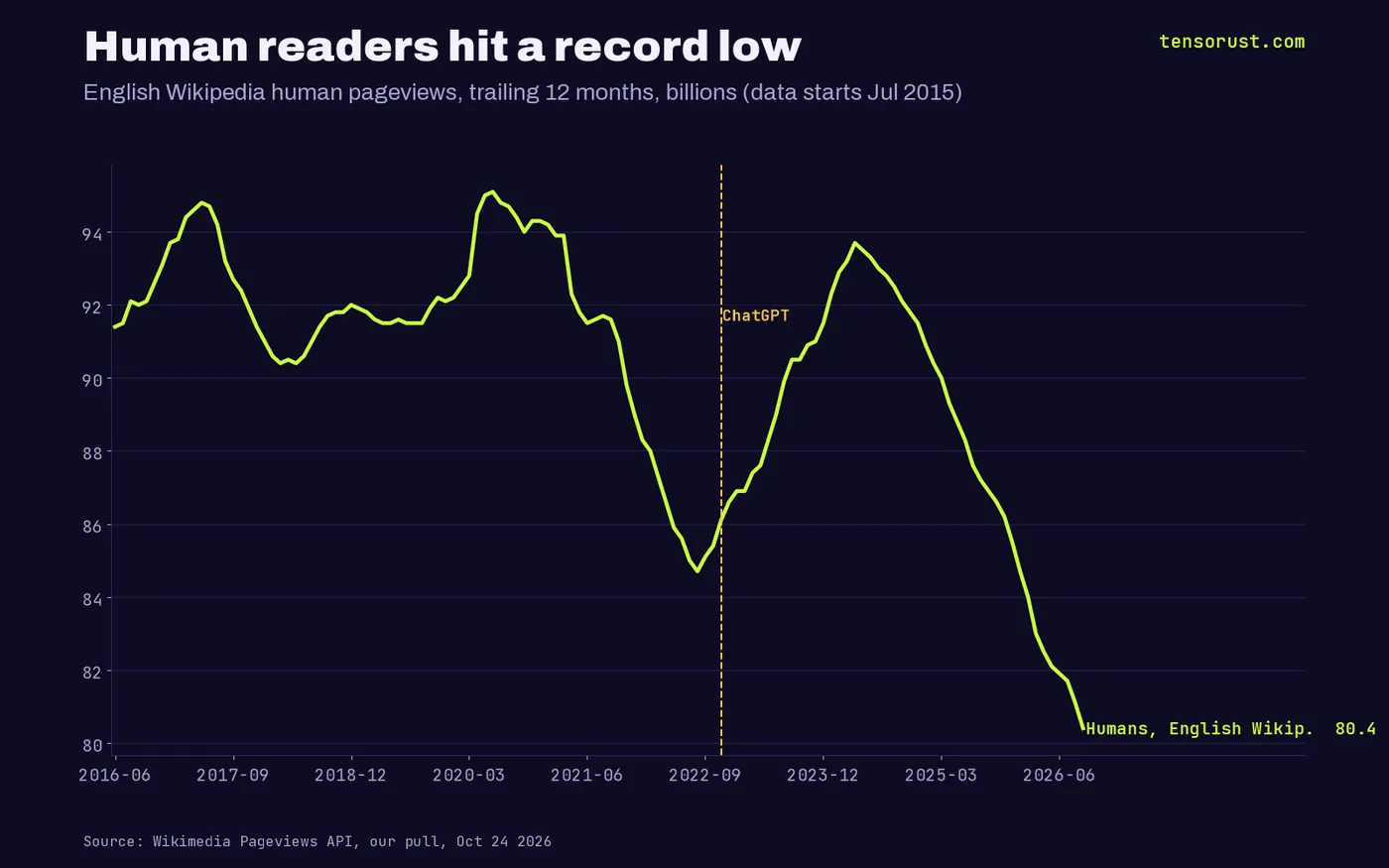
| Human pageviews, 12 months to Sep 2026 | 80.4B, lowest trailing year since the series began in Jul 2015 | Wikimedia Pageviews API, our pull |
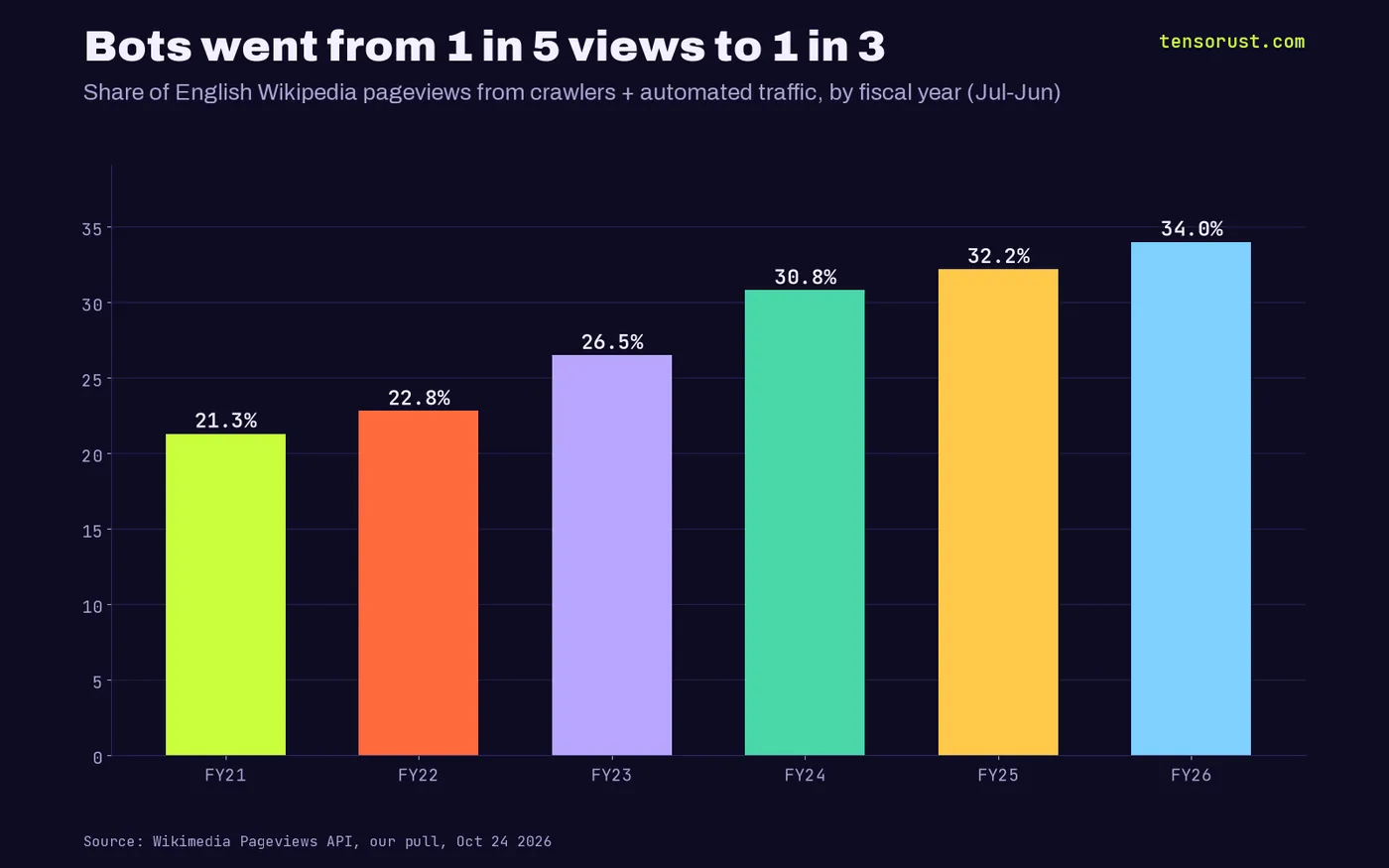
| Share of English Wikipedia views from crawlers + automated traffic | 21.3% (FY2021) to 34.0% (FY2026) | Wikimedia Pageviews API (spider + automated agents) |
| All Wikimedia projects, human pageviews FY2026 | 165.7B, lowest in the series (FY2020: 200.9B) | Wikimedia Pageviews API |
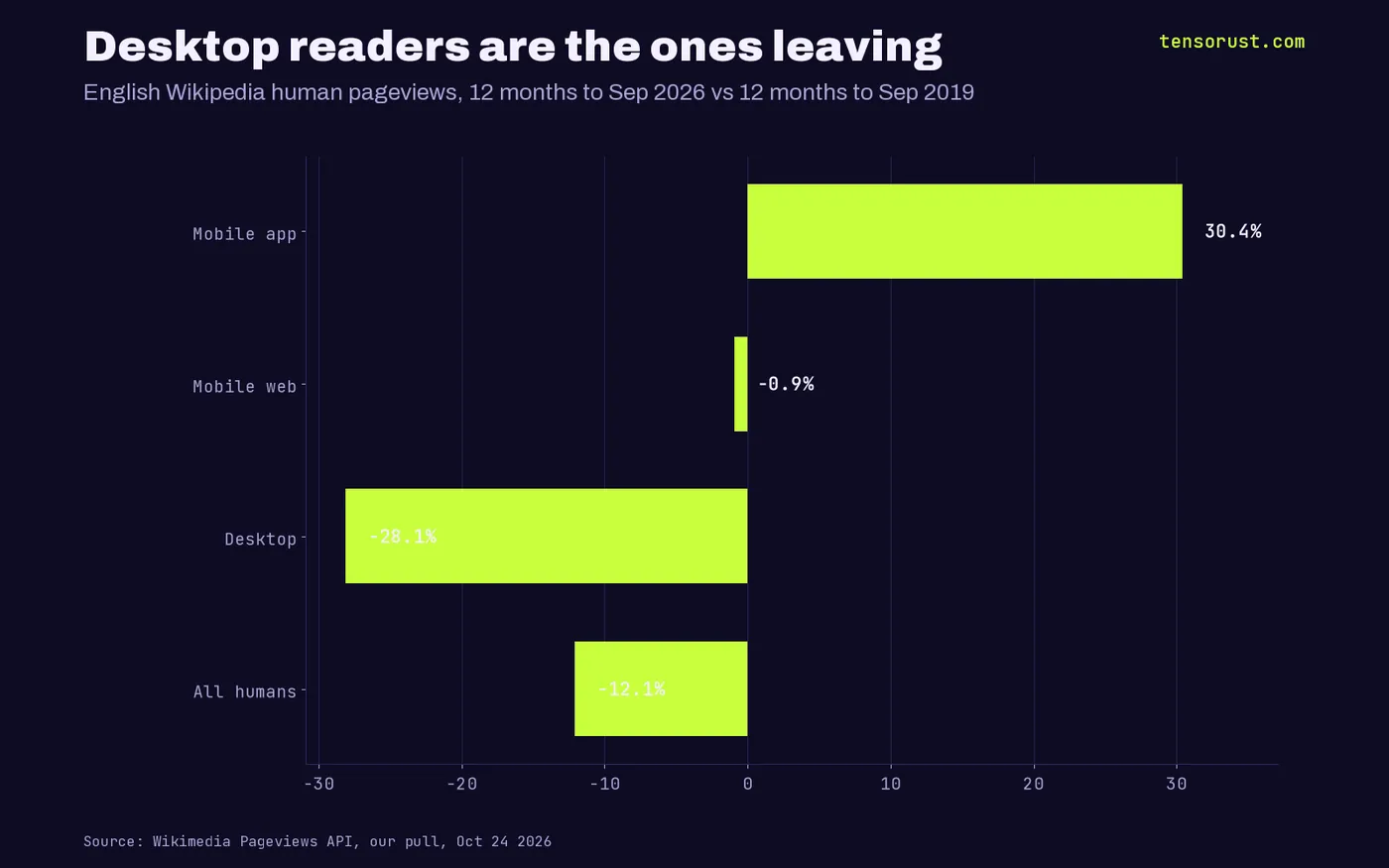
| Desktop human pageviews, 12 months to Sep 2026 vs 2019 | -28.1% (mobile app +30.4%) | Wikimedia Pageviews API, by access method |
| Casual editors (1-4 edits a month) vs power editors (100+), vs 2019 | -20.0% vs +18.0% | Wikimedia Analytics API, editors |
| Wikimedia Foundation revenue, FY2016 vs FY2023 | $78.7M to $180.2M | IRS Form 990 via ProPublica |
| Revenue per 1,000 human pageviews, FY2016 vs FY2023 | $0.41 to $0.96 | Form 990 + Pageviews API, our math |
| Local Wikipedia on Hacker News | 1,554 points, 244 comments | Hacker News |

The decline is real, and it is the steepest on record
Wikimedia classifies every pageview as a human ("user"), a self-declared crawler ("spider") or "automated", its label since April 2020 for bots that pretend to be people. We pulled all three for English Wikipedia, plus every Wikimedia project combined, month by month from July 2015 to September 2026.
The human line is the story. English Wikipedia peaked at 95.1 billion human views in the 12 months to June 2020, the lockdown year. It sat near 90 billion for years, then fell to 81.9 billion in the year to June 2026 and to 80.4 billion in the year to September 2026. That last number is the lowest trailing-year total Wikimedia has ever published.
Across every Wikimedia project, it is worse: 165.7 billion human views in FY2026, down 13.7% from FY2024 and 17.5% from the FY2020 peak. That is roughly 35 billion fewer human visits a year to the biggest free knowledge site on Earth.
Wikimedia already admitted it, and blamed AI
This is not our theory. In an October 2025 post, Marshall Miller of the Wikimedia Foundation wrote that after re-running its bot detection on March to August 2025 traffic, it saw human pageviews "decrease of roughly 8%" versus the same months of 2024. The cause, in the Foundation's own words: "the impact of generative AI and social media on how people seek information, especially with search engines providing answers directly to searchers, often based on Wikipedia content."
Our pull a year later says the drop did not stop. English Wikipedia's human views for the 12 months to September 2026 are down 7.5% on the 12 months before. The 8% was not a blip. It is the new slope.
One honest caveat the Foundation itself flags: it rewrote its bot rules in 2025 after "unusually high amounts of apparently human traffic, mostly originating from Brazil" turned out to be bots built to evade detection. So some of the "human" peak in older years was probably bots too. That cuts both ways, but it means the real human decline could be even bigger than the curve shows.
Bots now make 1 in 3 pageviews
Here is the part nobody puts in the headline. In FY2021, crawlers plus automated traffic were 21.3% of English Wikipedia's views. In FY2026 they were 34.0%: 20.2 billion crawler views and 21.9 billion automated ones, against 81.9 billion human.
Automated traffic alone, the bots dressed as people, is up 128% on the 12 months to September 2022, the last full year before ChatGPT. Those are the scrapers feeding the same AI answers that keep humans off the site. Wikipedia is paying the server bill for its own replacement.
Our bet, and it is an extrapolation, not a measurement: non-human traffic has added about 2.5 points of share a year since FY2021. Hold that pace and bots outnumber human readers on English Wikipedia around FY2032. Nobody has proven that curve stays straight, but nothing in five years of data says it bends.
Desktop readers left. Phones stayed
Split by device, the decline is almost all desktop. Human desktop pageviews fell 28.1% between the 12 months to September 2019 and the 12 months to September 2026. Mobile web is basically flat at -0.9%, and the official app grew 30.4%.
Our read: desktop is where people research at work, and desktop is exactly where ChatGPT, Claude, Copilot and Google's AI answers live. The person who used to open six Wikipedia tabs to write a report now asks one chatbot. The person looking up an actor on the couch still taps the Wikipedia result.
That matters well beyond Wikipedia. If you run any site that lives on search traffic, the desktop researcher is the reader AI takes first.
Casual editors quit. The hardcore work harder than ever
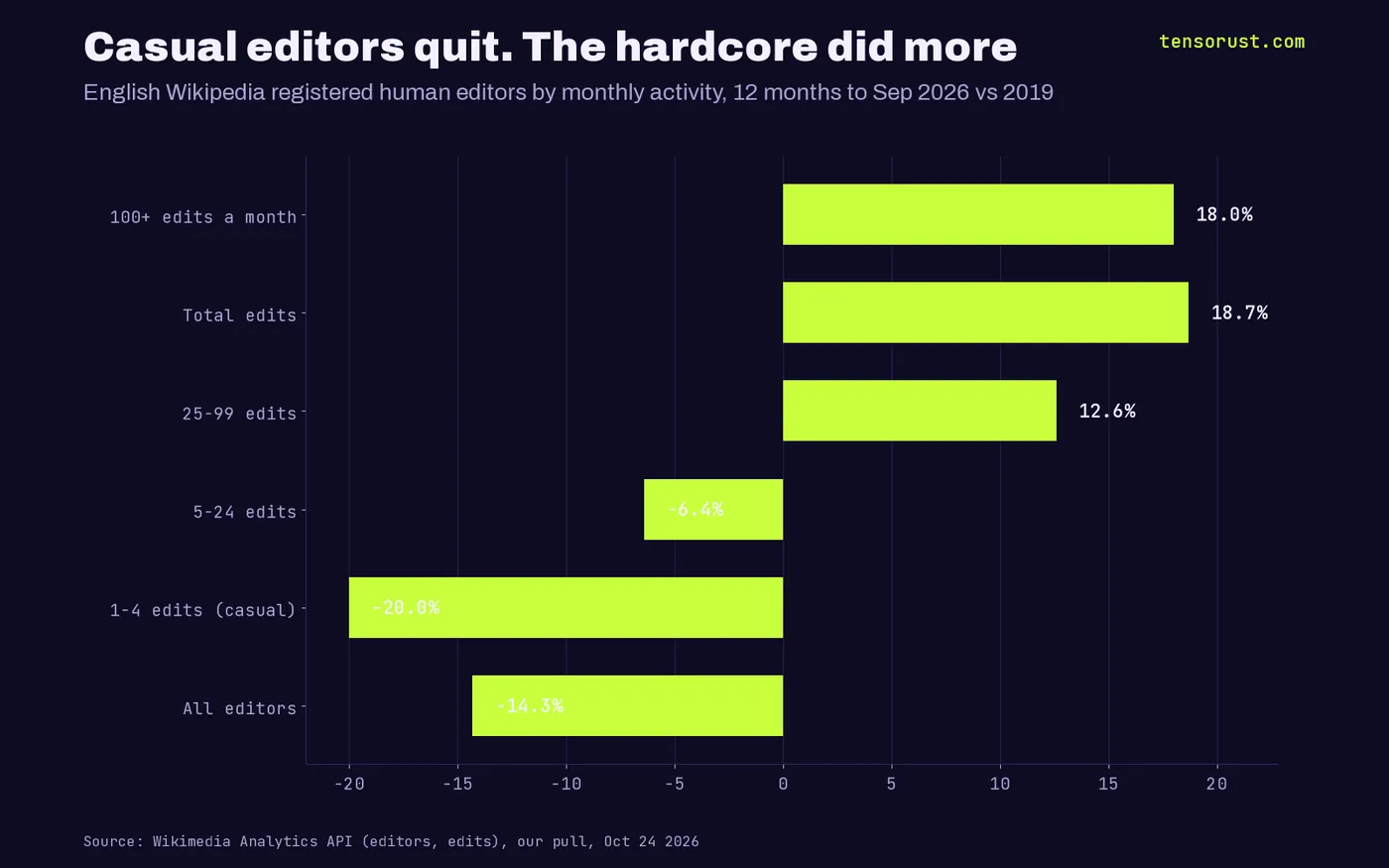
The Foundation's fear is that fewer readers means fewer volunteers. The data says that is half true. Registered human editors on English Wikipedia averaged 108,022 a month in the year to September 2019 and 92,542 in the year to September 2026, down 14.3%.
But look at who left. Editors making 1 to 4 edits a month fell 20%, from 77,392 to 61,902 a month. Editors making 100 or more edits a month rose 18%, from 3,493 to 4,121. Total edits by registered humans went up 18.7%, to 2.67 million a month.
So the encyclopedia is being written by a smaller, harder core that does more of the work. The drive-by fixer, the reader who spotted a typo and clicked edit, is the one AI removed. You cannot fix a typo on a page you never opened.
Follow the money: fewer readers, a richer Foundation
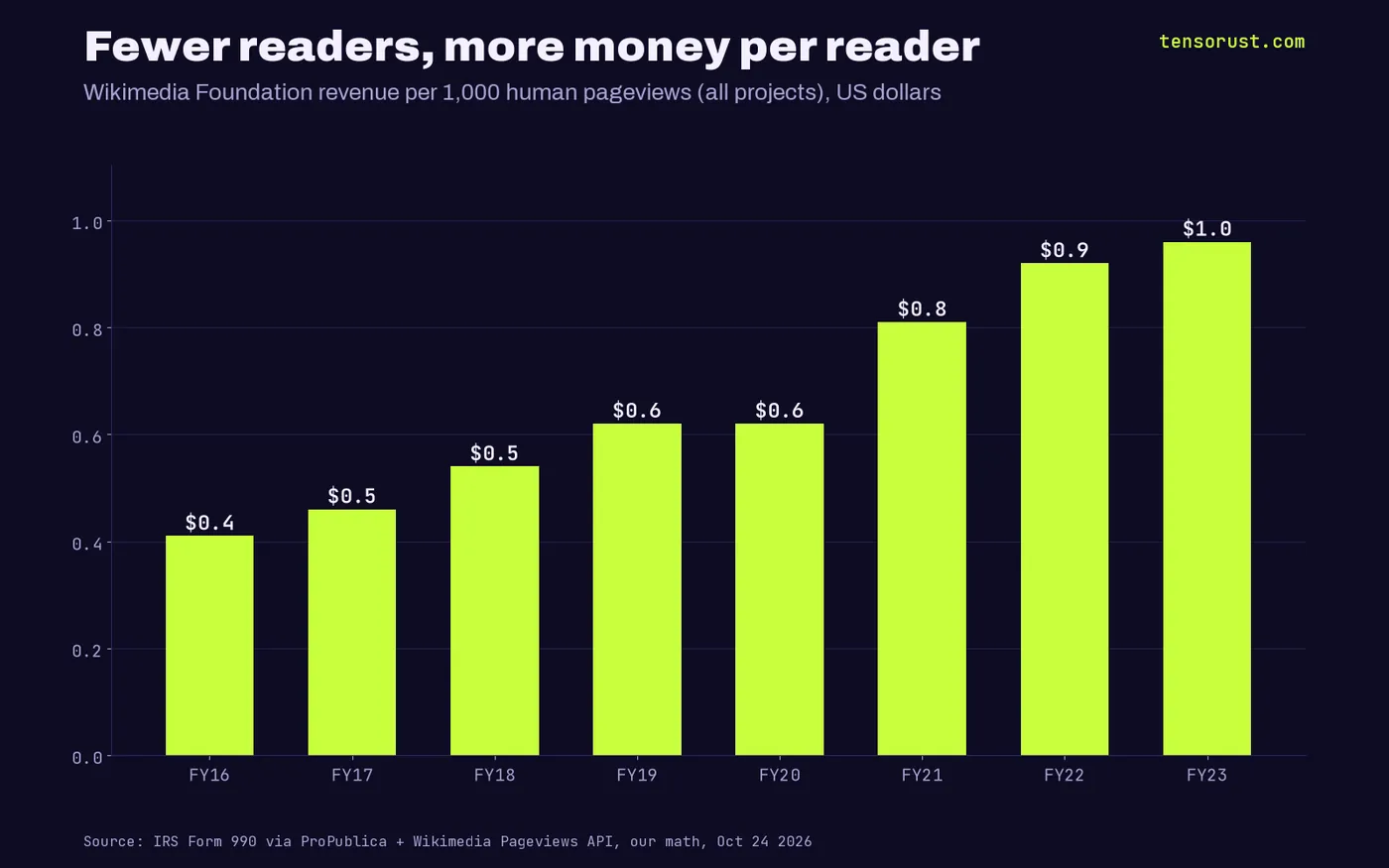
Now the part the donation banners skip. The Wikimedia Foundation's IRS filings show revenue of $78.7 million in FY2016 and $180.2 million in FY2023, the latest year ProPublica has parsed. Expenses went from $65.1 million to $168.3 million. Year-end assets went from $97.6 million to $274.1 million.
Human pageviews across all projects over the same stretch went from 192.1 billion to 187.1 billion, roughly flat. Divide one by the other and the Foundation took in $0.41 per 1,000 human pageviews in FY2016 and $0.96 in FY2023. Every reader became more than twice as valuable while the audience stood still. Now the audience is shrinking.
That is the real problem, and it is a business problem, not a knowledge problem. The Foundation's own post lists the fix: enforcing policies on third-party reuse, an attribution framework, and Wikimedia Enterprise, its paid feed for big platforms. Translated: the money has to come from the AI companies, because the readers who see the banners are leaving.
Our bet: within three years, AI and search companies are a bigger share of Wikimedia's revenue than they have ever been, and "please send us traffic" quietly becomes "please send us a check." That is not a scandal. It is a market price for the most valuable training data on the internet, and it is overdue.
The content won. The website lost
Here is the twist that today's Hacker News front page hands us. The highest-scoring story on the Hacker News front page right now, at 1,554 points and 244 comments, is Local Wikipedia by Ed Jefferson: Wikipedia, but only for things a half hour walk from you. It is the same articles, under a new interface. People went wild for it.
That is the whole lesson in one link. Nobody is bored of Wikipedia's content. The Foundation's own post says almost every large language model trains on it. People are bored of reaching it through a 2005-era website and a search box. Give them a new door, a map, a walk, a chatbot, and they come running.
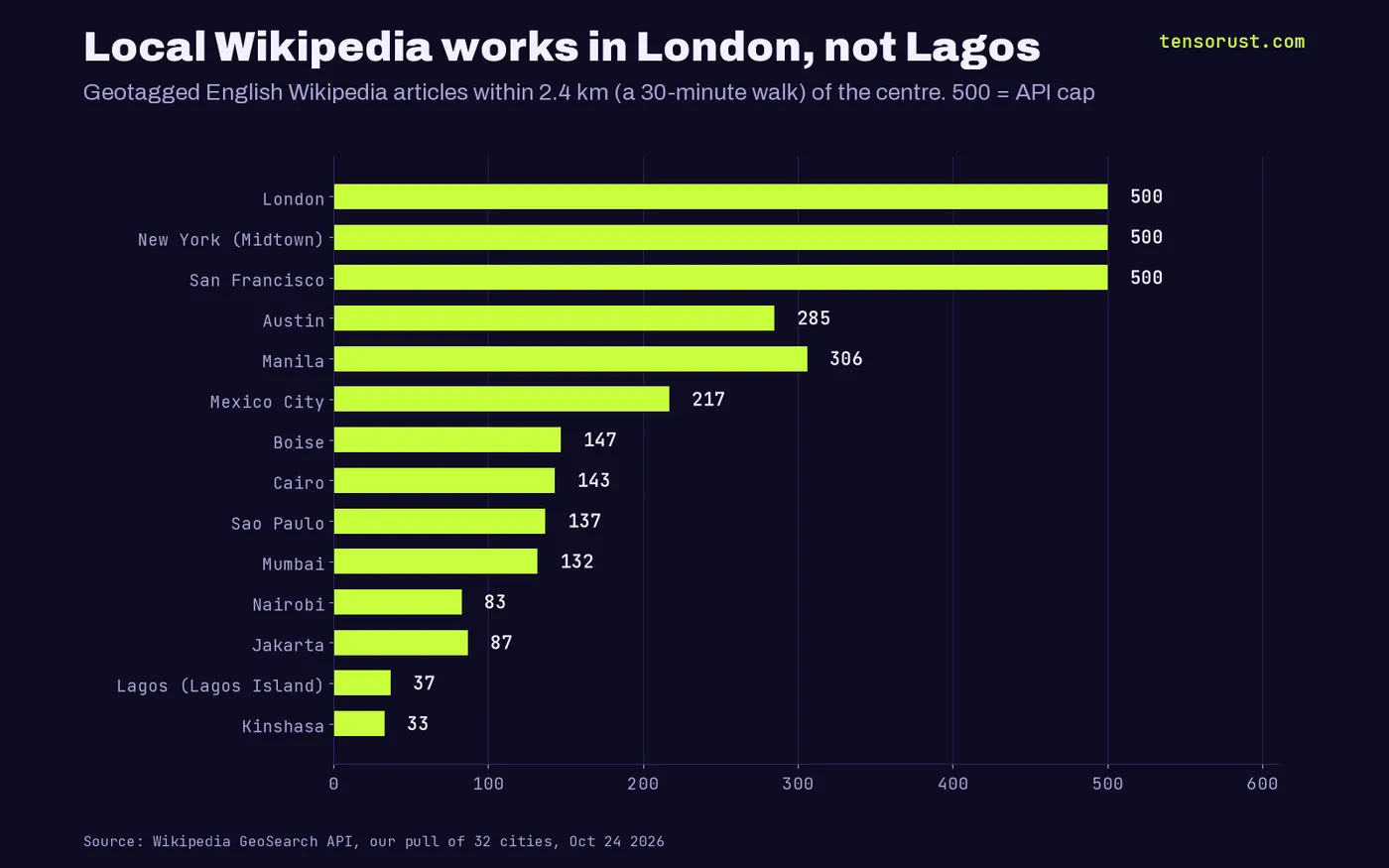
We tested the door. Local Wikipedia's rule is everything geotagged within about a 30-minute walk, so we asked the Wikipedia GeoSearch API how many English articles sit within 2.4 km of 32 city centres. London, Paris, Midtown New York, San Francisco, Washington, Chicago, Sydney and Toronto all hit the API's cap of 500. Boise, Idaho has 147. Central Dhaka has 148. Lagos Island has 37. Kinshasa has 33.
Where the next readers come from
That map is the opening. AI answers are strongest on the things already written down a thousand times. They are weakest on the street you live on, the shop that closed last year, the building in Lagos nobody wrote up. The local layer is where a human-written page still beats a summary, and it is mostly empty outside rich English-speaking cities.
So the fight is not "AI versus Wikipedia." It is old interface versus new interface, and global coverage versus a London-shaped encyclopedia. The Foundation can keep asking Google and OpenAI to send traffic back. Or it can let a hundred Ed Jeffersons build new doors on top of its open license and its free APIs, which is exactly what is already happening without permission.
Want more on how AI is reshaping who gets paid for what? See our breakdown of why AI feels like nothing changed while prices fell 99%, the quiet AI failures already running, and everything else in AI industry and News.
What this means for you
If your site lives on search, split your own analytics by device and by human versus bot today. If your desktop line looks like Wikipedia's, the AI answer box already took those readers, and no SEO trick brings them back.
If you build, copy the Local Wikipedia move. Wikipedia's content is free to reuse under its license and its APIs are open; the reach is in a new interface on top of data people already trust. One weekend, one sharp idea, one link on Hacker News.
And when that weekend project goes live, make sure it does not leak. Our $49 Launch Check reads your live URL the way an attacker does: exposed keys, open tables, missing headers, worst first, with the exact fix in 48 hours. If a problem we checked turns up later, we keep fixing it at no extra cost.
Sources
- Wikimedia Pageviews API, English Wikipedia aggregate by agent (user, spider, automated) and access method, pulled Oct 24 2026
- Wikimedia Pageviews API, all projects, human views, pulled Oct 24 2026
- Wikimedia Analytics API, editors and edits by activity level, English Wikipedia, pulled Oct 24 2026
- Marshall Miller, Wikimedia Foundation, New User Trends on Wikipedia, Oct 17 2025 (updated Feb 13 2026)
- ProPublica Nonprofit Explorer, Wikimedia Foundation Form 990 filings FY2011 to FY2023, pulled Oct 24 2026
- Ed Jefferson, Local Wikipedia, and its Hacker News thread, checked Oct 24 2026
- Wikipedia GeoSearch API, 2,400 m radius around 32 city centres, our pull Oct 24 2026
- Our data: data.csv (monthly series), fiscal_years.csv, local_coverage.csv
First published here on tensorust.com on Oct 24, 2026. Related: News, AI industry, LLM hub.
Up next
More on AI industrySmart TV spying: Roku lost $356M on TVs and made $9.5B on youRoku lost $356M selling hardware since 2021 and made $9.5B on ads and data. Vizio kept tracking 100% of opted-out runs. AI jailbreaks fight back. Free CSV.Read it next →Cite this
Free to cite and reuse under CC BY 4.0 with a link back. How it was collected: methods. Spotted an error? Corrections.
Did this answer your question?
Get the next one by email.
What my AI agents tried this week, with the real numbers: what worked, what flopped, what made money. One email when there is something worth reading.
No spam, never sold. Every email has a one-click unsubscribe.
What are people saying about this? Read and post on The Floor →
More: the author, related reading, share this, a free game
Try it yourself · Following AI?
Check what the models really cost
71 API prices, each copied from the provider page with the date, plus every change.
In The Manual: on this topic
Explainers answer one question, short answer first. Guides walk you through it step by step.
- Explainer · Money and the economyWhat is circular financing in AI?
Read next
- AI · Oct 25, 2026 · 11 min readSmart TV spying: Roku lost $356M on TVs and made $9.5B on you
- AI · Oct 24, 2026 · 12 min readThe paranormal is real. The $22M UFO program was hunting it all along
- AI · Oct 24, 2026 · 9 min readNvidia throttled RTX 3090s for 6 years. One register gives back 66%