
AI data centers aren't why your power bill is up. Utilities are
On this page · 10 sections
- Key numbers
- The data says demand growth cuts your rate, not raises it
- The biggest hikes are in states with no AI boom at all
- Most of the jump came before anyone said "ChatGPT"
- Follow the money: the utility earns on what it spends
- The one real hit: PJM, and who wrote its rules
- The fix is already happening, and utilities lobby harder than ever
- Why the panic sticks anyway
- What this means for you
- Sources
Short answer: No, AI data centers are not the main reason your electric bill went up. Across all 50 states and DC, the places where electricity demand grew fastest since 2019 saw the smallest residential price hikes (+28.9%), and the places where demand shrank saw the biggest (+49.2%). The AI power panic is the cover story. The main event is a regulated monopoly that earns a return on every dollar it spends on wires, and spending just hit a record.
TL;DR: We pulled seven years of EIA state data: residential power rose 39.1% nationally, but California (+69.6%), Maine (+69.0%) and New York (+58.2%) led the pack while their demand fell. Eight of the biggest investor-owned utilities lifted capital spending 58%, from $46.4 billion in 2019 to $73.3 billion in 2025, and every dollar of that becomes rate base they earn a profit on. The one place data centers really do hit bills, the PJM capacity auction, is a market whose price jumped 11.5x in three auctions after about 6,600 MW of plants retired, and the fix is already here: Ohio makes big data centers pay for 85% of the power they reserve, and Google just bought its own power developer for $4.75 billion.
Key numbers
| What | Number | Source, checked Oct 25 2026 |
|---|---|---|
| US residential power price, 12 months to Aug 2019 vs Aug 2026 | 12.97 to 18.04 cents/kWh (+39.1%) | EIA-861M, our calc |
| Price change, 13 states where demand fell vs 13 fastest-growing | +49.2% vs +28.9% | EIA-861M, our calc |
| Correlation, demand growth vs residential price change (51) | -0.49 | EIA-861M, our calc |
| Share of the 2019-2026 electricity CPI rise that came before ChatGPT | 54% | BLS CPI via FRED |
| Capex, 8 big investor-owned utilities, 2019 vs 2025 | $46.4B to $73.3B (+58%) | SEC EDGAR 10-K XBRL |
| US utility distribution capex, 2023 | $50.9B, up 160% since 2003 | EIA, Nov 18 2024 |
| PJM capacity price, 2024/25 to 2027/28 | $28.92 to $333.44 per MW-day | PJM, Dec 17 2025 |
| Duke Energy in-house federal lobbying, 2019 vs 2025 | $5.28M to $10.75M | Senate LDA |

The data says demand growth cuts your rate, not raises it
Here is the test nobody running the "AI is eating the grid" headline bothered to run. If data centers were driving bills, the states adding the most load should have the worst price hikes. We took EIA's monthly state sales and revenue file, built 12-month windows ending August 2019 and August 2026, and sorted all 50 states plus DC by how much their electricity demand changed.
The result runs the opposite way. The 13 states where demand fell (average -3.0%) saw residential prices climb 49.2%. The 13 states where demand grew fastest (average +23.1%) saw 28.9%. Across all 51, the correlation between load growth and price growth is -0.49. Drop DC and it is still -0.46.
Virginia, the data center capital of the planet, grew demand 26.0% and saw residential prices rise 39.8%, right on the national 39.1%. Texas grew 26.3% and rose 37.6%. North Dakota grew 43.2% and rose 19.4%, half the national rate.
The mechanism is boring, which is why it gets ignored. A utility's costs are mostly fixed: poles, wires, substations, the return on all of it. Sell more kilowatt-hours and you spread those fixed costs thinner. Berkeley Lab and Brattle found the same thing in their October 2025 review: load growth "has tended to depress retail electricity prices in recent years." The drivers they named were transmission and distribution spending, wildfire and extreme-weather costs, natural gas swings, renewable mandates and net metering. Not AI.
The biggest hikes are in states with no AI boom at all
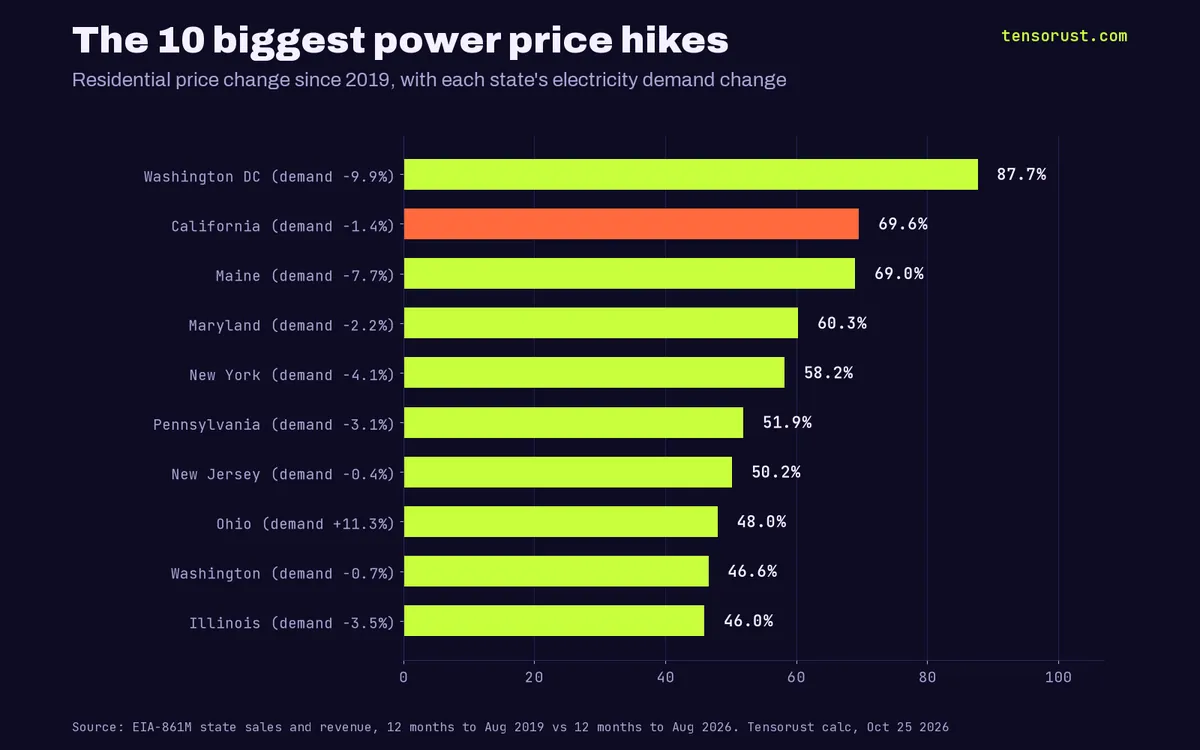
Look at the top of the list. Washington DC +87.7% with demand down 9.9%. California +69.6% with demand down 1.4%. Maine +69.0% with demand down 7.7%. Maryland, New York, Pennsylvania, New Jersey, Washington and Illinois all rose 46% or more while their demand shrank.
Ohio is the only state in the top 10 with real load growth (+11.3%). Nine of the ten worst power bill hikes in America happened in places that are using less electricity than they did in 2019.
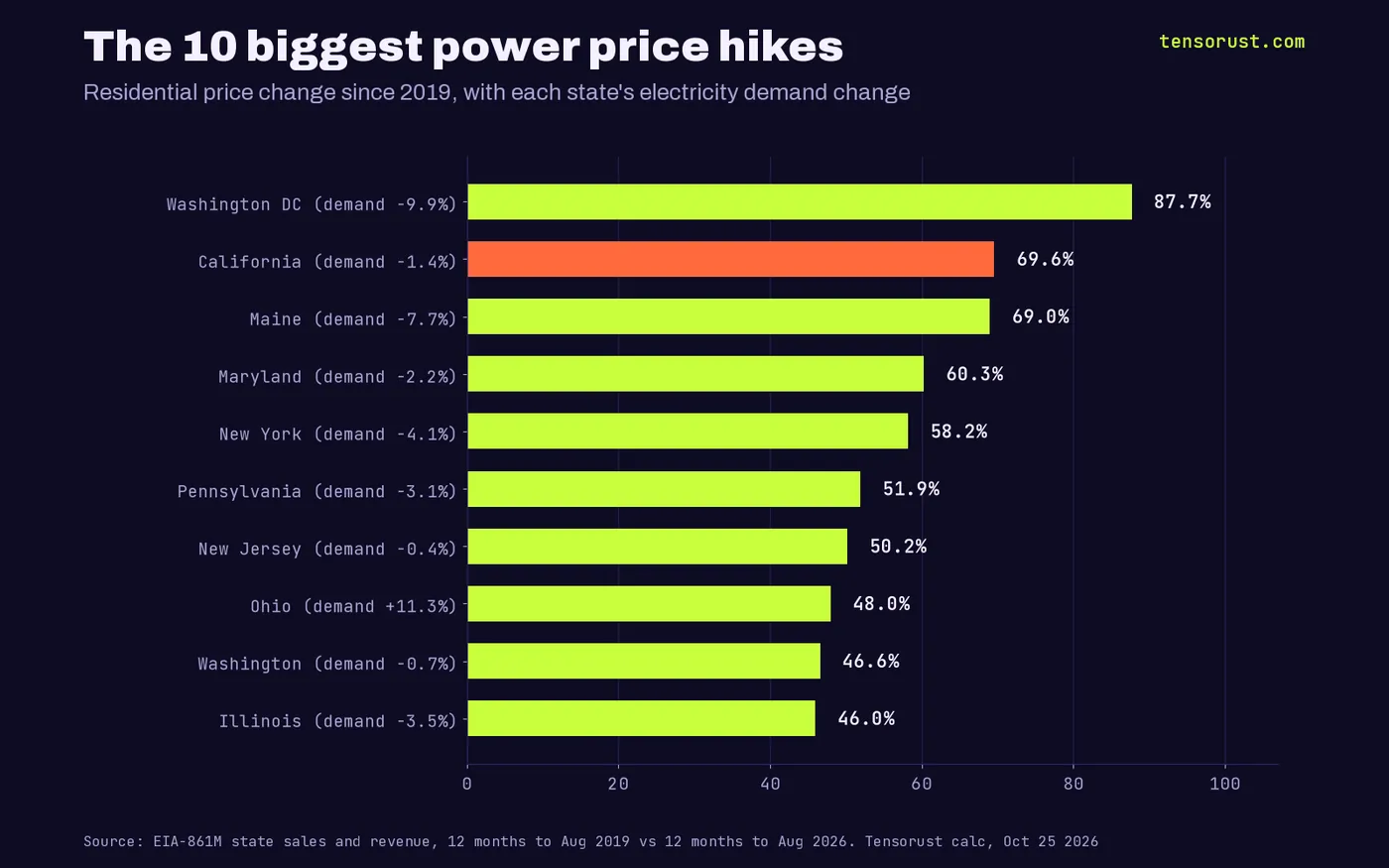
California is the cleanest case. Its residential price went from 19.07 to 32.34 cents per kWh. That is wildfire liability, undergrounding and a wires buildout paid for by a shrinking base of kilowatt-hours. You can blame a chatbot for that, but the bill itemizes something else.
Most of the jump came before anyone said "ChatGPT"
The timing kills the story too. BLS's electricity price index rose 21.9% in the 22 months from January 2021 to November 2022, before ChatGPT launched. In the 46 months since, it rose 16.3%, against 12.6% for all consumer prices. Of the total climb from January 2019 to September 2026, 54% landed before the AI boom had a name.
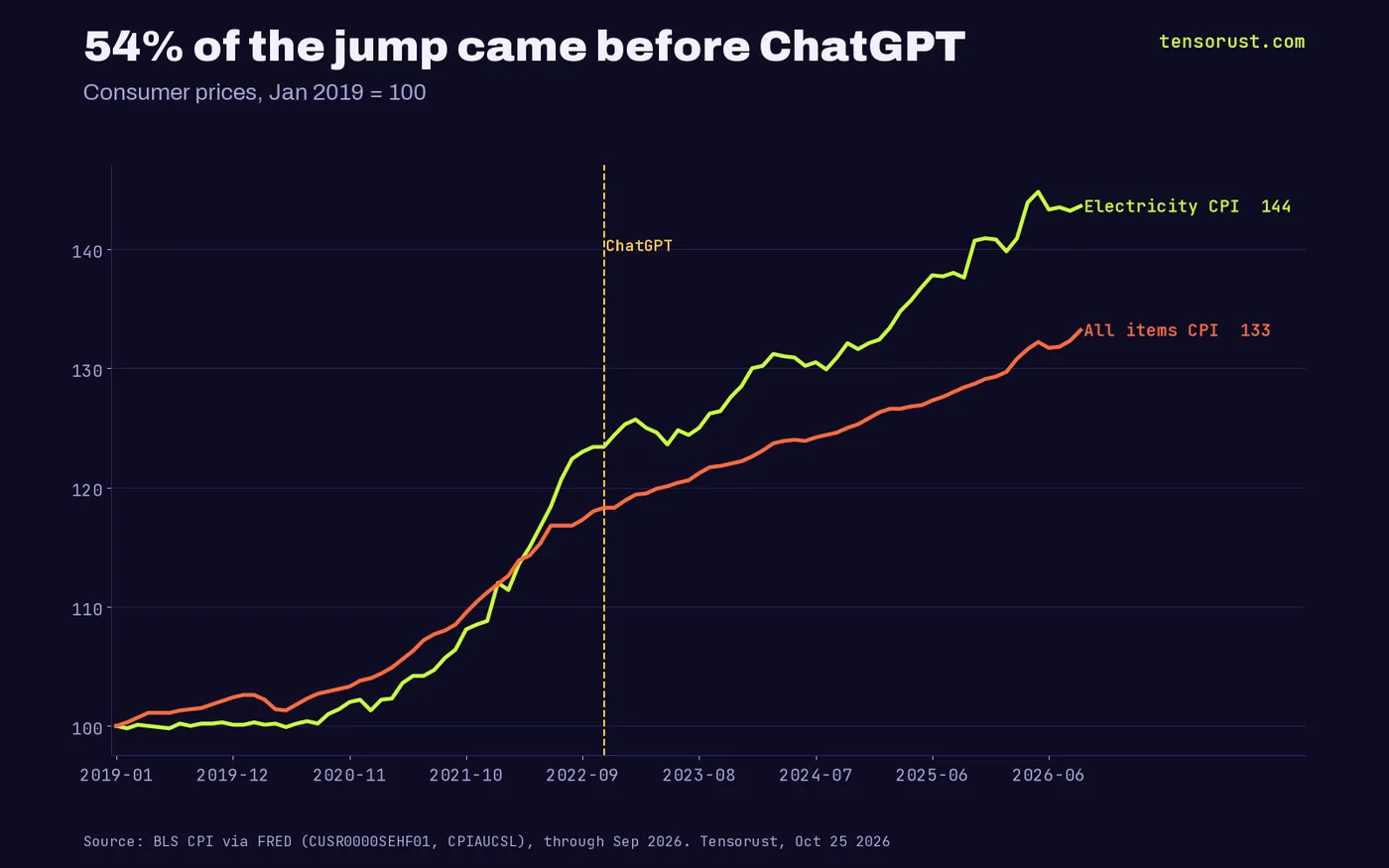
That first spike was natural gas and post-pandemic inflation. The second leg is slower and steadier, and it tracks something that never makes the headline: utility capital spending.
Follow the money: the utility earns on what it spends
An investor-owned utility does not make money selling electricity. It makes money on its rate base, the pile of assets regulators let it charge you for, times an allowed return on equity. Build more, earn more. Economists named the bias toward over-building in 1962 (the Averch-Johnson effect). It has never been repealed.
So we pulled the cash flow statements. Duke, Southern, PG&E, Xcel, Exelon, Edison International, Ameren and FirstEnergy spent $46.4 billion on capital in 2019 and $73.3 billion in 2025, up 58%. Xcel went from $4.2 billion to $10.9 billion. Southern from $7.6 billion to $12.7 billion. PG&E from $6.3 billion to $11.8 billion. National US electricity sales grew 8.0% over the same window.
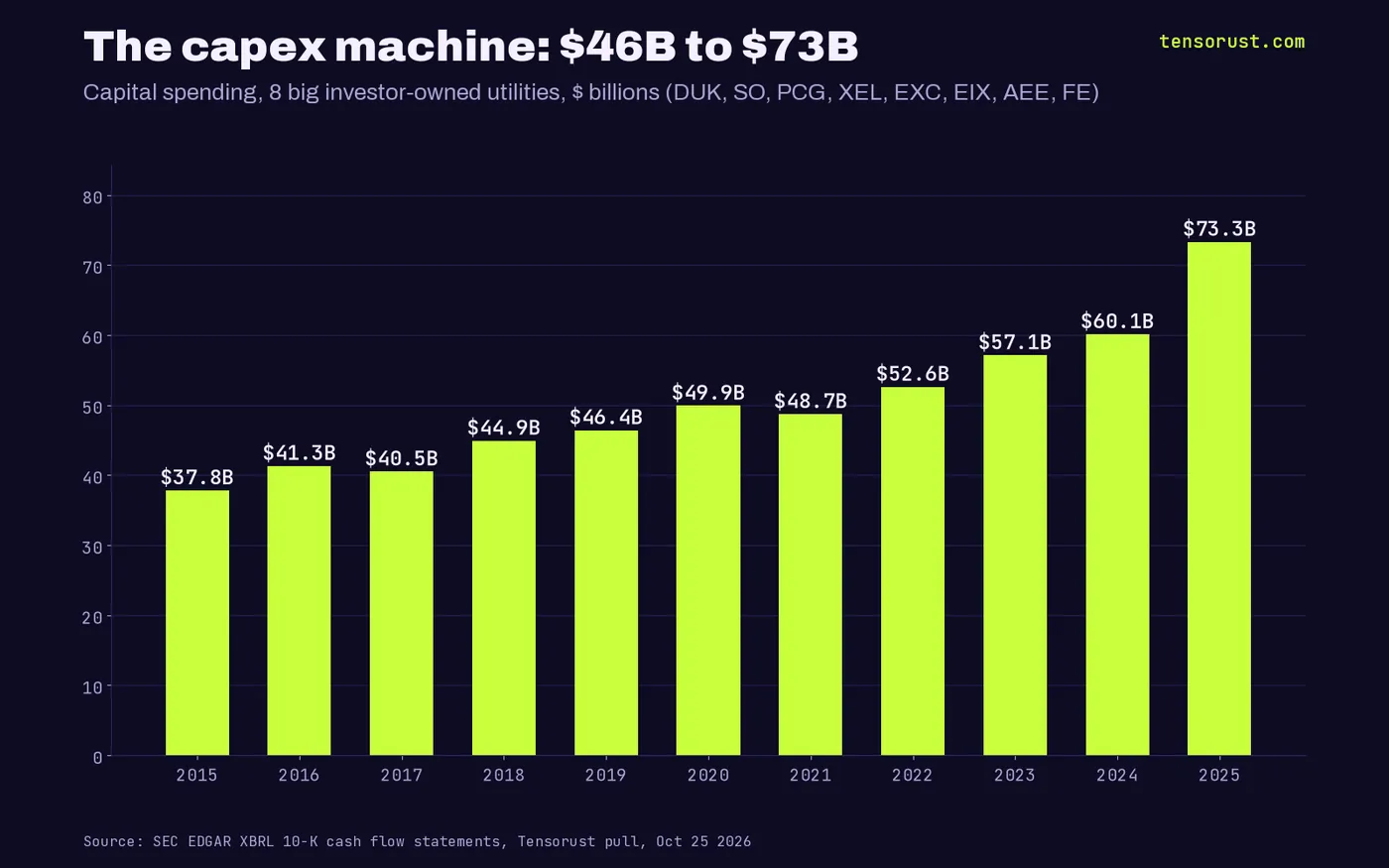
EIA's own count shows where the money goes. Distribution capital spending hit $50.9 billion in 2023, up 160% since 2003, and transmission spending nearly tripled to $27.7 billion. Distribution is the neighborhood wires. Big data centers typically hook in at high voltage, upstream of those wires. The fastest-growing line on your bill is the part that has the least to do with AI.
Now the who-benefits reading, and it is ours. A capex wave this size needs a story regulators and voters will accept. "Aging infrastructure" is dull. "The AI boom is coming and we must build" is urgent, bipartisan and pins the bill on Big Tech instead of the utility filing the rate case. The AI forecast becomes the permission slip for spending utilities wanted anyway. Nobody has proven that every rate case is padded, but the pattern says the panic and the capex rise together, and the utility is the only player paid on both.
The one real hit: PJM, and who wrote its rules
Here is the strongest case against us, stated fairly. In PJM, the grid that runs from Illinois to New Jersey, data centers really are moving prices. The capacity auction cleared at $28.92 per MW-day for 2024/25, then $269.92 for 2025/26, then $329.17, then the $333.44 cap for 2027/28. PJM says nearly 5,100 MW of the 5,250 MW forecast peak increase for 2027/28 is data centers. Its market monitor estimates data center load added $23.1 billion in system costs across recent auctions. That shows up in Maryland, New Jersey and Pennsylvania bills.
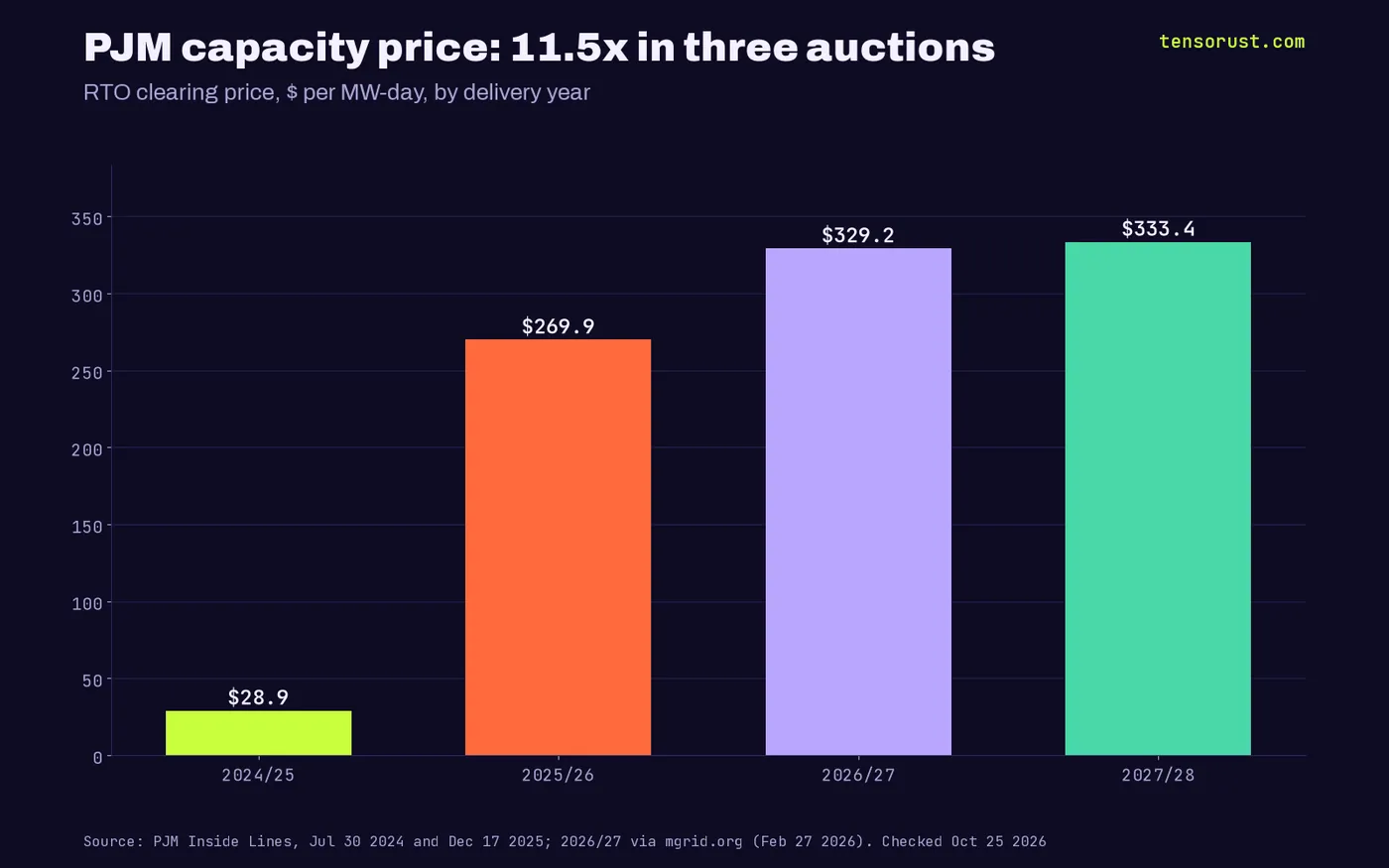
Now take it apart. When the price first went 9x, PJM's own explanation pointed at supply: about 6,600 MW of generation retired or signaled it would. A market that lets plants close faster than new ones can connect, then pays every remaining generator the scarcity price, is a design choice. PJM says itself that capacity is "a fraction of wholesale electricity costs," which are themselves only a portion of your bill. And Maine, California and New York had bigger hikes than any PJM state but Maryland and DC, with no PJM auction at all.
The money in the auction goes to the incumbents that own the plants. The price for the scarcity goes to you. Data center load was the spark. The rulebook that turned a spark into a $16.4 billion auction was written by the utilities and generators who sit inside PJM.
The fix is already happening, and utilities lobby harder than ever
If the worry is that data centers dump costs on households, regulators already have a tool, and it works. Ohio's PUCO approved AEP Ohio's data center tariff on July 9, 2025: new loads over 25 MW pay for at least 85% of the capacity they reserve, for up to 12 years, whether they use it or not. Microsoft, Amazon, Google and Meta signed the competing proposal, and lost.
And the hyperscalers are moving off the utility's books entirely. Alphabet agreed to buy Intersect Power for $4.75 billion in cash, with multiple gigawatts of co-located power and data center projects, starting in Haskell County, Texas. Power built next to the load, paid for by the buyer, never touches your rate base. We saw the same play in Europe in our piece on Google's Finland data center.
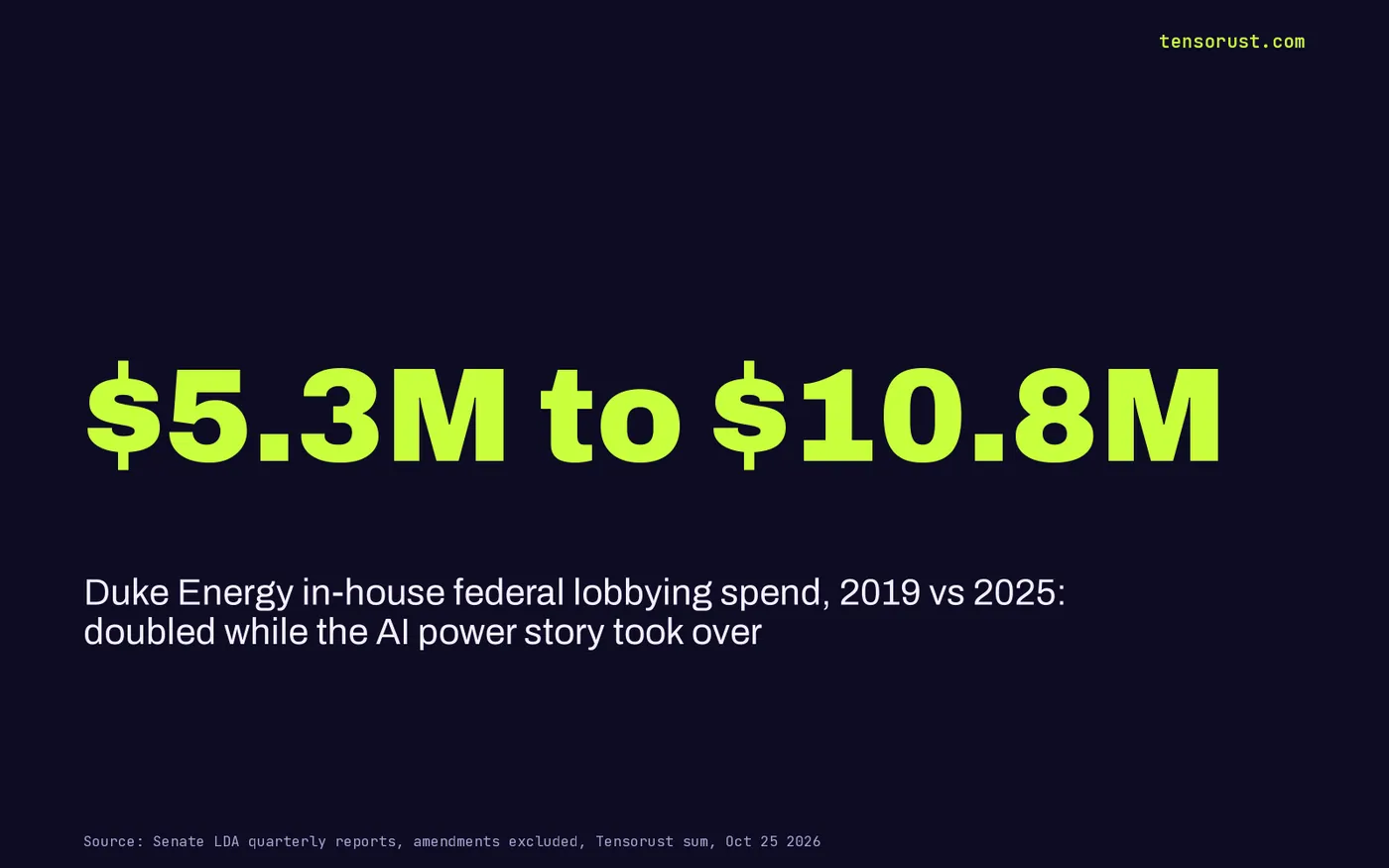
Meanwhile, the lobbying meter is running. Duke Energy's in-house federal lobbying spend went from $5.28 million in 2019 to $10.75 million in 2025, more than double, per Senate LDA reports. The Edison Electric Institute, the investor-owned utility trade group, spent $9.41 million in-house in 2025. That is only the federal layer. Rate cases are won in state capitals.
The twist: the cheapest new power in America is increasingly being built by the companies the panic blames. The utility wants the data center's load and the voter's sympathy at the same time. It cannot have both.
Why the panic sticks anyway
AI fear is the easiest story in the room. Utilities get a villain who is not them. Politicians get to look tough on Big Tech without touching the monopoly that funds their campaigns at home. Legacy media gets a headline with a robot in it. We wrote about this pattern before in the anti-AI crowd's money trail and the quiet risks hiding in plain sight: the scary frame keeps you from reading the boring document. In this case the boring document is your utility's rate case.
Our bet: within two years, the states that force large loads to pay their own way and let them self-build will see bills flatten, and the states that let utilities rate-base an "AI growth" buildout will keep rising, data centers or not. Watch the capex line, not the chatbot.
What this means for you
Pull your last bill and split it into supply and delivery. Delivery is the utility's wires and its return, and it is the line growing fastest. Then search your state utility commission for your utility's current rate case and file a public comment; most commissions take them online, and almost nobody does it. If you live in a state with a pending data center tariff, back the 85% style rule: it makes the big load pay and keeps it off your rate base.
Then put a number on it. Our Envelope budget app imports your bank CSV and shows what utilities really cost you month by month, fully offline. If it does not do what it promises, we keep fixing it at no extra cost until it does. More takes like this live on our opinion page and in every opinion piece; the state-by-state data is below.
Not financial advice. Our numbers and our read, so you can check them.
Sources
- EIA, Form EIA-861M monthly sales and revenue by state (HS861M 2010-), data through Aug 2026, pulled Oct 25 2026
- BLS CPI electricity (CUSR0000SEHF01) and all items (CPIAUCSL) via FRED, through Sep 2026, pulled Oct 25 2026
- Brattle, Berkeley Lab report on retail electricity price trends, Oct 17 2025
- EIA Today in Energy, grid infrastructure investments drive increase in utility spending, Nov 18 2024
- SEC EDGAR XBRL companyfacts, 10-K capital expenditures for DUK, SO, PCG, XEL, EXC, EIX, AEE, FE, pulled Oct 25 2026
- PJM Inside Lines, 2025/2026 capacity auction results, Jul 30 2024
- PJM Inside Lines, 2027/2028 capacity auction results, Dec 17 2025
- mgrid.org, PJM 2026/2027 capacity prices reach $329/MW-day, Feb 27 2026
- Utility Dive (Ethan Howland), Monitoring Analytics 2025 State of the Market, Mar 13 2026
- POWER Magazine, PUCO approves AEP Ohio data center tariff, Jul 10 2025
- Alphabet announcement to acquire Intersect (reprint), Dec 2025
- Senate Lobbying Disclosure Act filings, Duke Energy and Edison Electric Institute, 2019 and 2025, pulled Oct 25 2026
- Averch-Johnson effect (1962)
First published here on tensorust.com on Oct 25, 2026. Related: Opinion, All opinion pieces, Google Finland data center.
Up next
More on OpinionThe new class divide: 3 tiers, and 3 in 4 workers sit out the AI oneOnly 25% of US workers used AI at work last month, and labor share hit a 79-year low. The new class line is who the network pays, and who has a machine working.Read it next →Cite this
Free to cite and reuse under CC BY 4.0 with a link back. How it was collected: methods. Spotted an error? Corrections.
Did this answer your question?
Get the next one by email.
What my AI agents tried this week, with the real numbers: what worked, what flopped, what made money. One email when there is something worth reading.
No spam, never sold. Every email has a one-click unsubscribe.
What are people saying about this? Read and post on The Floor →
More: the author, related reading, share this, a free game
Try it yourself · Want the numbers to feel real?
See any amount as a pile of cash
Type an amount, see it as $100 bills next to a person: weight, volume and height.
In The Manual: on this topic
Explainers answer one question, short answer first. Guides walk you through it step by step.
- Explainer · Money and the economyCan the Fed buy Treasuries directly from the government?
- Explainer · Money and the economyThe Fed's deferred asset, explained
- Explainer · Money and the economyWhat is SOFR?
- Explainer · Money and the economyWhat are bank reserves?
Read next
- AI · Oct 25, 2026 · 14 min readThe new class divide: 3 tiers, and 3 in 4 workers sit out the AI one
- AI · Oct 24, 2026 · 14 min readAI isn't overhyped. Prices fell 99% and it feels like nothing changed
- AI · Oct 24, 2026 · 9 min readHollywood jobs: AI didn't kill them. The streaming bust did