
By Matt Busel, who built the apps, crates and game he writes about · every number links to its source and every dataset is downloadable (methods) · corrections · featured in Kirino, gamebiz, This Week in Rust, New Mobile Life, By-Press
AI productivity: workers already took the dividend as free time
On this page · 10 sections
- Key numbers
- The time savings are real, and they are big for the people using AI
- The paid hours did not move, so where did the time go?
- The steelman: if output did not rise, the gain is not real
- The real gap: measured gain versus reported gain
- Follow the behavior: workers are hiding the tool
- Follow the money: who wins, who loses
- The twist: the four-day week already happened
- What this means for you
- Sources
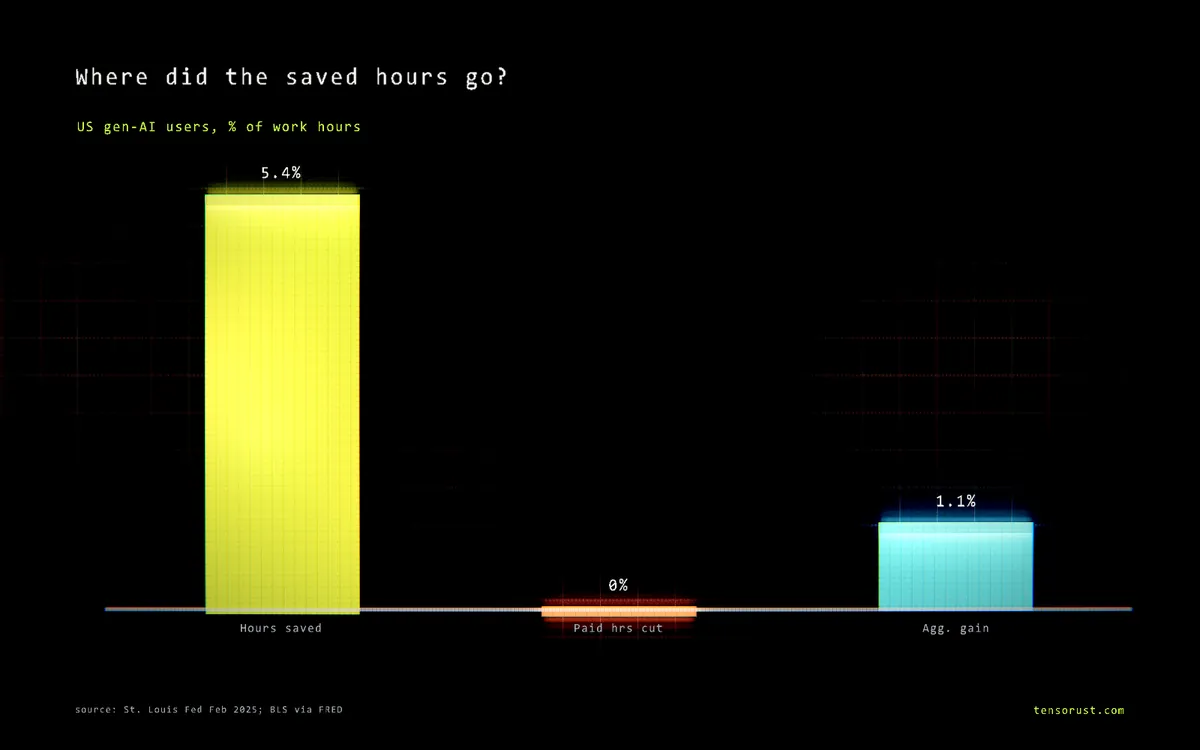
Short answer: AI is already paying a dividend, and workers collected it first. US generative AI users say the tools save them 5.4% of their work hours, about 2.2 hours a week, yet the paid workweek sits at 33.8 hours and Danish payroll records show no change in recorded hours. The saved time did not vanish. It went off the books, into slack, and the "AI has not raised productivity" headlines are counting the one place it was never going to show up.
TL;DR: A St. Louis Fed survey found gen AI users saved 5.4% of their work hours in November 2024, and 20.5% of them saved four hours or more in a single week. Over the same stretch, US average weekly hours went from 34.1 (January 2023) to 33.8 (September 2026), and a Danish study of administrative records rules out any effect on recorded hours or earnings larger than 2%. Meanwhile 78% of AI users bring their own tools to work and 52% are reluctant to admit using AI on their most important tasks, which is exactly what you would expect if the payout is being kept quietly. The four-day week already arrived, off the books, and the return-to-office fight is the attempt to claw it back.
Key numbers
| What | Number | Source, checked Oct 27 2026 |
|---|---|---|
| Work hours saved, average gen AI user (Nov 2024) | 5.4% (about 2.2 hrs on a 40-hr week) | St. Louis Fed |
| Hours saved across all workers, users and non-users | 1.4% of total hours | St. Louis Fed |
| Implied aggregate productivity gain | 1.1% | St. Louis Fed |
| Effect on recorded hours and earnings, Denmark, 2 yrs after ChatGPT | Null, ruling out more than 2% | Humlum and Vestergaard, NBER w33777 |
| US average weekly hours, private workers | 34.1 (Jan 2023) to 33.8 (Sep 2026) | BLS via FRED |
| Output per hour, annualized growth | 1.56% (2015-2019) vs 2.51% (Q4 2022 to Q2 2026) | BLS via FRED |
| AI users bringing their own AI to work | 78% | Microsoft and LinkedIn Work Trend Index |
| AI users reluctant to admit using it on key tasks | 52% | Microsoft and LinkedIn Work Trend Index |

The time savings are real, and they are big for the people using AI
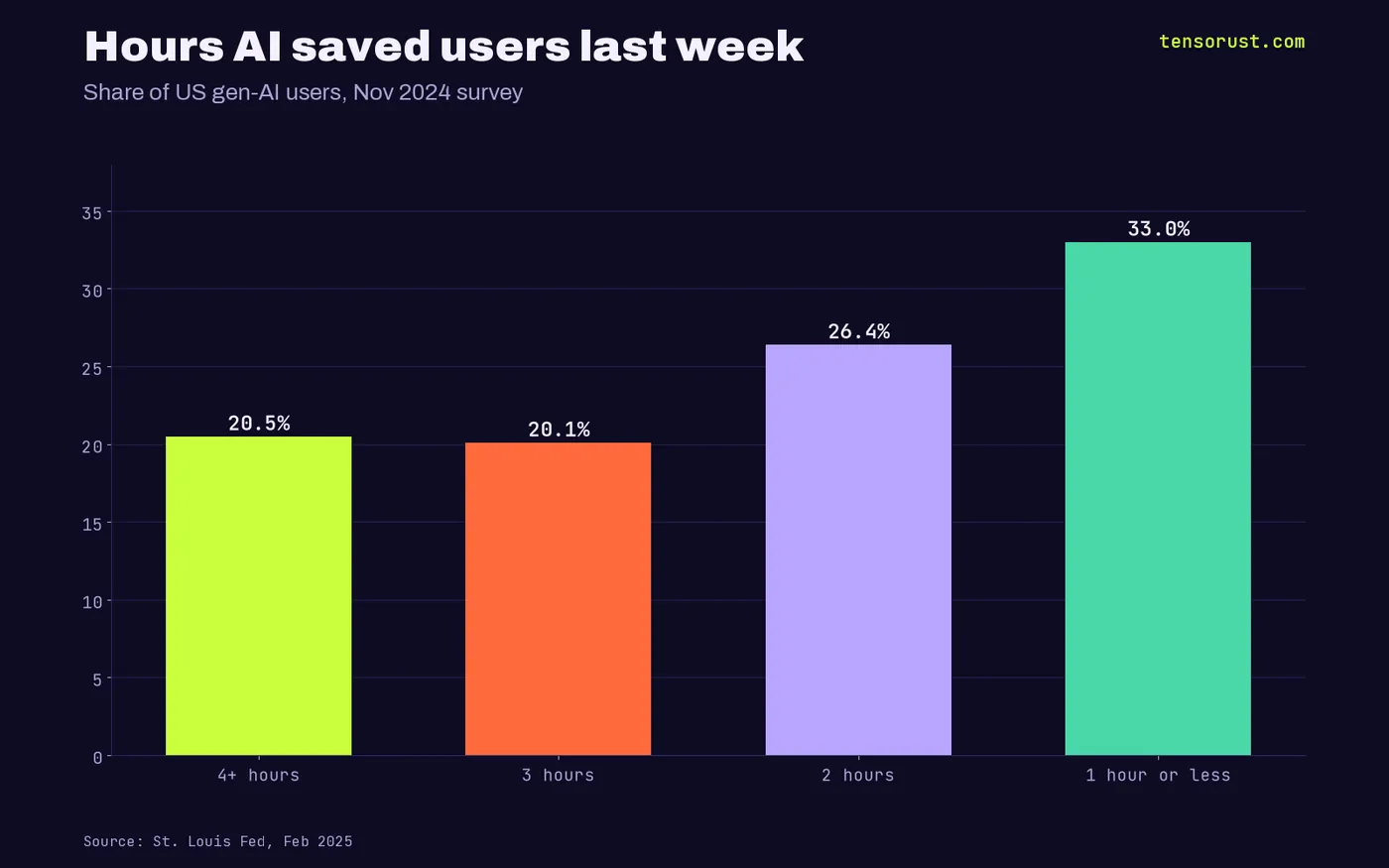
The St. Louis Fed ran the first nationally representative US survey of generative AI at work. Among people who used it in the previous week, 20.5% said it saved them four or more hours, 20.1% said three, 26.4% said two and 33.0% said an hour or less.
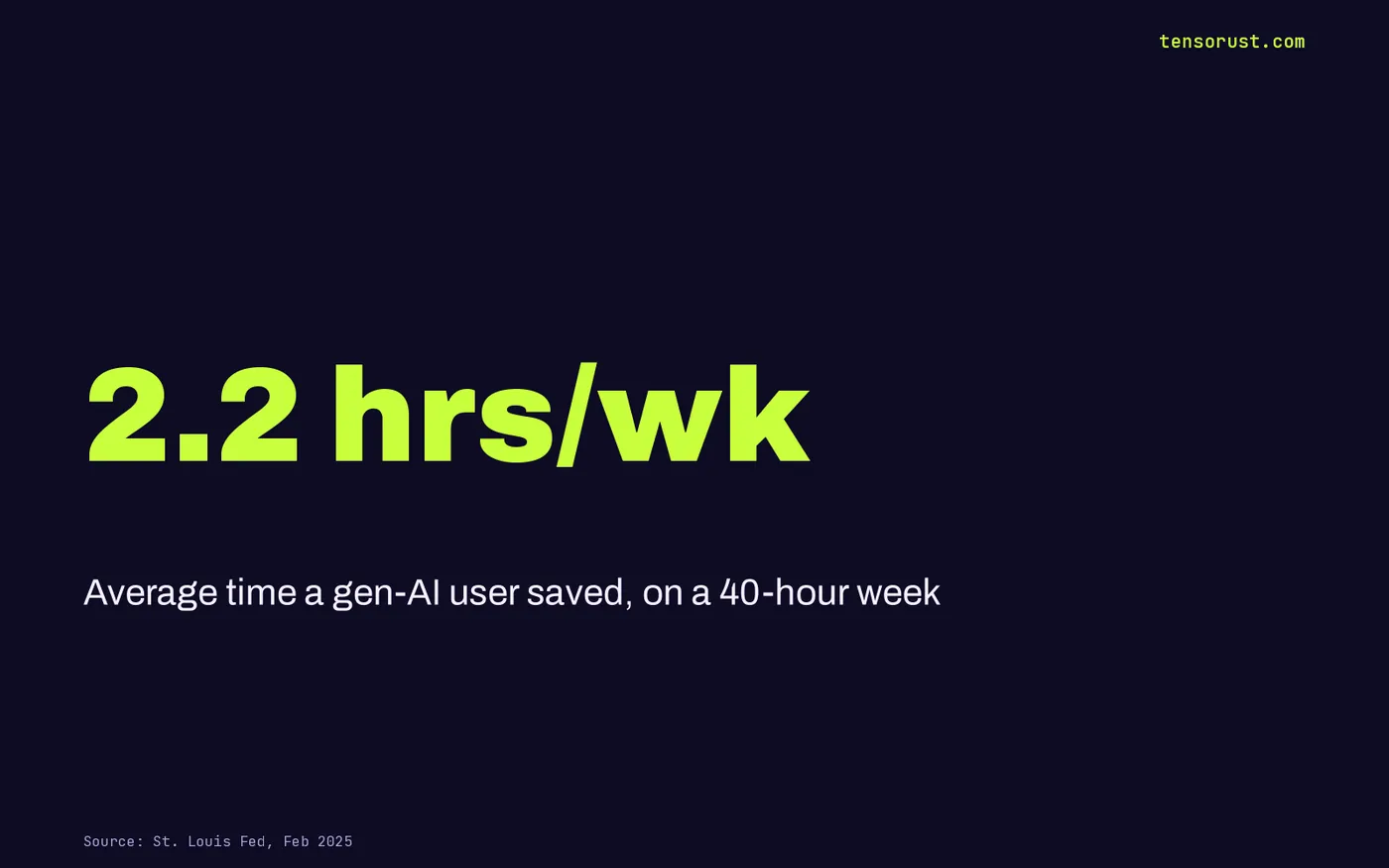
Averaged out, that is 5.4% of a user's work hours. On a 40-hour week, the Fed itself does the math: 2.2 hours.
The heavy users save the most. Among people who used AI every day, 33.5% saved four hours or more, against 11.5% of people who used it on only one day.
The paid hours did not move, so where did the time go?
If 2.2 hours a week came back to every heavy user, one of two things should show up in the data. Either people work fewer paid hours, or they produce visibly more in the same hours.
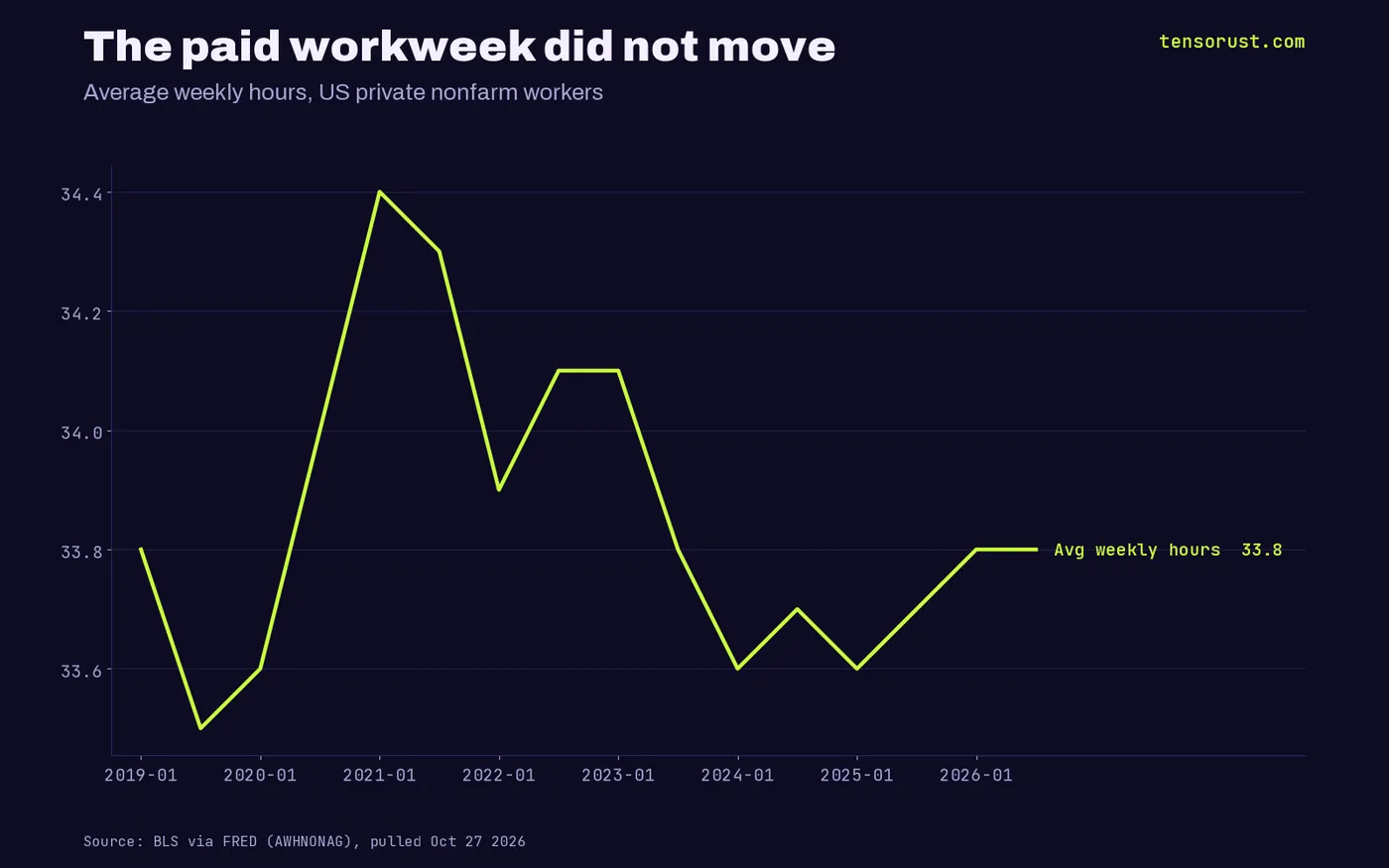
The first did not happen. US average weekly hours for private workers read 34.1 in January 2023 and 33.8 in September 2026, flat for every month of 2026 so far. That is the normal wobble of the series, not a shorter week.
Denmark checked the payroll directly. Anders Humlum and Emilie Vestergaard linked AI adoption surveys to administrative labor records and found "precise null effects on earnings and recorded hours," ruling out anything larger than 2%. Workers report productivity benefits. The records do not see them.
The steelman: if output did not rise, the gain is not real
The skeptic's case is simple and fair. A saved hour that produces nothing is not a productivity gain, it is a survey answer. People overrate how much a shiny tool helps them, and a self-reported number is not a measurement.
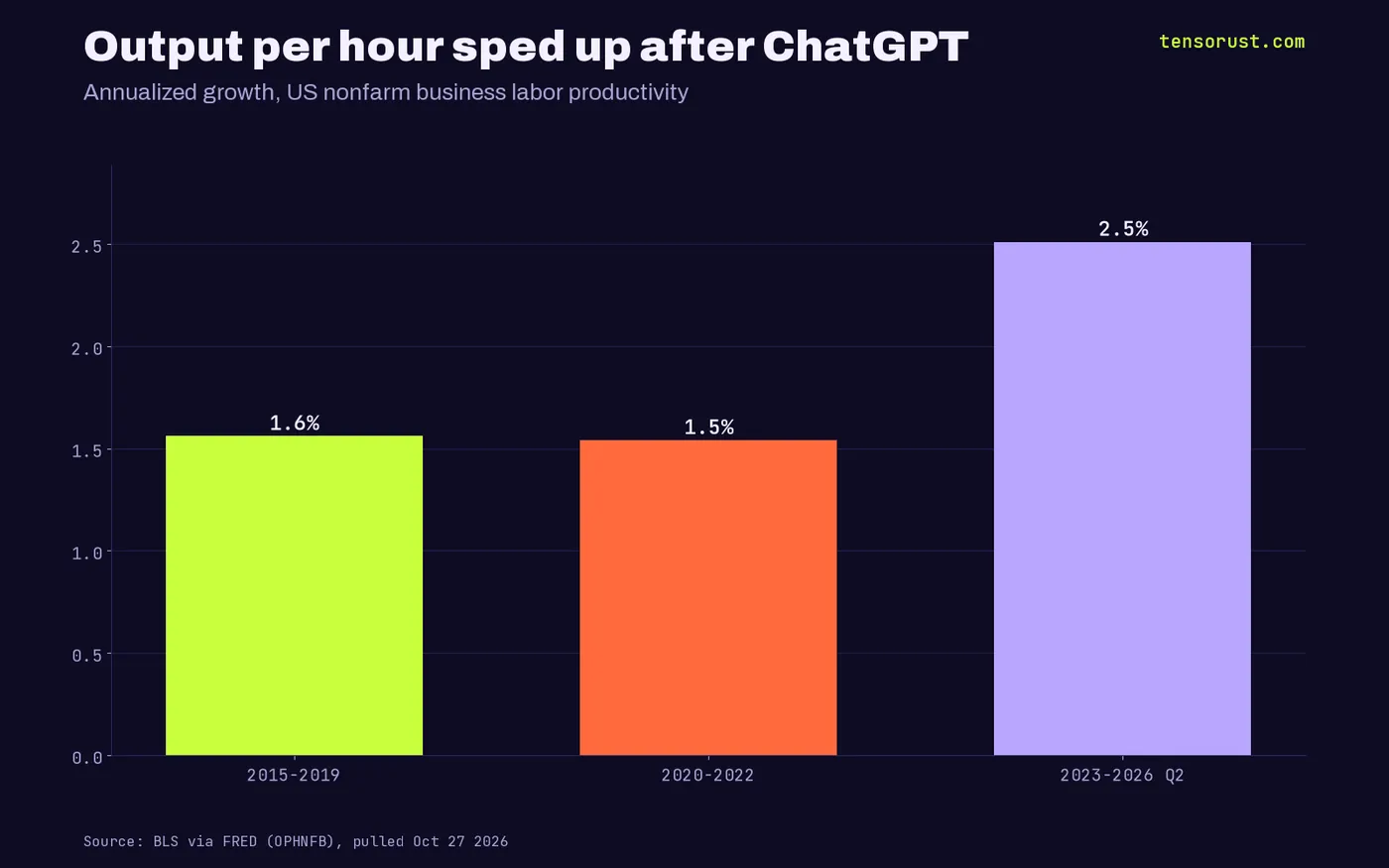
Here is the problem with stopping there. Output per hour did rise. US nonfarm labor productivity grew at 1.56% a year from 2015 through 2019, 1.54% from 2019 through 2022, and 2.51% a year from the end of 2022 to mid-2026. Something is lifting output per paid hour, and the Fed's own model turns the survey's time savings into a 1.1% aggregate gain, in line with what you would expect from 33% more output in each hour a person actually uses AI.
And where a firm measures output directly, the gain is not subtle. Erik Brynjolfsson, Danielle Li and Lindsey Raymond tracked 5,179 customer support agents: issues resolved per hour rose 14% with an AI assistant, and 34% for novice workers.
The real gap: measured gain versus reported gain
Put the two numbers side by side. Users say AI saves 5.4% of their hours. Paid hours are flat. The part of the saving that shows up as extra output is real but smaller than what people report saving.
Our reading: the difference is the dividend workers kept. A report that took three hours now takes one, and the other two hours become a longer lunch, a slower afternoon, a side project, school pickup without asking. Official statistics measure output per paid hour. They have no line item for an hour that is paid, logged and quietly not worked.
Nobody has proven the size of that slack yet. But the pattern says it exists, and the people inside it are acting like it does.
Follow the behavior: workers are hiding the tool
The Microsoft and LinkedIn Work Trend Index found 78% of AI users bring their own AI tools to work rather than waiting for the company's. It found 52% are reluctant to admit using AI for their most important tasks, and 53% worry that using it makes them look replaceable.
That is what keeping a dividend looks like. If your boss does not know the report takes one hour, your boss keeps paying for three. Admitting the shortcut hands the saved time back to the company as a bigger quota or a smaller team.
This is the first general-purpose technology where the worker got the tool before the employer did, often on a personal account. Every earlier wave, from mainframes to ERP software, was bought, installed and monitored by management, so the gain flowed upward by design.
Follow the money: who wins, who loses
Workers win first, in hours, not dollars. Danish earnings did not move, so the payout is time, the one asset no raise can buy back.
Shareholders are next in line and they know it. The productivity gain that does reach the books, the jump from roughly 1.5% to 2.5% a year, mostly lands as margin, because paid hours and wages did not rise to match it.
Our bet: the return-to-office mandates and the boom in employee-monitoring software are the attempt to close the gap. You cannot see slack from a quarterly report, but you can see it from an office floor or a keystroke log. The fight over where people work is really a fight over who owns the hours AI freed.

The twist: the four-day week already happened
Labor activists spent a decade lobbying for a 32-hour week. For heavy AI users, the math says a good part of it arrived without a law, a union contract or a pay cut: 2.2 hours a week is most of a half day, and the top fifth saved four hours or more.
It just arrived off the books, which is why the headlines say nothing changed. The fastest shifts feel like nothing happened, and this one was designed by the people collecting it to look exactly like that.
The ambitious version is not hiding it. It is owning it: turn the saved hours into your own output, your own product, your own second income, so the dividend compounds for you instead of leaking into slack or back to a manager.
What this means for you
Measure your own dividend this week. Log every task you hand to AI and the time it took before versus now; the Fed's average is 2.2 hours, and if you are a daily user it is likely more. Then decide on purpose where those hours go: a skill, a side product, a shorter week you negotiate openly. Our raw data is below (BLS productivity, hours and weekly hours since 2015, plus every study figure in this piece) so you or your agent can rerun the numbers. For more on the jobs side, read what really happened to developer job postings, and see who else is watching your work record in The Work Number. More arguments at Opinion and AI industry.
If you want to get more of those hours back, the AI Builder Kit is five offline apps that get AI to build what you meant and write like you, so the time you save is real time. We keep fixing it at no extra cost until it does what it promises.
Sources
- St. Louis Fed, The Impact of Generative AI on Work Productivity, Feb 2025, checked Oct 27 2026
- Humlum and Vestergaard, Still Waters, Rapid Currents: Early Labor Market Transformation under Generative AI, NBER w33777, revised Mar 2026, checked Oct 27 2026
- Brynjolfsson, Li and Raymond, Generative AI at Work, NBER w31161, checked Oct 27 2026
- Microsoft and LinkedIn, 2024 Work Trend Index, May 2024, checked Oct 27 2026
- BLS via FRED, Nonfarm Business Output Per Hour (OPHNFB), pulled Oct 27 2026
- BLS via FRED, Nonfarm Business Hours Worked (HOANBS), pulled Oct 27 2026
- BLS via FRED, Average Weekly Hours, Private Nonfarm (AWHNONAG), pulled Oct 27 2026
First published here on tensorust.com on Oct 27, 2026. Related: Opinion, AI feels like nothing changed.
Up next
More on OpinionOpen source is an unpaid utility, and the EU just sent the billOpen source is worth $8.8 trillion to companies, Rust crates with 2.8B downloads have one owner, and the EU answers with EUR 15M fines instead of pay.Read it next →Cite this
Free to cite and reuse under CC BY 4.0 with a link back. How it was collected: methods. Spotted an error? Corrections.
Did this answer your question?
Get the next one by email.
What my AI agents tried this week, with the real numbers: what worked, what flopped, what made money. One email when there is something worth reading.
No spam, never sold. Every email has a one-click unsubscribe.
What are people saying about this? Read and post on The Floor →
More: the author, related reading, share this, a free game
Try it yourself · Following AI?
Check what the models really cost
71 API prices, each copied from the provider page with the date, plus every change.
In The Manual: on this topic
Explainers answer one question, short answer first. Guides walk you through it step by step.
- Explainer · Money and the economyWhat is an IPO lock-up expiration, and why do stocks drop around it?
- Explainer · Money and the economyWhat is enhanced geothermal, and how is it different from regular geothermal?
- Explainer · Money and the economyWhat is a stock warrant? The AMD and OpenAI deal, explained
- Explainer · Money and the economyWhat is an at-the-market offering, and why is Meta planning a $60 billion one?
Read next
- Economics · Oct 27, 2026 · 6 min readThe Fed is the real AI regulator: rates, not bills, picked who builds
- Dev · Oct 26, 2026 · 6 min readOpen source is an unpaid utility, and the EU just sent the bill
- Economics · Oct 26, 2026 · 5 min readAI data center water panic: US home leaks waste 53x more
.jpg)