
Is my rent fair? How to check it with free data
- Steps
- 6
- Hands-on
- 20 min
- Reading
- 9 min
- Checked
- Oct 24
The short version
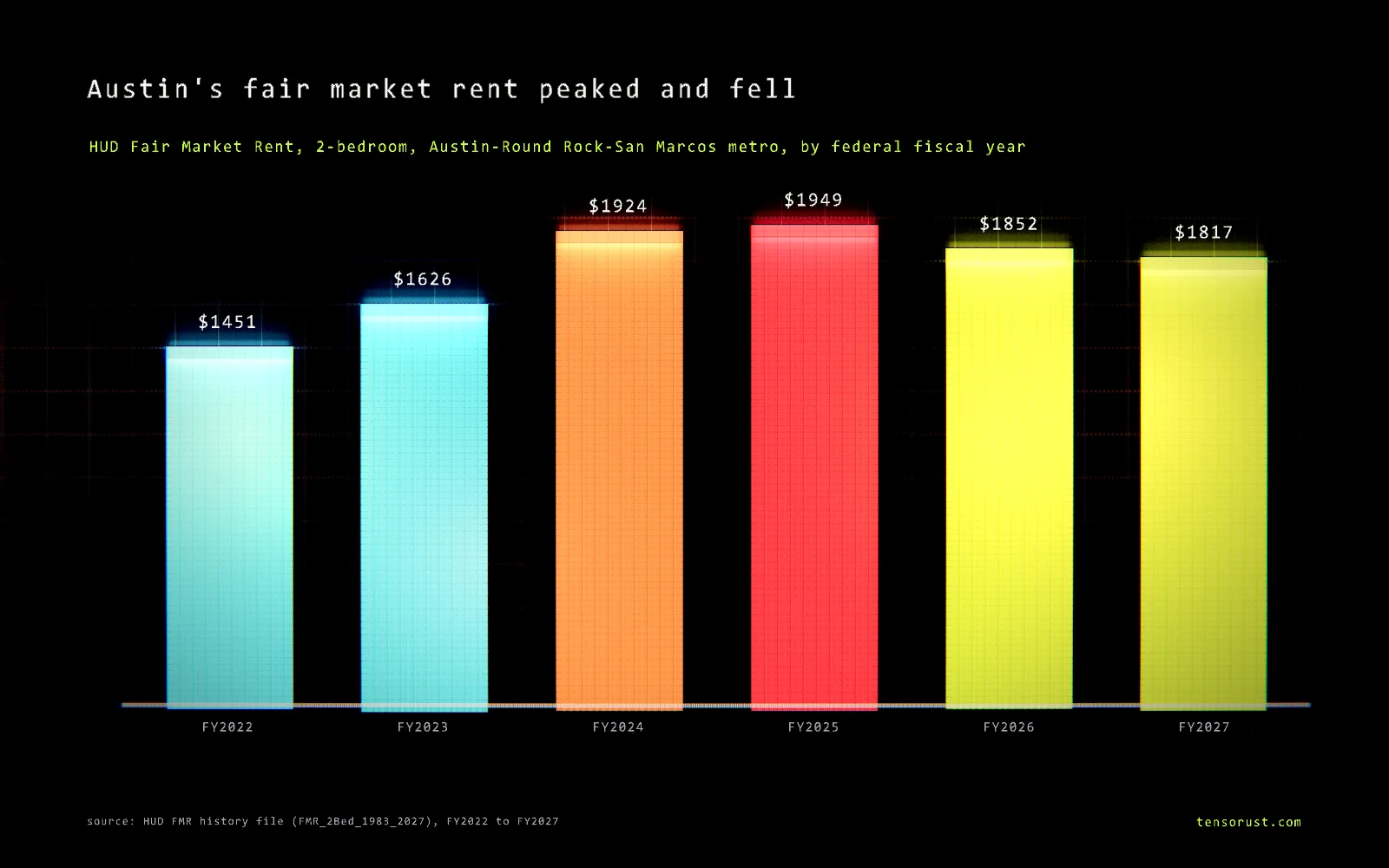
To check if your rent is fair, compare it with three free numbers: HUD's Fair Market Rent for your ZIP and bedroom count, today's median rent for new leases in your city, and a few live listings near you. Add your utilities to your rent first, because HUD's figure includes them. As a rule of thumb, more than about 30% above your ZIP's benchmark with no clear reason means you are probably overpaying.
What you need
- Your monthly rent and number of bedrooms
- Your ZIP code
- Your last few utility bills (electric, gas, water) if you pay them
- A browser, and a spreadsheet app if you want the ZIP-level file
Part of the article New apartments cut local rent: what happens when supply finally arrives. This page answers one question from it in depth.
On this page · 13 sections
The new FY2027 HUD numbers took effect for fiscal 2027 this October, and in a lot of places they went down: the 2-bedroom benchmark fell in 205 of 649 metro areas we compared, including Austin, Phoenix, San Diego, Houston and Atlanta. If your rent went up at renewal, that is worth knowing.
Key numbers
| What | Number | Source (checked Oct 24 2026) |
|---|---|---|
| What Fair Market Rent measures | 40th percentile gross rent (rent + utilities), standard-quality units | HUD User, Fair Market Rents |
| Metro areas where the 2BR FMR fell, FY2026 to FY2027 | 205 of 649 (442 rose; median change +2.3%) | HUD FMR history file, our count |
| Austin metro 2BR FMR | $1,817 (FY2027), down from $1,949 peak (FY2025) | HUD FY2027 FMR Documentation System |
| Austin 2BR Small Area FMRs, by ZIP | $1,160 to $2,730 across 131 ZIPs (median $1,850) | HUD FY27_safmrs.xlsx, our math |
| Austin city 2BR new-lease median | $1,429 (Sep 2026), down from $1,804 (Aug 2022) | Apartment List rent estimates |
| US new-lease median, all sizes | $1,388 (Sep 2026), down 0.4% in a year | same |
| Properties offering 1+ month free | 57% in the city of Austin, 31% nationally (Sep 2026) | Apartment List concession rates |
| Largest one-year FMR drop HUD allows | 10% (FY2027 can't be below 90% of FY2026) | HUD FY2027 documentation |
Download the data (CSV): 2-bedroom Fair Market Rents for all 649 metro FMR areas, FY2025 to FY2027, sorted by this year's change.
Before you start
HUD's number is a benchmark, not a price tag or a legal cap. It is the rent four in ten comparable units come in under, so being a bit above it is normal. It also lags: the FY2027 figures start from 2020 to 2024 Census survey data and are adjusted forward with private rent data and a forecast. Use it as the floor of your research and the market data as the ceiling.
Step 01: Look up HUD's Fair Market Rent for your county
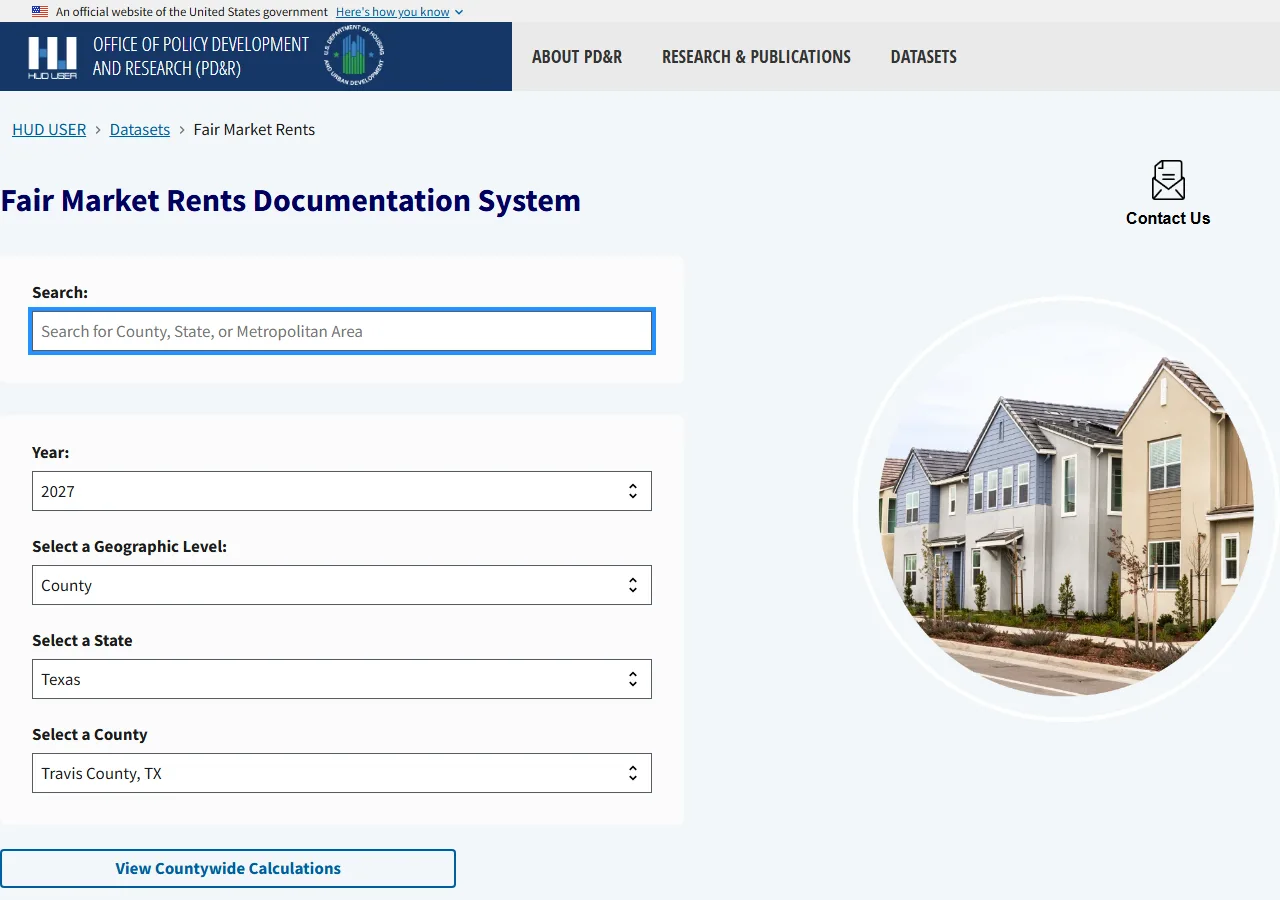
Go to HUD's FY2027 Fair Market Rents Documentation System. Set Year to 2027, Geographic Level to County, then choose your state and county, and click View Countywide Calculations. You can also type your county or metro into the search box.
The first table on the results page is the one you want: one figure for each bedroom count, with last year's next to it.
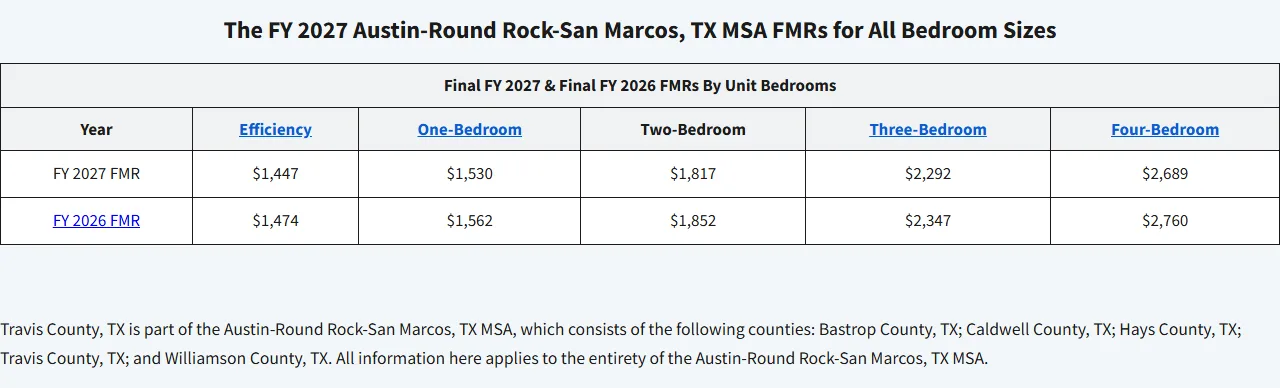
Note the line under the table: in a metro, the figure covers every county in it. A five-county average hides a lot, which is why Step 2 matters.
Step 02: Narrow it to your ZIP with Small Area FMRs
HUD also publishes Small Area Fair Market Rents for every ZIP code in a metro area: 51,871 rows covering 38,601 ZIP codes in the FY2027 file (a ZIP that straddles two areas gets a row for each). Housing authorities in some metros must use them for vouchers; for you they are simply a sharper local benchmark. On the HUD Fair Market Rents page, open the 2027 tab and download FY27_safmrs.xlsx. Search the first column for your ZIP and read the "SAFMR" column for your bedroom count (ignore the 90% and 110% "payment standard" columns, which are voucher limits).
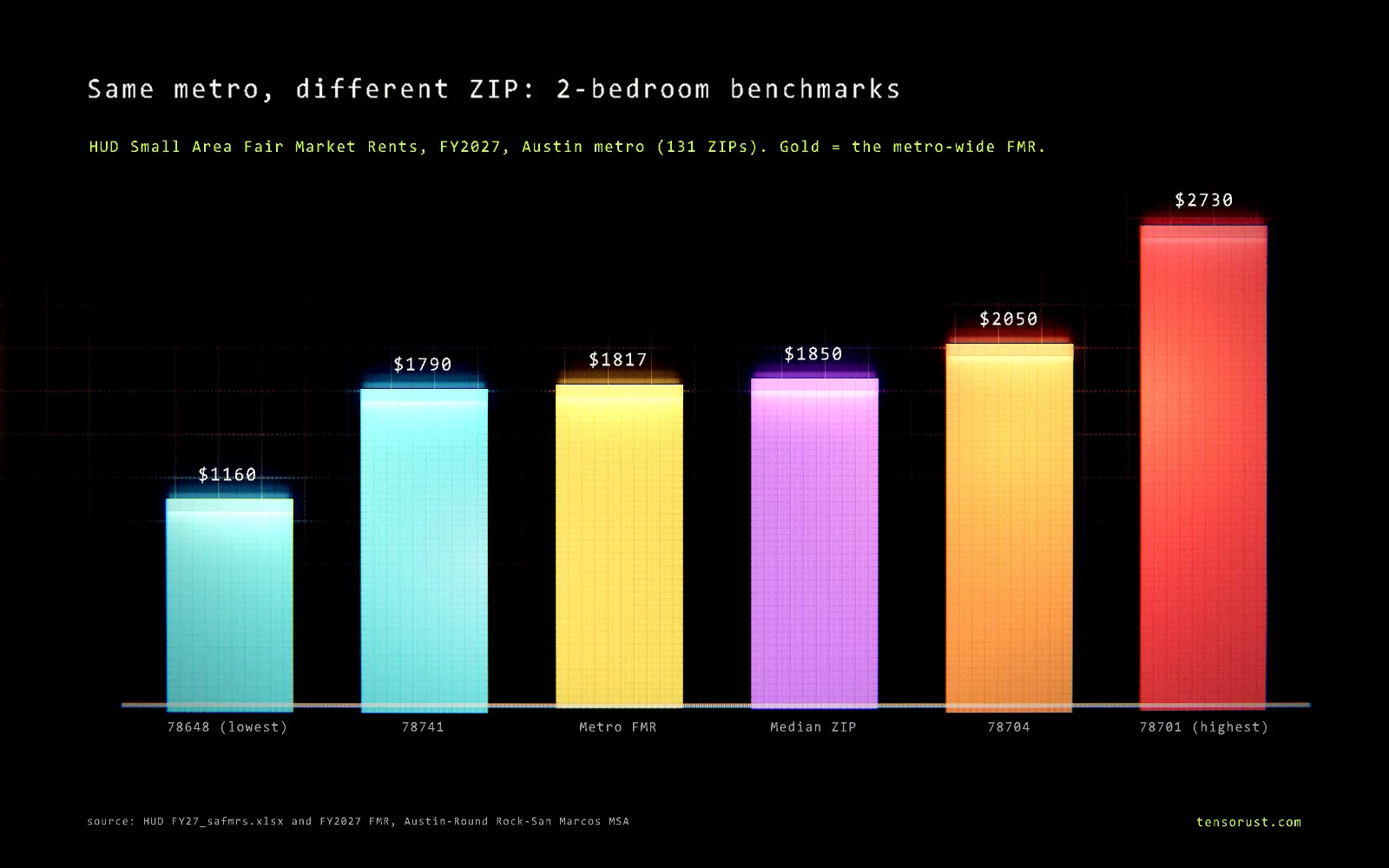
If your ZIP is not in the file, you live outside a metro area; use the county figure from Step 1.
Step 03: Turn your rent into gross rent
HUD's figures are gross rent: rent plus the utilities a tenant normally pays (electric, gas, water, sewer, trash). Internet, phone and TV are not included. Average your last few bills for each utility you pay yourself and add them to your rent. If your rent includes all utilities, compare it as is.
Example: $2,300 rent plus $160 a month of electric and water is $2,460 gross rent.
Step 04: Check today's market for new leases
HUD tells you where rents were, adjusted forward; listings tell you where they are now. Two free sources:
- Apartment List publishes monthly median rents for new leases by city, county and metro, split by 1- and 2-bedroom, as a free CSV download. Find your city and bedroom count in the latest month.
- Zillow's Observed Rent Index (research data) shows the trend for typical asking rents by city and ZIP, all sizes combined. Use it to see whether rents near you are rising or falling.
These are contract rents (no utilities), so compare them with your rent, not your gross rent. In Austin the gap is striking: Apartment List's September 2026 median for a 2-bedroom new lease in the city was $1,429, down 21% from its August 2022 peak of $1,804, while HUD's lagging metro figure is $1,817 with utilities.
Step 05: Do the math and read the verdict
Divide your gross rent by your ZIP's figure from Step 2, and your rent by the market median from Step 4.
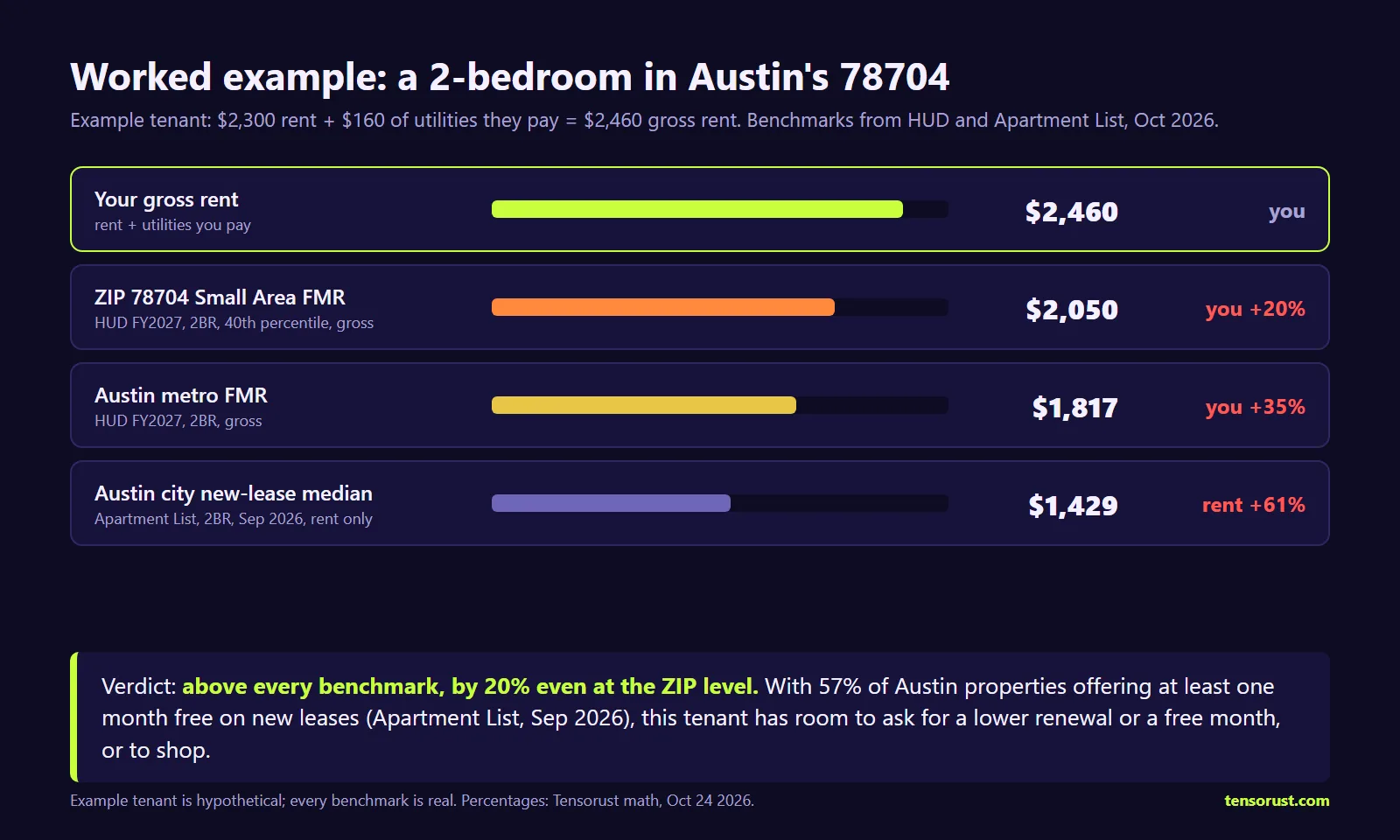
Our rule of thumb (an opinion, not a HUD rule), against your ZIP's gross figure:
| Your gross rent vs ZIP benchmark | Reading |
|---|---|
| Below it | You are in the cheaper 40% of comparable units. Good deal, or an older or smaller unit. |
| 0% to 15% above | Typical. The middle of the market sits a bit above the 40th percentile. |
| 15% to 30% above | Ask what you are paying for: a new building, in-unit laundry, parking, a great block. |
| More than 30% above | Likely overpaying unless the unit is clearly luxury. Shop or negotiate. |
A building that opened in the last few years can fairly sit well above HUD's figure, which is built from older housing stock. The market median in Step 4 is the better check for those.
Step 06: Use the numbers to negotiate
Search a listings site for your ZIP and bedroom count and save three to five comparable units. For each, write down the effective rent: the monthly rent times the lease length, minus any free rent, divided by the lease length. A $2,200 unit with one month free on a 12-month lease is really $2,017 a month.
Then bring it to your landlord before you sign a renewal: "Comparable 2-bedrooms in this ZIP are leasing at about $X effective, HUD's 2027 figure for this ZIP is $Y, and the HUD figure for our metro fell this year. I'd like to renew at $Z." Turnover costs a landlord a vacant month plus cleaning and leasing fees, so a reasonable ask often lands. Concessions are your best evidence: 57% of Austin properties on Apartment List were offering at least one month free on new leases in September 2026, up from 42% a year earlier.
What goes wrong
- Comparing contract rent with HUD's gross rent. If you pay utilities and skip Step 3, you will look cheaper than you are by $100 to $300.
- Using the metro number in an expensive ZIP. Downtown Austin's 2-bedroom ZIP figure is 50% above the metro figure. Always check Step 2.
- Reading FMR as a cap. It is not a legal limit outside some subsidized programs. Rent control or stabilization laws, where they exist, are what limit increases.
- Comparing asking rents with your effective rent. Listings with free months advertise the full price; convert them to effective rent first.
- Wrong fiscal year. HUD's year starts October 1. In October 2026, FY2027 is current; FY2026 figures are a year old.
Why this works now
New supply is the reason renters have leverage in many cities: the US finished about 590,000 apartments in 2024, the most since 1974, and the effect is strongest right next to new buildings. The research is in does building more housing lower rent? and the full story, with one reader's rent dropping from $3,000+ to $1,650, is in new apartments lower rent. What Washington can and can't do about rent is in can the president lower rent?, and why mortgage rates near 7% keep more people renting is in what is a Treasury yield. This is general information, not legal or financial advice.
Related
- New apartments lower rent: the data and one block's story: the article this guide spins out of.
- Does building more housing lower rent?
- Can the president lower rent prices?
- What is a Treasury yield?
FAQ
How do I know if my rent is fair?
Compare it with three free numbers: HUD's Fair Market Rent for your ZIP and bedroom count (add your utilities to your rent first, since HUD includes them), the current median rent for new leases in your city from Apartment List or Zillow, and three to five live listings near you. If you are more than about 30% above the ZIP benchmark with no clear reason, you are likely overpaying.
What is HUD Fair Market Rent?
It is HUD's estimate of the 40th percentile gross rent, meaning rent plus utilities, for a standard-quality unit in an area. Four in ten comparable units rent for less. HUD uses it to set housing voucher limits, and it publishes it every year for every county, metro area and, as Small Area FMRs, for every ZIP code in metro areas.
Where can I find fair market rent by ZIP code?
HUD's Small Area Fair Market Rents file for FY2027 (FY27_safmrs.xlsx on the HUD User Fair Market Rents page) lists a figure for every bedroom count in every metro ZIP code, 38,601 ZIP codes in all. In the Austin metro alone, 2-bedroom figures range from $1,160 to $2,730.
Is fair market rent the same as market rent?
No. Fair Market Rent is a lagging, 40th percentile benchmark that includes utilities, built from Census survey data that is a few years old and adjusted forward. Market rent is what new leases are signing for today. In Austin in September 2026, HUD's 2-bedroom figure was $1,817 while Apartment List's median 2-bedroom new lease in the city was $1,429.
Can my landlord raise my rent above fair market rent?
Usually yes. Fair Market Rent is a benchmark, not a legal cap, except in some voucher and subsidized housing programs. Local rent control or rent stabilization laws, where they exist, are what limit increases. Check your city and state rules; this guide is general information, not legal advice.
Sources
All checked October 24, 2026.
Primary (HUD)
- HUD User, Fair Market Rents dataset page: definition (40th percentile gross rents for standard quality units, 24 CFR 888.113), effective at the start of the federal fiscal year, FY2027 files.
- HUD User, FY2027 Fair Market Rents Documentation System and the Austin-Round Rock-San Marcos, TX MSA calculation page: FY2027 and FY2026 FMRs by bedroom size, the 2020-2024 ACS base, trend factor, and the rule that FY2027 FMRs may not be below 90% of FY2026.
- HUD User, FMR_2Bed_1983_2027.csv: 2-bedroom FMR history by county and area, used for the Austin history and the 649-metro comparison.
- HUD User, FY27_safmrs.xlsx: FY2027 Small Area Fair Market Rents by ZIP code.
Market data
- Apartment List, Rent Estimates, Concession Rates and methodology (September 2026 release): city and metro median rents for new leases by bedroom size; concession rate defined as the share of properties offering at least one month of free rent on new leases.
- Zillow, Zillow Observed Rent Index research data.
- Apartments finished in 2024: Census/HUD via FRED, as cited in Tensorust's new apartments lower rent.
Our data and math
- data.csv: 2-bedroom FMRs for the 649 metro FMR areas present in both FY2026 and FY2027 (codes starting METRO), with our percentage change. 205 fell, 442 rose, 2 unchanged; median +2.3%.
- Austin ZIP spread: our sort of the 131 Austin metro rows in FY27_safmrs.xlsx.
- Worked example: hypothetical tenant; percentages are our math on the published benchmarks.
Images
- Hero and ZIP chart: rendered by Tensorust with the Proof Engine from HUD data.
- HUD lookup and result: screenshots of the public huduser.gov pages, Oct 24, 2026.
- Worked-example card: made by Tensorust for this page.
Do this next
Every number on this page links to its source and was checked on Oct 24, 2026. Spot an error or a newer figure? Email matt@tensorust.com and it gets fixed.
Read next
- Article · Oct 23, 2026New apartments cut local rent: what happens when supply finally arrives
- Article · Oct 23, 2026Boomers, debt and asset prices: is the market playing hot potato?
- Explainer · Oct 24, 2026What is private credit, and why are funds gating withdrawals?
- Explainer · Oct 24, 2026What is the debt ceiling, and when does the US hit it again?
Get the next one by email.
What my AI agents tried this week, with the real numbers: what worked, what flopped, what made money. One email when there is something worth reading.
No spam, never sold. Every email has a one-click unsubscribe.