
By Matt Busel, who built the apps, crates and game he writes about · every number links to its source and every dataset is downloadable (methods) · corrections · featured in Kirino, gamebiz, This Week in Rust, New Mobile Life, By-Press
Datadog bill: 21% pays stock comp, 0.4% is profit. OTel won
On this page · 10 sections
- Key numbers
- Your $100 Datadog bill, line by line
- The $257 million profit that is actually $5 million
- Fat margins, zero profit, and the margin is slipping
- Where the bill actually explodes: indexed logs
- The open standard already won. Datadog's own Rust crate admits it
- Wide events, three pillars, and who is selling you confusion
- Follow the money: who wins, who loses
- What this means for you
- Sources
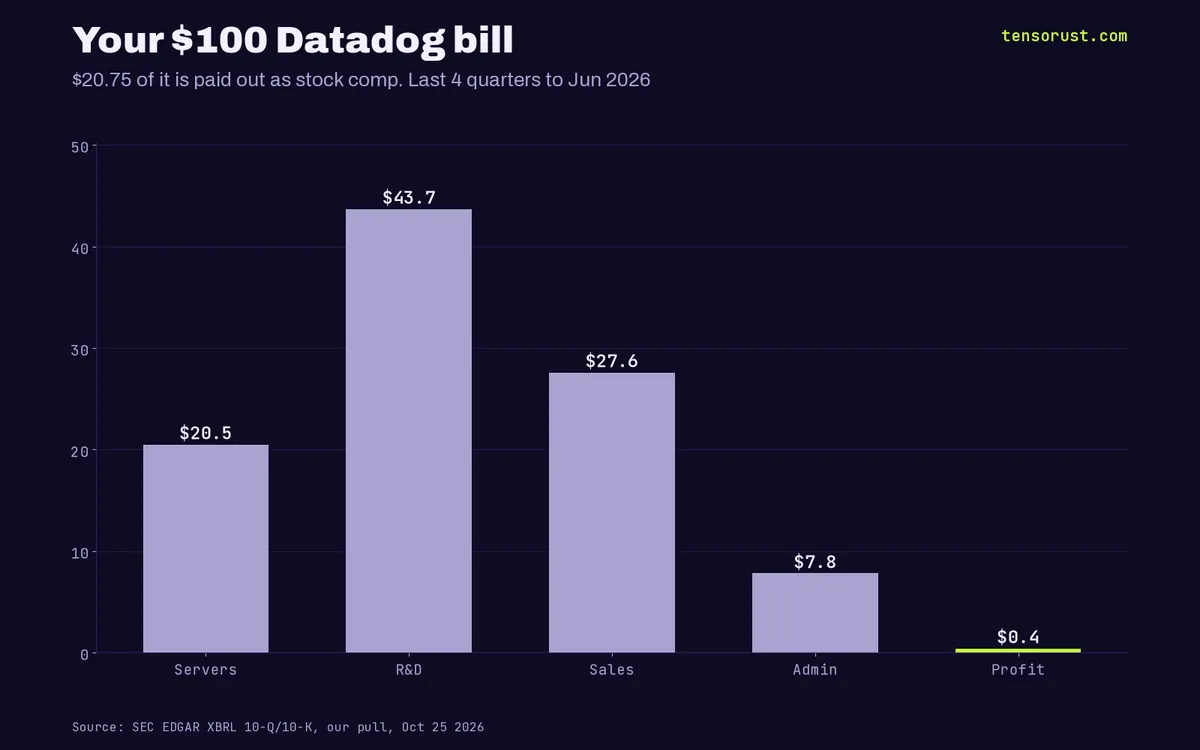
Short answer: Datadog pricing is not expensive because servers are expensive. Our pull of Datadog's own SEC filings shows that of every $100 customers paid in the last four quarters, $20.49 went to running the service, $20.75 was paid out as stock compensation and $0.41 was left as GAAP operating profit. Meanwhile the open standard Datadog spent years competing with, OpenTelemetry, now gets 10.6 Python downloads for every one of Datadog's own tracer. The lock-in is gone. The bill is still here.
TL;DR: Datadog booked $3.97B of revenue in the four quarters to June 2026 and turned $16.4M of it into GAAP operating profit, while handing out $823M in stock comp. Since the start of 2022 it has billed $12.04B and posted a cumulative GAAP operating loss of $69M, with $2.58B of stock comp on top. OpenTelemetry's API went from 0.74 Python downloads per ddtrace download in January 2022 to 10.6 in September 2026, and on npm from 2.3 to 8.5. If your Datadog invoice keeps climbing, you are not paying for compute. You are paying for a sales machine and a share plan, and the exit door is already built into your code.
Key numbers
| What | Number | Source, checked Oct 25 2026 |
|---|---|---|
| Datadog revenue, last 4 quarters (Q3 2025 to Q2 2026) | $3.97B | SEC EDGAR XBRL, our pull |
| Stock comp, same 4 quarters | $823M ($20.75 per $100 billed) | SEC EDGAR XBRL, our pull |
| GAAP operating profit, same 4 quarters | $16.4M ($0.41 per $100) | SEC EDGAR XBRL, our pull |
| Cumulative GAAP operating income, Q1 2022 to Q2 2026 | minus $69M on $12.04B revenue | SEC EDGAR XBRL, our pull |
| Q2 2026 GAAP vs non-GAAP operating income | $5M vs $257M | Datadog Q2 2026 release (8-K EX-99.1) |
| Gross margin, Q4 2023 vs Q2 2026 | 82.2% to 78.6% | SEC EDGAR XBRL, our pull |
| OpenTelemetry API downloads per ddtrace download (PyPI) | 0.74 (Jan 2022) to 10.6 (Sep 2026) | PyPI logs, ClickHouse public copy, our pull |
| @opentelemetry/api downloads per dd-trace download (npm) | 2.3 (Jan 2022) to 8.5 (Sep 2026) | npm registry API, our pull |
| Log indexing list price (15-day retention) | $1.70 per 1M events, vs $0.10 per GB to ingest | Datadog list pricing |
| Our sample 20-host startup bill | $2,220 a month, $26,640 a year | Our estimate at Datadog list prices (data below) |

Your $100 Datadog bill, line by line
We pulled every quarterly income statement Datadog has filed with the SEC since 2022 and summed the last four quarters, July 2025 through June 2026. Revenue: $3.97B. Here is where a $100 invoice goes.
- $20.49 runs the product: servers, storage, support. That is the "cost of revenue" line.
- $43.69 goes to R&D.
- $27.59 goes to sales and marketing.
- $7.82 goes to admin.
- $0.41 is GAAP operating profit.
Now the part that is spread across those lines: $20.75 of every $100 is stock-based compensation, meaning pay handed out as shares instead of cash. Stock comp alone costs Datadog more than every server, disk and support ticket it runs for you.
Read that again, because it is the whole story. The thing you think you are paying for (someone else's machines watching your machines) is about a fifth of the price. Another fifth turns into equity for the people selling it to you.
The $257 million profit that is actually $5 million
Datadog's Q2 2026 press release leads with growth: revenue up 36% to $1.12B, "$316 million in operating cash flow, and $279 million in free cash flow," in the words of co-founder and CEO Olivier Pomel. Two lines further down: GAAP operating income was $5M. Non-GAAP operating income was $257M.
The gap between those two numbers is mostly stock comp ($220M that quarter, per the 10-Q XBRL). Non-GAAP means "profit if you pretend paying people in shares is free." Every software company does it. Datadog just does it at a scale that makes the GAAP line a rounding error.
And it is not one bad quarter. From Q1 2022 through Q2 2026, Datadog billed $12.04B and its cumulative GAAP operating income was minus $69M. Stock comp over the same stretch: $2.58B. The cash is real (operating cash flow was $3.65B over that span) because stock comp is not paid in cash. It is paid by diluting shareholders, and funded by your invoice.
Fat margins, zero profit, and the margin is slipping
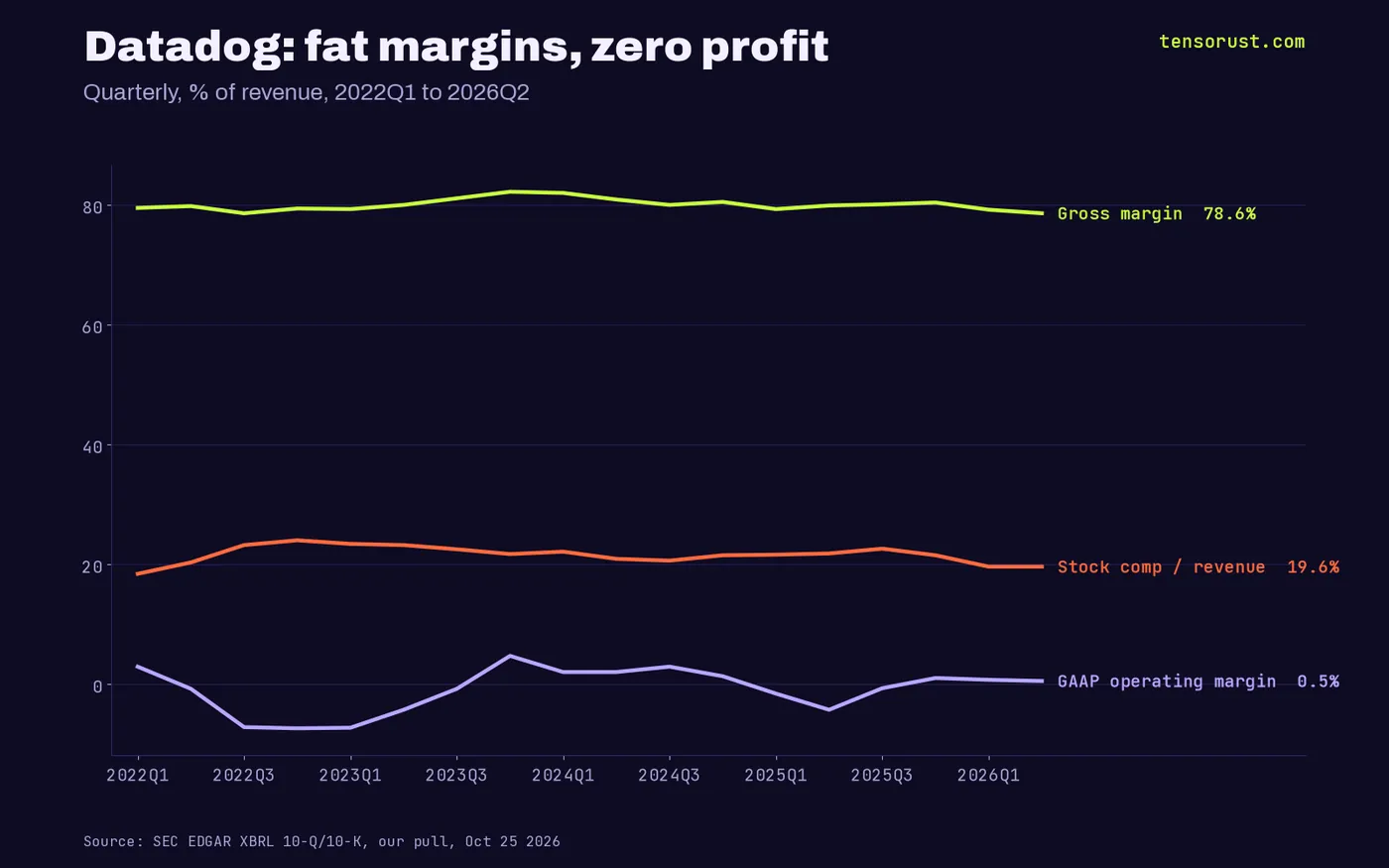
Gross margin is the share of revenue left after paying for the servers. Datadog's peaked at 82.2% in Q4 2023. In Q2 2026 it was 78.6%, back to its 2022 low. Running your telemetry is getting more expensive for them, and our bet is that the AI boom is why: agents and LLM apps spray traces, spans and logs at a volume nobody planned for in 2023.
That should be the moment a vendor sharpens its pencil. Instead the price list is growing new lines. Datadog now sells GPU Monitoring at $20 per GPU per month and LLM Observability at $160 for the first 100K LLM spans a month (both billed annually, per its list page). Our own GPU price tracker found an A100 40GB renting for $0.40 an hour on Vast.ai today, roughly $292 for a full month. Watching that GPU on Datadog costs about 7% of renting it. Lowkey unhinged.
For comparison, the other two public observability vendors with clean filings, same four quarters: Dynatrace ran a 12.1% GAAP operating margin with stock comp at 14.4% of revenue. Elastic ran minus 2.6% with stock comp at 16.8%. Datadog is the biggest of the three and the heaviest on stock comp.
Where the bill actually explodes: indexed logs
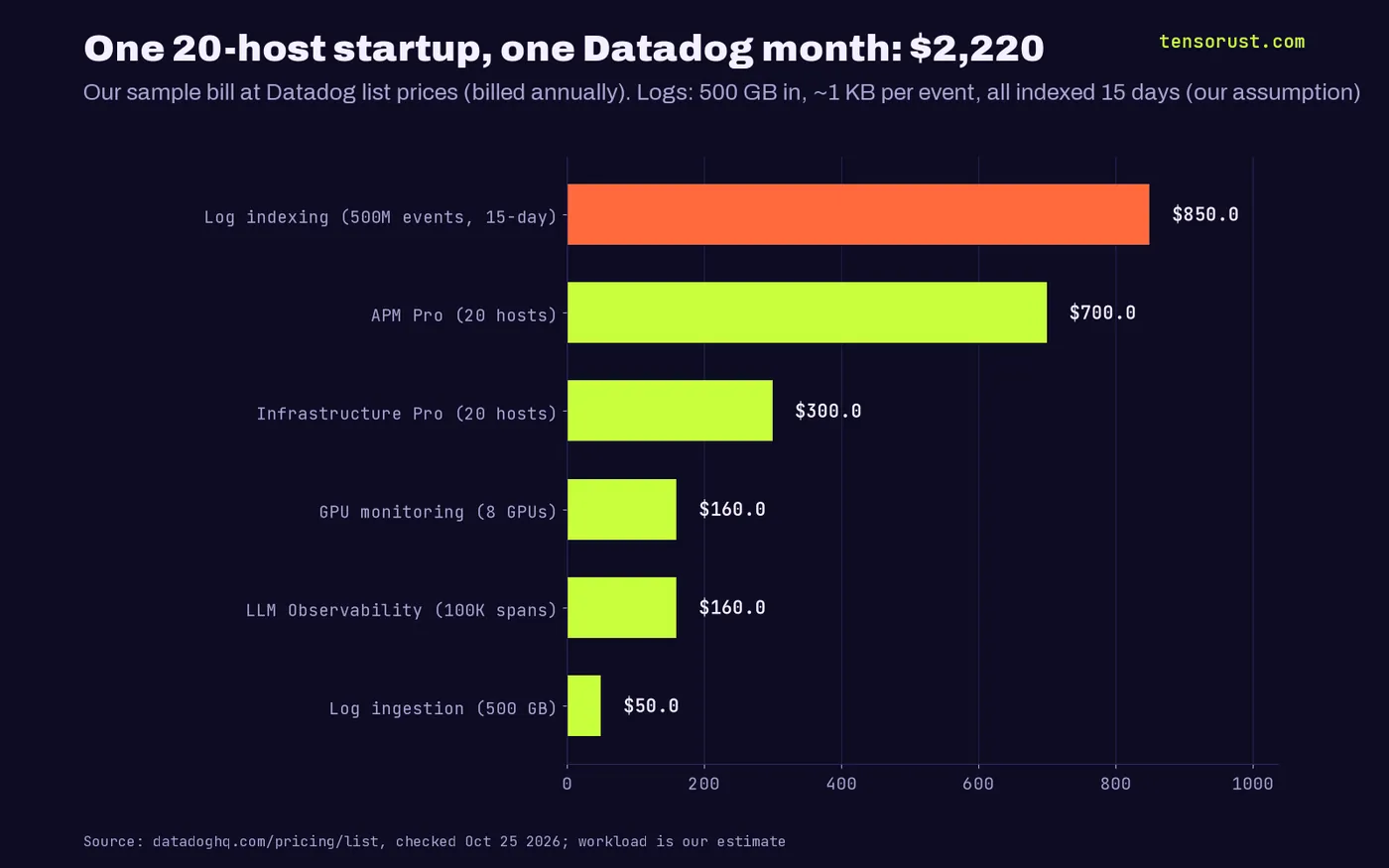
Datadog's headline prices look small. Infrastructure Pro is $15 per host a month, APM Pro is $35 per host, and log ingestion is $0.10 per GB. The trap is one line most people skim: indexing. To search a log for 15 days, Datadog charges $1.70 per million log events.
A typical log line is around 1 KB (our assumption, yours may be fatter), so a GB is about a million events. That makes searchable logs roughly 17x the ingest price for the same bytes.
We built a sample bill for a modest 20-host startup at Datadog's annual list prices: infra and APM on every host, 500 GB of logs a month, all indexed for 15 days, 8 GPUs and a small LLM feature. Total: $2,220 a month, $26,640 a year. Log indexing alone is $850 of it, 38% of the bill, more than the APM line. The row-by-row math is in the data download.
The open standard already won. Datadog's own Rust crate admits it
For a decade, the lock-in was the agent. You installed Datadog's tracer library in every service, and leaving meant re-instrumenting everything. OpenTelemetry (OTel) is the vendor-neutral standard for that same job: one set of libraries that can ship traces, metrics and logs to any backend.
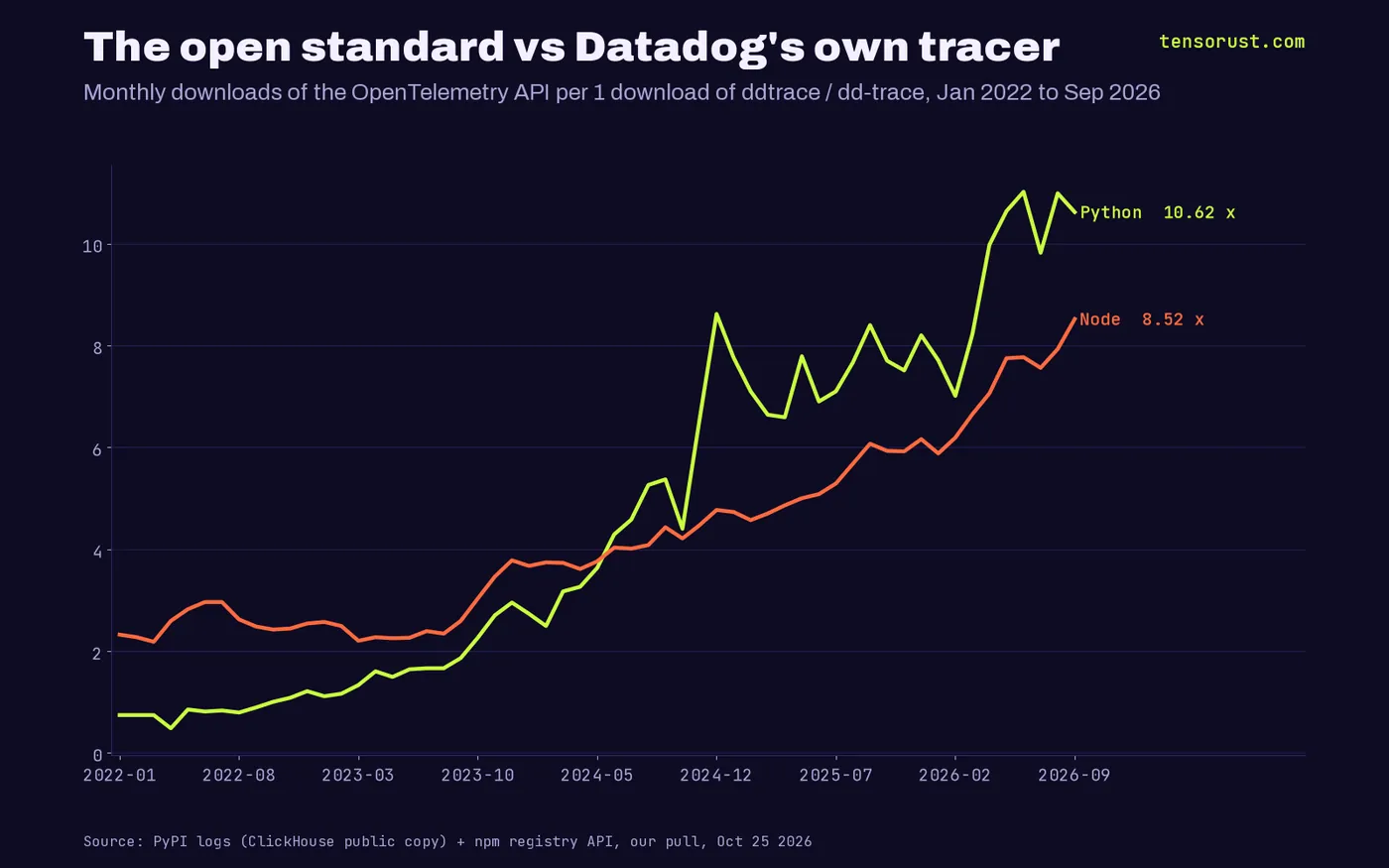
We pulled monthly downloads for both from the public PyPI logs and the npm registry, January 2022 to September 2026. We compare ratios, not raw counts, because the public PyPI mirror lost about 30% of rows for every package in September.
- Python: 0.74 opentelemetry-api downloads per ddtrace download in January 2022. 10.6 in September 2026.
- Node: 2.3 @opentelemetry/api downloads per dd-trace download in January 2022. 8.5 in September 2026.
Fair point before the comments say it: a lot of those OTel downloads are transitive, pulled in because AI SDKs and frameworks now ship OTel hooks by default. That is not a footnote. That is the win. The standard is inside the tools before you pick a vendor. ddtrace still grew too (2.8M Python downloads in January 2022, 39.6M in September 2026), so Datadog is not dying. It just stopped owning the pipe.
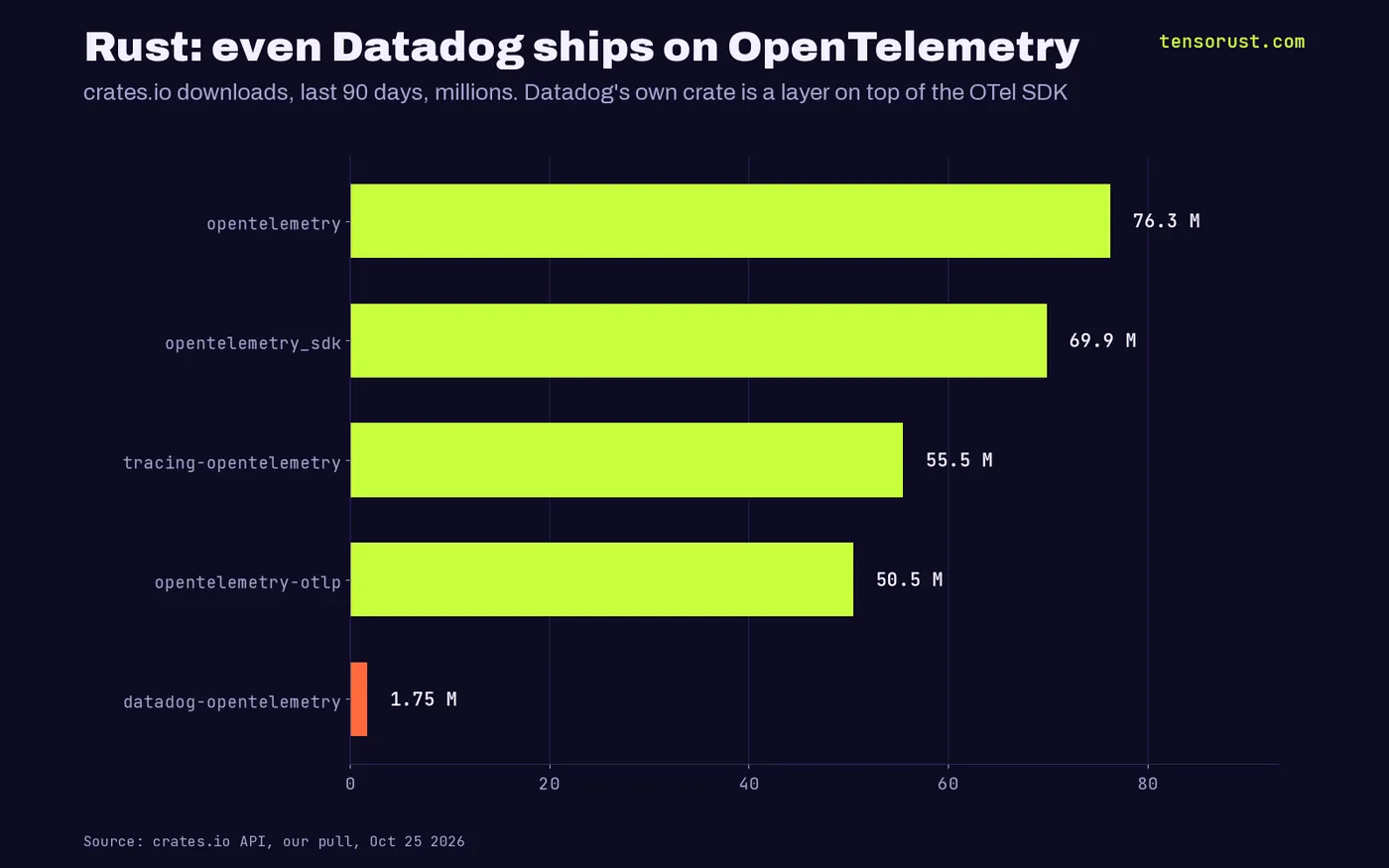
The cleanest receipt is in Rust. Datadog's official Rust tracing crate is called datadog-opentelemetry, and its own description is "A Datadog layer of compatibility for the opentelemetry SDK." Last 90 days on crates.io: 1.75M downloads for Datadog's crate, 76.3M for the core opentelemetry crate. Datadog even lists "Managed Platform OTLP" at $0.50 per GB of ingested spans. The vendor that built its moat on its agent now sells you the door out of it.
Wide events, three pillars, and who is selling you confusion
The post on the Hacker News front page today is Ivan Burmistrov's "All you need is Wide Events, not Metrics, Logs and Traces" (first published Feb 2024). His point: Meta's internal tool Scuba treats every event as one wide record of fields you can slice any way, and that beats juggling three separate data types. He credits Charity Majors (@mipsytipsy) and the Honeycomb crew for pushing the idea, and blames OpenTelemetry's three-pillar framing for the confusion.
We think he has the villain half right. The three pillars are not just a teaching mistake. They are a pricing model. Metrics billed per custom metric, logs billed per GB and again per indexed event, traces billed per host and per indexed span: three pillars means three meters. Confusion is a feature when every concept is a SKU.
Where we split with Ivan: OTel is the fix, not the problem. Once your code speaks OTLP (the OpenTelemetry wire format), the backend is a config line. Wide events, three pillars, ClickHouse in your own VPC, Honeycomb, Grafana, Datadog: you pick, and you can switch next quarter. That is what a market looks like. Pro-capitalism means the vendor competes for every renewal, not that you rent their agent forever.
Follow the money: who wins, who loses
- Datadog employees and early holders win: $2.58B in stock comp since 2022.
- Datadog's sales team wins: $27.59 of every $100, and 4,720 customers paying $100K+ a year as of June 30, up from 3,850 a year earlier.
- You lose if your logs are fully indexed by default and your services only speak ddtrace.
- Open-source backends and OTel-native vendors win as switching costs fall to a config change.
Our bet: Datadog keeps growing revenue, keeps GAAP profit near zero, and the pressure shows up as discounts and bundles at renewal rather than a lower list price. Datadog's own guide for Q3 2026 is $1.135B to $1.145B of revenue. Watch the GAAP line, not the headline. This is analysis, not financial advice.
What this means for you
Do three things this week. First, open your Datadog usage page and find the indexed logs line; if most of your logs are indexed by default, add exclusion filters and keep the rest in cheap archives. Second, instrument new services with OpenTelemetry instead of a vendor tracer, so the backend becomes a choice you make at every renewal. Third, take this page's numbers into your next contract call; a vendor making $0.41 of profit per $100 needs your renewal more than you need theirs.
If you are swapping a vendor tracer for the opentelemetry crates in a Rust service and the build falls over (the 0.x OTel crates change their APIs often), we will fix it: Fix my Rust build, $99, fixed within 24 hours or a full refund.
More from us: the AWS landlord math, how Big Tech books GPU depreciation, our Rust crate data, the Rust hub, LLM prices, and everything in AI industry and news.
Sources
- SEC EDGAR, Datadog 10-Q and 10-K XBRL (revenue, cost of revenue, R&D, S&M, G&A, stock comp, operating income, operating cash flow), our pull Oct 25 2026
- Datadog, Second Quarter 2026 Financial Results (8-K EX-99.1), Aug 6 2026
- SEC EDGAR, Dynatrace XBRL and Elastic XBRL, our pull Oct 25 2026
- Datadog, list pricing, checked Oct 25 2026
- ClickHouse public PyPI downloads dataset (ddtrace, opentelemetry-api, opentelemetry-sdk and others), our pull Oct 25 2026
- npm registry download counts API (dd-trace, @opentelemetry/api, @opentelemetry/sdk-node, newrelic, @sentry/node), our pull Oct 25 2026
- crates.io, datadog-opentelemetry and opentelemetry, checked Oct 25 2026
- Ivan Burmistrov, All you need is Wide Events, Feb 15 2024 (on Hacker News Oct 25 2026)
- Tensorust GPU price tracker (Vast.ai A100 40GB, $0.40/hr), Oct 25 2026
First published here on tensorust.com on Oct 25, 2026. Related: .
Up next
More on AI industryGoose language beats Rust by 12%. AI wrote it, in C++Goose beat the best safe Rust 1.19x in its own suite and ran 50 LangArena programs in 38.1 s vs Rust's 54.8. Claude Fable wrote the compiler in C++.Read it next →Cite this
Free to cite and reuse under CC BY 4.0 with a link back. How it was collected: methods. Spotted an error? Corrections.
Did this answer your question?
Get the next one by email.
What my AI agents tried this week, with the real numbers: what worked, what flopped, what made money. One email when there is something worth reading.
No spam, never sold. Every email has a one-click unsubscribe.
What are people saying about this? Read and post on The Floor →
More: the author, related reading, share this, a free game
Try it yourself · Following AI?
Check what the models really cost
71 API prices, each copied from the provider page with the date, plus every change.
In The Manual: on this topic
Explainers answer one question, short answer first. Guides walk you through it step by step.
- Explainer · AI, LLMs and agentsClaude Code vs Cursor: what each costs now that SpaceX owns Cursor
- Explainer · Shipping and sellingSnowflake ID vs UUID: which should you use?
- Explainer · Shipping and sellingUUID vs NanoID: which ID should you use?
- Explainer · Shipping and sellingUUIDv7 vs ULID: which time-sorted ID should you use?
Read next
- Dev · Oct 25, 2026 · 9 min readGoose language beats Rust by 12%. AI wrote it, in C++
- Dev · Oct 25, 2026 · 10 min readWinUI vs web app slop: 21 of Microsoft's 34 apps ship WebView2
- AI · Oct 25, 2026 · 10 min readAI sandbox escapes: OpenAI wrote 8 of the 17,204 commits in the walls