
By Matt Busel, who built the apps, crates and game he writes about · every number links to its source and every dataset is downloadable (methods) · corrections · featured in Kirino, gamebiz, This Week in Rust, New Mobile Life, By-Press
OpenAI's 80% price cut just undid its own 4x hike. China forced it
On this page · 10 sections
- Key numbers
- The 80% cut is a hike, refunded
- Anthropic actually cut. OpenAI round-tripped
- China cut first, and by 10x
- One tier up, the gap is still 10x
- Follow the money: why open weights win the price fight
- The $2 / $10 line looks a lot like a price floor
- The "subsidized tokens" panic is the wrong fear
- What this means for you
- Sources
Short answer: The LLM price war is real, but OpenAI's part of it is a round trip. We priced every model on OpenRouter as one 10M-token coding-agent session: GPT-6.1 Sol costs $2.56, and GPT-5 cost $2.58 in August 2025. In between, OpenAI raised its flagship to $9.30 a session. The real cutting came from Chinese open-weight labs, who sold Opus-level scores for 38 cents in August while the cheapest US model at that level cost $3.72.
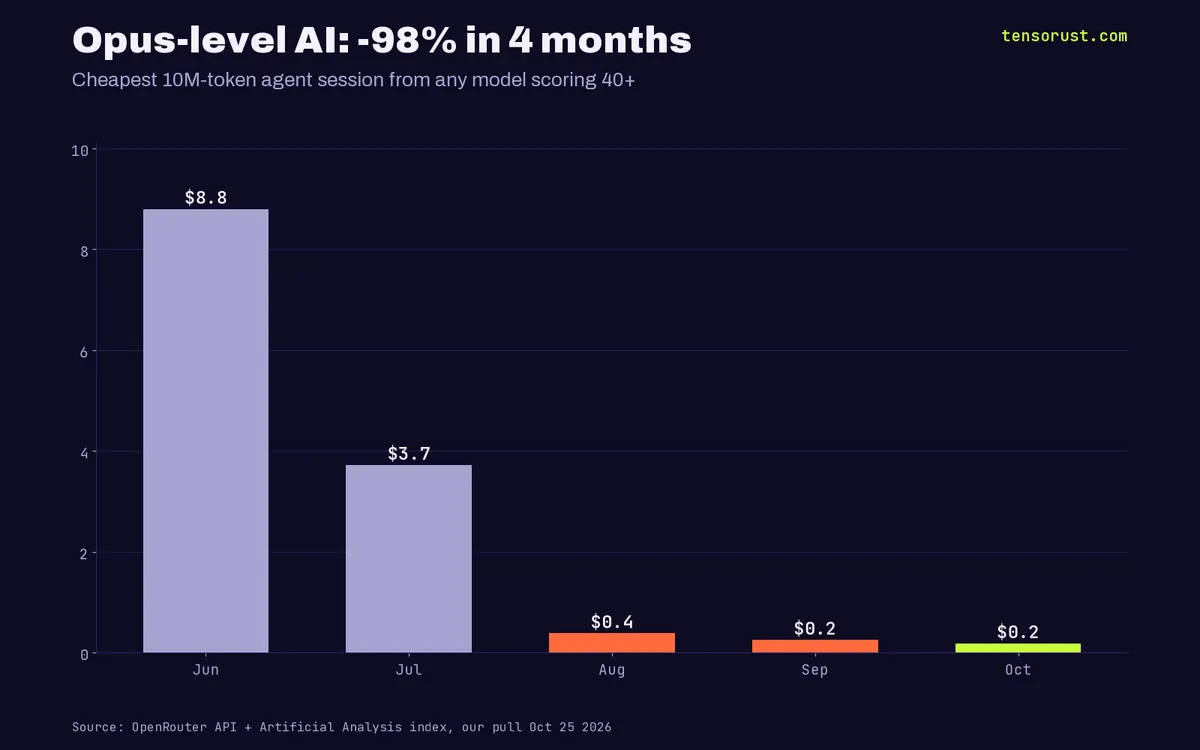
TL;DR: The cheapest agent session from any model scoring 40+ on the Artificial Analysis index fell from $8.80 in June to $0.18 in October, a 98% drop in four months. Chinese labs got there first: Zhipu's GLM-5.3 Flash hit $0.38 in August, almost 10x under the best US price that month, and OpenAI and Anthropic only matched it in October. One tier up, at 45+, China still sells the same score for $0.25 against $2.56, and 37 different companies serve GLM-5.3 while only 3 serve GPT-6.1 Sol. That competition, not generosity, is why your token bill dropped, and it is why the "prices will spike once the subsidy ends" crowd is cooked.
Key numbers
| What | Number | Source, checked Oct 25 2026 |
|---|---|---|
| GPT-5 agent session at launch price (Aug 2025) | $2.58 | OpenRouter models API, our session math |
| GPT-5.5 / GPT-5.6 Sol session at launch price | $9.30 (3.6x GPT-5) | OpenRouter, Max Woolf's price timeline |
| GPT-6.1 Sol session today | $2.56 | OpenRouter models API |
| Cheapest 40+ score session, June vs October | $8.80 to $0.18 (-98%) | OpenRouter prices x Artificial Analysis index, our pull |
| Cheapest 40+ session in August: China vs US | $0.38 vs $3.72 | OpenRouter, our pull |
| Cheapest 45+ session today: China vs US | $0.25 vs $2.56 | OpenRouter, our pull |
| Companies serving GLM-5.3 vs GPT-6.1 Sol | 37 vs 3 | OpenRouter endpoints API |
| OpenRouter listings at exactly $2 in / $10 out | 11 | OpenRouter models API |
| Cheapest / median on-demand H100 hour | $1.99 / $3.99 (38 offers) | Tensorust GPU price tracker |

The 80% cut is a hike, refunded
Max Woolf (@minimaxir) asked the question every builder with an API bill is asking: why did OpenAI and Anthropic cut prices by up to 80% in a few months, right before two IPOs? His timeline is the best one out there, so we took it and put every price on one ruler.
The ruler: one coding-agent session of 10 million tokens. Max notes that cache reads are 96% to 99% of agent spend, so our mix is 9.6M cache-read tokens, 0.3M fresh input and 0.1M output. That mix is our estimate; the prices are the list prices on OpenRouter today, with OpenAI's launch prices swapped in for the two models it later cut.
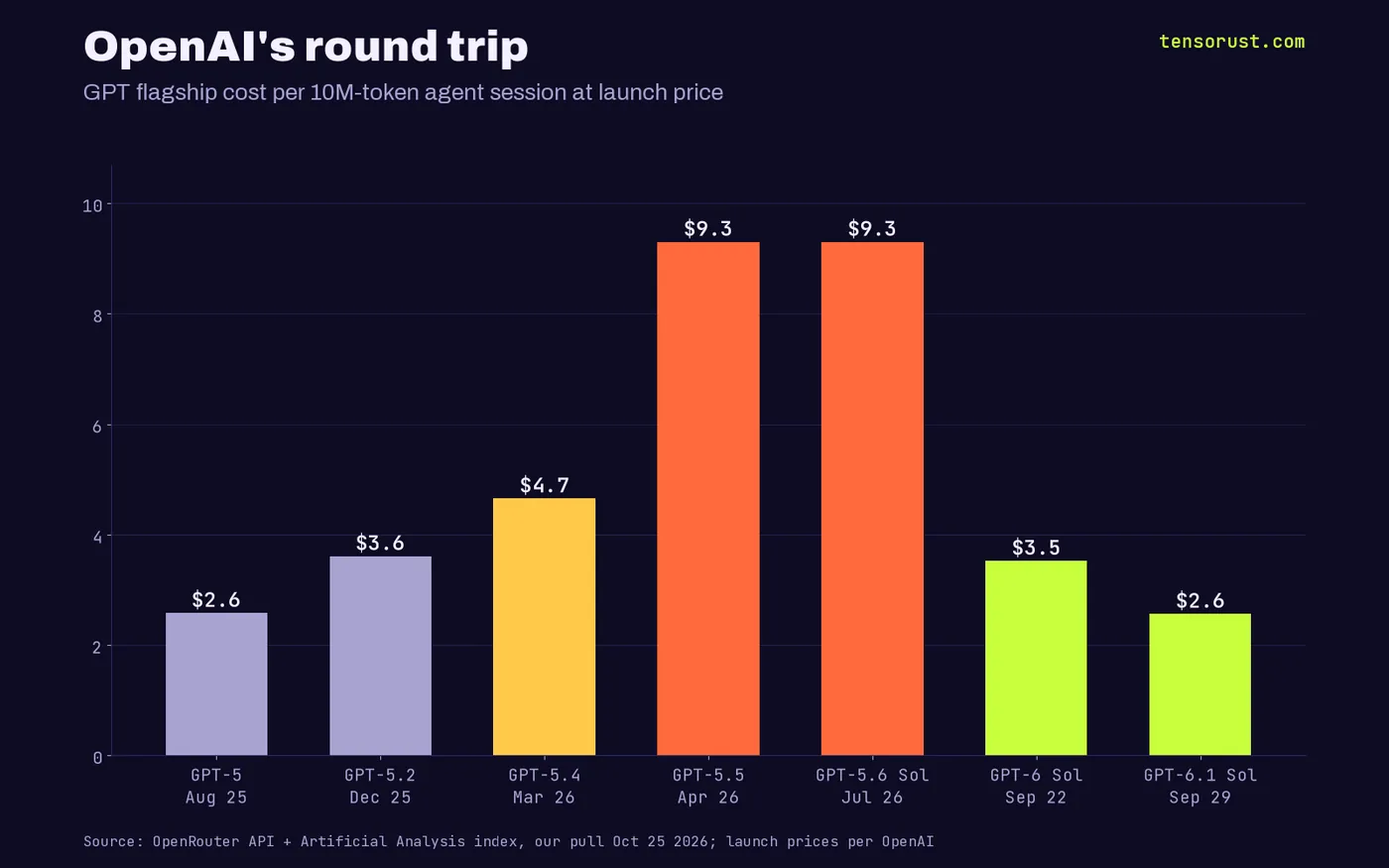
On that ruler, GPT-5 cost $2.58 a session in August 2025. GPT-5.2 went to $3.61, GPT-5.4 to $4.65, and GPT-5.5 in April 2026 jumped to $5 in and $30 out per million tokens: $9.30 a session. GPT-5.6 Sol launched at the same $9.30.
Then came the "massive cuts." GPT-6 Sol landed at $3.52 and GPT-6.1 Sol at $2.56. That is one cent under GPT-5, fourteen months later. The headline cut is real only if you start counting at the top of a hike OpenAI made itself.
The small model tells the same story. GPT-5 mini ran $0.52 a session. GPT-5.6 Luna launched at $1 in and $6 out, which is $1.86 a session, 3.6x more. The famous 80% Luna cut on July 30 took it to $0.37. Lowkey, that is still not a win for OpenAI's PR team: it is a return trip with better marketing.
To be fair to the models: GPT-6.1 Sol scores 51.8 on the Artificial Analysis Intelligence Index, GPT-5 scores 23.0. You get more than twice the score for the same money. But "same price, better model" is how software always worked. Calling it an 80% cut is the spin.
Anthropic actually cut. OpenAI round-tripped
Anthropic's ladder only goes one way. Claude Opus 4.1 cost $15 in and $75 out in August 2025, which is $26.40 a session on our ruler. Opus 4.5 dropped to $5 and $25 ($8.80), and Opus 5.5 in September went to $4 and $20 with a 5-cent-on-the-dollar cache read: $5.12. That is 81% off in fourteen months, with the score going from 22.8 to 57.6.
Sonnet did the same: Sonnet 4.5 at $5.28 a session, Sonnet 5.5 at $2.56. Anthropic also cut Fable 5.1's cache read by 75% while keeping the sticker at $10 and $50, which Max calls a 70% to 75% real cut for agent users. That is the cut that matters for coding agents, and it is the one nobody put in a headline.
So the honest scoreboard: Anthropic dropped prices, OpenAI undid a hike, and both of them did it in the same three-month window. The question is what changed in that window.
China cut first, and by 10x
Here is the data nobody else has lined up. For every month we asked one question: what is the cheapest agent session from any model that scores at least 40, the level of Claude Opus 4.7 in April? We split US closed labs (OpenAI, Anthropic, Google, xAI) from Chinese labs, using the date each model was listed on OpenRouter and today's OpenRouter list price, except where a launch price is on record (GPT-5.6 Sol, GPT-5.6 Luna, Kimi K3).
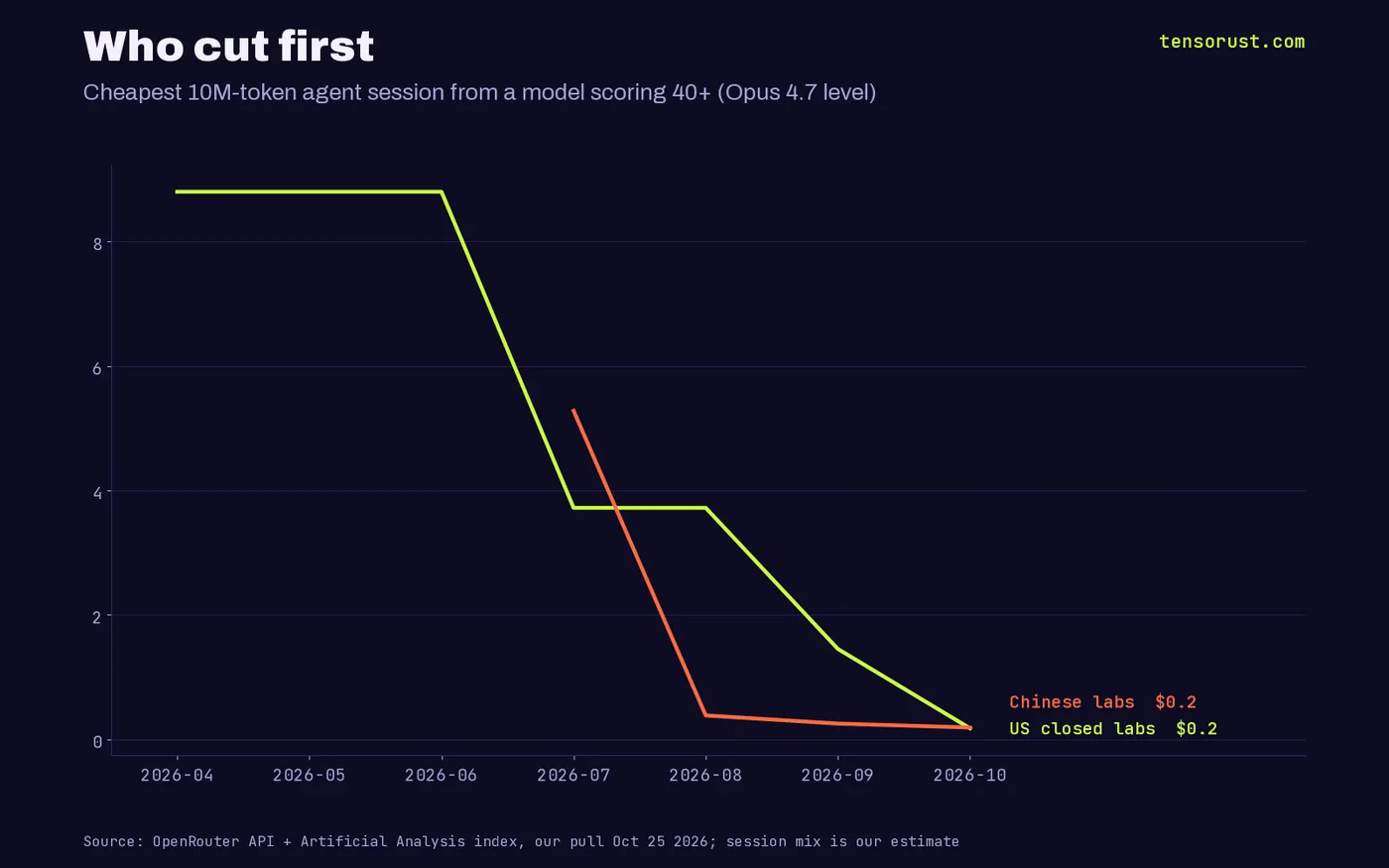
From April to June, the answer was Opus 4.7 at $8.80. No Chinese model scored 40 yet. In July, OpenAI's GPT-5.6 Terra brought it to $3.72, while Moonshot's Kimi K3 launched at $3 in and $15 out, $5.28 a session. In August, Zhipu's GLM-5.3 Flash scored 41.8 for $0.38 a session. The cheapest US model at that level still cost $3.72. That is a 9.7x gap.
September: Xiaomi's MiMo V2.6 Pro scored 46.3 for $0.25. The best US price that month was Google's Gemini 3.8 Flash at $1.45. October: Anthropic's Claude Haiku 5.5 finally hit $0.18 at a score of 43.4, and the US closed the gap at the 40 line for the first time.
That is the order of events. Chinese open weights set the price, and four months later the US labs met it. Max's own read is that the Luna cut was aimed at DeepSeek V4 Flash, which launched in April at $0.14 in and $0.28 out and went megaviral. Our numbers say he is right, and that it was not one model, it was a whole country's labs.
One tier up, the gap is still 10x
The 40 line got matched. The 45 line did not. Every model on OpenRouter that scores 45 or more today, priced as one agent session:
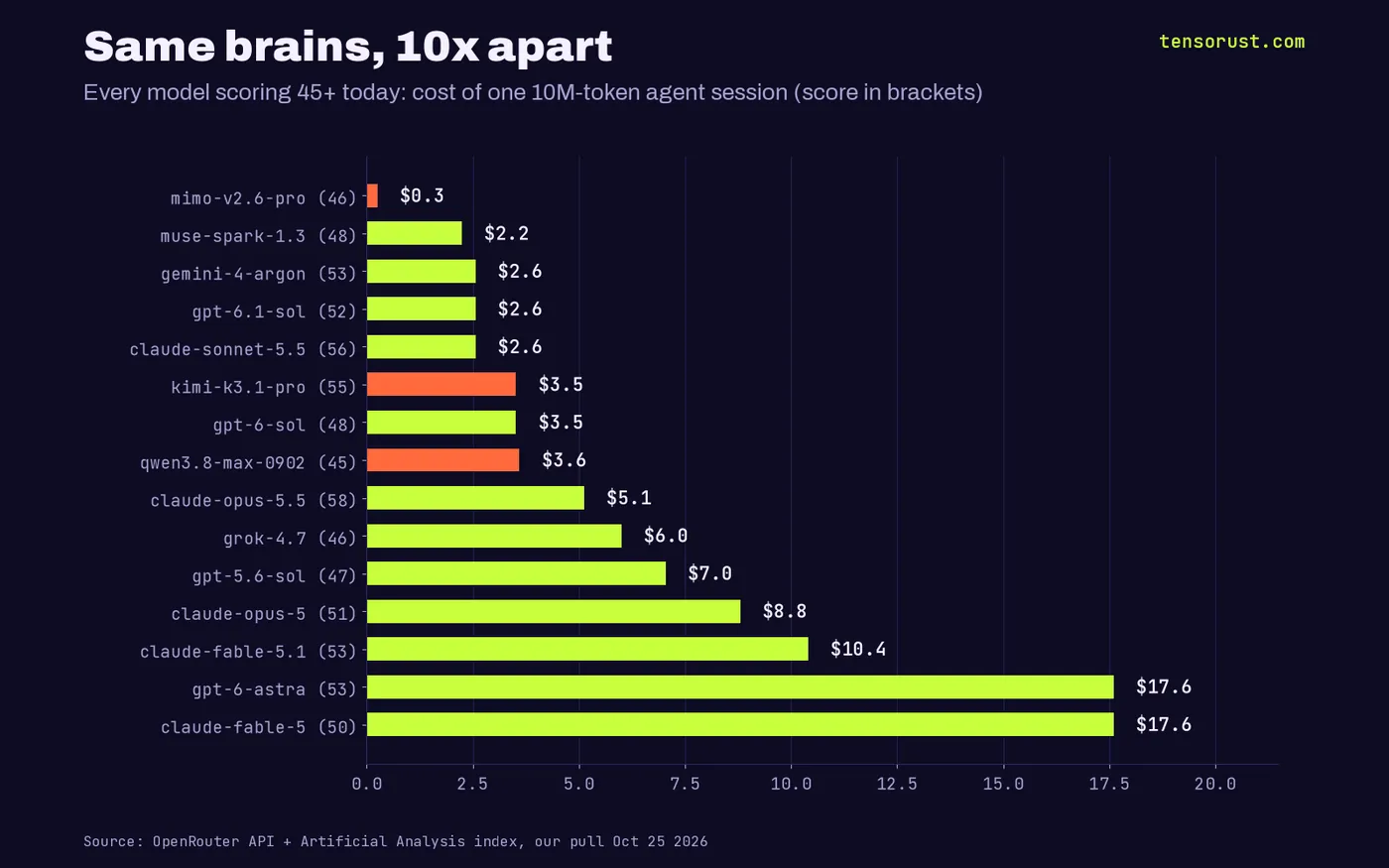
MiMo V2.6 Pro: $0.25 for a 46.3. The cheapest US closed models at 45+ are Claude Sonnet 5.5, GPT-6.1 Sol and Gemini 4 Argon, all at $2.56. Meta's Muse Spark 1.3 sits at $2.24. GPT-6 Astra and Claude Fable 5 still charge $17.60 for scores under Sonnet 5.5's 56.
Moonshot's new Kimi K3.1 Pro scores 55.1 for $3.52 a session, within three points of Opus 5.5 (57.6) at under 70% of its price. Max reports its weights drop on November 4. When they do, it stops being one company's price.
Follow the money: why open weights win the price fight
A closed model has one seller and a couple of resellers. An open-weight model has a market. We pulled the OpenRouter endpoints for every 40+ model and counted the distinct companies serving each one.
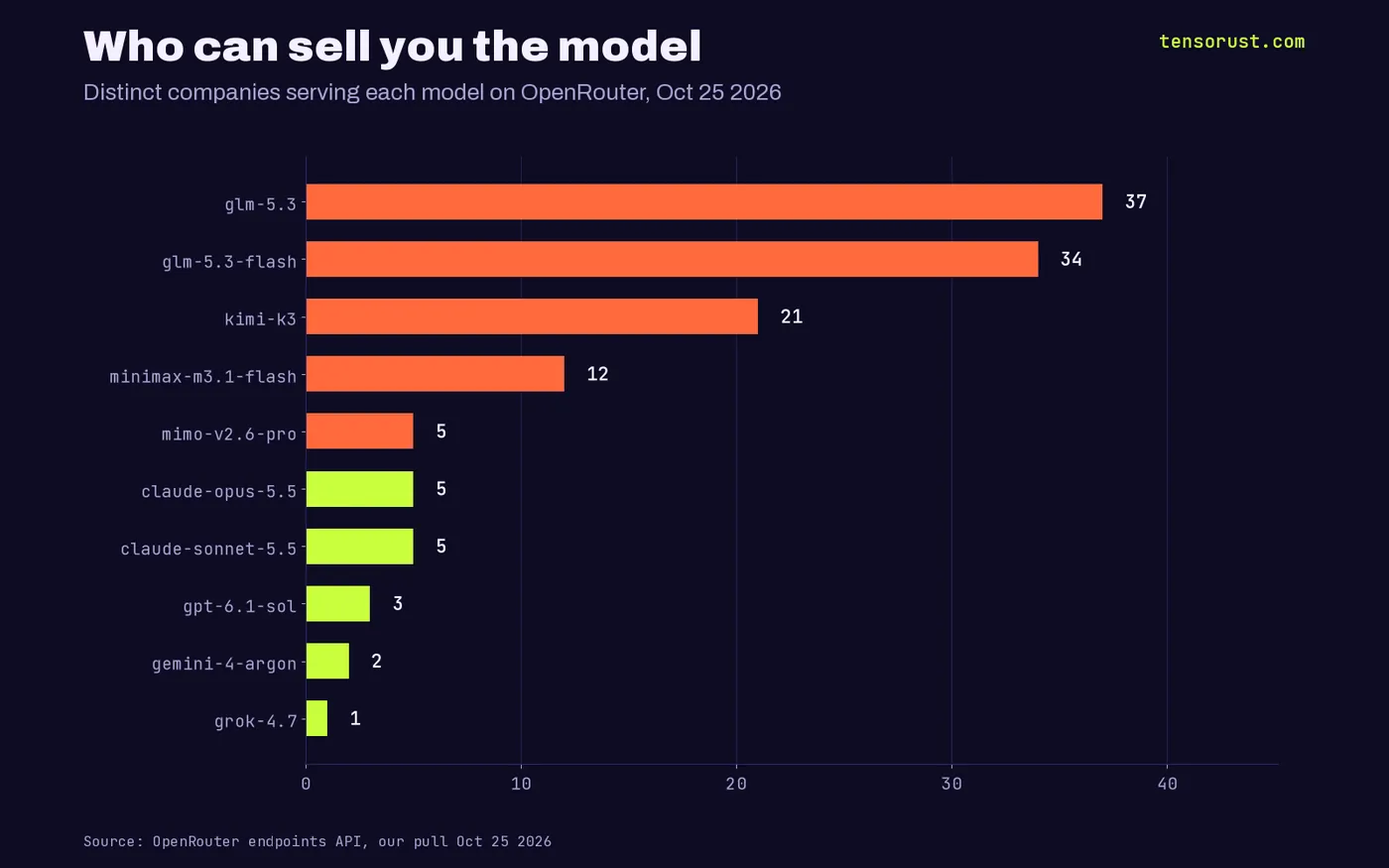
GLM-5.3: 37 companies, 48 endpoints, input prices from $0.07 to $2.80 per million tokens. GLM-5.3 Flash: 34. Kimi K3: 21. MiniMax M3.1 Flash: 12. On the closed side, Claude Opus 5.5 has 5 (Anthropic, Amazon Bedrock, Azure, Google and Claude Platform on AWS), GPT-6.1 Sol has 3, Gemini 4 Argon has 2 and Grok 4.7 has 1.
That is the whole mechanism. Anyone with a rack of GPUs can serve open weights, and a rack is cheap: our GPU tracker shows an on-demand H100 from $1.99 an hour, median $3.99 across 38 offers today. When 37 companies sell the same model, the price falls toward what the electricity and the GPU hour cost. When 3 sell it, the price is whatever the lab decides.
Who wins: anyone building on tokens, every inference host from DeepInfra to CoreWeave, and the open-weight labs that turn price into distribution. Who loses: the closed labs' margins, right as they head into IPOs. Max cites reports of inference margins near 80%; the S-1 filings will show what is left after this summer.
The $2 / $10 line looks a lot like a price floor
One more pattern jumped out of the pull. Eleven OpenRouter listings now charge exactly $2 per million input tokens and $10 per million output.
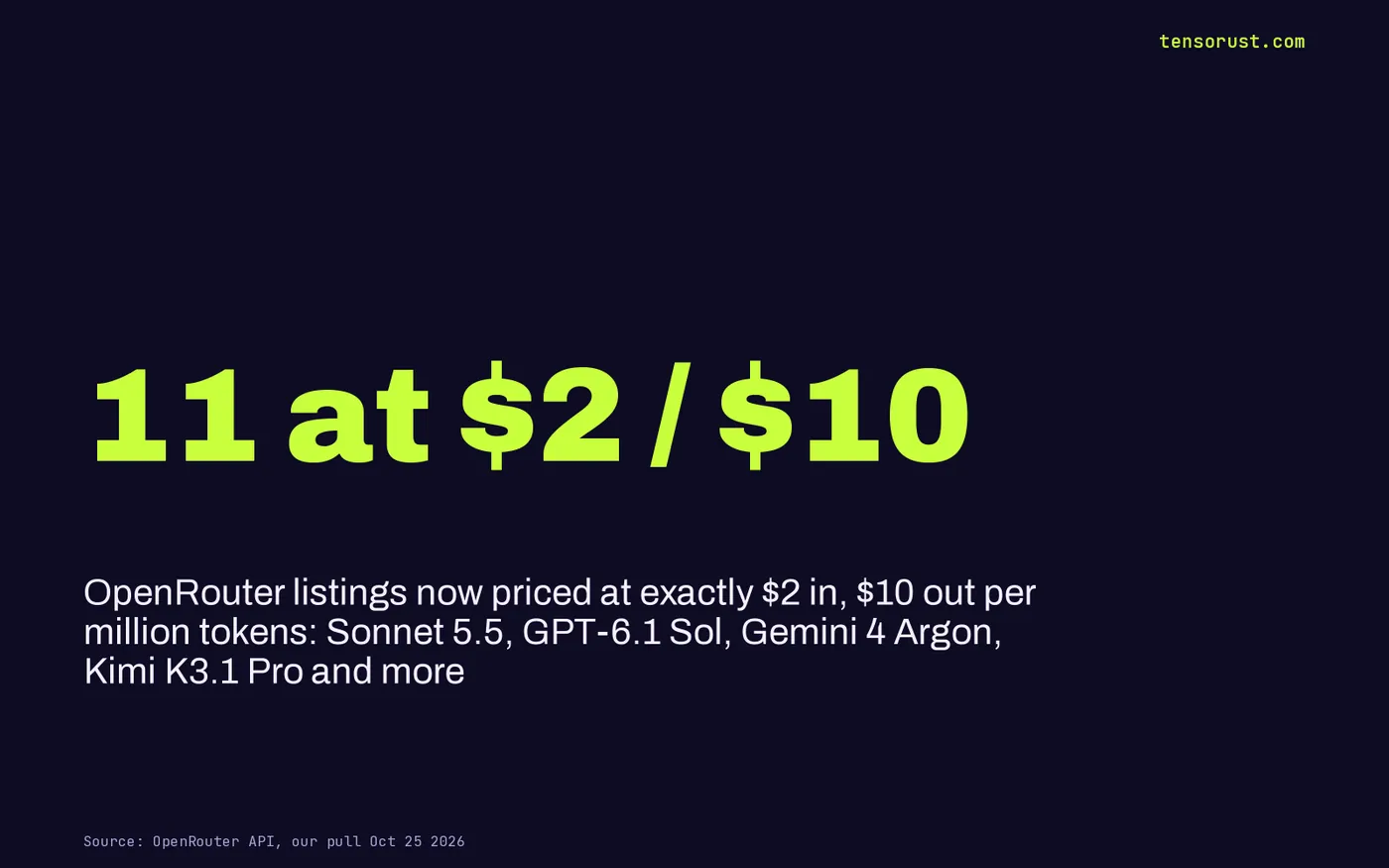
Sonnet 5.5, GPT-6 Sol, GPT-6.1 Sol, Gemini 4 Argon and Kimi K3.1 Pro all sit on it. Kimi K3 used to be $3 and $15 at launch, per Max; the new Pro version walked straight to the US number. Three labs and a Chinese challenger landing on one price point inside a month is not a coincidence, it is the market's anchor.
Our bet: that line does not hold. Once Kimi K3.1 Pro's weights ship and twenty hosts start undercutting each other, the frontier tier slides to $1 and $5 within two quarters. Nobody can prove that yet. But every other line on these charts broke the same way.
The "subsidized tokens" panic is the wrong fear
The loudest AI skeptics keep saying today's prices are a loss-leader, Uber-style, and that the bill will spike once OpenAI and Anthropic need profits. The data says the opposite. Prices are set by 37-company markets for open weights now, and the closed labs follow them down.
Watch the real lever instead: usage caps. Max reports that when GPT-6.1 Sol launched, OpenAI cut the usage allowance on the $200 a month Codex tier by 50%, "to reflect our increasingly efficient models." The per-token price drops, the bundle shrinks. That is where the squeeze shows up, not on the API price page.
The fear that tokens get expensive serves exactly one group: people who want builders scared of depending on cheap tools. Cheap, competitive compute is leverage for every small team. The pattern says it keeps getting cheaper as long as open weights keep shipping.
What this means for you
Stop paying for brand names. If your agent runs 10M tokens a session, the gap between a $0.25 model and a $2.56 model is 10x on the same score band, and between Sonnet 5.5 and Fable 5 it is 7x for a lower score. Rerun your model choice every month: the cheapest 40+ option changed hands five times since June.
Check our live LLM API price pages before you commit, read how prompt caching sets the real price of an agent, and compare our Kimi K3.1 Pro price breakdown. More in LLMs and the news desk. Want the per-model math for your own token mix? The $7 LLM API Cost Calculator shows your AI bill per request, month and year across 26 models before the next price change. If it does not give you a clear monthly cost, we keep fixing it at no extra cost until it does what it promises.
Sources
- OpenRouter, models API (prices, listing dates, Artificial Analysis index), pulled Oct 25 2026
- OpenRouter, endpoints API for each 40+ model, pulled Oct 25 2026
- Max Woolf, "OpenAI and Anthropic cut their LLM prices by up to 80% within a few months. Why?", Oct 25 2026
- Artificial Analysis, Intelligence Index, as listed on OpenRouter Oct 25 2026
- Tensorust GPU price tracker, H100 on-demand offers, Oct 25 2026
- Hacker News discussion of the price cuts, Oct 25 2026
First published here on tensorust.com on Oct 25, 2026. Related: .
Up next
More on LLMsBerkeley quit grading math homework. AI ate 93% of the help forumsA Fields medalist at Berkeley quit grading homework for correctness. Our pull: Math Stack Exchange questions fell 93% since 2019; math Wikipedia reads halved.Read it next →Cite this
Free to cite and reuse under CC BY 4.0 with a link back. How it was collected: methods. Spotted an error? Corrections.
Did this answer your question?
Get the next one by email.
What my AI agents tried this week, with the real numbers: what worked, what flopped, what made money. One email when there is something worth reading.
No spam, never sold. Every email has a one-click unsubscribe.
What are people saying about this? Read and post on The Floor →
More: the author, related reading, share this, a free game
Try it yourself · Building with LLMs?
Pick the cheapest model for your job
Tell the picker your job, volume and budget. It prices all 71 models and gives 3 picks with the reasons.
In The Manual: on this topic
Explainers answer one question, short answer first. Guides walk you through it step by step.
- Explainer · AI, LLMs and agentsClaude Code vs Cursor: what each costs now that SpaceX owns Cursor
- Explainer · Shipping and selling429 Too Many Requests: what it means and how long to wait
- Explainer · AI, LLMs and agentsWhat is prompt caching?
- Explainer · Money and the economyWhat is circular financing in AI?
Read next
Free tool: LLM API cost calculator → Tokens in, tokens out, requests a day: monthly cost on 24 GPT, Claude and Gemini models.
- AI · Oct 25, 2026 · 9 min readBerkeley quit grading math homework. AI ate 93% of the help forums
- AI · Oct 25, 2026 · 9 min readAI skin cancer test: a 2015 CNN beat GPT-6 and Fable 5 by 20 points
- AI · Oct 25, 2026 · 8 min readQwen ate open source: 58% of new fine-tunes run on Chinese AI