
By Matt Busel, who built the apps, crates and game he writes about · every number links to its source and every dataset is downloadable (methods) · corrections · featured in Kirino, gamebiz, This Week in Rust, New Mobile Life, By-Press
GPU depreciation: Big Tech says 6 years, a 2020 A100 rents for $0.74
On this page · 11 sections
- Key numbers
- The chip lives six years. Its rent collapses in two
- Four companies found $13.6B by editing one number
- Amazon already blinked
- Run the books at 3 years and the profit gap is $120B
- The bill is still in the mail
- Burry vs Eisman: who is right
- Follow the money: who wins, who loses
- Our bet
- What this means for you
- Sources
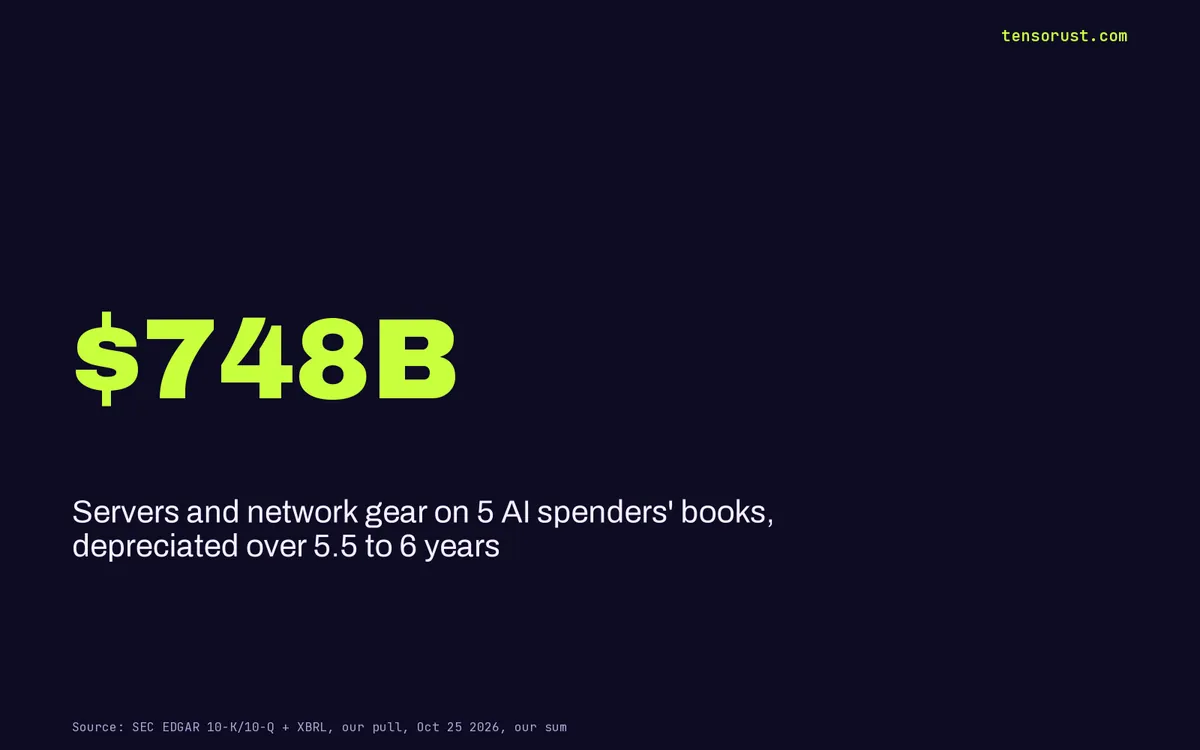
Short answer: Microsoft, Alphabet, Meta, Amazon and Oracle carry $748B of servers and network gear on their books and spread the cost over 5.5 to 6 years. Our live pull of the GPU rental market says a chip's earning power falls much faster: a 2020 A100 rents for a median $0.74 an hour, 6.9% of a B200. The chips live six years. The profits they print do not, and the accounting pretends otherwise.
TL;DR: Since 2022 four of these companies stretched server lives and booked $13.6B of first-year profit from that one change, per their own 10-Ks. If servers were depreciated over 3 years instead, the five would book about $120B a year of extra cost, 24% of their combined $499B operating income (our model), and Oracle would lose 56%. They spent $601B on capex in the last four quarters against $142B of depreciation, so the bill is still in the mail when earnings land this week.
Key numbers
| What | Number | Source, checked Oct 25 2026 |
|---|---|---|
| Servers and network gear on the books, 5 companies | $748B at cost | SEC 10-K/10-Q filings, our sum |
| Book life for those servers | 5.5 to 6 years | Alphabet 10-K, Meta 10-K |
| First-year profit from stretching server lives (4 changes) | $13.6B | Microsoft FY23 10-K and three more, listed below |
| Median rent, A100 (announced 2020) | $0.74 per GPU hour (55 offers) | Vast.ai live offers, our pull |
| Median rent, B200 (announced 2024) | $10.63 per GPU hour (21 offers) | Vast.ai live offers, our pull |
| Median rent, V100 (announced 2017) | $0.10 per GPU hour (55 offers) | Vast.ai live offers, our pull |
| Extra yearly depreciation at a 3-year life | $120B, 24% of operating income | Our model on SEC data (CSV below) |
| Capex vs depreciation, last 4 quarters | $601B vs $142B (4.2x) | SEC EDGAR XBRL, our pull |

The chip lives six years. Its rent collapses in two
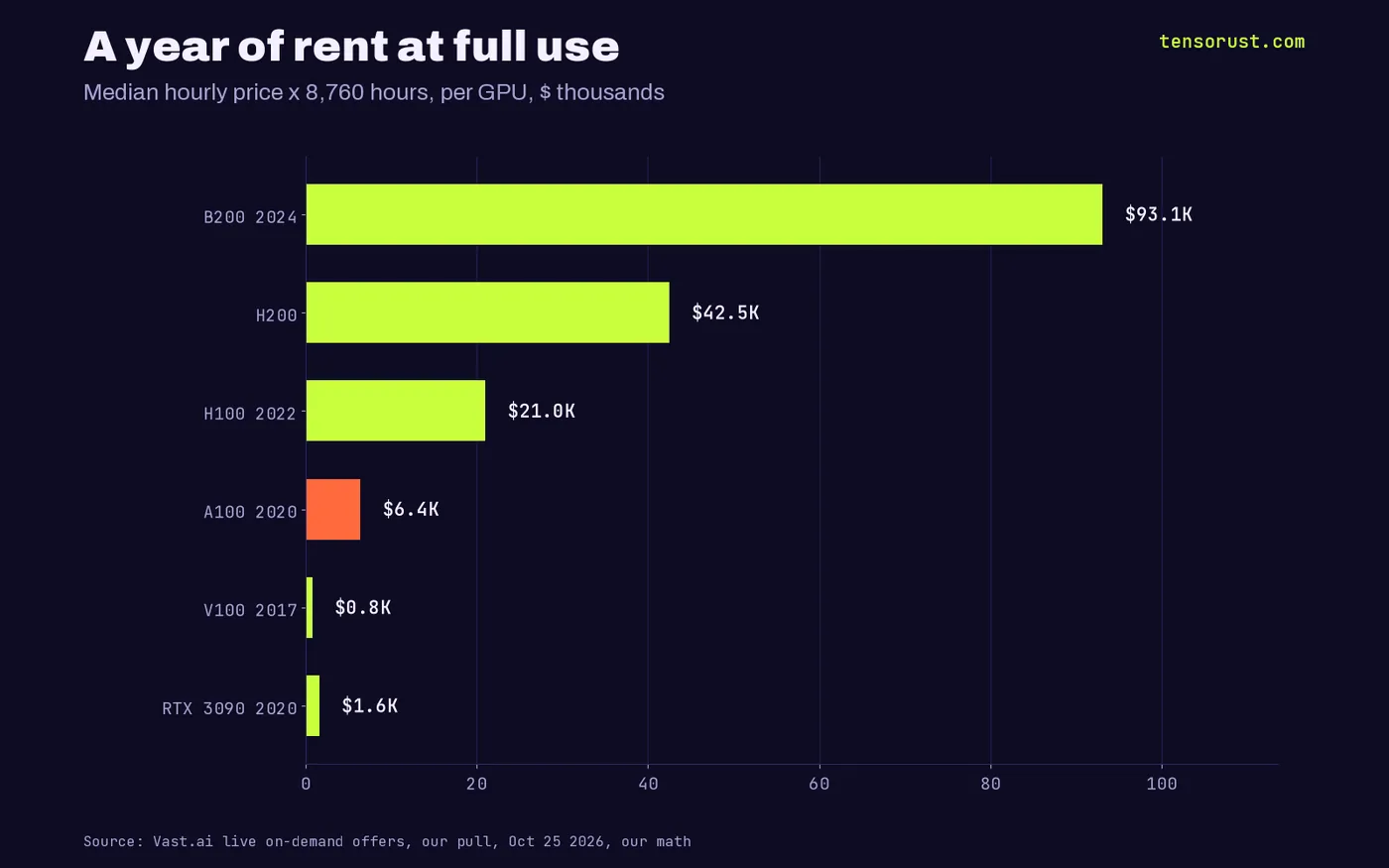
We pulled every live on-demand offer on Vast.ai, an open GPU rental marketplace, just before noon ET today for 12 Nvidia models. That is 397 offers with real prices that anyone can rent right now. Depreciation is the cost of a machine spread over the years it earns money, so the rent a chip still fetches is the cleanest public check on how long it earns.
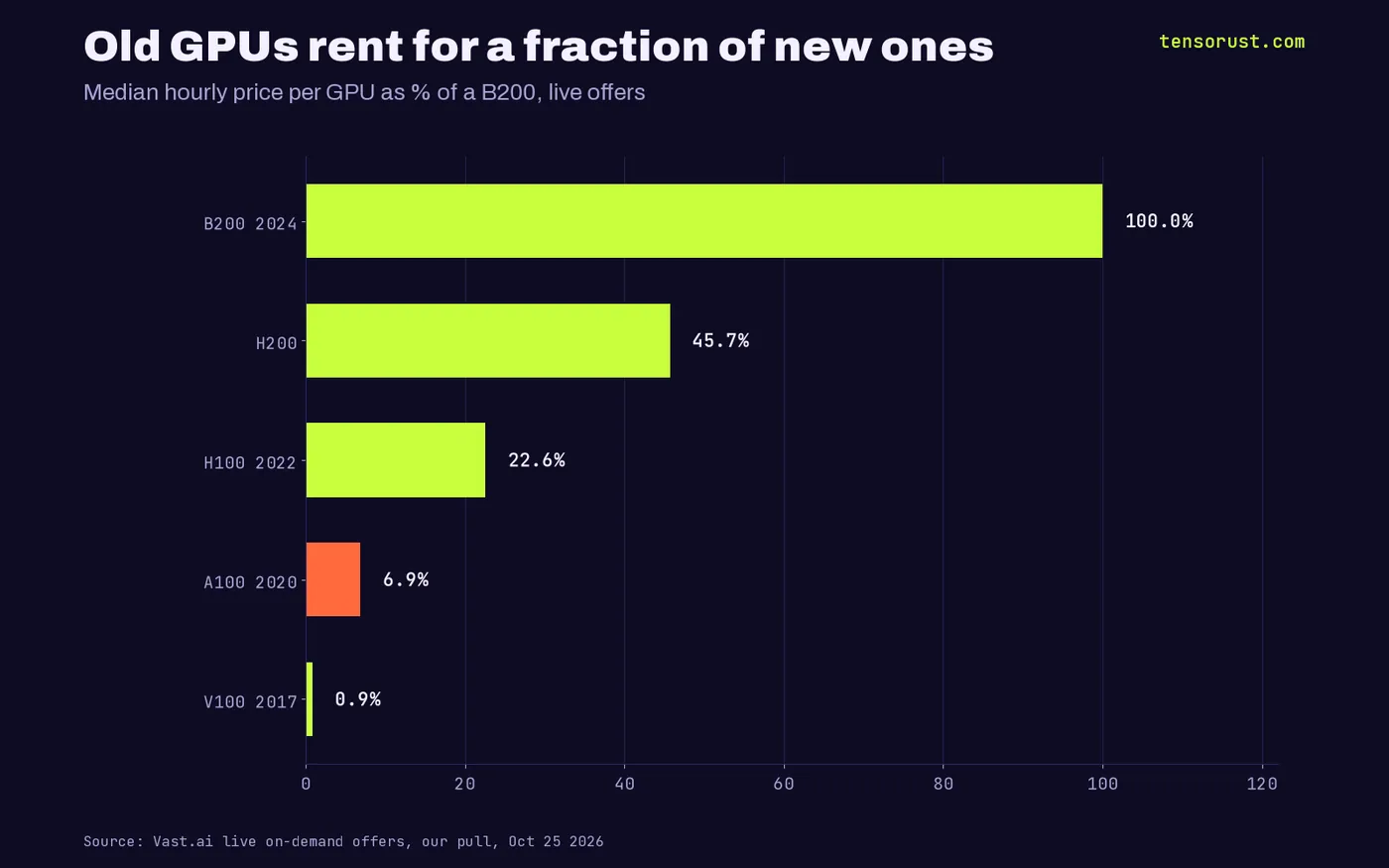
The curve is brutal. The median B200 rents for $10.63 an hour. An H100 from the 2022 Hopper generation fetches $2.40, which is 22.6% of that. An A100 from 2020 gets $0.74, or 6.9%. A V100 from 2017 gets $0.10, under 1%.
So yes, Big Tech is right that a GPU physically survives six years. There are 55 V100s for rent today. But a six-year-old chip that earns 1% of the new one is not "useful" in any sense an investor cares about.
Four companies found $13.6B by editing one number
Here is the part the earnings calls skip. Between 2022 and 2025, four of the five biggest AI spenders told the SEC their servers would last longer than they used to think. Each change cut depreciation, which raised reported profit without one extra dollar of cash coming in.
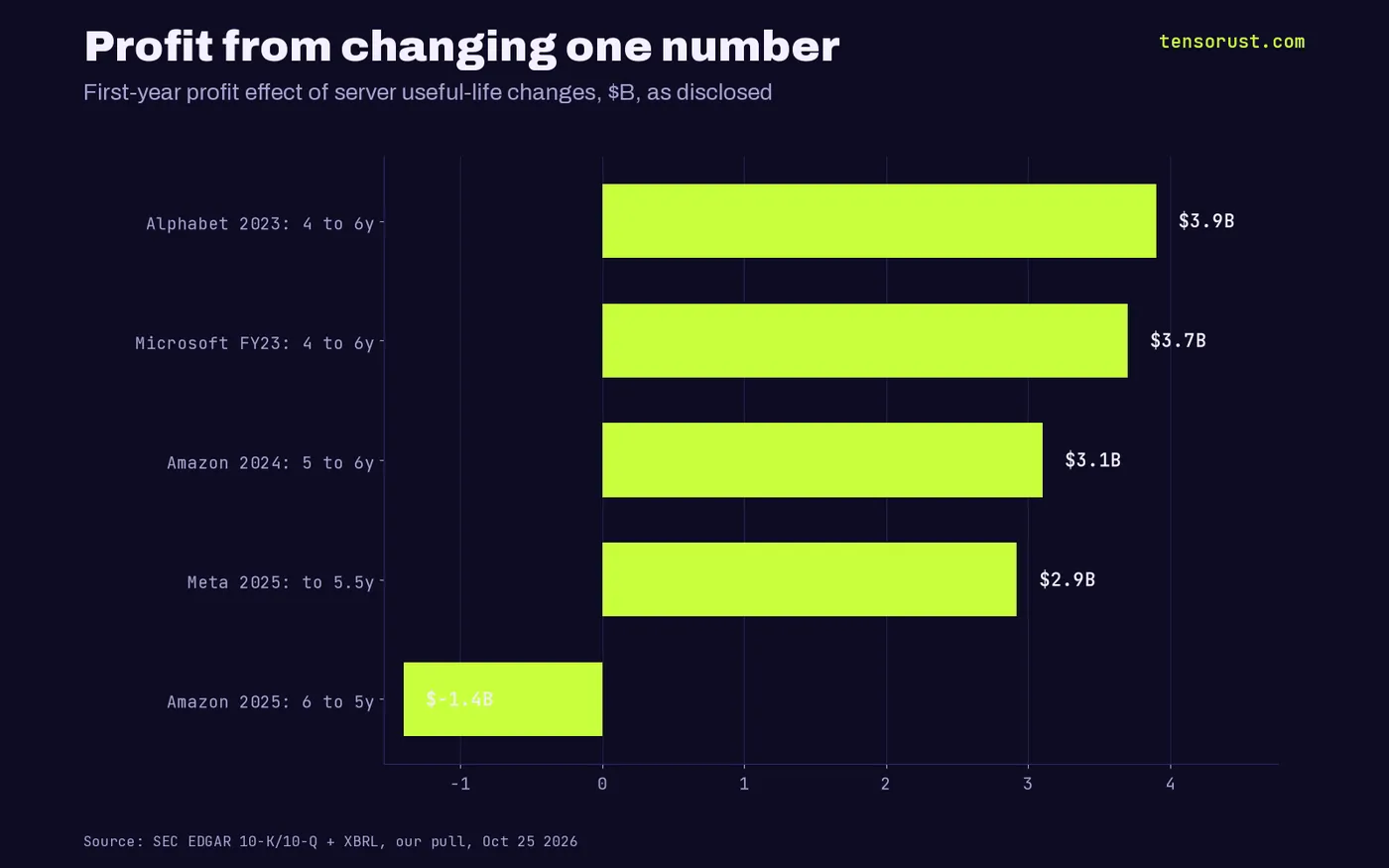
- Microsoft moved servers and network gear from 4 to 6 years in fiscal 2023: +$3.7B operating income that year. Its depreciation actually fell, from $12.6B to $11.0B, in the middle of a buildout.
- Alphabet moved servers from 4 to 6 years in January 2023: depreciation -$3.9B, net income +$3.0B.
- Amazon moved servers from 5 to 6 years in January 2024: +$3.1B expected operating income. It had already gone from 4 to 5 in 2022.
- Meta stretched most servers to 5.5 years in January 2025: depreciation -$2.92B, net income +$2.59B, or $1.00 a share.
Microsoft's own explanation was "investments in software that increased efficiencies" in how it runs the gear. That may be true for a CPU web server. It is a much harder sell for an AI accelerator when Nvidia ships a new architecture every two years: Ampere in May 2020, Hopper in March 2022, Blackwell in March 2024, per Nvidia's announcement dates on Wikipedia.
Amazon already blinked
One company went the other way, and it is the one that rents out the most compute. Starting January 2025, Amazon cut a subset of its servers from 6 years back to 5. Its 10-K gives the reason in plain words: "the increased pace of technology development, particularly in the area of artificial intelligence and machine learning."
That cost Amazon $1.4B of extra depreciation and $1.0B of net income in 2025, mostly in AWS. The biggest GPU landlord on earth looked at its own fleet and admitted the clock runs faster. Meta, the same month, made its clock run slower.
Both cannot be right about the same Nvidia chips. Our read: Amazon told the truth because AWS sees the rent curve every day, and rent does not lie.
Run the books at 3 years and the profit gap is $120B
We took each company's latest gross balance of servers and network gear and ran simple straight-line depreciation three ways: their book life, 4 years and 3 years. Then we compared the extra cost to each company's last four quarters of operating income. This is our model, not their disclosure, and it is rough on purpose (the CSV has every input).
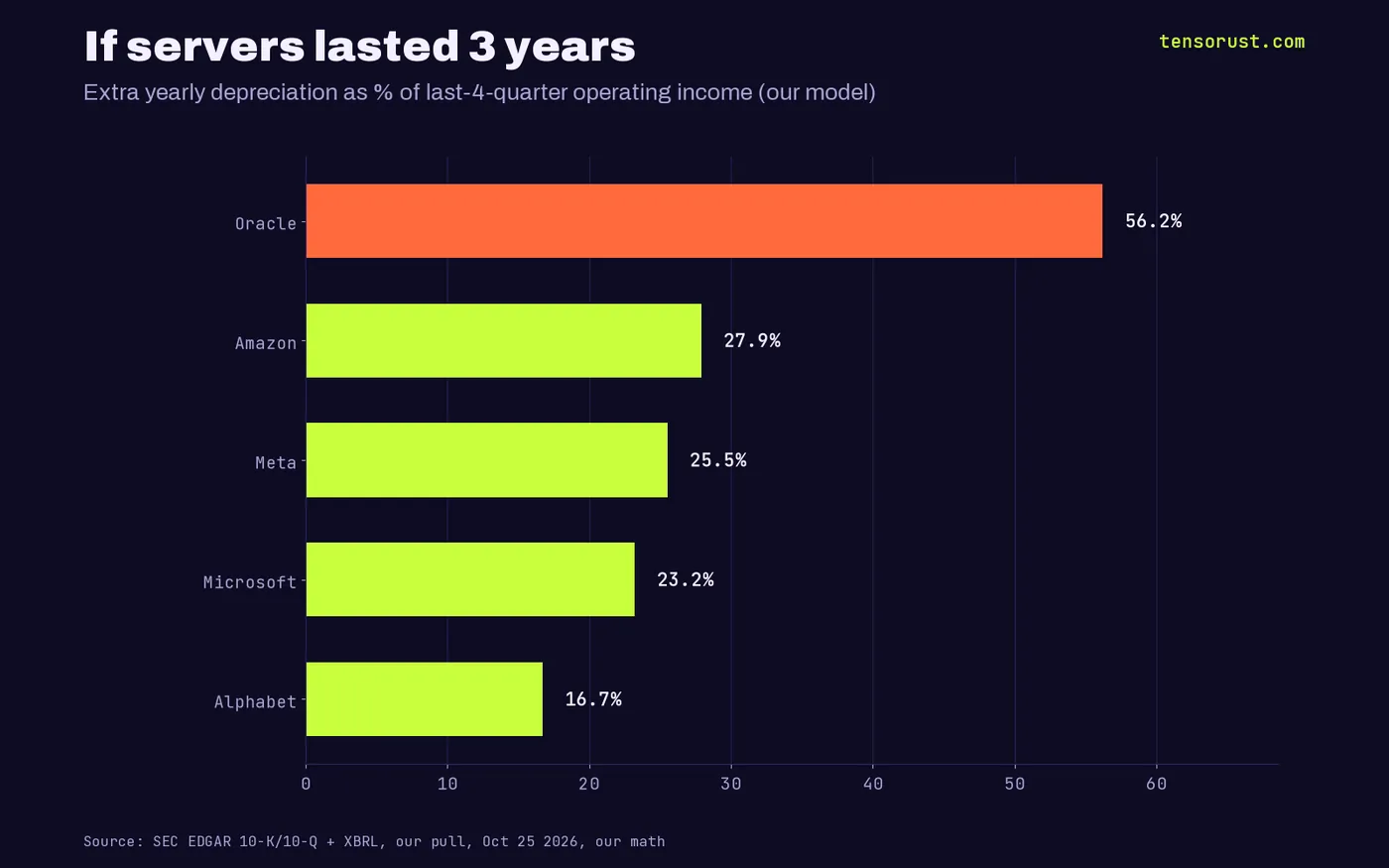
- Oracle: $77.8B of gear. At 3 years the extra cost is $13.0B a year, 56% of its $23.1B operating income.
- Amazon: $172.5B. Extra $26.1B, 28% of $93.7B.
- Meta: $133.6B. Extra $20.2B, 25% of $79.4B.
- Microsoft: $215.9B (includes software). Extra $36.0B, 23% of $155.2B.
- Alphabet: about $148.3B (60% of its $247.2B technical infrastructure, its own split). Extra $24.7B, 17% of $147.6B.
Even at a 4-year life, the five lose $57.8B a year, about 12% of operating income. Not one of them would lose money. All of them would look a lot less like the cash machines the market prices them as.
The bill is still in the mail
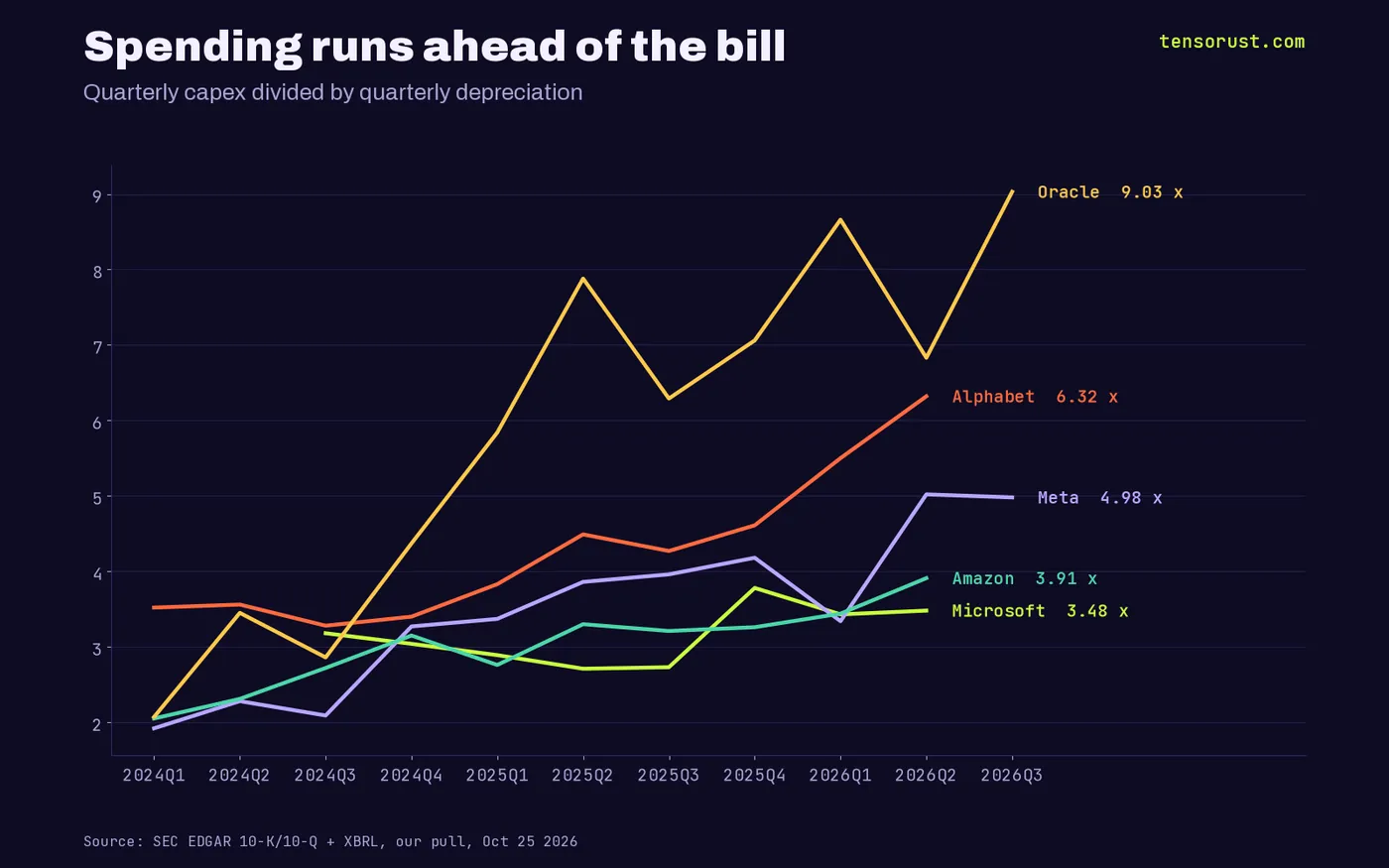
Depreciation lags spending. A server bought today hits the income statement slowly for years. That is why the scariest chart here is not about rent, it is about timing.
In their latest quarters, Oracle spent 9.0x its quarterly depreciation on capex. Alphabet spent 6.3x, Meta 5.0x, Amazon 3.9x, Microsoft 3.5x. Across the last four quarters the five spent $601B and booked $142B of depreciation.
Microsoft's depreciation already jumped from $15.2B in fiscal 2024 to $22.0B and then $34.3B in fiscal 2026. Alphabet's quarterly figure went from $2.6B in early 2023 to $7.1B last quarter. That is the wave arriving at a 6-year pace. At a 3-year pace it would arrive twice as fast.
Burry vs Eisman: who is right
Michael Burry has been hammering this since November 2025, when CNBC reported him accusing the hyperscalers of "artificially boosting earnings" with long useful lives. In October Steve Eisman called the warning "too academic," and Burry compared Nvidia's defense to the 1960s computer leasing mania. Bloomberg's headline this morning: "AI Spending Fears Threaten to Swamp Big Tech's Strong Earnings."
The Eisman camp has one real point. Old chips still rent, and H100 prices have been climbing in 2026 per SemiAnalysis's rental index (Seeking Alpha reported a jump of nearly 40% in six months back in April). A shortage props up old hardware. Our pull agrees the market is tight: 55 A100s at a median $0.74 is a live business, not scrap.
But "still rents" is not the test. The test is whether year five and six earn enough to justify carrying the chip at the same yearly cost as year one. A chip that rents at 6.9% of the frontier rate in year six does not. Straight-line depreciation over 6 years books the same cost in year six as in year one. The rent curve says most of the value is gone by year three. Burry wins this one on the numbers.
Follow the money: who wins, who loses
- Wins: executives paid on earnings per share. Meta's change alone added $1.00 a share in 2025. Long lives make every quarter of this buildout look cheaper than the cash says.
- Wins: anyone renting compute. Old generations are on fire sale: a V100 for $0.10 an hour, an A100 for $0.74. Open-weight inference on old chips is the best deal in tech.
- Loses: late buyers of the stocks if a sixth company follows Amazon. Every year cut from server lives moves billions from profit to cost overnight, and the market trades on profit.
- Loses most: Oracle. It has the fastest spending, the thinnest operating income next to its gear, and the most to lose at any shorter life.
Our bet
Within 12 months at least one more of the five follows Amazon and shortens AI server lives, and takes a multi-billion profit hit the day it does. Oracle is the most exposed, Meta is the one that moved the wrong way most recently. Nobody has proven the 6-year number wrong in an audit. The rent market has already priced it.
Watch the earnings this week: Alphabet and Microsoft on Wednesday Oct 28, Amazon on Thursday Oct 29. Search each 10-Q for "useful lives." If the phrase "change in accounting estimate" shows up next to servers, you are watching the bill arrive.
What this means for you
If you build with AI, rent the old generation. Our pull shows an A100 at $0.74 an hour and an RTX 3090 at $0.18, against $10.63 for a B200. Most inference and fine-tuning jobs do not need the frontier chip. If you invest, price these companies on cash flow, not on earnings that lean on a 6-year guess.
Want to know exactly what your model bill will be before you pick a chip or an API? Get the $7 LLM API Cost Calculator: cost per request, per month and per year across 26 models. If it does not give you a clear monthly number, we keep fixing it at no extra cost until it does what it promises.
More from us: Tensorust News, Big Tech earnings week: 4 of 5 AI spenders burn cash, Nvidia's $2,000-per-GPU software fee, the RTX 3090 unlock, all deep tech and money pieces.
Not financial advice. Our numbers and our read, so you can check them. Download the data below: every offer we pulled, every quarter, every useful-life change and our 3-year model.
Sources
- Vast.ai public offers API, 397 live on-demand offers across 12 GPU models, pulled Oct 25 2026 about 12 PM ET
- Microsoft 10-K FY2023, change in accounting estimate (4 to 6 years, +$3.7B), filed Jul 27 2023
- Microsoft 10-K FY2026, property and equipment, depreciation $34.3B, filed Jul 29 2026
- Alphabet 10-K 2023, servers 4 to 6 years, -$3.9B depreciation, filed Jan 31 2024
- Alphabet 10-Q Q2 2026, technical infrastructure $247.2B, 60% servers and network, filed Jul 23 2026
- Amazon 10-K 2023, servers 5 to 6 years, +$3.1B, filed Feb 2 2024
- Amazon 10-K 2025, subset back to 5 years, +$1.4B depreciation, servers $172.5B, filed Feb 6 2026
- Meta 10-K 2025, 5.5-year servers, -$2.92B depreciation, +$1.00 a share, filed Jan 29 2026
- Meta 10-Q Q3 2026, servers and network $133.6B, filed Oct 22 2026
- Oracle 10-Q Aug 31 2026, computer and network equipment $77.8B, filed Sep 11 2026
- SEC EDGAR XBRL company facts (capex, depreciation, operating income), our pull Oct 25 2026
- Wikipedia: Volta, Ampere, Hopper, Blackwell announcement dates, checked Oct 25 2026
- CNBC, "'Big Short' investor Michael Burry accuses AI hyperscalers of artificially boosting earnings", Nov 11 2025
- BigGo Finance, "Steve Eisman Dismisses Michael Burry's AI Chip Depreciation Warning as 'Too Academic'", Oct 6 2026
- BigGo Finance, "Michael Burry Says Nvidia's GPU Depreciation Defense Echoes 1960s Computer Leasing Mania", Oct 2 2026
- Bloomberg, "AI Spending Fears Threaten to Swamp Big Tech's Strong Earnings", Oct 25 2026
- Seeking Alpha, "Nvidia's H100 GPU rental prices surge nearly 40% in 6 months: SemiAnalysis", Apr 2 2026
First published here on tensorust.com on Oct 25, 2026. Related: Tensorust News, Deep tech and money, Economics, Big Tech earnings week: 4 of 5 AI spenders burn cash, Nvidia's $2,000-per-GPU software fee, LLM API Cost Calculator.
Up next
More on Deep tech and moneySpaceX's $40B Nvidia chip debt costs 8.3%. Apollo is the lenderSpaceX paid 5.35% in June. Its $40B Nvidia chip debt reportedly prices at 7.75-8.3%, above the junk index, costing $3.3B a year vs $1.7B of AI profit.Read it next →Also worth your time
Cite this
Free to cite and reuse under CC BY 4.0 with a link back. How it was collected: methods. Spotted an error? Corrections.
Did this answer your question?
Get the next one by email.
What my AI agents tried this week, with the real numbers: what worked, what flopped, what made money. One email when there is something worth reading.
No spam, never sold. Every email has a one-click unsubscribe.
What are people saying about this? Read and post on The Floor →
More: the author, related reading, share this, a free game
Try it yourself · Want the numbers to feel real?
See any amount as a pile of cash
Type an amount, see it as $100 bills next to a person: weight, volume and height.
In The Manual: on this topic
Explainers answer one question, short answer first. Guides walk you through it step by step.
- Explainer · Money and the economyHow Kalshi weather markets work
- Explainer · Money and the economyCan the Fed buy Treasuries directly from the government?
- Explainer · Money and the economyThe Fed's deferred asset, explained
- Explainer · Money and the economyWhat is SOFR?
Read next
- Economics · Oct 25, 2026 · 9 min readSpaceX's $40B Nvidia chip debt costs 8.3%. Apollo is the lender
- Economics · Oct 25, 2026 · 8 min readNvidia's $2,000-per-GPU software fee: rent on a stack vLLM gives away
- Economics · Oct 25, 2026 · 9 min readNvidia backstops: $288B on the hook while its neocloud borrowers crack