
By Matt Busel, who built the apps, crates and game he writes about · every number links to its source and every dataset is downloadable (methods) · corrections · featured in Kirino, gamebiz, This Week in Rust, New Mobile Life, By-Press
AWS is a landlord: 39% margins and a $496B lease on your stack
On this page · 11 sections
- Key numbers
- The cloud earns like a landlord, not a utility
- All three landlords are raising the take
- The lease book just doubled, and the leases got longer
- Follow the money: the rent buys more buildings
- Same GPU, different landlord: the 3.5x premium
- The exit fee is the lock on the door
- The steelman, and why it fails for most teams
- The twist: the landlord's best tenants can least afford the rent
- What this means for you
- Sources
Short answer: The cloud is not a utility, it is a landlord. AWS kept 39.4 cents of operating profit from every dollar of revenue in Q2 2026, Microsoft's Intelligent Cloud kept 41.3% for its fiscal year, and Amazon's book of signed long-term cloud contracts doubled in six months to $496 billion. Those are rent numbers, and the builders paying them are the ones who can least afford it.
TL;DR: AWS was 18% of Amazon's 2025 sales and 57% of its operating profit, at a 35.4% margin, while Amazon's own North America retail business earned 6.9%. The same Nvidia H100 rents for $3.14 an hour at Massed Compute and $11.06 at Google Cloud and Azure, a 3.5x gap for identical silicon, per our GPU price tracker on Oct 25 2026. 37signals walked out, cut its cloud bill from $3.2 million a year to $1.3 million, and paid off about $700,000 of servers inside a year: the rent was always optional for steady workloads, and the people who notice early keep the difference.
Key numbers
| What | Number | Source, checked Oct 25 2026 |
|---|---|---|
| AWS operating margin, Q2 2026 | 39.4% ($16.6B on $42.2B) | Amazon 10-Q, Q2 2026 |
| AWS share of Amazon operating income, 2025 | 57.0% ($45.6B of $80.0B) | Amazon 10-K, FY2025 |
| Amazon North America retail margin, 2025 | 6.9% | Amazon 10-K, FY2025 |
| Microsoft Intelligent Cloud margin, FY to June 2026 | 41.3% ($57.0B on $137.8B) | Microsoft 10-K, FY2026 |
| Google Cloud margin, Q2 2026 vs Q2 2025 | 35.6% vs 20.7% | Alphabet 10-Q, Q2 2026 |
| Amazon long-term contract backlog (mostly AWS) | $80.4B (Dec 2021) to $496B (Jun 2026) | Amazon 10-K and 10-Q filings |
| Average remaining term of those contracts | 4.1 years (Dec 2025) to 6.4 years (Jun 2026) | Amazon 10-Q, Q2 2026 |
| H100 SXM on-demand, cheapest vs Google Cloud | $3.14 vs $11.06 per GPU-hour | Tensorust GPU price tracker |
| AWS internet egress, first 10 TB | $0.09 per GB ($90 per TB) | AWS Price List API |
| 37signals cloud bill after leaving | $3.2M a year to $1.3M | David Heinemeier Hansson, Oct 17 2024 |

The cloud earns like a landlord, not a utility
The industry sold the cloud as electricity: a utility, a commodity, a meter on the wall. Utilities earn thin, regulated margins. The cloud does not.
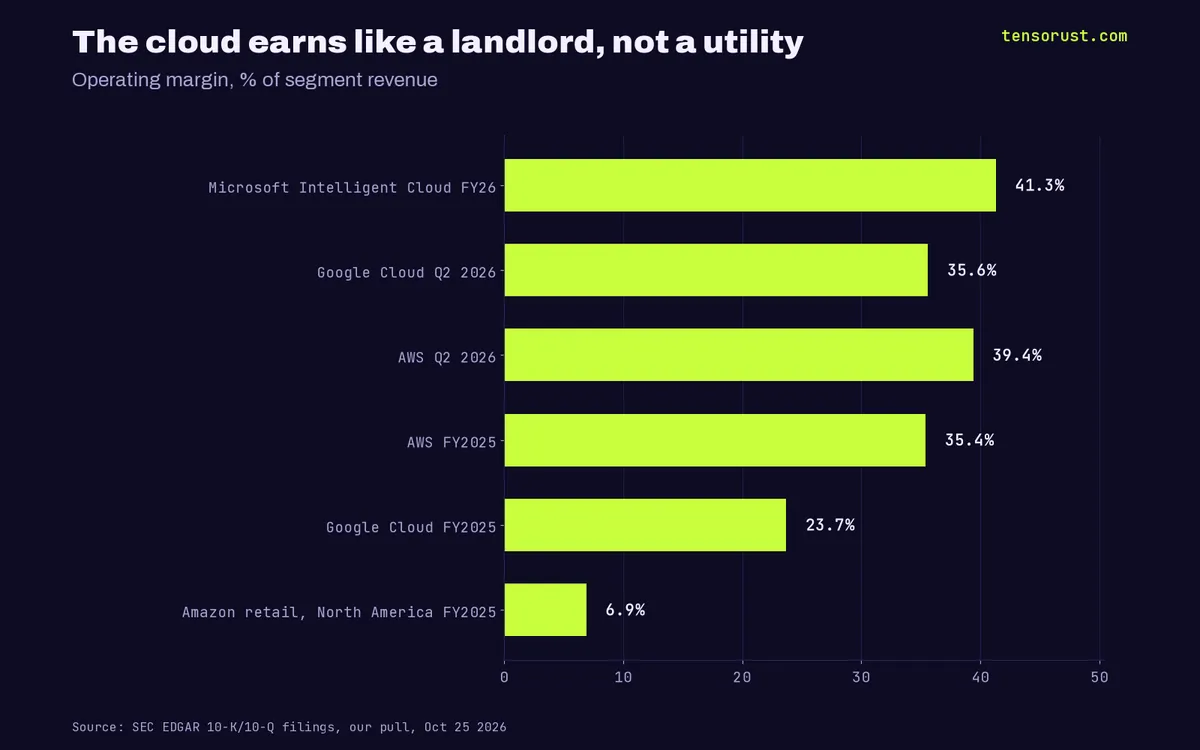
Amazon's own segment table is the cleanest proof, because it puts a landlord and a shopkeeper side by side in one filing. In 2025, Amazon's North America store sold $426.3 billion of goods and kept $29.6 billion, a 6.9% margin. AWS sold $128.7 billion of compute and storage and kept $45.6 billion, a 35.4% margin.
So AWS was 18% of Amazon's sales and 57% of its operating profit. The famous retailer is, by the numbers, a property company with a shop on the ground floor.
And the margin is climbing, not compressing the way a commodity's should. AWS ran between 26% and 30% from 2018 to 2023, jumped to 37.0% in 2024, and hit 39.4% in Q2 2026. Commodities get cheaper as they scale. Rent goes up when the tenants cannot leave.
All three landlords are raising the take
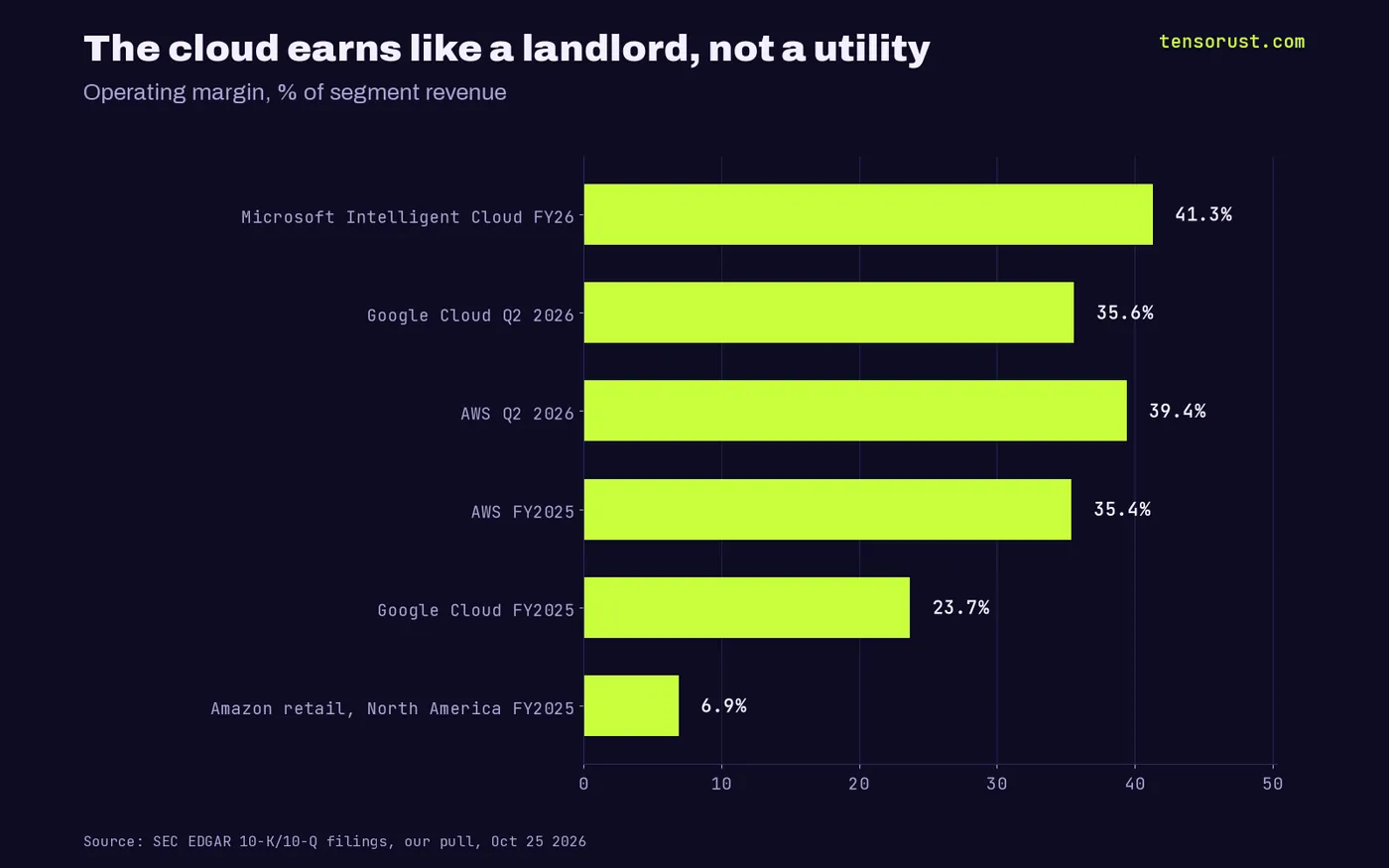
This is not an Amazon quirk. Microsoft's Intelligent Cloud segment, which holds Azure, earned $57.0 billion on $137.8 billion of revenue in the fiscal year to June 2026: 41.3%.
Google Cloud is the tell. It earned 5.2% in 2023, 14.1% in 2024 and 23.7% in 2025, and in Q2 2026 it kept $8.8 billion of $24.8 billion, a 35.6% margin, up from 20.7% a year earlier. The "underdog" cloud did not use its scale to undercut the others. It used it to catch up to their margin.
Add the most recent full years together and the three biggest clouds booked about $116 billion of operating profit (AWS 2025, Microsoft Intelligent Cloud fiscal 2026, Google Cloud 2025; our sum across their different fiscal calendars). That is the yearly rent roll on the internet's servers.
The lease book just doubled, and the leases got longer
Every landlord's real asset is the signed lease. Amazon discloses its version in the revenue note of every 10-Q: "commitments in customer contracts for future services," primarily AWS, not yet recognized as revenue.
That number was $80.4 billion at the end of 2021. It reached $244 billion at the end of 2025. Then it went to $364 billion in March 2026 and $496 billion in June 2026. It doubled in six months.
The length matters even more than the size. The weighted average remaining life of those contracts sat between 3.5 and 4.1 years for four straight years. By June 2026 it was 6.4 years. Customers are not just renting more. They are signing longer leases.
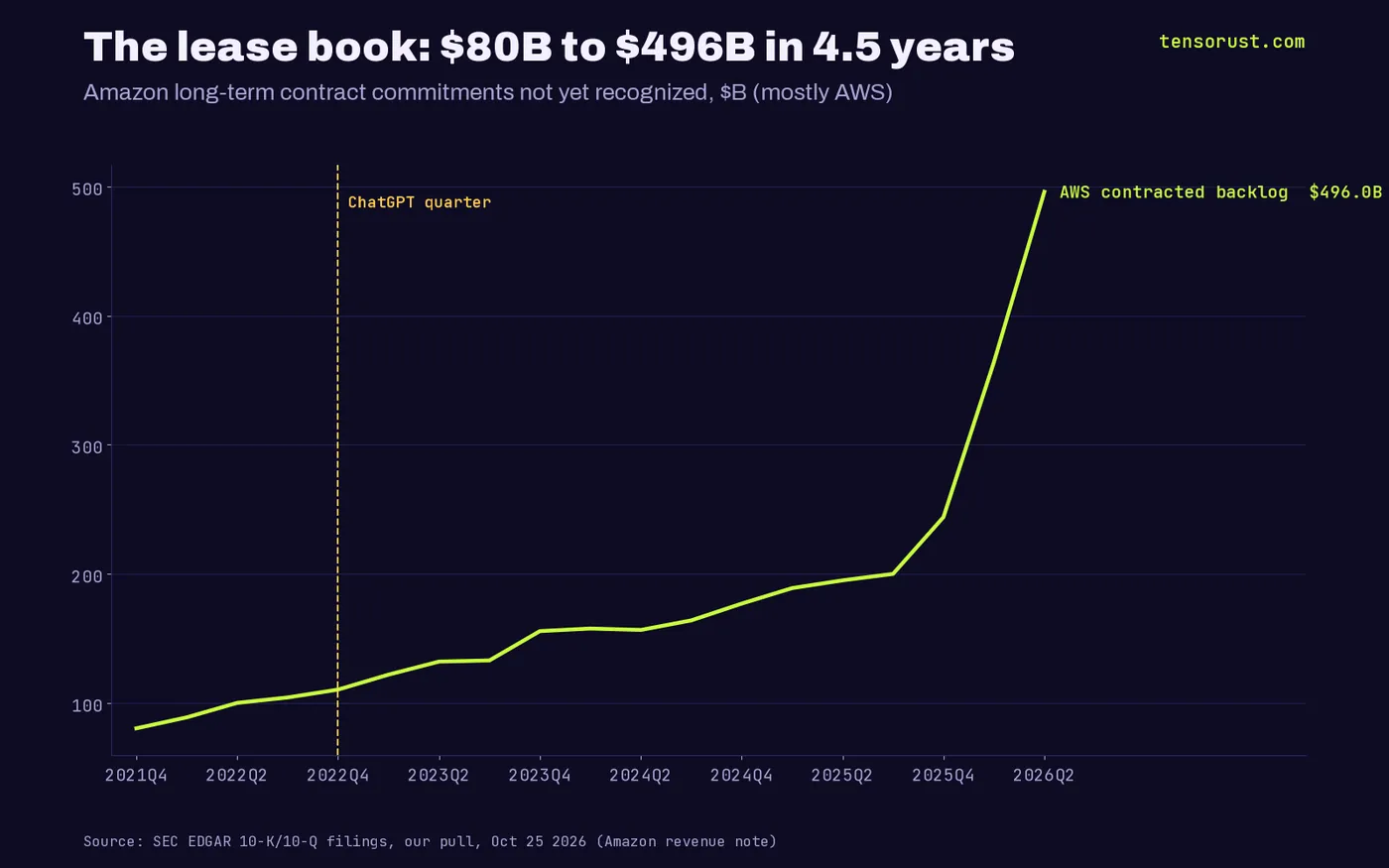
Amazon's filing does not name who signed. Our reading: the AI build-out turned the cloud from month-to-month rentals into multi-year leases, and the tenants locking in for six-plus years are the AI companies that believe they cannot get compute any other way. That belief is worth half a trillion dollars of booked rent to Amazon alone.
Follow the money: the rent buys more buildings
Here is the loop nobody draws. The rent funds the next round of buildings, which locks in the next round of tenants.
Amazon, Microsoft and Alphabet together spent $30.1 billion on property and equipment in Q1 2022. In Q2 2026 they spent $134.9 billion in a single quarter: $54.2 billion at Amazon, $44.9 billion at Alphabet and $35.8 billion at Microsoft, per their XBRL filings.
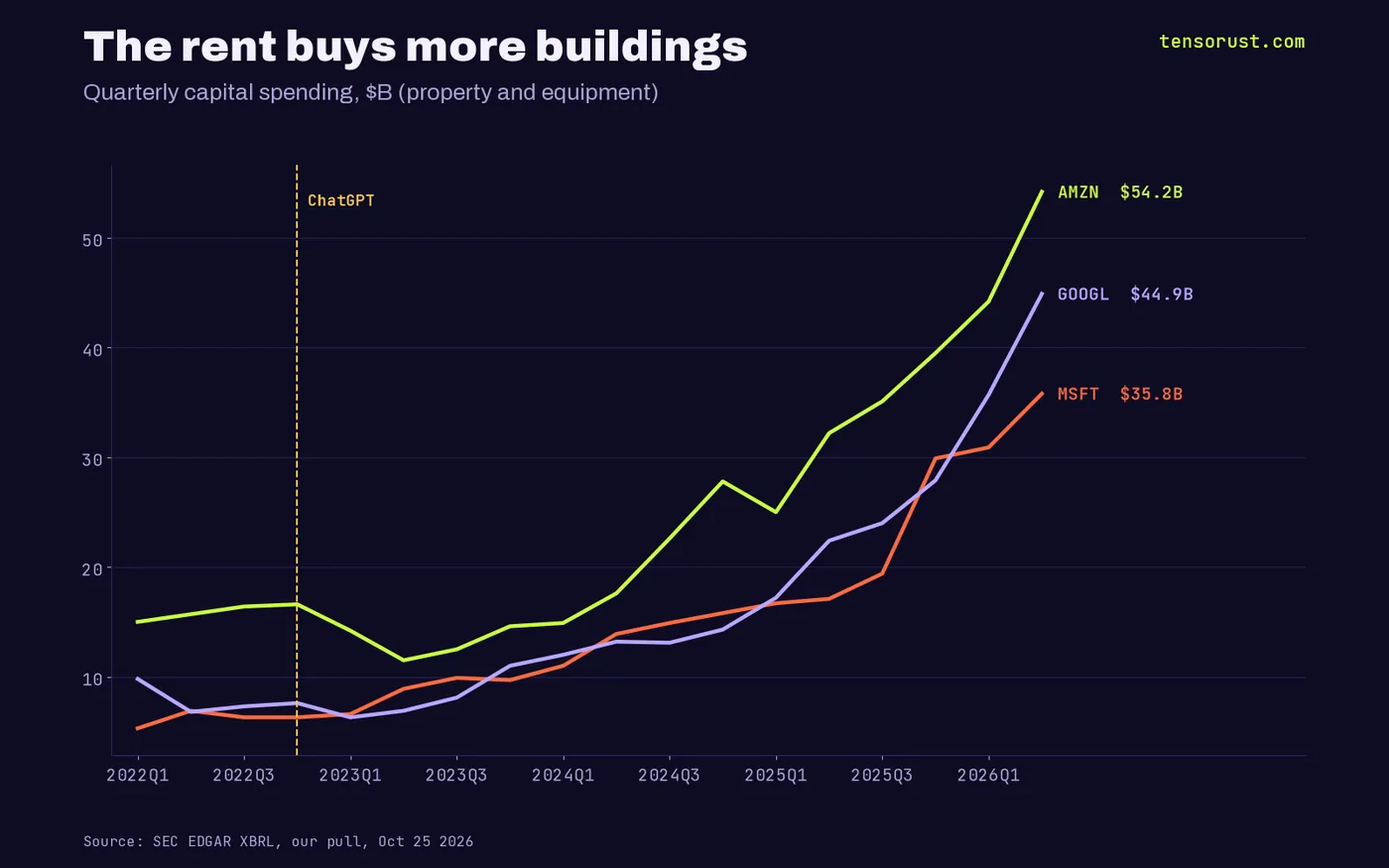
Who wins: the three landlords, whose capex turns into an owned asset with a rent stream attached, and Nvidia, which sells them the GPUs. Who loses: every startup and mid-size company paying list price, because it is their margin that funds the landlord's next data center.
The "nobody ever got fired for buying AWS" consensus is the control play. It turns a pricing decision into a career-safety decision, and career safety never asks what the rent is.
Same GPU, different landlord: the 3.5x premium
If the cloud were a commodity, the same chip would cost about the same everywhere. Our GPU price tracker pulls on-demand prices from 17+ providers every day. On Oct 25 2026, the cheapest on-demand H100 SXM 80GB listing per provider ran from $3.14 an hour at Massed Compute and $3.20 at Hyperstack, through $3.99 at Lambda, to $6.88 at AWS and $11.06 at Google Cloud and Microsoft Azure.
Same silicon. A 3.5x spread between the cheapest listing and the two biggest brand names.
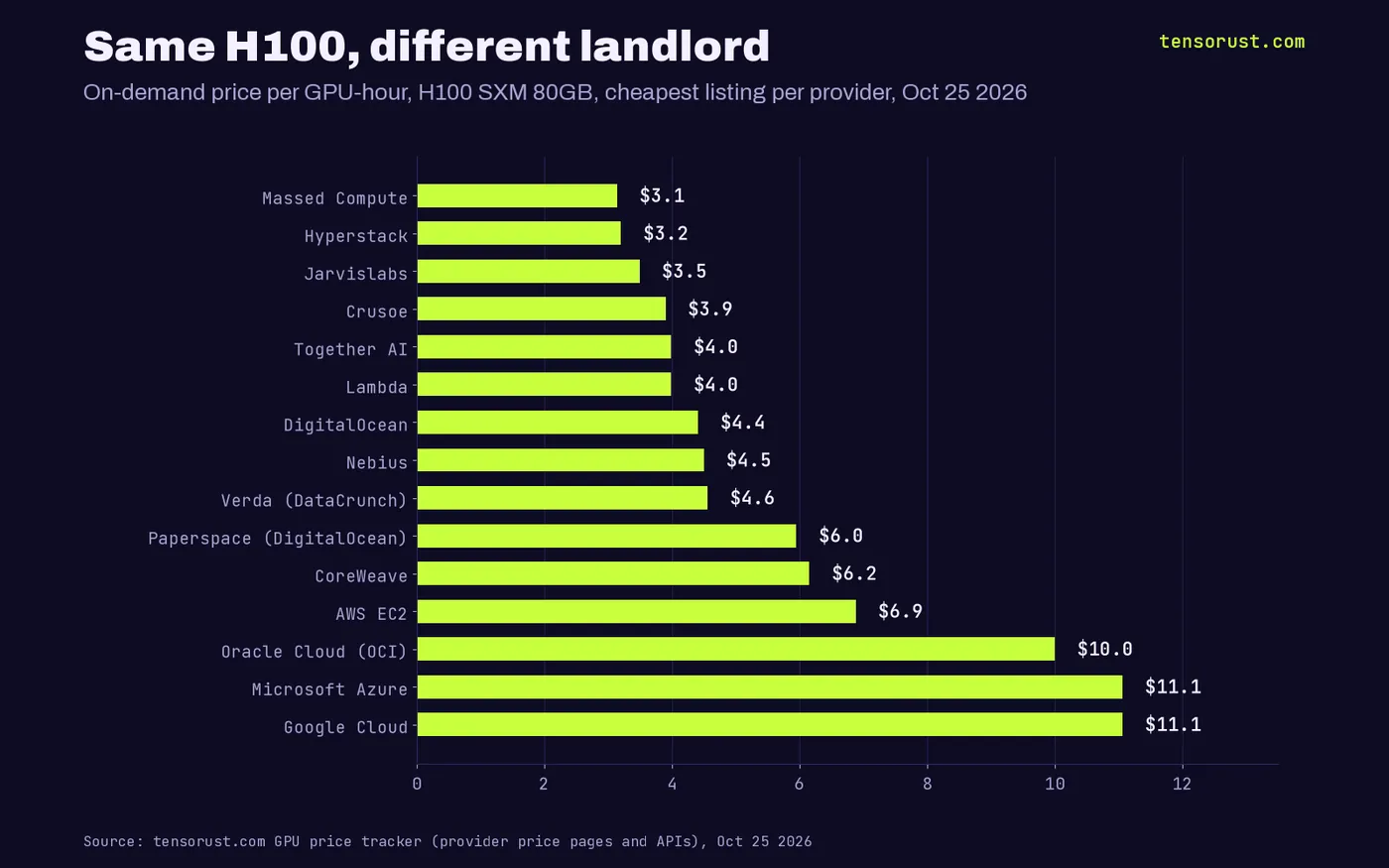
Run one GPU around the clock for a year and the difference stops being abstract. At Google's $11.06 that is about $96,900. At Massed Compute's $3.14 it is about $27,500. The roughly $69,000 gap per GPU per year is the brand premium, and for a team running eight GPUs it is more than half a million dollars a year (our arithmetic on the tracker's prices).
The neoclouds are not charities. They are proof that the hyperscaler price is a choice, not a cost floor. More on that market in our pieces on Nvidia backstopping the neoclouds and how Big Tech depreciates its GPUs over six years.
The exit fee is the lock on the door
Landlords make it cheap to move in and expensive to move out. In the cloud, that is egress: the fee to send your own data out to the internet.
AWS's own price list, published Sep 16 2026, charges $0.09 per GB for the first 10 TB a month from us-east-1, or $90 per terabyte, after a 100 GB monthly free tier. Azure's East US list price is $0.087 per GB on Microsoft's network. Cloudflare's R2 storage charges $0 for egress, because it can.
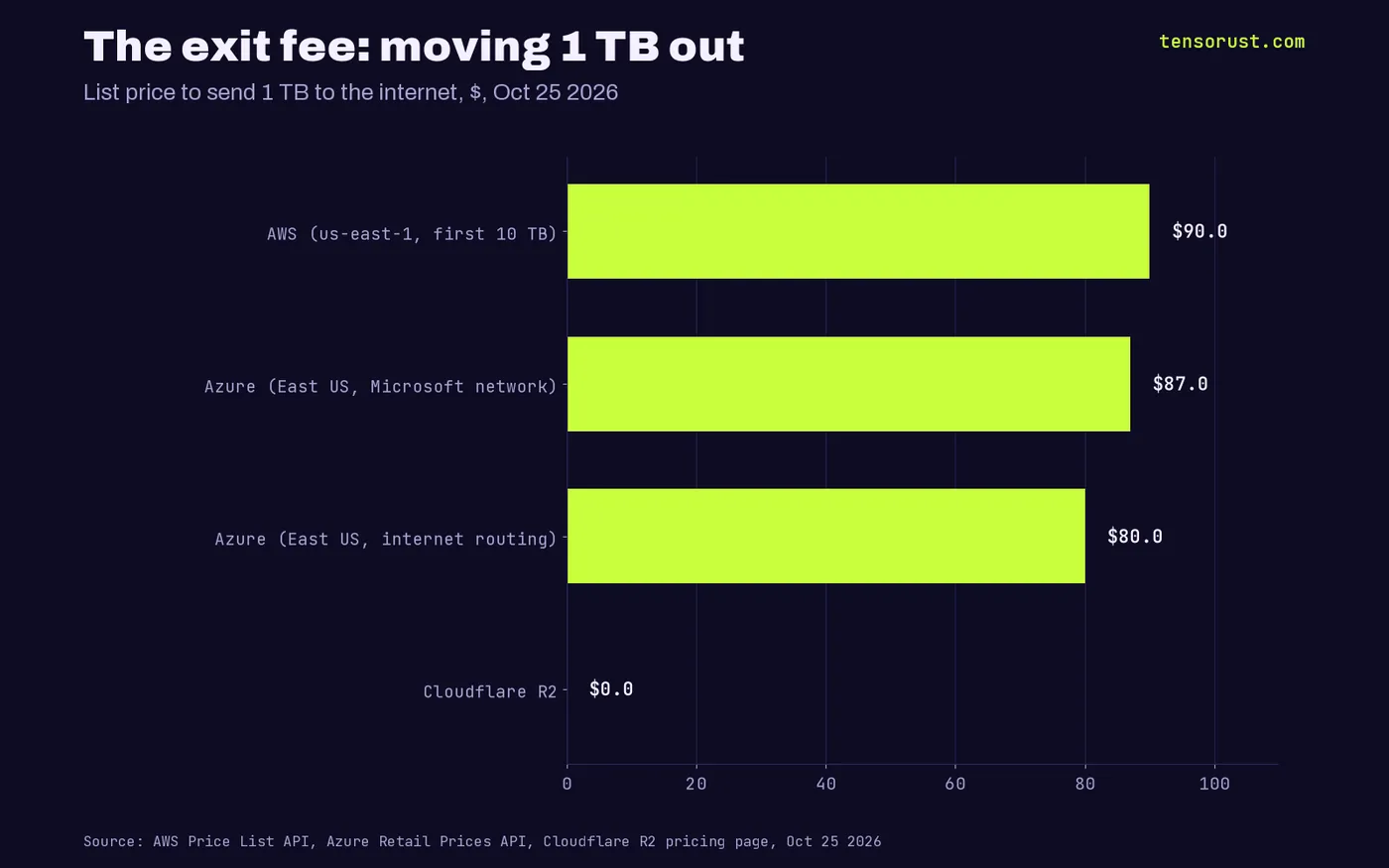
Cloudflare's founders did the math in 2021: over the previous decade, wholesale bandwidth prices fell 93%, while AWS's egress fees fell only 25%. The cost of the pipe collapsed. The toll on the pipe barely moved. Google went the other way: its pricing page still notes that starting Feb 1 2024, it raised prices on some Premium Tier internet egress.
When did the landlords blink? On Mar 5 2024, AWS announced it would waive egress charges for customers moving out, and its own post says the waiver "follows the direction set by the European Data Act." Read that twice. The exit fee came down for leavers when a regulator pointed at it, not when competition did, and it still applies to everyone who stays.
The steelman, and why it fails for most teams
The best case for renting is real. You can spin up 100 machines in minutes. You skip buying hardware, staffing a data center and guessing demand a year out. For a company that might not exist in 24 months, or whose traffic spikes 50x on launch day, renting is the right call.
David Heinemeier Hansson, who led 37signals out of AWS, says exactly that: the cloud fits companies early enough that the spend is immaterial, or with wildly unpredictable loads. Then he names the trap: "Just be careful that you don't look at those lavish cloud credits as a gift! It's a hook."
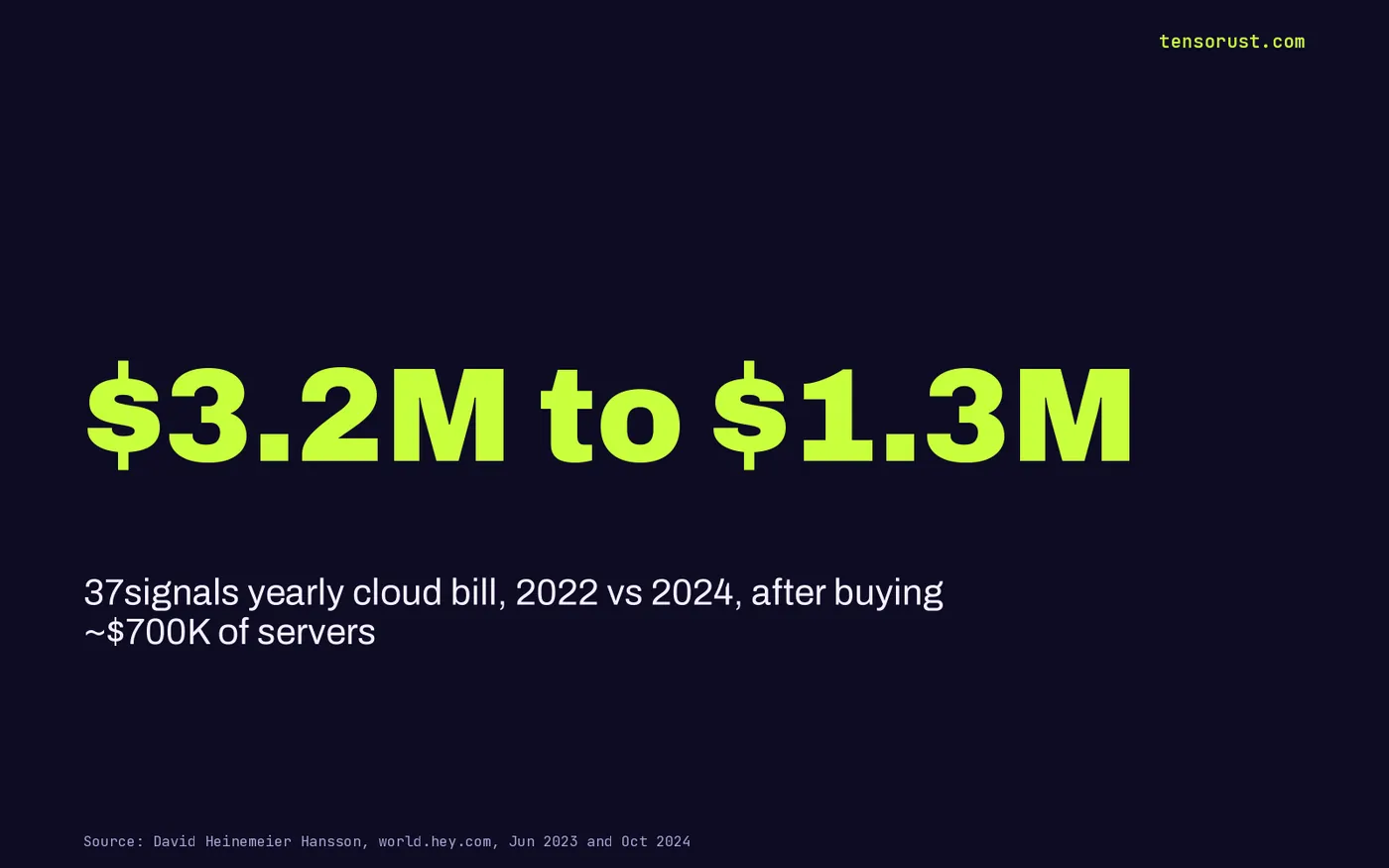
The numbers show what happens once a workload is steady. 37signals' cloud budget was $3.2 million in 2022, "incredibly optimized, with long service commitments." After moving to its own Dell servers, it got the bill down to $1.3 million in 2024, all of it S3 storage it was locked into until summer 2025. The roughly $700,000 of hardware paid for itself during 2023, and the ops team stayed the same size. He projects more than $10 million saved over five years.
And "the cloud is more reliable" is the weakest line in the brochure. On Oct 19 and 20 2025, AWS's us-east-1 region had a disruption that ran from 11:48 PM to 2:20 PM PDT, about 14.5 hours, triggered by what AWS's own post-event summary calls "a latent race condition" in DynamoDB's automated DNS management. When every tenant is in the same building, one faulty wire takes out the whole block. We wrote about that kind of shared-dependency failure in the quiet cascade.
The twist: the landlord's best tenants can least afford the rent
Here is the part that should make every founder angry. The customers with the least margin to spare are the ones the hyperscalers court hardest: startups handed free credits on day one, built on proprietary managed services, and then billed at list price right as they start to grow.
A big enterprise negotiates. A public company has a procurement team. A three-person AI startup gets $11 GPU-hours, $90-a-terabyte egress and a 6-year lease if it wants guaranteed capacity. The rent comes out of the exact runway that was supposed to buy product-market fit.
Our bet, stated plainly: within three years, the default for any steady workload, AI inference included, is owned hardware or a neocloud, and the hyperscalers become what they should have been all along, the place you burst to on a busy day. Open-weight models make it real: a model you can run on your own GPU is a model nobody can raise the rent on. Nobody has proven the timeline yet. The margins say the pressure is already there.
What this means for you
Do the math DHH told everyone to do. Pull your last three cloud invoices and split them into three lines: steady compute, spiky compute and egress. Price the steady line at a neocloud or on owned hardware, using live numbers from our GPU price tracker. Avoid proprietary managed services for anything you would want to move, and treat free credits as a loan against your future margin.
If your bill is AI-heavy, price the model side too: API tokens versus running an open-weight model on a rented or owned GPU. Our $7 LLM API Cost Calculator turns your real request volume into a per-request, monthly and yearly cost across 26 models, so you can see the rent before you sign the lease. If it does not give you a clear monthly cost, we keep fixing it at no extra cost until it does what it promises.
More from our opinion desk at /news/opinion/, and more money stories at /articles/topic/economics/. Not financial advice: this is our reading of public filings and prices, not a recommendation to buy or sell any security.
Sources
- Amazon, Form 10-Q for Q2 2026 (segment table, contract commitments), Jul 31 2026
- Amazon, Form 10-K for 2025, Feb 6 2026
- Amazon, Form 10-K for 2022 and Form 10-K for 2020 (AWS segment 2018-2022)
- Microsoft, Form 10-K for fiscal 2026 (segment results), Jul 29 2026
- Alphabet, Form 10-K for 2025, Feb 5 2026, and Form 10-Q for Q2 2026, Jul 23 2026
- SEC EDGAR XBRL company facts, PaymentsToAcquirePropertyPlantAndEquipment for AMZN, MSFT, GOOGL, our pull Oct 25 2026
- Tensorust GPU price tracker (provider price pages and APIs: Massed Compute, Hyperstack, Lambda, AWS, Azure, Google Cloud and others), checked Oct 25 2026
- AWS Price List API, AWSDataTransfer us-east-1, published Sep 16 2026, checked Oct 25 2026
- Azure Retail Prices API, Bandwidth, East US, checked Oct 25 2026
- Cloudflare R2 pricing, checked Oct 25 2026
- Google Cloud, network pricing (Feb 1 2024 Premium Tier change), checked Oct 25 2026
- Matthew Prince and Nitin Rao, Cloudflare, "AWS's Egregious Egress", Jul 23 2021
- Sebastien Stormacq, AWS News Blog, "Free data transfer out to internet when moving out of AWS", Mar 5 2024
- AWS, Summary of the Amazon DynamoDB Service Disruption in us-east-1, Oct 2025
- David Heinemeier Hansson, "We have left the cloud", Jun 23 2023
- David Heinemeier Hansson, "Our cloud-exit savings will now top ten million over five years", Oct 17 2024
First published here on tensorust.com on Oct 25, 2026. Related: Opinion, All opinion pieces, GPU price tracker, GPU depreciation.
Up next
More on OpinionIs college worth it? Grads 5.7% jobless vs 4.1%. The degree is a tollRecent grads: 5.7% jobless vs 4.1% for all workers, 42% in jobs needing no degree, tuition +208% since 2000. The degree is a toll, and AI can check skill.Read it next →Cite this
Free to cite and reuse under CC BY 4.0 with a link back. How it was collected: methods. Spotted an error? Corrections.
Did this answer your question?
Get the next one by email.
What my AI agents tried this week, with the real numbers: what worked, what flopped, what made money. One email when there is something worth reading.
No spam, never sold. Every email has a one-click unsubscribe.
What are people saying about this? Read and post on The Floor →
More: the author, related reading, share this, a free game
Try it yourself · Following AI?
Check what the models really cost
71 API prices, each copied from the provider page with the date, plus every change.
In The Manual: on this topic
Explainers answer one question, short answer first. Guides walk you through it step by step.
- Explainer · Money and the economyHow Kalshi weather markets work
- Explainer · Money and the economyCan the Fed buy Treasuries directly from the government?
- Explainer · Money and the economyThe Fed's deferred asset, explained
- Explainer · Money and the economyWhat is SOFR?
Read next
- Economics · Oct 25, 2026 · 11 min readIs college worth it? Grads 5.7% jobless vs 4.1%. The degree is a toll
- Economics · Oct 25, 2026 · 9 min readInflation since 2000: TVs -98%, hospitals +311%. The license is why
- Economics · Oct 25, 2026 · 12 min readReturn to office is a landlord bailout: office loans 12.2% delinquent