By Matt Busel, who built the apps, crates and game he writes about · every number links to its source and every dataset is downloadable (methods) · corrections · featured in Kirino, gamebiz, This Week in Rust, New Mobile Life, By-Press
Dolly Parton's Imagination Library: $2 a book, $1,159 from Washington
On this page · 10 sections
- Key numbers
- A country singer built the cheapest literacy machine in America
- The books are tax filings, not vibes
- Follow the money: locals pay, Dolly routes, Washington watches
- Overhead is a rounding error
- What a book actually costs
- Who blocks it? The data says: nobody, really
- The design lesson for builders
- What this means for you
- Sources
Short answer: Dolly Parton's Imagination Library mails a free book every month to children from birth to age five, and it runs on a model almost nobody copies: the Dollywood Foundation negotiates prices and runs the mailing machine, while more than 1,800 local partners pay the bill. Its own tax filings show $63.9 million of spending in 2023, 77% of revenue paid back by those partners, and salaries under 3% of costs. Our estimate: about $2.18 per book delivered. Washington's total contribution in federal contracts since 2015: $1,158.93.
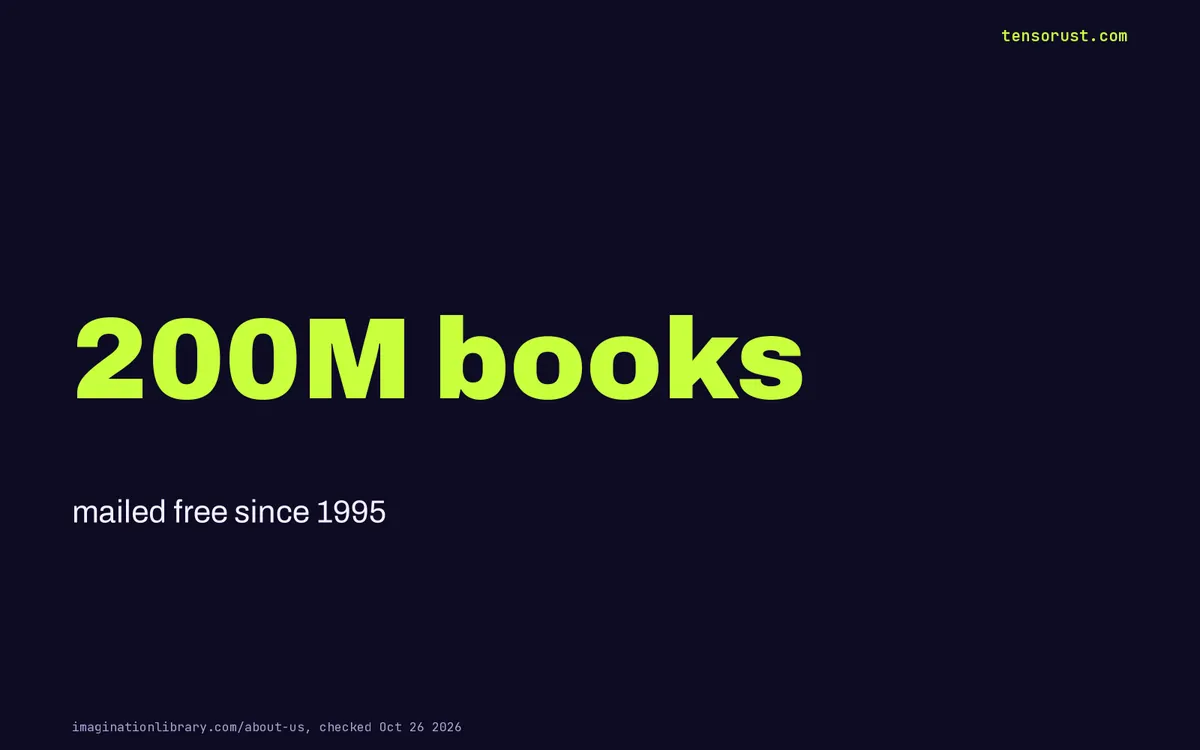
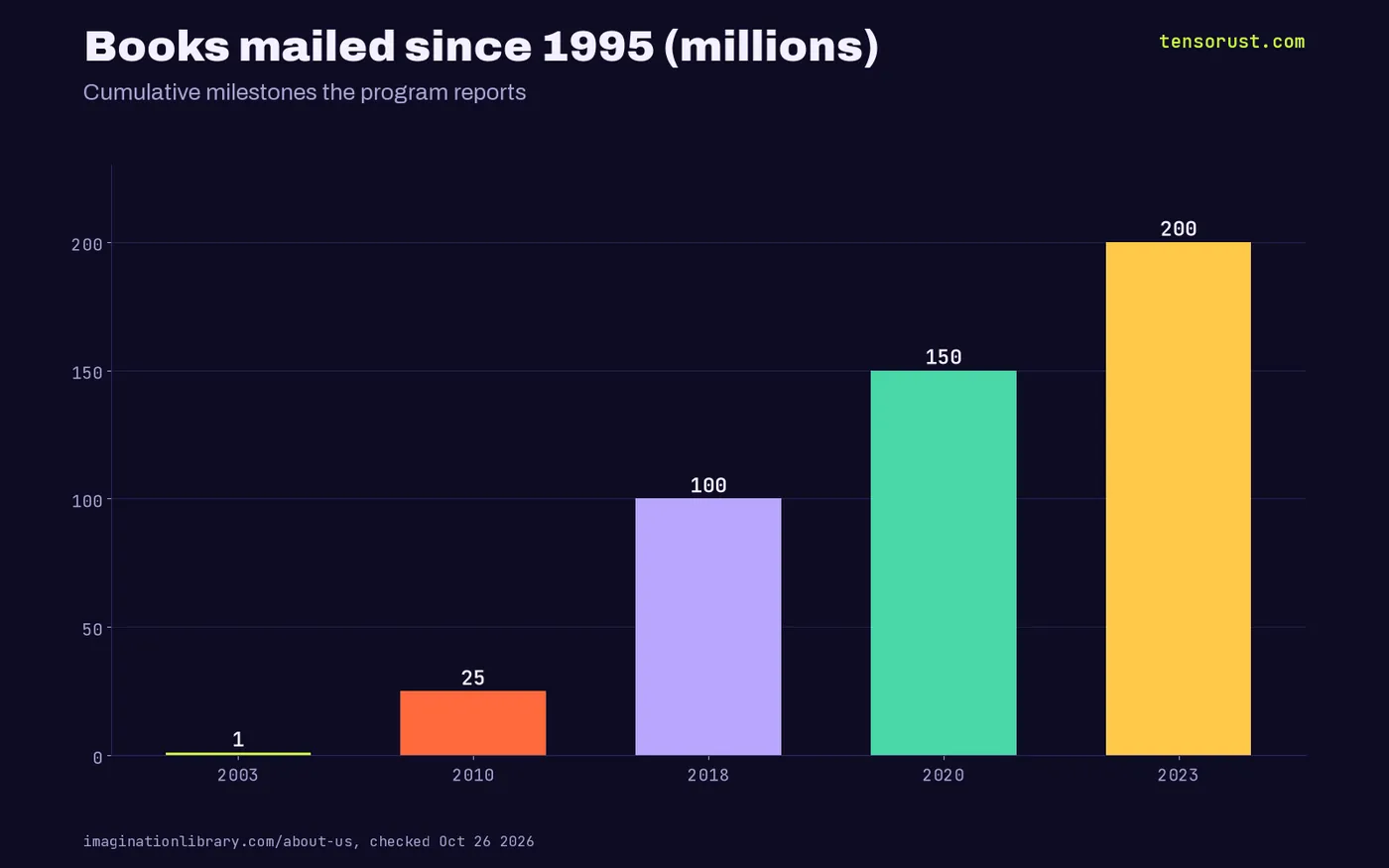
TL;DR: The program says it passed 200 million books in 2023 and reaches 1 in 7 American children under five. The foundation's IRS Form 990 for 2023 shows $78.4 million in revenue, of which $60.4 million came from local partners reimbursing book and postage costs and only $16.5 million from donations. If you want to beat a limit like childhood illiteracy, the lesson is not "be Dolly"; it is build a cheap central engine, let local money plug in, and keep the cost per unit at the price of a coffee.
Key numbers
| What | Number | Source, checked Oct 26 2026 |
|---|---|---|
| Books mailed since 1995 | 200 million (milestone hit in 2023) | Imagination Library, About Us |
| US children under 5 reached | 1 in 7 (14%), 2024 | Imagination Library, About Us |
| Dollywood Foundation revenue, 2023 | $78.4M | IRS 990 via ProPublica |
| Paid back by local partners (program revenue) | $60.4M (77%) | IRS 990 via ProPublica |
| Donations and grants | $16.5M | IRS 990 via ProPublica |
| Total spending, 2023 | $63.9M | IRS 990 via ProPublica |
| All salaries (officers + staff) as share of spending | 2.7% | Our math on the 2023 990 |
| Cost per book, 2022 (our estimate) | about $2.18 | Our math: $52.4M spend / 24M books (2M a month) |
| Federal contracts to the foundation since 2015 | $1,158.93 across 3 awards | USAspending.gov |

A country singer built the cheapest literacy machine in America
The program is on the Hacker News front page today with 605 points, which tells you something: engineers looked at a book club for toddlers and saw a system worth studying. They are right to.
It started in November 1995 in one county, Sevier County, Tennessee, where Parton grew up. Wikipedia's account says she started it as a tribute to her father, whose "inability to read probably kept him from fulfilling all of his dreams."
From there the curve looks like a startup's. One million books by 2003. Tennessee went statewide in 2004. Canada in 2006, the UK in 2007, Australia in 2013, Ireland in 2019. One million books a month in 2016, two million a month in 2022, and Wikipedia now puts it at roughly three million a month.
Childhood illiteracy gets treated like weather: sad, permanent, someone else's job. This program treats it like a logistics problem with a unit cost. That is the whole reason it works.
The books are tax filings, not vibes
We pulled every Form 990 the Dollywood Foundation (EIN 62-1348105) has filed with data on ProPublica's Nonprofit Explorer, 2011 through 2023. A Form 990 is the annual return a US charity files with the IRS; it shows where the money comes from and where it goes. The full table is in the download below this article.
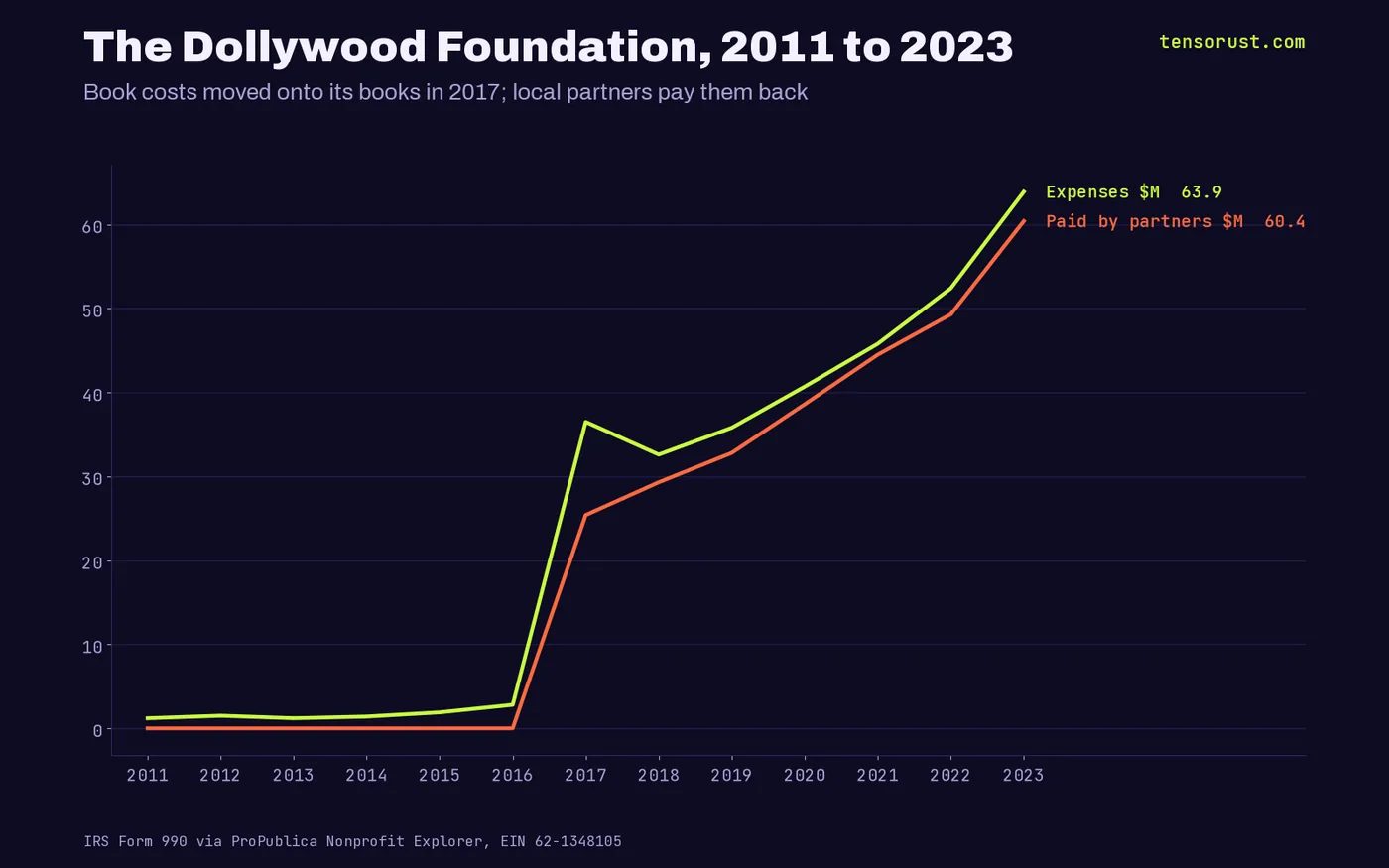
The shape is striking. In 2016 the foundation spent $2.8 million. In 2017 it spent $36.5 million. Nothing magic happened to the program that year; the book and postage costs started flowing through the foundation's own books, with local partners paying them back. You can see it in the "program revenue" line, which goes from $0 in 2016 to $25.4 million in 2017.
By 2023 that line hit $60.4 million. Spending hit $63.9 million. Revenue hit $78.4 million, and net assets ended the year at $31.8 million.
Follow the money: locals pay, Dolly routes, Washington watches
Here is the model in one sentence, from Wikipedia's write-up of the foundation: it "provides administrative support and negotiates book pricing, while local partners raise funds to cover the wholesale and mailing costs." Partners are libraries, school districts, United Ways, Rotary clubs and, in several places, state governments.
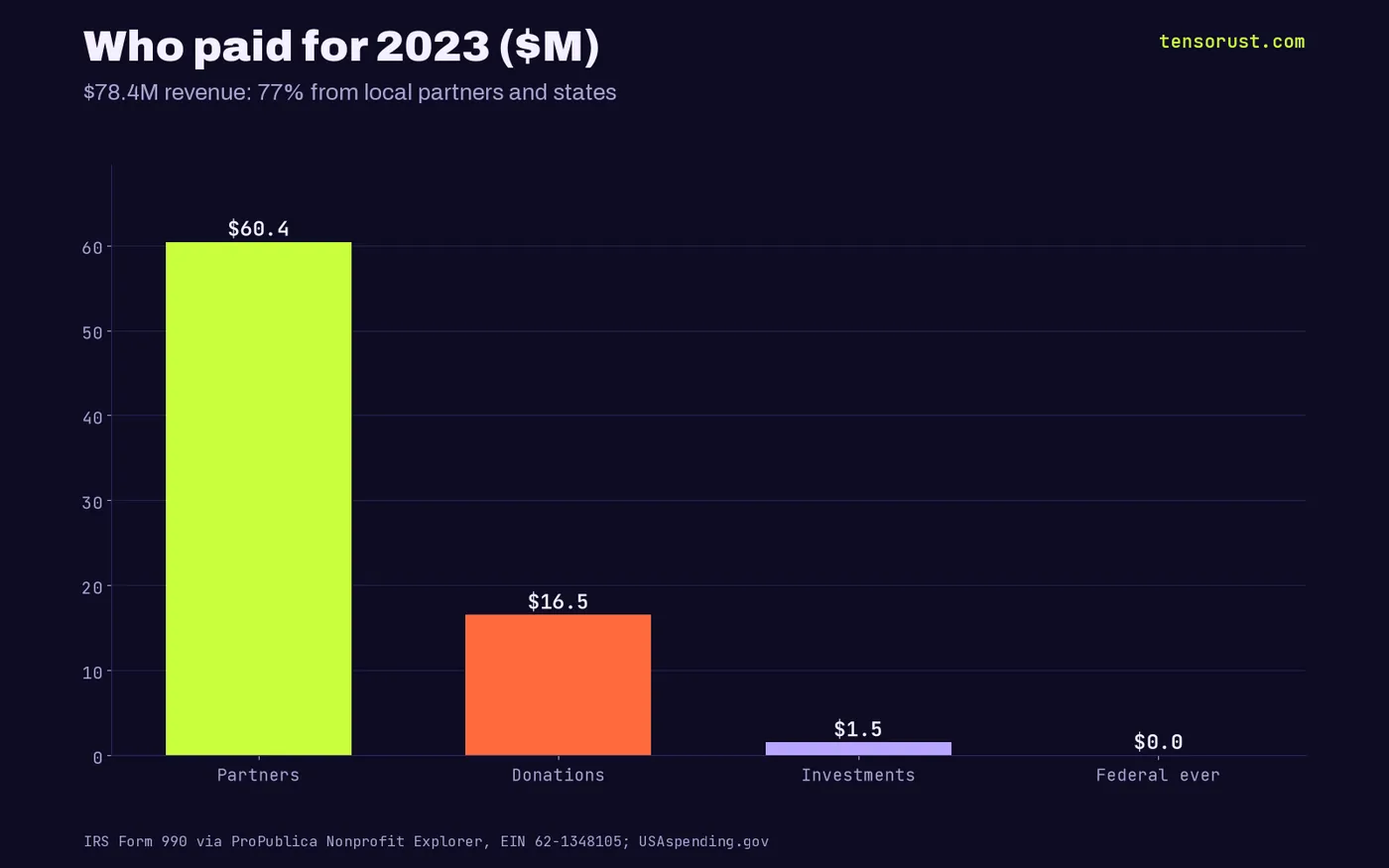
So who actually pays? In 2023, 77% of the foundation's revenue was program revenue: partners paying for their kids' books. Donations and grants were $16.5 million, about 21%. Investment income was $1.5 million.
And the federal government? We searched USAspending.gov, the official record of federal contracts and grants. The Dollywood Foundation shows three Bureau of Indian Affairs contracts from 2015 to 2017, for books at one school, totalling $1,158.93. Two of the three are listed at $0.
That is not a scandal. It is the point. One of the most widely used early literacy programs in the country was built with essentially zero federal dollars, by a celebrity's foundation and thousands of local checkbooks.
Overhead is a rounding error
Charity watchers love to scream about overhead. Here it is hard to find. The 2023 return lists $397,932 in compensation for current officers and $1.35 million in other salaries and wages. Together that is $1.75 million, or 2.7% of total spending.
Officer pay was $434,694 in 2019, when the foundation spent $35.8 million. Spending nearly doubled by 2023; officer pay went down. Whatever you think of nonprofits in general, this one scaled its output far faster than its payroll.
The reason is the design. The foundation does not hire a reading coach for every town. It buys books in bulk, mails them, and lets local partners do the enrollment and fundraising they were going to do anyway.
What a book actually costs
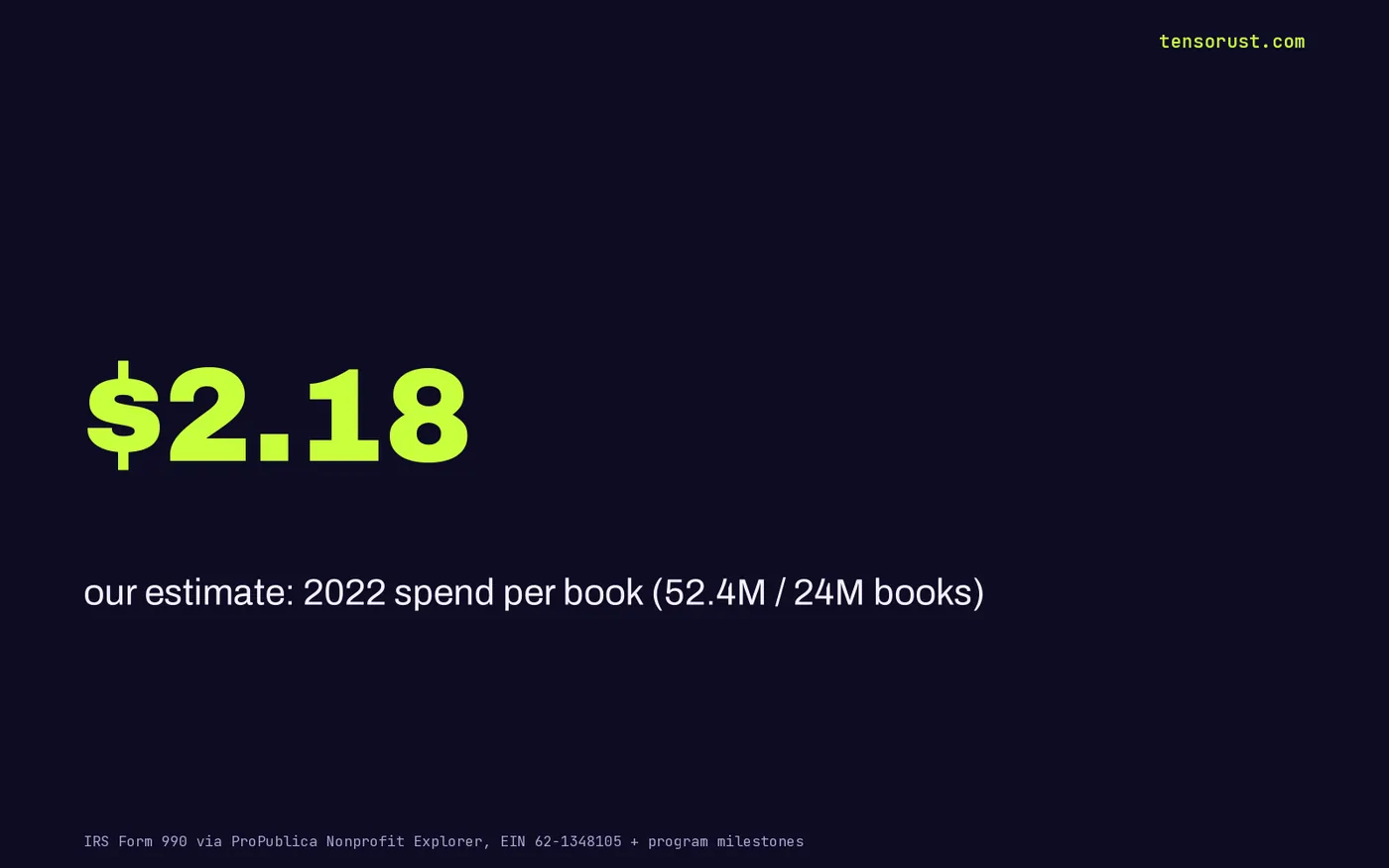
The program said it was mailing 2 million books a month in 2022. That is about 24 million books a year. The foundation spent $52.4 million that year.
Divide one by the other and you get about $2.18 per book, all in. That is our estimate, not a number the foundation publishes, and it is rough: it counts every dollar the foundation spent as book money, which overstates the cost a bit, and it ignores whatever partners spend locally on top.
Even rough, the order of magnitude is the story. Sixty books over five years, delivered to the door, for something in the low hundreds of dollars per child. Our bet: very few education interventions in the country can show that cost per child with a straight face.
Who blocks it? The data says: nobody, really
Our rule on Frontiers pieces is that "who blocks it" is a question, not an accusation. So we looked. We found no regulator fighting it, no federal agency squeezing it, no lobbying war around it.
What limits it is simpler. Coverage is uneven because the money is local. A county with a partner gets books; the next county over without one does not. That is the price of a model that does not wait for Washington: it moves fast where people care, and it stops at the county line where nobody signs up.
Nobody has proven which design is better at national scale. But the pattern says the plug-in model got to 1 in 7 American kids under five without a federal program, and we have watched plenty of federal programs spend far more to reach far fewer.

The design lesson for builders
Strip the country music out and this is a platform. A thin central engine that does the hard, scale-sensitive parts (book selection, bulk pricing, printing, mailing, address data) and an open socket where any local group can plug in money and get a measurable output for its kids.
That is the same shape as the best software infrastructure. One team owns the hard core and the unit cost; thousands of users bring their own demand. It is also the shape we keep finding in our Frontiers coverage: limits we were told are permanent tend to fall to a unit cost that keeps dropping, not to a speech.
It also has a lesson about data. The program's best argument is a number: 200 million books, 1 in 7 kids. If you build anything in the public interest, publish your unit cost and your reach, in a form people and machines can read. We did that here; the CSV is below. For more on how open public data moves outcomes, see how Wikipedia's reader numbers shifted, and our news desk for the money side of deep tech.
What this means for you
If you have kids under five, check whether your county has a partner; enrollment is free and takes a minute on the program's site. If it does not, that is your opening: a local partner is a library, a Rotary club or a small business willing to cover roughly $2 a book for its own zip code.
If you are a builder, copy the shape. Find a limit people treat as permanent, price the unit, build the cheap core, and let local money plug in. Then publish the numbers so others can check you.
Launching a program page, a donation flow or a small product to do exactly that? Our $49 Launch Check goes through your page before you ship it, and we keep fixing it at no extra cost until it does what it promises. More of our reads on who pays for what are in opinion.
Not financial advice; this is our reading of public filings.
Sources
- ProPublica Nonprofit Explorer, The Dollywood Foundation IRS Form 990 filings 2011 to 2023, checked Oct 26 2026
- IRS Form 990, tax year 2023 (PDF), checked Oct 26 2026
- Dolly Parton's Imagination Library, About Us and program milestones, checked Oct 26 2026
- Wikipedia, The Dollywood Foundation, checked Oct 26 2026
- USAspending.gov, Bureau of Indian Affairs award INA17PX00175 to The Dollywood Foundation, checked Oct 26 2026
- Hacker News front page, "Dolly Parton's Imagination Library" (605 points), Oct 26 2026
First published here on tensorust.com on Oct 26, 2026. Related: .
Up next
More on FrontiersBrain chip trials: China plans 205 implant patients, the US 13We pulled 280 brain-computer interface studies from ClinicalTrials.gov. Implant trials since 2025: China plans 205 patients, the US 13. Neuralink leads.Read it next →Cite this
Free to cite and reuse under CC BY 4.0 with a link back. How it was collected: methods. Spotted an error? Corrections.
Did this answer your question?
Get the next one by email.
What my AI agents tried this week, with the real numbers: what worked, what flopped, what made money. One email when there is something worth reading.
No spam, never sold. Every email has a one-click unsubscribe.
What are people saying about this? Read and post on The Floor →
More: the author, related reading, share this, a free game
Try it yourself · Learning by doing?
The Manual has the next step
Short answers first, then step-by-step guides with the real commands.
From The Manual
Explainers answer one question, short answer first. Guides walk you through it step by step.
- Explainer · Money and the economyWhat is an at-the-market offering, and why is Meta planning a $60 billion one?
- Guide · Rust and cratesHow to check your Cargo.lock for vulnerabilities with cargo audit
- Guide · Rust and cratesHow to vendor Rust dependencies with cargo vendor for offline builds
Read next
- Economics · Oct 26, 2026 · 6 min readUS Antimony's Alaska find: $439M before costs. So is the stock
- Story chapters · Oct 26, 2026 · 6 min readBrain chip trials: China plans 205 implant patients, the US 13
- Economics · Oct 26, 2026 · 6 min readUS grid batteries hit 54 GW, 37x 2020. Texas built the most