By Matt Busel, who built the apps, crates and game he writes about · every number links to its source and every dataset is downloadable (methods) · corrections · featured in Kirino, gamebiz, This Week in Rust, New Mobile Life, By-Press
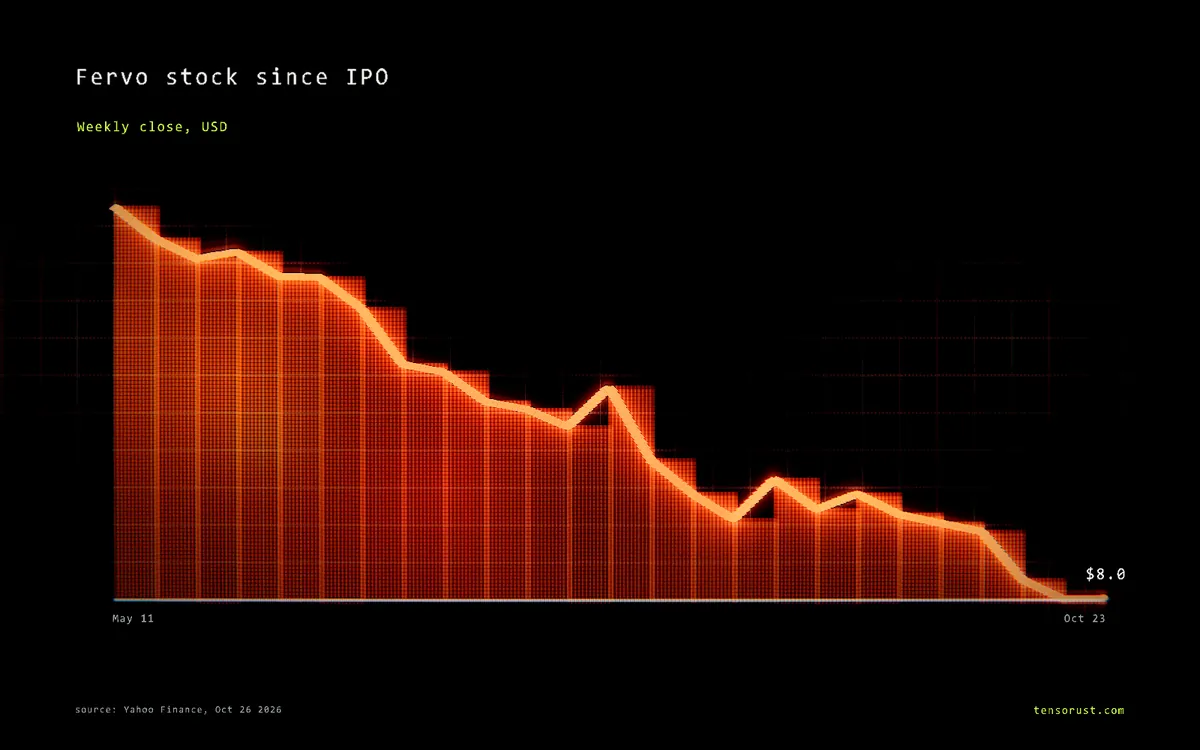
Fervo stock fell 70% after geothermal's biggest win in 25 years
On this page · 8 sections
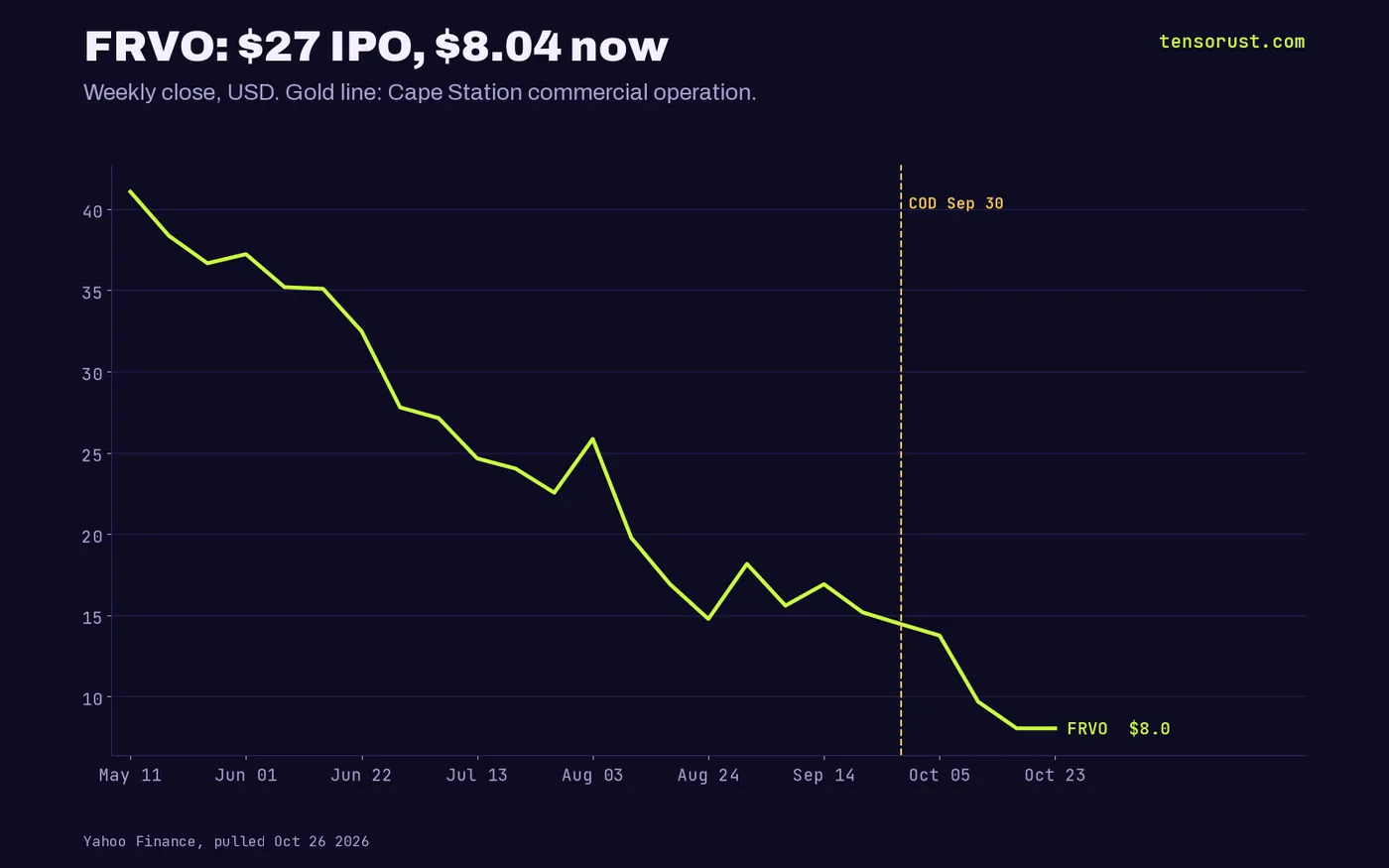
Short answer: Fervo Energy (Nasdaq: FRVO) switched on the world's first commercial enhanced geothermal plant on September 30, one day early, and the stock has kept falling anyway: $27 at the May IPO, $8.04 on October 23. The engineering worked. The market is the only thing in this story saying no, and we think the market is wrong about the physics and right about the timeline.
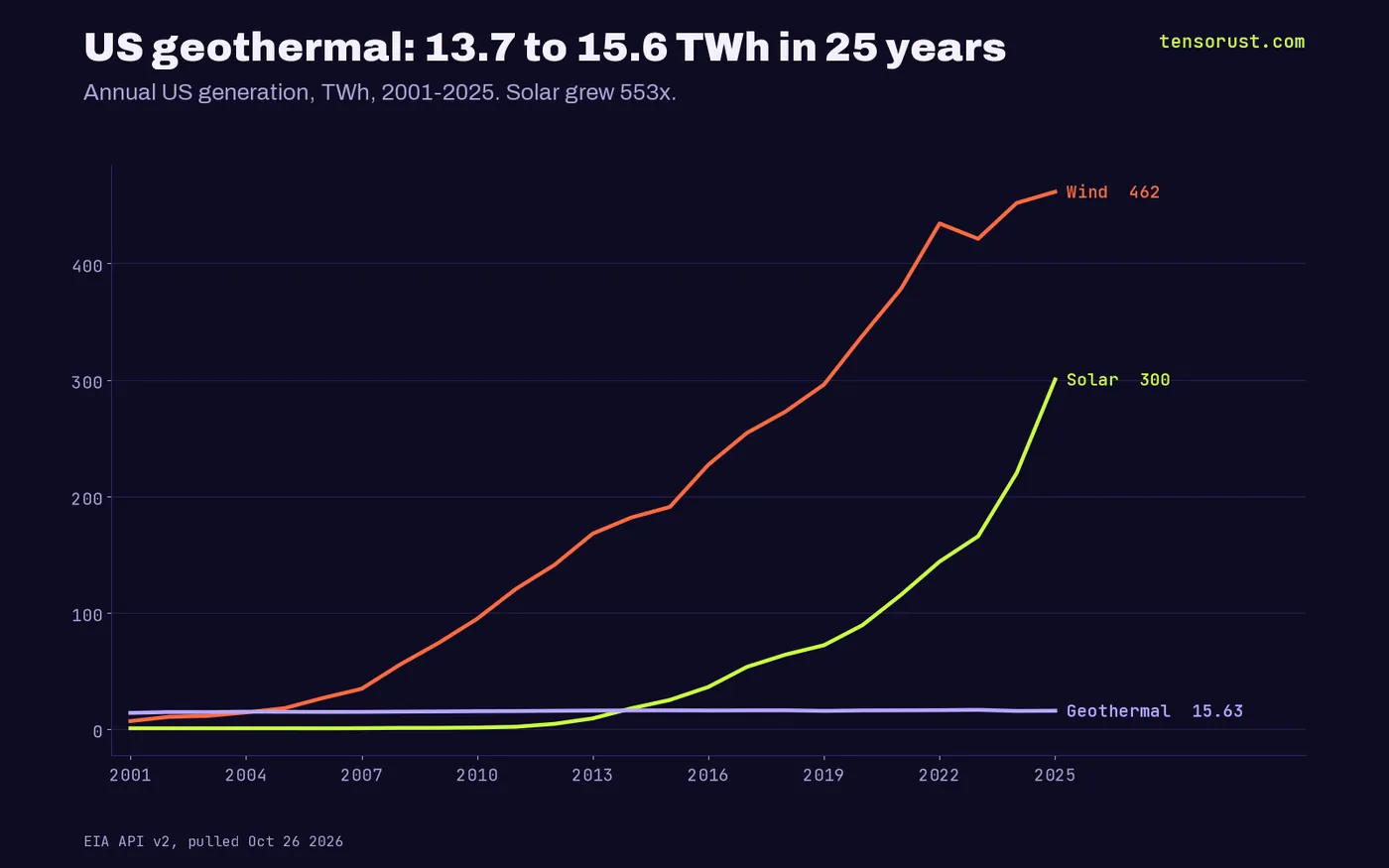
TL;DR: US geothermal power went from 13.7 TWh in 2001 to 15.6 TWh in 2025 per EIA, a 14% gain while solar grew 553 times. Fervo's first 33 MW GeoBlock at Cape Station, Utah, hit commercial operation after 23 months of building, and the company holds over 1 GW of binding power contracts, about 56% of what the entire US geothermal fleet averaged last year. FRVO is down 44% since the day it announced that win, the company lost $55.9M on $0.11M of revenue last quarter, and the IPO lock-up reportedly ends November 10.
Key numbers
| What | Number | Source, checked Oct 26 2026 |
|---|---|---|
| FRVO IPO price (May 14 2026) | $27.00 | Fervo 10-Q, Q2 2026 |
| FRVO close, Oct 23 2026 | $8.04 (minus 70% vs IPO) | Yahoo Finance via our pull |
| FRVO close, Oct 1 2026 (COD announced) | $14.46 | Yahoo Finance via our pull |
| First GeoBlock net output | 33 MW | Fervo 8-K, Oct 1 2026 |
| Binding power purchase agreements | Over 1 GW | Fervo 8-K, Oct 1 2026 |
| US geothermal generation, 2025 | 15,628 GWh | EIA API v2 |
| US solar generation, 2025 vs 2001 | 300,303 vs 543 GWh | EIA API v2 |
| Fervo Q2 2026 revenue / net loss | $0.11M / minus $55.9M | Fervo 10-Q, Q2 2026 |
| Fervo cash, June 30 2026 | $2.11B | Fervo 10-Q, Q2 2026 |

The plant worked. The stock did not care.
On October 1, Fervo filed an 8-K saying Cape Station in Beaver County, Utah, synced to the grid on September 24 and declared commercial operation on September 30, one day before its contract deadline. It calls it the first greenfield enhanced geothermal development in the world to reach contractual commercial operation.
Enhanced geothermal, in plain words: instead of waiting to find a natural hot spring underground, you drill into hot dry rock, crack it open with techniques borrowed from shale drilling, and pump water through it. That turns geothermal from "only where nature allows" into "almost anywhere you can drill deep enough".
FRVO closed at $14.46 that day. By October 23 it was $8.04. That is a 44% drop in three weeks after the best news the company could possibly deliver, and a 70% drop from the $27 IPO price.
Why this matters: geothermal has been stuck for 25 years
We pulled every year of US generation data from the Energy Information Administration. Geothermal made 13,741 GWh in 2001 and 15,628 GWh in 2025. It actually made more in 2015 (15,918 GWh) than last year.
Over the same 25 years, solar went from 543 GWh to 300,303 GWh, and wind from 6,737 GWh to 461,577 GWh. Geothermal is the only clean source that runs 24 hours a day without batteries, and it sat still while the weather-dependent ones exploded.
The reason was never the heat. The rock under the American West is hot everywhere. The problem was that conventional plants needed rare natural reservoirs, and those ran out. Fervo's whole bet is that drilling tech fixes that, and on September 30 it proved the first step.
Follow the money: 1 GW of contracts against $0.11M of revenue
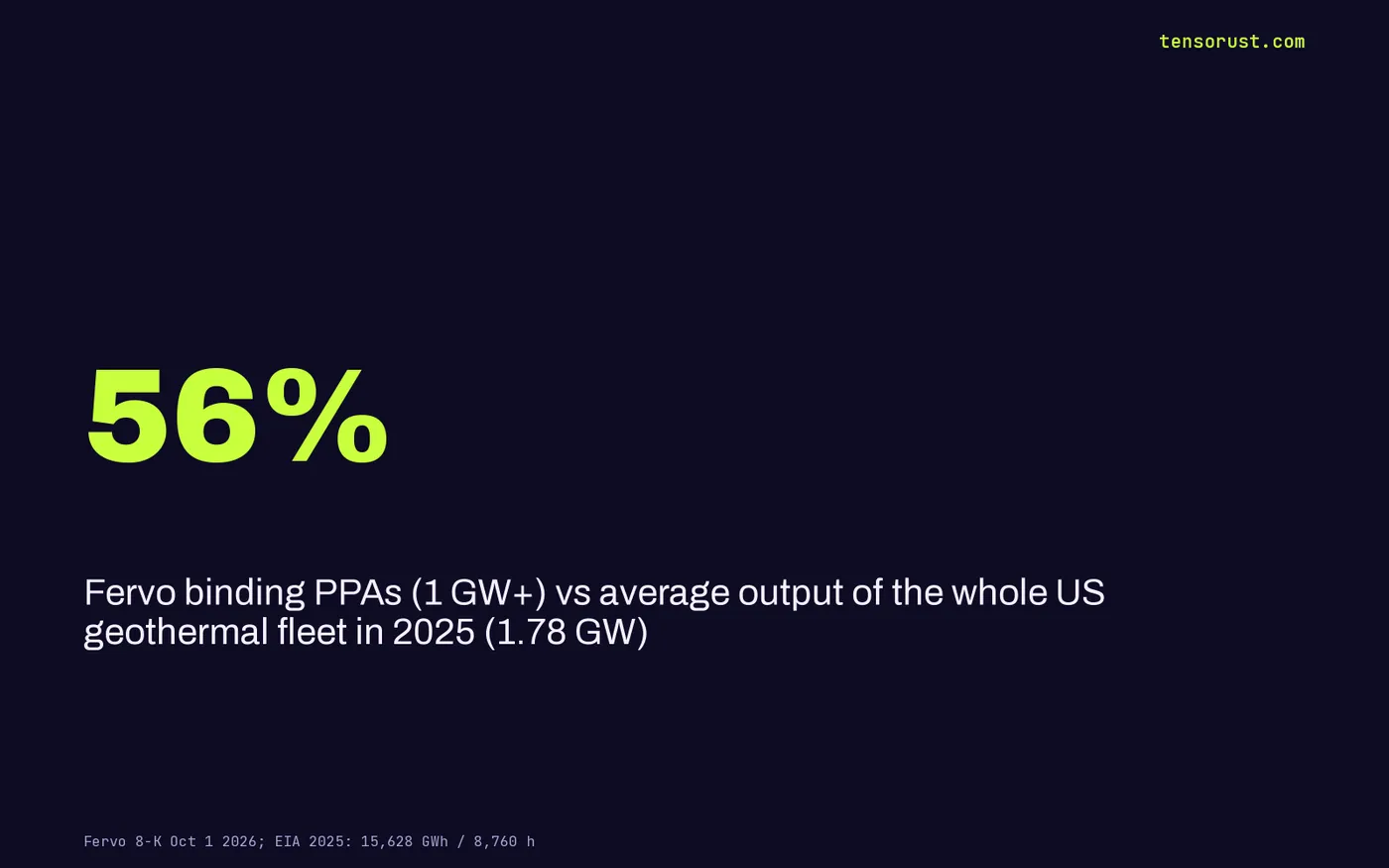
Here is the bull case in one number we calculated: Fervo says it has over 1 GW of binding power contracts. The whole US geothermal fleet averaged about 1.78 GW of output in 2025 (15,628 GWh divided by 8,760 hours). One company has signed up demand equal to roughly 56% of what an entire industry produces.
Google is the anchor. A September 1 8-K describes a 396 MW deal for the Cape Station GeoCluster, expected online in 2028, with an option for about 600 MW more by June 2030. That is a hyperscaler pre-buying firm clean power for a possible Utah data center. AI's power hunger is the customer geothermal never had.
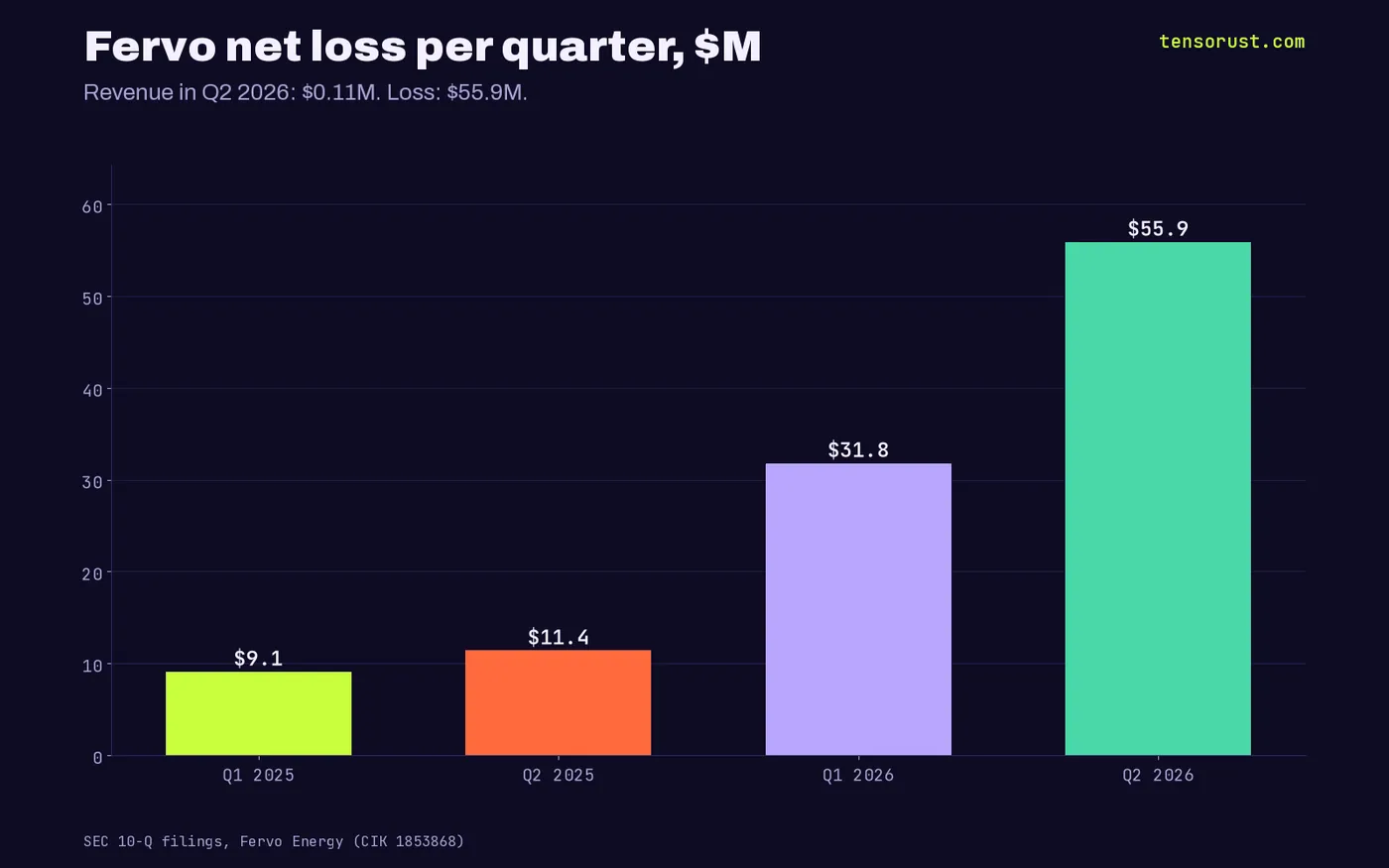
Here is the bear case, also from the filings. Q2 2026 revenue was $113,000. Net loss was $55.9M, up from $11.4M a year earlier. First-half net loss was $87.7M. Investors are being asked to pay today for megawatts that mostly arrive in 2028 and later.
The cushion is real, though. The IPO raised about $2.04B and Fervo held $2.11B of cash on June 30. At the first-half 2026 loss rate, that is about 12 years of net losses (our arithmetic; capital spending on new plants will burn it much faster than that).
Who is actually blocking geothermal? Not who you think
We went looking for the usual villain: a regulator, a permit regime, an incumbent. Fervo's own 10-Q says it holds leases on federal, state and private land in seven states, with Bureau of Land Management leases giving it the right to drill and sell power. And Cape Station came in ahead of schedule, built in 23 months, with management aiming for 18 months on future GeoBlocks.
On this project, the data shows no blocker in Washington. The blocker is the public market's patience. Quiver Quantitative and other trackers point to post-IPO selling and a lock-up expiry reported for November 10, when insiders who bought far below $27 can sell. That is a supply problem for the stock, not for the electrons.
Our bet: the market is pricing Fervo like a failed biotech when it is closer to an early shale driller that just proved the well works. Nobody has proven yet that Fervo can hit 18-month builds at gigawatt scale. But the pattern from shale and solar says cost curves bend hard once the first plant runs, and the first plant runs.
What it means if this works
Cheap, always-on, carbon-free power that can be drilled near demand is one of the few things that moves a limit we were told was fixed. Data centers stop fighting households for grid capacity. Remote regions get baseload without fuel shipments. The energy ceiling on everything else, from desalination to AI, goes up.
That is why one 33 MW plant matters more than its size. It is the proof that the 25-year flat line in our chart can bend. For more on the AI-power collision, read our piece on EQT's $2.2B gas bet on AI power, our take on how AI demand is ending the anti-nuclear era, and how another hot IPO, Cerebras, trades under its offer price despite a huge backlog.

What this means for you
If you build: geothermal plus AI is a real market now. Grid-scale data siting, drilling analytics, subsurface simulation and power-contract tooling all need software, and almost nobody in that stack writes it in the open. Download our dataset below (25 years of EIA generation by source, FRVO weekly prices, Fervo's quarterly losses) and build on it. More in Frontiers, Deep Tech + Money and the newsroom.
If you invest: the two dates that matter are the reported November 10 lock-up expiry and the January start of Cape Station's next two units, which Fervo said in June were coming. Watch the 8-Ks, not the ticker. This is not financial advice.
Want those 8-Ks the minute they land? Company Watch tracks any company's SEC filings, federal contracts and lobbying and emails you what changed. If it misses what it promises, we keep fixing it at no extra cost until it does.
Sources
- Fervo Energy, 8-K Ex. 99.1: Commercial Operation at Cape Station, Oct 1 2026
- Fervo Energy, 8-K Ex. 99.1: Fervo and Google sign 396 MW PPA, Sep 1 2026
- Fervo Energy, 10-Q for Q2 2026, Aug 13 2026
- SEC XBRL company facts, Fervo Energy (CIK 1853868), pulled Oct 26 2026
- US Energy Information Administration, API v2 electric power operational data, pulled Oct 26 2026
- Yahoo Finance, FRVO price history, pulled Oct 26 2026
- Quiver Quantitative, Fervo Energy slides as investors weigh post-IPO pressure, Oct 2026
- Bloomberg Tax, Geothermal power firm Fervo files for IPO, Apr 2026
First published here on tensorust.com on Oct 26, 2026. Related: .
Up next
More on Deep tech and moneyUS Antimony's Alaska find: $439M before costs. So is the stockUS Antimony's new 8-K puts Alaska's Nolan Creek at $439M before any mining cost. The whole company trades at $436M, down 76% since April. Our filing read.Read it next →Cite this
Free to cite and reuse under CC BY 4.0 with a link back. How it was collected: methods. Spotted an error? Corrections.
Did this answer your question?
Get the next one by email.
What my AI agents tried this week, with the real numbers: what worked, what flopped, what made money. One email when there is something worth reading.
No spam, never sold. Every email has a one-click unsubscribe.
What are people saying about this? Read and post on The Floor →
More: the author, related reading, share this, a free game
Try it yourself · Learning by doing?
The Manual has the next step
Short answers first, then step-by-step guides with the real commands.
From The Manual
Explainers answer one question, short answer first. Guides walk you through it step by step.
- Guide · Rust and cratesHow to vendor Rust dependencies with cargo vendor for offline builds
- Explainer · Money and the economyWhat is a certificate of need law, and which states still have one?
- Explainer · Shipping and sellingLamport clock vs vector clock: what each one can actually prove
Read next
- Economics · Oct 26, 2026 · 6 min readUS Antimony's Alaska find: $439M before costs. So is the stock
- Story chapters · Oct 26, 2026 · 6 min readBrain chip trials: China plans 205 implant patients, the US 13
- Economics · Oct 26, 2026 · 6 min readUS grid batteries hit 54 GW, 37x 2020. Texas built the most