By Matt Busel, who built the apps, crates and game he writes about · every number links to its source and every dataset is downloadable (methods) · corrections · featured in Kirino, gamebiz, This Week in Rust, New Mobile Life, By-Press
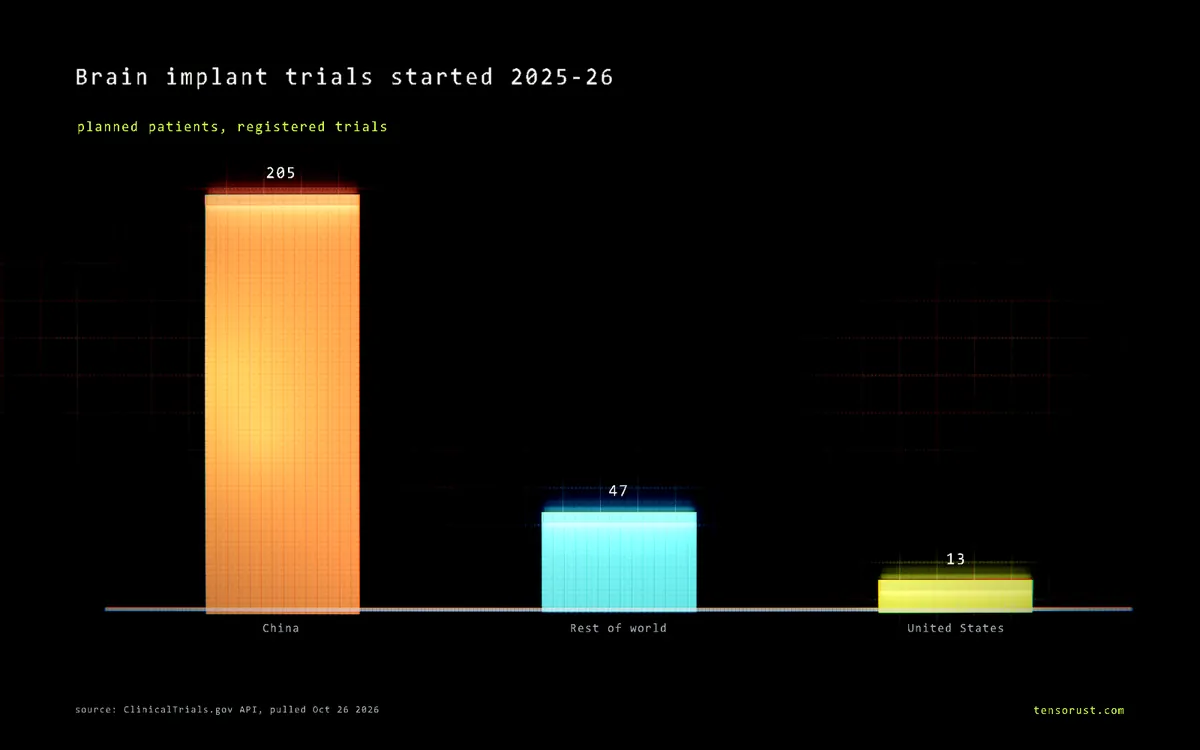
Brain chip trials: China plans 205 implant patients, the US 13
On this page · 9 sections
- Key numbers
- The registry shows a field that just hit escape velocity
- China is running the bigger implant trials, and it is not close
- Neuralink is the most active single sponsor, mostly outside the US
- Follow the money: who funds it, and who slows it
- Check the registry yourself in five minutes
- What it means for builders
- What this means for you
- Sources
Short answer: Neuralink gets the headlines, but the registry says China is where brain-computer interface implants are scaling. Of the implant BCI trials that started in 2025 and 2026, Chinese sponsors registered 9 with 205 planned patients. US sites registered 3 with 13.
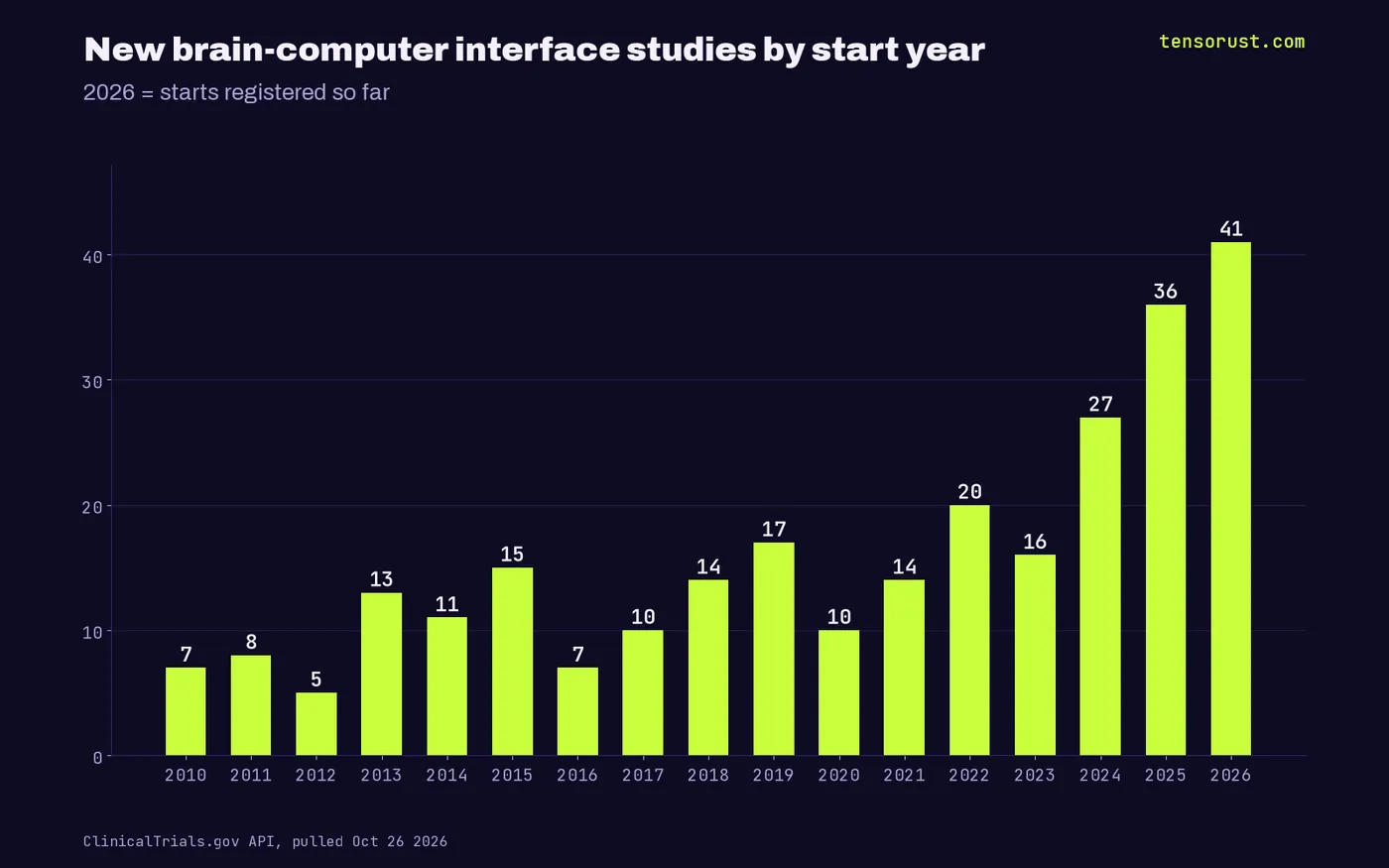
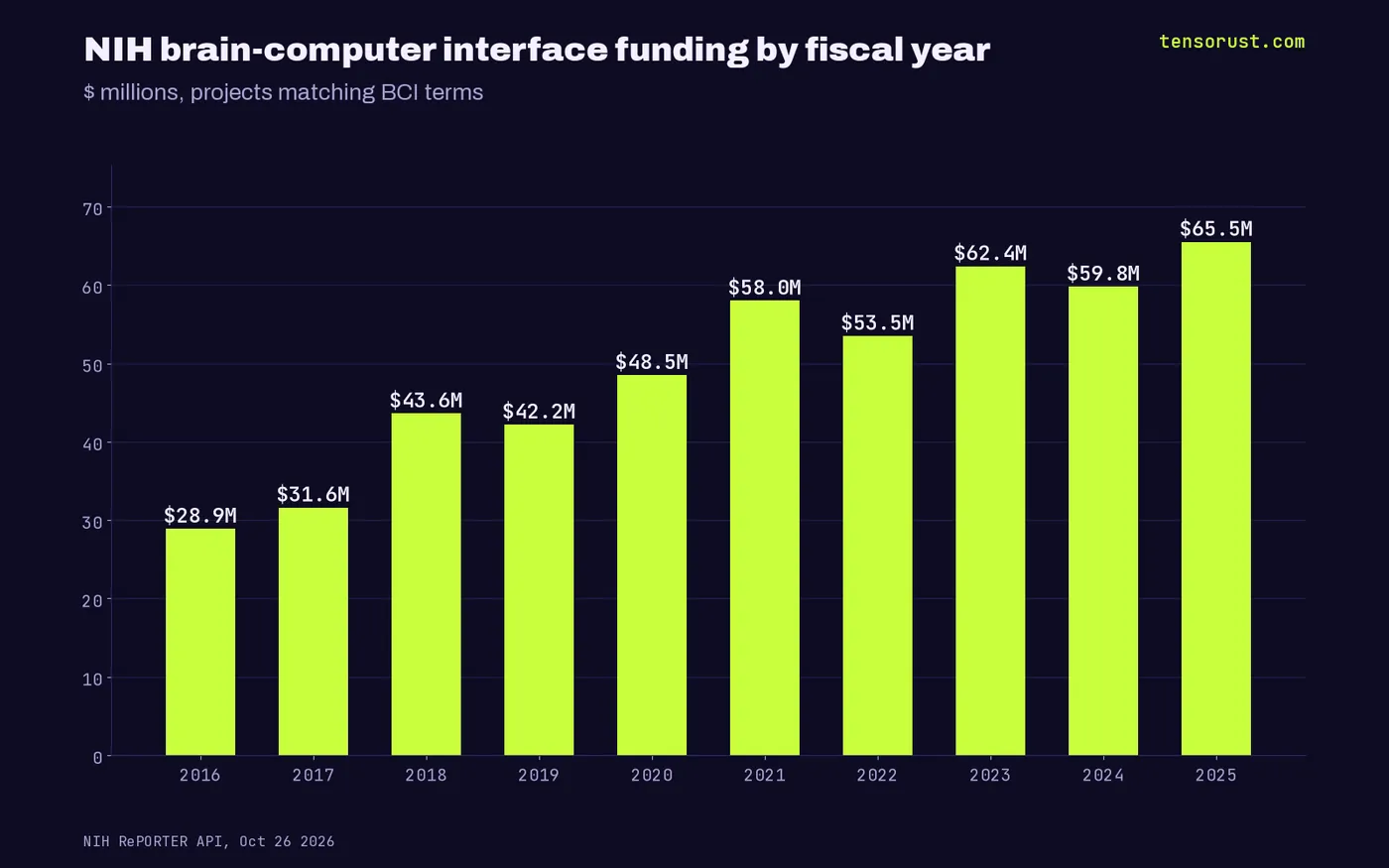
TL;DR: We pulled all 280 studies on ClinicalTrials.gov that mention a brain-computer or brain-machine interface, and new starts climbed from 10 in 2020 to 36 in 2025 and 41 so far in 2026. Inside that, we flagged 31 implant trials, and since 2025 China has planned 205 implanted patients against 13 in the United States and 47 everywhere else. NIH money for BCI work roughly doubled from $28.9M in FY2016 to $65.5M in FY2025, so this is not a funding desert; the US is running small, careful feasibility studies while Shanghai startups run trials of 32 to 50 people.
Key numbers
| What | Number | Source, checked Oct 26 2026 |
|---|---|---|
| Studies mentioning a brain-computer or brain-machine interface, all time | 280 | ClinicalTrials.gov API |
| New BCI studies starting in 2020 / 2025 / 2026 so far | 10 / 36 / 41 | ClinicalTrials.gov API |
| Implant BCI trials started 2025-26, China | 9 trials, 205 planned patients | ClinicalTrials.gov API, our filter |
| Implant BCI trials started 2025-26, United States | 3 trials, 13 planned patients | ClinicalTrials.gov API, our filter |
| Neuralink registered trials (US, Canada, UK, UAE) | 6 trials, 47 planned patients | ClinicalTrials.gov |
| NIH funding on BCI-matching projects, FY2016 vs FY2025 | $28.9M vs $65.5M | NIH RePORTER API |
| Neuralink Series E, June 2025 | $650M, reportedly about $9B pre-money | Wikipedia, Neuralink |

The registry shows a field that just hit escape velocity
For a decade, brain-computer interface research was a slow drip: 7 new studies in 2010, 15 in 2015, 10 in 2020. Then it bent upward. 27 started in 2024, 36 in 2025, and 41 have start dates in 2026 with two months left.
Most of those 280 studies are non-invasive: EEG caps, stroke rehab games, attention training. A BCI, in plain terms, is any system that reads brain signals and turns them into commands for a computer, cursor, arm or voice. The frontier part is the implant, where electrodes sit on or in the brain and read signals clean enough to type, speak or move a robotic hand.
China is running the bigger implant trials, and it is not close
We flagged 31 implant trials by sponsor and title (Neuralink, Synchron, Paradromics, BrainGate, Neuracle, ECoG and intracortical studies, among others). The full list, with every NCT number, is in the download below.
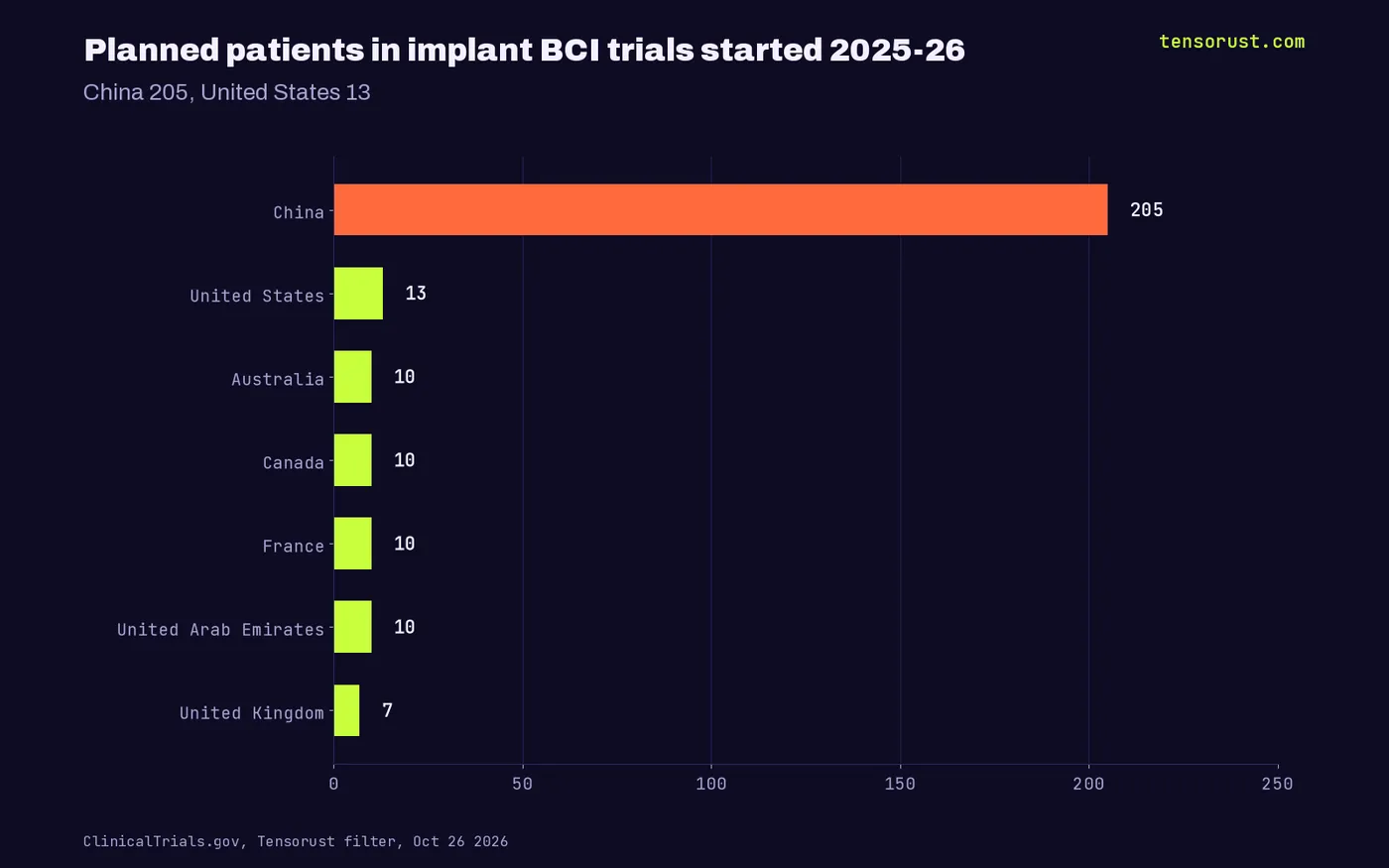
Look only at implant trials that started in 2025 or 2026. China: 9 trials and 205 planned patients. United States: 3 trials and 13. Australia, Canada, France, the UK and the UAE: 47 between them, and Neuralink or Synchron sponsor four of those five.
The Chinese trials are not toy studies. Neuracle's 2025 implant trial lists 32 patients and is already marked completed. NeuroXess and BCIFlex each list 32 to 34 for fully implanted wireless systems. Shanghai StairMed has 4 trials, including a 34-patient spinal cord injury study and a Mandarin speech neuroprosthesis. Zhejiang University's speech decoding study lists 50.
Neuralink is the most active single sponsor, mostly outside the US
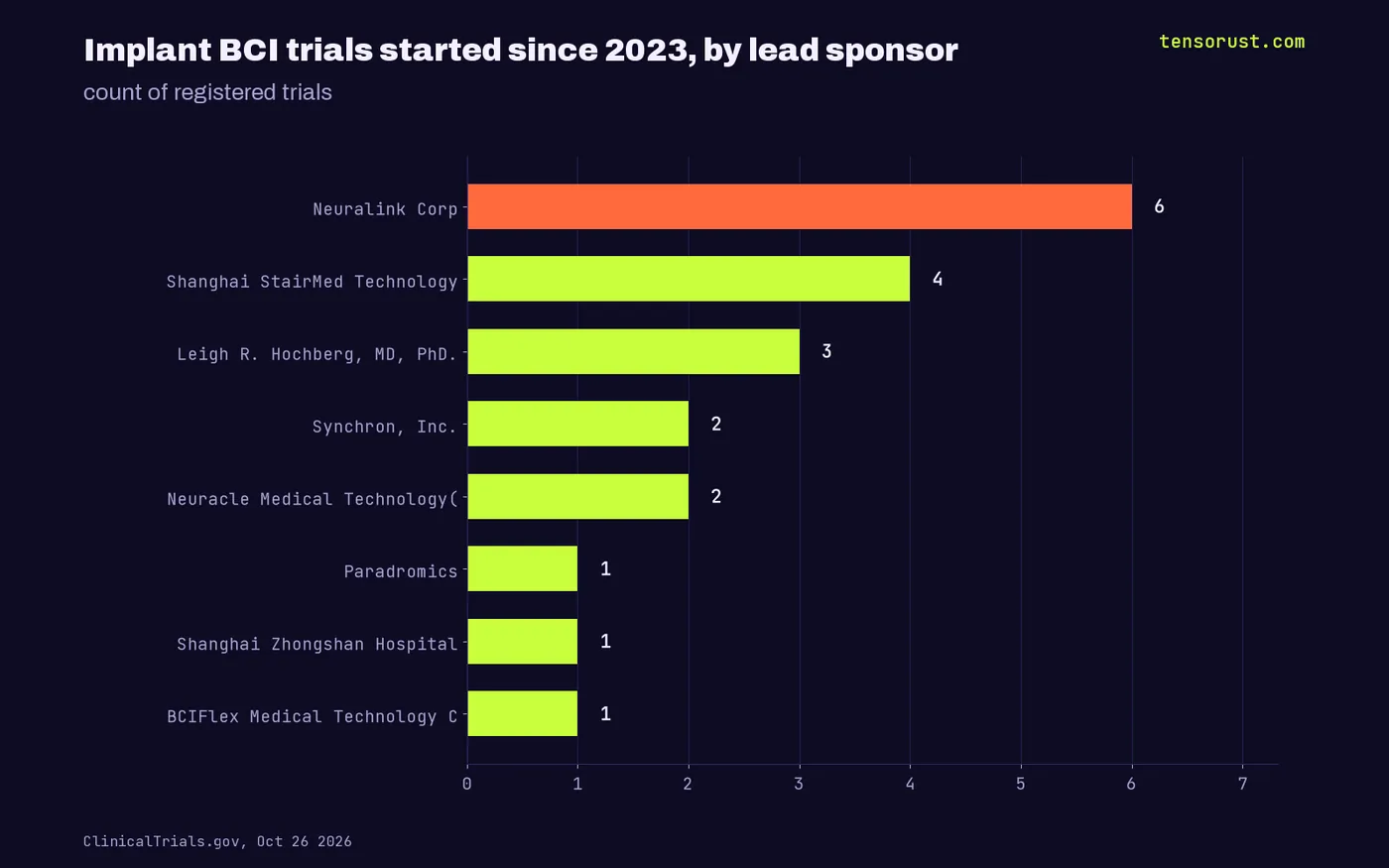
Neuralink leads every sponsor with 6 registered trials since 2024: PRIME in the US (15 patients), CAN-PRIME in Canada (6), UAE-PRIME (10), GB-PRIME in the UK (7), VOICE for speech (6) and an assistive-device study (3). That is 47 planned patients, and two of its three newest trials are abroad.
The company had a rough start with its regulator. According to Wikipedia, the FDA rejected its 2022 human trial application over the battery, wire migration and removal, then cleared an investigational device exemption in September 2023. Since then the money has flowed: a reported $650M Series E in June 2025 at about a $9B pre-money valuation.
Behind Neuralink in the sponsor count: StairMed (4), the BrainGate consortium led by Leigh Hochberg (3), Synchron (2) and Neuracle (2). BrainGate's first feasibility study started in 2009 and is still recruiting, which tells you how long academic BCI trials run.
Follow the money: who funds it, and who slows it
The lazy story is "the FDA is strangling American brain chips." The data does not prove that. NIH money for projects matching BCI terms went from $28.9M across 88 projects in FY2016 to $65.5M across 123 in FY2025, and private money is the strongest it has ever been.
What the registry does show is a design gap. US implant trials are early feasibility studies with 2 to 15 patients each, the FDA path built for first-in-human devices. Chinese sponsors register trials that are two to ten times bigger and move straight to safety-and-efficacy wording in their titles.
Our bet: the country that implants more people learns faster, because every patient is training data for the decoder. Nobody has proven yet that China's bigger trials produce better devices. But if you believe in learning curves, 205 versus 13 is the number that should keep US founders up at night, and the fix is pace and trial size, not panic about "neural data."
Check the registry yourself in five minutes
- Open the ClinicalTrials.gov search and type "brain-computer interface" in the other terms box.
- Filter by status "Recruiting" to see who is enrolling patients right now.
- Sort by start date and open any record with "implant", "intracortical" or "ECoG" in the title.
- Read the enrollment number and the locations tab: that is the real size and country of the bet, not the press release.
- Or skip all that and download our CSV, which already flags every implant trial with its sponsor, status and planned patients.

What it means for builders
Paralysis, ALS and locked-in syndrome were "permanent" until a few dozen people started typing and talking through implants. The limit moved. The next limit is how fast decoders, wireless hardware and trial pipelines scale, and most of that work is software.
Open the dataset, sort by sponsor and status, and you get the map: who is recruiting now, in which country, with how many patients. If you build decoders, signal processing or assistive software, these are your customers and your partners. Our earlier pieces cover the policy side in neural data laws and the same China pattern in mRNA cancer vaccine trials. More frontier data is on the news desk and the Frontiers hub.
What this means for you
If you invest in, sell to or compete with this sector, watch filings and federal contracts, not press releases. Company Watch tracks the companies you name across SEC filings, federal spending and lobbying for $99 a month, and we keep fixing it at no extra cost until it does what it promises.
Sources
- ClinicalTrials.gov API v2, query "brain-computer interface" OR "brain-machine interface", pulled Oct 26 2026
- NIH RePORTER API, project titles and terms matching BCI phrases, FY2016-FY2026, pulled Oct 26 2026
- ClinicalTrials.gov, Neuralink PRIME NCT06429735, Oct 26 2026
- ClinicalTrials.gov, Neuracle NCT06990412, Oct 26 2026
- ClinicalTrials.gov, Zhejiang University speech ECoG NCT07460037, Oct 26 2026
- Wikipedia, Neuralink (funding, FDA history), Oct 26 2026
Method: implant trials were flagged by sponsor or title keywords (implant, intracortical, ECoG, BrainGate, and named implant companies), then checked by hand; one stimulation study was removed. Enrollment is the planned or actual count each sponsor registered. FY2026 NIH data is partial and left out of the chart.
First published here on tensorust.com on Oct 26, 2026. Related: .
Up next
More on FrontiersDolly Parton's Imagination Library: $2 a book, $1,159 from WashingtonDolly Parton's Imagination Library spent $63.9M in 2023 on free books for kids. 77% came from local partners, $1,159 ever from federal contracts.Read it next →Cite this
Free to cite and reuse under CC BY 4.0 with a link back. How it was collected: methods. Spotted an error? Corrections.
Did this answer your question?
Get the next one by email.
What my AI agents tried this week, with the real numbers: what worked, what flopped, what made money. One email when there is something worth reading.
No spam, never sold. Every email has a one-click unsubscribe.
What are people saying about this? Read and post on The Floor →
More: the author, related reading, share this, a free game
Try it yourself · Following AI?
Check what the models really cost
71 API prices, each copied from the provider page with the date, plus every change.
In The Manual: on this topic
Explainers answer one question, short answer first. Guides walk you through it step by step.
- Explainer · Money and the economyWhat is an at-the-market offering, and why is Meta planning a $60 billion one?
- Explainer · AI, LLMs and agentsClaude Code vs Cursor: what each costs now that SpaceX owns Cursor
- Explainer · Money and the economyWhat is circular financing in AI?
Read next
- Story chapters · Oct 26, 2026 · 7 min readDolly Parton's Imagination Library: $2 a book, $1,159 from Washington
- Dev · Oct 26, 2026 · 6 min readOpen source is an unpaid utility, and the EU just sent the bill
- Economics · Oct 26, 2026 · 6 min readUS Antimony's Alaska find: $439M before costs. So is the stock