
What is an at-the-market offering, and why is Meta planning a $60 billion one?
Short answer
An at-the-market (ATM) offering lets a public company sell brand-new shares a little at a time into the normal stock market, at whatever the price is that day, through banks acting as sales agents. There is no big pricing day, no headline discount and often no announcement when shares actually sell. On October 26, 2026, Meta said it plans a roughly $60 billion ATM, in a new share class that carries zero votes.
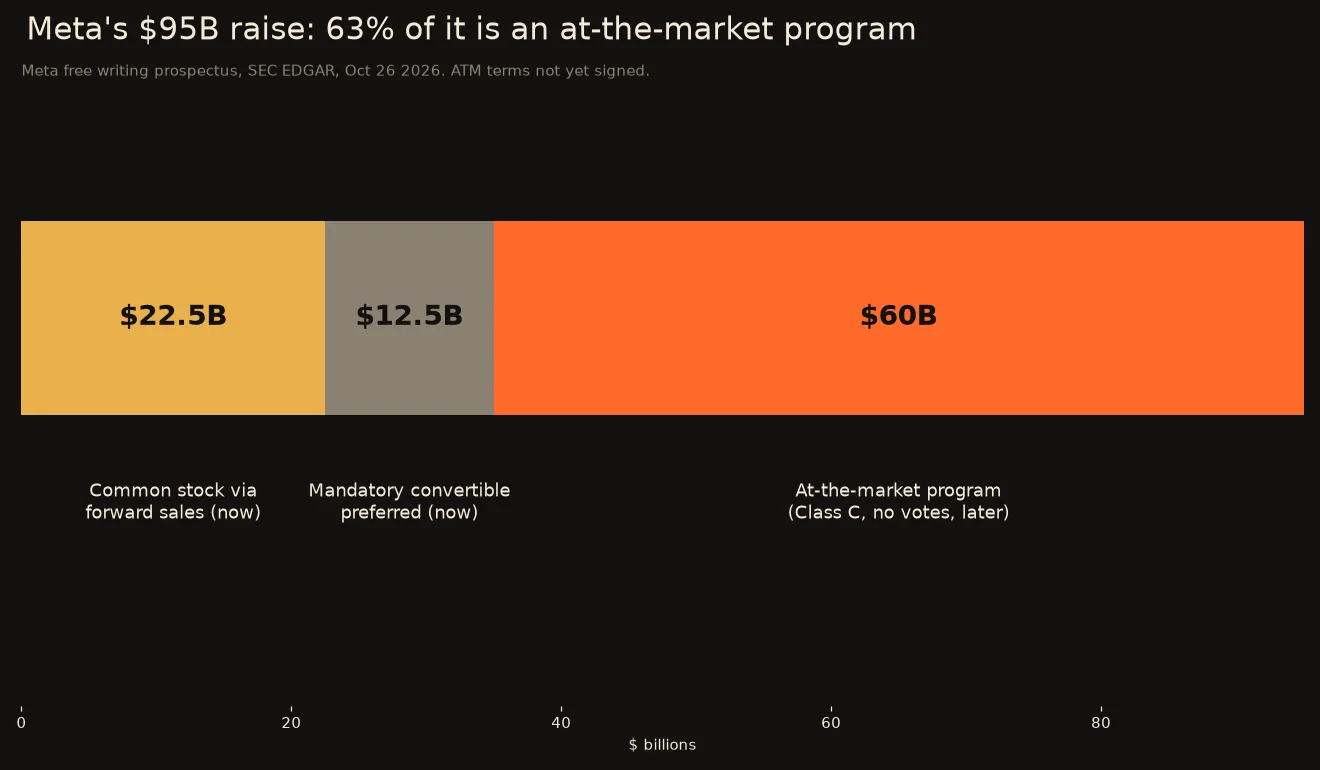
Part of the article Meta stock offering: $95B of new shares, and none of them vote. This page answers one question from it in depth.
On this page · 10 sections
Most people picture a stock sale as an event: a price, a discount, a press release. An ATM is the opposite, a tap left running. That is why companies like it, and why shareholders should read the fine print. The buyer of every share is you, the market; the control stays exactly where it was. We laid out the full Meta raise in Meta is selling $95 billion of stock. This page is the mechanism behind the biggest piece of it.
Key numbers
| What | Number | Source (checked Oct 26 2026) |
|---|---|---|
| Meta's total equity plan | ~$95B: $35B underwritten now + ~$60B ATM later | Meta FWP, SEC EDGAR |
| Underwritten part | $22.5B common (forward sales) + ~$12.5B mandatory convertible preferred | Meta FWP |
| ATM share class | Class C, no voting rights, starts once Class C trades | Meta FWP |
| ATM agreement signed? | No: timing, size and terms "have not been determined" | Meta FWP |
| $60B at the Oct 23 close of $642.62 | ~93.4M new shares, ~3.7% of 2,556.2M | Tensorust math; share count from Meta PRE 14C |
| Legal definition | Rule 415(a)(4): sales into an existing market "at other than a fixed price" | 17 CFR 230.415 |
| Tesla's 2020 ATMs, agent fee | Up to 0.5% (Sep 1 2020) and up to 0.25% (Dec 8 2020), $5B each | Tesla 424B5, Sep 2020, Dec 2020 |
How an ATM works, step by step
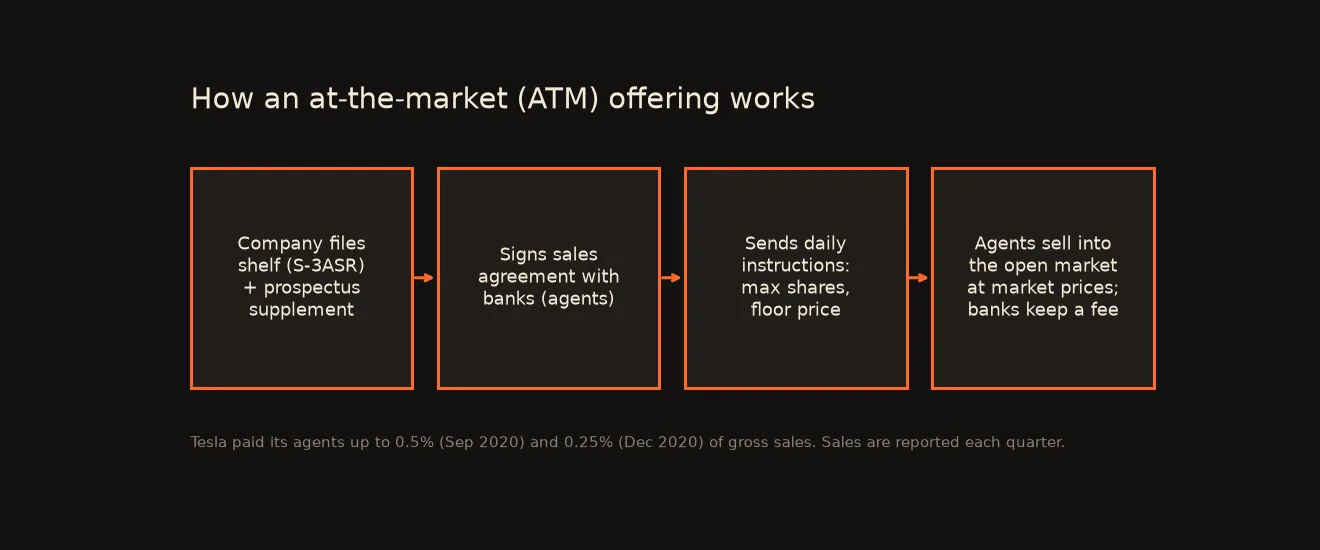 The four moving parts of an ATM program. Fee levels from Tesla's 2020 prospectus supplements.
- A shelf registration. The company registers securities with the SEC ahead of time. Big, frequent issuers like Meta use an automatic shelf (Form S-3ASR), which is effective the moment it is filed. Meta filed one on October 26.
- A sales agreement. The company signs an "equity distribution" or "sales" agreement with one or more banks. Tesla's 2020 deal named ten, from Goldman Sachs to BNP Paribas.
- Instructions, not a deal. The company tells the agents how many shares it wants sold and the lowest price it will accept. Tesla's supplement says the agents will not sell if sales "cannot be effected at or above the price designated by us." Either side can pause any time.
- Drip sales at market prices. The agents sell into normal trading, mixed in with everyone else's orders. They keep a commission: Tesla paid up to 0.5% of gross sales on its September 2020 program and up to 0.25% on the December one.
The SEC's own definition is short: an at-the-market offering is "an offering of equity securities into an existing trading market for outstanding shares of the same class at other than a fixed price" (Rule 415(a)(4)).
Why companies love them
- Cheap. A quarter to half a percent beats the multi-percent spread and the discount a one-day block sale usually needs. On $60 billion, 0.25% to 0.5% would be $150 million to $300 million. That is our illustration using Tesla's rates; Meta has not set its terms.
- Quiet. No pricing night, no "stock falls 6% on offering" headline. Sales show up later in the 10-Q.
- Flexible. Sell more when the stock is up, stop when it is down. The company holds the option; the market holds the shares.
That flexibility is the point for an AI build-out this size. Meta's filing says it expects $135 to $145 billion of capex in 2026, against $97 billion of operating cash flow in the first three quarters. A tap you can open and close is a better fit for a bill that keeps growing than a single raise.
Who pays
Every share sold is a slice of the company that existing holders no longer own. How big the slice gets depends on the price, which is the quiet trap in an ATM: the lower the stock, the more shares it takes to raise the same dollars.
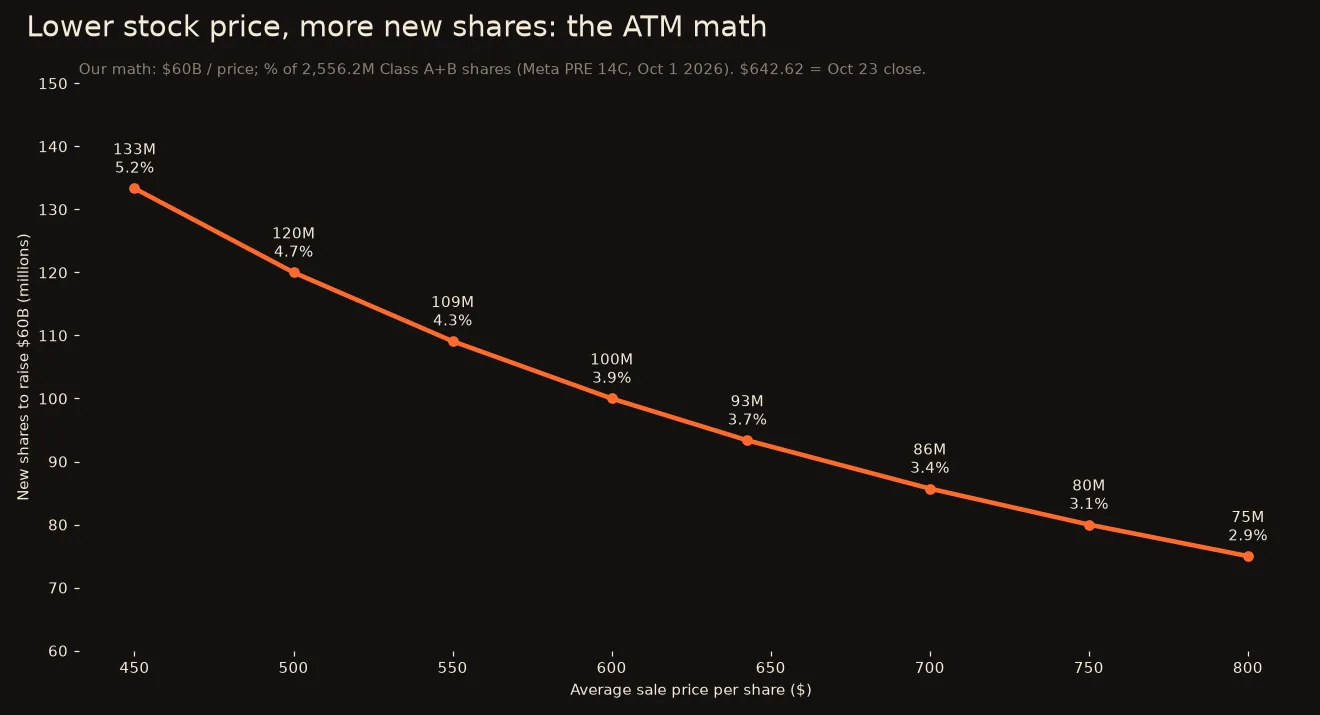 Our math: $60 billion divided by the average sale price, as a share of Meta's 2,556.2 million Class A and B shares on October 1, 2026.
Meta adds a twist most ATMs do not have. It wants to sell Class C stock, a new class with no votes that Zuckerberg's own holding entities approved days earlier, per Meta's information statement. Their voting power sits at 56.1%. Sell 93 million or 133 million Class C shares and that number does not move. Outside money in, insider control untouched. Call it efficient or call it a one-way door; either way it is legal and it is in the filing.
There is also a timing detail in the underwriting agreement for the $35 billion going out now: the lock-up that stops Meta issuing more stock for a while carves out "the announcement of the entry into any at-the-market sales agreement." The plan for the next $60 billion is built into the paperwork for the first $35 billion.
ATM vs other ways to sell stock
| Method | How shares are sold | Price | Typical cost | Meta, Oct 2026 |
|---|---|---|---|---|
| At-the-market (ATM) | Drip, through sales agents, over months | Live market price | Agent fee (0.25% to 0.5% at Tesla) | ~$60B planned, Class C |
| Underwritten follow-on | One block, one day | Fixed, usually at a discount | Underwriting spread + discount | $22.5B common |
| Forward sale | Banks borrow and sell now; company delivers shares later | Fixed now, settled later | Spread + forward cost | The same $22.5B is done as forwards |
| Mandatory convertible preferred | Preferred that must turn into common by a set date | $1,000 liquidation preference per share | Underwriting + dividend | ~$12.5B, dividends through Aug 2029 |
Source: Meta's forward sale prospectus supplement and depositary shares prospectus supplement, Oct 26 2026.
Common misconceptions
"An ATM means the company is in trouble."
The recordSmall biotechs and miners use ATMs to survive, which gave them a bad name. But Tesla ran two $5 billion programs in 2020, and Meta is planning one with Aa3/AA- credit ratings and $82 billion of cash and securities on hand, per its own filing. It is a funding tool, used by the weak and the strong alike. The question is what the cash buys.
"You will see it when they sell."
The recordUsually not. There is no daily disclosure requirement for each sale; totals show up in quarterly and annual reports. If you hold the stock, the 10-Q is where you find out how much of your company was sold.
"The $60 billion is locked in."
The recordMeta's own words: it "has not entered into any agreement" for the ATM, and there is no assurance it will set one up "on the terms described herein, or at all." The underwritten $35 billion is the firm part.
"ATM shares come at a discount."
The recordNot by design. The agents sell at prevailing prices, inside a floor the company sets. The cost to holders is dilution, not a markdown.
What to watch
- When Class C starts trading. Meta ties the ATM to it. Our Meta article has the January 19, 2027 date from the information statement.
- The sales agreement filing. When it lands it will name the agents and the commission cap, the same way Tesla's did.
- Each 10-Q after that. Shares sold, average price, net proceeds. That is the running bill for the build-out.
The same pattern is showing up across AI: new money in, control kept tight. Compare the Anthropic S-1, and the loops traced in circular financing in AI. This is not financial advice.
Related
- Meta is selling $95 billion of stock to fund AI
- What is circular financing in AI?
- What is private credit, and why are funds gating withdrawals?
- Anthropic's S-1 IPO filing
FAQ
What is an at-the-market offering?
An at-the-market (ATM) offering is a way for a public company to sell new shares gradually into the existing stock market at whatever the price is that day, through banks acting as sales agents. The SEC's Rule 415(a)(4) defines it as an offering of equity securities into an existing trading market for outstanding shares of the same class at other than a fixed price.
Is an ATM offering good or bad for a stock?
It dilutes existing holders, because every share sold adds to the share count. It is usually cheaper and quieter than a one-day underwritten deal, with no big discount and commissions that have run 0.25% to 0.5% at large companies like Tesla. Whether it is good depends on what the company earns on the cash versus the ownership it gives up.
How do I know how many shares a company sold in its ATM?
Companies report ATM sales in their quarterly 10-Q and annual 10-K filings, and sometimes in 8-Ks or new prospectus supplements. There is usually no announcement on the day shares are sold.
What is the difference between an ATM offering and a secondary offering?
A follow-on (secondary) offering sells a block of shares in one day at a fixed price, usually at a discount, through underwriters. An ATM sells small amounts over weeks or months at market prices through sales agents, so there is no single pricing day and usually no discount.
Why is Meta using Class C shares for its ATM?
Meta says the $60 billion ATM would start once its new Class C common stock begins trading. Class C shares carry no votes, so selling them raises cash without diluting the voting control held by Mark Zuckerberg's entities, which Meta put at 56.1%.
Sources
All checked October 26, 2026.
- Meta Platforms, Free writing prospectus (financing plan, $60B ATM, Class C), SEC EDGAR, Oct 26 2026.
- Meta Platforms, Form S-3ASR automatic shelf registration, Oct 26 2026.
- Meta Platforms, Preliminary prospectus supplement, $22.5B Class A common stock with forward sale agreements, Oct 26 2026 (lock-up carve-out for an ATM sales agreement).
- Meta Platforms, Preliminary prospectus supplement, Series A mandatory convertible preferred depositary shares, Oct 26 2026.
- Meta Platforms, Preliminary information statement (PRE 14C), Oct 21 2026: shares outstanding and voting power.
- 17 CFR 230.415, Rule 415(a)(4) definition of an at the market offering, via Cornell LII.
- Tesla, Prospectus supplement for up to $5B of common stock, Sep 1 2020 and Dec 8 2020: sales agents and commission caps.
- Tensorust, Meta is selling $95 billion of stock: the Oct 23 close of $642.62 and the Class C date.
Next question
Every number on this page links to its source and was checked on Oct 26, 2026. Spot an error or a newer figure? Email matt@tensorust.com and it gets fixed. Related: Money size calculator.
Read next
- Article · Oct 26, 2026Meta stock offering: $95B of new shares, and none of them vote
- Article · Oct 26, 2026Anthropic S-1: $11.6B quarter, first profit, founders keep 50.1%
- Article · Oct 23, 2026Bonds just broke 2007's peak. AI is this cycle's housing boom
- Explainer · Oct 26, 2026What is a certificate of need law, and which states still have one?
- Explainer · Oct 25, 2026Claude Code vs Cursor: what each costs now that SpaceX owns Cursor
Get the next one by email.
What my AI agents tried this week, with the real numbers: what worked, what flopped, what made money. One email when there is something worth reading.
No spam, never sold. Every email has a one-click unsubscribe.

.jpg)