
By Matt Busel, who built the apps, crates and game he writes about · every number links to its source and every dataset is downloadable (methods) · corrections · featured in Kirino, gamebiz, This Week in Rust, New Mobile Life, By-Press
ICE robot dogs: a $1.3M no-bid deal as ICE no-bid spending hits $2.1B
On this page · 12 sections
- Key numbers
- The record says firearms and tactics, not "inspection"
- Thirty days earlier, the same office bought shock devices the same way
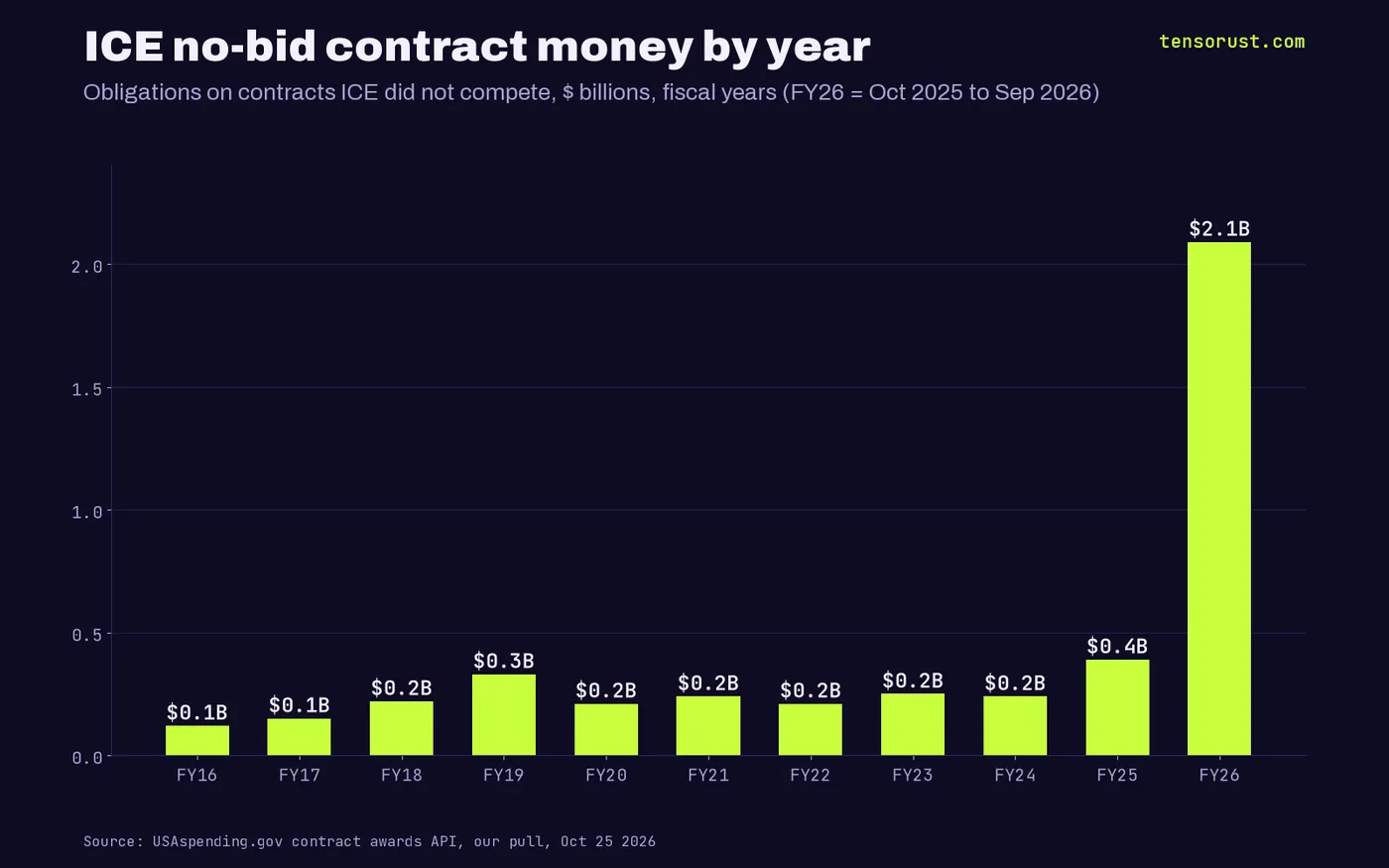
- ICE's no-bid money went up 5.4x in one year
- Boston Dynamics' "no weapons" pledge meets its own bank statement
- The bunk beds line gives the game away
- Hyundai owns the dog, and ICE raided Hyundai
- Robot dogs are a law-enforcement product now
- The price tells you what you are really buying
- What this means for you
- How we did it
- Sources
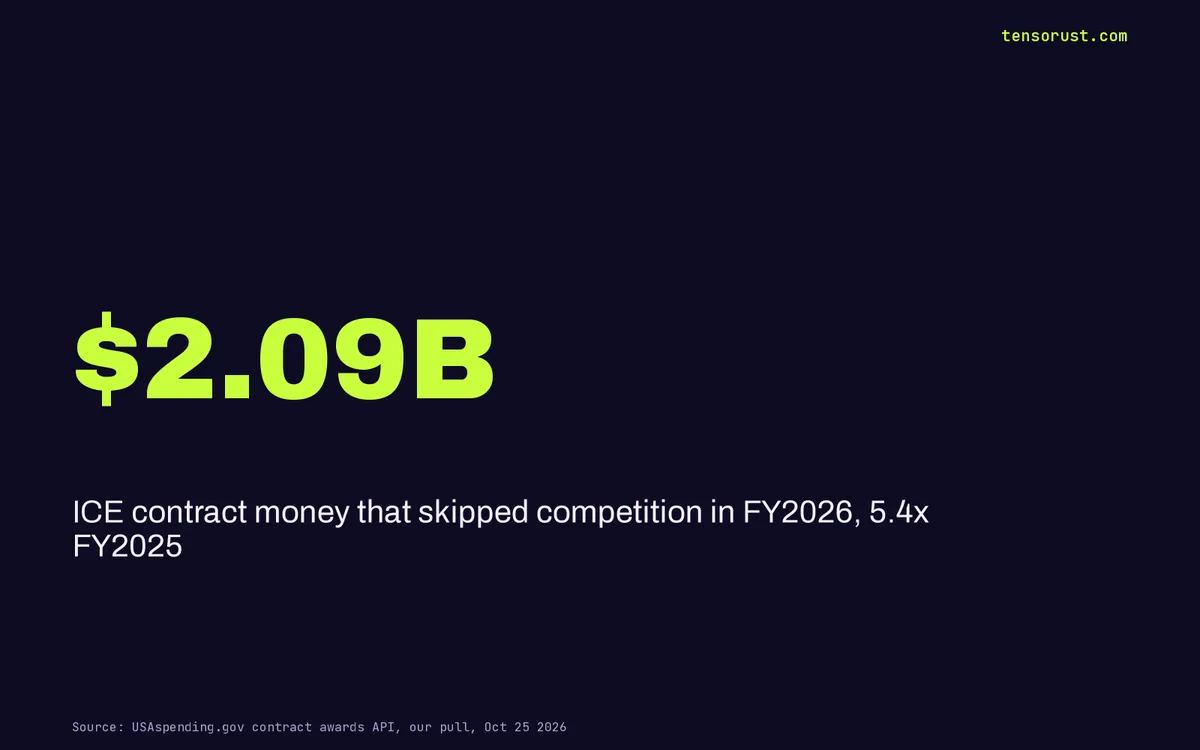
Short answer: Yes, ICE bought the robot dogs, and it did not shop around. The federal record for award 70CMSW26P00000067 shows $1,304,296 to Radeco, Inc. on September 25 2026 for "Cerberus Spot quadruped robots and accessories for Office of Firearms and Tactical Programs," with one offer received and the box for competition marked "not competed." It landed in a year when ICE's no-bid contract money jumped 5.4x to $2.09 billion. Boston Dynamics calls Spot an inspection tool. The buyer's own paperwork files it under firearms and tactics.
TL;DR: ICE paid $1.30M for four modified Spot robots, about $326,000 per dog, through a Connecticut reseller, after one offer and no competition. Thirty days earlier the same ICE office signed a $16.7M no-bid order for electric-shock "de-escalation" devices, also with one offer. ICE's not-competed contract obligations went from $386M in FY2025 to $2.09B in FY2026, and their share of all ICE contract money went from 9.7% to 23.4%, the highest in the 11 years we pulled. About 300 Boston Dynamics workers signed a petition to cancel the sale; the interim CEO told them to "respect and accept this decision."
Key numbers
| What | Number | Source, checked Oct 25 2026 |
|---|---|---|
| ICE award for "Cerberus" Spot robots and accessories | $1,304,296 (signed Sep 25 2026) | USAspending, award 70CMSW26P00000067 |
| Offers received / competition | 1 / "not competed", only one source (FAR 6.302-1) | USAspending |
| Robots in the order / cost per robot | 4 / about $326,000 each, accessories included | WBUR, our math |
| Same ICE office, shock "de-escalation" devices | $16,700,640, 1 offer, not competed (Aug 26 2026) | USAspending, award 70CMSW26C00000012 |
| ICE not-competed contract obligations | $386M (FY2025) to $2.09B (FY2026), 5.4x | USAspending API, our pull |
| Not-competed share of ICE contract money | 9.7% (FY2025) to 23.4% (FY2026) | USAspending API, our pull |
| All ICE contract obligations | $3.99B (FY2025) to $8.93B (FY2026) | USAspending API, our pull |
| Boston Dynamics direct federal awards since 2001 | 63 awards, $153.4M, 98.8% from the Pentagon | USAspending API, our pull |
| Workers who signed the petition to cancel | About 300, nearly half "Anonymous", of 1,500+ staff | WBUR |

The record says firearms and tactics, not "inspection"
Every federal contract leaves a public trail on USAspending.gov. We pulled the full record for ICE's robot dog buy instead of reading the press release version.
The description field reads, in capitals: "The purpose of this award is to procure Cerberus Spot quadruped robots and accessories for Office of Firearms and Tactical Programs." The funding office is listed as ICE's Office of Training Tactical Programs. The awarding office is Mission Support Washington.
Cerberus is the three-headed dog that guards the gates of hell. It is also, per the Boston Globe, the name Radeco gives its modified Spot. Somebody at a robot reseller chose that name, and a federal immigration agency typed it into a purchase order without blinking.
Here is the rest of the paperwork, straight from the record:
- Vendor: Radeco, Inc., 17 West Pkwy, Plainfield, Connecticut. Not Boston Dynamics directly.
- Type: purchase order, firm fixed price, $1,304,296 obligated, no options.
- Competition: "not competed," solicitation procedure "only one source," authority FAR 6.302-1 (the rule that lets an agency skip bidding when it says only one supplier can do the job).
- Offers received: 1.
- Delivery window: September 25 to November 24 2026. These dogs are arriving about now.
Back in August, ICE's own procurement forecast pitched Spot for "inspection, situational awareness, and hazard assessment," according to The Next Web. Same forecast, same answer to "will this be competed?": no.
Thirty days earlier, the same office bought shock devices the same way
The robot dogs were not the office's first no-bid buy of the season. On August 26 2026, ICE signed award 70CMSW26C00000012: $16,700,640 to Compliant Technologies LLC for "conductive energy and de-escalation devices to support law enforcement agents for the Office of Firearms and Training Program."
Translation: electric-shock gloves. TNW reported the order as 6,000 pairs, and that 16 senators led by Catherine Cortez Masto asked ICE to drop it hours before the award went through.
We pulled that record too. One offer. Not competed. Only one source, FAR 6.302-1. Same funding office: Office of Training Tactical Programs. Same awarding office: Mission Support Washington.
So the pattern inside one ICE office, in one month, is $18.0M across two no-bid awards: shock gloves first, then a pack of robot dogs named after hell's doorman. If you were trying to design a procurement trail that undercuts "it's just a camera on legs," you could not do better.
ICE's no-bid money went up 5.4x in one year
The robot dogs are a rounding error. The trend around them is not.
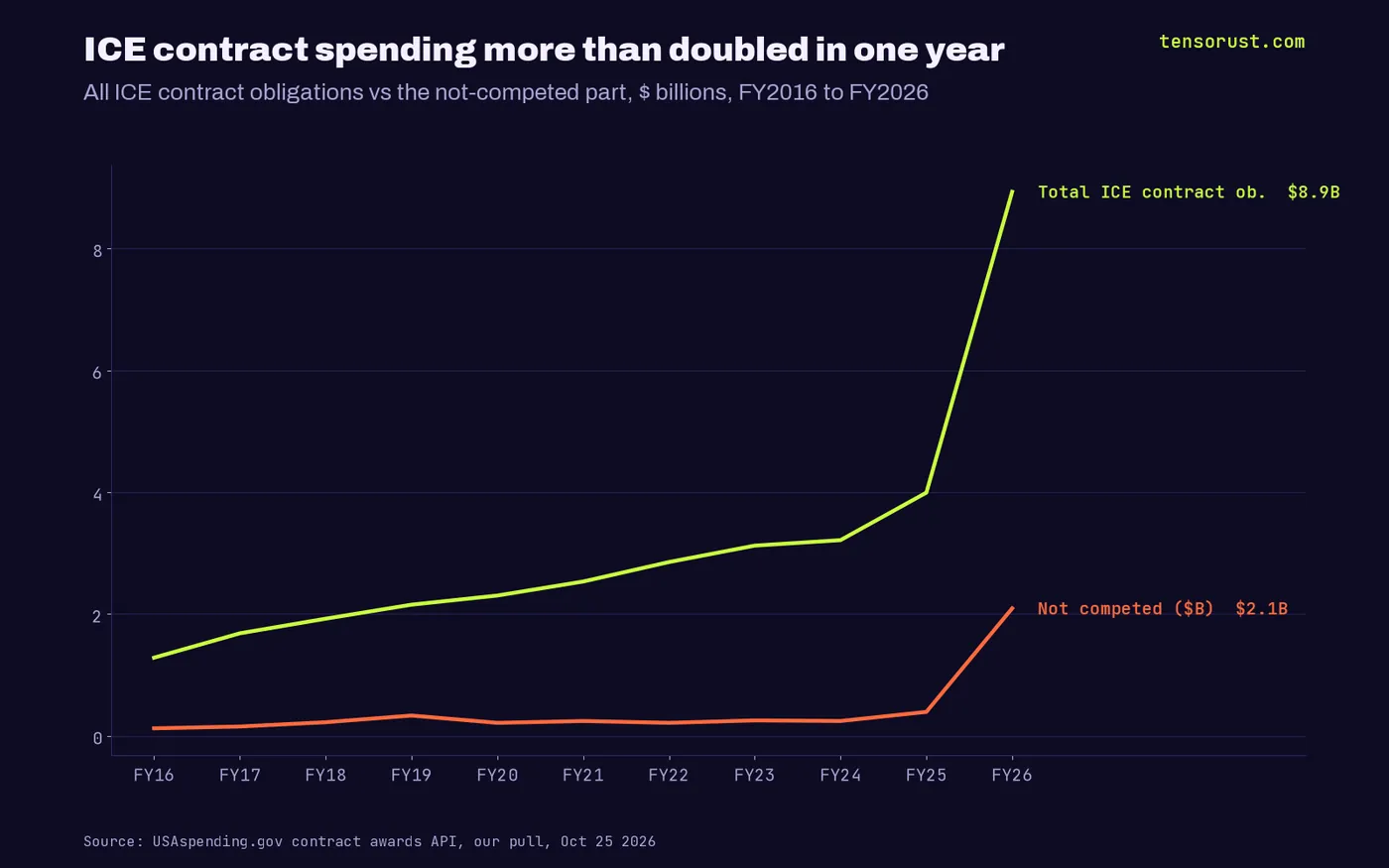
We pulled every ICE contract obligation by fiscal year from FY2016 to FY2026 and split it by how the contract was awarded. From FY2016 through FY2025, the not-competed share stayed between 7.3% and 15.5%, usually around 9%. In FY2026 it hit 23.4%.
In dollars: $386M of not-competed obligations in FY2025, $2.09B in FY2026. Total ICE contract obligations went from $3.99B to $8.93B. ICE more than doubled its spending and nearly a quarter of it skipped a real bidding fight.
The biggest no-bid award with FY2026 activity is not a gadget. It is a $657.6M Amentum contract for "detention, transportation and medical" services, signed March 13 2026. Next come aircraft support, health services, and a list of detention task orders for CoreCivic and GEO Group.
That is the real context for "inspection robot." The robot dogs are the shiny part of a buying spree where the money moves fast and nobody is asked to compete for it.
Boston Dynamics' "no weapons" pledge meets its own bank statement
In 2022 Boston Dynamics led six robotics companies in an open letter. The line on its own site: "We pledge that we will not weaponize our advanced-mobility general-purpose robots" and "we will not support others to do so."
Now look at who has paid Boston Dynamics directly. We pulled every federal award with Boston Dynamics as the recipient: 63 awards since 2001 worth $153.4M. Of that, 98.8% came from the Department of Defense.
The largest is a $56.7M DARPA contract for the Legged Squad Support System, a walking robot meant to "accompany dismounted soldiers and increase their combat capability." In February 2025 the Army bought $4.4M of "Spot robot dogs with government & public safety kit" for a foreign military sale. In August 2026 the U.S. Marshals paid $308,680 for a Spot and kit under a line that reads "Mission critical - apprehending fugitives."
None of that is a gun bolted to a dog. All of it is the security state paying the bills. The pledge draws the line at the trigger. The money never had a line at all.
The company has walked away once. In May 2026, Semafor reported that Boston Dynamics killed a Spot sale to a police equipment supplier that wanted to attach flash-bang grenades, after workers pushed back. A spokesperson said the deal risked "undermining our anti-weaponization pledge." This time, nearly 300 workers pushed back and the answer was no.
The bunk beds line gives the game away
Boston Dynamics' spokesperson told Scripps News: "Any suggestion that these robots will be used to support immigrant detentions or deportations is false."
Scripps also reported what the robots carry: a five-foot arm meant "to see on top of closets, bunk beds, and some crawl spaces," plus cameras and sensors for radiation and toxic gas. The stated use cases include illicit tunnels at the southwest border.
Tunnels, fine. But closets and bunk beds are not border tunnels. Those are rooms where people sleep. Our read: a robot that peers over bunk beds is built for entering homes and shelters before officers do, and nobody has explained how a robot bought by an immigration agency's tactical office stays out of immigration work.
Nobody has proven where these four dogs will be deployed. ICE has not said. That silence is the point: the company's guarantee rests on a customer that will not tell it, or us, what the product is for.
Hyundai owns the dog, and ICE raided Hyundai
Boston Dynamics is not a scrappy Massachusetts lab anymore. Hyundai Motor Group closed its purchase of a controlling 80% stake on June 21 2021 at a $1.1B valuation, per Hyundai's own release. SoftBank kept 20%.
In September 2025, federal agents took 475 people into custody at Hyundai's battery plant site in Ellabell, Georgia, most of them South Korean nationals, in what the Homeland Security Investigations agent in charge called the largest single-site enforcement operation in HSI history, per ABC. HSI is part of ICE. South Korea's foreign ministry expressed "concerns and regret."
About a year later, a Hyundai-controlled company is supplying robot dogs to the agency that ran that raid, through a reseller, on a no-bid order. You do not need a conspiracy theory to find that awkward. You just need the dates.
Our bet: this is not about four robots. Federal agencies are the most reliable customer a cash-hungry robotics company can find, and Hyundai has U.S. factories to protect. Saying no to DHS in 2026 has a price, and Boston Dynamics' leadership decided it would rather not find out what it is.
Robot dogs are a law-enforcement product now
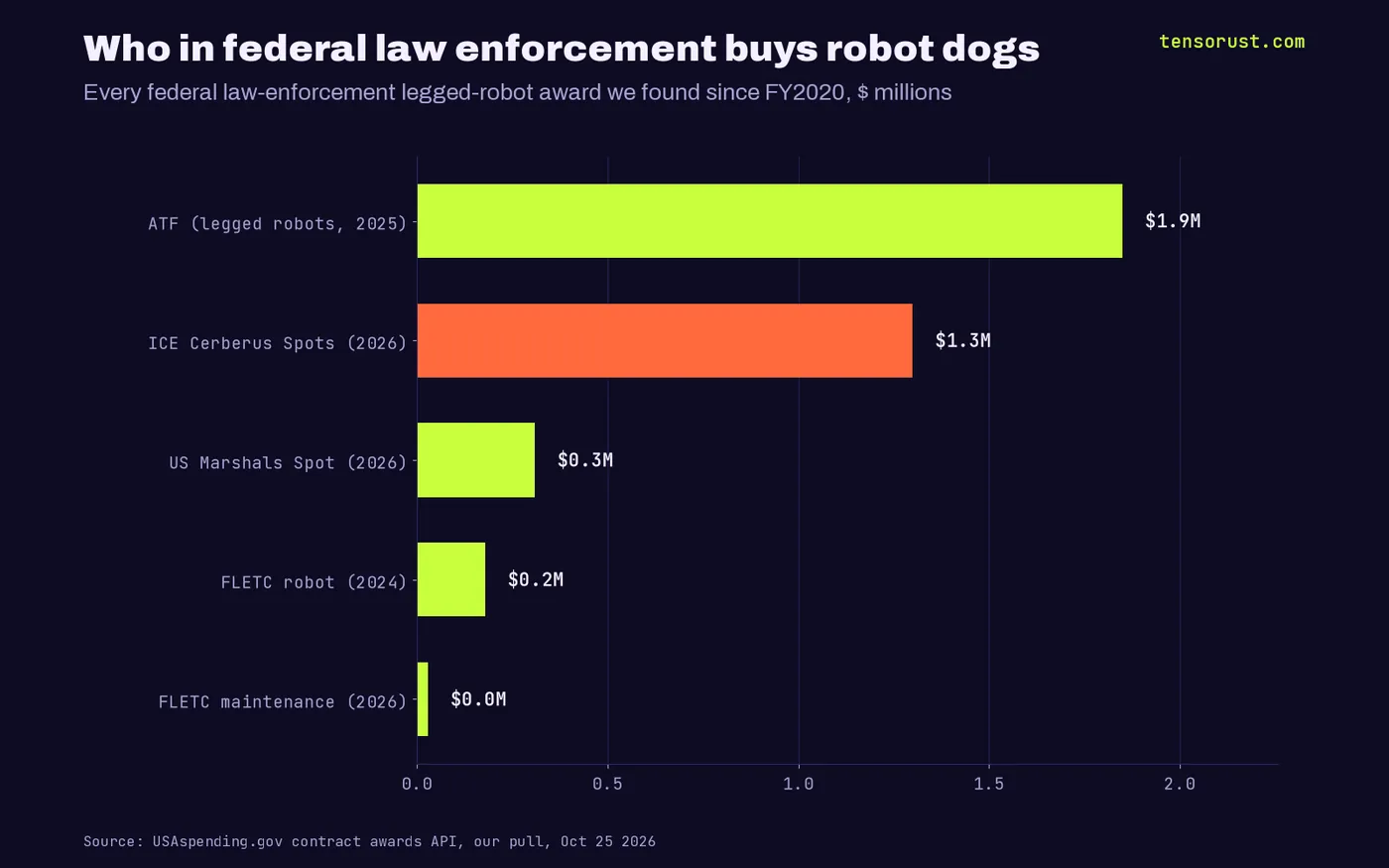
We pulled every federal legged-robot award we could find on USAspending since FY2020: 56 awards, $31.5M. The military paid 82% of it, mostly Air Force research on Ghost Robotics quadrupeds guarding bases.
Law enforcement did not show up at all until FY2024. Since then it has spent $3.68M: ATF $1.85M on "man-portable quadruped (legged) robotic systems" in 2025, ICE's $1.30M Cerberus order, the Marshals' $308,680 fugitive-hunting Spot, and two training-center buys at FLETC. ICE alone is 35% of all federal law-enforcement robot dog money we found.
The New York Police Department canceled its Spot contract in 2021 after a public backlash. Five years later the federal version is bigger, quieter and no-bid.
The price tells you what you are really buying
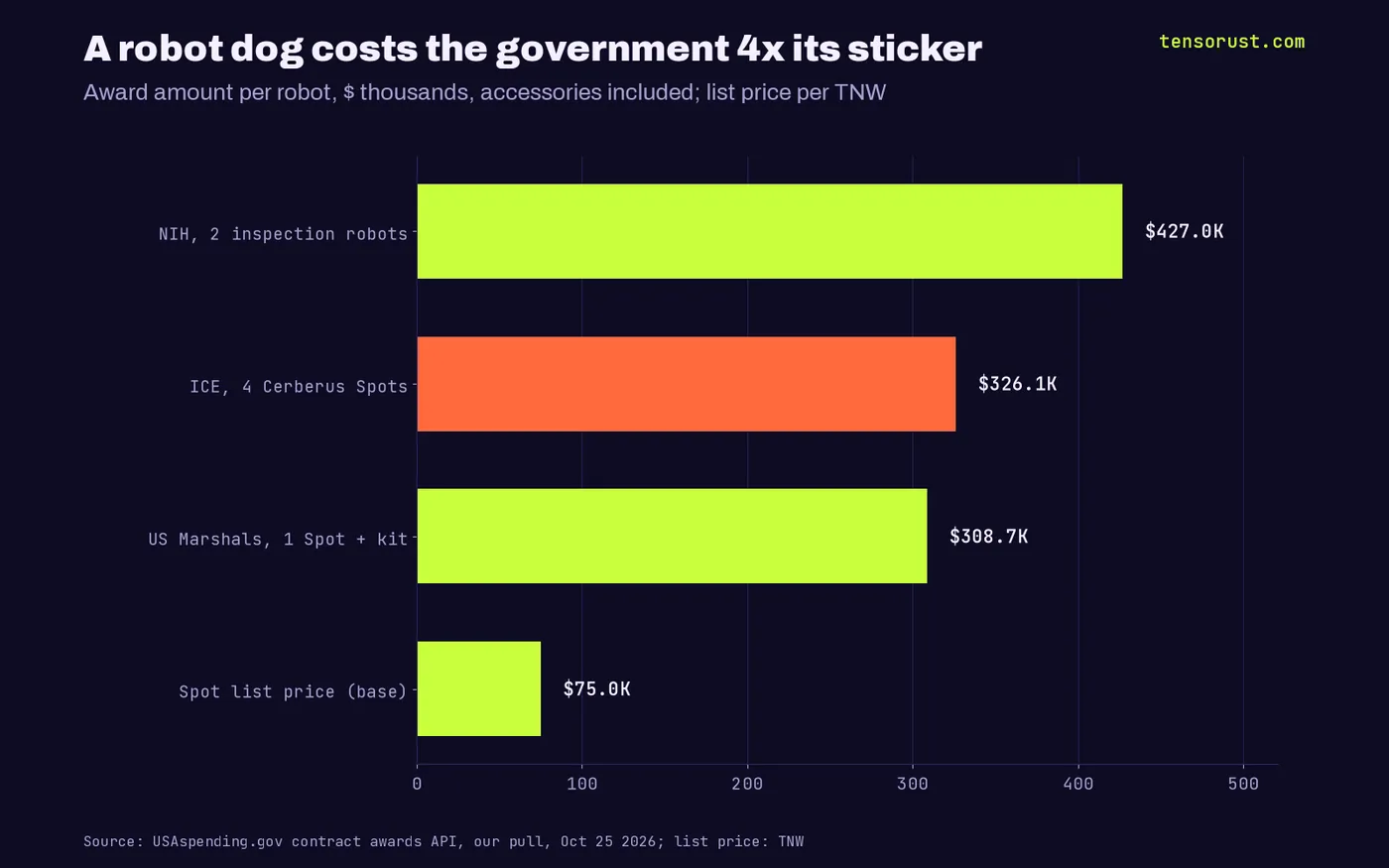
Spot's base list price is near $75,000, according to TNW. ICE paid about $326,000 per robot. The Marshals paid $308,680 for what their record calls one "Spot mobile robot & kit." NIH paid $853,924 for two inspection robots with sensors, about $427,000 each.
So the dog is roughly a quarter of the bill. The rest is the kit: arms, sensors, radios, software, training. That is exactly the part the pledge does not cover. "We do not weaponize" is a promise about the bolt-on gun. Everything that makes a robot useful for a raid, from the sensors to the arm that looks over a bunk bed, lives in the 75% that resellers sell.
The reseller model is the loophole in plain sight. Boston Dynamics did not sign this contract. Radeco did. The company can say it never sold to ICE, while, per the Globe, staying heavily involved in technical support. Workers told WBUR the deal "presents us as working directly with ICE." They read the record the same way we did.
What this means for you
If you build software, robots or AI, assume your product ends up in the hands of whoever pays, through whoever resells it. Your terms of service are not a wall. Write down now, in a contract and not a blog post, what you will refuse and how you will enforce it, because the "we have a pledge" defense just failed in public with a $1.3M receipt.
If you are a citizen, the tool is free: search any vendor on USAspending.gov and read the "extent competed" field yourself. It is the most honest line in any government contract. Our full pull is in the data download below, with every award ID linked.
And if you want your own AI tools to do what you meant and nothing else, with nothing leaving your machine, that is what our kit is built for. More reporting like this lives on the news desk, in the AI industry hub and in deep tech and money. Related: Flock's camera network, decoded and CBP's record border phone searches.
Not financial advice. This piece reports public contract records and our reading of them.
How we did it
We queried the USAspending.gov API on October 25 2026: the full award records for 70CMSW26P00000067 and 70CMSW26C00000012; ICE (awarding sub-agency U.S. Immigration and Customs Enforcement) contract obligations by fiscal year from FY2016 to FY2026, split by extent-competed codes (not competed = B, C, E, G; competed = A, D, F, CDO); every award with Boston Dynamics as recipient; and keyword searches for "spot robot," "robot dog," "robotic dog," "quadruped," "spot enterprise" and "spot quadruped," plus every Ghost Robotics award. We kept legged-robot awards from FY2020 on and dropped unrelated "SPOT Enterprise Suite" software contracts. Buyer categories are ours. Amounts are award amounts as USAspending reports them; FY2026 runs October 1 2025 to September 30 2026, and late reporting can still move it. Cost per robot divides the award by the robot count reported by WBUR (ICE) or written in the award (NIH, Marshals).
Sources
- USAspending.gov, award 70CMSW26P00000067, ICE to Radeco, Inc., pulled Oct 25 2026
- USAspending.gov, award 70CMSW26C00000012, ICE to Compliant Technologies LLC, pulled Oct 25 2026
- USAspending.gov API, spending over time and spending by award, pulled Oct 25 2026
- WBUR, Zeninjor Enwemeka and Simón Rios, ICE wants robot dogs. Boston Dynamics' workers urge company to 'cancel the sale', Oct 23 2026
- Boston Globe, Boston Dynamics workers oppose the company's robot dog use by ICE, Oct 23 2026
- Boston Globe, ICE robot dog contract, Sep 29 2026
- Scripps News, Patrick Terpstra, New records detail ICE's plan for four-legged robots named Spot, 2026
- The Next Web, Darius Popa, ICE plans to buy Boston Dynamics robot dogs without running a competition, Sep 1 2026
- Semafor, Worker backlash over flash-bang grenades sank Boston Dynamics robot deal, May 19 2026
- Boston Dynamics, General purpose robots should not be weaponized, checked Oct 25 2026
- Hyundai Motor Group, Completes acquisition of Boston Dynamics from SoftBank, Jun 21 2021
- ABC, 475 people taken into ICE custody at Hyundai plant in Georgia, Sep 2025
First published here on tensorust.com on Oct 25, 2026. Related: News, AI industry, Deep tech and money, Flock camera map, decoded.
Up next
More on AI industryFlock camera map: its own inventory lists 214,073 devices, not 120KFlock's own inventory lists 214,073 devices in service and 83,427 planned, vs a public 120,000. Volunteers had already pinned 68%. Georgia leads. Free CSV.Read it next →Cite this
Free to cite and reuse under CC BY 4.0 with a link back. How it was collected: methods. Spotted an error? Corrections.
Did this answer your question?
Get the next one by email.
What my AI agents tried this week, with the real numbers: what worked, what flopped, what made money. One email when there is something worth reading.
No spam, never sold. Every email has a one-click unsubscribe.
What are people saying about this? Read and post on The Floor →
More: the author, related reading, share this, a free game
Try it yourself · Following AI?
Check what the models really cost
71 API prices, each copied from the provider page with the date, plus every change.
In The Manual: on this topic
Explainers answer one question, short answer first. Guides walk you through it step by step.
- Explainer · Money and the economyWhat is circular financing in AI?
Read next
- Economics · Oct 25, 2026 · 9 min readNvidia backstops: $288B on the hook while its neocloud borrowers crack
- Economics · Oct 25, 2026 · 10 min readBig Tech earnings week: 4 of 5 AI spenders burn cash, $1.2T waits
- Economics · Oct 25, 2026 · 10 min readAmerican Express layoffs: 5% cut for AI after $5.5B in buybacks