
By Matt Busel, who built the apps, crates and game he writes about · every number links to its source and every dataset is downloadable (methods) · corrections · featured in Kirino, gamebiz, This Week in Rust, New Mobile Life, By-Press
Nvidia backstops: $288B on the hook while its neocloud borrowers crack
On this page · 10 sections
- Key numbers
- Nvidia's own 10-K said it did not do this. Six months later it does it at $288B scale
- How the backstop machine works, in plain English
- The tell: Nvidia is getting paid slower, and its cash flow halved
- The borrowers are cracking first: October in one chart
- CoreWeave by the numbers: $17.7B burned, a quarter of revenue to interest
- Follow the money: who wins, who loses
- Where this goes next
- What this means for you
- Sources
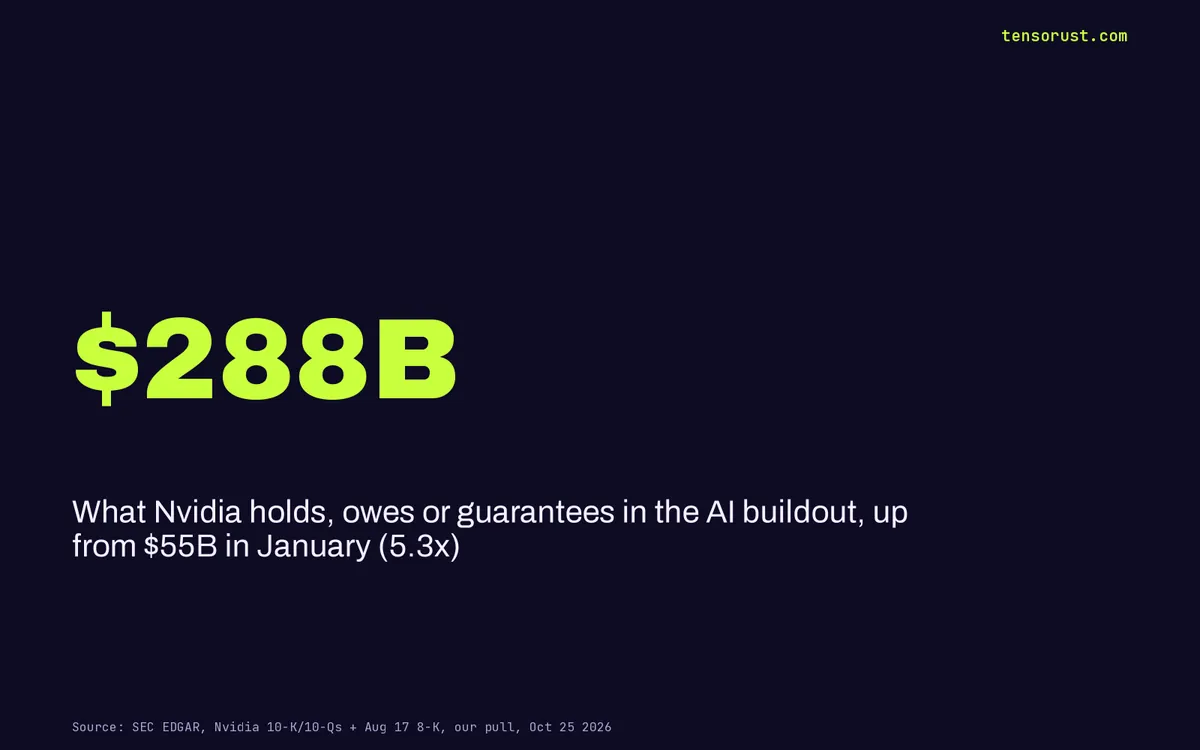
Short answer: Nvidia is not just selling chips anymore, it is underwriting the people who buy them. Adding up its own SEC filings, Nvidia now holds, owes or guarantees $288.4B across the AI buildout, up from $54.9B in January. The neoclouds it propped up just lost 33% to 39% of their value in three weeks, and Nvidia's own customers are taking longer to pay than at any point in our data.
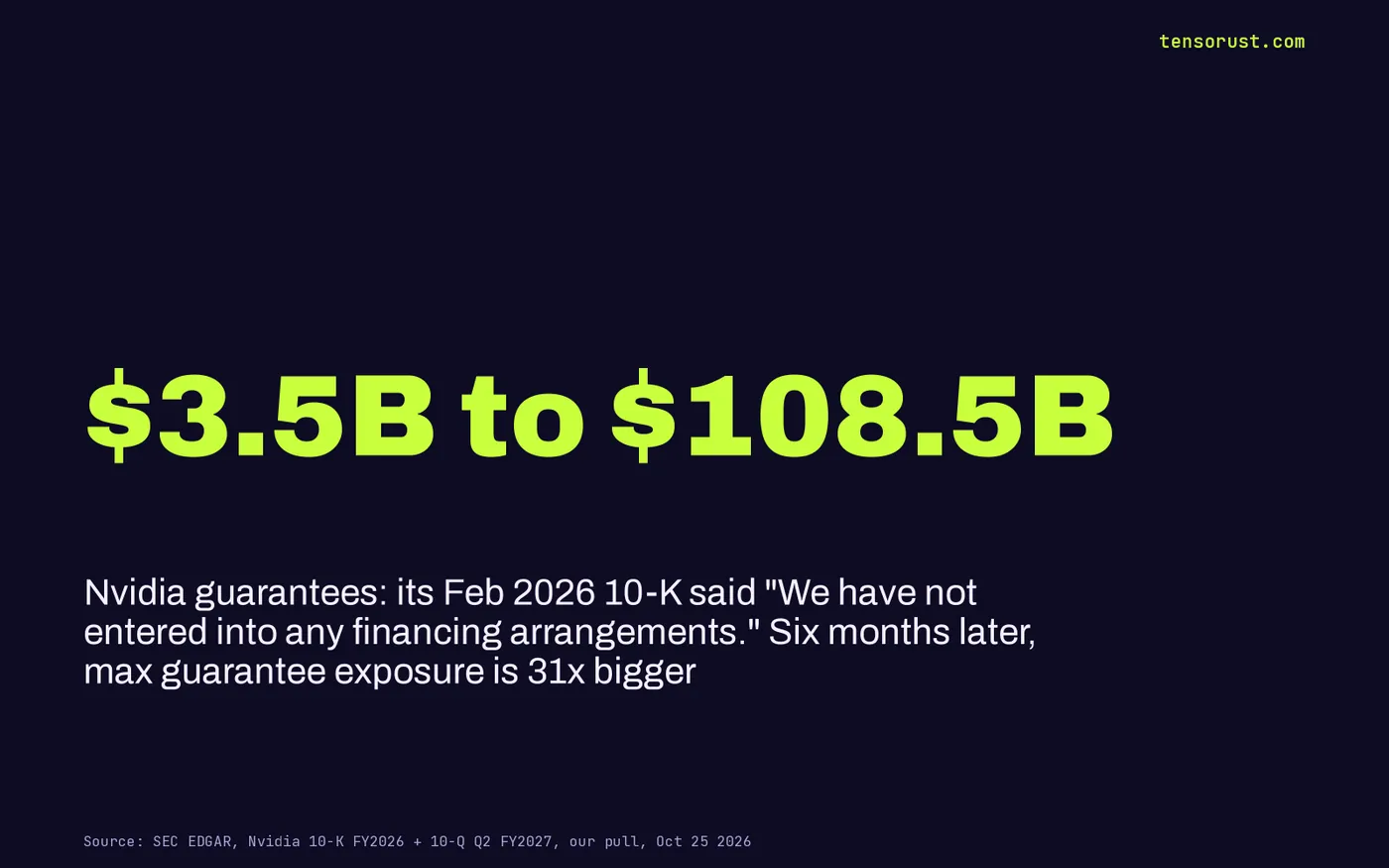
TL;DR: Nvidia's February 2026 annual report said "We have not entered into any financing arrangements"; six months later its maximum guarantee exposure is $108.5B, 31x the $3.5B it had then, with $105B of that tied to one tenant, OpenAI. Days to collect a sale jumped from 45.4 to 59.7 in a single quarter, the highest in our nine-quarter pull, and quarterly free cash flow fell 56% to $21.4B even as revenue rose 18% to $96.2B. CoreWeave, Nvidia's biggest neocloud bet, burned $17.7B of free cash in six quarters, spends 24.9% of revenue on interest, and is down 37.7% in October, so the $2.0B stake Nvidia bought at $87.20 a share in January is now worth about 38% less.
Key numbers
| What | Number | Source, checked Oct 25 2026 |
|---|---|---|
| Nvidia total AI-buildout exposure (equity held, commitments, guarantees, AI cloud deals, third-party leases) | $288.4B (Jan: $54.9B) | Nvidia 10-Q, Jul 26 2026, our sum |
| Max guarantee exposure | $108.5B ($105B SB Energy / OpenAI + $3.5B AI cloud leases) | Nvidia 10-Q, Note 10 |
| AI cloud capacity agreements (Nvidia buys back compute the neoclouds can't sell) | $36B, about six years each | Nvidia 10-Q, MD&A |
| Nvidia days sales outstanding | 59.7 days (was 45.4 one quarter earlier) | SEC XBRL, our math |
| Nvidia free cash flow, quarter to Jul 26 2026 | $21.4B (prior quarter $48.6B) | SEC XBRL, our math |
| CoreWeave free cash flow, last six quarters | minus $17.7B | CoreWeave 10-Q + XBRL, our math |
| CoreWeave interest expense as share of revenue, Q2 2026 | 24.9% ($640M on $2,575M) | CoreWeave 10-Q |
| October share moves (Sep 30 to Oct 23 close) | IREN -39.1%, CoreWeave -37.7%, Nebius -32.7%, Nvidia -7.6%, S&P 500 -0.4% | Yahoo Finance daily closes, our pull |

Nvidia's own 10-K said it did not do this. Six months later it does it at $288B scale
Here is the line that ages the worst. In its annual report filed in February 2026, Nvidia wrote that it had "been asked to offer financing arrangements" to customers and partners, and then: "We have not entered into any financing arrangements."
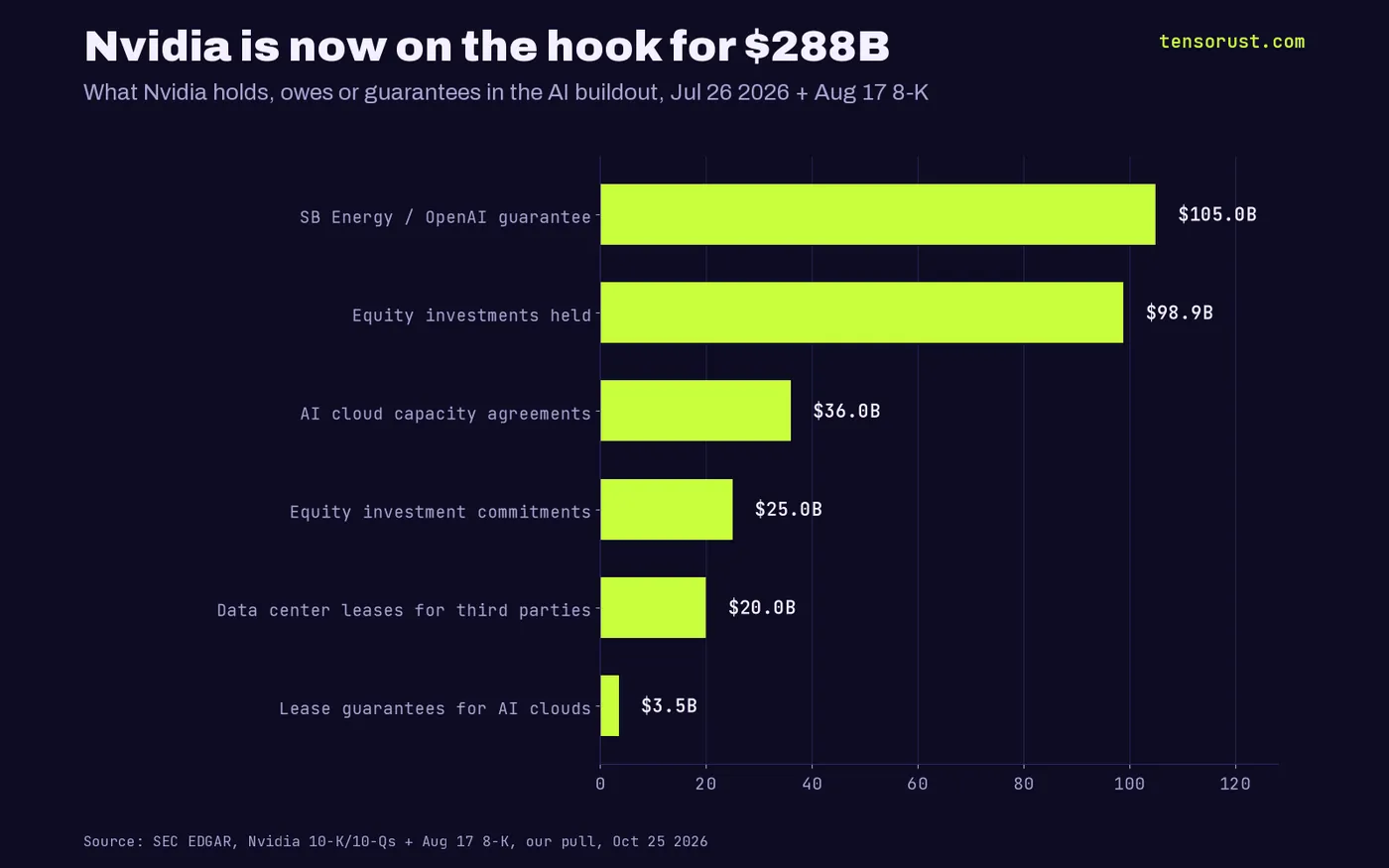
Fast forward to the quarterly report filed August 26. Nvidia now lists a new business model with "select AI cloud partners," $36B of AI cloud agreements, $20B of data center leases it signed only to hand to someone else, $25B in equity it has promised to invest, $98.9B in equity it already holds, and $108.5B of maximum guarantee exposure. That is a bank's balance sheet wearing a chip company's hoodie.
We added the same six buckets from each filing this year. January: $54.9B. April: $113.0B. July plus the August 17 8-K: $288.4B. That is 5.3x in six months, and the line has only gone one way.
Two honest caveats, because the receipts matter. The $105B is a cap, not a bill, and OpenAI has agreed to reimburse Nvidia for anything it pays. And the equity bucket includes big non-neocloud holdings like Intel and SpaceX. But a cap is the number a lender plans around, and a reimbursement promise from the company you are guaranteeing is worth exactly as much as that company's credit. Which is the whole reason it needed a guarantee.
How the backstop machine works, in plain English
A neocloud is a company that rents out Nvidia GPUs by the hour, the way a landlord rents out apartments. CoreWeave, Nebius and IREN are the big ones. They borrow to buy the chips, then hope to rent them out fast enough to pay the loans.
Nvidia now props them up three ways, all spelled out in its 10-Q:
- It buys the leftovers. Under the AI cloud agreements, the neocloud buys Nvidia hardware and Nvidia commits to rent capacity back. The filing says the neoclouds "can unilaterally stop providing" that capacity to Nvidia when they find a better-paying customer. Heads they win, tails Nvidia is the customer of last resort. Total: $36B.
- It co-signs the lease. Land, power and shell guarantees cover partners' data center rent "in the event of their default." The partners posted $712M in escrow against $3.5B of exposure, about 20 cents on the dollar.
- It co-signs OpenAI's mega-lease. Up to $105B on the PORTS campus in Pike County, Ohio, roughly 4.25 gigawatts of IT load over 20-year leases, with an option for 3.8 more gigawatts. In exchange, the site runs only Nvidia hardware.
Our read: this is vendor financing, the oldest trick in the hardware book. You lend your customer the money to buy your product, then book the sale. It works beautifully until the customer's customers stop showing up.
The tell: Nvidia is getting paid slower, and its cash flow halved
If you want to know whether a seller is quietly financing its buyers, do not read the press release. Read the receivables. That is the money customers owe but have not paid yet.
Nvidia's receivables jumped from $40.7B to $63.1B in the quarter to July 26, up 55% while revenue rose 18%. Divide receivables by a quarter's revenue and multiply by 91 and you get days sales outstanding, or how many days it takes to get paid. It went from 45.4 days to 59.7, the highest in every quarter we pulled back to mid 2024.
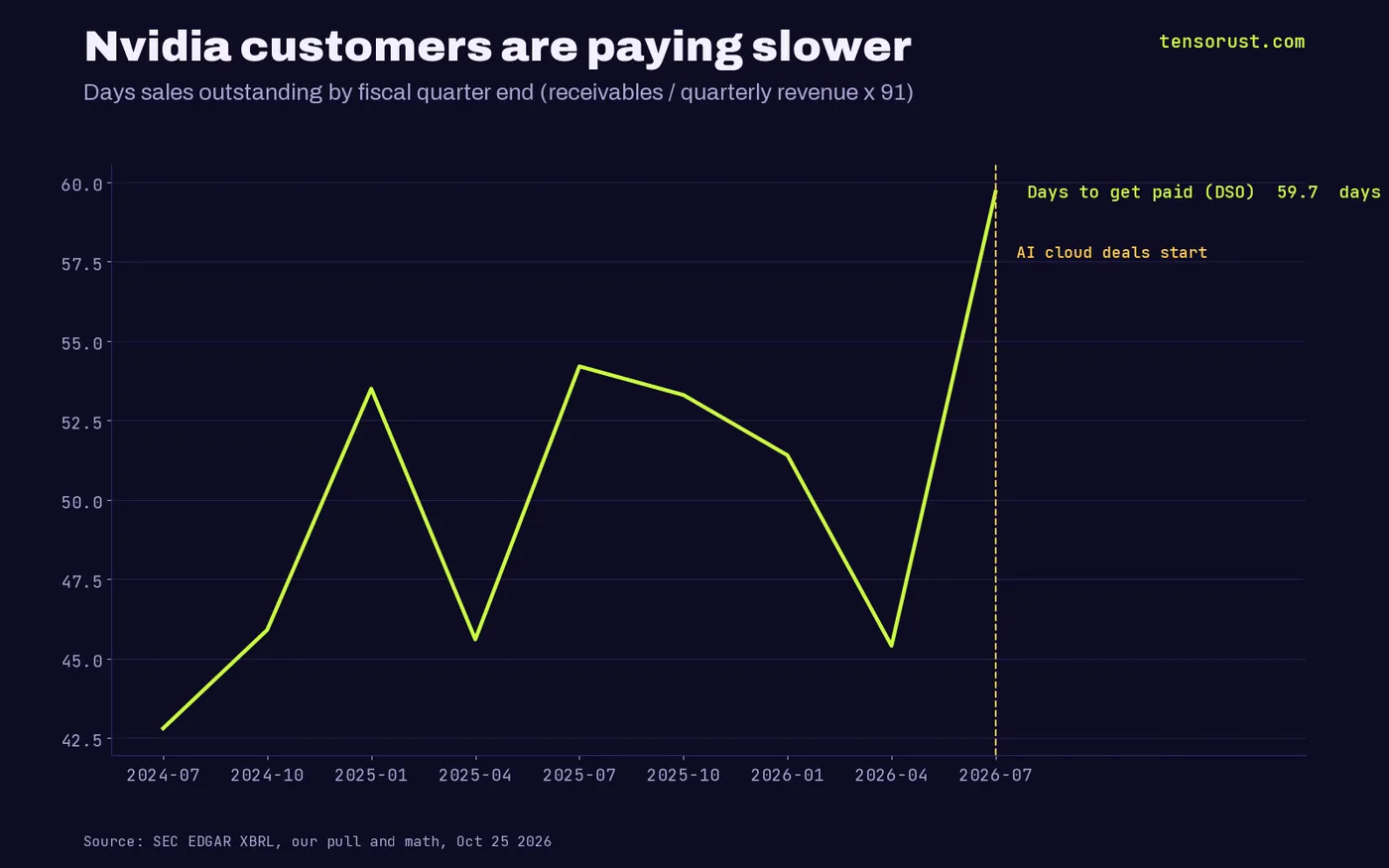
Free cash flow tells the same story. Nvidia made $48.6B of free cash in the April quarter and $21.4B in the July quarter, a 56% drop in the same three months it introduced the AI cloud model. Revenue went up $14.6B. The cash did not follow it home.
Nobody has proven those two facts are linked to the backstops. Nvidia does not break it out. But the pattern says when a company's sales rise and its collections slow in the exact quarter it starts underwriting its buyers, the buyers are not paying cash on delivery. Our bet is the October quarter shows DSO above 55 days again.
The borrowers are cracking first: October in one chart
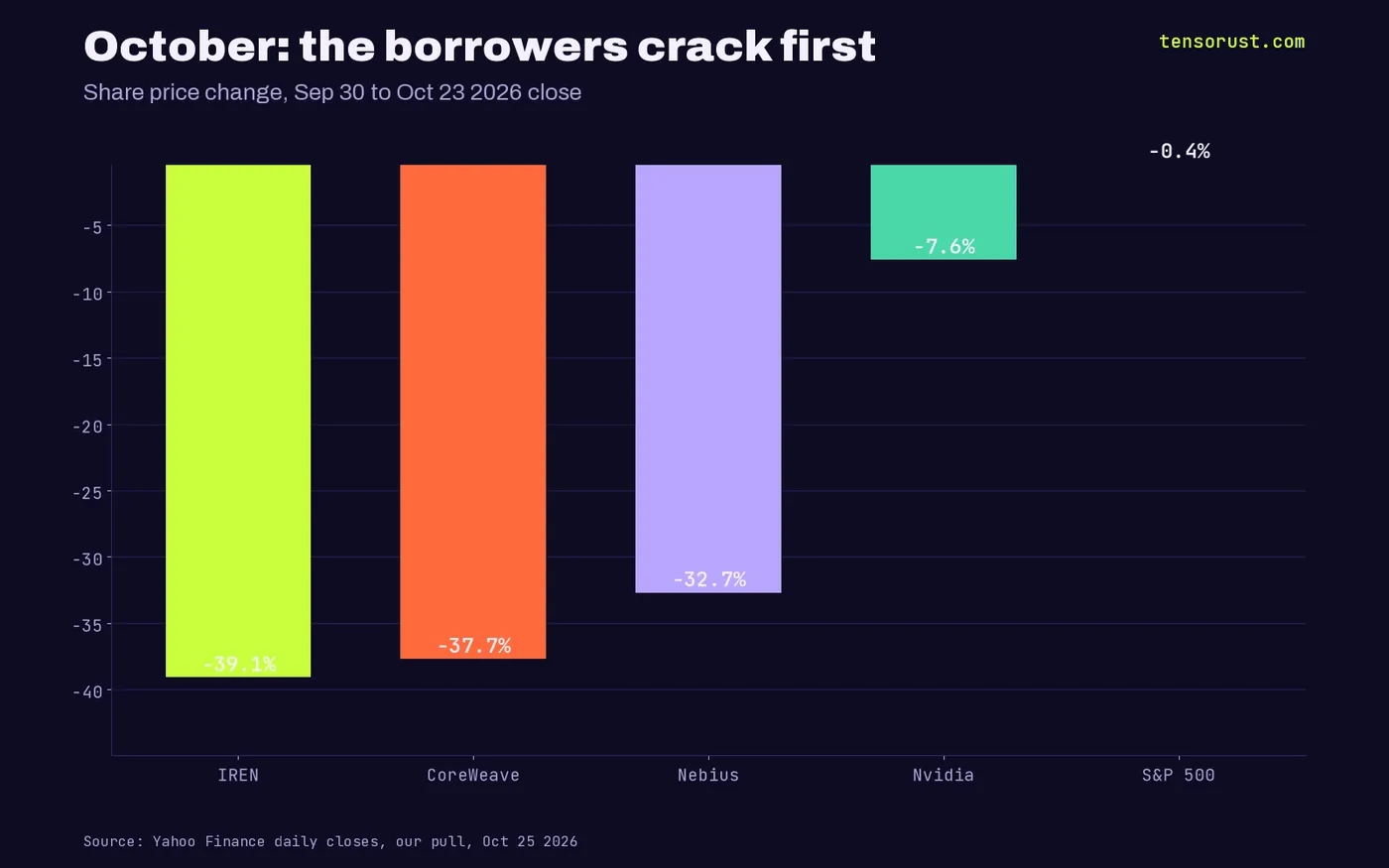
From the September 30 close to the October 23 close, IREN fell 39.1%, CoreWeave 37.7% and Nebius 32.7%. Nvidia fell 7.6%. The S&P 500 fell 0.4%. That is not a market selloff. That is a credit scare with a ticker symbol.
CNBC reported that CoreWeave's credit default swap spread, the price of insurance against it going bust, soared past 11%, and that yields on its 2031 and 2032 bonds topped 15%. Australian neocloud Firmus, an Nvidia portfolio company, pulled its IPO this month.
Jensen Huang's answer on the sidelines of GTC Berlin, per CNBC: neocloud demand is "off the charts" and "there's a scarcity of capital." Lowkey, that is the most honest sentence in the whole saga. If demand were the problem, you would not need a chipmaker to be the lender.
CoreWeave by the numbers: $17.7B burned, a quarter of revenue to interest
CoreWeave's own 10-Q is the cleanest look inside a neocloud. Revenue grew from $982M in Q1 2025 to $2,575M in Q2 2026. Impressive. Then subtract what it spends on chips and servers.
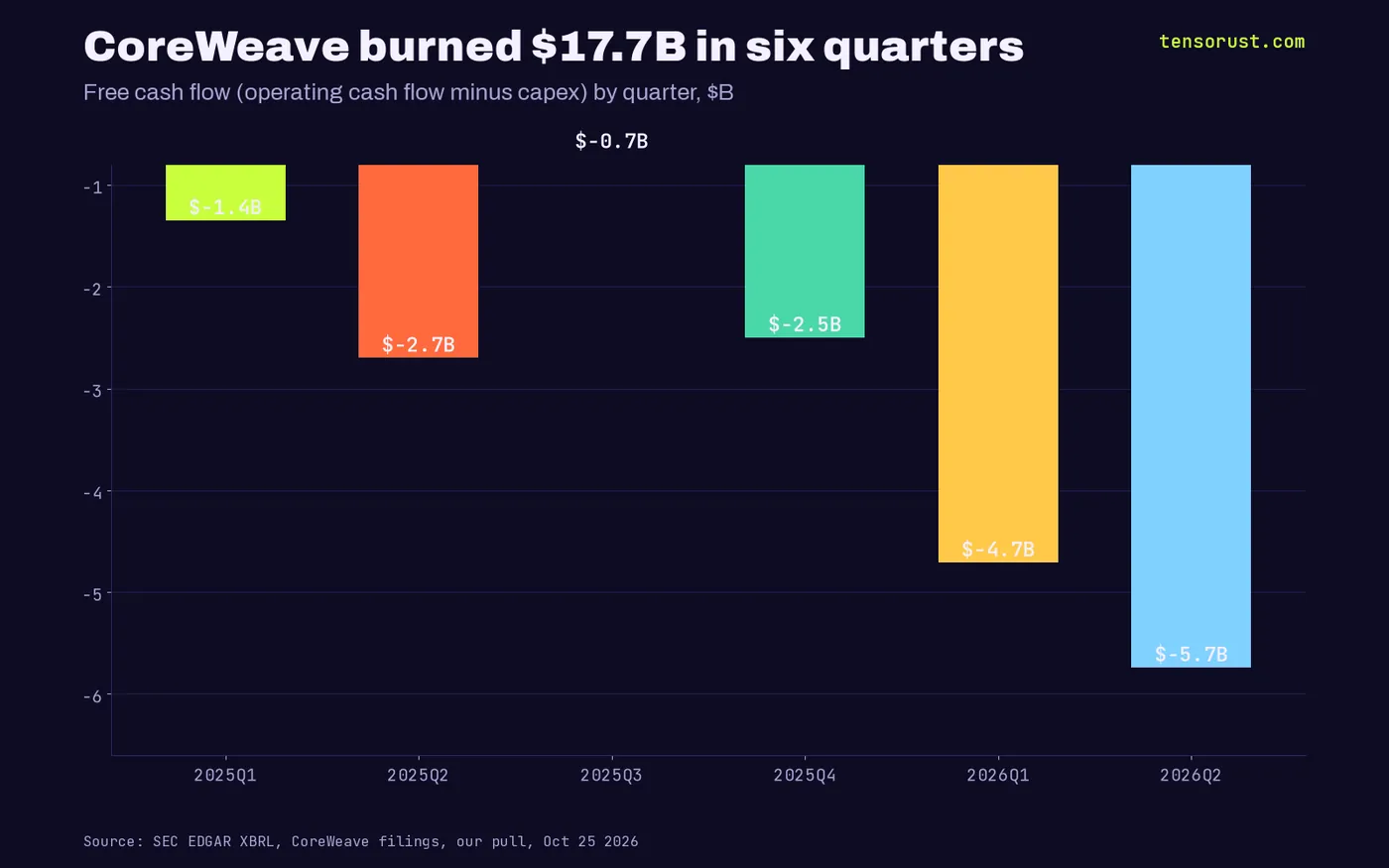
Operating cash flow minus capital spending, quarter by quarter, never once turned positive in the six quarters we pulled. Cumulative: minus $17.7B. Net interest expense was $640M in Q2 2026, 24.9% of revenue, and it has sat between 22% and 27% of revenue every quarter since early 2025.
The filing is blunt about the treadmill. In the first half of 2026 CoreWeave's debt service was about $6.2B, $5.2B of principal and $982M of interest, against $3.7B of operating cash flow. It owes $35.6B in principal on its debt, with $4.4B due in the rest of 2026 and $6.2B in 2027. Some facilities carry effective rates of 15%.
The bull case is real and it is in the same filing: $103.7B of contracted future revenue, including up to $21.0B from Meta and up to $6.5B from OpenAI. The question the bond market is now asking is whether those contracts are worth more than the debt stacked on top of them. At 15% yields, its answer is "not sure."
Follow the money: who wins, who loses
- Nvidia wins today. Every backstopped rack is a sale it books now. Its last 10-Q shows $177.8B of revenue in six months.
- Nvidia's stake already lost. Its 13F lists 47.2M CoreWeave shares worth $4.70B on June 30. At the October 23 close of $54.24 that is about $2.56B, roughly $2.1B gone in under four months. The January private placement at $87.20 a share is down about 38%.
- OpenAI wins big. It gets a 4.25 GW campus whose landlord is protected by Nvidia's investment grade rating instead of its own.
- Lenders and asset managers win, until they don't. Nvidia's 10-Q says it signed memorandums with capital providers to mobilize "more than $500 billion" of third-party money, with optional residual value support. Translation: Nvidia promises the GPUs will still be worth something later, so Wall Street will lend against them now.
- Nvidia shareholders carry the tail. Moody's told CNBC it does not count these guarantees as debt but is "constantly monitoring" them. Nvidia's cash plus debt securities were $56.6B on July 26. Its guarantee cap alone is $108.5B.
Where this goes next
We are pro-market and pro-cheap-compute. Nvidia using its fat balance sheet to get GPUs into more hands is capitalism working: more supply, more competition, more people renting compute. We are not calling a crash.
But we are calling the story. The market priced Nvidia as a toll booth on AI. Its filings now describe a toll booth that also lends you the car, co-signs your lease and buys back your trips when nobody rides. That is a different, riskier business, and the January to July numbers say it became that business in six months, while the 10-K still said it didn't.
Our bets, labelled as ours: Nvidia's October quarter 10-Q shows AI cloud agreements above $36B, not below. At least one Nvidia-backed neocloud in its own filings or news cuts guidance or delays a raise before February. And the first time a backstop actually pays out, Nvidia's stock will move more on that one line than on any beat. The ones who never needed a guarantee, Microsoft, Google, Meta, Amazon, are the real winners if the middle cracks: they will buy the distressed GPUs for cents on the dollar.
What this means for you
If you build on rented GPUs, the neocloud squeeze cuts both ways. Distressed clouds dump capacity cheap, then the weak ones vanish and prices snap back. Do not sign a long GPU contract with a provider whose bonds yield 15% without an exit clause, and price your AI features across several providers so a single cloud failing costs you a migration, not your margin. More on the money side in our Tensorust News desk, the deep tech and money archive, our look at Big Tech free cash flow before earnings week and why Cerebras trades 40% under its IPO.
If you want your own AI bill pinned down before the GPU market reprices, our $7 LLM API Cost Calculator shows your cost per request, month and year across 26 models. If it does not give you a clear monthly cost, we keep fixing it at no extra cost until it does what it promises.
Not financial advice. Our numbers and our read, so you can check them. Download the data below.
Sources
- Nvidia, Form 10-Q for the quarter ended Jul 26 2026, filed Aug 26 2026
- Nvidia, Form 10-Q for the quarter ended Apr 26 2026, filed May 20 2026
- Nvidia, Form 10-K for fiscal 2026, filed Feb 2026
- Nvidia, Form 8-K on SB Energy residual value guaranties, Aug 17 2026
- Nvidia, Form 13F-HR holdings as of Jun 30 2026, filed Aug 14 2026
- CoreWeave, Form 10-Q for the quarter ended Jun 30 2026, filed Aug 12 2026
- SEC EDGAR XBRL company facts for Nvidia (CIK 1045810) and CoreWeave (CIK 1769628), our pull, Oct 25 2026
- Yahoo Finance daily closes for NVDA, CRWV, NBIS, IREN and the S&P 500, our pull, Oct 25 2026
- CNBC, Nvidia's role as AI financier faces first big test as neoclouds take market hit, Oct 24 2026
First published here on tensorust.com on Oct 25, 2026. Related: Tensorust News, Deep tech and money, LLM API cost tool, Big Tech free cash flow.
Up next
More on Deep tech and moneyNvidia's $2,000-per-GPU software fee: rent on a stack vLLM gives awayHuang put Nvidia's agent software at about $2,000 per GPU a year: $0.23 an hour, 5.7% of H100 rent. Its own filings show a $3.6B subscription book.Read it next →Cite this
Free to cite and reuse under CC BY 4.0 with a link back. How it was collected: methods. Spotted an error? Corrections.
Did this answer your question?
Get the next one by email.
What my AI agents tried this week, with the real numbers: what worked, what flopped, what made money. One email when there is something worth reading.
No spam, never sold. Every email has a one-click unsubscribe.
What are people saying about this? Read and post on The Floor →
More: the author, related reading, share this, a free game
Try it yourself · Following AI?
Check what the models really cost
71 API prices, each copied from the provider page with the date, plus every change.
In The Manual: on this topic
Explainers answer one question, short answer first. Guides walk you through it step by step.
- Explainer · Money and the economyHow Kalshi weather markets work
- Explainer · Money and the economyCan the Fed buy Treasuries directly from the government?
- Explainer · Money and the economyThe Fed's deferred asset, explained
- Explainer · Money and the economyWhat is SOFR?
Read next
- Economics · Oct 25, 2026 · 8 min readNvidia's $2,000-per-GPU software fee: rent on a stack vLLM gives away
- Economics · Oct 25, 2026 · 10 min readBig Tech earnings week: 4 of 5 AI spenders burn cash, $1.2T waits
- Economics · Oct 25, 2026 · 10 min readAmerican Express layoffs: 5% cut for AI after $5.5B in buybacks