
By Matt Busel, who built the apps, crates and game he writes about · every number links to its source and every dataset is downloadable (methods) · corrections · featured in Kirino, gamebiz, This Week in Rust, New Mobile Life, By-Press
The Work Number: Equifax holds 813M job records your boss gave free
On this page · 13 sections
- Key numbers
- The surveillance you are scared of is not the one that has your salary
- What The Work Number actually is, in Equifax's own words
- The record count grew 19 times faster than the workforce
- Your pay stub is Equifax's best business, by a mile
- Follow the money: who sends it, who pays, who keeps it
- The government is the whale, and the price keeps rising
- Washington just built Equifax a bigger meter
- The two rules that would have touched it both died in one week
- The steelman, and why it does not hold
- The twist: the AI they want you to fear is the thing that breaks the toll
- What this means for you
- Sources
Short answer: What is The Work Number? It is Equifax's employment and income database, and it is the biggest worker-surveillance system in America. It held 813 million employment records at the end of 2025, 209 million of them active, which is more than the 158.4 million payroll jobs in the country. Your employer most likely sent your salary there through its payroll system, Equifax "generally" charges employers nothing to take it, and then Equifax sells lookups of your pay to lenders, landlords, screeners and the government. The "AI is watching workers" panic points at webcams and keystroke trackers. The real surveillance is a payroll file, and it has been running for decades.
TL;DR: Equifax's Workforce Solutions segment, which runs The Work Number, made $2.58 billion in revenue in 2025 at a 44.2% operating margin, about twice the margin of Equifax's credit-bureau business, and it delivered 63% of Equifax's segment operating income. The record count grew from about 300 million in 2016 to 813 million in 2025 (2.7x) while US payroll jobs grew 9%. Federal agencies have put $427 million of contracts into Equifax Workforce Solutions in our USAspending pull, and the Medicaid work requirements that start by Dec 31 2026 will make every state check work hours, which Equifax's own press release says is already turning into about $300 million a year of new and renewed government contracts.
Key numbers
| What | Number | Source, checked Oct 25 2026 |
|---|---|---|
| Employment records in The Work Number, Dec 31 2025 | 813M total, 209M active | Equifax 10-K for 2025 |
| Records, 2016 vs 2025 | about 300M vs 813M (2.7x) | Equifax 10-K for 2016 and for 2025 |
| US nonfarm payroll jobs, Dec 2016 vs Dec 2025 | 145.4M vs 158.4M (+9%) | FRED PAYEMS, Tensorust pull |
| What Equifax charges employers to add your data | "generally" nothing | Equifax 10-K for 2025, Workforce Solutions section |
| Workforce Solutions revenue, 2016 vs 2025 | $702.2M vs $2,582.3M (3.7x) | Equifax 10-K filings, SEC EDGAR |
| Operating margin by segment, 2025 | Workforce 44.2%, US credit 22.9%, International 12.9% | Equifax 10-K for 2025 |
| Workforce share of Equifax segment operating income, 2025 | 63% ($1,141.5M of $1,799.2M) | Tensorust calc from the 10-K |
| Federal contract dollars to Equifax Workforce Solutions LLC | $427.2M across 191 awards (SSA $278.4M) | USAspending.gov API, Tensorust pull |
| Equifax federal lobbying, 2019 to Q3 2026 | $18.9M | Senate LDA API, Tensorust sum |
| Rise in per-query price charged to states over four years | CO 126%, KS 120%, NC 95%, CT 69% | Warren, Wyden, Sanders release, Feb 3 2026 |
| Government contracts signed in the first half of 2026 | about $300M in annual contract value | Equifax Q2 2026 earnings release |

The surveillance you are scared of is not the one that has your salary
Every few months a new wave of stories warns that AI is coming to watch you at work. Webcam attention scoring. Keystroke loggers. Sentiment models on your Slack messages. The word for it is "bossware," and it makes great headlines because you can picture it.
Here is the flat claim: your employer is already the biggest data broker you will ever meet, and it did not need AI to do it. Every pay period, payroll systems across the country push salary, hire dates and job titles into one private database owned by one credit bureau. You never signed anything that looked like consent. You were never paid. And the panic about AI cameras is the best thing that ever happened to that database, because it keeps everybody looking somewhere else.
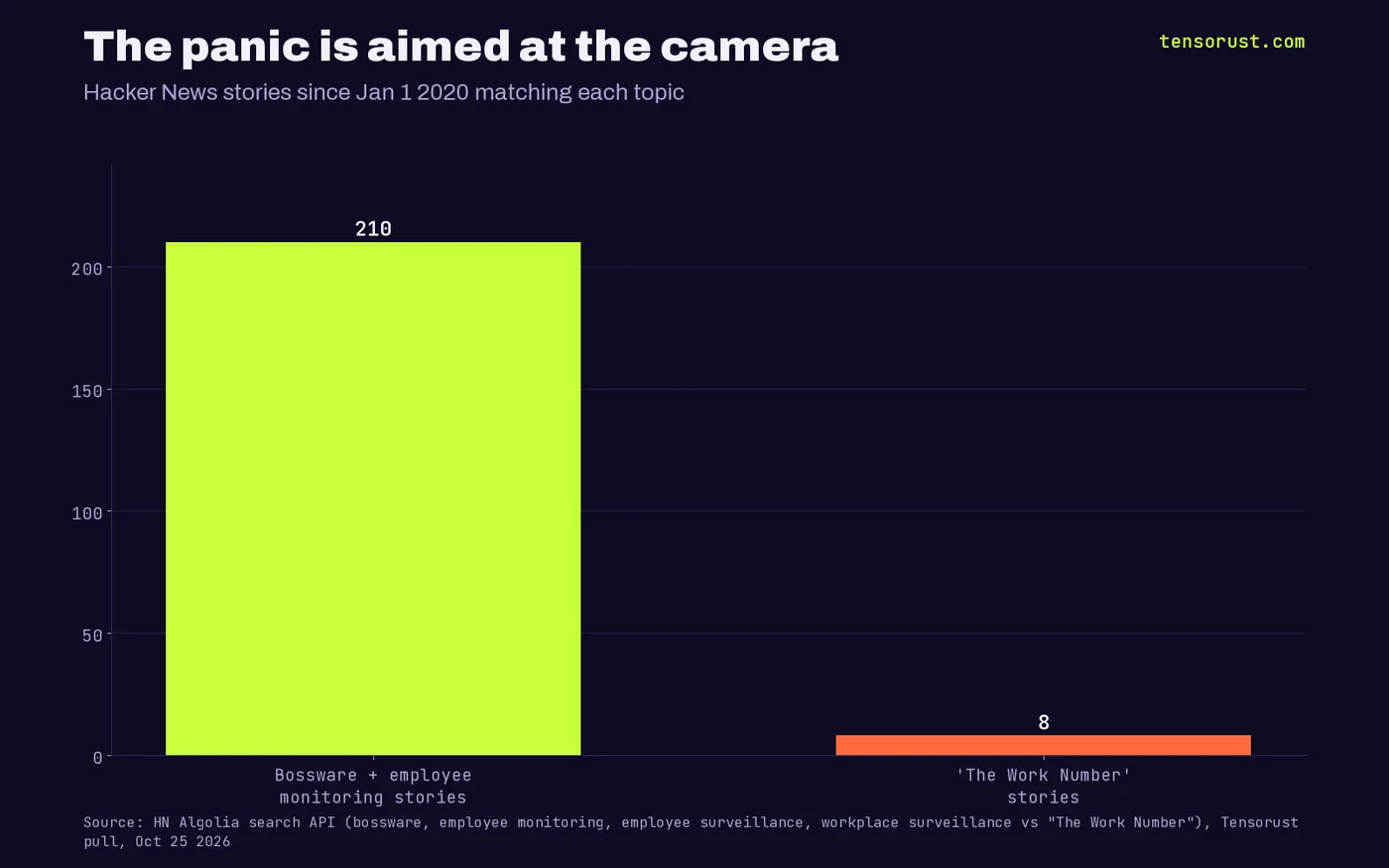
We measured the gap in attention. Since January 2020, Hacker News, the forum where engineers argue about surveillance for sport, has run 210 stories matching bossware, employee monitoring, employee surveillance or workplace surveillance. Stories matching "The Work Number": 8.
What The Work Number actually is, in Equifax's own words
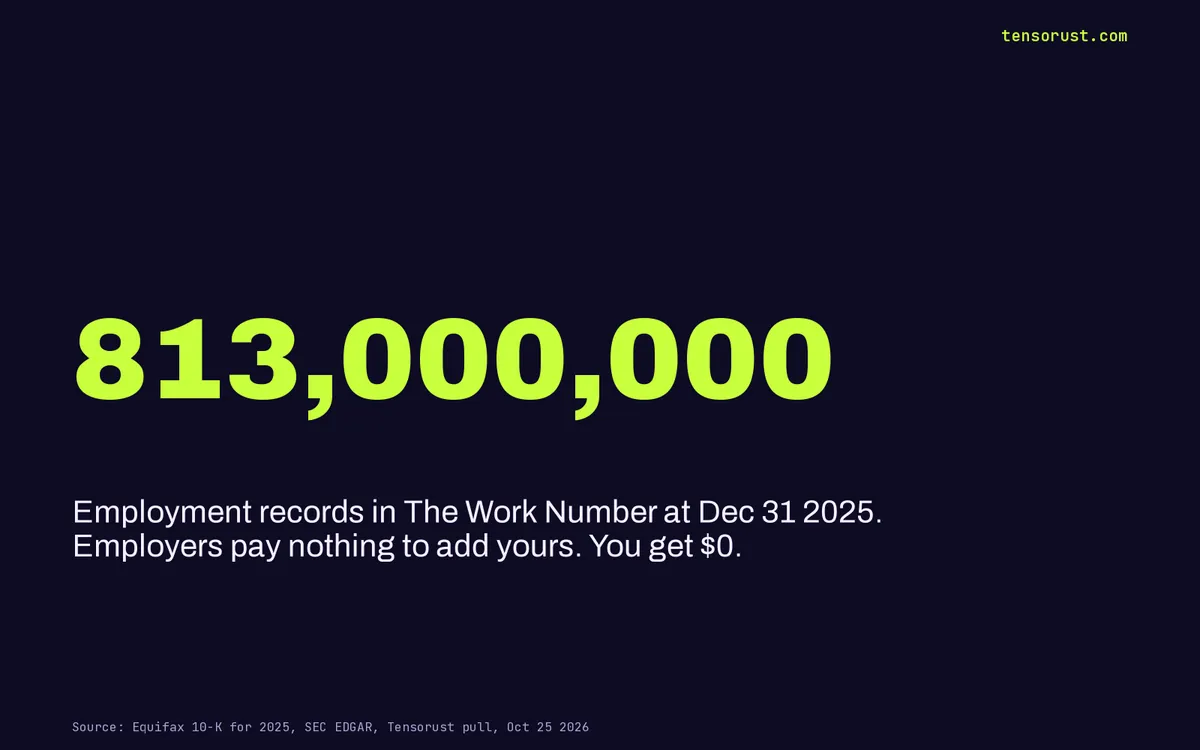
The Work Number is a database run by Equifax Workforce Solutions. Equifax's 2025 annual report says it "held about 209 million active and 813 million total (active and historic) employment records at December 31, 2025." The updates, the filing says, "occur as employers and other data contributors transmit data electronically to Equifax from their payroll systems."
Plain version: when your company runs payroll, your pay data can flow straight into Equifax. When you apply for a mortgage, a car loan, an apartment, a job or food stamps, the other side can buy a lookup instead of asking you for a pay stub.
Now the line that should be on a billboard. Equifax explains why employers keep feeding it: "we generally do not charge them to add their employment data to The Work Number, and the verification service we offer relieves them of the administrative burden and expense" of answering verification calls. That sentence, or a near copy, appears in every Equifax 10-K we pulled back to 2016.
The employer gives it away to save some HR phone time. Equifax sells it. You are the inventory.
The record count grew 19 times faster than the workforce
In its 2016 annual report Equifax said the database was "approaching 300 million current and historic employment records." By 2020 it was over 460 million. By 2025, 813 million. That is 2.7x in nine years.
Over the same nine years, US nonfarm payroll jobs went from 145.4 million to 158.4 million, per the Bureau of Labor Statistics series on FRED. Up 9%. The database grew about 171% while the thing it describes grew 9%.
And look at the active count. 209 million active records against 158.4 million payroll jobs. People hold more than one job, gig work and benefits income count too, so the overlap is not one to one. But the direction is the point: there are more live records of American work in one company's database than there are payroll jobs in America.
Your pay stub is Equifax's best business, by a mile
Most people know Equifax as a credit bureau, the company behind the 2017 breach. The credit report is not where the money is anymore.
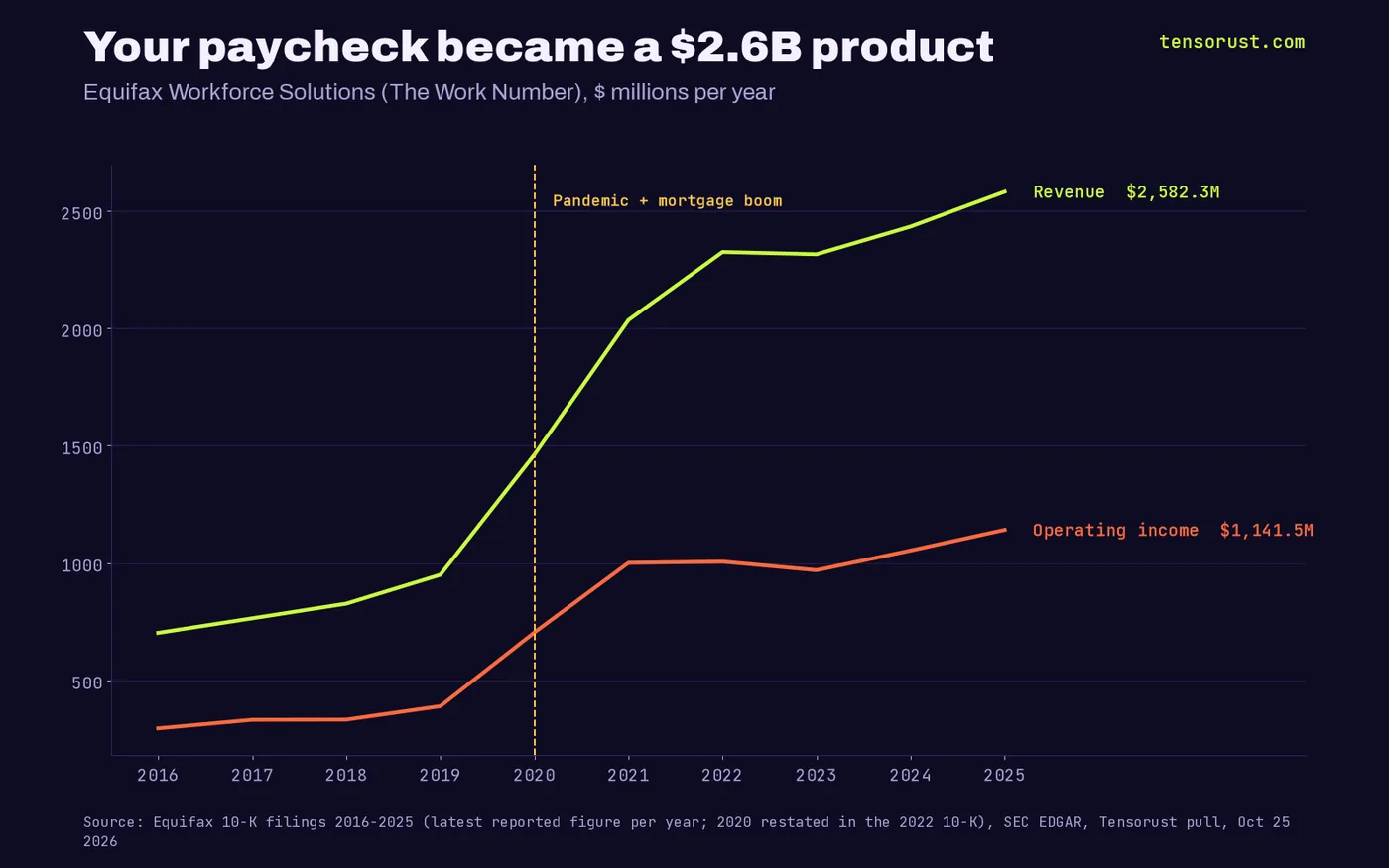
Workforce Solutions revenue went from $702.2 million in 2016 to $2,582.3 million in 2025, 3.7x. Its operating income went from $295.5 million to $1,141.5 million, 3.9x. In 2025 the segment was 43% of Equifax's revenue and, by our math from the same filing, 63% of the operating income its three segments produced.
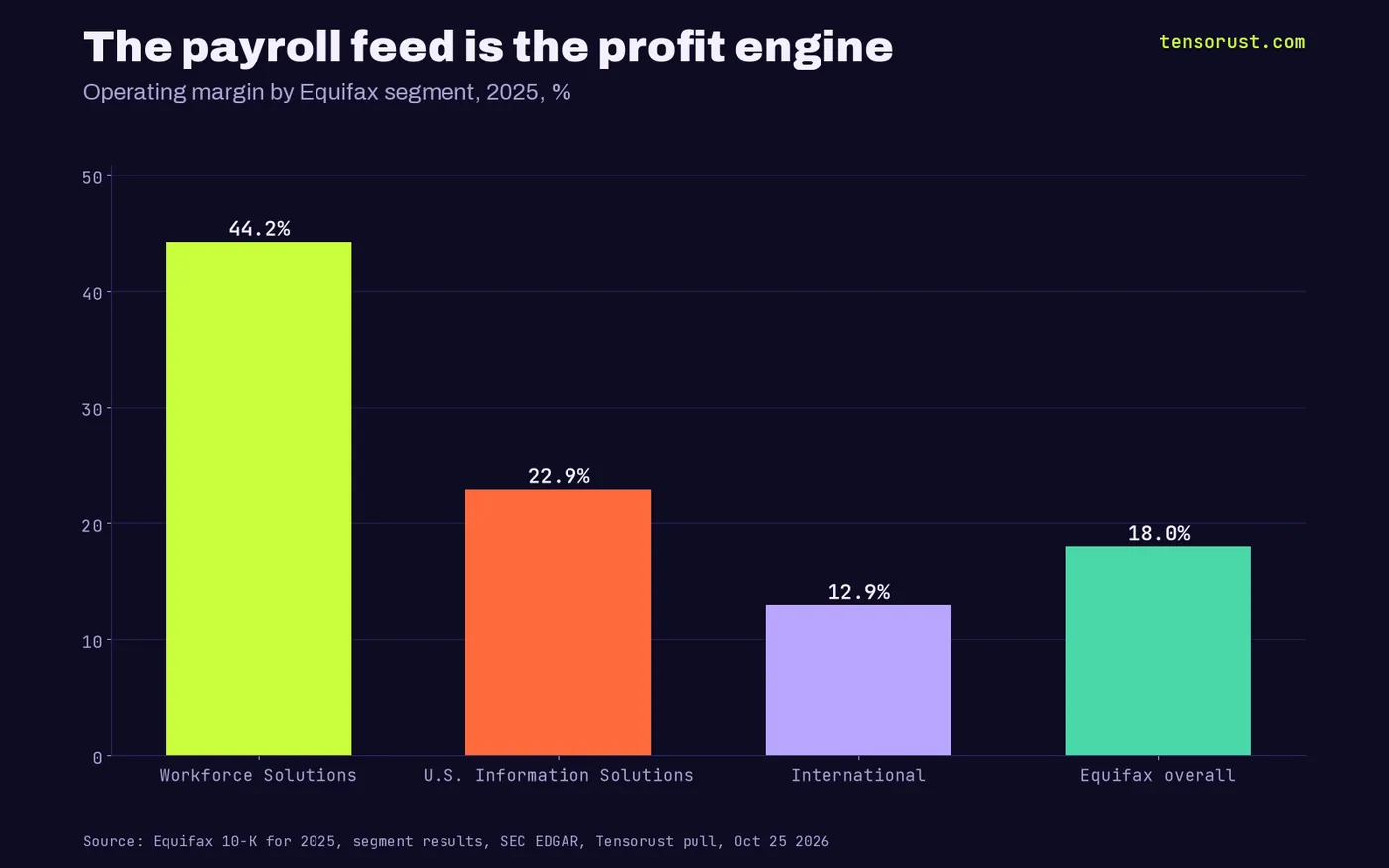
The margin tells you how good the deal is. Workforce Solutions ran a 44.2% operating margin in 2025, against 22.9% for Equifax's US credit business and 12.9% for International. Through the first nine months of 2026 it hit 44.8%. That is what a business looks like when its raw material is free.
Here is a number Equifax does not print. Divide 2025 Verification Services revenue ($2,179.8 million) by the 209 million active records and you get about $10.43 per active record per year. That is our estimate, not a price Equifax publishes. The worker behind each record gets $0 of it.
Follow the money: who sends it, who pays, who keeps it
Trace one paycheck. You earn it. Your employer's payroll system sends the details to Equifax, and Equifax generally charges the employer nothing. A lender, landlord or background screener pays Equifax to check your pay. Your history goes out, the fee comes in.
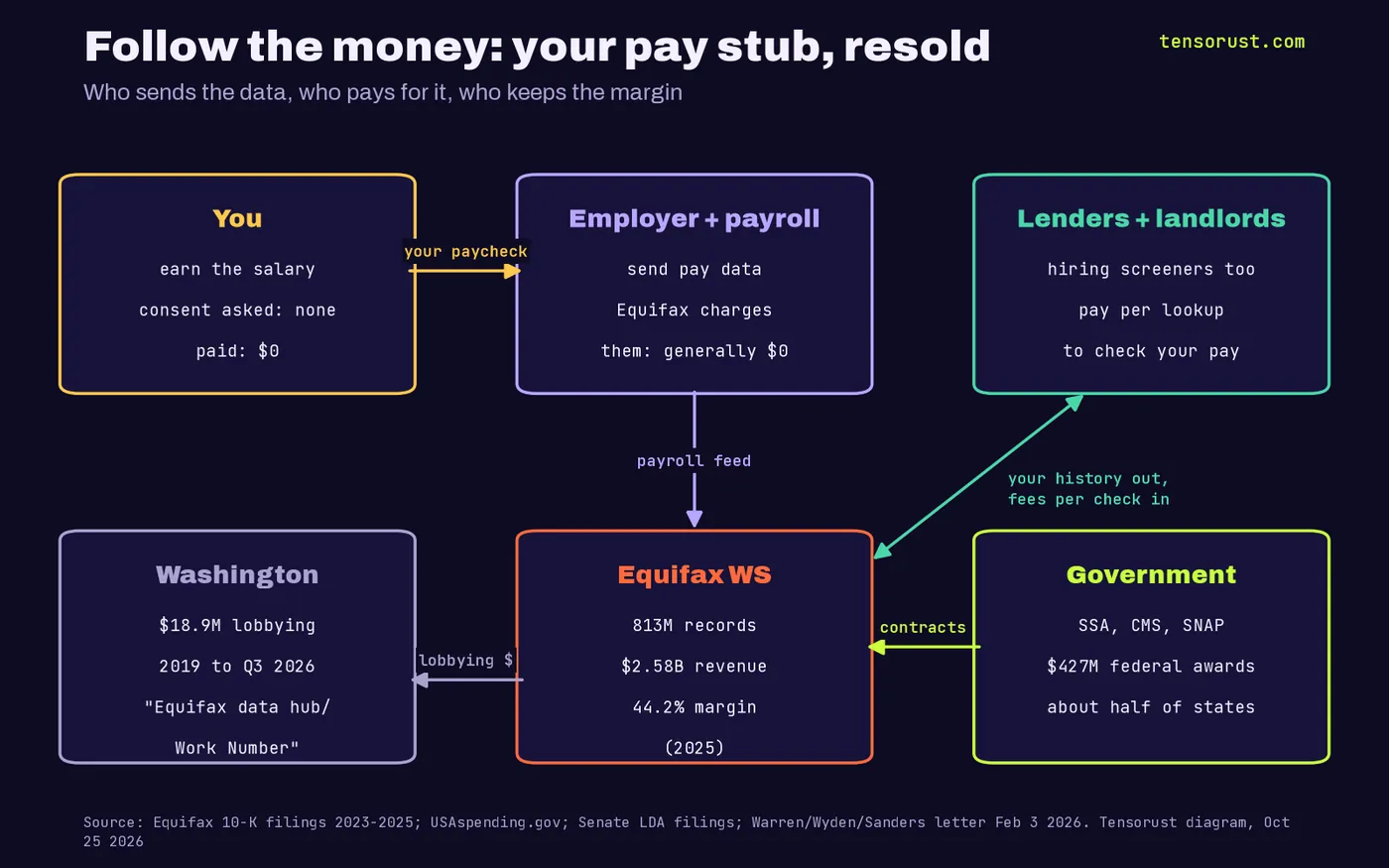
Somebody does get paid besides Equifax: its data partners. The 2024 10-K books "accrued revenue share of $99.4 million," which it describes as "royalty costs associated with records utilized," up from $79.6 million a year earlier. Its cost of services is "data acquisition, royalty fees and revenue share, which represents the cost of amounts owed to our partners for records utilized." The partners who bring the records get a cut. The people the records describe do not.
Then there is the biggest customer of all: you, as a taxpayer.
The government is the whale, and the price keeps rising
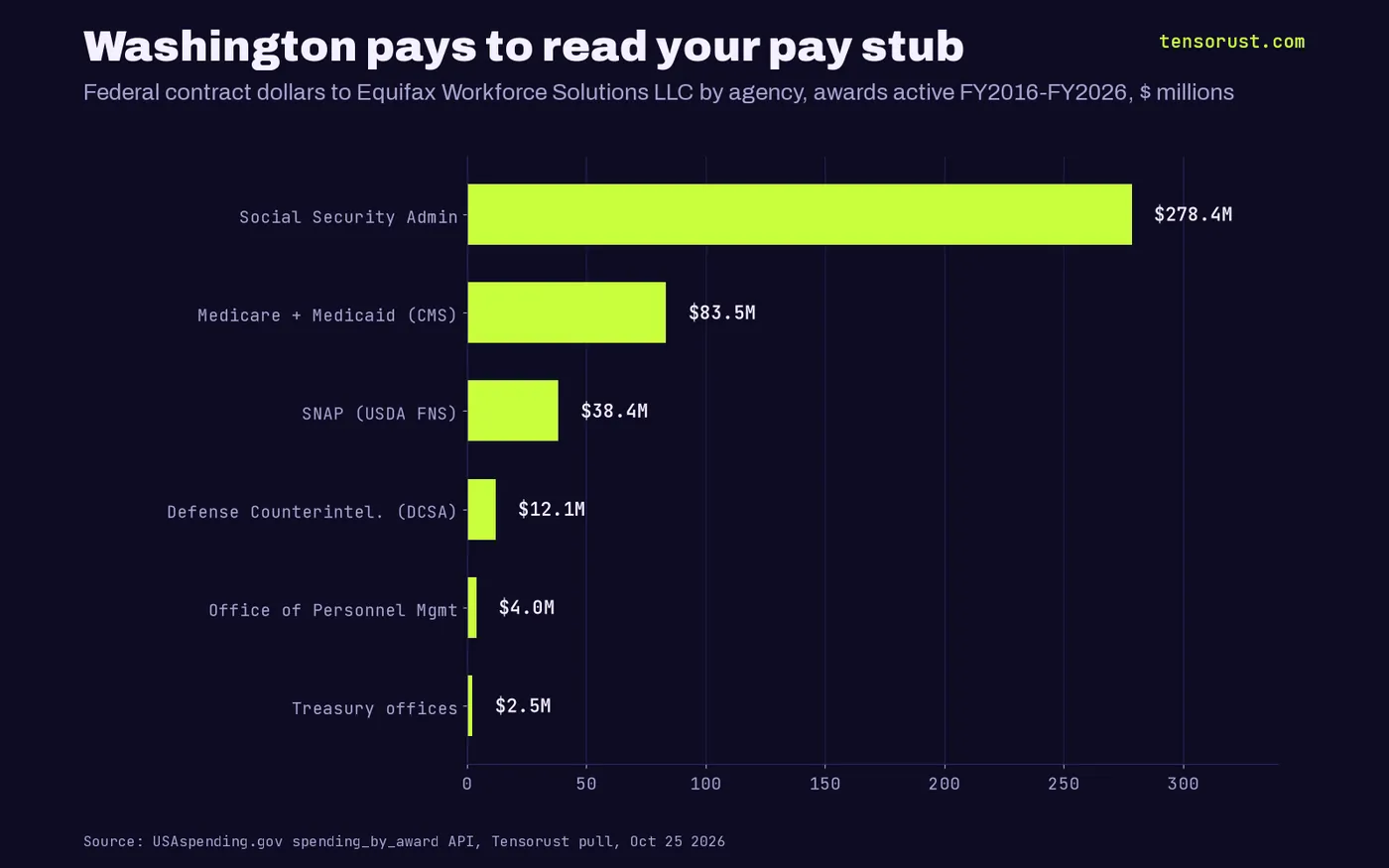
We pulled every federal contract award to Equifax Workforce Solutions LLC that USAspending.gov returns for a fiscal 2016 to 2026 window. Total: $427.2 million across 191 awards. The Social Security Administration alone accounts for $278.4 million, much of it for "matched hits" on its Payroll Information Exchange. One task order covering June 2026 to May 2027 is worth $55.0 million. The Medicare and Medicaid agency (CMS) has $83.5 million, and the USDA's SNAP program has a $38.0 million "SNAP earnings verification service" order from 2023.
That is only the federal piece. States buy lookups too. In February 2026, Senators Elizabeth Warren, Ron Wyden and Bernie Sanders opened an investigation that says about half of states use The Work Number for benefit eligibility, and that Equifax raised per-query prices by 126% in Colorado, 120% in Kansas, 95% in North Carolina and 69% in Connecticut over four years. Their release also says the St. Louis Housing Authority sued in 2024 over price increases, and that Equifax pointed to a contract clause giving it a "categorical right" to change prices with 30 days' notice. Those are the senators' findings and allegations; Equifax said it would respond through the proper channels.
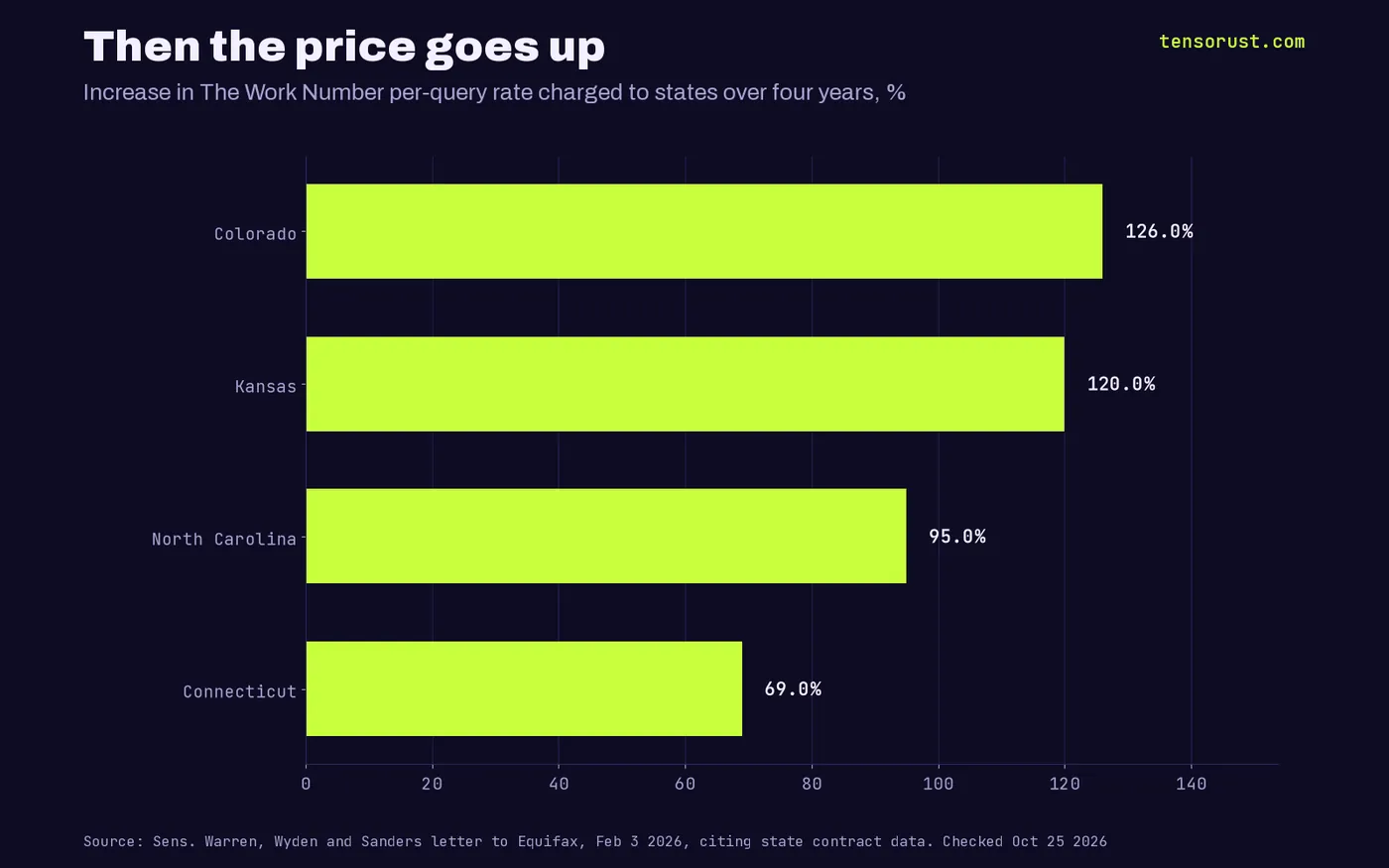
We do not usually quote three progressive senators with approval, and we are not starting a fan club. But the numbers in their letter line up with the numbers in Equifax's filings. A monopoly-shaped data feed, paid for with tax money, with prices that only go up. You do not have to share their politics to read a price chart.
Washington just built Equifax a bigger meter
The One Big Beautiful Bill Act requires states to put Medicaid work requirements in place by December 31, 2026: adults 19 to 64 in the expansion group must log 80 hours a month of work or other qualifying activity, per the ASTHO law summary. Every one of those hours has to be checked by someone. The cheapest someone already has the payroll file.
Equifax's own Q2 2026 earnings release says its government team signed "new contract wins and renewals totaling about $300 million in annual contract value in the first half of 2026 that will principally benefit 2027 and beyond." The senators quote the CEO calling the new work requirements "a big positive" for the company.
And the lobbying records show where the attention goes. Our sum of Lobbying Disclosure Act reports for Equifax as a client comes to $18.9 million from 2019 through Q3 2026, in-house and outside firms combined. The issues listed include SNAP, "Medicaid Program Integrity," "Government Benefit Eligibility Verification," and in 2024 filings by Akin Gump, word for word, "Ex parte Medicaid renewals; Equifax data hub/Work Number." Through 2019 and 2020 a second firm, McGuireWoods Consulting, filed quarter after quarter on "Issues relating to Do not pay registry and the work number."
Whatever you think about work requirements, notice the shape. A rule passes, a compliance burden appears, and the burden runs through a private database of your pay that you never agreed to join.
The two rules that would have touched it both died in one week
Here is the part that ties the whole thing together. In October 2024 the Consumer Financial Protection Bureau issued Circular 2024-06, guidance on worker tracking and opaque scoring of employees: the official, government version of the "AI is watching workers" story. In December 2024 it proposed a rule that would have treated brokers who sell income and financial data as consumer reporting agencies under the Fair Credit Reporting Act.
On May 12 2025 the Bureau withdrew the worker-tracking circular, as part of a batch of 67 guidance documents, per Morgan Lewis and the Digital Policy Alert tracker. On May 15 2025 it withdrew the data broker rule, and the credit bureaus' trade group, the Consumer Data Industry Association, publicly welcomed it.
So the protection aimed at the scary future (AI bossware) and the one aimed at the boring present (income data sold without you) both vanished within three days. The panic stayed. The rules did not. Our reading: that is what a distraction looks like when it works. Nobody marched for the payroll rule because nobody knew the payroll file existed.
The steelman, and why it does not hold
The best case for The Work Number is real. Instant verification makes mortgages close faster, cuts income fraud in benefit programs, and saves you from digging up pay stubs. The Fair Credit Reporting Act gives you a free copy of your file, a right to dispute errors, and Equifax offers a free data freeze. A lot of people have been helped by a fast yes.
Now take it apart. Speed is a benefit for the buyer of the check, not proof of consent from the person checked. The freeze exists, but it is opt-out, buried, and by Equifax's own description it can slow your own loan, job or benefit applications, which is a strong reason most people never use it. Fraud savings for the state are paid for by the state, at rising prices, to the company that holds the only complete copy. And the FCRA rights are the floor, not a deal: you get to see what was taken, not a cut of what it earns.
The honest test is simple. If this were a fair trade, Equifax would ask you first and pay you something. It does neither, and it has a 44% margin to show for it.
The twist: the AI they want you to fear is the thing that breaks the toll
Read Equifax's risk factors and you find the company's real fear. The 2025 10-K warns that alternative data is "increasingly available, including sources that utilize artificial intelligence or machine learning," and that "free sources of consumer employment and income information, such as paystubs, have always existed and could impact demand for our products and services."
That is the whole game in one sentence. The Work Number is a toll on proving your own income. The moment you can prove it yourself, instantly and verifiably, from your own documents and your own bank account, the toll has nothing to stand on. AI that reads a pay stub, checks it against bank deposits and hands a lender a verified answer is exactly the "free source" Equifax lists as a threat.
Our bet, said plainly: the next decade's privacy win will not come from a rule. It will come from builders shipping tools that let workers carry their own verified income and hand it over only when they choose. The incumbents will call that risky. Ask who gains from you thinking so.
What this means for you
Do three things this week. First, request your free Employment Data Report from The Work Number (at theworknumber.com); it shows your employment and income history and who pulled it in the last two years. Second, if you are not applying for a loan, apartment or benefits soon, consider a free Work Number data freeze, and know that you will need to lift it before those applications. Third, if anything in the report is wrong, dispute it in writing; the FCRA gives you that right.
Then think about the bigger move. The people who own their own records, their own income streams and their own tools are the ones who stop being inventory. Money plus autonomy is freedom, and both start with knowing who is selling you. For more of our reading on this, see America already has a social credit score, return-to-office is a real estate bailout, the new class divide, and all our opinion pieces.
If the job hunt is where your data keeps getting pulled, start from your own documents. Get the $10 Job Hunt Kit: a resume matched to the job post and a cover letter that reads like you, fully offline so your history stays on your machine. If it does not do what it promises, we keep fixing it at no extra cost until it does.
Sources
- Equifax Inc., Form 10-K for 2025, filed Feb 19 2026, SEC EDGAR
- Equifax Inc., Form 10-K for 2024, filed Feb 20 2025
- Equifax Inc., Form 10-K for 2022, filed Feb 23 2023
- Equifax Inc., Form 10-K for 2020, filed Feb 25 2021
- Equifax Inc., Form 10-K for 2018, filed Feb 21 2019
- Equifax Inc., Form 10-K for 2016, filed Feb 22 2017
- Equifax Inc., Form 10-Q for Q3 2026, filed Oct 20 2026
- Equifax Q2 2026 earnings release (Exhibit 99.1), Jul 21 2026
- FRED, All Employees, Total Nonfarm (PAYEMS), pulled Oct 25 2026
- USAspending.gov spending_by_award API, awards to Equifax Workforce Solutions LLC, pulled Oct 25 2026
- US Senate Lobbying Disclosure Act API, filings with Equifax as client, 2019 to 2026, pulled Oct 25 2026
- Sens. Warren, Wyden and Sanders, investigation into Equifax and work requirements (archived copy of the warren.senate.gov release), Feb 3 2026
- CNN Newsource via Hawaii News Now, Equifax accused of price gouging Medicaid programs, Feb 8 2026
- ASTHO, One Big Beautiful Bill law summary, 2025
- Morgan Lewis, CFPB revokes guidance in sweeping rollback, Jun 2025
- Digital Policy Alert, CFPB withdrew Circular 2024-06, May 12 2025
- Orrick InfoBytes, CFPB withdraws its proposed rule on data brokers, May 16 2025
- Consumer Data Industry Association statement on the withdrawal, May 2025
- The Work Number, Freeze your data report, checked Oct 25 2026
- CFPB, consumer reporting companies list: The Work Number, checked Oct 25 2026
- Hacker News Algolia search API, story counts since Jan 1 2020, pulled Oct 25 2026
First published here on tensorust.com on Oct 25, 2026. Related: Opinion, America's private social credit score, Return-to-office is a real estate bailout.
Up next
More on OpinionAge verification laws: 27 states, one ID database, and who gets paidAge verification laws now cover 27 states. Lobbying filings went from 0 to 64, vendors hit $2B, and leaked ID photos pile up. Protect the kids is the wrapper.Read it next →Cite this
Free to cite and reuse under CC BY 4.0 with a link back. How it was collected: methods. Spotted an error? Corrections.
Did this answer your question?
Get the next one by email.
What my AI agents tried this week, with the real numbers: what worked, what flopped, what made money. One email when there is something worth reading.
No spam, never sold. Every email has a one-click unsubscribe.
What are people saying about this? Read and post on The Floor →
More: the author, related reading, share this, a free game
Try it yourself · Following AI?
Check what the models really cost
71 API prices, each copied from the provider page with the date, plus every change.
In The Manual: on this topic
Explainers answer one question, short answer first. Guides walk you through it step by step.
- Explainer · Money and the economyWhat is circular financing in AI?
Read next
- AI · Oct 25, 2026 · 12 min readAge verification laws: 27 states, one ID database, and who gets paid
- AI · Oct 25, 2026 · 12 min readAI slop panic: newspapers lost half their jobs before ChatGPT existed
- AI · Oct 25, 2026 · 12 min readSleep trackers are a data business: 4.8 billion nights just got sold