
By Matt Busel, who built the apps, crates and game he writes about · every number links to its source and every dataset is downloadable (methods) · corrections · featured in Kirino, gamebiz, This Week in Rust, New Mobile Life, By-Press
OpenAI's $1 government year ended. First bills: $4.05M from 5 agencies
On this page · 10 sections
- Key numbers
- The $1 year was a sales funnel, and the funnel worked
- Who signed the checks
- Follow the money: OpenAI 3.7x Claude
- Labor is the hedge
- Before the $1 year, agencies already paid full price
- How we built this, and what we could not see
- Why this number matters beyond Washington
- What this means for you
- Sources
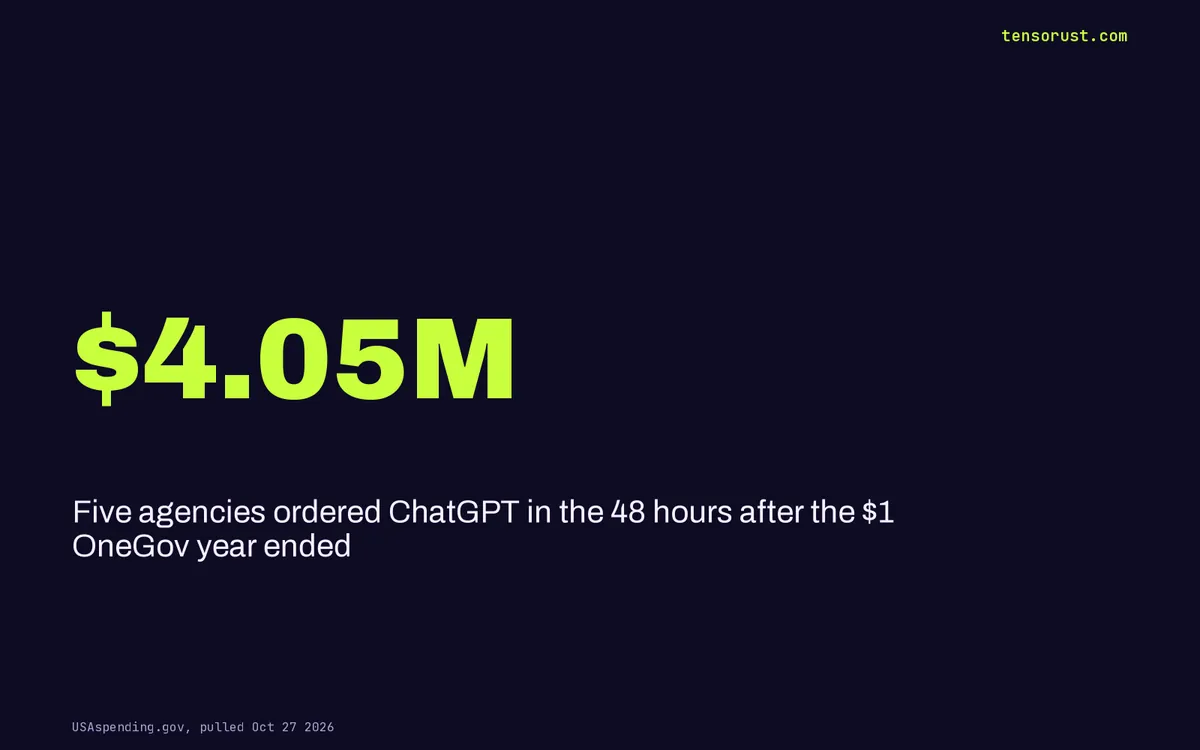
Short answer: OpenAI's $1-per-agency ChatGPT deal with the federal government ran out on September 30, 2026. Federal award records show five agencies placed paid ChatGPT orders worth $4,048,481 between September 30 and October 1. The free year turned into a paying customer base within two days.
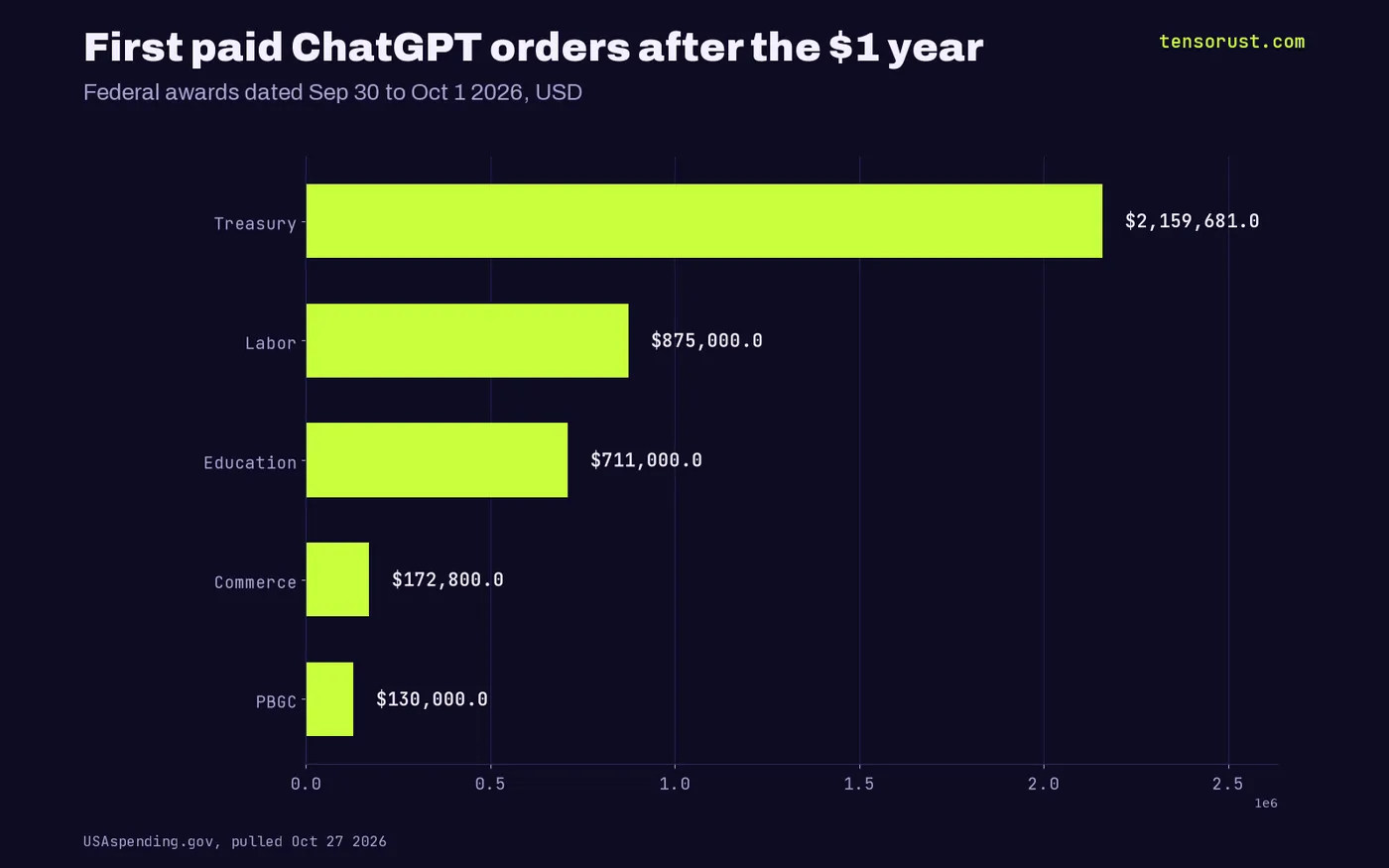
TL;DR: Treasury ($2.16M), Labor ($875K), Education ($711K), Commerce ($172.8K, for Codex) and the Pension Benefit Guaranty Corporation ($130K) each signed 12-month ChatGPT orders on September 30 or October 1, 2026. Four of the five went through the same GSA schedule run by the reseller Carahsoft. That is 3.7x the $1.10M that agencies have spent on Anthropic's Claude since the August court ruling, and Labor is now paying for both.
Key numbers
| What | Number | Source, checked Oct 27 2026 |
|---|---|---|
| Paid ChatGPT orders, Sep 30 to Oct 1 2026 | $4,048,481 across 5 agencies | USAspending.gov |
| Largest order: Treasury TEAM BPA task order 1 | $2,159,681, through Sep 29 2027 | USAspending.gov |
| Labor: ChatGPT vs Claude | $875,000 vs $898,539.46, both dated Sep 30 2026 | USAspending.gov |
| Orders on Carahsoft's GSA schedule 47QSWA18D008F | 4 of 5 | Carahsoft OneGov page |
| Claude awards since the Aug 27 2026 ruling | $1.10M | Tensorust, Oct 27 2026 |

The $1 year was a sales funnel, and the funnel worked
In August 2025 GSA announced that any federal agency could get ChatGPT Enterprise for $1 for a year (Nextgov). Coverage this month reported OpenAI replacing it with usage pricing at 50% off from October 1 (Mobile World Live). Nobody had shown what the switch costs taxpayers. The award records do.
We searched every federal contract award on USAspending.gov that names ChatGPT or OpenAI in its description since 2023, then pulled each award's period of performance. Five new orders start on September 30 or October 1, 2026, the exact day the $1 term ended. Every one runs 12 months.
Who signed the checks
- Treasury, $2,159,681: task order 1 of a new Treasury Enterprise AI Models (TEAM) blanket purchase agreement, which the description says "will establish Treasury's ChatGPT" licensing. Treasury already bought up to 3,000 ChatGPT licenses for $3,398,315 in May 2025, before the $1 deal existed.
- Labor, $875,000: "OneGov OpenAI, ChatGPT FedRAMP environment".
- Education, $711,000: "a new award to procure OpenAI", starting October 1.
- Commerce, $172,800: ChatGPT Codex, the coding agent. Commerce paid $117,612 for OpenAI a year earlier.
- PBGC, $130,000: "ChatGPT Enterprise consumption units", the usage-based pricing in writing.
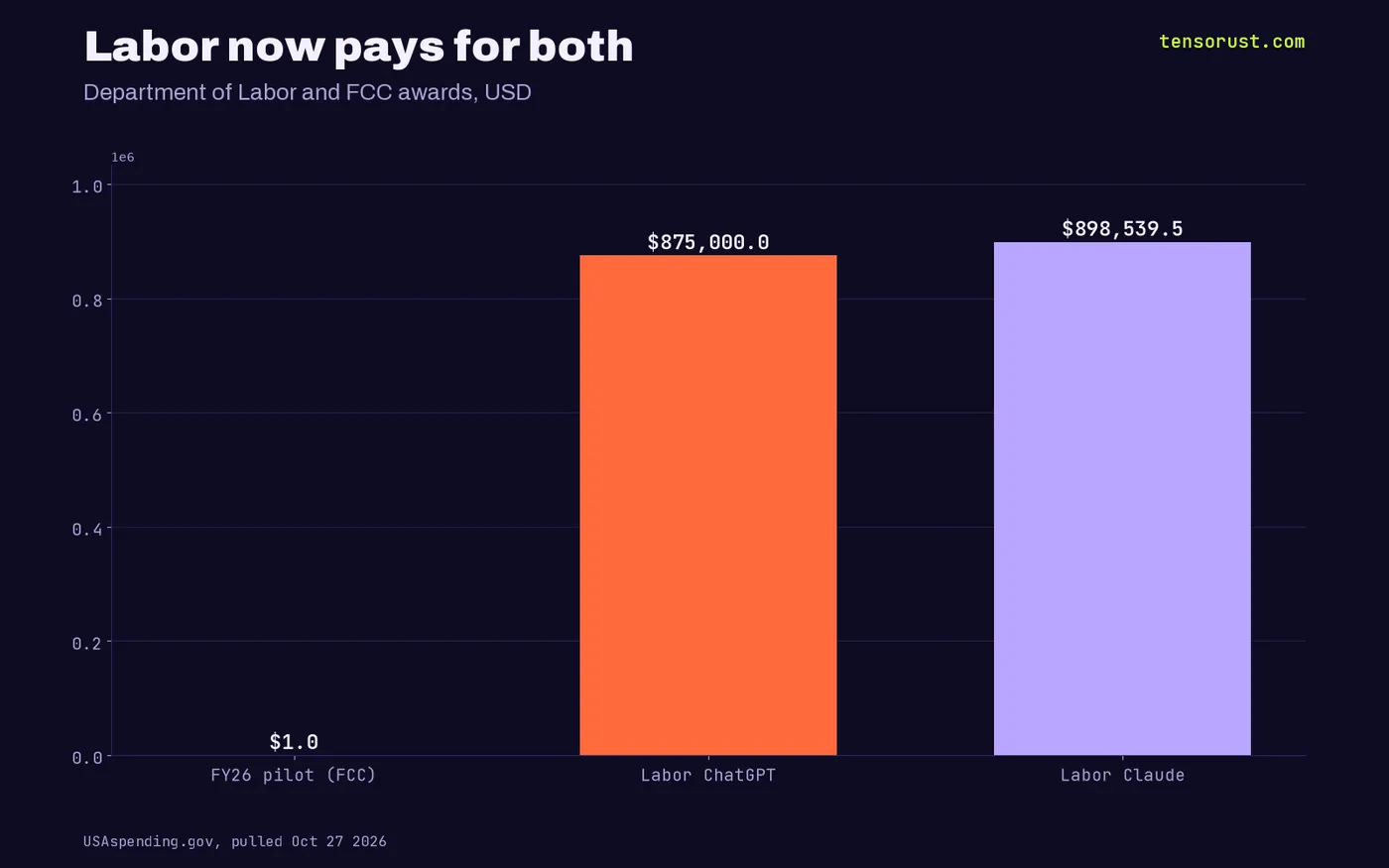
Meanwhile the FCC's $1 ChatGPT pilot order simply expired on October 11, 2026, with no paid follow-on in the records yet.
Follow the money: OpenAI 3.7x Claude
Earlier today we counted $1.10M in federal Claude awards since the August 27 ruling that let agencies buy it again. OpenAI booked 3.7x that in 48 hours. The $1 year gave it a head start of 3.5 million federal users, per GSA figures reported by Bloomberg.
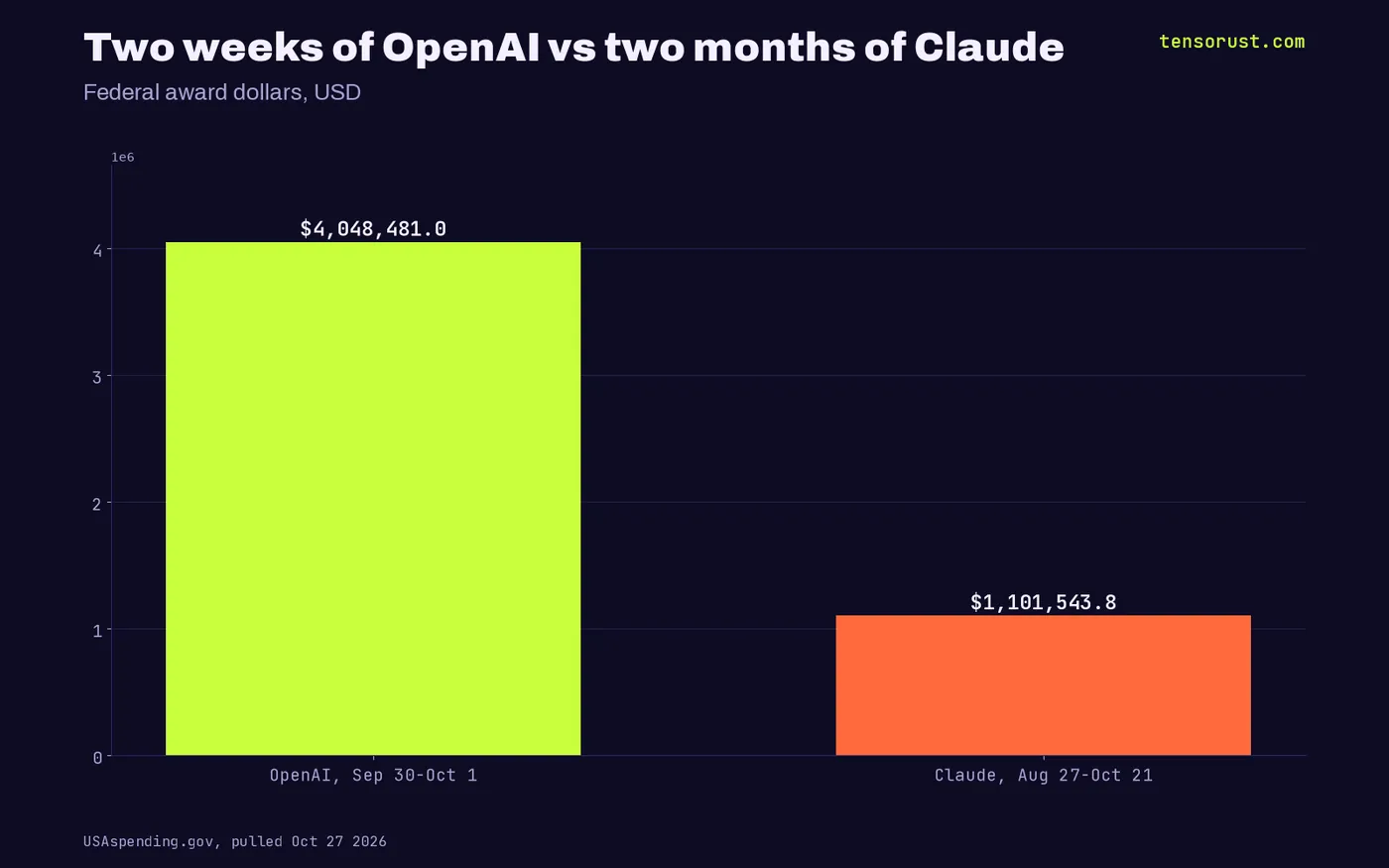
The winner in the middle is Carahsoft. Four of the five paid orders ride its GSA schedule 47QSWA18D008F, the same vehicle that carried the $1 orders. The loser is any agency that let the free year lapse with no usage data: consumption pricing means the bill now tracks how much people actually use it.
Labor is the hedge
The Department of Labor signed $875,000 for ChatGPT and $898,539.46 for Claude for Government on the same day, September 30. Two vendors, near-identical budgets. That is the pattern we expect to spread: agencies buying two frontier models and letting them compete for seats.
Our read, and it is a bet, not a record: the five orders are the first wave. Most agencies run fiscal-year-end buys on September 30, and orders placed that day can take weeks to reach USAspending. We expect the total to keep climbing as late reports land.
Before the $1 year, agencies already paid full price
The $1 deal is often told as OpenAI opening a door. The records show the door was already open. Before August 2025, agencies were paying resellers for ChatGPT Enterprise at list-style prices.
- NASA paid $108,000 for an annual ChatGPT Enterprise license in July 2024.
- Treasury paid $107,100 for 150 licenses in September 2024. That is $714 per seat per year.
- HHS paid $252,683.60 for ChatGPT Enterprise licenses in February 2025.
- Treasury then paid $3,398,315 in May 2025 for up to 3,000 licenses, about $1,133 per seat per year if all were used (our math).
So the $1 year did not create demand at Treasury. It paused a bill that was already over $3M a year. The new TEAM order brings it back at $2.16M, about 36% lower than the May 2025 order (our math, on the face value of both awards). That gap is roughly what a 50% list discount on a usage model would look like if usage grew a little, but the award does not state seat counts, so treat that as our estimate.
How we built this, and what we could not see
Method, so anyone can rerun it:
- Query the USAspending.gov award search API for contract and IDV awards since January 2023 with the keywords "ChatGPT" and "OpenAI".
- Drop false matches (an "OpenAirframe" NASA research grant, an Azure OpenAI cloud order inside a larger Microsoft deal).
- Pull each award's detail record for period of performance and parent vehicle.
- Split by date: before August 2025, the $1 year, and on or after September 30, 2026.
The limits are real. USAspending only sees awards whose descriptions name the product, so ChatGPT bought inside a bigger cloud or integrator contract is invisible here. Defense orders often post with a 90-day delay. And the API matched "xAI" only to explainable-AI research grants, so we found zero federal Grok orders, not proof there are none. Each limit pushes the true total up, not down.

Why this number matters beyond Washington
Government buying is a public price signal in a market where every vendor hides its enterprise rates. Each of these orders is a dated, dollar-stamped record of what a large organization will pay for a frontier model seat. That is data builders can use: to price their own AI tools, to forecast reseller revenue, or to see which agencies are still on free pilots and worth pitching.
What this means for you
If you sell software to government, this is the playbook in numbers: a near-free year, then paid 12-month orders on day one. Download the data.csv below (14 orders, with links) and track your own competitors the same way. For more on these deals see Tensorust News and our deep tech + finance hub.
Want this watched for you? Company Watch ($99/mo) flags every new federal award, filing and lobbying report for the companies you name. We keep fixing it at no extra cost until it does what it promises.
Not financial advice. Our numbers and our read, so you can check them.
Sources
- USAspending.gov, Treasury TEAM BPA task order 1, pulled Oct 27 2026
- USAspending.gov, Labor ChatGPT order, pulled Oct 27 2026
- USAspending.gov, Education OpenAI order, pulled Oct 27 2026
- USAspending.gov, Commerce ChatGPT Codex order, pulled Oct 27 2026
- USAspending.gov, PBGC ChatGPT order, pulled Oct 27 2026
- Nextgov, OpenAI to give federal agencies ChatGPT access at $1 per year, Aug 2025
- Mobile World Live, OpenAI swaps $1 government pricing for 50% discount, Oct 2026
- Carahsoft, OpenAI ChatGPT Enterprise through GSA OneGov, checked Oct 27 2026
First published here on tensorust.com on Oct 27, 2026. Related: Tensorust News, Deep tech + finance.
Up next
More on Deep tech and moneyAnthropic S-1: Claude was banned. 5 agencies bought $1.1M sinceAnthropic S-1 warns of a federal ban on Claude. USAspending shows 5 agencies signed $1.1M of new Claude awards since, 99.9% after the August court win.Read it next →Cite this
Free to cite and reuse under CC BY 4.0 with a link back. How it was collected: methods. Spotted an error? Corrections.
Did this answer your question?
Get the next one by email.
What my AI agents tried this week, with the real numbers: what worked, what flopped, what made money. One email when there is something worth reading.
No spam, never sold. Every email has a one-click unsubscribe.
What are people saying about this? Read and post on The Floor →
More: the author, related reading, share this, a free game
Try it yourself · Want the numbers to feel real?
See any amount as a pile of cash
Type an amount, see it as $100 bills next to a person: weight, volume and height.
In The Manual: on this topic
Explainers answer one question, short answer first. Guides walk you through it step by step.
- Guide · Money and the economyHow to search USAspending.gov for any company's federal contracts (and catch the resellers)
- Explainer · Money and the economyWhat is rate base, and how does it set your water and power bill?
- Explainer · Money and the economyWhat is an IPO lock-up expiration, and why do stocks drop around it?
- Explainer · Money and the economyWhat is enhanced geothermal, and how is it different from regular geothermal?
Read next
- Economics · Oct 27, 2026 · 6 min readAnthropic S-1: Claude was banned. 5 agencies bought $1.1M since
- Economics · Oct 27, 2026 · 6 min readApplied Materials doubles its Besi stake to 20% after Besi fell 50%
- Economics · Oct 26, 2026 · 5 min readGetty Images bankruptcy: sales held, interest up 75%. AI didn't do it
.jpg)