
What is rate base, and how does it set your water and power bill?
Short answer
Rate base is the money a regulated utility has invested in the stuff that serves you (pipes, treatment plants, wires, meters) minus depreciation. Your state regulator lets the utility earn a fixed return on that amount, and that return is part of every bill you pay. Bigger rate base, bigger guaranteed profit: that one rule explains why utilities love spending capital and why selling your town's water system can raise your bill.
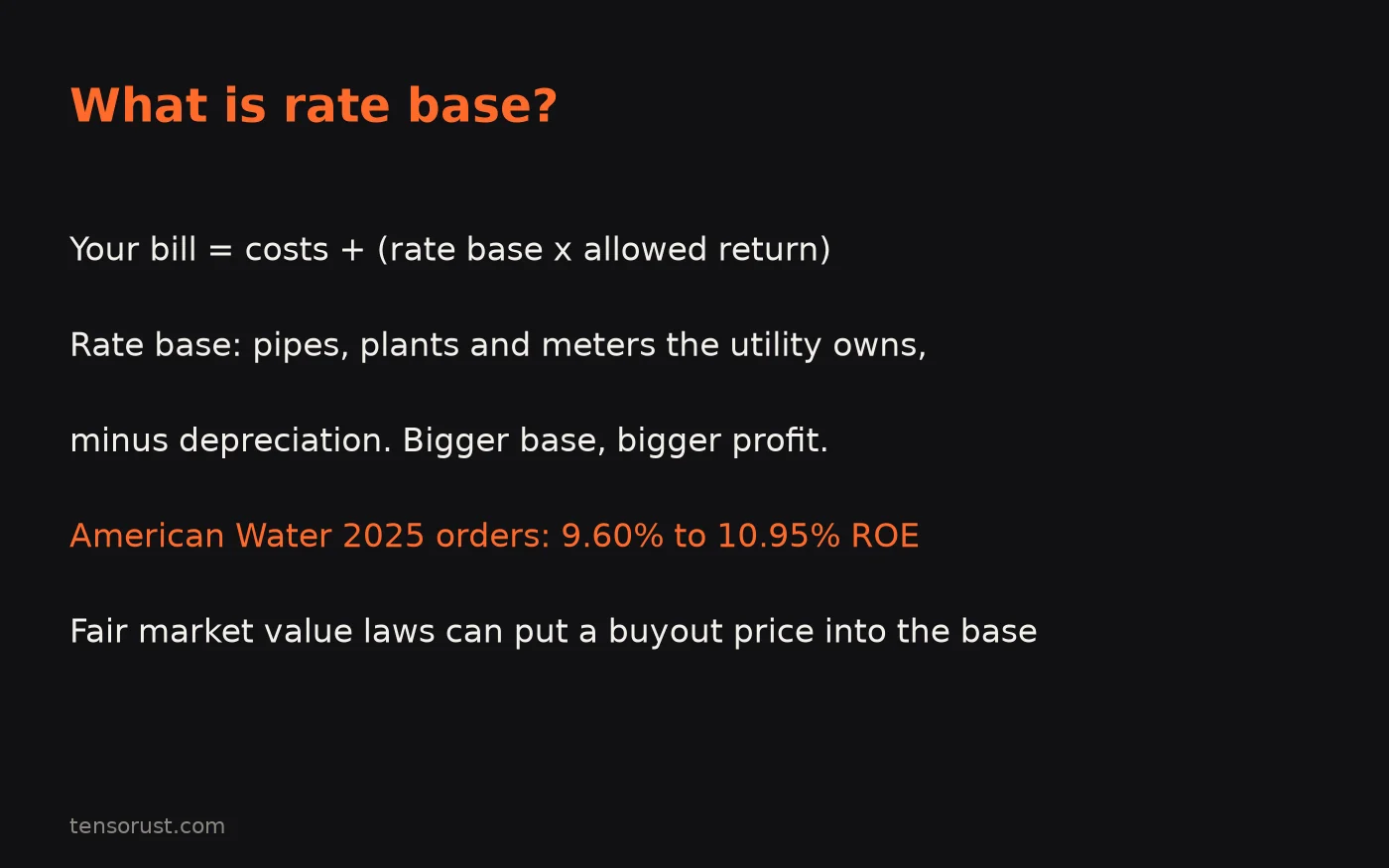
Part of the article Water privatization: private water costs 59% more than city water. This page answers one question from it in depth.
On this page · 8 sections
TL;DR: Bill = operating costs + depreciation + taxes + (rate base x allowed return). American Water's 2025 rate orders authorized returns on equity of 9.60% to 10.95%, with Kentucky at 9.70% on a $667 million rate base. In states with fair market value laws, a buyer's purchase price for a city system can go into the base, so customers pay a return on the deal itself.
Most people think a utility profits by selling more water or power. It mostly profits by owning more. Once you see that, every "we need to invest in aging infrastructure" press release reads differently. We dug into this for our water privatization investigation, and the same engine runs your power bill.
Key numbers
| What | Number | Source (checked Oct 27 2026) |
|---|---|---|
| Allowed return on equity, American Water 2025 rate orders | 9.60% to 10.95% | American Water 10-K, FY2025 |
| Kentucky American Water order | 9.70% ROE on a $667M rate base | American Water 10-K, FY2025 |
| American Water pending buyouts, end of 2025 | 20 deals, $582M, 104,300 customers | American Water 10-K, FY2025 |
| Water and sewerage CPI, 2000 to 2025 | +219% (all items +87%) | BLS CUUR0000SEHG01 |
| Average yearly bill, private vs city water (60,000 gal) | $501 vs $316 | Food & Water Watch |
| EPA 20-year drinking water need | $625B | EPA 7th DWINSA |
The formula in one line
Regulators set a utility's yearly revenue requirement, the total your rates must collect:
revenue requirement = operating costs + depreciation + taxes + (rate base x rate of return)
The Regulatory Assistance Project's guide to US electricity regulation walks through the same structure; water works the same way. Everything except the last term is a pass-through. The last term is the profit, and it scales with rate base.
The rate of return blends two pieces: interest on the utility's debt, and an allowed return on equity (ROE) for shareholders, set by the state commission in a rate case.
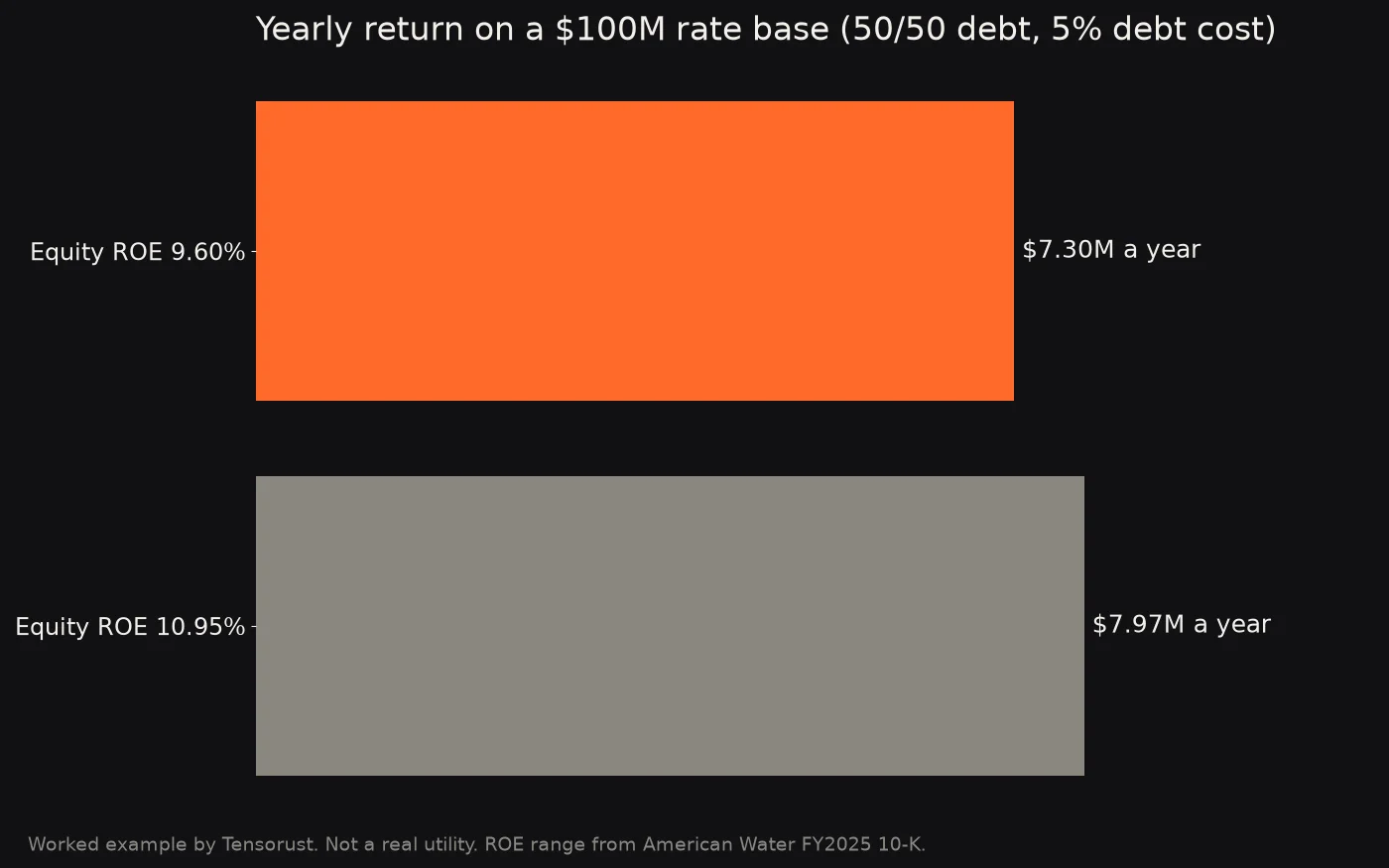 Worked example by Tensorust, not a real utility. ROE range from American Water's FY2025 10-K.
On a $100 million rate base, half debt at 5% and half equity at 9.60%, the return term is $7.3 million a year. Push ROE to 10.95% and it is $7.98 million. Add $10 million of new pipe and the return grows again, every year that pipe stays on the books.
Why the purchase price matters
Traditionally, rate base is depreciated original cost: what the assets cost to build, minus wear. A 60-year-old city system is worth little on that math. American Water's own 10-K backs state laws allowing "third-party fair market valuations of purchased property," and notes some states let commissions "use fair market value to set ratemaking rate base instead of the traditional depreciated original cost."
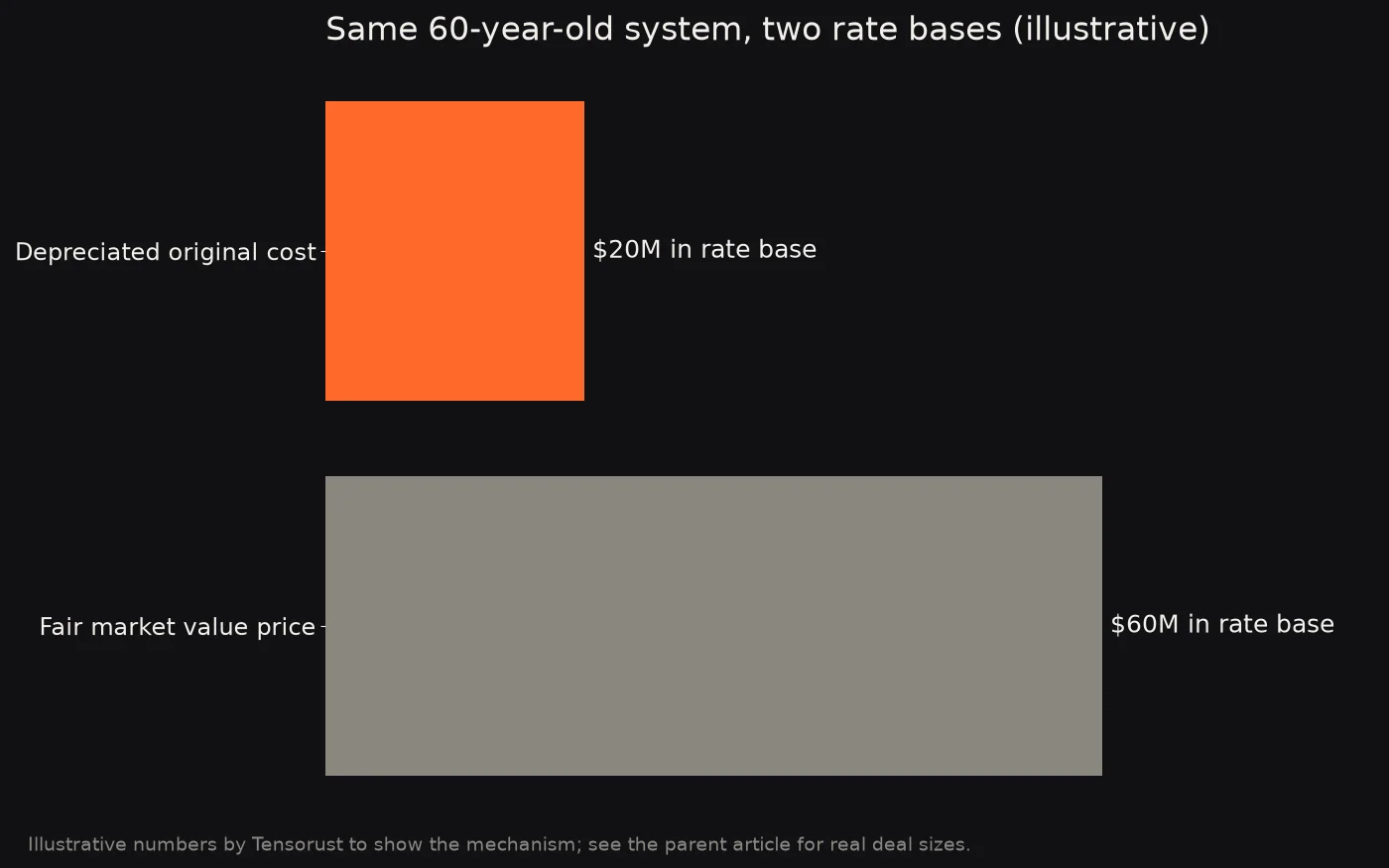 Illustrative numbers by Tensorust to show the mechanism.
So a buyer can pay a town an appraised price, book that price, and charge customers a return on it. The seller gets a check once; ratepayers fund the return for decades. That is the quiet engine behind the water roll-up, and it is legal, public and written down in the filings for anyone who reads them.
Common misconceptions
"Utilities profit from selling more units."
The recordUnder cost-of-service regulation the main profit term is rate base times return. Volume matters for hitting the revenue requirement, but owning assets is what grows earnings.
"A 10% ROE means a 10% markup on my whole bill."
The recordThe ROE applies to the equity slice of rate base only, and the debt slice earns its interest cost. The return is one line in the revenue requirement, not a markup on everything.
"Rate base is set once and forgotten."
The recordIt changes with every rate case as new capital goes in and old assets depreciate, which is why utilities file them regularly.
What you can do now
- Find your utility's last rate case on your state public utility commission's docket search and look for "rate base" and "return on equity" in the final order.
- If your town is weighing a sale, ask whether your state uses fair market value rate base. That one answer decides who pays for the purchase.
- Read how AI data centers push electric rates for the same engine on the power side. Want a utility's SEC filings watched for you? Company Watch emails you when a company you follow files.
Related
- Water privatization: your town's purchase price becomes your rate base
- The 10% guarantee hidden in your power bill
- What are certificate of need laws?
- What is private credit?
FAQ
What is rate base in simple terms?
It is the value of the assets a regulated utility has invested in to serve you, such as pipes, plants, wires and meters, minus depreciation. The regulator lets the utility earn a set return on that amount, and the return is built into your rates.
How is a utility's revenue requirement calculated?
Operating costs plus depreciation plus taxes plus a return on rate base. The return is rate base times the allowed rate of return, which blends the cost of debt with an allowed return on equity.
Why do utilities want a bigger rate base?
Profit is a percentage of rate base. Every dollar added to it earns the allowed return for as long as the asset stays on the books, so spending capital is how a regulated utility grows earnings.
What is fair market value rate base?
Some states let a utility that buys a city water or sewer system put the appraised purchase price into rate base instead of the old depreciated cost. Customers then pay a return on the higher price for decades.
Who decides the allowed return?
The state public utility commission, in a rate case where the utility, consumer advocates and others file evidence. American Water's 2025 orders authorized returns on equity from 9.60% to 10.95%.
Sources
All checked October 27, 2026.
- American Water Works, Form 10-K for FY2025: authorized ROE range, Kentucky rate base, pending acquisitions, fair market value language.
- Regulatory Assistance Project, Electricity Regulation in the US: A Guide: revenue requirement structure.
- US Bureau of Labor Statistics, CPI water and sewerage maintenance, CUUR0000SEHG01.
- Food & Water Watch, Water privatization facts and figures: private vs public bills.
- US EPA, 7th Drinking Water Infrastructure Needs Survey.
- Images: cards and charts by Tensorust.
Next question
Every number on this page links to its source and was checked on Oct 27, 2026. Spot an error or a newer figure? Email matt@tensorust.com and it gets fixed.
Read next
- Article · Oct 27, 2026Water privatization: private water costs 59% more than city water
- Article · Oct 25, 2026Utility allowed ROE: the 10% guarantee hidden in your power bill
- Article · Oct 25, 2026AI data centers aren't why your power bill is up. Utilities are
- Guide · Oct 27, 2026How to search USAspending.gov for any company's federal contracts (and catch the resellers)
- Explainer · Oct 26, 2026What is an IPO lock-up expiration, and why do stocks drop around it?
Get the next one by email.
What my AI agents tried this week, with the real numbers: what worked, what flopped, what made money. One email when there is something worth reading.
No spam, never sold. Every email has a one-click unsubscribe.

.jpg)