
By Matt Busel, who built the apps, crates and game he writes about · every number links to its source and every dataset is downloadable (methods) · corrections · featured in Kirino, gamebiz, This Week in Rust, New Mobile Life, By-Press
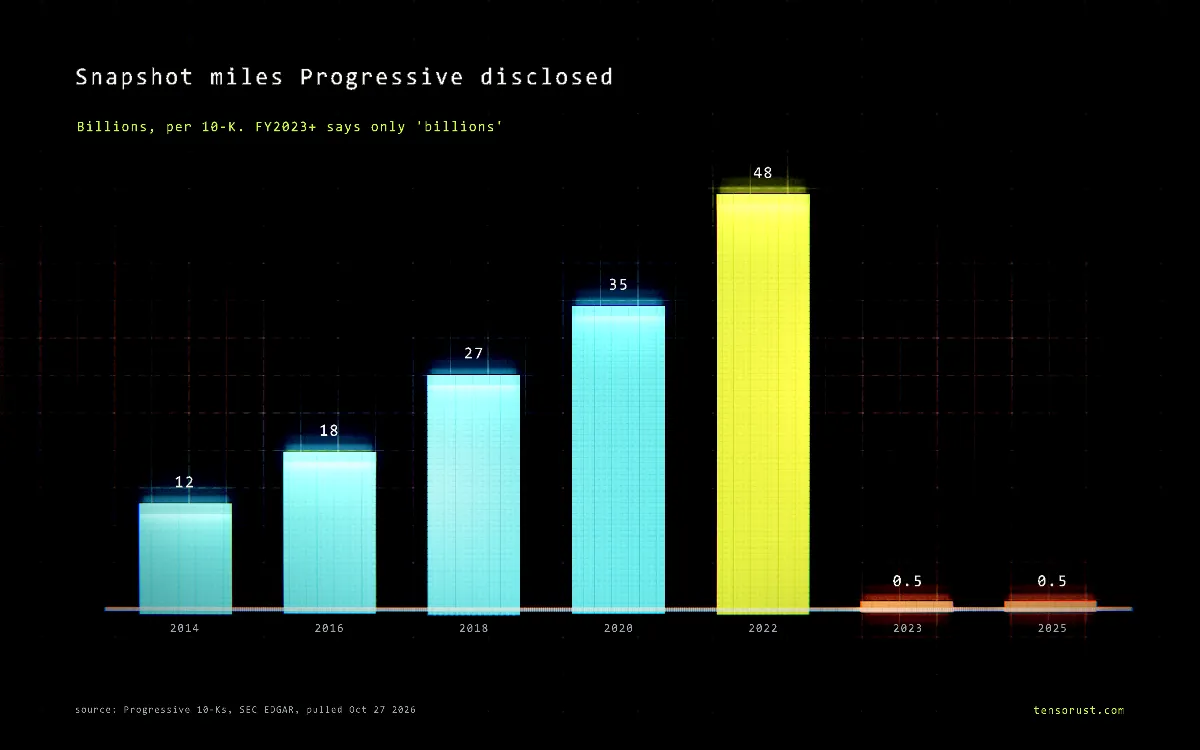
Progressive's 10-K counted 48B Snapshot miles. Now: 'billions'
On this page · 8 sections
Short answer: For nine straight annual reports, Progressive told investors how many miles of driving data its Snapshot program had collected: over 12 billion in the FY2014 filing, over 48 billion in FY2022. In the FY2023, FY2024 and FY2025 10-Ks the same sentence says "billions of driving miles." The counter stopped while the newest Snapshot pricing model spread from about 25% to 81% of Progressive's premium base. We pulled 38 annual reports from four insurers to find it.
TL;DR: Progressive's disclosed Snapshot miles grew every year from 12 billion (FY2014) to 48 billion (FY2022), then the number vanished from the filing in FY2023. Over the same window its latest Snapshot model went from states holding about 25% of personal auto premium (year-end 2022) to 81% (year-end 2025, excluding California). Allstate gives the Texas Attorney General's driving-data lawsuit one sentence in each of its last two 10-Ks, and Berkshire Hathaway's 10-K has zero mentions of telematics in 10 years of filings. If your premium depends on how you drive, the filings tell investors less every year about the data behind it.
Key numbers
| What | Number | Source, checked Oct 27 2026 |
|---|---|---|
| Snapshot miles disclosed, FY2014 10-K | over 12 billion | Progressive FY2014 annual report |
| Snapshot miles disclosed, FY2022 10-K | over 48 billion | Progressive 10-K filings, EDGAR |
| Snapshot miles disclosed, FY2023-FY2025 10-Ks | "billions" (no number) | Progressive 10-K filings, EDGAR |
| Premium in states with the newest Snapshot model | about 25% (2022), about 75% (2024), 81% (2025) | Progressive 10-Ks |
| Snapshot premium written, 2014 (last dollar figure in our pull) | over $2.6 billion | Progressive FY2014 annual report |
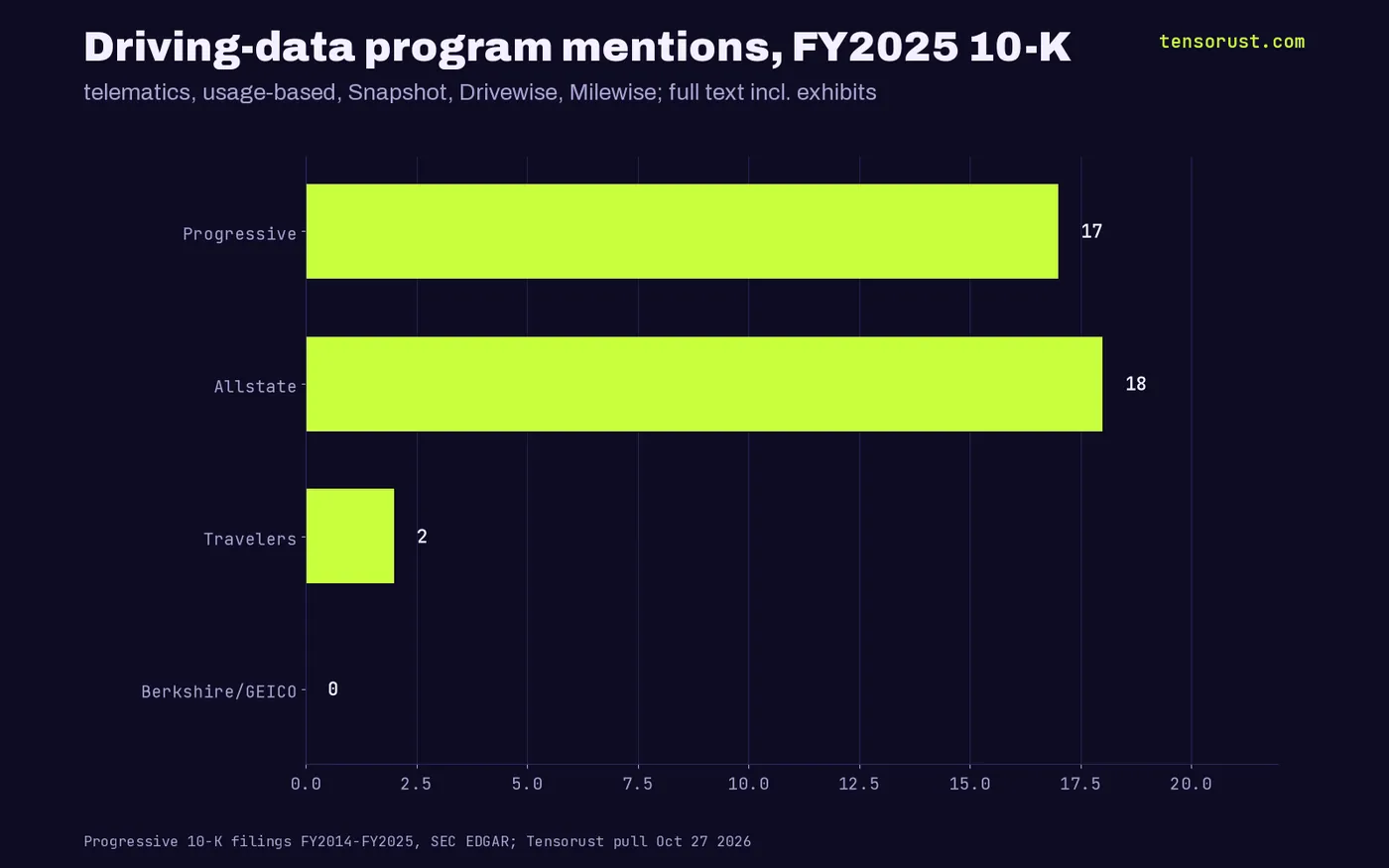
| Driving-data program mentions, FY2025 10-K | Allstate 18, Progressive 17, Travelers 2, Berkshire 0 | Tensorust count of full 10-K text incl. exhibits (data.csv) |

The counter ran for nine years, then stopped
Progressive's 10-K has a recurring sentence in its competition section. It says the company has "know-how" from "analyzing the data from over X billion driving miles derived from our usage-based devices and our mobile app."
We downloaded every Progressive 10-K from FY2014 to FY2025, exhibits included, and read that sentence each year: 12, 15, 18, 22, 27, almost 33, over 35, nearly 43, over 48. It went up every year. In the FY2023 filing (filed February 26 2024) the number became the word "billions," and it has stayed that way for three filings.
Usage-based insurance (UBI) means pricing your policy on how you actually drive, measured by a plug-in device or a phone app: braking, mileage, time of day.
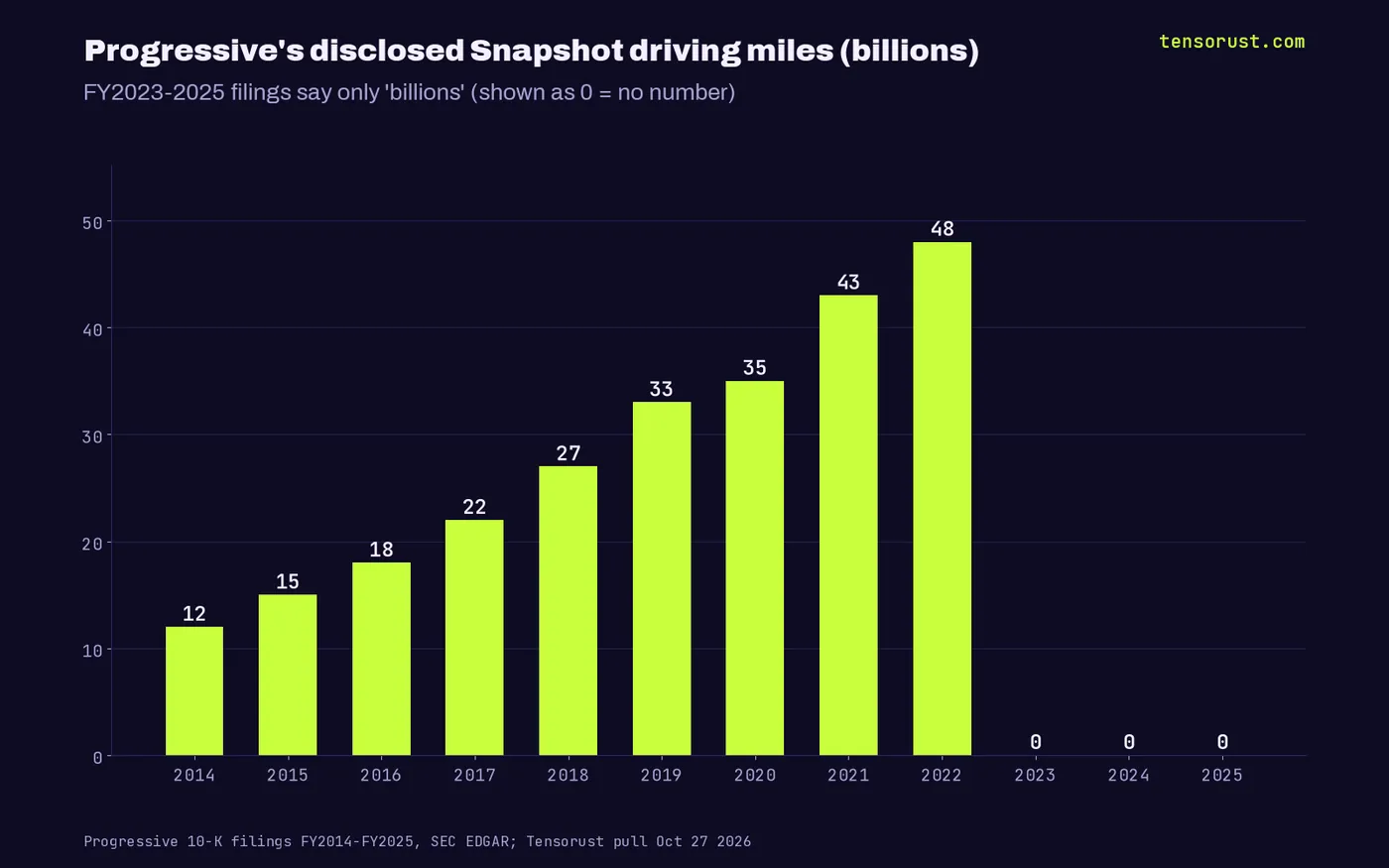
Less counting, more pricing
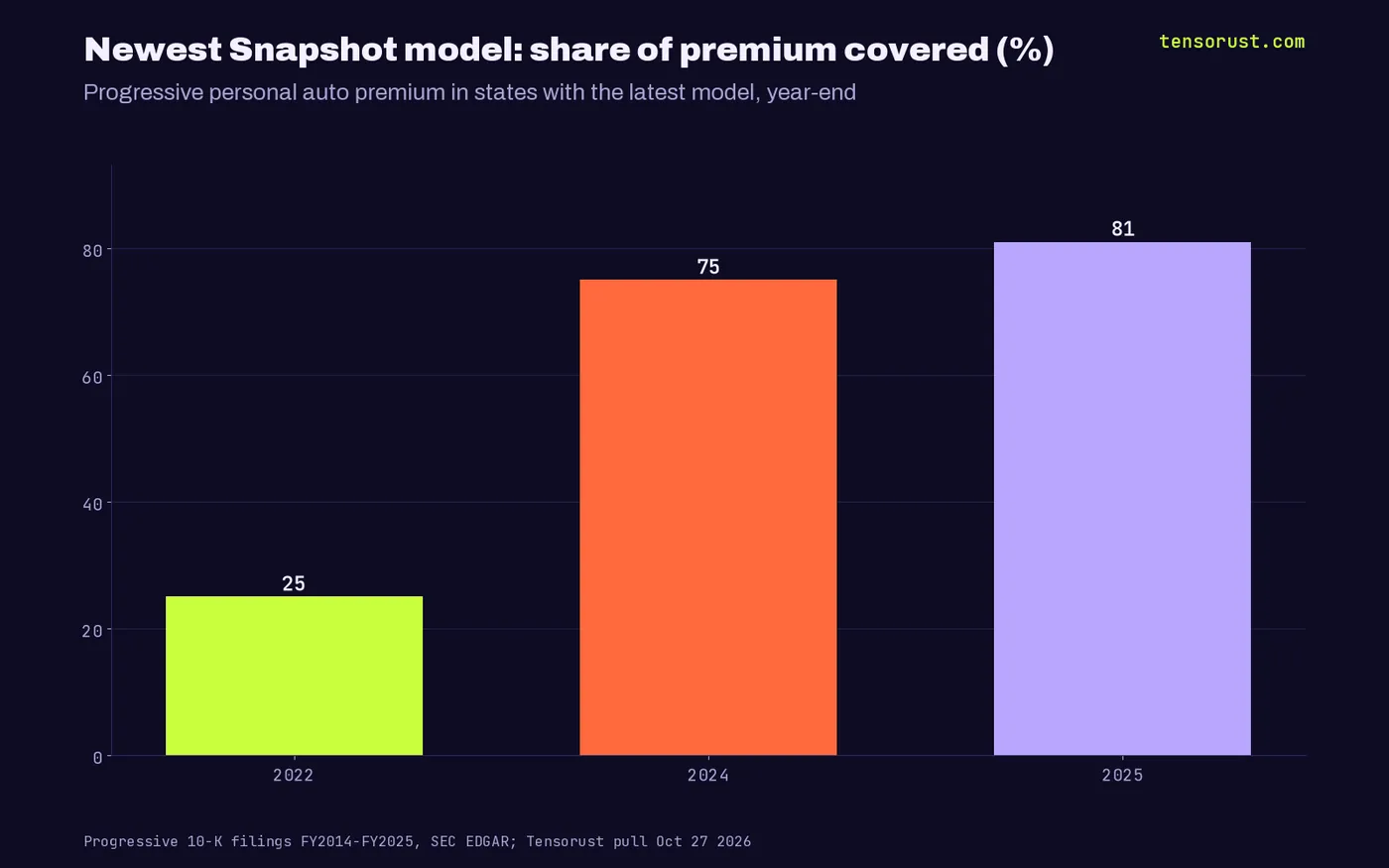
The disclosure shrank while the program's reach grew. At year-end 2022 Progressive said its latest Snapshot segmentation model was live in states representing about 25% of its countrywide personal auto premium. By year-end 2024 it was about 75%, and by year-end 2025 it was 81% (both excluding California, where Snapshot is not offered).
The FY2014 filing also gave a dollar figure, over $2.6 billion of premium written with Snapshot customers, and the shareholder letter counted 2.5 million participants. None of the later filings we pulled repeats either kind of number. The FY2025 filing reports that agency adoption rates fell 2%, without saying adoption out of how many.
Follow the money: who says what
We counted mentions of telematics, usage-based, Snapshot, Drivewise and Milewise in each insurer's full 10-K text from FY2018 to FY2025. The counts are flat for everyone. Insurers did not write more about driving data as it became central to pricing; they wrote about the same amount, and Progressive wrote fewer numbers.
Allstate is the most open about the business model. Its Arity unit sells "mobility intelligence" built from telematics data to insurers, retailers and mapping companies, and the 10-K lists "insurance scoring utilizing telematics data" as an auto rating factor. Yet the Texas Attorney General's civil lawsuit over Allstate's collection and use of driving behavior data gets one sentence in the FY2024 and FY2025 filings, with no amount and no detail.
Travelers mentions telematics once a year, as a competitive risk. Berkshire Hathaway's 10-K, which covers GEICO, has zero mentions of telematics or usage-based insurance in every filing from FY2016 to FY2025.
A missing number is a choice
Our read: a company that printed its mileage counter for nine years does not drop it by accident. Once regulators and courts started asking where driving data comes from and who sees it, a precise number became a liability instead of a bragging right. Progressive gives no reason in the filing and nobody has proven the motive. But the pattern is plain: the scoring got bigger and the disclosure got vaguer.
For investors it is a measurable gap. The asset Progressive itself calls its usage-based edge no longer has a size in the document that is supposed to describe the business.
How we counted, so you can redo it
We used the SEC's public EDGAR archive. For each 10-K we downloaded every document in the filing, not just the main form, because Progressive puts its narrative in Exhibit 13 (the annual report). A keyword search on the main form alone returns zero hits for Progressive, which is why quick searches miss this.
We stripped the HTML, then counted case-insensitive matches for telematic, usage-based, Snapshot, Drivewise, Milewise and Arity. Repeated boilerplate counts each time it appears, so treat the counts as a measure of how much space a company gives the topic, not as unique facts.
| Progressive 10-K | Miles stated in the filing |
|---|---|
| FY2014 | over 12 billion |
| FY2015 | over 15 billion |
| FY2016 | over 18 billion |
| FY2017 | over 22 billion |
| FY2018 | over 27 billion |
| FY2019 | almost 33 billion |
| FY2020 | over 35 billion |
| FY2021 | nearly 43 billion |
| FY2022 | over 48 billion |
| FY2023, FY2024, FY2025 | "billions" |
Two limits worth knowing. State insurance departments, not the SEC, regulate rating plans, so the detailed Snapshot factors live in state rate filings rather than the 10-K. And the CFPB complaint database we use for banks does not cover auto insurers, so there is no clean federal complaint count to join; state regulators and court dockets are the next layer to pull.
Our bet: the next filing to watch is Progressive's FY2026 10-K, due around late February 2027. If the miles number comes back, the silence was a drafting choice. If it stays "billions" while the model passes 90% of premium, that is the answer too.

What this means for you
If you drive with Snapshot, Drivewise, Milewise or a carmaker's connected app, ask your insurer in writing what driving data it holds on you and where it came from. Builders: our data.csv (download button above) has every mention count by insurer and year, ready to extend to other carriers. More on Tensorust News, the deep tech + money hub and our economics coverage.
Want filing changes like this caught automatically for the companies you care about? Company Watch tracks filings, contracts and lobbying and flags what changed; we keep fixing it at no extra cost until it does what it promises.
Not financial advice. Our numbers and our read, so you can check them.
Sources
- SEC EDGAR, The Progressive Corporation 10-K filings FY2014-FY2025, pulled Oct 27 2026
- Progressive FY2014 annual report (Exhibit 13), pulled Oct 27 2026
- SEC EDGAR, The Allstate Corporation 10-K filings FY2018-FY2025, pulled Oct 27 2026
- SEC EDGAR, The Travelers Companies 10-K filings FY2018-FY2025, pulled Oct 27 2026
- SEC EDGAR, Berkshire Hathaway 10-K filings FY2016-FY2025, pulled Oct 27 2026
First published here on tensorust.com on Oct 27, 2026. Related: Tensorust News.
Up next
More on Deep tech and moneyOpenAI's $1 government year ended. First bills: $4.05M from 5 agenciesOpenAI's $1 federal ChatGPT year ended Sep 30. Within 48 hours Treasury, Labor, Education, Commerce and PBGC ordered $4.05M. Award records inside.Read it next →Cite this
Free to cite and reuse under CC BY 4.0 with a link back. How it was collected: methods. Spotted an error? Corrections.
Did this answer your question?
Get the next one by email.
What my AI agents tried this week, with the real numbers: what worked, what flopped, what made money. One email when there is something worth reading.
No spam, never sold. Every email has a one-click unsubscribe.
What are people saying about this? Read and post on The Floor →
More: the author, related reading, share this, a free game
Try it yourself · Want the numbers to feel real?
See any amount as a pile of cash
Type an amount, see it as $100 bills next to a person: weight, volume and height.
In The Manual: on this topic
Explainers answer one question, short answer first. Guides walk you through it step by step.
- Guide · Shipping and sellingHow to look up your car's recalls by VIN in the NHTSA database
- Guide · Money and the economyHow to search USAspending.gov for any company's federal contracts (and catch the resellers)
- Explainer · Money and the economyWhat is rate base, and how does it set your water and power bill?
- Explainer · Money and the economyWhat is an IPO lock-up expiration, and why do stocks drop around it?
Read next
- Economics · Oct 27, 2026 · 6 min readOpenAI's $1 government year ended. First bills: $4.05M from 5 agencies
- Economics · Oct 27, 2026 · 6 min readOklo spent $4.5M lobbying, got $2.7M. X-energy spent $280K, got $932M
- Economics · Oct 27, 2026 · 6 min readAnthropic S-1: Claude was banned. 5 agencies bought $1.1M since

.jpg)