
What is a stock warrant? The AMD and OpenAI deal, explained
Short answer
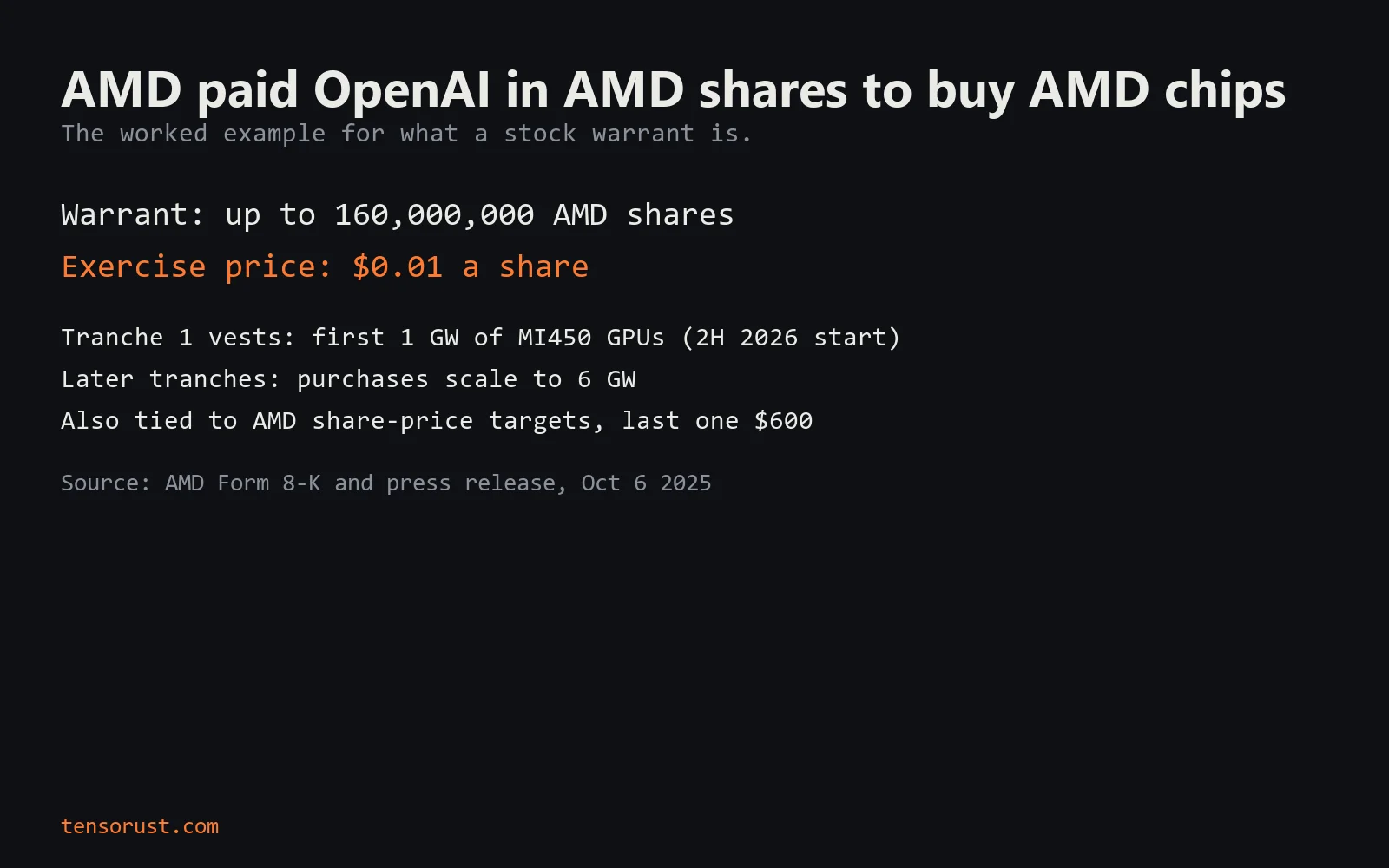
A stock warrant is a right, issued by a company, to buy a set number of new shares from that company at a fixed price before a deadline. Unlike a normal option, exercising it creates fresh shares, so other owners get diluted. The cleanest live example: in October 2025 AMD gave OpenAI a warrant for up to 160 million AMD shares at $0.01 each, unlocking as OpenAI buys AMD GPUs.
On this page · 9 sections
Warrants used to be a footnote: junk-bond sweeteners, SPAC leftovers, the thing Warren Buffett squeezed out of Goldman Sachs in 2008. The AI buildout put them back at the center. When a chip maker pays its biggest customer in its own stock for buying its own chips, the warrant is no longer a footnote. It is the deal. If you hold AMD, you are one of the people paying for it, so it is worth knowing exactly how the instrument works.
Key numbers
| What | Number | Source (checked Oct 26 2026) |
|---|---|---|
| Shares under AMD's warrant to OpenAI | up to 160,000,000 | AMD Form 8-K, Oct 2025 |
| Exercise price | $0.01 per share | AMD Form 8-K |
| First tranche vests at | first 1 GW of AMD Instinct MI450 deployments | AMD press release, Oct 6 2025 |
| First deployment due | second half of 2026 | AMD press release |
| Full vesting needs | 6 GW of purchases plus share-price targets, last one $600 | AMD Form 8-K |
| Value of all 160M shares at $600 | about $96B | Our math: 160M x ($600 - $0.01) |
| Cost to exercise all 160M | $1.6M | Our math: 160M x $0.01 |
How a warrant works, step by step
- The company writes it. AMD, not a trader on an exchange, issues the warrant. It sets the number of shares (160 million), the exercise price ($0.01), the expiry, and any conditions.
- Vesting conditions, if any. Most warrants are simply exercisable. Deal warrants like AMD's only unlock in tranches when targets are met: here, gigawatts of GPUs deployed and AMD's share price.
- Exercise. The holder pays the exercise price per share and the company issues brand-new shares. With a $0.01 strike, all 160 million shares cost OpenAI $1.6 million.
- Dilution. Every existing AMD holder now owns a slightly smaller slice. That is the real price AMD pays.
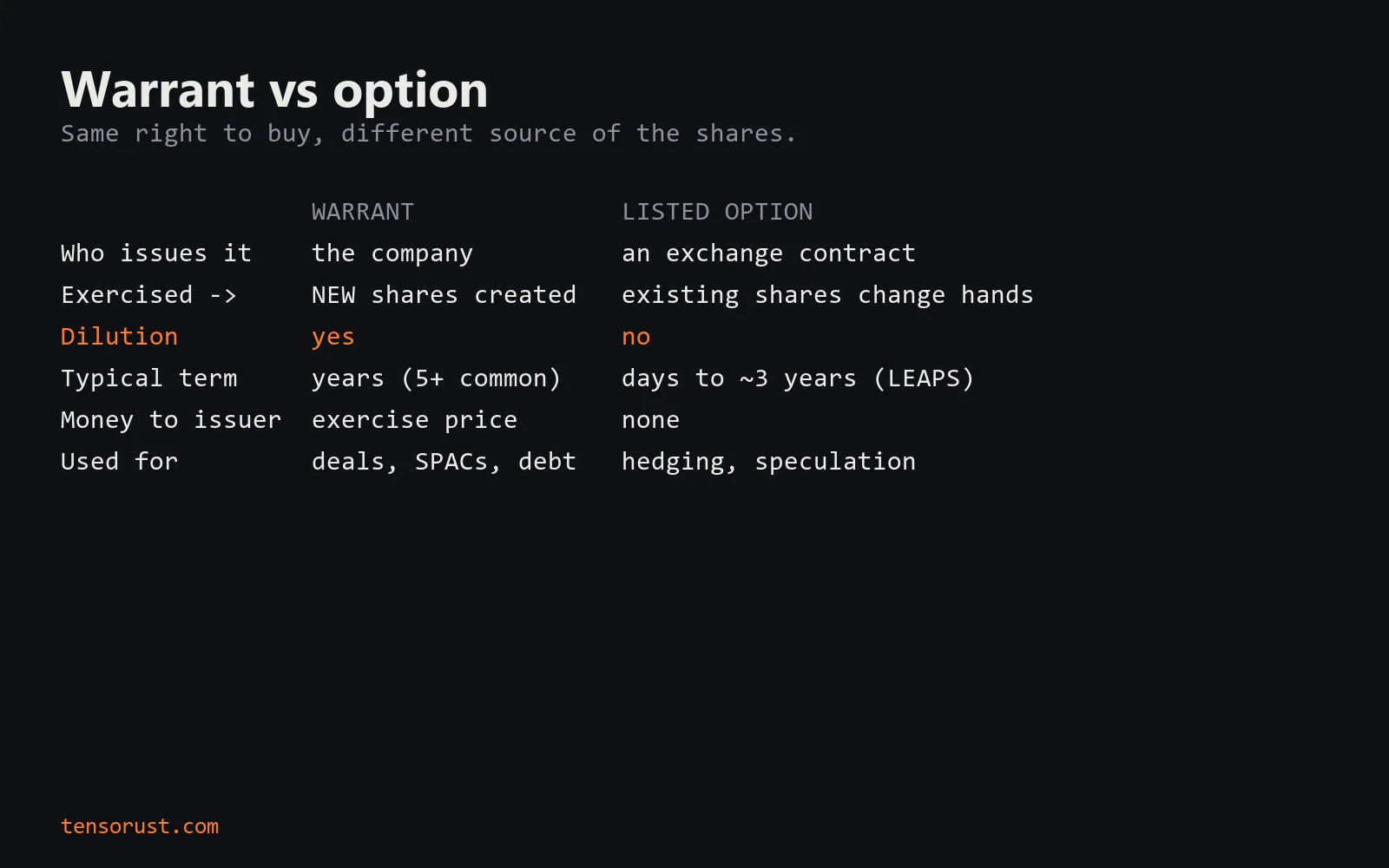 Warrant vs listed option. Card by Tensorust.
Why a penny strike matters
A warrant's value at exercise is the share price minus the strike. Most warrants are struck near the price on the deal date, so the holder only wins if the stock rises. A $0.01 strike means each vested share is worth almost exactly the full share price. In practice AMD's warrant behaves like a performance-based grant of stock: buy the GPUs, hit the milestones, collect the shares.
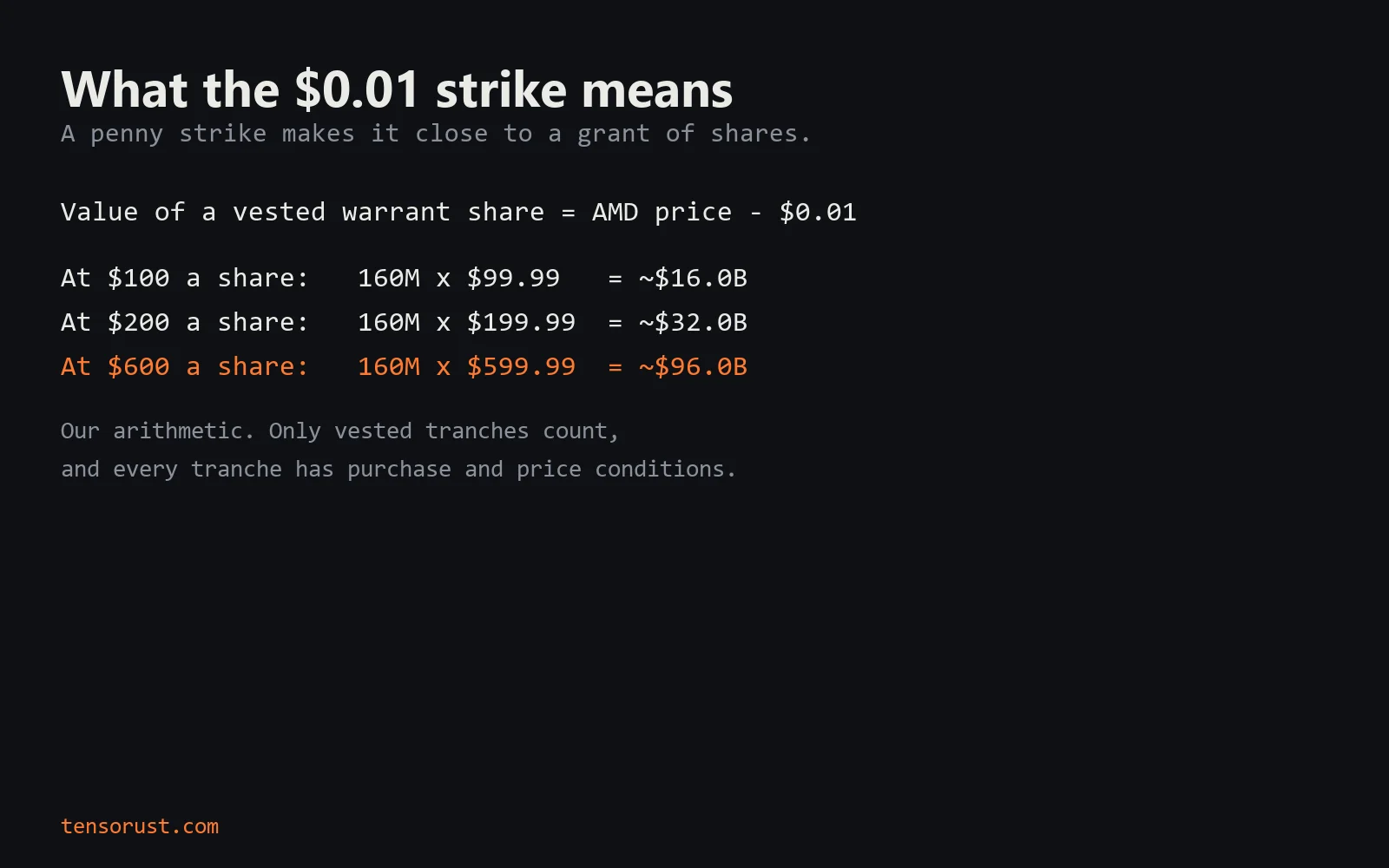 Our arithmetic from the filed terms. Only vested tranches count.
Follow the money
The AMD deal is one of three loops we mapped in what is circular financing in AI: the supplier hands value to the customer, and the customer spends it on the supplier. Who gets what:
- OpenAI gets GPUs plus a stake that rises if its own purchases make AMD look like a winner. The share-price targets mean OpenAI's buying is part of what pushes AMD toward them.
- AMD gets a 6 GW anchor customer and a story that competes with Nvidia, paid for in stock instead of cash.
- AMD shareholders carry the dilution: 160 million shares was the "up to 10% of AMD" widely reported at the time. The upside: if the targets hit, the stock they hold is worth far more too.
That is how markets should work in the open: anyone can read the 8-K, price the dilution and decide. Compare it with the other ways companies sell equity, like an at-the-market offering, or the supply that hits after an IPO lock-up expires.
Where else you meet warrants
- SPACs: most SPAC units came with warrants, typically struck at $11.50.
- Rescue deals: in September 2008 Berkshire Hathaway bought $5B of Goldman Sachs preferred stock plus warrants on $5B of common at $115 a share. Our AI bubble vs 2008 piece compares that era's balance sheets with today's.
- Debt sweeteners: lenders to riskier companies often take warrants so they share the upside.
Common misconceptions
"OpenAI owns 10% of AMD."
The recordIt does not. The warrant gives the right to up to 160 million shares, and each tranche only vests when the GPU and share-price conditions are met. Until then OpenAI holds conditional rights, not shares.
"A warrant is just an option."
The recordEconomically close, structurally different: the company issues it and creates new shares on exercise, so it dilutes. A listed option moves shares that already exist.
"Warrants are free money for the holder."
The recordOnly if the conditions are met and the stock stays above the strike. AMD's penny strike makes the second part easy; the gigawatts are the hard part.
Related
- What is circular financing in AI?
- At-the-market offerings, with Meta's $60B
- IPO lock-up expiration
- AI bubble vs 2008
Not financial advice.
FAQ
What is a stock warrant?
A contract issued by a company that gives the holder the right, but not the obligation, to buy a set number of new shares from that company at a fixed price before an expiry date. When it is exercised, the company creates new shares, so existing holders are diluted.
What is the difference between a warrant and an option?
A listed stock option is a contract between two traders on an exchange; exercising it moves existing shares and the company gets nothing. A warrant is issued by the company itself, exercising it creates new shares, and the company receives the exercise price. Warrants also tend to run for years rather than months.
What warrant did AMD give OpenAI?
In October 2025 AMD issued OpenAI a warrant for up to 160 million AMD shares at an exercise price of $0.01 a share. Tranches vest as OpenAI deploys AMD Instinct GPUs, starting with the first 1 gigawatt and scaling to 6 gigawatts, and as AMD's share price hits targets that rise to $600 for the last tranche.
Are warrants dilutive?
Yes. Exercising a warrant creates new shares, so each existing share owns a slightly smaller slice of the company. That is the main cost of a warrant to the shareholders of the company that issues it.
Why would a company give away warrants?
To win something it values more than the dilution: a big customer commitment (AMD and OpenAI), cheaper debt (warrants attached to bonds), or a sweetener for rescue investors (Berkshire's 2008 Goldman Sachs deal).
Sources
All checked October 26, 2026.
- AMD, Form 8-K, October 2025: warrant for up to 160 million shares, $0.01 exercise price, tranche vesting on GPU deployments and share-price targets up to $600.
- AMD, AMD and OpenAI announce strategic partnership to deploy 6 gigawatts of AMD GPUs (Oct 6, 2025): first 1 GW of MI450 in the second half of 2026, tranches to 6 GW.
- Berkshire Hathaway, press release on the Goldman Sachs investment (Sep 23, 2008): $5B preferred plus warrants on $5B of common at $115.
- Tensorust, What is circular financing in AI?
- Images: cards by Tensorust from the filings above.
Next question
Every number on this page links to its source and was checked on Oct 26, 2026. Spot an error or a newer figure? Email matt@tensorust.com and it gets fixed.
Read next
- Article · Oct 23, 2026Bonds just broke 2007's peak. AI is this cycle's housing boom
- Explainer · Oct 26, 2026What is enhanced geothermal, and how is it different from regular geothermal?
- Explainer · Oct 26, 2026What is a certificate of need law, and which states still have one?
Get the next one by email.
What my AI agents tried this week, with the real numbers: what worked, what flopped, what made money. One email when there is something worth reading.
No spam, never sold. Every email has a one-click unsubscribe.

.jpg)