
What is a certificate of need law, and which states still have one?
Short answer
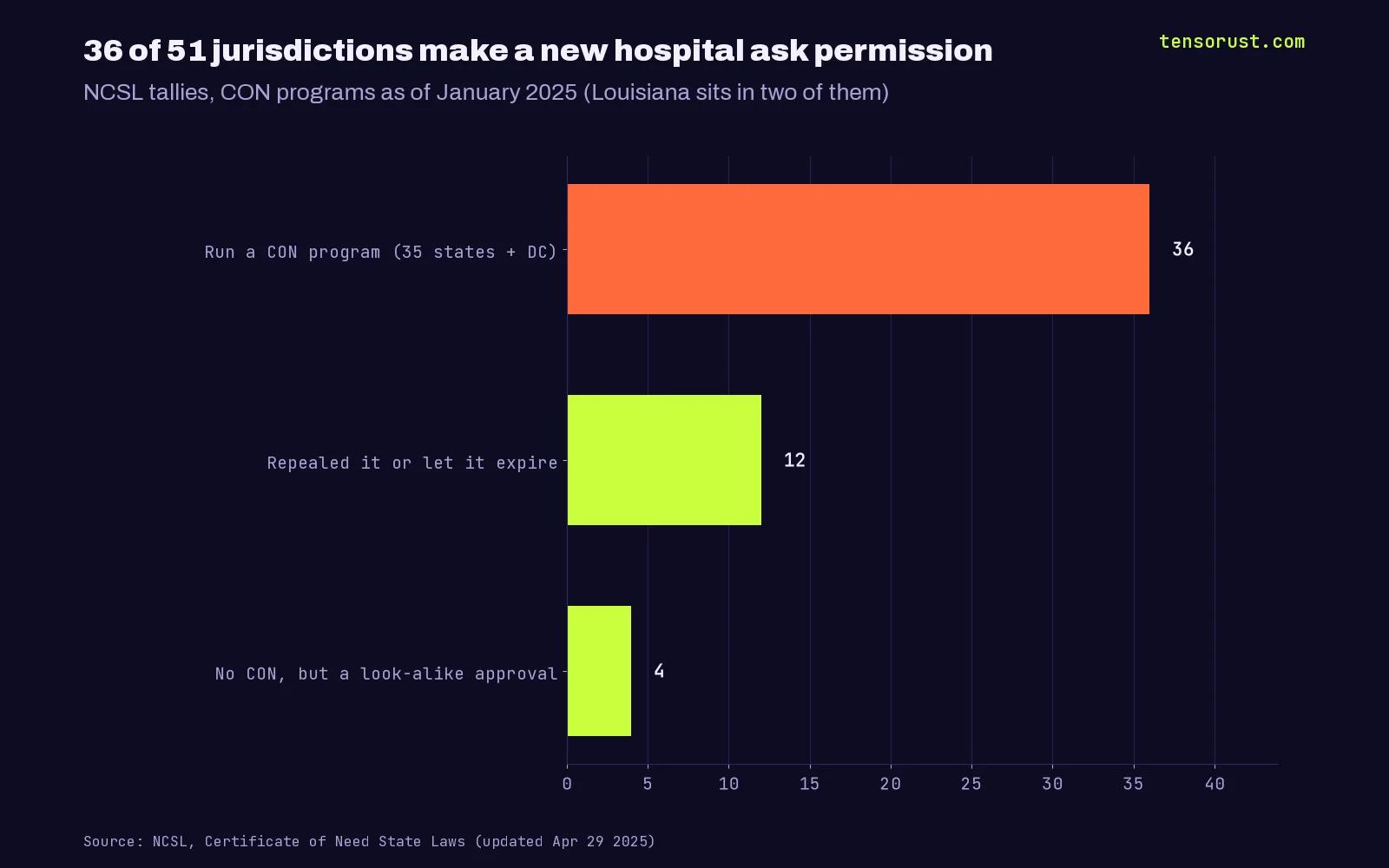
A certificate of need (CON) law makes a hospital, surgery center, nursing home or imaging center get state permission before it opens, adds beds, buys big equipment or offers a new service. A state board decides whether the area "needs" it. 35 states plus Washington, D.C. still run CON programs, according to NCSL, and in most of them the hospital that would lose patients to the newcomer gets to argue against it.
Part of the article Hospital prices +311% since 2000: hospitals are the new landlords. This page answers one question from it in depth.
On this page · 9 sections
Imagine needing your future competitor's blessing to open a store. That is the deal CON offers anyone who wants to build a new front door into American health care, and it is a big reason the building, not the doctor, is where the money in medicine sits. We traced the price side in Hospital prices +311% since 2000. This page is the permit side.
Key numbers
| What | Number | Source (checked Oct 26 2026) |
|---|---|---|
| States + DC that run a CON program | 35 + DC | NCSL, Certificate of Need State Laws, updated Apr 29 2025 |
| States that repealed CON or let it expire | 12 (latest full repeal: New Hampshire, 2016) | NCSL |
| States with no official CON but a look-alike approval | 4: Arizona, Louisiana, Minnesota, Wisconsin | NCSL |
| States with a moratorium on some facilities | at least 13 | NCSL |
| First CON law | New York, 1964 | NCSL |
| States with some form of CON by 1982 | every state except Louisiana | NCSL |
| Hospital services price change, Jan 2000 to Sep 2026 | +311.2% | BLS CPI-U, CUUR0000SEMD01 |
| Physicians' services, same period | +83.4% | BLS CPI-U, CUUR0000SEMC01 |
How a certificate of need works
The details change by state, but the shape is the same. Before you spend money on a covered project, you file an application with a state health planning agency, the department of health, or a CON board appointed by the governor or legislature. NCSL lists what those bodies usually weigh:
- the projected need for the service in the area,
- whether the applicant has the staff and financing,
- the effect on specific groups, like rural communities,
- the effect on health care costs.
Then the state approves, denies, or approves with limits. What counts as a covered project is set by spending thresholds. Alabama's law, for example, catches major medical equipment over $2,000,000, new annual operating costs over $800,000, and any other capital spending over $4,000,000, plus any change in bed count or any new health service. Alaska's line is capital spending over $1 million. If your project is under the line, you build. If it is over, you ask.
Notice what is not on the list: whether patients want it, whether it is cheaper, whether it is better. "Need" is decided by a planner, in advance, for everyone.
Where the 2026 map stands
NCSL's three tallies. Louisiana appears in two of them, which is why they sum past 51.
From NCSL's state-by-state table (coverage as of January 2025):
- No CON law listed: California, Colorado, Idaho, Kansas, New Mexico, North Dakota, Pennsylvania, South Dakota, Texas, Utah, Wyoming. New Hampshire repealed its program in 2016.
- No official CON, but a look-alike: Arizona (ambulance certificates of necessity), Louisiana, Minnesota (a hospital moratorium), Wisconsin (nursing home limits).
- Everyone else runs a CON program, from narrow ones like Montana's, which since 2021 covers only long-term care, to wide ones like New York's.
"Repealed" does not always mean free. Watch the moratoria: at least 13 states simply refuse to approve certain projects at all, most often new long-term care beds.
The trend: lots of edits, few repeals
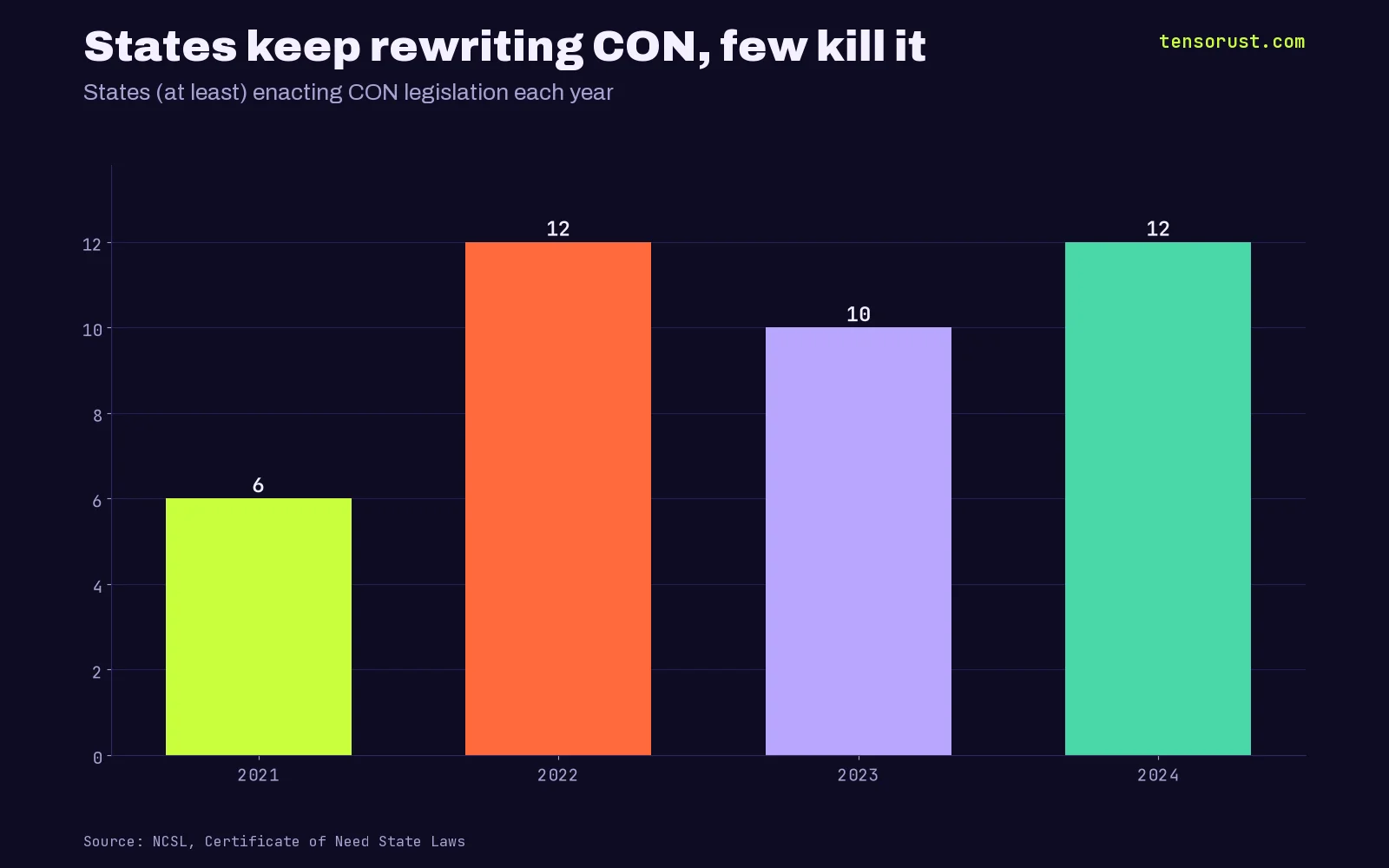 Counts are NCSL's "at least" figures for states plus DC enacting CON legislation each year.
Legislatures touch CON every year. NCSL counts at least 6 states in 2021, 12 in 2022, 10 in 2023 and 12 in 2024. Most of those bills carve out one facility type at a time: psychiatric beds (Georgia, Iowa, Oklahoma, Washington), surgery centers, imaging. The big swings are rare. Montana exempted everything except long-term care in 2021. South Carolina repealed all CON requirements except for nursing homes and a few hospital rules in 2023.
The pattern is a lobby that cannot hold the whole wall but defends every brick. Three states (Iowa, Tennessee, Massachusetts) answered in 2024 by commissioning studies, which is what a legislature does when it wants to look busy without upsetting the hospital association.
Why it exists, and who it actually protects
The original logic, which NCSL lays out, is cost control: if a town gets an extra hospital, empty beds have to be paid for, so prices rise. Federal money cemented it. The 1974 National Health Planning and Resources Development Act pushed every state to adopt CON, and by 1982 all of them but Louisiana had. Congress repealed that mandate in 1987. Most states kept the law anyway.
Here is the record since. Hospital services in the CPI are up 311.2% from January 2000 to September 2026, while physicians' services rose 83.4% and overall prices 99.6%, per BLS. The cost-control law has been on the books in most of the country for that entire stretch.
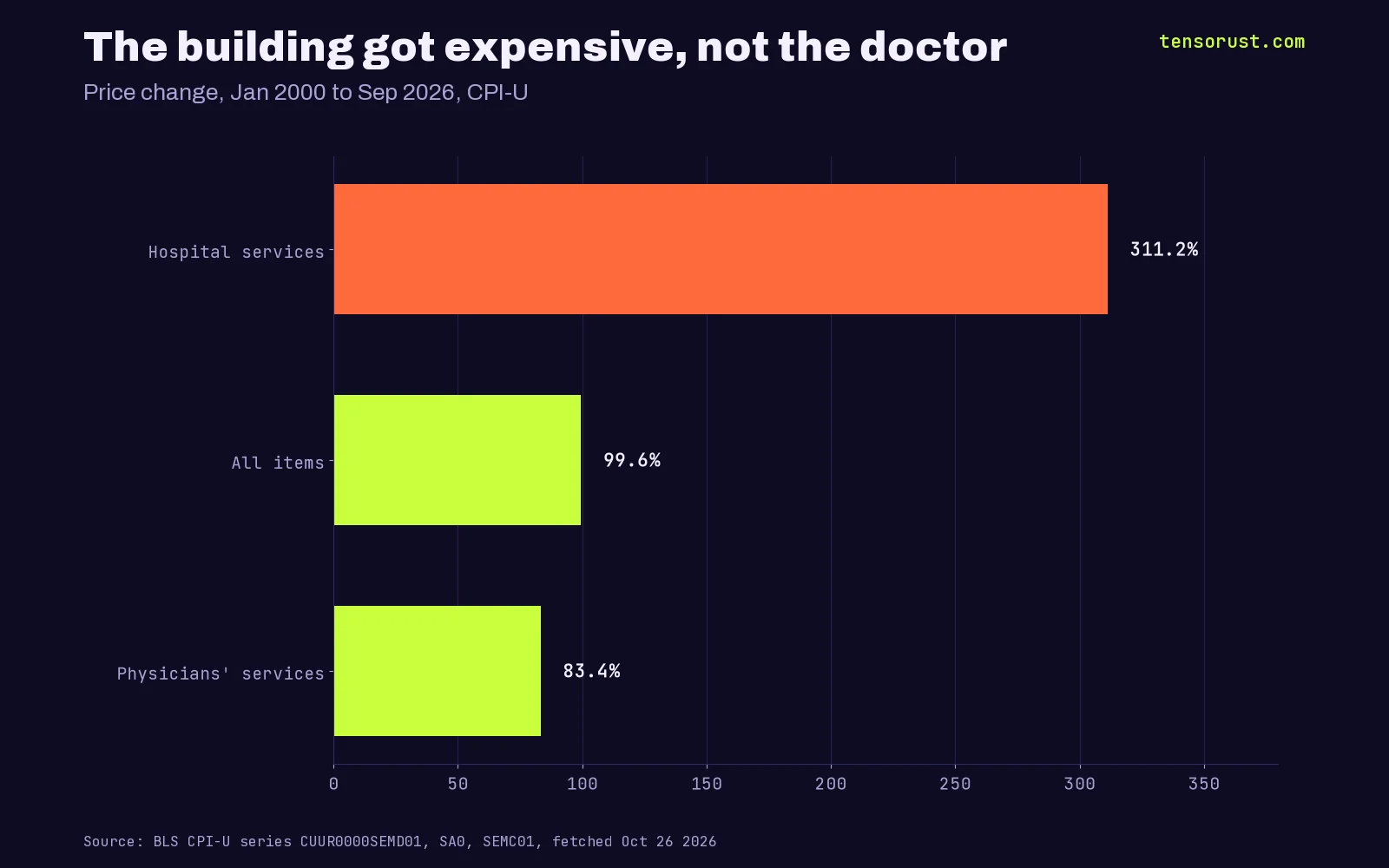 BLS CPI-U, U.S. city average, not seasonally adjusted, fetched Oct 26 2026.
Follow the money and the design makes sense. A CON board protects whoever is already licensed. In many states an incumbent hospital can comment on or contest a rival's application, so the cheapest way to beat a competitor is to keep it from ever opening. NCSL sums up the opponents' case in one line: CON laws "stifle competition by protecting incumbent providers." It is the same supply story as housing: cap the new supply and the owners of the old supply set the price.
Common misconceptions
"CON laws keep hospital prices down."
The recordThat was the promise in 1974. Hospital prices have since roughly quadrupled, far faster than doctors' fees, in a country where most states kept CON on the books. NCSL itself records that many researchers find little to no evidence the programs control costs.
"Only hospitals need a certificate."
The recordCoverage reaches far wider in many states: nursing homes, surgery centers, dialysis units, home health agencies, hospices, imaging machines. Alabama's list alone includes laboratories, outpatient clinics and HMOs.
"Repeal states are a free-for-all."
The recordStates without CON still license every facility on safety and quality. CON is a separate economic test: not "is it safe" but "do we let you compete."
"It is a federal rule."
The recordIt was federally pushed from 1974 and the mandate died in 1987. Every CON program running today is a state choice, which means it can be changed at the next session.
What you can do with this
If you are building something in health care, check your state's CON thresholds before you sign a lease; a project just under the dollar line can skip review entirely. If you are a patient, a CON state is a good reason to price-shop outpatient and telehealth options, which are the front doors incumbents find hardest to block. And if you vote, CON is decided in your statehouse, usually in bills that never make the news.
More on the money side: Hospital prices +311% since 2000, Inflation is a tax on what software can't touch, and the housing version of the same fight in Does building more housing lower rent? and Rent control pros and cons.
FAQ
What is a certificate of need law?
A certificate of need (CON) law makes a health care provider get state approval before it builds a new facility, adds beds, buys major equipment or offers a new service. A state planning agency or board decides whether the area needs it. Without the certificate, the project cannot open.
How many states have certificate of need laws?
35 states and Washington, D.C. operate CON programs, according to the National Conference of State Legislatures, with coverage as of January 2025. Twelve states have repealed their programs or let them expire, and four (Arizona, Louisiana, Minnesota and Wisconsin) have no official program but run approval processes that work much the same way.
Which states do not have certificate of need laws?
Per NCSL's state table, California, Colorado, Idaho, Kansas, New Mexico, North Dakota, Pennsylvania, South Dakota, Texas, Utah and Wyoming list no CON law, and New Hampshire repealed its program in 2016. Arizona, Minnesota and Wisconsin have no official CON program but keep similar approval steps.
Why were certificate of need laws created?
New York passed the first one in 1964. The federal National Health Planning and Resources Development Act of 1974 tied federal money to states adopting CON, and by 1982 every state except Louisiana had some form of it. Congress repealed the mandate in 1987, and states have been trimming or repealing their programs since.
Can a competing hospital object to a certificate of need?
In many states, yes. Review processes typically weigh projected need and the effect on existing providers, and incumbents can comment on or contest an application. That is the core critique: the business that would lose customers gets a say in whether its competitor is allowed to open.
Sources
All checked October 26, 2026.
- National Conference of State Legislatures, Certificate of Need State Laws, updated April 29, 2025: 35 states plus DC, 12 repeals, four look-alike states, moratoria, history (1964, 1974 Act, 1982, 1987 repeal), per-state statutes and thresholds, annual legislation counts.
- U.S. Bureau of Labor Statistics, CPI-U series CUUR0000SEMD01 (hospital services), CUUR0000SEMC01 (physicians' services) and CUUR0000SA0 (all items), January 2000 and September 2026 values via the BLS public API.
- Tensorust, Hospital prices +311% since 2000: hospitals are the new landlords, October 26, 2026.
Next question
Every number on this page links to its source and was checked on Oct 26, 2026. Spot an error or a newer figure? Email matt@tensorust.com and it gets fixed. Related: Money size calculator.
Read next
- Article · Oct 26, 2026Hospital prices +311% since 2000: hospitals are the new landlords
- Article · Oct 25, 2026Inflation since 2000: TVs -98%, hospitals +311%. The license is why
- Article · Oct 23, 2026New apartments cut local rent: what happens when supply finally arrives
- Explainer · Oct 25, 2026How Kalshi weather markets work
- Explainer · Oct 24, 2026Can the Fed buy Treasuries directly from the government?
Get the next one by email.
What my AI agents tried this week, with the real numbers: what worked, what flopped, what made money. One email when there is something worth reading.
No spam, never sold. Every email has a one-click unsubscribe.
.jpg)