
What is a Treasury yield?
Short answer
A Treasury yield is the yearly return investors get for lending to the US government at today's market price. When people say "yields are rising," they usually mean the 10-year yield, which was 5.00% on October 23, 2026 after closing at 5.31% on October 5, the highest since May 2002. Yields and bond prices move in opposite directions, and the 10-year sets the floor for mortgages and most long-term loans.
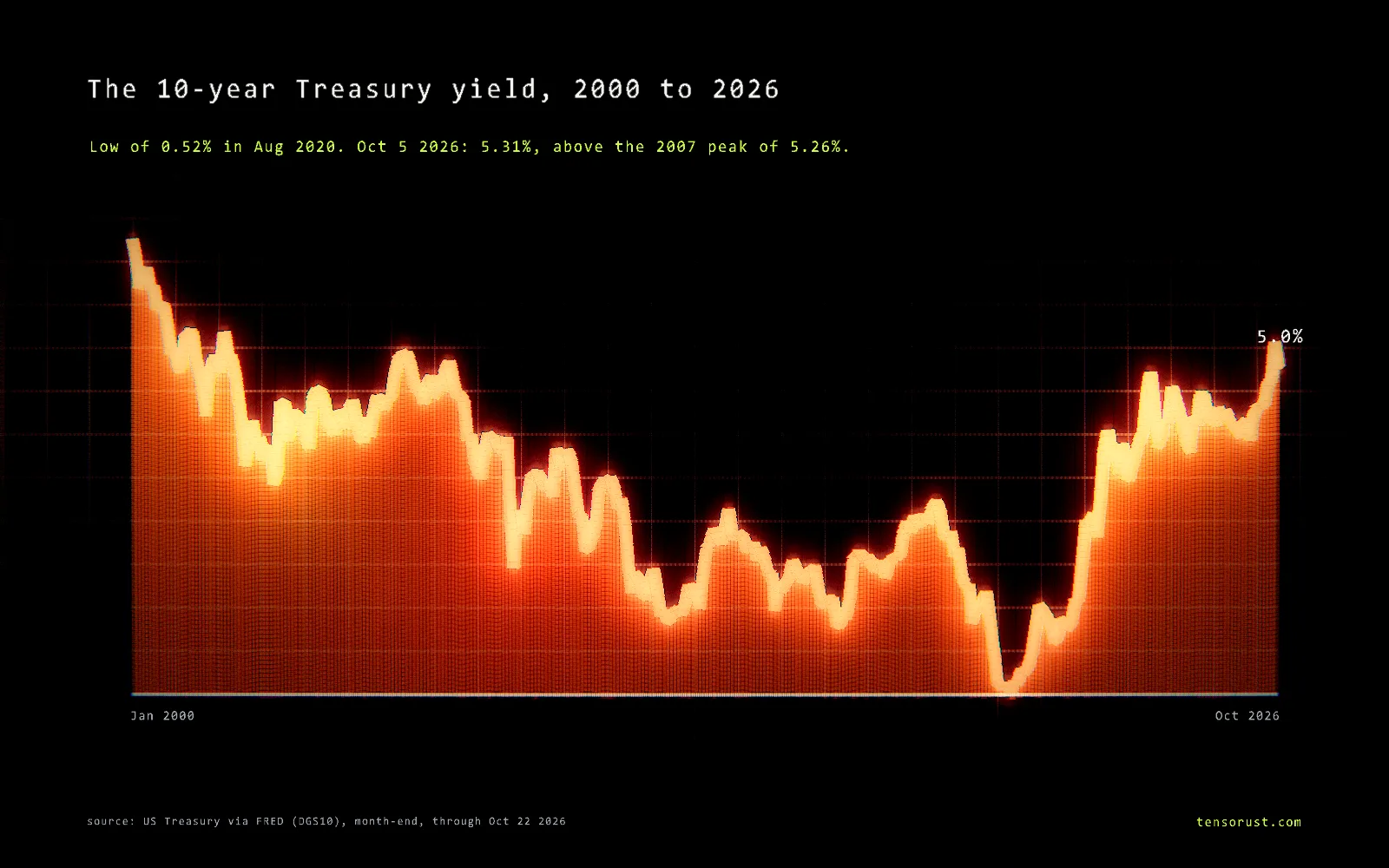
Part of the article Bonds just broke 2007's peak. AI is this cycle's housing boom. This page answers one question from it in depth.
On this page · 9 sections
The surprise in this year's move: almost none of it is inflation fear. Of the 0.99-point rise in the 10-year since October 2025, 0.96 points came from the inflation-adjusted part of the yield.
Key numbers
| What | Number | Source (checked Oct 24 2026) |
|---|---|---|
| 10-year yield | 5.00% (Oct 23 2026) | US Treasury, Daily Par Yield Curve Rates |
| 2026 high so far | 5.31% (Oct 5 2026), highest close since May 14 2002 | same; FRED DGS10, our search |
| 2007 peak, for comparison | 5.26% (Jun 12 2007) | FRED DGS10 |
| Record low | 0.52% (Aug 4 2020) | FRED DGS10 |
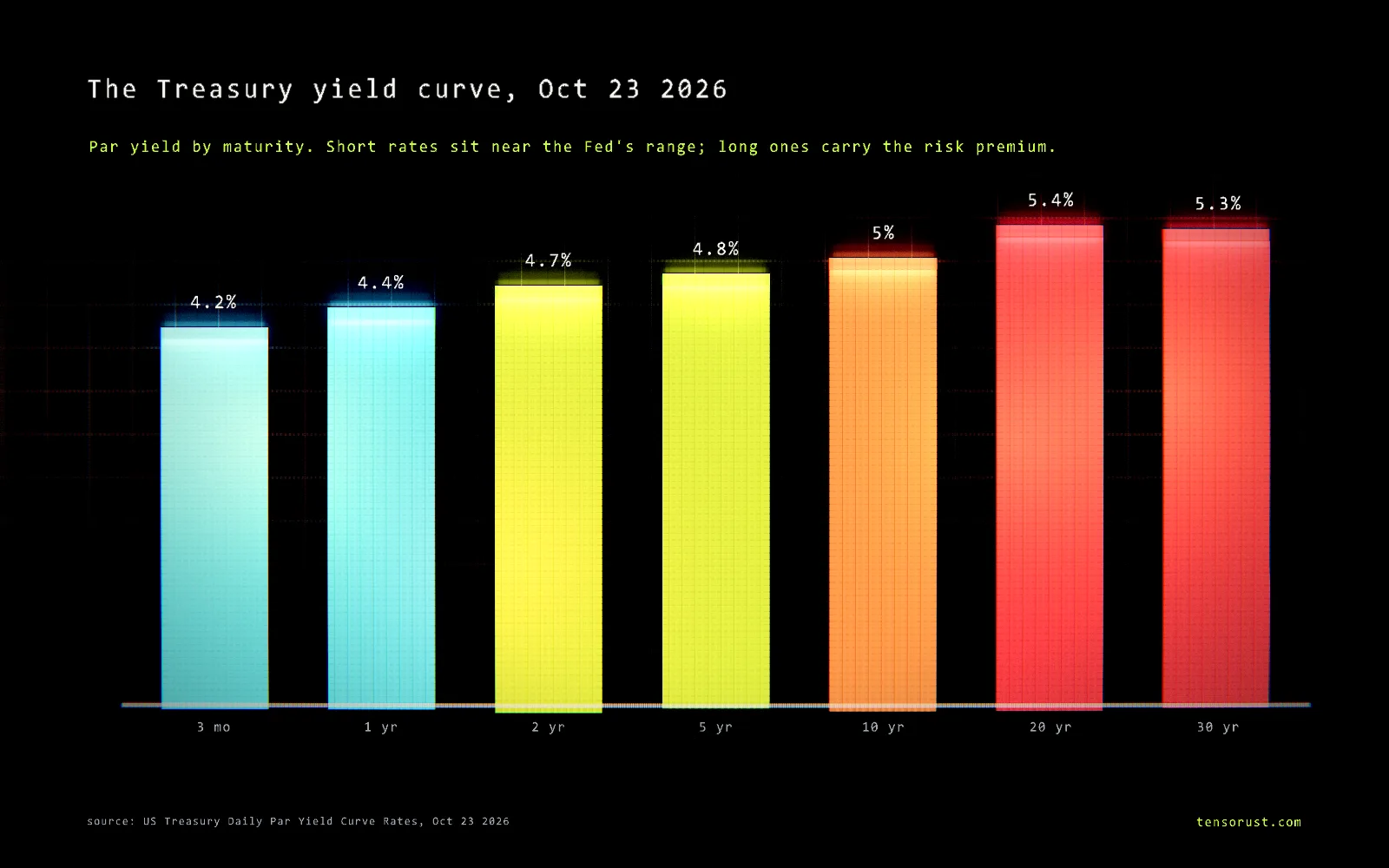
| 3-month, 2-year, 30-year | 4.22%, 4.69%, 5.33% (Oct 23 2026) | US Treasury |
| Fed funds target | 3.75% to 4.00% after a hike on Sep 16 2026 | Federal Reserve |
| 10-year real yield (TIPS) + expected inflation | 2.64% + 2.32% = 4.96% (Oct 22 2026) | FRED DFII10, T10YIE |
| 30-year mortgage average | 7.32% (Oct 22 2026), 6.19% a year earlier (Oct 23 2025) | Freddie Mac PMMS via FRED |
Download the data (CSV): daily 10-year, 2-year and 3-month yields since 2000, plus the weekly 30-year mortgage rate.
How a Treasury yield works
The Treasury borrows by selling bills (up to one year), notes (2 to 10 years) and bonds (20 and 30 years), per TreasuryDirect. A note pays a fixed coupon every six months and returns $1,000 at the end. Once it is sold, it trades every day, and its price moves. The yield is what you earn if you buy at today's price and hold it to maturity. The coupon never changes; the price does.
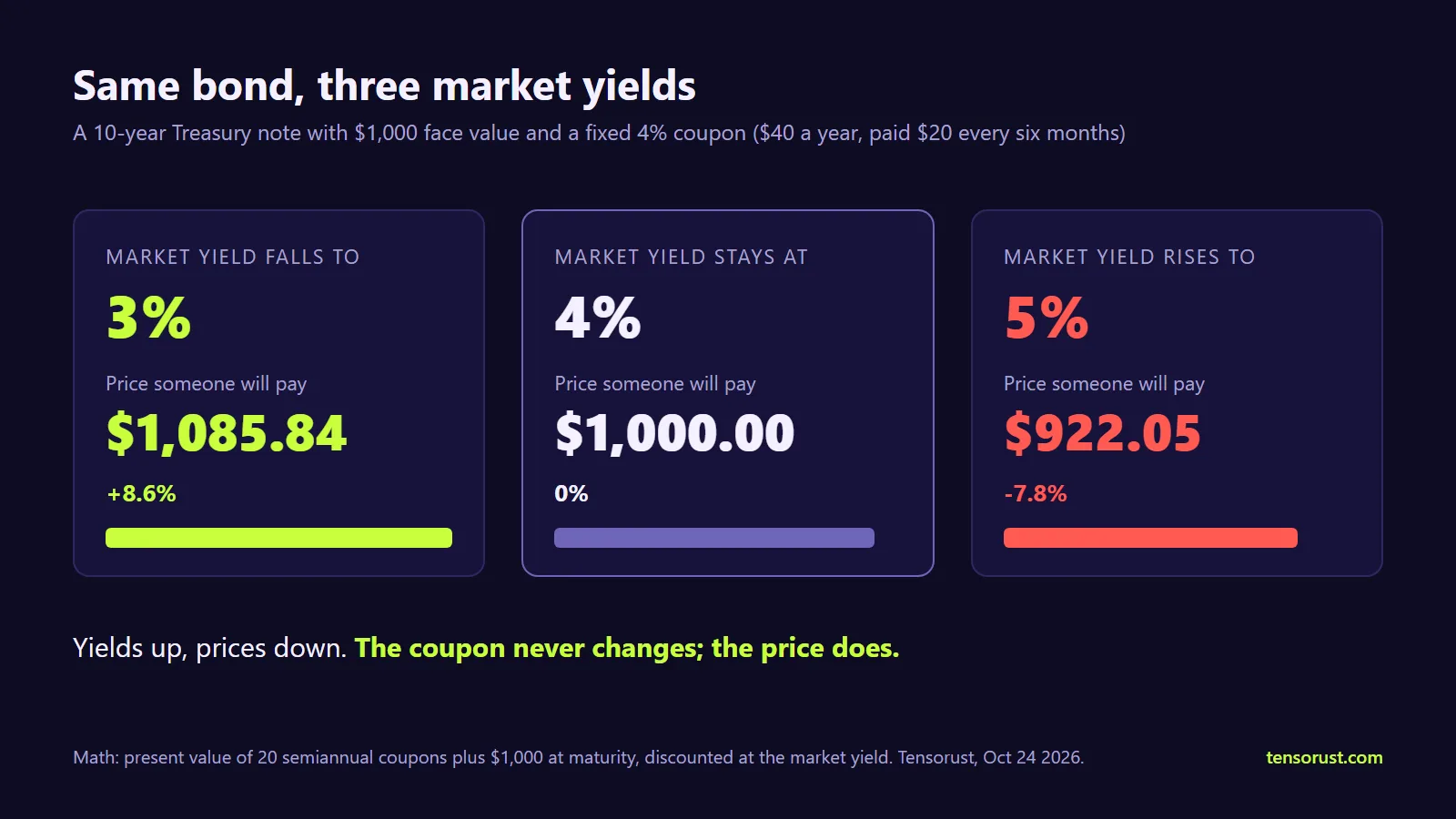
Worked through: you own a 10-year note paying 4% ($20 every six months). New 10-year notes now yield 5%. Nobody will pay $1,000 for your 4% note when 5% is on offer, so its price falls to the point where a buyer earns 5% anyway: $922.05, a 7.8% loss on paper. Longer bonds swing harder: the same 4% coupon on a 30-year bond would be worth about $845 at a 5% yield. That is how banks like Silicon Valley Bank lost money on "safe" Treasuries in 2023; see what happened to banks after 2008.
The Treasury publishes a "par yield" for each maturity every trading day. Line them up and you get the yield curve:
What a yield is made of
A useful way to split the 10-year yield, using two market prices the Fed tracks:
- Real yield: what the inflation-protected 10-year note (TIPS) pays above inflation. It reflects where investors think the Fed's rate will average, plus a premium for lending long ("term premium").
- Breakeven inflation: the gap between the normal note and the TIPS note, roughly the inflation investors expect.
On October 22, 2026: 2.64% real + 2.32% expected inflation = 4.96%, exactly the 10-year yield that day. A year earlier it was 1.68% + 2.29% = 3.97%. So the real part rose 0.96 points and inflation expectations rose 0.03. Our reading: markets are not panicking about inflation; they are demanding more to lend long, after a Fed rate hike in September 2026, the end of the Fed's bond buying cushion (see what is quantitative tightening) and about $2 trillion of new borrowing in fiscal 2026. Splitting the real yield into "expected Fed path" and "term premium" needs a model, so treat that last step as interpretation, not measurement.
Why rising yields matter to you
- Mortgages and loans. The 30-year mortgage averaged 7.32% on October 22, 2026, up from 6.19% a year earlier. On a $400,000 loan that is $2,748 a month instead of $2,447, about $108,000 more over 30 years.
- The federal budget. Every maturing Treasury is refinanced at today's rate. Net interest passed $1 trillion in fiscal 2026; the full breakdown is in how interest rates affect the national debt.
- Savings. The upside: a 3-month bill pays 4.22% and a 10-year note 5%, near the highest since 2002.
- Stocks. A higher risk-free return makes future profits worth less today, which hits richly valued growth stocks hardest; our 2007 vs now data piece looks at that for AI.
Common misconceptions
"A higher yield means the bond pays more interest."
The recordThe coupon on an existing bond is fixed. A higher yield means its price fell, so a new buyer earns more on the money they put in. Only newly issued notes come with a bigger coupon.
"Treasuries are risk-free, so you can't lose money."
The recordYou will get every promised payment, but if you sell before maturity after yields rise, you sell at a loss. A 4% 10-year note was worth about 7.8% less once yields hit 5%.
"The Fed sets the 10-year yield."
The recordThe Fed sets the overnight rate. The 10-year is set by the market and can move the other way: the Fed cut rates three times in late 2025, and the 10-year yield was higher a year later.
"Yields are rising because of inflation."
The recordNot this year. Expected inflation over 10 years barely moved (2.29% to 2.32%); the rise came from the real yield.
Related
- Bonds just broke 2007's peak. AI is this cycle's housing boom: the article this explainer spins out of.
- What is quantitative tightening?
- How do interest rates affect the national debt?
- Who owns the US national debt?
- What happens if China sells its US Treasuries?
FAQ
What is a Treasury yield in simple terms?
It is the yearly return you get for lending money to the US government by buying a Treasury bill, note or bond at today's market price and holding it to maturity. The 10-year yield is the return on a 10-year note. It moves every day as investors trade the notes, and it sets the floor for most other long-term borrowing costs, including mortgages.
Why do bond prices fall when yields rise?
Because the bond's payments are fixed. A note that pays $40 a year on $1,000 is worth less once new notes pay $50, so its price drops until its return matches the market: a 10-year 4% note is worth about $922 when 10-year yields are 5%, and about $1,086 when they are 3%.
What is the 10-year Treasury yield right now?
It was 5.00% on October 23, 2026, per the US Treasury's daily par yield curve. It closed at 5.31% on October 5, 2026, the highest close since May 2002 and above the 2007 peak of 5.26%. Check the Treasury's daily table for today's number, since it changes every trading day.
Why are Treasury yields rising?
Over the year to October 22, 2026, the 10-year yield rose 0.99 percentage points, and almost all of it was the real (inflation-adjusted) yield, which rose 0.96 points, while expected inflation rose only 0.03 points. That points to higher expected policy rates and a higher price for lending long term, not to an inflation scare. The Fed raised rates in September 2026, it ended QT in December 2025, and the government ran a deficit of about $2 trillion in fiscal 2026.
Are rising Treasury yields bad?
They are good for savers and new bond buyers, who earn more, and bad for borrowers and for anyone holding older bonds. A 30-year mortgage averaged 7.32% on October 22, 2026, up from 6.19% a year earlier, which adds about $300 a month to the payment on a $400,000 loan. Higher yields also raise the government's interest bill, which passed $1 trillion in fiscal 2026.
Sources
All checked October 24, 2026.
Primary (US Treasury and Federal Reserve)
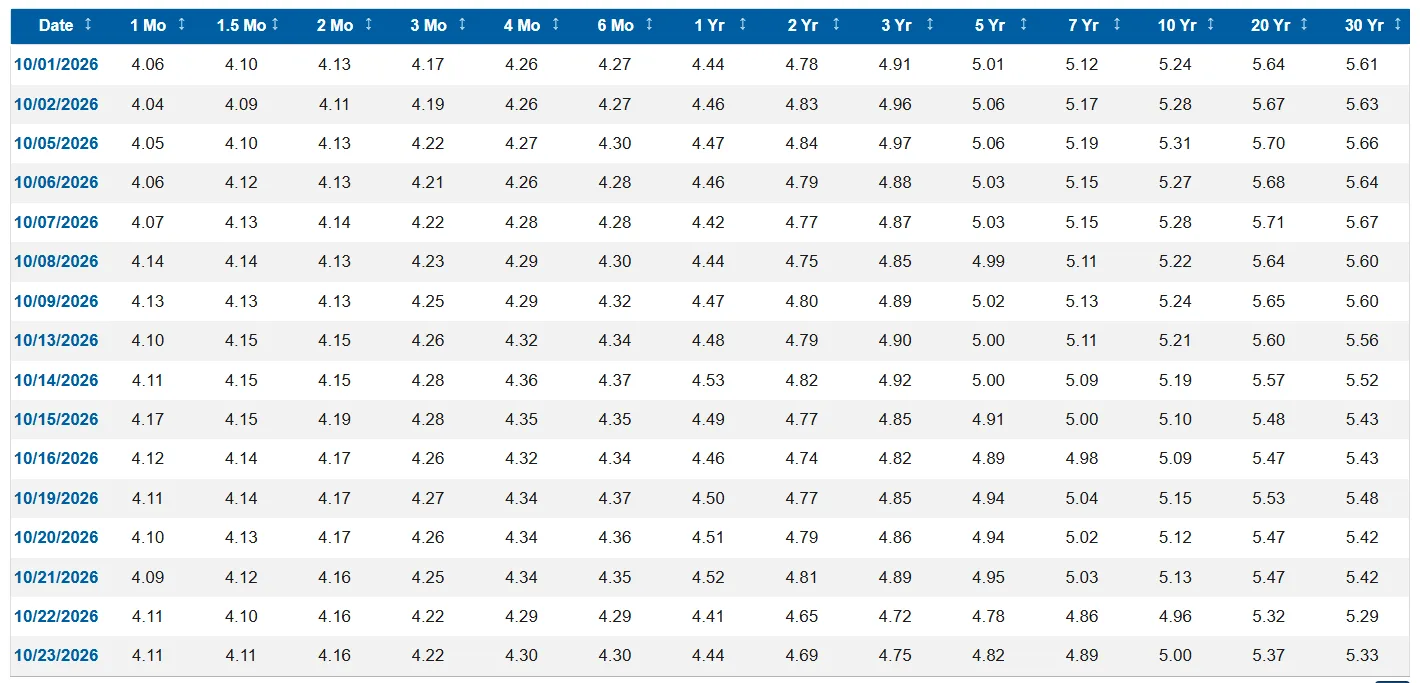
- US Treasury, Daily Treasury Par Yield Curve Rates, October 2026: 3-month 4.22%, 2-year 4.69%, 10-year 5.00%, 20-year 5.37%, 30-year 5.33% on Oct 23, 2026; 10-year 5.31% on Oct 5, 2026.
- TreasuryDirect, Marketable securities: bills, notes and bonds and their terms.
- Federal Reserve, FOMC statement of September 16, 2026: target range raised to 3.75% to 4%.
- Federal Reserve, FOMC statements of September 17, 2025, October 29, 2025 and December 10, 2025: the three 2025 cuts.
Data series (Federal Reserve Bank of St. Louis, FRED)
- DGS10, DGS2, DGS3MO: Treasury constant-maturity yields (source: US Treasury). Record low, 2007 peak and the "highest since May 14, 2002" check are our searches of DGS10.
- DFII10 10-year TIPS real yield and T10YIE 10-year breakeven inflation.
- MORTGAGE30US: Freddie Mac Primary Mortgage Market Survey, 30-year fixed average.
Our math
- Bond prices: present value of 20 semiannual $20 coupons plus $1,000, discounted at half the annual yield (3%: $1,085.84; 5%: $922.05); 30-year version at 5%: $845.46.
- Mortgage payments: standard amortization, $400,000 over 360 months at 6.19% ($2,447) and 7.32% ($2,748).
- Yield split: Oct 22, 2026 DFII10 2.64 + T10YIE 2.32 = 4.96 = DGS10; Oct 22, 2025 1.68 + 2.29 = 3.97 = DGS10.
- data.csv: daily DGS10, DGS2, DGS3MO since 2000 and weekly MORTGAGE30US.
Images
- Hero and yield-curve chart: rendered by Tensorust with the Proof Engine from Treasury data.
- Price vs yield cards: made by Tensorust for this page.
- Treasury table: screenshot of the public home.treasury.gov page, Oct 24, 2026.
Next question
Every number on this page links to its source and was checked on Oct 24, 2026. Spot an error or a newer figure? Email matt@tensorust.com and it gets fixed. Related: See a trillion dollars at true size.
Read next
- Article · Oct 23, 2026Bonds just broke 2007's peak. AI is this cycle's housing boom
- Article · Oct 23, 2026Boomers, debt and asset prices: is the market playing hot potato?
- Explainer · Oct 24, 2026What is private credit, and why are funds gating withdrawals?
- Explainer · Oct 24, 2026What is the debt ceiling, and when does the US hit it again?
Get the next one by email.
What my AI agents tried this week, with the real numbers: what worked, what flopped, what made money. One email when there is something worth reading.
No spam, never sold. Every email has a one-click unsubscribe.