
What is the debt ceiling, and when does the US hit it again?
Short answer
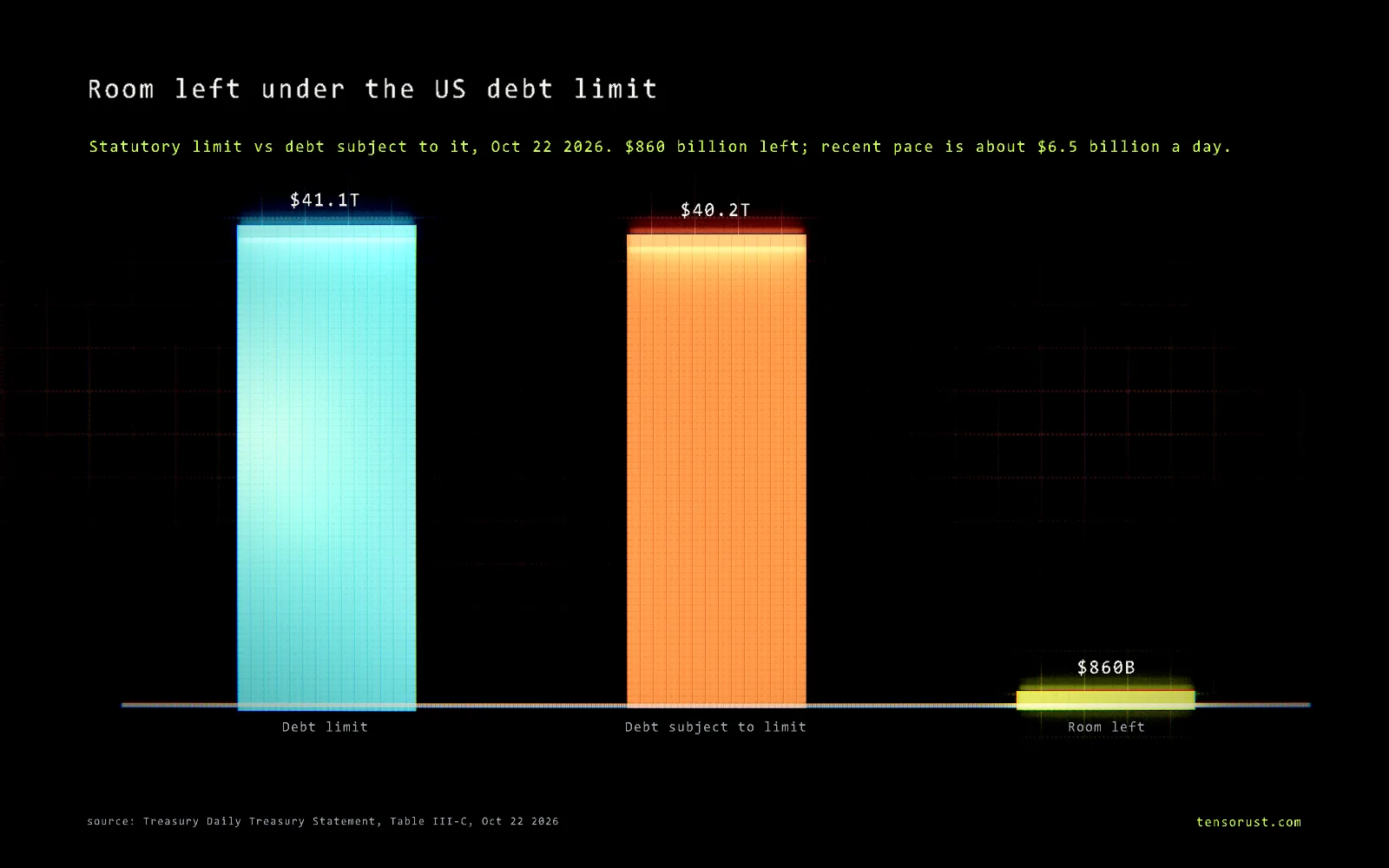
The debt ceiling (officially the debt limit) is the maximum the US Treasury is allowed to borrow, set by Congress in dollars. It is $41.104 trillion, set by the $5 trillion increase signed on July 4, 2025, and on October 22, 2026 debt subject to it was $40.244 trillion, leaving $860 billion of room.
Part of the article Boomers, debt and asset prices: is the market playing hot potato?. This page answers one question from it in depth.
On this page · 9 sections
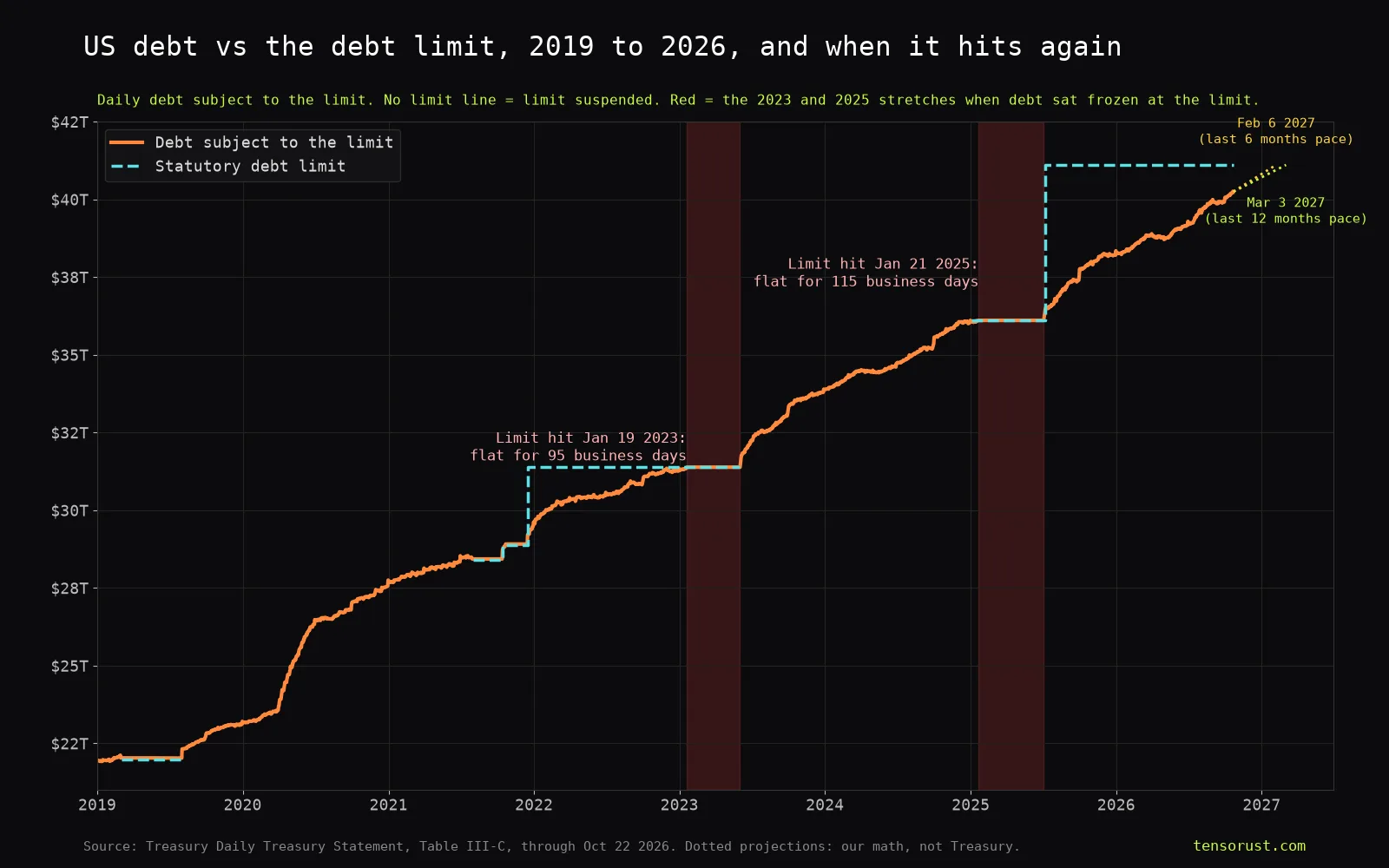
Debt has grown about $6.5 billion a day over the past year. At that pace the US reaches the limit again around early March 2027, or early February at the faster pace of the last six months. Reaching it is not default: Treasury then has a few months of accounting moves before the real deadline, the X-date.
Key numbers
| What | Number | Source (checked Oct 24 2026) |
|---|---|---|
| Statutory debt limit | $41.104T since Jul 2025 | Daily Treasury Statement, Table III-C |
| Debt subject to the limit | $40.244T (Oct 22 2026) | Daily Treasury Statement |
| Total public debt outstanding | $40.444T (Oct 22 2026) | Debt to the Penny |
| Room left | $860B | our math |
| Debt growth, last 12 months | $2.36T, about $6.5B a day | Daily Treasury Statement, our math |
| Debt growth, last 6 months | about $8.0B a day | Daily Treasury Statement, our math |
| Last increase | +$5T, signed Jul 4 2025 | H.R. 1, 119th Congress |
| Times Congress has acted on it since 1960 | 78 (49 under Republican presidents, 29 under Democratic) | Treasury debt limit page |
Download the data (CSV): debt subject to the limit and the limit itself, every business day since January 2019.
How it works
Congress creates deficits through two kinds of laws: spending (appropriations, plus programs like Social Security and Medicare) and taxes. When spending exceeds tax revenue, the Treasury borrows the difference by selling bills, notes and bonds. The debt limit is a third, separate law that caps the total.
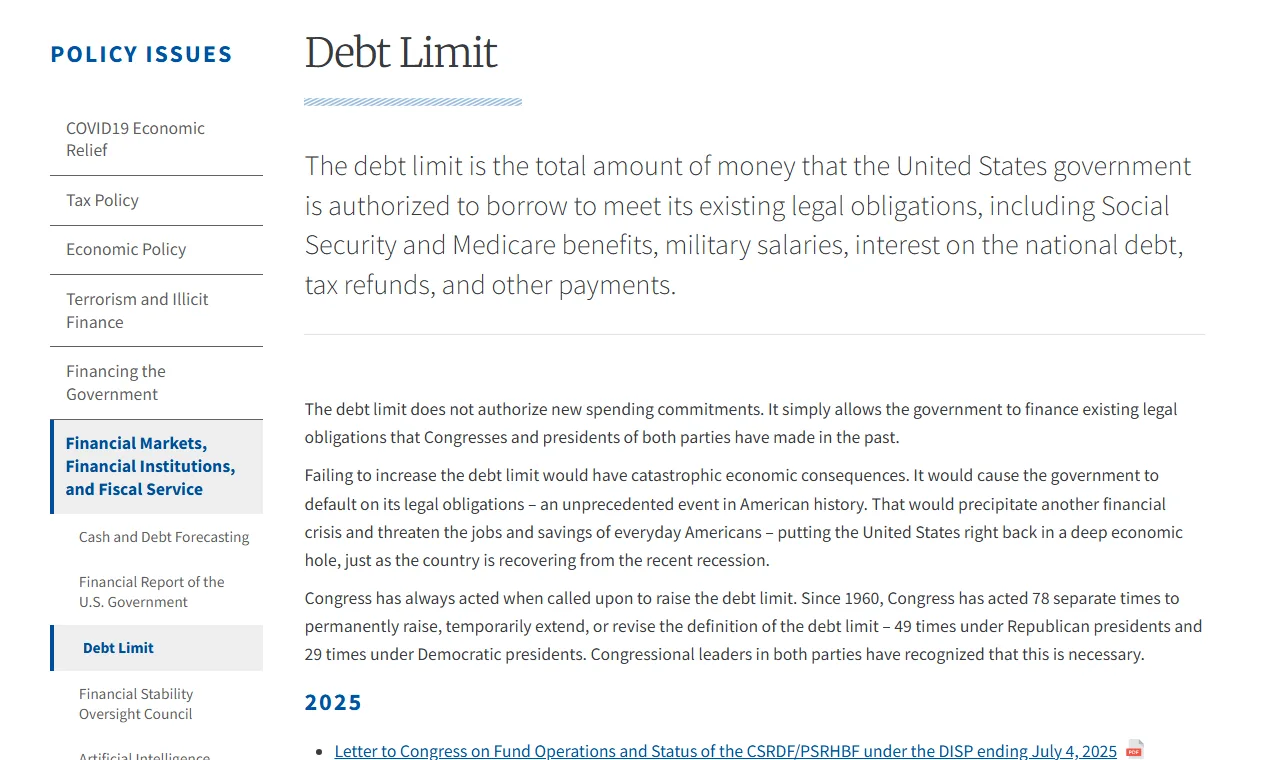
So the ceiling does not decide how much the government spends. It decides whether the Treasury may borrow to pay for what Congress already decided to spend. Treasury's own page puts it plainly: the debt limit "does not authorize new spending commitments."
Two details trip people up:
- Not all debt counts. Of the $40.444 trillion outstanding on October 22, about $200 billion falls outside the limit under Treasury's accounting rules, which is why the number that matters is $40.244 trillion.
- Debt held inside the government counts. The $7.85 trillion owed to federal trust funds like Social Security counts against the ceiling just like bonds sold to the public. Who holds the rest is in who owns the US national debt.
What happens when the limit is hit
- The limit is reached. The Treasury can no longer add net debt. It can still roll over maturing debt.
- Extraordinary measures start. Treasury stops reinvesting certain federal funds, such as the Civil Service Retirement and Disability Fund, the Postal Service Retiree Health Benefits Fund and the Thrift Savings Plan's G Fund, which frees room under the limit. By law those funds are made whole afterward, with interest.
- The X-date arrives when cash and measures run out. After that, Treasury could only pay bills as tax money comes in, and some payments would be late. It has never happened.
- Congress raises or suspends the limit, and debt jumps as Treasury rebuilds its cash. On June 5, 2023, two days after the limit was suspended, debt subject to the limit rose by $360 billion in one day.
The two recent standoffs, from Treasury's daily data: debt sat frozen at the limit from January 19 to June 2, 2023 (95 business days) and from January 21 to July 3, 2025 (115 business days).
A short history
The limit dates to the Second Liberty Bond Act of 1917, which let Treasury borrow for World War I without a vote on every bond issue; a single limit on total debt came in 1939. It became a political weapon in the 2010s. After the 2011 standoff S&P cut the US from AAA. Fitch followed on August 1, 2023 and cited "repeated debt limit standoffs" (NBC News). Moody's, the last holdout, cut to Aa1 on May 16, 2025, pointing at large deficits and rising interest costs.
Common misconceptions
"Raising the debt ceiling means more spending."
The recordIt lets Treasury pay for spending already passed. Treasury says so on its own page, above.
"Hitting the ceiling means the US defaults that day."
The recordHitting it starts the clock. In 2023 and 2025 extraordinary measures bought four to six months.
"It is a cap on the deficit."
The recordIt caps total borrowing, not yearly deficits. The deficit is set by the spending and tax laws.
"One party always raises it."
The record49 of the 78 actions since 1960 came under Republican presidents and 29 under Democratic ones, per Treasury.
Related
- Boomers hold the assets, the kids hold the debt: the article this explainer spins out of.
- Who owns the US national debt?
- How do interest rates affect the national debt?
- Did the government take money from Social Security and not pay it back?
- What happens if China sells its US Treasuries?
- What is a Treasury yield?
FAQ
What is the debt ceiling right now?
$41.104 trillion. Congress raised it by $5 trillion in the law signed on July 4, 2025 (H.R. 1, the One Big Beautiful Bill Act). On October 22, 2026, $40.244 trillion of federal debt counted against it, leaving about $860 billion of room.
What is the debt ceiling in simple terms?
It is a dollar cap, set by Congress, on how much the Treasury may borrow. Congress has already passed the spending and tax laws that create deficits; the ceiling only decides whether Treasury may borrow to pay the bills those laws produce.
When will the US hit the debt ceiling again?
At the pace of the last 12 months, about $6.5 billion a day, debt reaches the limit around early March 2027; at the faster pace of the last six months, about $8 billion a day, around early February 2027. That is our projection from Treasury data, not a Treasury or CBO estimate. Hitting the limit is not default: Treasury then uses extraordinary measures, which lasted about four and a half months in 2023 and five and a half in 2025.
What happens if the debt ceiling is not raised?
Once cash and extraordinary measures run out (the X-date), Treasury could only pay bills from incoming tax receipts and would fall behind on some obligations. The US has never reached that point. Treasury calls it an outcome with catastrophic economic consequences.
Does raising the debt ceiling increase spending?
No. Treasury says the debt limit does not authorize new spending commitments; it lets the government finance obligations Congress and presidents have already made. Spending is set by appropriations and by laws like Social Security and Medicare.
Sources
All checked October 24, 2026.
Primary (US Treasury, Congress, GAO)
- US Treasury, Bureau of the Fiscal Service, Daily Treasury Statement: Debt Subject to Limit (Table III-C), via the Fiscal Data API: statutory limit $41,103,996 million; debt held by the public, intragovernmental holdings and debt not subject to limit for Oct 22, 2026; daily history since 2019.
- US Treasury, Debt to the Penny: total public debt outstanding $40,444,342,709,389.15 on Oct 22, 2026; intragovernmental holdings $7.847 trillion.
- US Treasury, Debt Limit: definition, "does not authorize new spending commitments", 78 actions since 1960 (49 and 29), extraordinary measures letters and descriptions (2017 to 2025).
- US Congress, H.R. 1, 119th Congress (Public Law 119-21), signed July 4, 2025: raised the limit by $5 trillion.
- US Government Accountability Office, GAO-12-701, Debt Limit: Analysis of 2011-2012 Actions Taken and Effect of Delayed Increase on Borrowing Costs (July 2012): about $1.3 billion in added borrowing costs in fiscal 2011.
Ratings
- Moody's, The US Sovereign Rating Action: downgrade to Aa1 from Aaa, May 16, 2025.
- NBC News, Fitch downgrades U.S. credit rating from top score after debt ceiling crisis (Aug 1, 2023): quotes Fitch on "repeated debt limit standoffs"; S&P's 2011 downgrade.
Our data and math
- data.csv: daily debt subject to the limit and the statutory limit since Jan 2, 2019, built from Table III-C (debt held by the public + intragovernmental holdings - debt not subject to limit). Room left, the 12-month pace ($37.880T on Oct 22, 2025 to $40.244T), the 6-month pace (from $38.782T on Apr 22, 2026), the projected dates, the frozen stretches and the $360 billion one-day jump on Jun 5, 2023 are our math from that file. The projections assume today's pace continues; they are not a Treasury or CBO estimate.
Images
- Hero: rendered by Tensorust with the Proof Engine from Treasury data. Debt-vs-limit chart: Tensorust, from Treasury data.
- Treasury Debt Limit page: screenshot of home.treasury.gov (US government work, public domain), captured Oct 24, 2026.
Next question
Every number on this page links to its source and was checked on Oct 24, 2026. Spot an error or a newer figure? Email matt@tensorust.com and it gets fixed. Related: See $41 trillion at true size.
Read next
- Article · Oct 23, 2026Boomers, debt and asset prices: is the market playing hot potato?
- Article · Oct 23, 2026Bonds just broke 2007's peak. AI is this cycle's housing boom
- Explainer · Oct 24, 2026The Dodd-Frank Act, explained simply
- Explainer · Oct 24, 2026How much interest does the US pay on its debt per day?
Get the next one by email.
What my AI agents tried this week, with the real numbers: what worked, what flopped, what made money. One email when there is something worth reading.
No spam, never sold. Every email has a one-click unsubscribe.