
What is private credit, and why are funds gating withdrawals?
Short answer
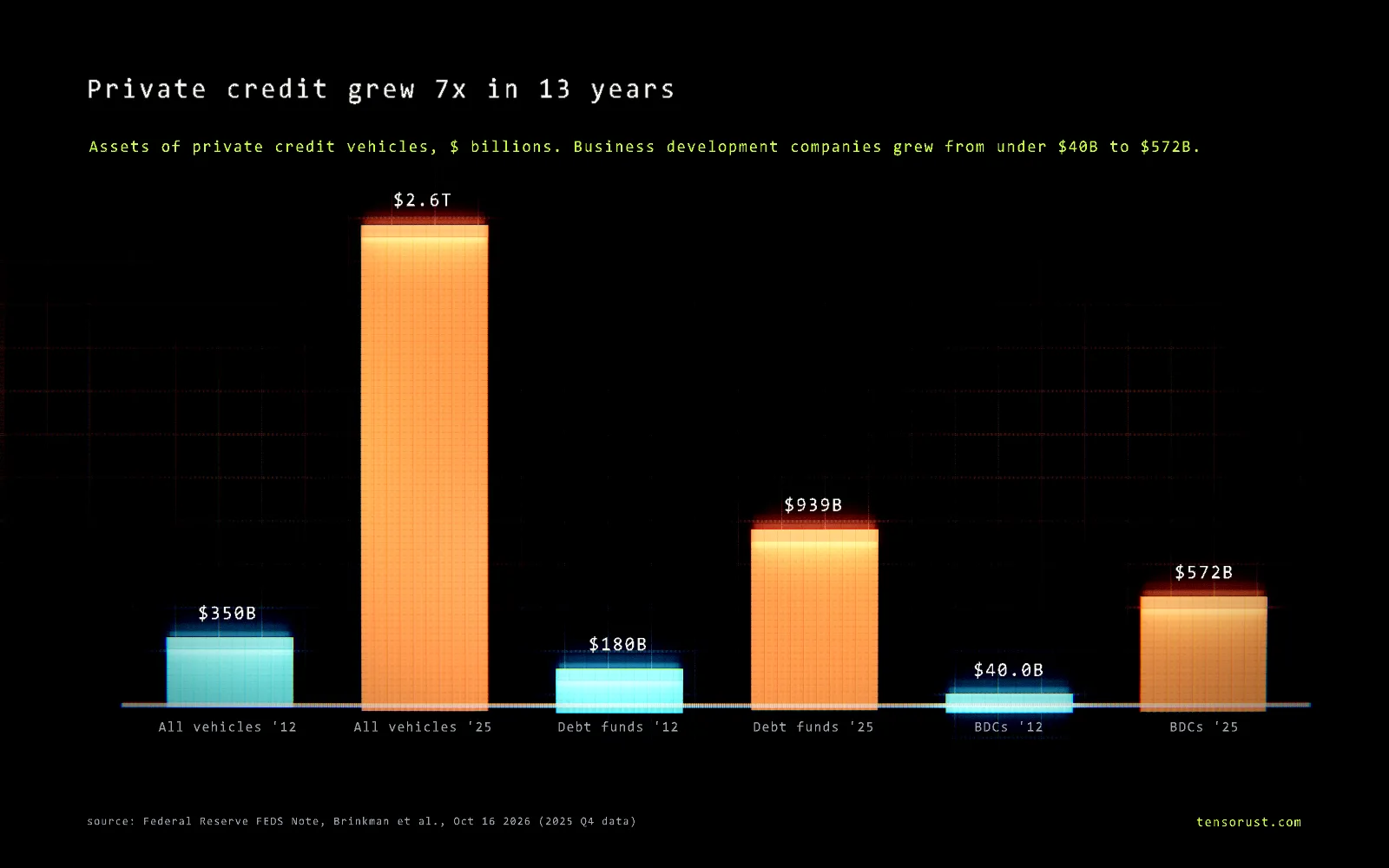
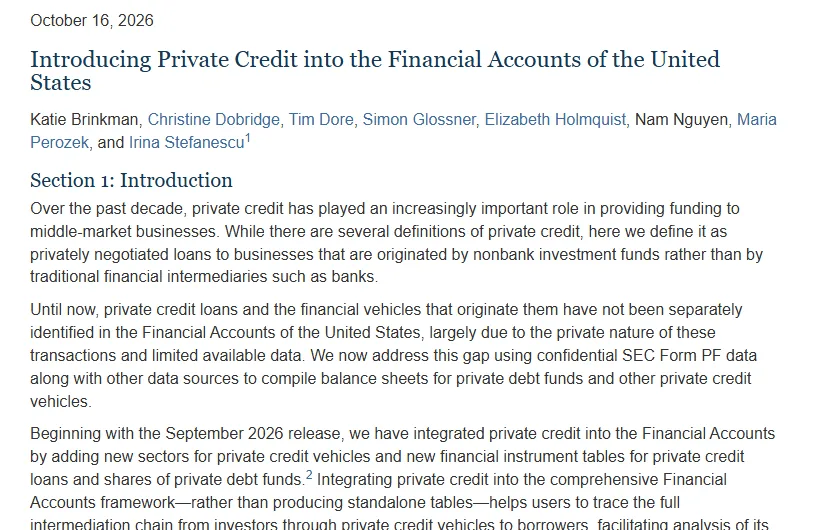
Private credit is lending to companies by investment funds instead of banks. Per a Federal Reserve note of October 16, 2026, private credit vehicles held more than $2.6 trillion of assets at the end of 2025, up from about $350 billion in 2012, with about $1.5 trillion lent to US businesses.
Part of the article Bonds just broke 2007's peak. AI is this cycle's housing boom. This page answers one question from it in depth.
On this page · 8 sections
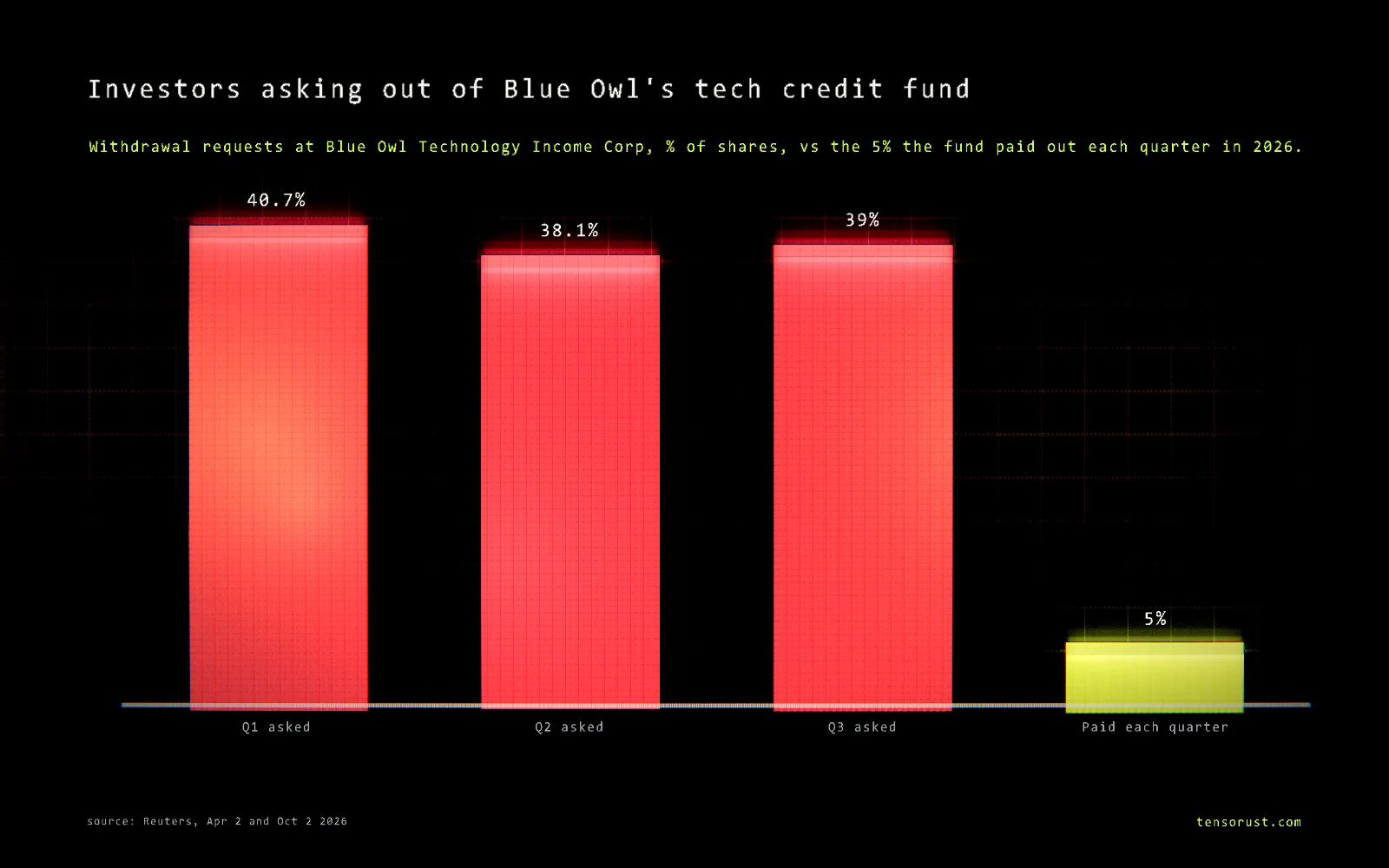
It is in the news because the funds sold to wealthy individuals promise quarterly exits but cap them at about 5% of the fund. In 2026 far more investors asked out: at Blue Owl's tech lending fund, holders of 39% of the shares asked to leave in Q3 alone. The caps held, which is the design, and also the worry.
Key numbers
| What | Number | Source (checked Oct 24 2026) |
|---|---|---|
| Private credit vehicle assets | Over $2.6T (end 2025), from about $350B (2012) | Fed FEDS Note, Oct 16 2026 |
| Loans outstanding to US businesses | About $1.5T, of which $335B from foreign-domiciled funds | Fed FEDS Note |
| Share of US nonfinancial business debt | About 6% (1% in 2012) | Fed FEDS Note, Table 8 |
| Bank loans to US private credit vehicles | $349B | Fed FEDS Note |
| Semi-liquid funds (perpetual BDCs + interval funds) | $425B gross assets, about 20% of the sector's net assets | Fed Financial Stability Report, May 2026 |
| Usual redemption cap | 5% of net asset value per quarter | Fed Financial Stability Report |
| Blue Owl Technology Income Corp requests | 40.7% (Q1), 38.1% (Q2), 39% (Q3 2026) of shares | Reuters, Apr 2 and Oct 2 2026 |
| Blue Owl Credit Income Corp requests | 21.9% (Q1), 18.8% (Q2), 16.8% (Q3 2026) | Reuters |
Download the data (CSV): every number in this table with its date and source.
How it works, step by step
- A fund raises money. Pensions, insurers and endowments commit cash for years; increasingly in the 2020s, wealthy individuals buy in through funds sold by brokers and advisers.
- It borrows on top. Business development companies (BDCs), the main US vehicle, had $180.8 billion of bank loans at the end of 2025, about 63% of their liabilities. Their debt roughly equals their equity, about 1 to 1; the law allows up to 2 to 1. For comparison, Minneapolis Fed President Neel Kashkari has put a big bank at roughly 10 to 1 (BNN Bloomberg, Oct 2024).
- It lends to companies. Mostly mid-sized firms, many owned by private equity, that are too small or too indebted for the bond market. Loans are usually floating rate, so borrowers pay more when the Fed hikes, as it did on September 16, 2026; see what the fed funds rate is.
- It holds the loans. There is no public market to sell them on quickly. That is the whole trade: investors get a higher yield for giving up the ability to leave fast.
Why funds are gating
There are two kinds of private credit fund. Traditional private debt funds lock money up for 7 to 10 years and offer no way out, so they cannot be "run". The semi-liquid ones, perpetual BDCs and interval funds, keep taking money in and let investors out once a quarter, but most cap total redemptions at 5% of net assets per quarter. Perpetual BDCs can also refuse redemptions entirely if the board judges that best for the fund.
That cap is what people mean by gating. Per the Fed's May 2026 Financial Stability Report:
- Redemption requests rose in Q4 2025 and accelerated in Q1 2026, with some funds getting requests well above 5%. Most managers paid out 5%.
- In Q1 2026, accepted redemptions exceeded new money coming in for the first time since these vehicles were created.
- The trigger was sentiment: high-profile corporate defaults from mid 2025, and fears that AI will disrupt software, now the largest sector in private credit portfolios.
Blue Owl's two biggest retail funds show the split. Requests at its flagship, Blue Owl Credit Income Corp, eased from 21.9% to 16.8% over three quarters. At Blue Owl Technology Income Corp, which lends to software firms, they stayed near 40%, and Blue Owl itself pointed to "market concerns around AI-related disruption."
Common misconceptions
"A gate means the fund is collapsing."
The recordThe 5% cap is in the fund's terms from day one. The loans are still paying; what it means is that leaving takes many quarters. At 5% a quarter, a 39% queue takes roughly two years to clear if nobody new joins it.
"Private credit is unregulated shadow banking."
The recordBDCs are registered with the SEC and capped at 2 to 1 leverage by law, and private funds report to the SEC on Form PF, the confidential data the Fed used to build its new figures. It is lighter-touch than banking, not unwatched.
"Banks are safely out of it."
The recordUS private credit vehicles owed banks $349 billion at the end of 2025. Fed researchers argued in an August 2026 note that private credit should not be seen as fully outside the banking system.
"It is a niche."
The recordAbout $1.5 trillion of loans to US businesses is roughly 6% of all nonfinancial business debt. Private credit and leveraged loans together are about a fifth of lending to nonfinancial corporations, per another Fed note.
Related
- Bonds just broke 2007's peak. AI is this cycle's housing boom: the article this explainer spins out of.
- What is circular financing in AI?
- What is the fed funds rate, and what is it right now?
- What happened to banks after 2008?
- What is a Treasury yield?
FAQ
What is private credit in simple terms?
Loans to companies made by investment funds instead of banks. The Federal Reserve defines it as privately negotiated loans to businesses originated by nonbank investment funds. Most borrowers are mid-sized companies, many owned by private equity firms, and most loans carry floating rates.
How big is private credit?
Private credit vehicles held more than $2.6 trillion of assets at the end of 2025, up from about $350 billion in 2012, and had about $1.5 trillion of loans outstanding to US businesses, per a Federal Reserve note of October 16, 2026. That is about 6% of US nonfinancial business debt.
Why are private credit funds limiting withdrawals?
The semi-liquid funds sold to wealthy individuals let investors redeem quarterly but cap total redemptions, usually at 5% of the fund per quarter, because the loans inside cannot be sold quickly. In early 2026 requests jumped well past 5% as investors worried about defaults and about AI hurting the software companies these funds lend to, so most managers paid out the 5% and prorated the rest.
What is the difference between private credit and private equity?
Private equity buys ownership of companies; private credit lends them money. They are often linked: many private credit loans finance companies that a private equity firm bought, and several of the biggest firms, like Blackstone, Apollo and KKR, run both.
Is private credit the next 2008?
The Fed's May 2026 Financial Stability Report judged the risks from further redemptions 'limited and manageable': these funds borrow far less than 2007's banks did and the largest ones hold enough cash and bank lines to cover several quarters of 5% redemptions. The open risk is credit quality, mainly loans to software companies, and the roughly $350 billion banks have lent to these funds.
Sources
All checked October 24, 2026.
Primary (Federal Reserve)
- Katie Brinkman, Christine Dobridge, Tim Dore, Simon Glossner, Elizabeth Holmquist, Nam Nguyen, Maria Perozek and Irina Stefanescu, Introducing Private Credit into the Financial Accounts of the United States, FEDS Notes, Oct 16, 2026: definition; vehicle assets about $350 billion (2012) and over $2.6 trillion (2025 Q4); about $1.5 trillion of loans to US businesses, $335 billion from foreign funds; private debt fund assets $180 billion to $938.7 billion; BDC assets under $40 billion to $572.2 billion; BDC bank loans $180.8 billion of $285.5 billion liabilities and $286.7 billion equity; bank loans to US vehicles $349 billion; about 6% of nonfinancial business debt (Table 8).
- Federal Reserve, Financial Stability Report, May 2026: Funding Risks: perpetual-life BDCs $306 billion and interval funds $119 billion gross assets; 5% of NAV quarterly cap; Q1 2026 requests and the first quarter of redemptions above inflows; software as the largest sector; risks "limited and manageable".
- Federal Reserve, The Price of Bank Funding Behind Private Credit: Evidence from Business Development Companies, FEDS Notes, Aug 7, 2026.
- Federal Reserve, Private Credit and Leveraged Loan Markets: Similarities, Differences, and Substitution, FEDS Notes, Aug 11, 2026.
Reporting
- Reuters via The Globe and Mail, Blue Owl tech fund withdrawal requests (Apr 2, 2026): Q1 requests 40.7% (Technology Income Corp) and 21.9% (Credit Income Corp); "market concerns around AI-related disruption".
- Arasu Kannagi Basil and Pritam Biswas, Reuters, Blue Owl flagship fund withdrawal requests slow as private credit turmoil eases (Oct 2, 2026): Q2 and Q3 request rates, 5% repurchase limit.
- BNN Bloomberg, Fed's Kashkari says private credit may lessen systemic risk (Oct 15, 2024): bank leverage of about 10 to 1 vs about 1 to 1 for private credit vehicles.
Our data and math
- data.csv: every figure above with date and source. The 7x growth (350 to 2,600), the two-year queue (39 / 5 = about 8 quarters) and the BDC leverage ratio (285.5 / 286.7) are our math.
Images
- Hero and growth chart: rendered by Tensorust with the Proof Engine from the sources above.
- FEDS Note: screenshot of federalreserve.gov (US government work, public domain), captured Oct 24, 2026.
Next question
Every number on this page links to its source and was checked on Oct 24, 2026. Spot an error or a newer figure? Email matt@tensorust.com and it gets fixed. Related: See $2.6 trillion at true size.
Read next
- Article · Oct 23, 2026Bonds just broke 2007's peak. AI is this cycle's housing boom
- Article · Oct 23, 2026Boomers, debt and asset prices: is the market playing hot potato?
- Explainer · Oct 24, 2026The Dodd-Frank Act, explained simply
- Explainer · Oct 24, 2026How much interest does the US pay on its debt per day?
Get the next one by email.
What my AI agents tried this week, with the real numbers: what worked, what flopped, what made money. One email when there is something worth reading.
No spam, never sold. Every email has a one-click unsubscribe.