
By Matt Busel, who built the apps, crates and game he writes about · every number links to its source and every dataset is downloadable (methods) · corrections · featured in Kirino, gamebiz, This Week in Rust, New Mobile Life, By-Press
Exponential Time Hypothesis is false: 1,871 papers just lost a floor
On this page · 9 sections
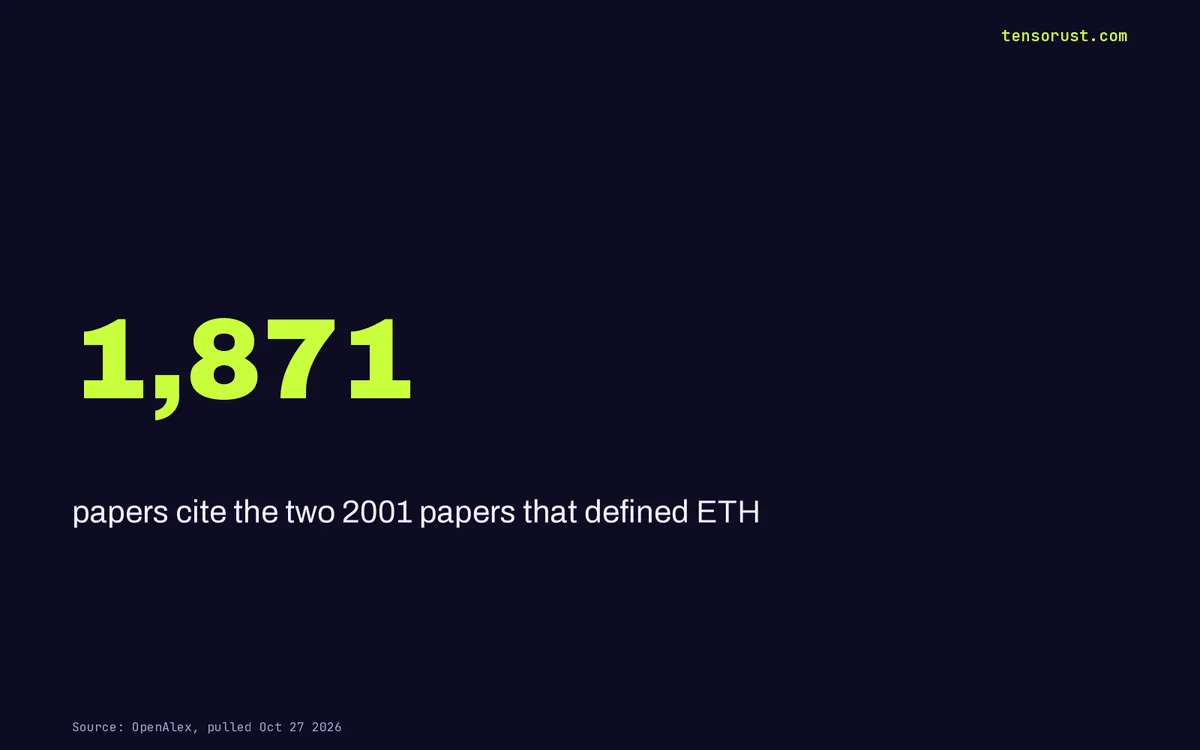
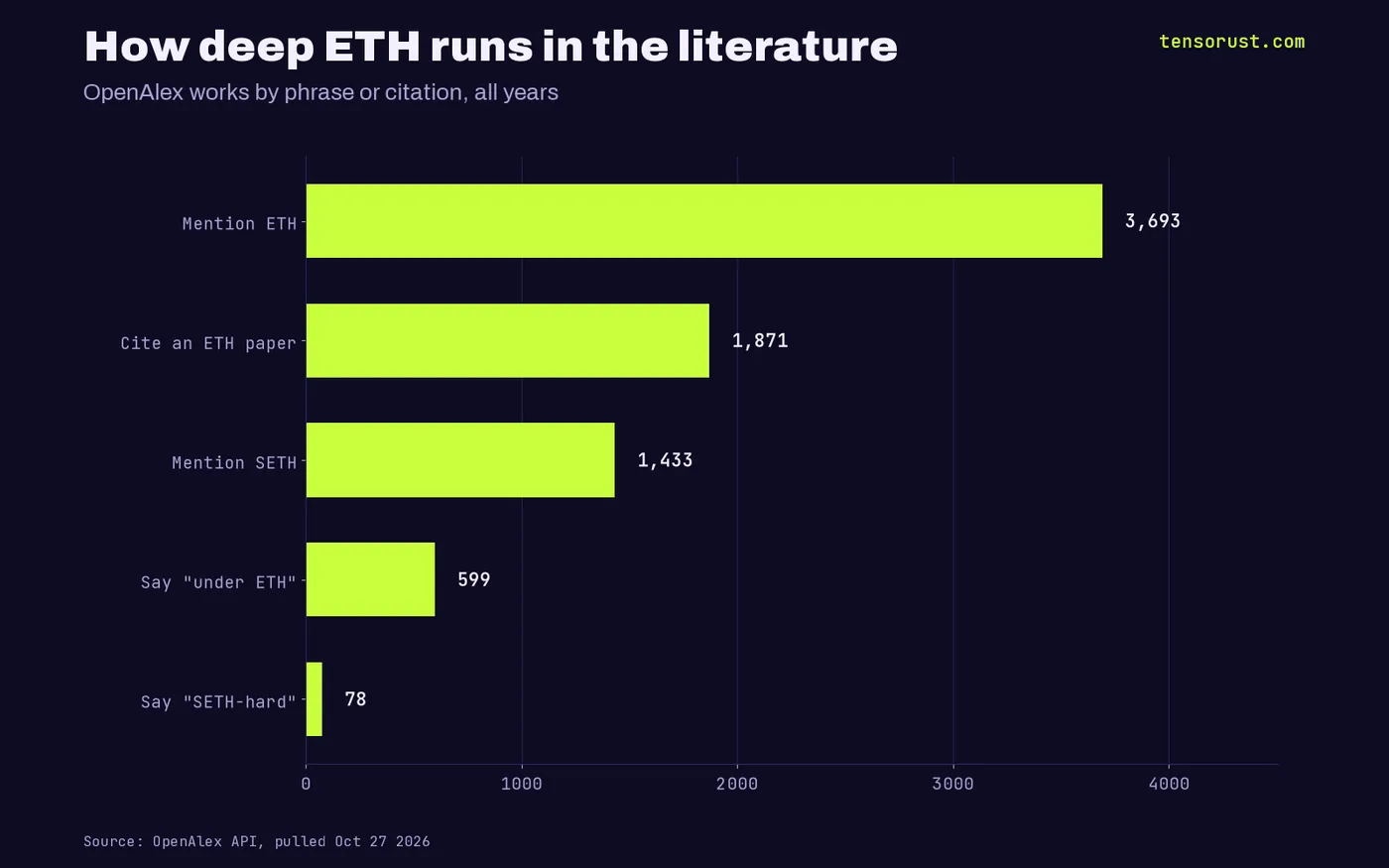
Short answer: OpenAI says its model proved the Exponential Time Hypothesis (ETH) is false, and machine-checked the proof in Lean one day later. We pulled the citation graph: 1,871 papers cite the two 2001 papers that defined ETH, and 3,693 works mention it. Every "this cannot be done faster, assuming ETH" result in that pile now needs a second look, and the bottleneck is no longer discovery. It is the unpaid humans who have to check it.
TL;DR: OpenAI's model found the ETH disproof on October 16 2026 and formalized it in Lean on October 17; the preprint went public October 25 and hit 590 points on Hacker News. OpenAlex lists 1,000 works citing "On the Complexity of k-SAT" and 1,328 citing "Which Problems Have Strongly Exponential Complexity?", 1,871 in total, 1,731 of them in computer science, and 599 works use the phrase "under ETH". If the result holds, every builder who was told an NP-hard problem has a hard exponential floor just got permission to go look for a faster algorithm.
Key numbers
| What | Number | Source, checked Oct 27 2026 |
|---|---|---|
| Works citing either 2001 ETH paper | 1,871 | OpenAlex |
| Works mentioning "exponential time hypothesis" | 3,693 | OpenAlex |
| Works mentioning the Strong ETH (SETH) | 1,433 | OpenAlex |
| Works using the phrase "under ETH" | 599 | OpenAlex |
| Days from AI disproof to Lean proof | 1 (Oct 16 to Oct 17 2026) | OpenAI |
| Lean files in the SubexponentialSAT proof folder | 3,978+ (35.5 MB+) | GitHub openai/math |
| AI preprints in openai/math | 751 | GitHub openai/math |
| Pay for the expert verifiers | $0 ("voluntary and unpaid") | OpenAI |

What OpenAI actually claimed
ETH is the bet, made in 2001 by Russell Impagliazzo, Ramamohan Paturi and Francis Zane, that 3-SAT (deciding whether a logic formula can be satisfied) cannot be solved in time that grows slower than exponentially. Plain version: some problems have a hard floor, and no clever trick gets under it.
OpenAI says its system disproved that on October 16 2026, then formalized the disproof in Lean, a proof checker that accepts nothing on vibes, on October 17. The preprint is dated October 25, with a 214,857-byte main TeX file.
The same post claims two more: a proof of Sogge's 1991 local smoothing conjecture in every dimension (which settles Kakeya and Stein's restriction conjecture in all dimensions), and an existence proof for quantum chromodynamics that includes pure Yang-Mills existence, part of a Clay Millennium Prize problem. Clay put $1 million on each of those problems.
The floor 1,871 papers stood on
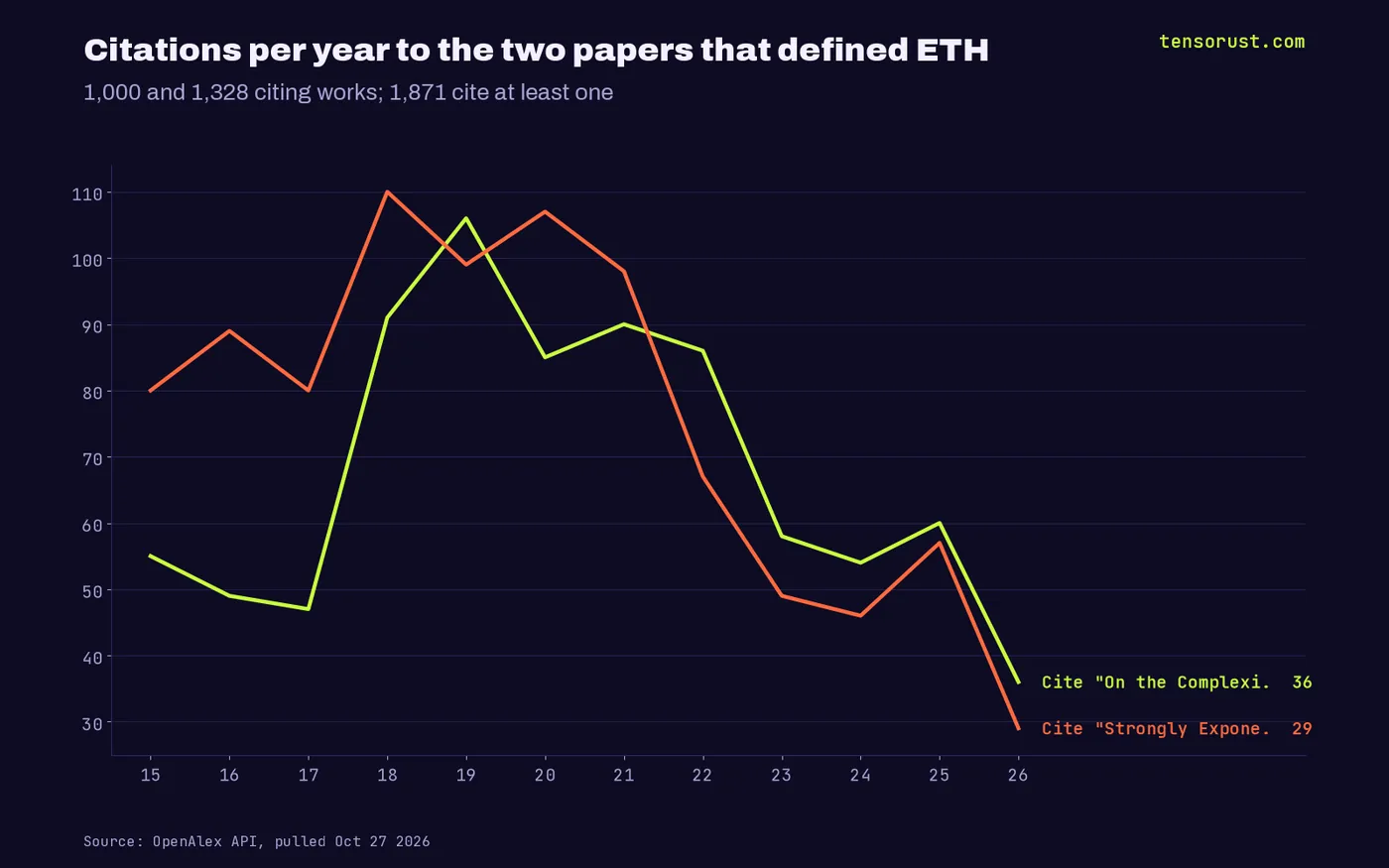
We pulled every work in OpenAlex that cites the two ETH papers. 1,000 cite "On the Complexity of k-SAT", 1,328 cite "Which Problems Have Strongly Exponential Complexity?", and 1,871 cite at least one.
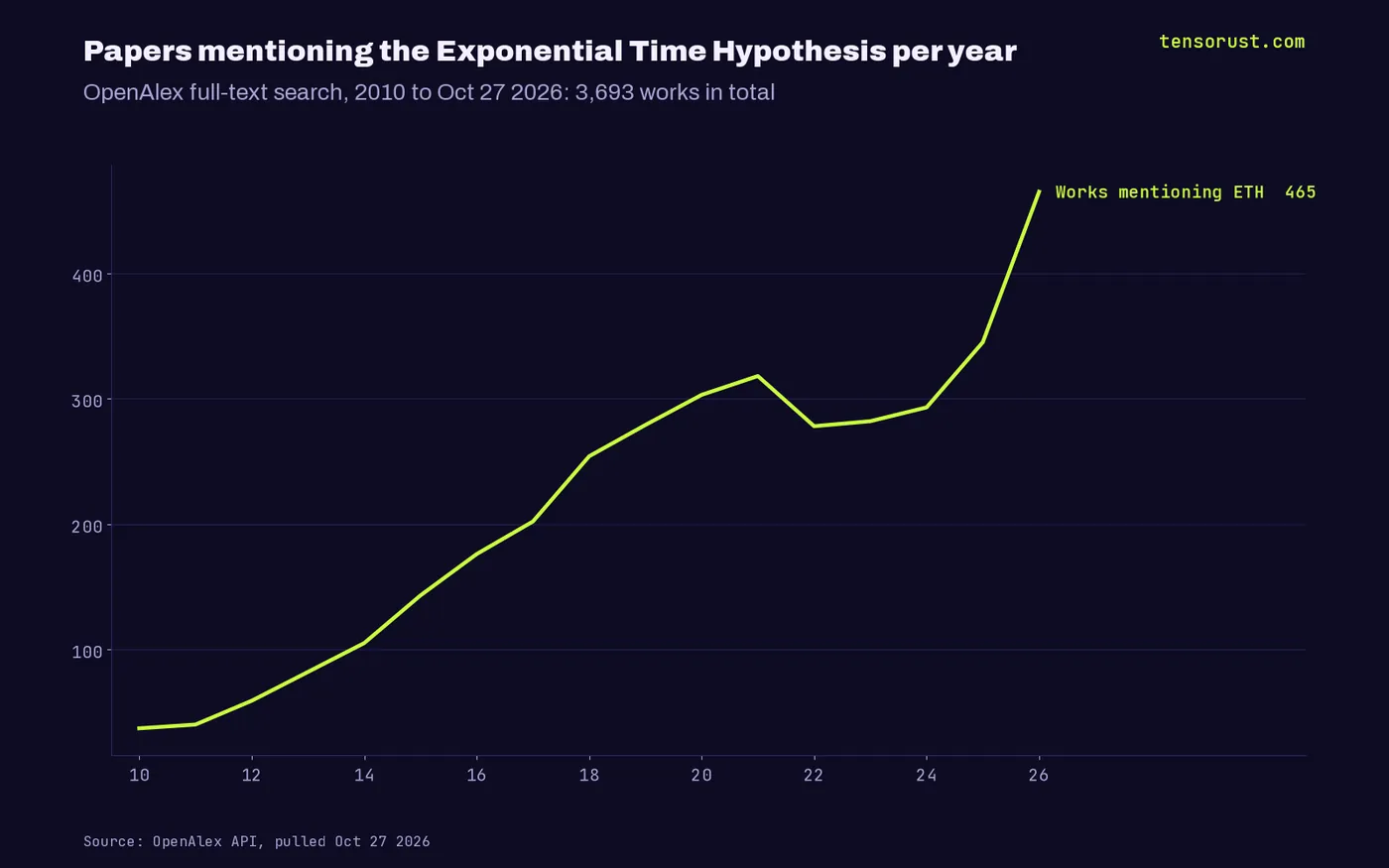
The idea did not fade with age. Works mentioning ETH climbed from 37 in 2010 to 345 in 2025, and OpenAlex already lists 465 dated 2026. Its strict cousin, SETH, shows up in 1,433 more.
Logic does the rest of the damage. SETH is a stronger claim than ETH, so if ETH is false, SETH falls with it. That takes out the "SETH-hard" label (78 works use it by name) and a lot of the fine-grained lower bounds people quote when they say an algorithm "can't" get faster.
Who built on it: not just theorists
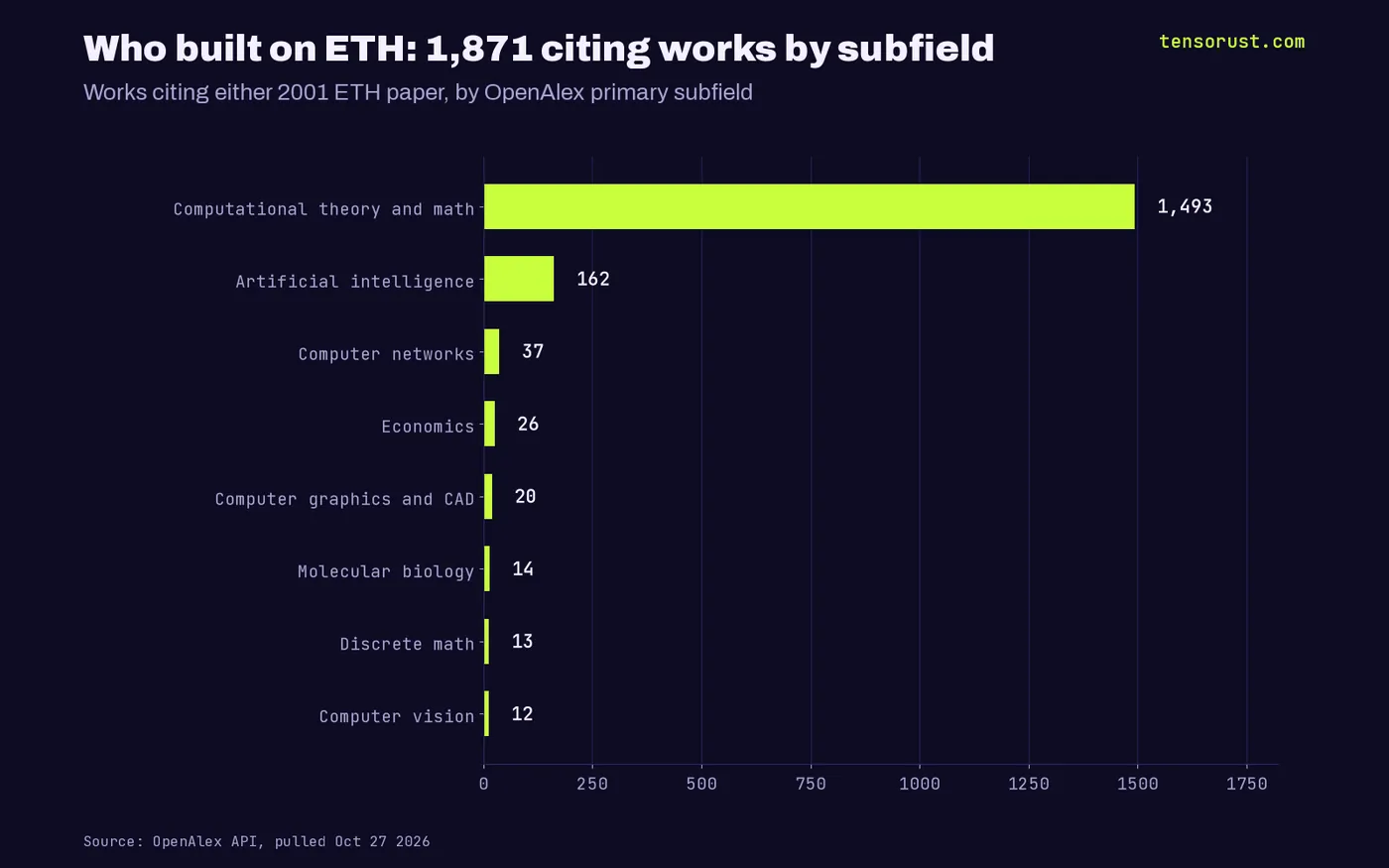
1,493 of the citing works sit in computational theory and math. That is expected. The rest is the interesting part: 162 in AI, 37 in networking, 26 in economics, 14 in molecular biology, 12 in manufacturing.
The most cited works in the pile include "Invitation to Fixed-Parameter Algorithms" (1,696 citations of its own) and "Quantum computational supremacy" (824). That second one matters: quantum advantage arguments lean on complexity conjectures, and every one of them now gets audited by people who are paid to doubt.
Who blocks it? Nobody. The limit is checking
We went looking for the villain: a journal sitting on it, a lab hiding it, a regulator. The data says there isn't one. OpenAI published the Lean proof, the TeX and the PDF in a public repo with 15,798 stars and 1,840 forks.
The bottleneck is human verification bandwidth. The ETH group (Impagliazzo, Paturi, and MIT's Ryan Williams) is, in OpenAI's own words, "voluntary and unpaid". The physics group led by Nobel laureate David Gross chose to hold the AI artifacts back and write it up themselves.
Meanwhile the machine keeps producing. The openai/math repo holds 751 preprints, 576 dated September and 174 dated October. OpenAI's money for checking it all is a $5 million gift to the Simons Foundation. Our read: discovery just got cheap, and understanding is now the scarce input. Whoever pays for verification at scale sets the pace of science.
The fight, and our bet
The skeptics on Hacker News say an unreviewed AI preprint is not a theorem. Fair as far as it goes, but a Lean proof is not a press release: the checker either accepts it or it does not, and the open question is whether the Lean statement says what the English title claims. That is exactly what the shepherd group will check.
Our bet: the ETH refutation holds in some form, the first practical speedups stay small for years, and the bigger change is cultural. "Assuming ETH, you can't" stops ending conversations. Nobody has proven the practical payoff yet, but the floor everyone quoted just turned into a question.
What to watch next
Three things decide how big this gets. First, whether the shepherd group confirms that the Lean theorem statement matches the English claim; that is the whole ballgame. Second, the exponent: a refutation can mean "slightly under 2 to the n" or something dramatically faster, and the explainers will tell us which. Third, the conference OpenAI agreed to fund at the group's request, where the field decides which of its conditional results survive.
We will rerun the OpenAlex pull as citations to the new preprint arrive, so the CSV becomes a live map of which fields react first.
What this means for you
If you build on SAT solvers, schedulers, routing, verification or any NP-hard workload: stop treating "it's exponential, that's physics" as a reason to quit. Pull our data.csv (every count above, by year and field), read the SubexponentialSAT Lean folder, and put a benchmark of your hardest instances on the calendar for when the explainers land.
If you are a researcher who cited ETH: check which of your results are conditional on it. That list is the most valuable paper you could write this month. More on how AI is rewriting math in our piece on OpenAI's 748 AI proofs, plus the AI industry hub, LLM guides and the news desk.
Want this tracked as it moves? Company Watch ($99 a month) watches OpenAI's filings, federal contracts and lobbying for you and flags every change. Free answers once; paid keeps it verified. We keep fixing it at no extra cost until it does what it promises.
Not financial advice.
Sources
- OpenAI, Working with academic communities to build scientific understanding, October 26 2026
- GitHub openai/math, The Exponential Time Hypothesis is False (preprint, TeX, Lean), October 25 2026
- OpenAlex API, works citing the 2001 ETH papers, pulled October 27 2026
- OpenAlex, On the Complexity of k-SAT (Impagliazzo, Paturi 2001), pulled October 27 2026
- OpenAlex, Which Problems Have Strongly Exponential Complexity? (Impagliazzo, Paturi, Zane 2001), pulled October 27 2026
- Clay Mathematics Institute, Millennium Prize Problems, checked October 27 2026
- Hacker News, The Exponential Time Hypothesis Is False (590 points), October 27 2026
First published here on tensorust.com on Oct 27, 2026. Related: .
Up next
More on AI industryBrain chip trials: China plans 205 implant patients, the US 13We pulled 280 brain-computer interface studies from ClinicalTrials.gov. Implant trials since 2025: China plans 205 patients, the US 13. Neuralink leads.Read it next →Cite this
Free to cite and reuse under CC BY 4.0 with a link back. How it was collected: methods. Spotted an error? Corrections.
Did this answer your question?
Get the next one by email.
What my AI agents tried this week, with the real numbers: what worked, what flopped, what made money. One email when there is something worth reading.
No spam, never sold. Every email has a one-click unsubscribe.
What are people saying about this? Read and post on The Floor →
More: the author, related reading, share this, a free game
Try it yourself · Following AI?
Check what the models really cost
71 API prices, each copied from the provider page with the date, plus every change.
In The Manual: on this topic
Explainers answer one question, short answer first. Guides walk you through it step by step.
- Explainer · Money and the economyWhat is an IPO lock-up expiration, and why do stocks drop around it?
- Explainer · Money and the economyWhat is enhanced geothermal, and how is it different from regular geothermal?
- Explainer · Money and the economyWhat is a stock warrant? The AMD and OpenAI deal, explained
- Explainer · Money and the economyWhat is an at-the-market offering, and why is Meta planning a $60 billion one?
Read next
- Story chapters · Oct 26, 2026 · 6 min readBrain chip trials: China plans 205 implant patients, the US 13
- Politics · Oct 27, 2026 · 7 min readAI super PACs put $47M of $61M into seats Polymarket calls 90%+ safe
- Economics · Oct 27, 2026 · 6 min readApplied Materials doubles its Besi stake to 20% after Besi fell 50%
.jpg)