
By Matt Busel, who built the apps, crates and game he writes about · every number links to its source and every dataset is downloadable (methods) · corrections · featured in Kirino, gamebiz, This Week in Rust, New Mobile Life, By-Press
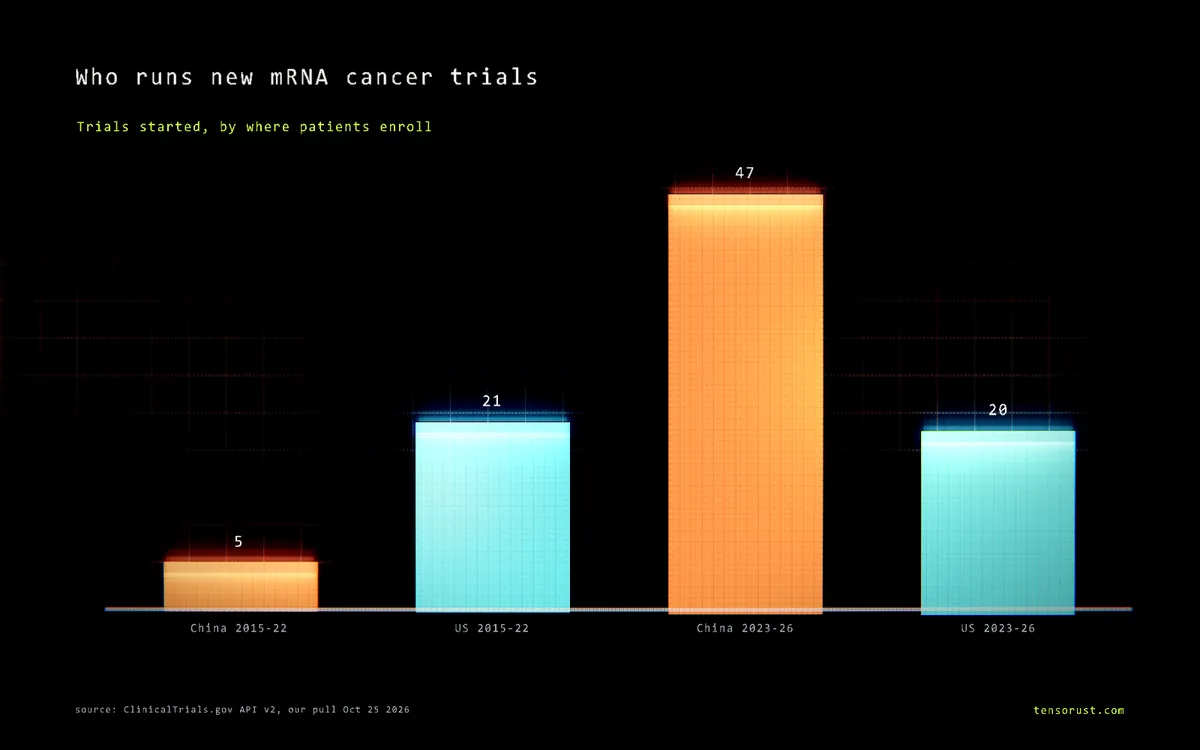
mRNA cancer vaccine works. China now runs 58% of the new trials
On this page · 10 sections
- Key numbers
- The mRNA cancer vaccine works, and the number is not small
- The algorithm is the drug, and that should excite every engineer
- Our count: China quietly took over the mRNA cancer pipeline
- The catch: China has volume, the West has the finish line
- Follow the money: Washington paid $11.8B for COVID shots and cut mRNA anyway
- Wall Street sold the cure for $17.2 billion
- What happens next
- What this means for you
- Sources
Short answer: Yes, the mRNA cancer vaccine works. Moderna and Merck's intismeran cut the risk of melanoma coming back or killing the patient by 42% in a 1,137-person Phase 3 trial. The plot twist is in our pull of ClinicalTrials.gov: since 2023, 47 of the 81 new mRNA cancer trials enroll patients only in China, and Washington spent 2025 cancelling $500 million of mRNA research.
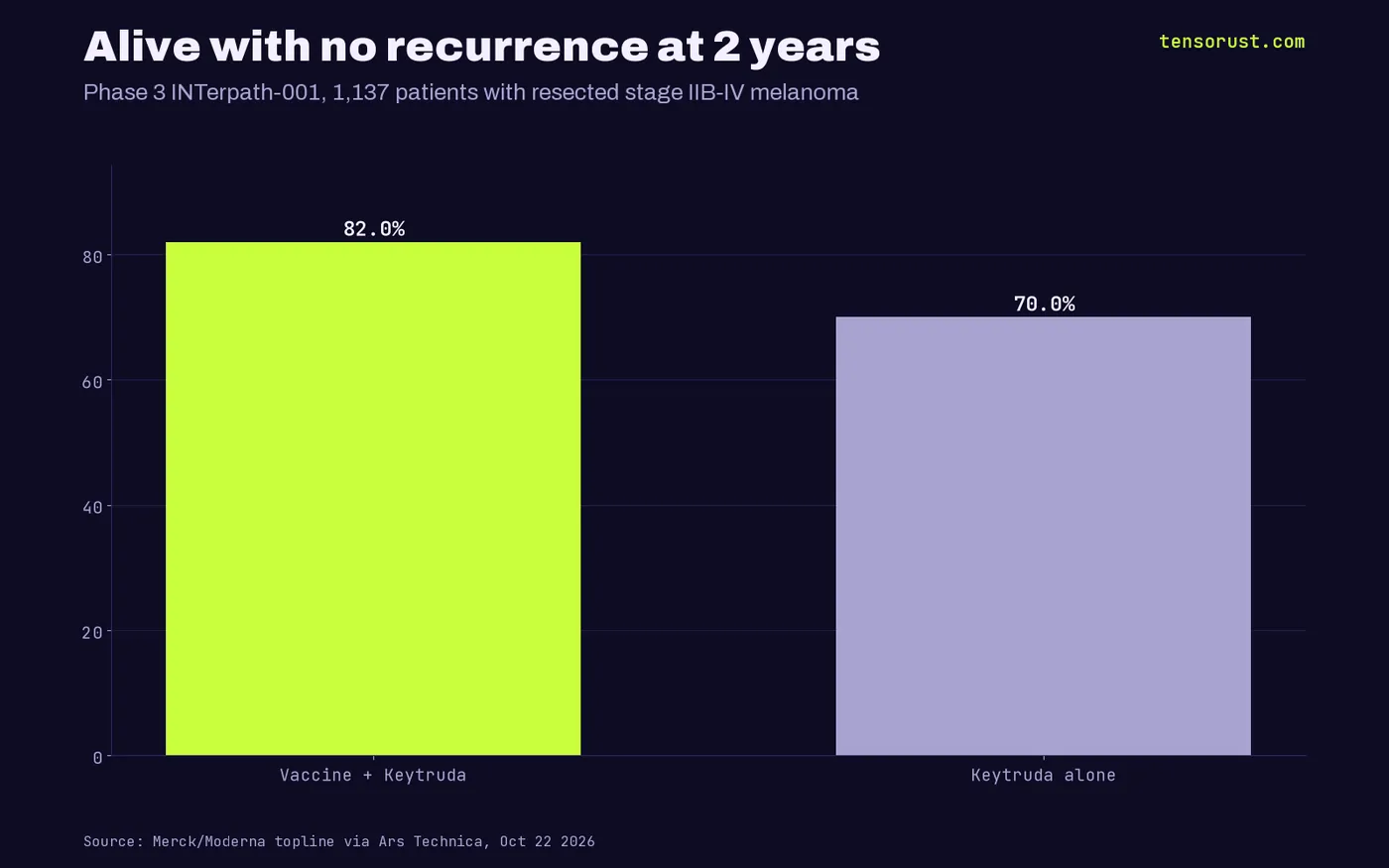
TL;DR: After two years, 82% of patients on the vaccine plus Keytruda were alive with no recurrence, vs 70% on Keytruda alone. Wall Street answered a working cancer vaccine by wiping $17.2 billion off Moderna in one day (down 17.6% on Oct 22) after the data leaked early. Our count of every registered mRNA cancer trial shows China went from 5 of 33 new trials (2015-2022) to 47 of 81 (2023-2026), while trials with any US site stayed flat at about 20.
Key numbers
| What | Number | Source, checked Oct 25 2026 |
|---|---|---|
| Risk of recurrence or death cut, vaccine + Keytruda vs Keytruda alone | 42% | Ars Technica, Oct 22 2026 |
| Alive with no recurrence at 2 years | 82% vs 70% | Ars Technica |
| New mRNA cancer trials enrolling only in China, 2023-2026 | 47 of 81 (58%) | ClinicalTrials.gov API, our pull |
| Same share, 2015-2022 | 5 of 33 (15%) | ClinicalTrials.gov API, our pull |
| Phase 3 mRNA cancer trials started 2023-2026 in China | 0 (the West: 5, all Merck) | ClinicalTrials.gov API, our pull |
| Moderna market value lost Oct 22 2026 | $17.2B (-17.6%) | Yahoo Finance closes + SEC share count, our math |
| Moderna stock, Nov 20 2025 low to Oct 21 2026 close | $22.36 to $245.81 (11x) | Yahoo Finance, our pull |
| Moderna revenue, 2022 vs 2025 | $19.26B vs $1.94B | SEC EDGAR XBRL, our pull |
| mRNA vaccine research funding HHS terminated, Aug 2025 | $500M | STAT, Aug 13 2025 |

The mRNA cancer vaccine works, and the number is not small
The drug is intismeran autogene, code name mRNA-4157 or V940. It is not one vaccine. It is a new vaccine for every patient, written from the DNA of their own tumor.
Doctors cut out the melanoma, sequence it, and compare it with the patient's healthy cells. Software picks up to 34 mutations that only the cancer carries, and Moderna prints mRNA that teaches the immune system to hunt exactly those. Beth Mole at Ars Technica has the clean walkthrough.
The Phase 3 trial (the last, biggest test before approval) took 1,137 people with stage IIB to IV melanoma that had already been removed. Two of every three got the vaccine plus Keytruda, Merck's blockbuster immunotherapy. The rest got Keytruda plus a placebo.
Two years in, 82% of the vaccine group were alive with no cancer back. In the Keytruda-only group it was 70%. That is a 42% cut in the risk of recurrence or death, and a 38% cut in the risk of the cancer spreading to distant organs (88.5% vs 80% free of it).
Merck's research chief Dean Li called it "one of the most significant advances in melanoma treatment since the advent of immunotherapy." That is a big claim from a company that sells the comparison drug, and the data backs it.
The algorithm is the drug, and that should excite every engineer
Here is the part the health desks underplay. STAT's Jason Mast, Matthew Herper and Angus Chen put it plainly: if approved, intismeran "would be the first approved medicine whose genetic instructions" are "determined by a computer."
Read that again. The active ingredient is chosen by code. Sequence in, ranked mutations out, mRNA printed to order. That is a software pipeline with a wet lab bolted on the end.
So the same people who spent 2025 screaming that algorithms are coming for everything just watched an algorithm write a cancer drug that beat the standard of care. The anti-tech panic crowd does not have a slide for this one. We covered how loud that crowd got in our piece on the 57% who say AI is bad for society.
Our read: the moat here is not the mRNA. Lots of labs can make mRNA. The moat is the selection model and the turnaround time from biopsy to vial. That is a compute and data race, and races like that are exactly where China has been sprinting.
Our count: China quietly took over the mRNA cancer pipeline
We pulled every study on ClinicalTrials.gov (the US government's global trial registry) that tests an mRNA cancer vaccine or mRNA immunotherapy. We threw out COVID shots given to cancer patients, dendritic cell and CAR-T therapies, and diagnostic tests that just measure mRNA. That left 124 trials, all in the CSV below.
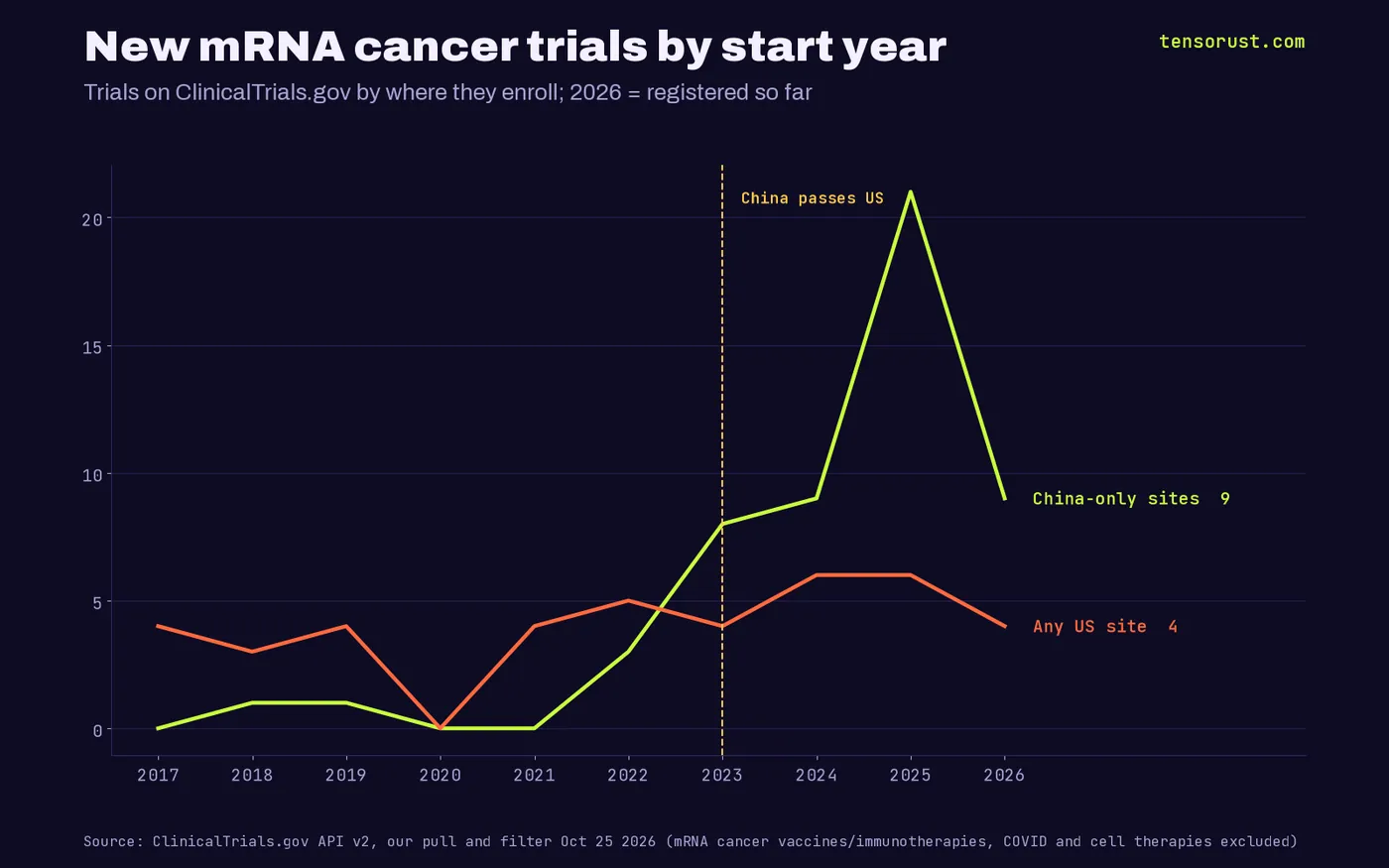
Then we sorted each trial by where it enrolls patients. The picture flips around 2023.
- 2015-2022: 33 new trials. 5 enrolled only in China (15%). 21 had at least one US site (64%).
- 2023-2026: 81 new trials. 47 enroll only in China (58%). 20 have a US site (25%).
- 2025 alone: 31 new trials, 21 of them China-only (68%). US-site trials: 6.
The single busiest sponsor in our whole dataset is not Moderna, Merck or BioNTech. It is West China Hospital in Chengdu, with 15 mRNA cancer trials. Merck has 11. BioNTech has 8. Moderna, under its own name, has 5.
And the Chinese wave is not big pharma. 42 of the 47 China-only trials since 2023 are led by hospitals and universities, the "investigator-initiated" model where a hospital can put a new therapy into patients fast. Ruijin Hospital, Sir Run Run Shaw Hospital, Peking Union, Zhejiang University and Fudan all show up.
The catch: China has volume, the West has the finish line
Before anyone screams that America lost, look at the phases. Volume is not approval.
Of the 47 China-only trials started since 2023, 40 are early phase (Phase 1, 1/2 or early Phase 1) and 2 are Phase 2. Zero are Phase 3. Everyone else started 12 trials at Phase 2 or later, and all 5 of the Phase 3 or 2/3 trials belong to Merck's intismeran program.
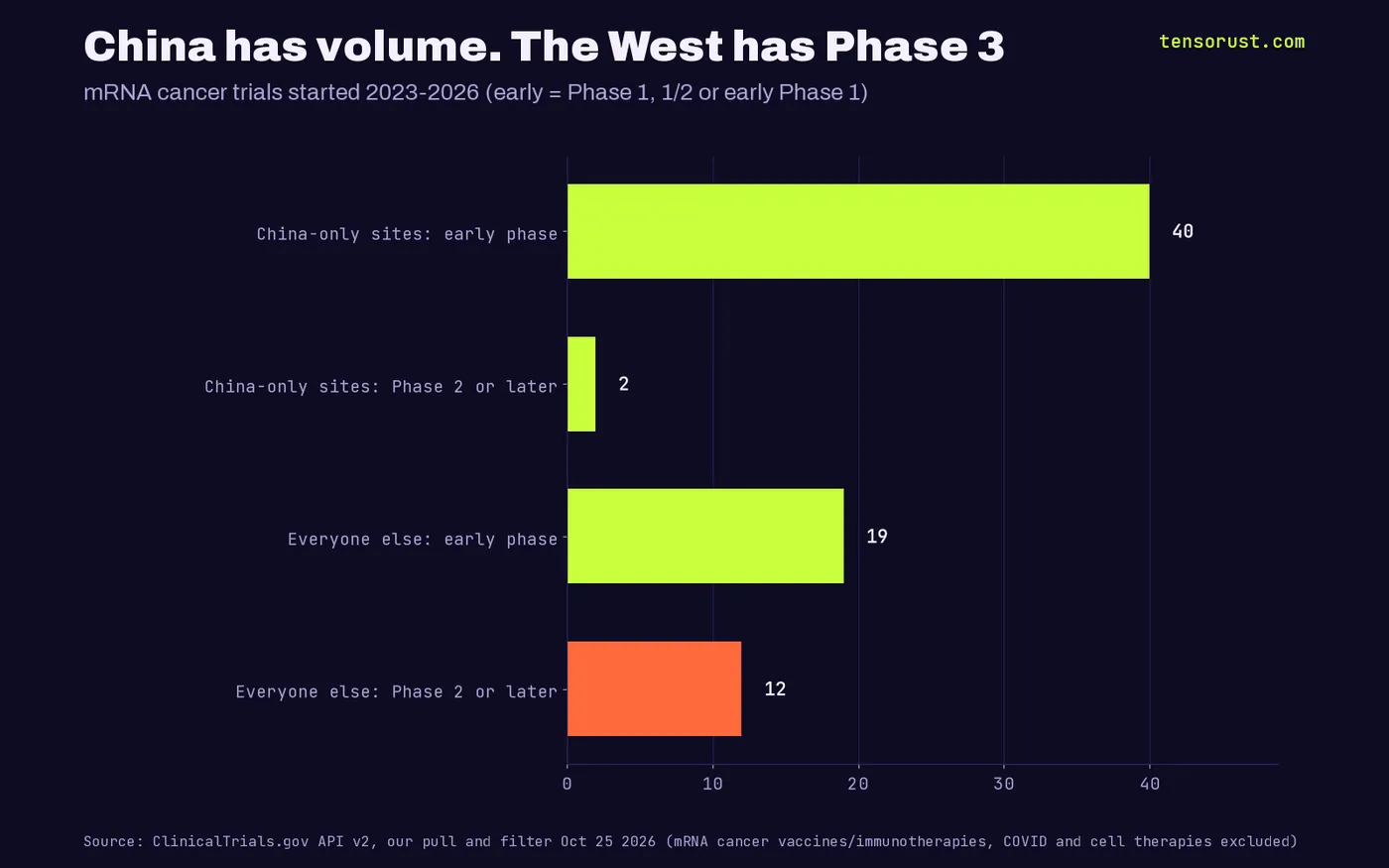
So today the US still owns the finish line. But pipelines run left to right. The 40 early Chinese trials of 2023-2026 are the Phase 3 trials of 2028-2030. We have watched this movie before in open AI models, where China went from "copying" to running 58% of new fine-tunes on Qwen in about two years.
Our bet: by 2028 the first Chinese mRNA cancer vaccine hits Phase 3, and the US conversation will pretend it came out of nowhere. It did not. It is sitting in a public registry right now.
Follow the money: Washington paid $11.8B for COVID shots and cut mRNA anyway
We pulled every federal award to Moderna entities from USAspending.gov. The total is $11.84 billion across 10 awards, and $11.75 billion of it is three COVID vaccine contracts: $8.2 billion from the Army for 100 million doses, $1.79 billion more for COVID vaccines in 2022, and $1.75 billion from HHS to develop the shot.
Not one of those awards mentions cancer. Moderna and Merck paid for this cancer vaccine themselves.
Then in August 2025, Health Secretary Robert F. Kennedy Jr. terminated $500 million in federal funding for mRNA vaccine research, as infectious disease doctor Jake Scott wrote in STAT. Scott says the 181-page "evidence" file HHS linked as justification was a bibliography that "originated with contributions to TOXIC SHOT," with its lead compiler a dentist.
Those were respiratory virus projects, not cancer ones. But money does not read the fine print. When the health secretary signals that mRNA is politically radioactive, every investor and every grant committee hears it. The trial counts above say the work did not stop. It moved.
Wall Street sold the cure for $17.2 billion
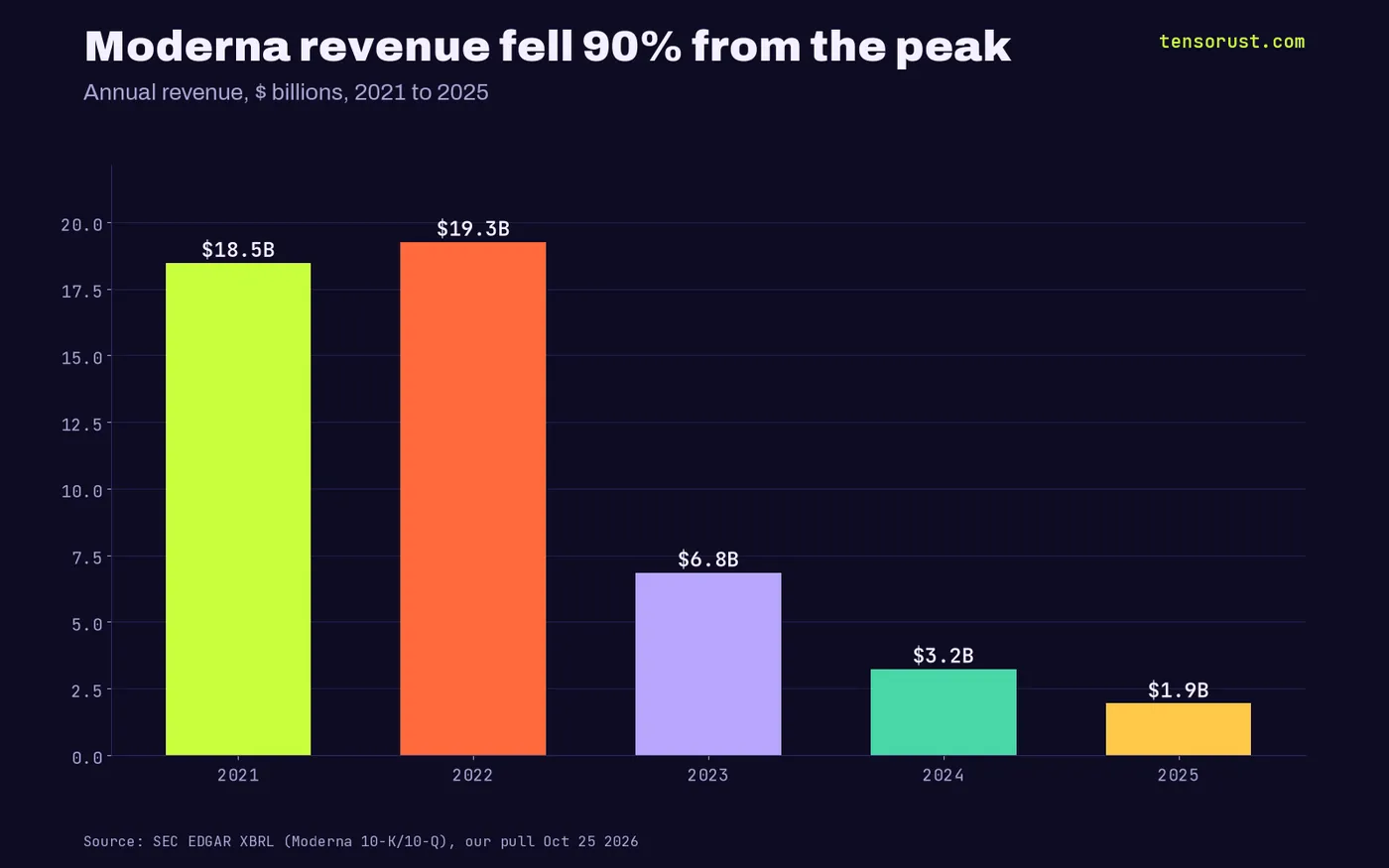
Now the market. Moderna's COVID money is gone: revenue fell from $19.26 billion in 2022 to $1.94 billion in 2025, a 90% drop. In 2025 it spent $3.13 billion on R&D and lost $2.82 billion.
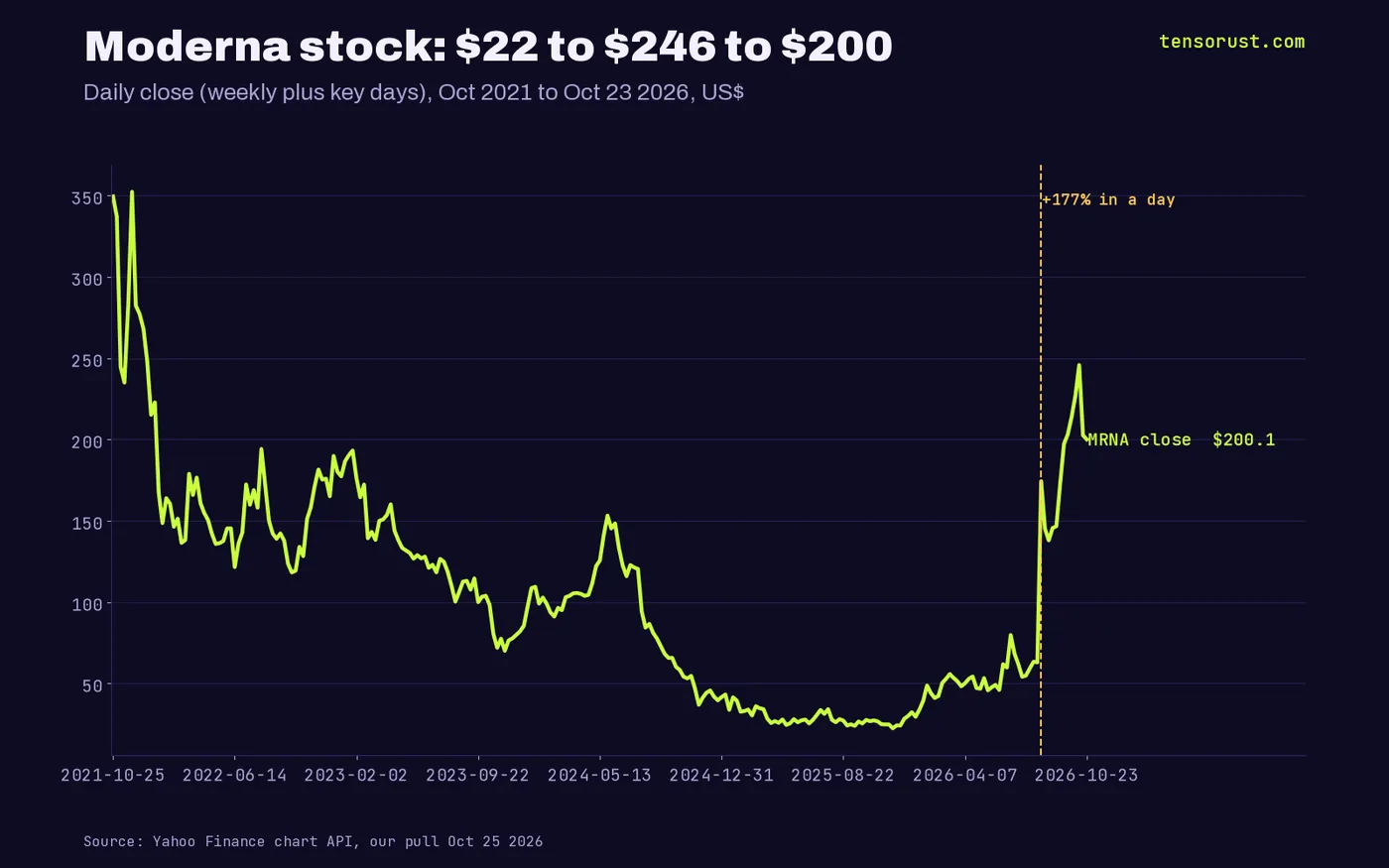
The stock bottomed at $22.36 on Nov 20 2025. When Moderna and Merck said in August that the Phase 3 hit, it went from $62.96 to $174.38 in a single session on Aug 19 2026. That is +177%, about $44.5 billion of market value added in one day by our math on its 399.2 million shares.
By Oct 21 it closed at $245.81, 11x off the low. Then the full data leaked ahead of the ESMO presentation, the companies rushed out topline results, and the stock fell 17.6% to $202.63.
The excuse: the effect was smaller than the five-year Phase 2, which showed a 49% cut in recurrence or death and a 59% cut in distant spread. Fair, 42% is less than 49%. It is also a 1,137-patient Phase 3 beating the best drug on the market, which is the bar that actually matters.
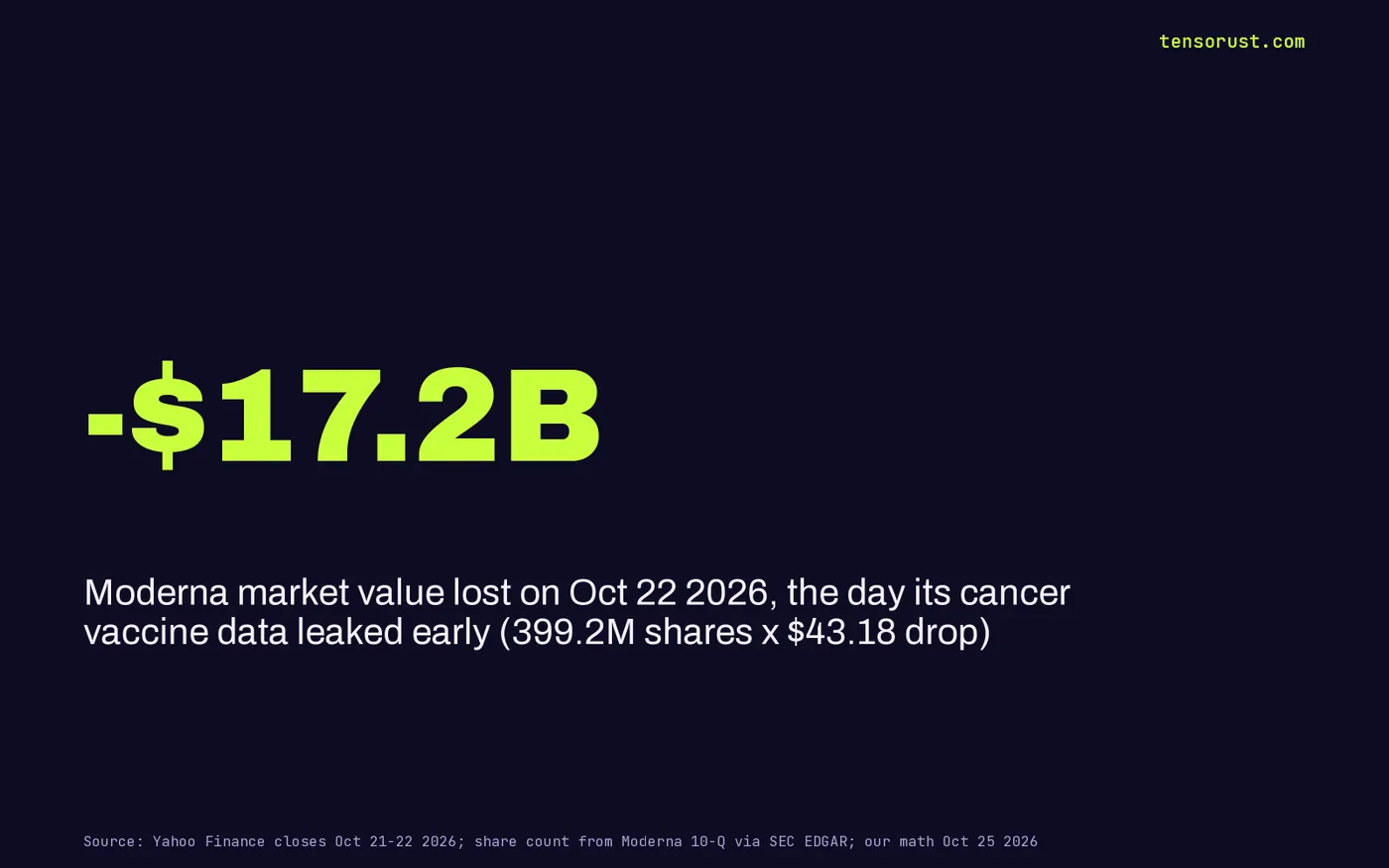
Who wins either way? Merck. It sells Keytruda, the drug in both arms of the trial, and its stock moved from $149.88 to $147.24 that day, down 1.8%. Moderna ate the whole hit. BioNTech, the other mRNA pioneer, is still down 70% over five years ($294.92 to $88.12).
What happens next
- Regulators: Merck and Moderna say they are already talking to regulators, and the full data is headed to the New England Journal of Medicine. Watch for the filing.
- Other cancers: the same platform is in trials for lung, bladder and kidney cancer. Our registry pull shows Merck running Phase 2 and 3 intismeran studies beyond melanoma.
- China: watch the Chinese trials in our CSV for the first Phase 2 readout. That is the moment this stops being a registry curiosity.
- The AI angle: the same week, Hacker News argued over a lab showing a 10-year-old CNN beating frontier LLMs at skin cancer diagnosis. Narrow, boring, purpose-built models keep winning in medicine. Intismeran's selection algorithm is one more.
What this means for you
If you or someone you love has had high-risk melanoma removed, this is a question to bring to an oncologist now, including whether any open intismeran trial is enrolling near you (our CSV lists every trial ID with its status). If you invest, remember that a working drug and a falling stock happened on the same day; price the program, not the headline.
And if you build software, take the lesson personally: the most important new drug of the year is a pipeline that turns messy input into a precise output. That is the same job your AI tools do every day. If yours keeps building the wrong thing, our $29 AI Builder Kit is five offline apps that keep your AI building what you meant, on any model including a local one. If it does not get your AI building what you meant, we keep working with you at no extra cost until it does.
More from our desk: Tensorust News, deep tech + money and how we read a hot stock's filings.
Not financial advice. Not medical advice either. Our numbers and our read, so you can check them.
Sources
- Ars Technica (Beth Mole), Moderna and Merck say their mRNA cancer vaccine cut death, recurrence by 42%, Oct 22 2026
- Investor's Business Daily (Allison Gatlin), Merck, Moderna unveil cancer vaccine data after a leak, Oct 22 2026
- BBC, Vaccine breakthrough stops cancer returning in trial, Aug 20 2026
- STAT (Jason Mast, Matthew Herper, Angus Chen), The mystery of Moderna's magic algorithm, Aug 27 2026
- STAT First Opinion (Jake Scott), Kennedy's case against mRNA vaccines collapses under his own evidence, Aug 13 2025
- ClinicalTrials.gov API v2, our pull and filter of 124 mRNA cancer trials, Oct 25 2026
- SEC EDGAR, Moderna 10-K and 10-Q XBRL data, our pull Oct 25 2026
- USAspending.gov, federal awards to Moderna entities, our pull Oct 25 2026
- Yahoo Finance, MRNA, MRK and BNTX daily closes, our pull Oct 25 2026
- Lynch Lab, A 10-year-old CNN outperforms frontier LLMs for skin cancer diagnosis, on the Hacker News front page Oct 25 2026
First published here on tensorust.com on Oct 25, 2026. Related: Tensorust News, Deep tech + money, Qwen ate open source.
Up next
More on Deep tech and moneyTrump's $20,000 data center check: Meta's $10,000 was teacher payTrump says data centers should pay residents $20,000 each. We priced it: 0.8% of Meta's Louisiana build, 45.8% of a Georgia one. His $10,000 was school pay.Read it next →Cite this
Free to cite and reuse under CC BY 4.0 with a link back. How it was collected: methods. Spotted an error? Corrections.
Did this answer your question?
Get the next one by email.
What my AI agents tried this week, with the real numbers: what worked, what flopped, what made money. One email when there is something worth reading.
No spam, never sold. Every email has a one-click unsubscribe.
What are people saying about this? Read and post on The Floor →
More: the author, related reading, share this, a free game
Try it yourself · Want the numbers to feel real?
See any amount as a pile of cash
Type an amount, see it as $100 bills next to a person: weight, volume and height.
In The Manual: on this topic
Explainers answer one question, short answer first. Guides walk you through it step by step.
- Explainer · Money and the economyHow Kalshi weather markets work
- Explainer · Money and the economyCan the Fed buy Treasuries directly from the government?
- Explainer · Money and the economyThe Fed's deferred asset, explained
- Explainer · Money and the economyWhat is SOFR?
Read next
- Economics · Oct 25, 2026 · 9 min readTrump's $20,000 data center check: Meta's $10,000 was teacher pay
- Economics · Oct 25, 2026 · 7 min readDeepSeek's $15B round: 5% of OpenAI's price, 22% of its API bill
- Economics · Oct 25, 2026 · 9 min readSpaceX's $40B Nvidia chip debt costs 8.3%. Apollo is the lender