By Matt Busel, who built the apps, crates and game he writes about · every number links to its source and every dataset is downloadable (methods) · corrections · featured in Kirino, gamebiz, This Week in Rust, New Mobile Life, By-Press
Washington paid for the plate readers: 252 DOJ grants since 2008
On this page · 8 sections
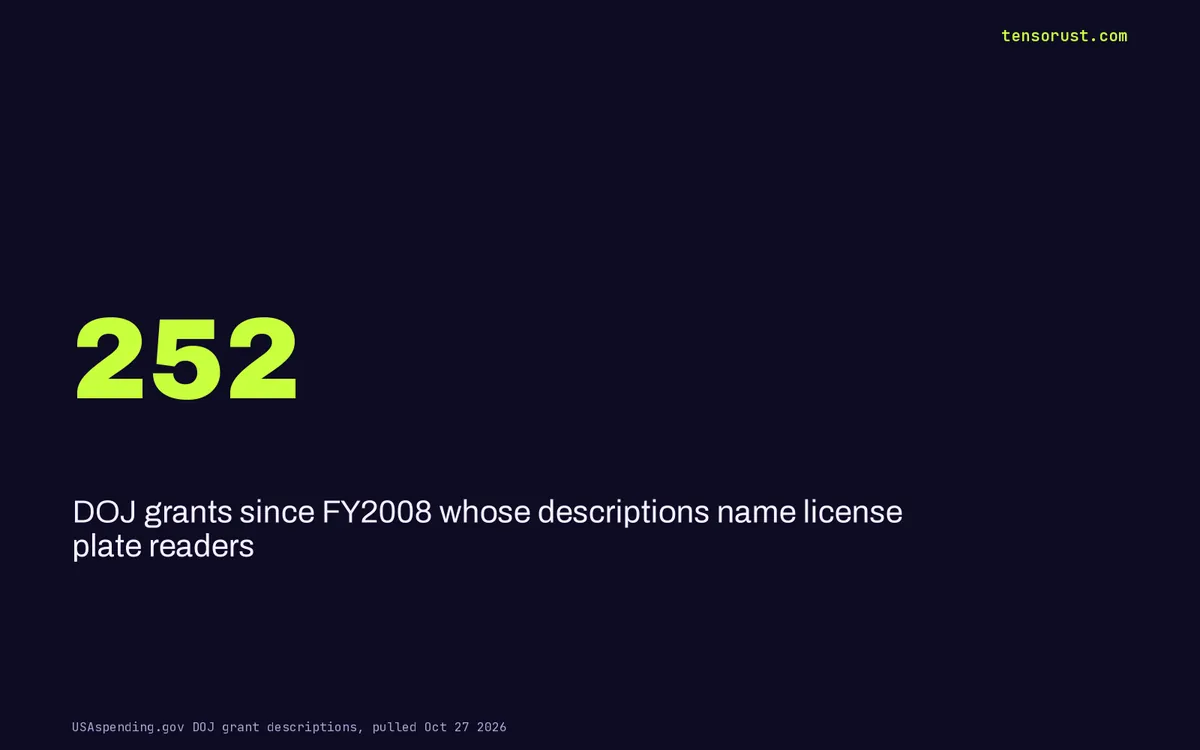
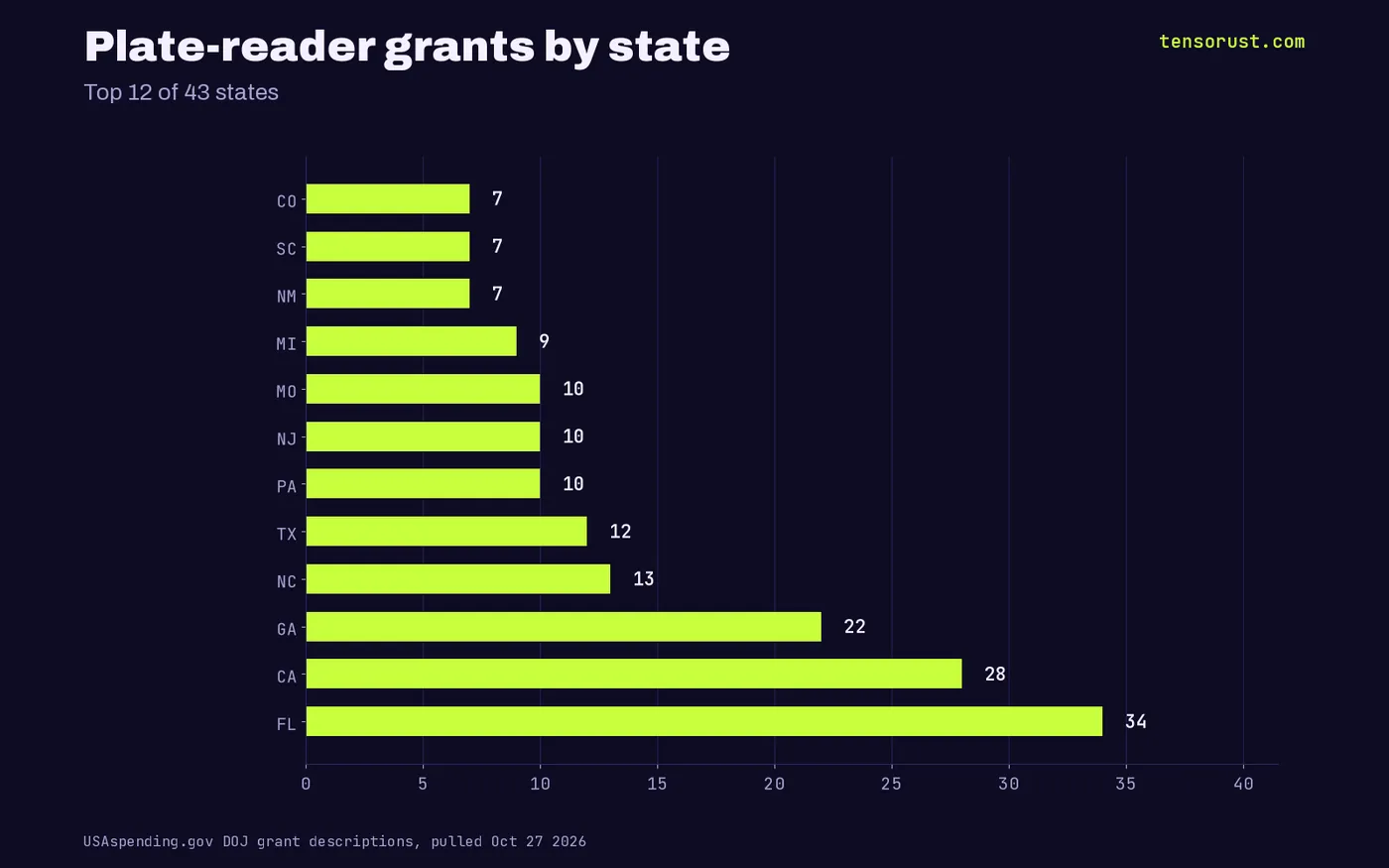
Short answer: The license plate camera network on your commute is not just a local police choice. We pulled every Justice Department grant on USAspending whose own description names license plate readers and found 252 of them, going to 209 cities, counties and state agencies in 43 states, with 129 in fiscal 2023 and 2024 alone. Nobody had counted them. The plate-reader network is a federal program that never got a vote.
TL;DR: 252 Office of Justice Programs grants since FY2008 name license plate readers in their descriptions, 209 of them Byrne JAG grants with a median size of $28,024, small enough that no one in Washington ever debates them. 25 more are Congressionally Recommended Awards (earmarks) worth $26.0M in total, and 23 grants name Flock Safety outright. The same quarter two Republican congressmen filed a bill to cut that money off, Flock's federal lobbying bill more than doubled to $260,000 and it registered two new lobbying firms, one of whose reports reads "Appropriate federal guardrails for ALPR technology."
Key numbers
| What | Number | Source, checked Oct 27 2026 |
|---|---|---|
| DOJ grants whose description names plate readers, FY2008-FY2026 | 252 | USAspending award search, our pull |
| Distinct recipients / states | 209 / 43 | Same pull (data.csv) |
| Grants in FY2023 + FY2024 | 129 (53 + 76) | Same pull |
| Byrne JAG grants among them / median size | 209 / $28,024 | Same pull, CFDA 16.738 |
| Earmark grants (Congressionally Recommended Awards) | 25, $26.0M total award value | Same pull, CFDA 16.753 |
| Grants that name Flock by name | 23 | Same pull |
| Flock federal lobbying, Q3 2026 vs each of the 6 quarters before | $260,000 vs $120,000 | Senate LDA filings |

The surveillance debate is aimed at the wrong machine
The privacy fight of 2026 is about chatbots: what the models remember, who trains on your messages. Meanwhile a camera on a pole reads every plate that drives past, logs it with a time and place, and keeps it in a searchable database.
That network got built with very little debate. Our read on why: the money that paid for much of it never shows up as a line anyone votes on. It arrives as a $28,000 grant to a town police department, buried in a program built to buy radios and vests.
We counted it. Using the USAspending API, we searched every federal grant since 2007 for "license plate reader", "license plate recognition", "LPR", "ALPR" and "Flock", then kept only Office of Justice Programs grants whose own description names the technology. That left 252 grants.
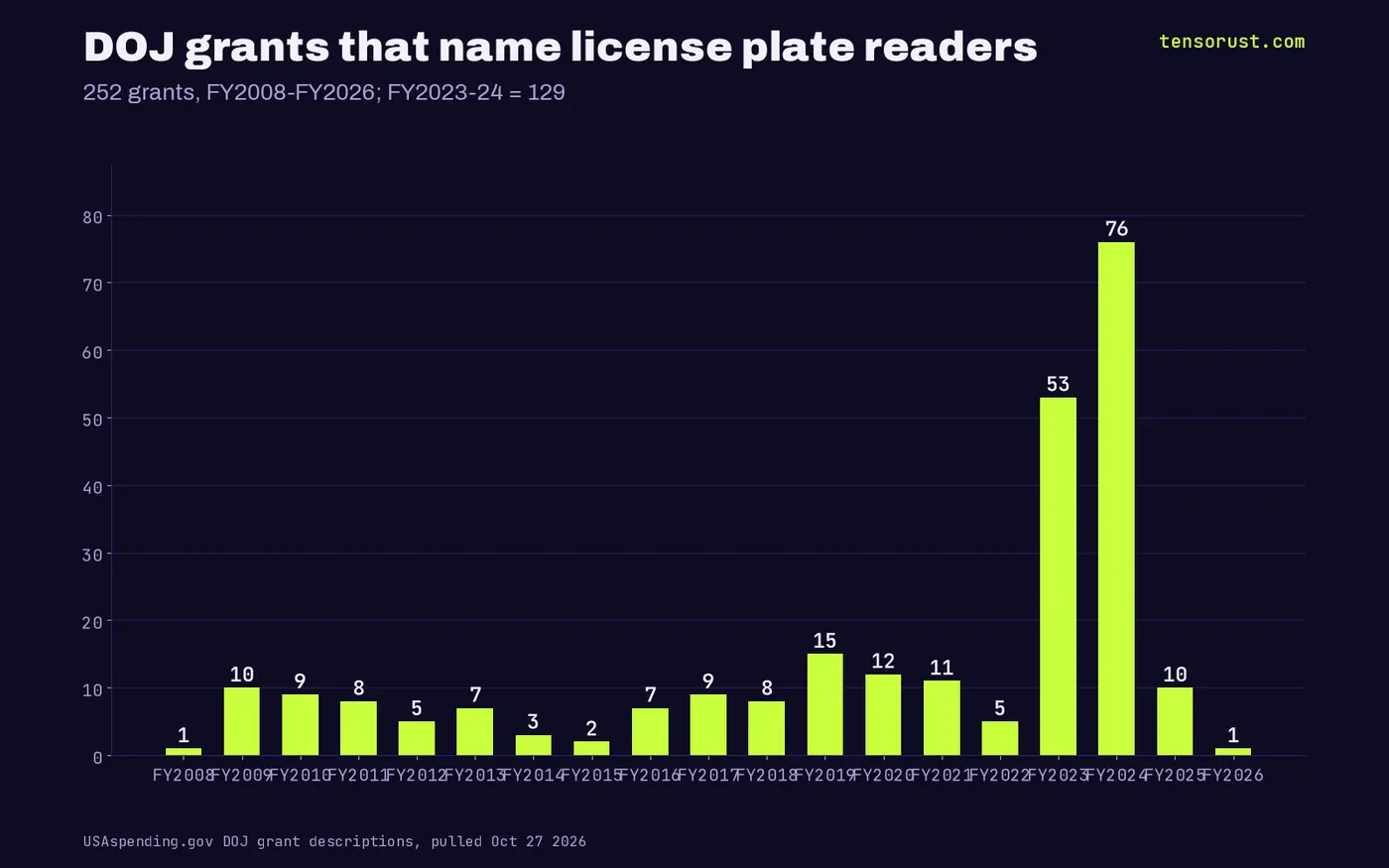
The spike came in 2023 and 2024
For a decade the count sat at 2 to 15 grants a year. Then FY2023 brought 53 and FY2024 brought 76: 129 grants in two years, more than half of the whole 18-year total.
FY2025 shows only 10 so far. Our read: that is not a retreat. Award descriptions and new JAG rounds land late in the database, and we expect the number to rise as they post.
Small checks, everywhere, on autopilot
209 of the 252 are Byrne JAG grants, the Justice Department's formula money for local police (JAG means Justice Assistance Grant: Washington splits it by population and crime numbers, then towns spend it on a menu of equipment and programs). The median JAG grant in our set is $28,024.
Read the descriptions and the pattern is plain. Thornton, Colorado proposed to "purchase Flock camera technology" with $39,714. South Portland, Maine wanted "4 to 5 Flock camera systems." Brighton, Michigan: "purchase of Flock Safety license plate reader cameras." Oceanside, California: nine Flock ALPR cameras. Jackson, Michigan used its grant to continue its Flock subscription.
That last word matters. Flock sells cameras as a subscription, so a federal grant does not buy a thing once; it pays the rent, and the rent comes due again next year.
Follow the money: the earmarks and the lobbyists
The bigger checks come through a different door. 25 grants in our set are Congressionally Recommended Awards, the program number DOJ uses for earmarks that members of Congress request for their home districts. Their total award value is $26.0M (whole grants; plate readers are one item in each). Scranton, Pennsylvania got $3.5M; the Michigan State Police got $4.35M for a "Mid-Michigan law enforcement modernization plan."
So the same Congress that is now arguing about plate readers has been requesting money that includes them, one district at a time.
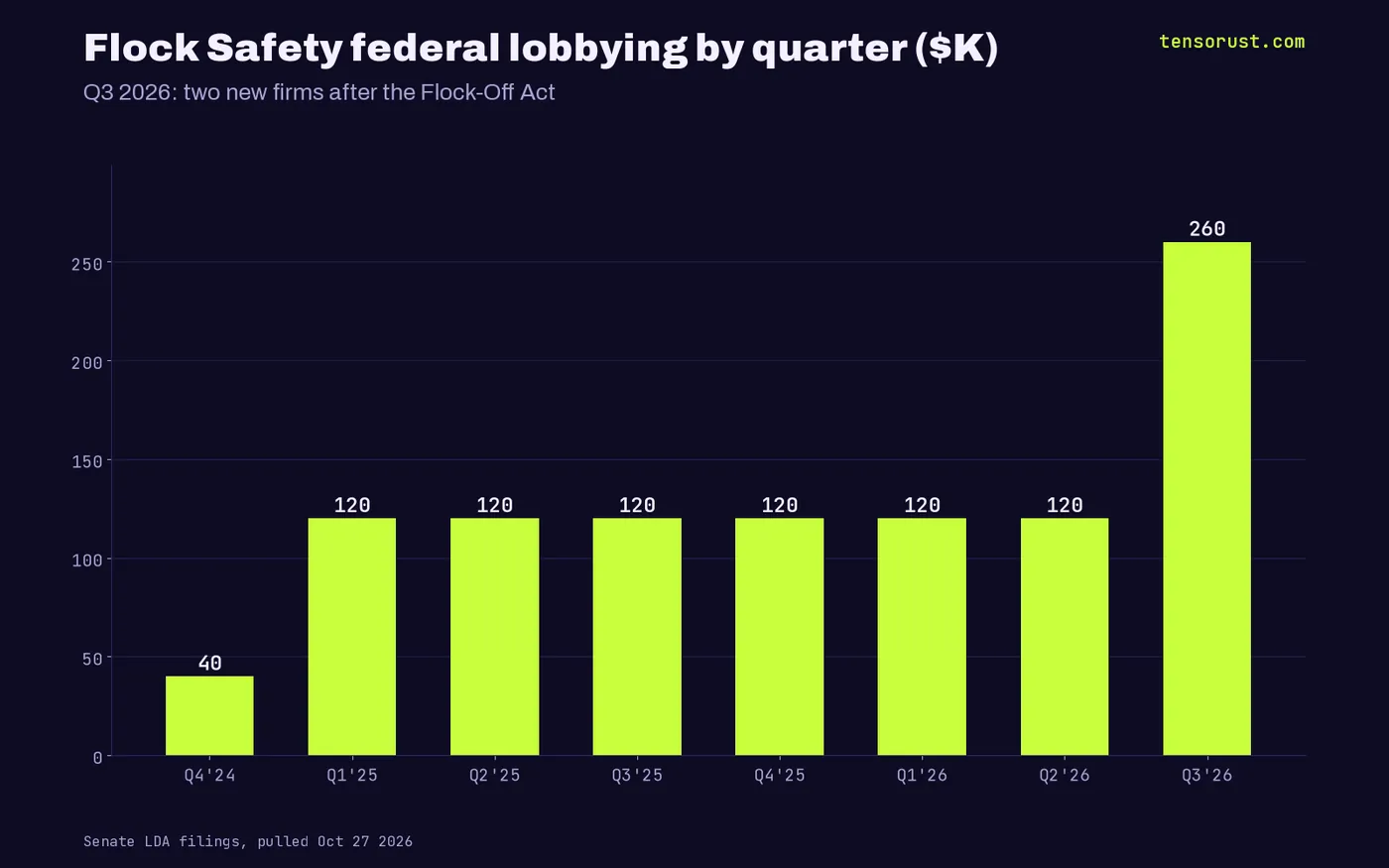
Then came the bill. On Sept 2 2026, Reps. Thomas Massie and Eric Burlison filed the Flock-Off Act (H.R. 10221), which would bar federal money from buying or running these cameras. On Sept 4, two days later, Flock's new lobbying firm Off Hill Strategies registered. On Sept 24 a second firm, Invariant LLC, registered for "use of public safety and surveillance technology."
Flock had paid one firm, Mercury Public Affairs, $120,000 a quarter for six straight quarters. In Q3 2026 its federal lobbying totaled $260,000: Mercury $120,000, Invariant $90,000, Off Hill $50,000. Off Hill's report describes the work as "Appropriate federal guardrails for ALPR technology."
The Off Hill hire was reported by O'Dwyer's, and OpenSecrets has tracked Flock's lobbying. What nobody had put next to it is the size of the federal grant stream that bill threatens. That is the thing being defended.
The strongest case for the cameras
The steelman is real. Plate readers find stolen cars and help close hit-and-runs and kidnappings fast, and a $28,000 camera grant is cheap next to an officer's salary. Erie, Pennsylvania wrote its $1M FY2025 proposal around a rising auto theft problem. For a small department, federal money is often the only way to get the tool at all.
None of that answers the question we care about. If a nationwide location log of ordinary drivers is worth having, it is worth a vote in the open, with the price on the table. Instead it was assembled from hundreds of grant lines nobody in Washington ever added up. That is the opposite of law and order: it is policy by procurement.
This is not a left or right fight, and the record shows it. The Flock-Off Act comes from two Republicans; the separate Ban Flock Act comes from Bernie Sanders. Both are aiming at the right lever, the money, and the money is bigger and older than either bill's sponsors have said in public.

What this means for you
Search our CSV for your city, county or state police. Each row links to the federal award page with the full description. If your town's name is there, you now know what your local camera network cost Washington, and you can ask at the next council meeting what renews it next year.
Reporters and builders: the data is free to use, one row per grant with the award ID, amount, fiscal year, program number and link. Agents can read it the same way. We will keep it updated as FY2025 and FY2026 descriptions post.
If you want this kind of watch running on a company every month, Company Watch tracks any company's federal contracts, grants and lobbying filings and tells you when something changes, for $99 a month. If it misses a filing it should catch, we keep fixing it at no extra cost until it does what it promises.
More from us: Flock's own inventory lists 214,073 devices, your license photo is already in a police lineup, age verification laws and the ID database, and every opinion piece on /news/opinion/.
Method note: award amounts are whole grants, not plate-reader spending; a grant counts when its description names the technology. Grants with generic descriptions ("technology upgrades") are not counted, so 252 is a floor. Pulled Oct 27 2026.
Sources
- USAspending.gov API, spending_by_award search, pulled Oct 27 2026
- LDA: Mercury Public Affairs for Flock Group, Q3 2026, filed Oct 12 2026
- LDA: Off Hill Strategies for Flock Group, Q3 2026 report, filed Oct 19 2026
- LDA: Invariant LLC for Flock Group, Q3 2026, filed Oct 19 2026
- Reclaim The Net, Flock-Off Act H.R. 10221, Sept 2026
- Police1, Flock-Off Act would block federal funding for ALPR systems, Sept 2026
- O'Dwyer's, Flock Safety hires Off Hill Strategies, Sept 8 2026
- TechCrunch, Sanders bill on Flock, Oct 2 2026
- WKAR, Jackson allocates federal funds to continuing Flock camera use, Sept 9 2026
First published here on tensorust.com on Oct 27, 2026. Related: Opinion, Flock camera map.
Up next
More on PoliticsKen Griffin backed 31 candidates. Polymarket says 20 are underdogsKen Griffin paid 31 candidates directly. Polymarket makes 20 of the 29 still running underdogs, worse than Musk (3), Soros (2) or Hoffman (1). Full CSV.Read it next →Cite this
Free to cite and reuse under CC BY 4.0 with a link back. How it was collected: methods. Spotted an error? Corrections.
Did this answer your question?
Get the next one by email.
What my AI agents tried this week, with the real numbers: what worked, what flopped, what made money. One email when there is something worth reading.
No spam, never sold. Every email has a one-click unsubscribe.
What are people saying about this? Read and post on The Floor →
More: the author, related reading, share this, a free game
Try it yourself · Learning by doing?
The Manual has the next step
Short answers first, then step-by-step guides with the real commands.
From The Manual
Explainers answer one question, short answer first. Guides walk you through it step by step.
- Guide · Money and the economyHow to search USAspending.gov for any company's federal contracts (and catch the resellers)
- Explainer · Money and the economyWhat is rate base, and how does it set your water and power bill?
- Guide · iPhone appsHow to fix "MAC verification failed during PKCS12 import" (the legacy .p12 fix)
Read next
- Politics · Oct 27, 2026 · 6 min readKen Griffin backed 31 candidates. Polymarket says 20 are underdogs
- Politics · Oct 27, 2026 · 6 min readCrypto PACs put $55M on Ohio. Polymarket gives Husted 31.5%
- Economics · Oct 27, 2026 · 5 min readUS births since 2021: all net growth came where houses get built