
By Matt Busel, who built the apps, crates and game he writes about · every number links to its source and every dataset is downloadable (methods) · corrections · featured in Kirino, gamebiz, This Week in Rust, New Mobile Life, By-Press
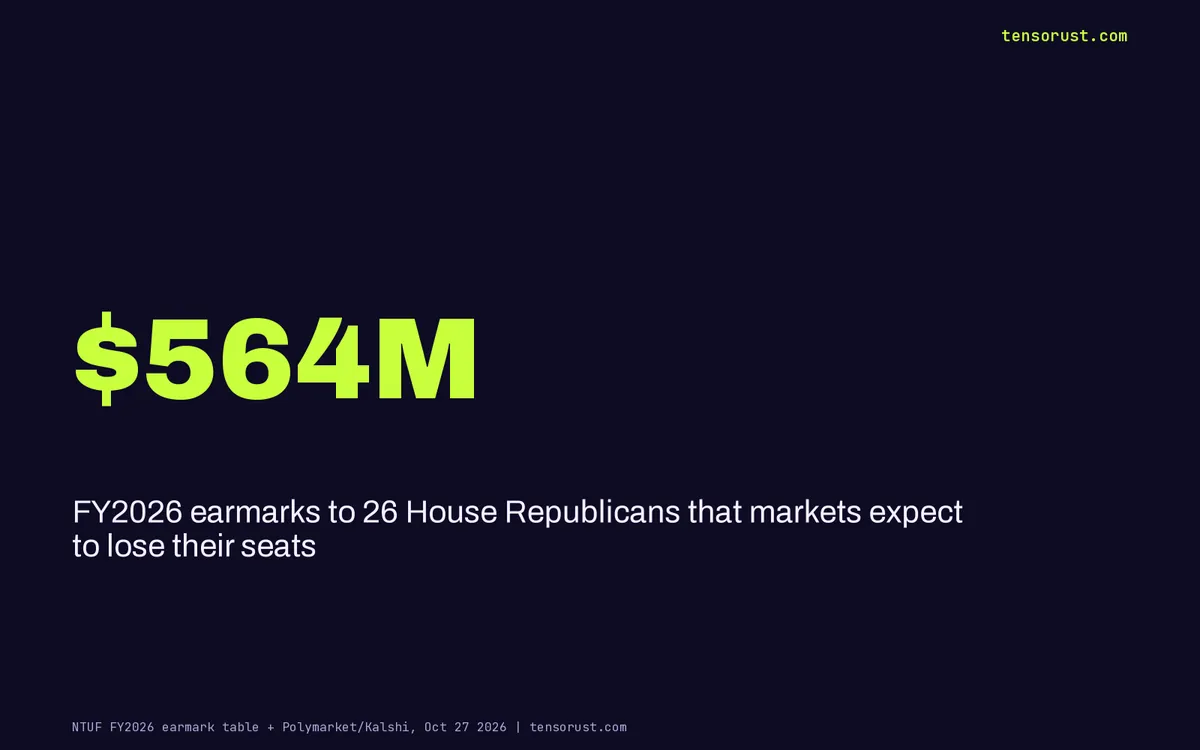
House Republicans Polymarket says will lose took $564M in earmarks
On this page · 9 sections
- Key numbers
- The swing-seat money went to the seats now priced to flip
- Kiggans: a harbor, a highway and a 9% market
- Follow the money: vulnerable members got more, not less
- Democrats in redrawn seats got the same treatment
- The whole House, side by side
- How we counted, and what it does not say
- What this means for you
- Sources
Short answer: Congress wrote $564 million in FY2026 earmarks for 26 House Republicans whose seats the betting markets now expect the GOP to lose on November 3. Jen Kiggans (VA-2) leads with $93 million and a 9% Polymarket chance her party holds the seat. Earmarks were sold as the incumbent's shield. The markets say the shield is paper.
TL;DR: We took all 7,611 earmarks in the seven enacted FY2026 bills that the National Taxpayers Union Foundation compiled, credited each one to its House requestors, and joined every member to a live Polymarket or Kalshi seat market on Oct 27. The 26 Republicans in seats priced under 50% were credited $564.1 million, and their median haul ($16.7M) beats the median safe-seat Republican ($13.9M). Seven Democratic underdogs, most of them in freshly redrawn Southern seats, took another $100.5 million.
Key numbers
| What | Number | Source, checked Oct 27 2026 |
|---|---|---|
| FY2026 earmarks in the seven bills | 7,611 worth $14.35B | NTUF earmark table |
| Dollars credited to a sitting House member | $7.87B | Our join, NTUF + congress-legislators |
| Earmarks to 26 GOP members whose seat is under 50% | $564.1M (233 projects) | Our join + Polymarket/Kalshi |
| Median GOP haul: underdog seat vs safe seat (90%+) | $16.7M vs $13.9M | Our join |
| Top: Jen Kiggans, VA-2 | $93.0M, GOP 9% to hold | Polymarket VA-02 market |
| Earmarks to 7 Democratic underdogs | $100.5M | Our join + Kalshi/Polymarket |

The swing-seat money went to the seats now priced to flip
Earmarks came back in 2021 with a quiet pitch inside both caucuses: let vulnerable members bring home ribbon-cuttings. Roll Call has tracked how endangered incumbents campaign on their earmark totals. Nobody had put the final FY2026 numbers next to what traders are now paying for each seat.
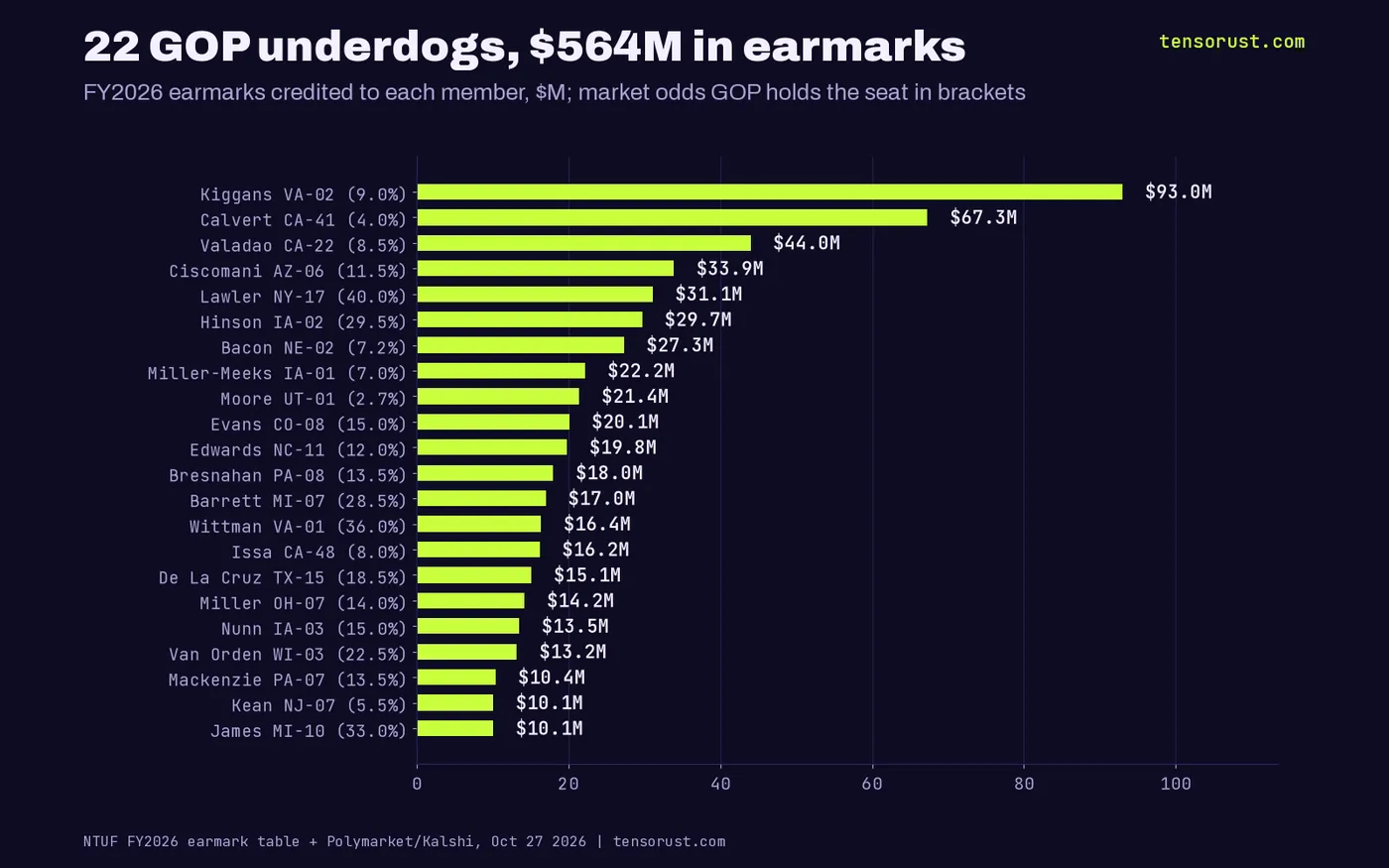
We did. Of the 26 House Republicans whose party is below 50% to keep their seat, 22 have FY2026 earmarks in these seven bills, and together they were credited $564.1 million across 233 projects.
The top of the list reads like the DCCC's target memo: Kiggans $93.0M (9%), Ken Calvert CA-41 $67.3M (4%), David Valadao CA-22 $44.0M (8.5%), Juan Ciscomani AZ-6 $33.9M (11.5%), Mike Lawler NY-17 $31.1M (40%), Ashley Hinson IA-2 $29.7M (29.5%) and Don Bacon NE-2 $27.3M (7.2%, retiring).
Kiggans: a harbor, a highway and a 9% market
Most of Kiggans's number is one line: $75.6 million for the Army Corps' Norfolk Harbor project, requested with Senators Tim Kaine and Mark Warner. Add $10 million for the I-264 and Independence Boulevard interchange and smaller sewer and road jobs, and she is the single biggest earmark earner among Republicans the market is writing off.
Calvert, the Defense appropriations chairman, shows up through the Transportation-HUD bill: 15 projects, from $8 million for Lake Elsinore water quality to a $5 million French Valley airport tower. California's new map moved his seat, and Polymarket now gives the GOP 4%.
Valadao's $44 million is mostly water and housing in Kern County: $8.1 million for a Delano water plant, $7.6 million for senior housing. His seat sits at 8.5%.
Follow the money: vulnerable members got more, not less
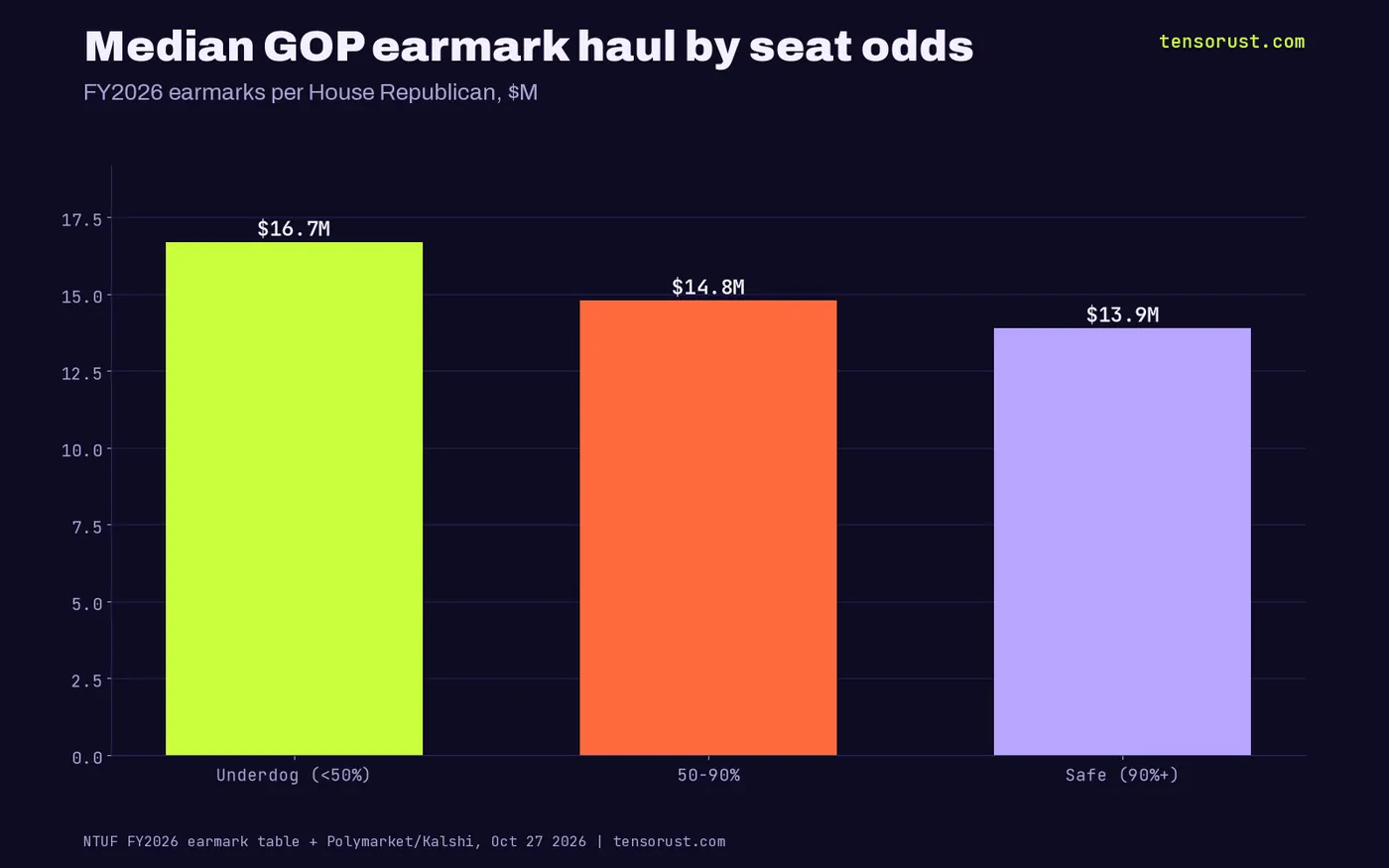
If earmarks were just seniority, the underdogs would trail. They do not. The median Republican in an underdog seat was credited $16.7 million. Republicans in 50-90% seats: $14.75 million. Republicans in 90%+ safe seats: $13.9 million.
The giant single numbers still sit with cardinals and the safe: Brian Mast's $475.6 million is almost all the $461 million South Florida Ecosystem Restoration line, and appropriators Chuck Fleischmann ($247.8M), Hal Rogers ($134.0M) and Tom Cole ($111.1M) all sit above 96%. But the typical swing-seat member was fed above the typical safe one. Leadership did its part. It is not moving the market.
Democrats in redrawn seats got the same treatment
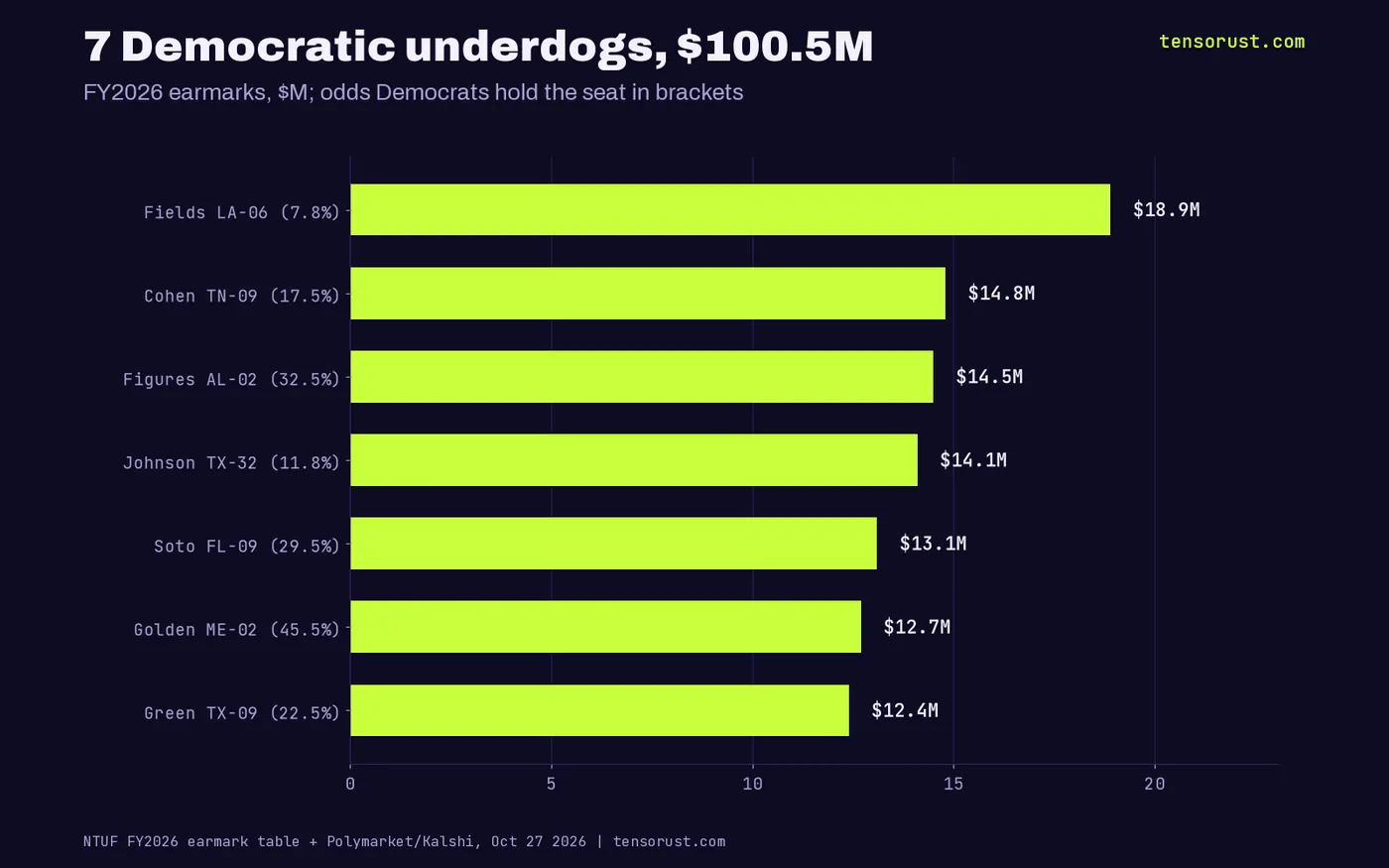
This is not a one-party habit. Seven Democrats whose party is under 50% to hold the seat were credited $100.5 million: Cleo Fields LA-6 $18.9M (7.8%), Steve Cohen TN-9 $14.8M (17.5%), Shomari Figures AL-2 $14.5M (32.5%), Julie Johnson TX-32 $14.1M (11.8%), Darren Soto FL-9 $13.1M (29.5%), Jared Golden ME-2 $12.7M (45.5%) and Al Green TX-9 $12.4M (22.5%).
Most of those are map changes, not voter anger: new lines in Louisiana, Tennessee, Alabama, Texas and Florida. The projects were written for districts that, on these maps, will belong to someone else next January.
The whole House, side by side
Zoom out and the split by party is narrower than the talking points. Of 439 current House seats in our member table, 378 members were credited at least one earmark in these seven bills. The median Republican came out at $14.6 million, the median Democrat at $13.4 million.
The gap opens at the top, where Republicans hold the gavels, and in the swing seats, where leadership has a reason to spend. Both of those groups sit inside the $564 million number. That is the trade this cycle tests: a water tank or a bridge back home against a national wave: Polymarket gives Democrats 91.5% to take the House.
Our bet: on November 4 most of these 26 seats change hands anyway, and the earmark-as-armor theory takes its biggest hit since the 2021 revival. If the incumbents hold, the markets were wrong and the projects worked. Either way, the CSV scores itself on election night.

How we counted, and what it does not say
The NTUF table covers the seven bills it compiled (CJS, Energy-Water, Interior, Financial Services, Homeland, Labor-HHS, Transportation-HUD), not Agriculture, MilCon-VA or Legislative Branch. When several House members shared a project, we split it evenly; Senate co-requestors were not subtracted, which is how most member tallies work and why Norfolk Harbor counts fully for Kiggans. Members who left the House (Sherrill, Connolly, Greene and others, about $169 million) are not in the member table.
Odds are the market's chance that the member's party holds the seat, not that the member personally wins: Bacon is retiring and Hinson is running for Senate. Kalshi seat markets covered 349 members, Polymarket filled 83 more, and 7 had no market. Earmarks are legal and public. Nothing here says a project is wasteful or that anyone broke a rule; it says the money and the odds point in opposite directions.
What this means for you
If you live in one of these 33 districts, the projects are already funded: the money follows the project, not the member. Open the CSV, find your district, and check the recipient's name on USAspending as the grants post. Pay attention to who claims the ribbon-cutting in 2027. If you build in civic data, the CSV is machine-readable: member, district, earmark dollars, seat odds, market link.
Want this kind of trail on a company instead of a congressman? Company Watch flags federal contracts, grants, lobbying and SEC filings as they land for $99 a month, and we keep fixing it at no extra cost until it does what it promises.
More from the politics desk: Ken Griffin's underdog slate, House odds vs FEC money, all politics pieces and the news desk.
Not financial advice: market odds are prices, not predictions we vouch for, and nothing here is a recommendation to trade any contract.
Sources
- National Taxpayers Union Foundation, Tracking Congress's FY2026 earmarks (unified table), pulled Oct 27 2026
- Senate Appropriations, FY2026 Energy-Water congressionally directed spending table, pulled Oct 27 2026
- Senate Appropriations, FY2026 THUD conference CDS/CPF table, pulled Oct 27 2026
- Polymarket, House seat markets by district, Oct 27 2026
- Kalshi, KXHOUSERACE district markets, Oct 27 2026
- congress-legislators, current members, Oct 27 2026
- Roll Call, Endangered incumbents tout earmarking prowess, Sep 10 2024
First published here on tensorust.com on Oct 27, 2026. Related: .
Up next
More on PoliticsKen Griffin backed 31 candidates. Polymarket says 20 are underdogsKen Griffin paid 31 candidates directly. Polymarket makes 20 of the 29 still running underdogs, worse than Musk (3), Soros (2) or Hoffman (1). Full CSV.Read it next →Cite this
Free to cite and reuse under CC BY 4.0 with a link back. How it was collected: methods. Spotted an error? Corrections.
Did this answer your question?
Get the next one by email.
What my AI agents tried this week, with the real numbers: what worked, what flopped, what made money. One email when there is something worth reading.
No spam, never sold. Every email has a one-click unsubscribe.
What are people saying about this? Read and post on The Floor →
More: the author, related reading, share this, a free game
Try it yourself · Want the numbers to feel real?
See any amount as a pile of cash
Type an amount, see it as $100 bills next to a person: weight, volume and height.
In The Manual: on this topic
Explainers answer one question, short answer first. Guides walk you through it step by step.
- Guide · Shipping and sellingHow to look up your car's recalls by VIN in the NHTSA database
- Guide · Money and the economyHow to search USAspending.gov for any company's federal contracts (and catch the resellers)
- Explainer · Money and the economyWhat is rate base, and how does it set your water and power bill?
- Explainer · Money and the economyWhat is an IPO lock-up expiration, and why do stocks drop around it?
Read next
- Politics · Oct 27, 2026 · 6 min readKen Griffin backed 31 candidates. Polymarket says 20 are underdogs
- Politics · Oct 27, 2026 · 6 min readPeter Thiel funded 38 House Republicans. Polymarket says 28 lose
- Economics · Oct 27, 2026 · 6 min readOpenAI's $1 government year ended. First bills: $4.05M from 5 agencies

.jpg)