
By Matt Busel, who built the apps, crates and game he writes about · every number links to its source and every dataset is downloadable (methods) · corrections · featured in Kirino, gamebiz, This Week in Rust, New Mobile Life, By-Press
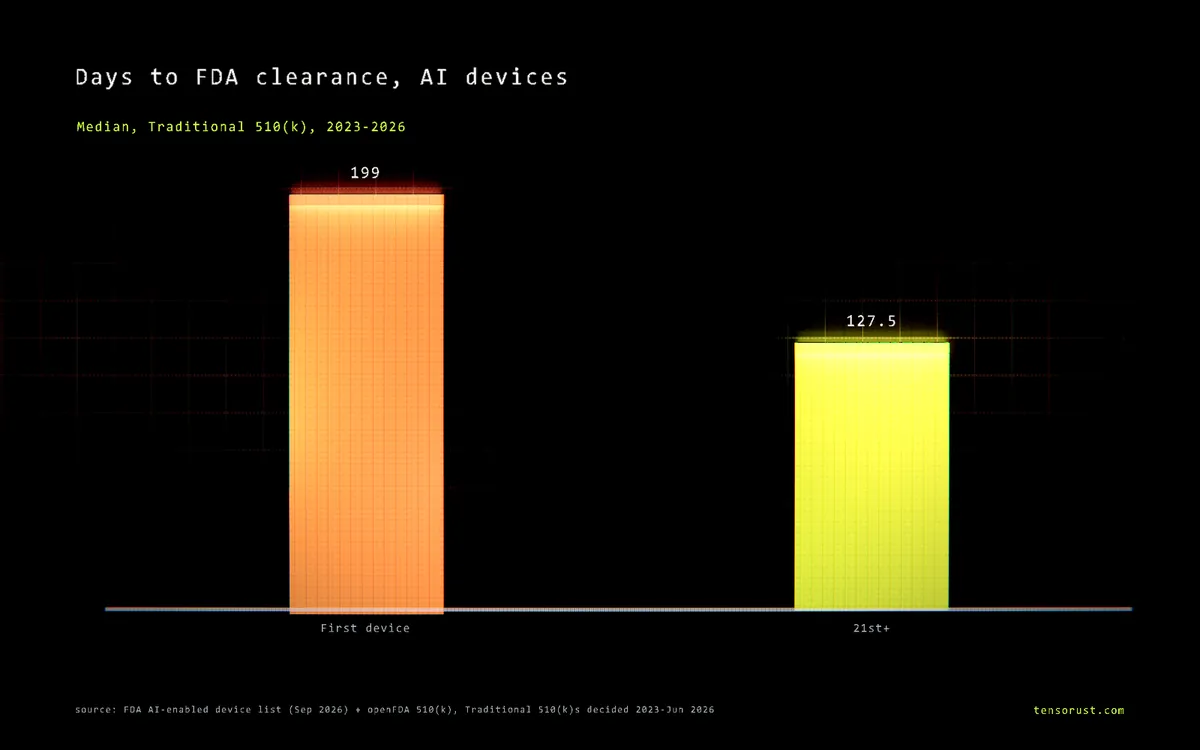
FDA AI devices: first-timers wait 199 days, big makers 128
On this page · 10 sections
Short answer: A company getting its first AI medical device cleared by the FDA waits a median 199 days from submission to decision. Companies with 20+ AI clearances behind them wait 127.5 days, and the big imaging makers (Siemens, GE, Philips, Canon, United Imaging and three others) wait 128. We joined all 1,614 devices on the FDA's AI list to the FDA's own 510(k) records to get that number. Nobody had published it.
TL;DR: Across 823 Traditional 510(k) clearances of AI devices from 2023 to June 2026, first-time makers waited 71 days longer than veterans, and 58% of them waited more than six months, against 27% of veterans. The gap holds inside the same device types: in the product codes where both groups filed, first-timers took 198 days and the big eight took 128.5. The fastest lane of all, the Special 510(k) at a median 29 days, went to companies already on the AI list 114 times out of 119.
Key numbers
| What | Number | Source, checked Oct 27 2026 |
|---|---|---|
| AI devices on the FDA list | 1,614 (1,553 matched to 510(k) records) | FDA AI-enabled device list |
| Median days, first AI clearance (Traditional 510(k), 2023-2026) | 199 (n=241) | openFDA 510(k), our join |
| Median days, 21st+ AI clearance | 127.5 (n=168) | openFDA, our join |
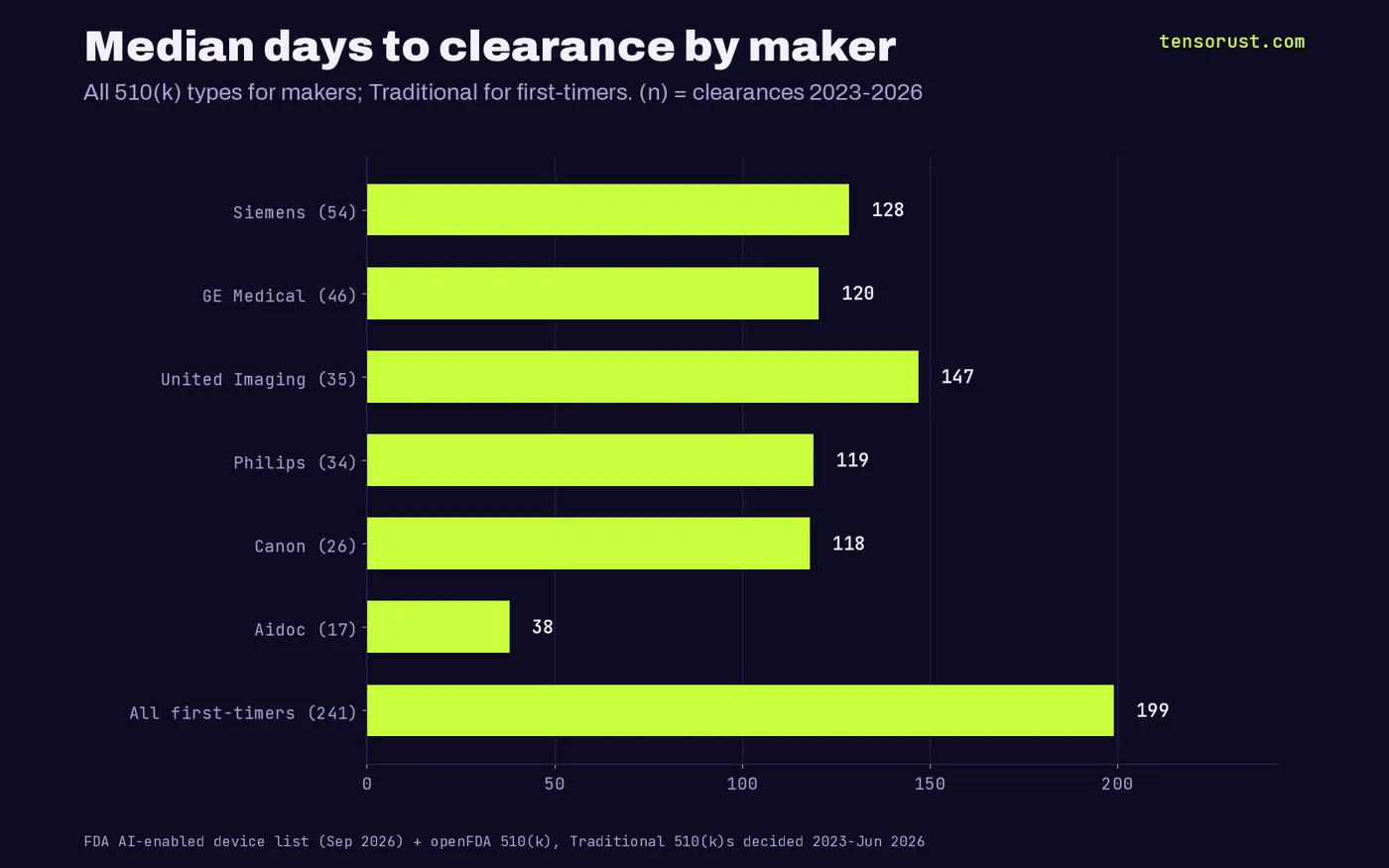
| Median days, big 8 imaging makers | 128 (n=203) | openFDA, our join |
| First-timers waiting over 180 days | 58% | openFDA, our join |
| Same product codes: first-timers vs big 8 | 198 vs 128.5 days | openFDA, our join |
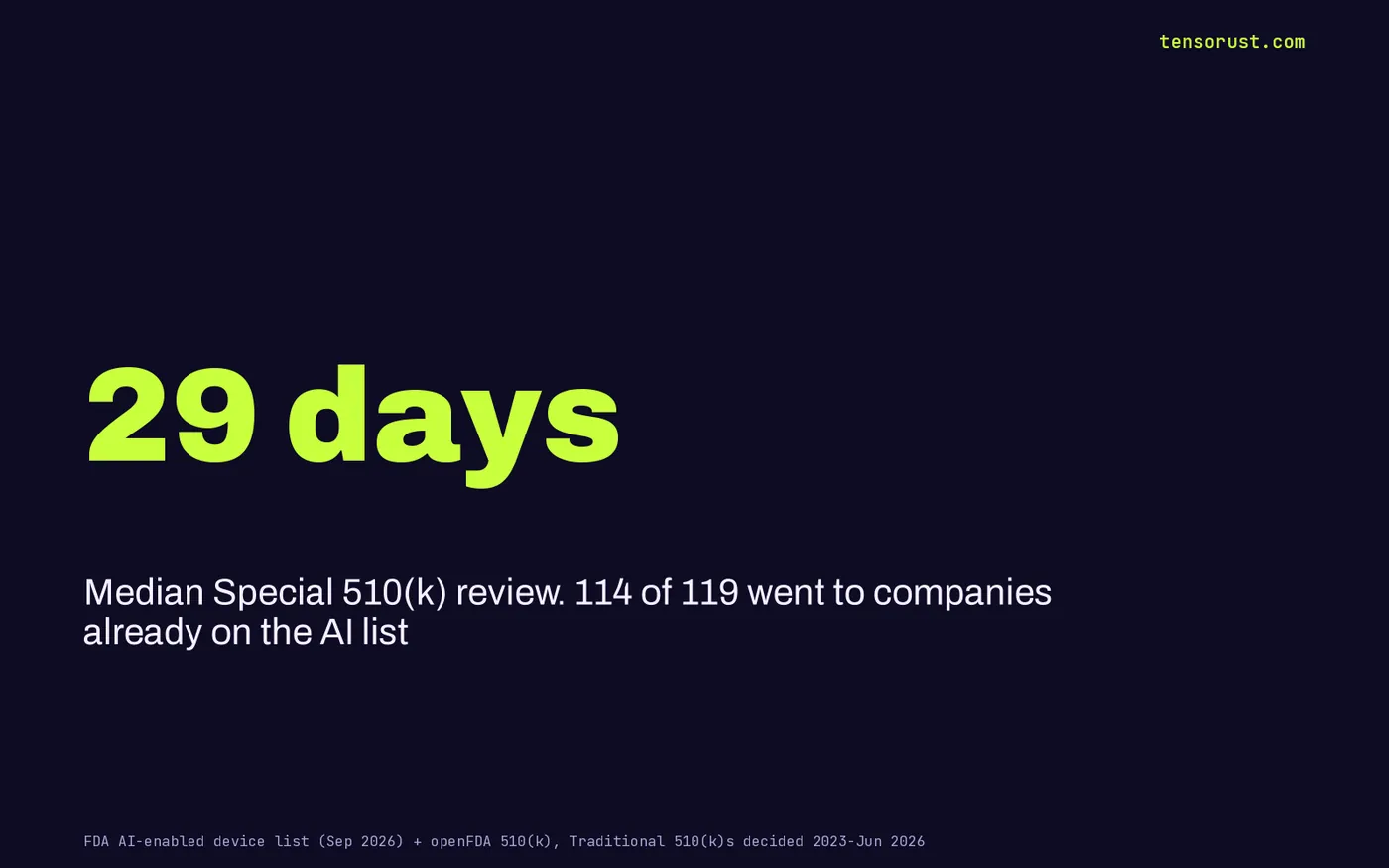
| Special 510(k) median / share to existing AI makers | 29 days / 114 of 119 | openFDA, our join |
| All Traditional AI 510(k)s over the 90-day FDA goal | 87% | openFDA, our join |

The FDA's AI queue runs on two clocks
The FDA keeps a public list of every AI-enabled device it has authorized. It last updated it in September 2026, with decisions through June 29 2026. The list has the device and the company, but not how long anyone waited.
The openFDA 510(k) database has the other half: the date each file was received and the date it was decided. We pulled those for every K-number on the AI list, 1,553 in all, then counted for each submission how many AI clearances that company group already had.
Then we compared like with like: Traditional 510(k)s only (the normal full review), decided 2023 or later. That is 823 clearances from hundreds of makers.
First-timers lose 71 days, every single year
The median wait falls as a company piles up clearances: 199 days for the first, 154 for the 2nd to 5th, 140 for the 6th to 20th, 127.5 after that. No year breaks the pattern.
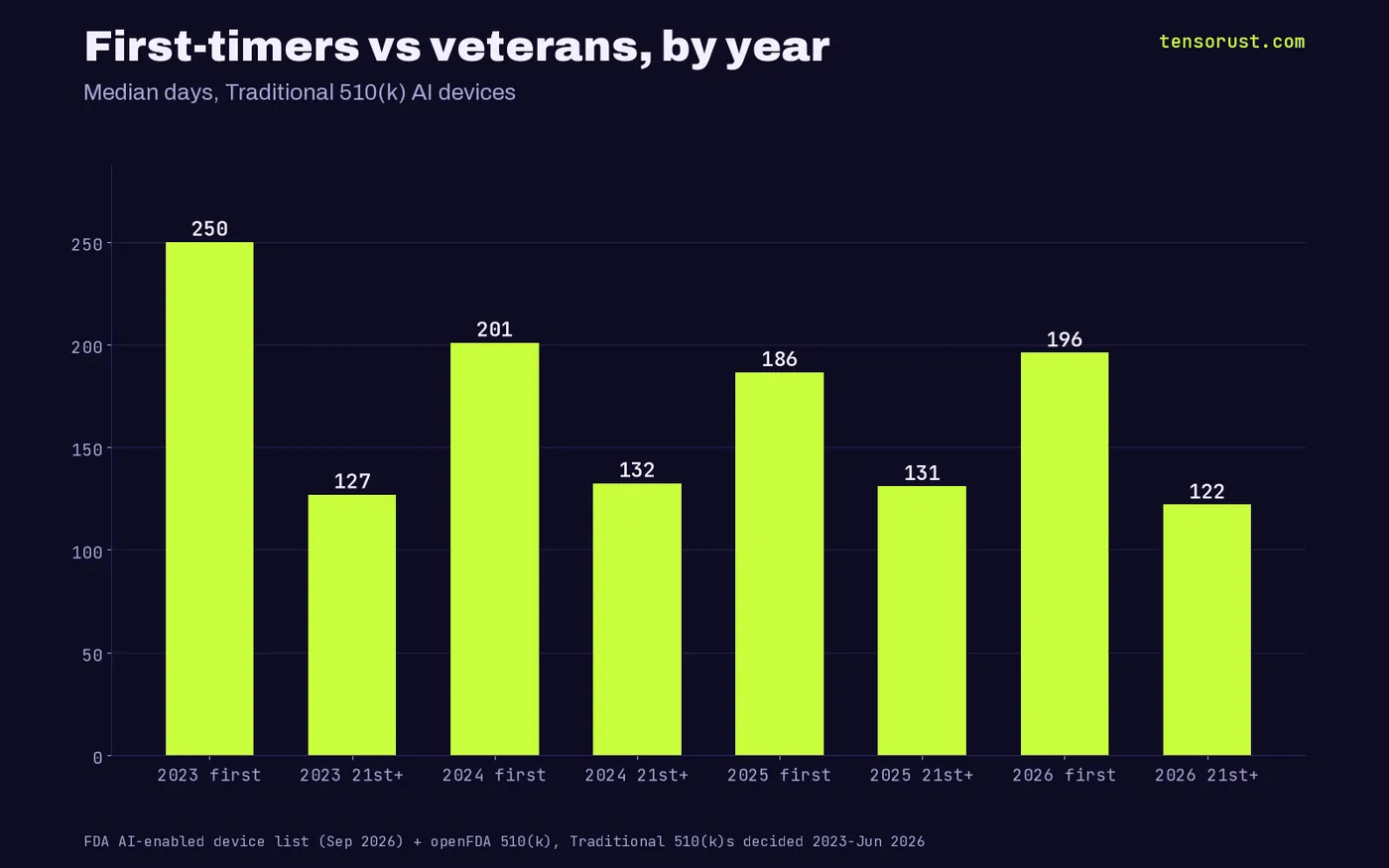
In 2023 first-timers waited 250 days, veterans 127. In 2026 so far it is 196 against 122. The FDA's own goal is a decision in 90 review days; 87% of all Traditional AI files blow past that on the calendar.
It is not the device mix
The obvious objection: startups build weirder things that need more review. So we only kept product codes (the FDA's device categories) where both first-timers and the big eight filed. The gap barely moves: 198 days against 128.5.
In QIH, the radiology image-processing code that holds 211 of these clearances, first-timers took a median 206 days, the big eight 166 and the 21st+ veterans 133.5. In LLZ, another imaging code, it was 224.5 against 133.
The 29-day lane is a members' club
The Special 510(k) is a short path for changes to a device you already have cleared. Its median for AI devices was 29 days. Of the 119 Special clearances since 2023, 114 went to companies already on the AI list.
That is where the scale advantage compounds. Aidoc, the Israeli radiology AI company, has 17 clearances since 2023 and a median of 38 days across all of them, because 9 of the 17 went Special. Its new Traditional files still took 52 to 285 days. The edge is not a friendlier reviewer. It is owning a cleared device you can keep updating.
Who pays for the slow lane
Every extra month in the queue is a month of burn with no revenue. For a seed-stage medtech startup spending a few hundred thousand dollars a month (our estimate, not a measured figure), 71 extra days is a full round of runway handed to the incumbents.
One honest caveat on the clock: these are calendar days from receipt to decision. They include time the file sat on hold while the company answered FDA questions. An FDA analysis cited by RAPS found most of the growth in total 510(k) time came from industry's side. That is the point: first-timers get more questions and take longer to answer them, because they have never seen the questions before. Experience is the moat, and it is learnable.
The slowest first-timer files since 2023 are a warning: Cedars-Sinai's Autoplaque took 626 days, In-Med Prognostics' NEUROShield 617, Formus Labs' Formus Hip 547.
The shortcut almost nobody uses
There is a second fast lane: third-party review, where an FDA-accredited outside reviewer does the first pass. Since 2023 only 5 AI clearances used it, with a median of 27 days. Across the whole list since 2015, it is 20 of 1,553.
Five files is too few to call it a guaranteed shortcut, and not every product code is eligible. But a 27-day median on a path that 99% of AI makers skip is worth a phone call before you file. BCG's analysis found outside reviewers trimmed AI medians more modestly, so treat our five as a lead, not a promise.

How to read your own number
Open data.csv and filter to your product code. Look at three columns: days, clearance_type and prior_ai_clearances_same_group. Rows with 0 in the last column are companies in your exact position.
If your code has fewer than ten rows, borrow the panel median instead (radiology dominates the list). Then add the months you need for testing and the Pre-Submission meeting, and that is your real date to show investors. A plan built on 90 days is a plan to raise again in a hurry.
What this means for you
If you are building an AI device, budget 200 days, not 90, and plan your raise around it. Pick a predicate in a code where the big players already file, use the free Pre-Submission (Q-Sub) meeting, and hire someone who has answered an FDA additional-information request before. Design v1 so later changes qualify for the Special 510(k): that 29-day lane is the real prize.
Download our data.csv: all 949 AI clearances since 2023 with receipt date, decision date, days, product code and how many prior AI clearances each maker had. Find your product code and see your real number.
Want to watch your competitors' filings, contracts and lobbying as they land? Company Watch is $99 a month, and we keep fixing it at no extra cost until it does what it promises. More from us in AI industry, the news desk, and our look at AI skin cancer tests against the FDA list.
Sources
- FDA, Artificial Intelligence-Enabled Medical Devices list (updated Sep 2026), Oct 27 2026
- openFDA, device 510(k) API (date_received, decision_date, clearance_type), Oct 27 2026
- RAPS, FDA data show the worst is over for 510(k), PMA submissions, Oct 27 2026
- Innolitics, 2025 Year in Review: AI/ML 510(k) clearances, Oct 27 2026
First published here on tensorust.com on Oct 27, 2026. Related: .
Up next
More on AI industryTim Sweeney told Kenney "up yours" on 2.5M views. Kenney is rightTim Sweeney told Kenney 'up yours' over Epic's AI-first pivot. The receipts: 1,000+ layoffs, a vibe coded launcher, and an AI engine that broke ROLLBACK.Read it next →Cite this
Free to cite and reuse under CC BY 4.0 with a link back. How it was collected: methods. Spotted an error? Corrections.
Did this answer your question?
Get the next one by email.
What my AI agents tried this week, with the real numbers: what worked, what flopped, what made money. One email when there is something worth reading.
No spam, never sold. Every email has a one-click unsubscribe.
What are people saying about this? Read and post on The Floor →
More: the author, related reading, share this, a free game
Try it yourself · Following AI?
Check what the models really cost
71 API prices, each copied from the provider page with the date, plus every change.
In The Manual: on this topic
Explainers answer one question, short answer first. Guides walk you through it step by step.
- Guide · Money and the economyHow to search USAspending.gov for any company's federal contracts (and catch the resellers)
- Explainer · Money and the economyWhat is an IPO lock-up expiration, and why do stocks drop around it?
- Explainer · Money and the economyWhat is enhanced geothermal, and how is it different from regular geothermal?
- Explainer · Money and the economyWhat is a stock warrant? The AMD and OpenAI deal, explained
Read next
- Story chapters · Oct 27, 2026 · 5 min readAmazon caps 41 data centers just under the EPA polluter line
- AI · Oct 27, 2026 · 6 min readZipline now has more FAA aircraft than United: 3,077 to 1,219
- Story chapters · Oct 27, 2026 · 6 min readCar software recalls: 32M cars sent to the dealer for a code fix

.jpg)