
By Matt Busel, who built the apps, crates and game he writes about · every number links to its source and every dataset is downloadable (methods) · corrections · featured in Kirino, gamebiz, This Week in Rust, New Mobile Life, By-Press
The GPU shortage was manufactured. H100 rental prices just proved it
On this page · 9 sections
- Key numbers
- A shortage that sells the same hour at six prices is not a shortage
- The steelman: fabs and memory really are tight
- Follow the money: whose margin is the shortage?
- Washington wrote the third part of the shortage
- The price already cracked where nobody was guarding it
- Who benefits from you believing compute is scarce
- What this means for you
- Sources
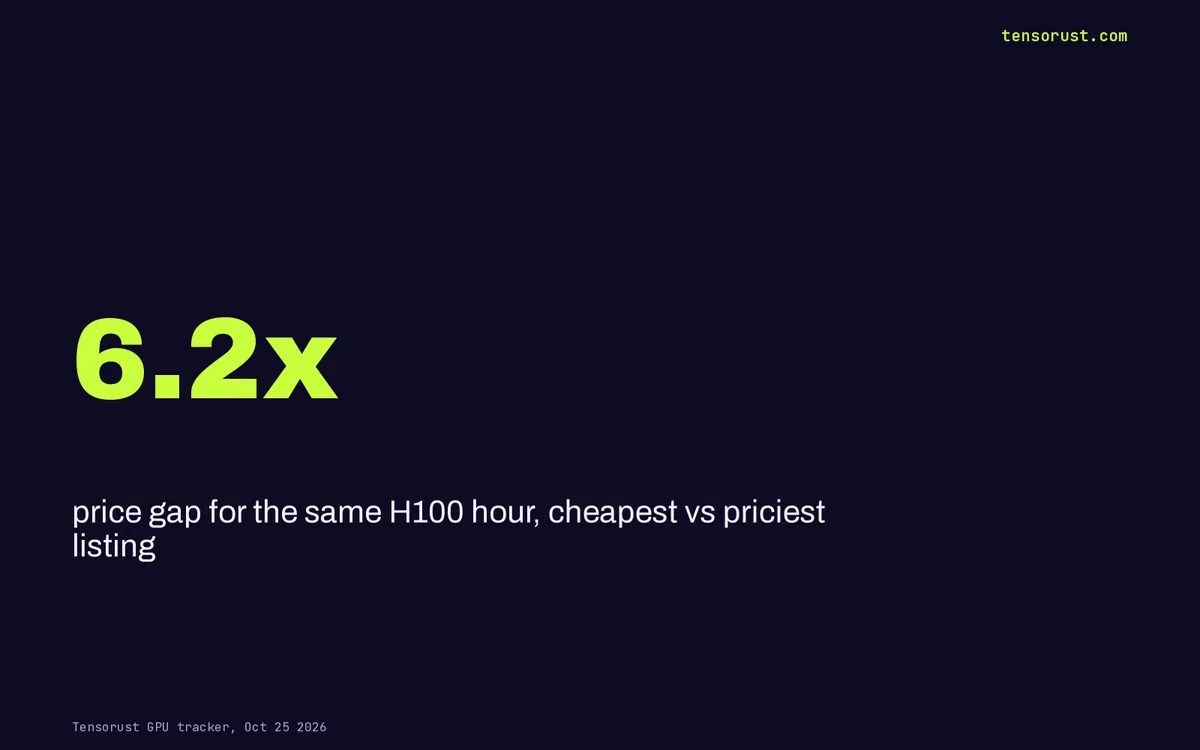
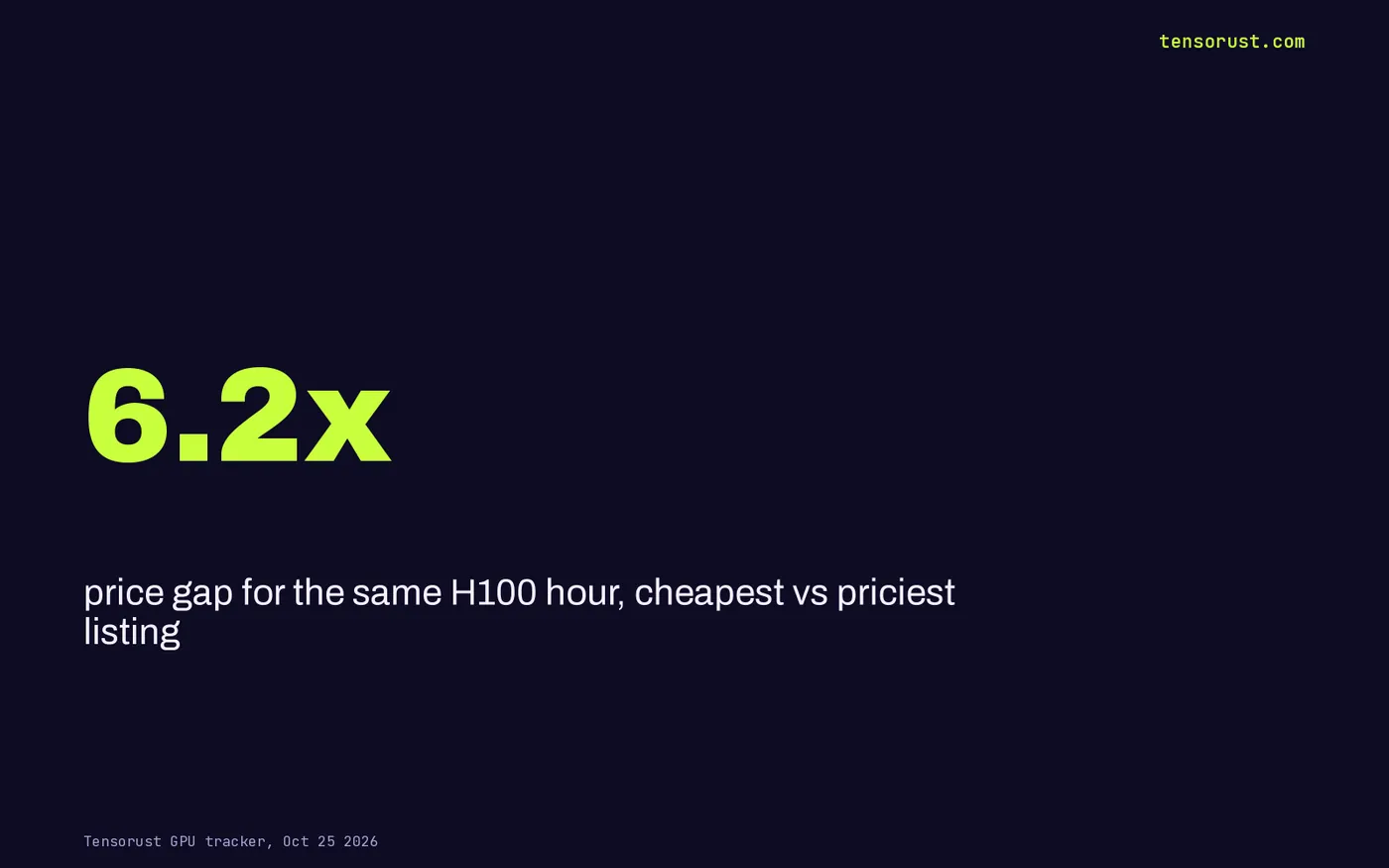
Short answer: The GPU shortage is not mainly a physics problem. On October 25 2026 we found the exact same Nvidia H100 hour listed for $1.99 at the bottom of the market and $12.29 at Microsoft Azure, a 6.2x gap for one chip doing one job. A real shortage does not produce a spread like that. A pricing regime does.
TL;DR: Nvidia's gross margin climbed from 43.5% in Q2 2022 to 75.0% in Q2 2026, per its own SEC filings, while quarterly revenue went from $6.7 billion to $96.2 billion. Microsoft, Alphabet, Amazon and Meta together went from $37.0 billion to $165.1 billion of capital spending per quarter over the same stretch, pre-buying the supply everyone else is told is scarce. Meanwhile the Commerce Department published 24 export-control rules touching advanced computing since October 2022, and the independent clouds now rent an H100 for less than a third of what the big three charge: if you buy compute, shop the spread, not the panic.
Key numbers
| What | Number | Source, checked Oct 26 2026 |
|---|---|---|
| Cheapest H100 hour listed (spot / community) | $1.99 | Tensorust GPU tracker |
| Priciest H100 hour listed (Azure on-demand, SXM) | $12.29 | Tensorust GPU tracker |
| H100 listings tracked across clouds | 54 | Tensorust GPU tracker |
| Nvidia gross margin, Q2 2022 vs Q2 2026 | 43.5% vs 75.0% | SEC EDGAR XBRL |
| Nvidia quarterly revenue, Q2 2022 vs Q2 2026 | $6.7B vs $96.2B | SEC EDGAR XBRL |
| Big Tech capex per quarter (MSFT, GOOGL, AMZN, META) | $37.0B to $165.1B | SEC EDGAR XBRL |
| BIS export rules on advanced computing, Oct 2022 to Jul 2026 | 24 | Federal Register |
| RunPod H100 SXM on-demand, Nov 2023 vs Oct 2026 | $4.69 vs $3.99 secure, $2.69 community | Wayback Machine |

A shortage that sells the same hour at six prices is not a shortage
Here is the test nobody runs. If H100s were physically scarce, every seller would charge roughly the clearing price, because any cheap hour would get snapped up and arbitraged away.
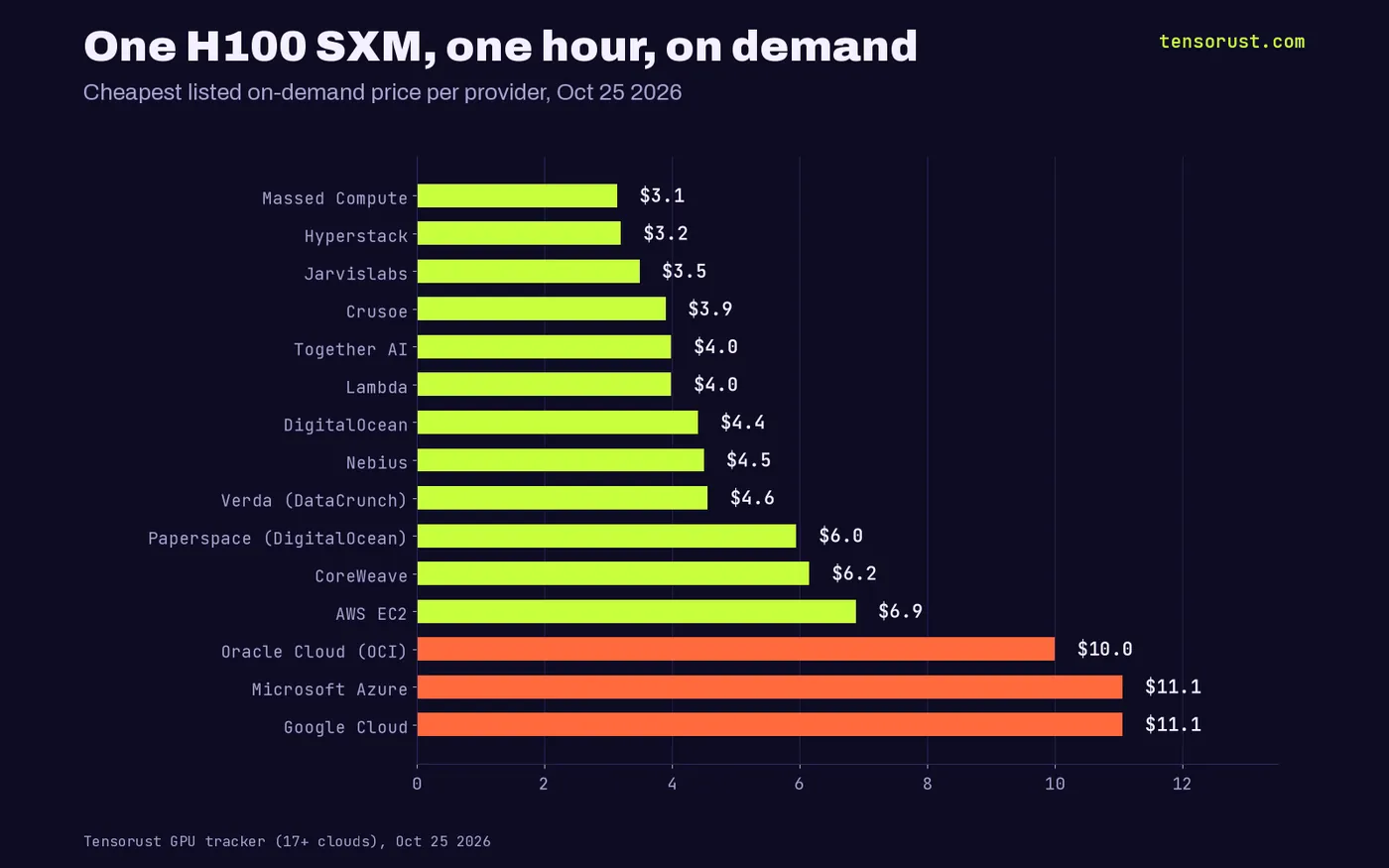
That is not what the market shows. Our tracker pulled 54 H100 listings from 17+ clouds on October 25. Massed Compute, Hyperstack and Jarvislabs list on-demand H100 SXM hours between $3.14 and $3.49. Lambda and Together AI sit at $3.99. AWS lists $6.88. Google Cloud and Azure list $11.06 on demand, and Azure tops out at $12.29.
Same silicon. Same 80 GB of memory. A 3.5x gap between the cheapest on-demand SXM listing and the hyperscalers, and 6.2x once you count spot and community capacity. That is what a market looks like when the price is set by who you buy from, not by how many chips exist.
The steelman: fabs and memory really are tight
The fair version of the other side is real. Advanced packaging and high-bandwidth memory are hard to make, only a few plants on Earth make them, and new capacity takes years. Nvidia cannot print Blackwells on demand.
Fine. But physical limits explain why the newest chip has a waitlist. They do not explain why a three-year-old H100 still rents at $11 an hour at Google while a smaller cloud sells it at $3.14 with the lights on. Capacity constraints set a floor. The 6x spread above that floor is margin, lock-in and fear.
Follow the money: whose margin is the shortage?
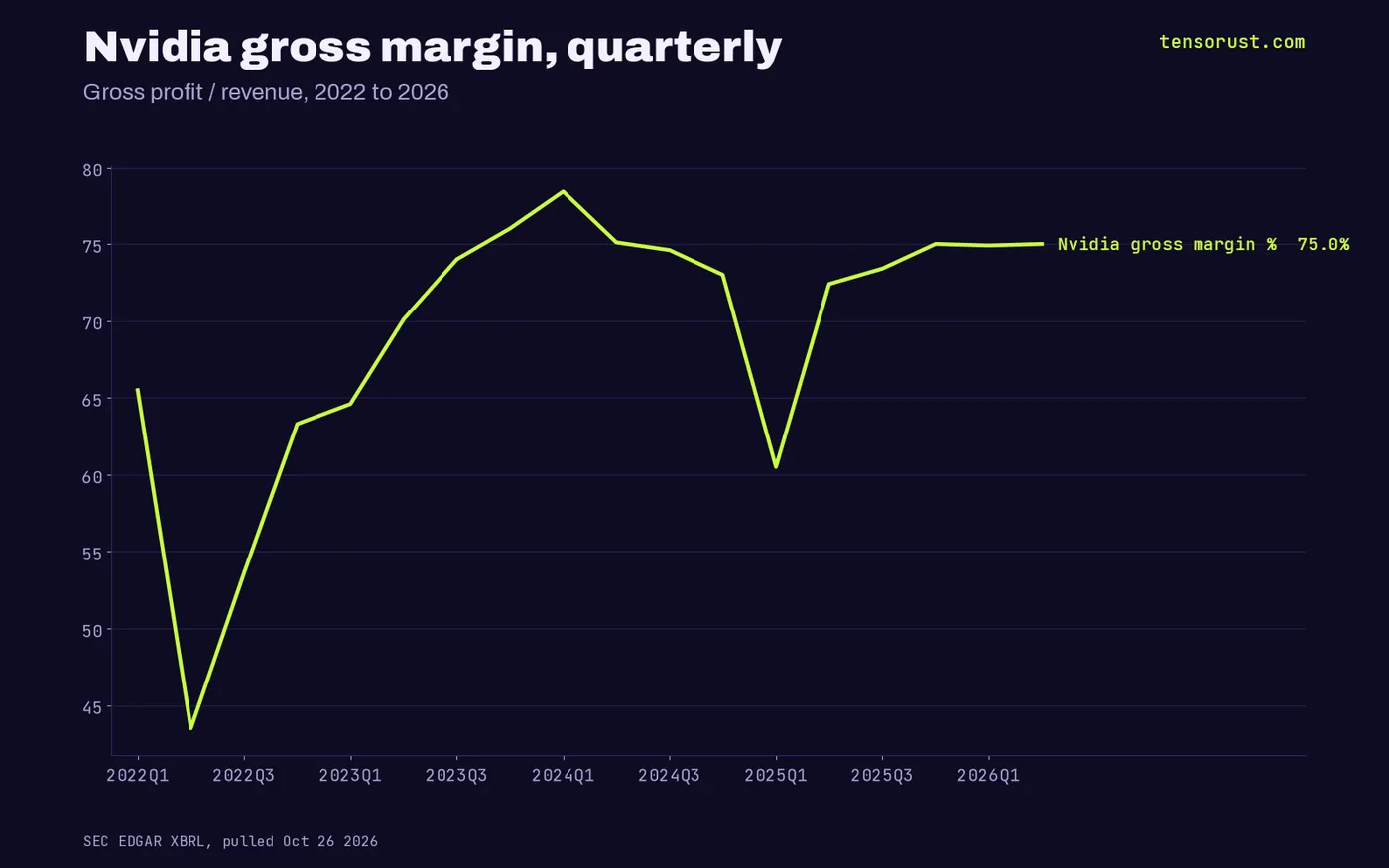
Start with the supplier. Nvidia's SEC filings show gross margin at 43.5% in Q2 2022, the quarter of its inventory write-down, then 65% to 75% almost every quarter since the AI boom began. In Q2 2026 it booked $72.1 billion of gross profit on $96.2 billion of revenue.
A 75% gross margin on hardware is not a commodity business. It is the margin of a company whose buyers believe they have no alternative. Every "we can't get GPUs" headline is free marketing for that belief.
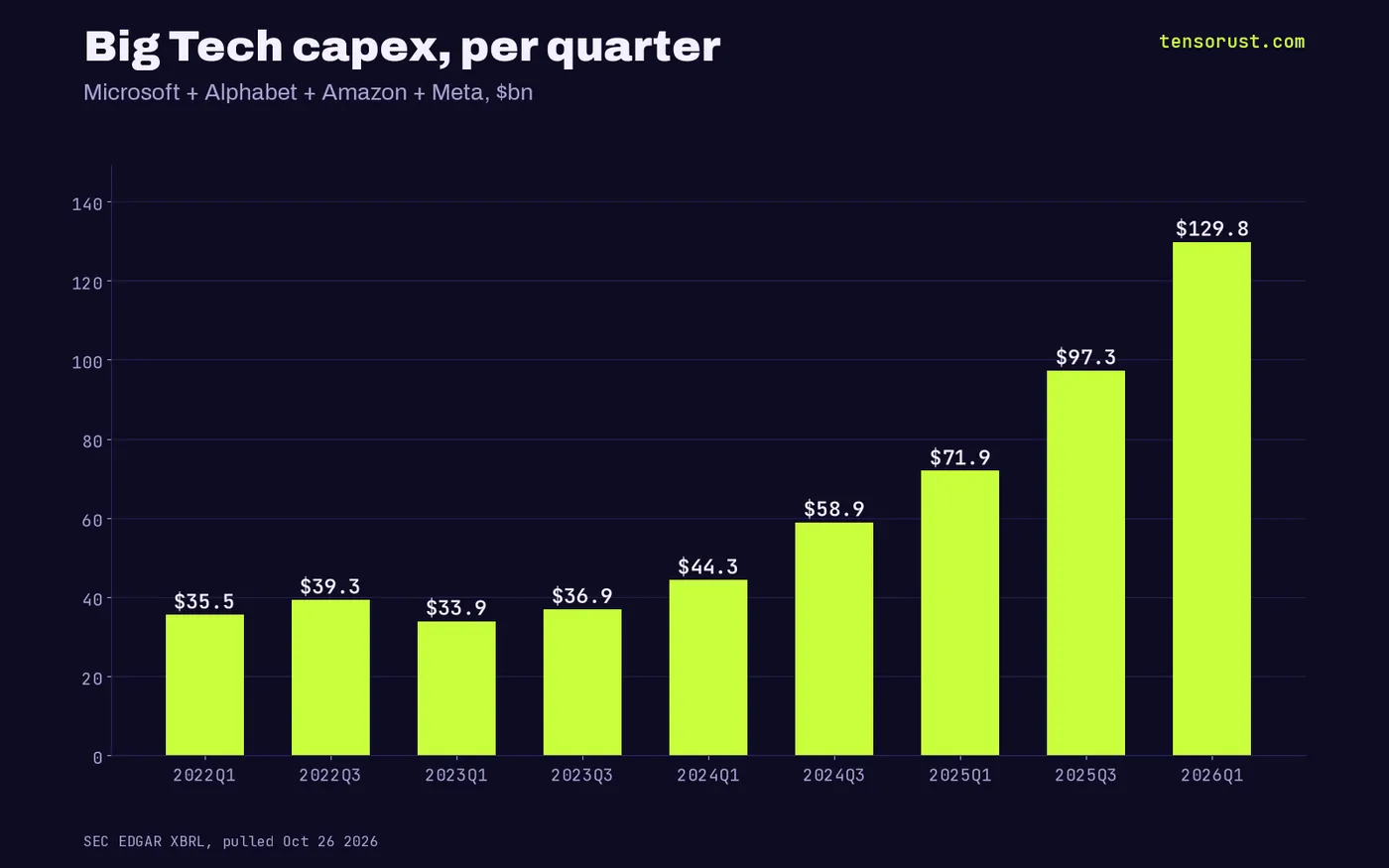
Then the buyers. Microsoft, Alphabet, Amazon and Meta spent $37.0 billion on capital projects in Q2 2022 and $165.1 billion in Q2 2026, per their filings, a 4.5x jump. Most of that is data centers and the chips inside them. When four companies pre-order a large share of the world's accelerator supply, everyone else experiences "scarcity" that is really a queue behind the incumbents.
Washington wrote the third part of the shortage
The Commerce Department's Bureau of Industry and Security published its first big advanced-computing export rule on October 13 2022. The Federal Register API lists 24 BIS rules mentioning advanced computing between then and July 2026, including the AI Diffusion framework of January 15 2025, a license-policy revision in January 2026 and a UAE carve-out in July 2026.
That is a new rule roughly every two months. Each one redraws who may buy, where, and how much. Our reading: a supply that a government can switch on and off by country is not a market with a shortage. It is a rationing system, and rationing always rewards whoever is already inside the gate.
Documented: the rule dates and count. Our bet: the constant rule churn did more to keep compute feeling scarce, and buyers panic-ordering, than any fab limit did.
The price already cracked where nobody was guarding it
Look at one seller over time. RunPod's archived pricing page from November 2023 lists an H100 SXM on demand at $4.69 an hour. In June 2024 it was $3.99 on its secure cloud and $2.99 on community. Today it is $3.99 secure and $2.69 community, and a PCIe H100 on its community cloud is $1.99.
The independents cut. The hyperscalers did not. That gap is the tell. Where a buyer can walk, the "shortage" price fell. Where the buyer is locked into credits, contracts and egress fees, it stayed. We made the same point about cloud rent in AWS is a landlord and about write-down games in GPU depreciation.
Who benefits from you believing compute is scarce
Scarcity is the moat. If founders believe compute is rationed, they sign multi-year commitments with the big three, take cloud credits that lock them in, and accept that only giants can train or serve real models. Every one of those beliefs routes money to the four companies on the capex chart and the one company on the margin chart.
It also feeds the safety-regulation story: if only a handful of firms can ever afford serious compute, licensing those firms looks reasonable. The shortage narrative and the "only big labs are responsible enough" narrative are the same story told twice.
The escape hatch is already priced in public. Open weights run on rented H100s at $2 to $4 an hour, on consumer cards, and on the half-price independents. See our LLM price tracker and the Nvidia software fee piece for how much of the stack is toll, not physics.
What this means for you
Stop paying the panic premium. Price the same GPU hour across at least five providers before you sign anything, take spot or community capacity for anything that can restart, and never let a credit deal decide your stack. The money you save on one $12 hour versus one $3 hour is the margin your product needs.
If you pay for model APIs instead of raw GPUs, our LLM API Cost Calculator ($7) shows what each provider really costs at your volume; if it gets your numbers wrong, we keep fixing it at no extra cost until it does what it promises. More arguments like this on Opinion and AI industry.
Not financial advice. Prices are listed rates on the date shown and change daily.
Sources
- Tensorust GPU price tracker, Oct 25 2026
- Nvidia 10-Q/10-K XBRL (Revenues, GrossProfit), pulled Oct 26 2026
- Microsoft, Alphabet, Amazon, Meta XBRL capital expenditures, pulled Oct 26 2026
- Federal Register, Bureau of Industry and Security rules, Oct 26 2026
- RunPod pricing, Wayback Machine Nov 15 2023 and Jun 1 2024, fetched Oct 26 2026
First published here on tensorust.com on Oct 26, 2026. Related: Opinion, LLM price tracker.
Up next
More on OpinionCharacter.AI bankruptcy: your chats are next, 23andMe proved it23andMe sold 14M genomes in court for $305M, about $22 each. Character.AI's 12M users are next, and 28 of 31 privacy policies we read pre-approve the sale.Read it next →Cite this
Free to cite and reuse under CC BY 4.0 with a link back. How it was collected: methods. Spotted an error? Corrections.
Did this answer your question?
Get the next one by email.
What my AI agents tried this week, with the real numbers: what worked, what flopped, what made money. One email when there is something worth reading.
No spam, never sold. Every email has a one-click unsubscribe.
What are people saying about this? Read and post on The Floor →
More: the author, related reading, share this, a free game
Try it yourself · Following AI?
Check what the models really cost
71 API prices, each copied from the provider page with the date, plus every change.
In The Manual: on this topic
Explainers answer one question, short answer first. Guides walk you through it step by step.
- Explainer · AI, LLMs and agentsClaude Code vs Cursor: what each costs now that SpaceX owns Cursor
- Explainer · Money and the economyHow Kalshi weather markets work
- Explainer · Money and the economyCan the Fed buy Treasuries directly from the government?
- Explainer · Money and the economyThe Fed's deferred asset, explained
Read next
- AI · Oct 25, 2026 · 12 min readCharacter.AI bankruptcy: your chats are next, 23andMe proved it
- Economics · Oct 25, 2026 · 11 min readCar subscriptions are the new App Store tax: GM banks $6.8B
- AI · Oct 25, 2026 · 10 min readInsurers filed 4,078 AI exclusions. They're the real AI regulator